Catálogo publicado con motivo de la exposición Pasiones mitológicas: Tiziano, Veronese, Allori, Rubens, Ribera, Poussin, Van Dyck, Velázquez, celebrada en el Museo Nacional del Prado, Madrid, entre el 2 de marzo y el 4 de julio de 2021.
En la mitología griega y romana el amor, el deseo y la belleza están íntimamente relacionados y dominan las vidas de los dioses y los humanos. Los textos que se refieren a estos asuntos —la Ilíada y la Odisea de Homero, las Metamorfosis de Ovidio, la Eneida de Virgilio, entre otros muchos— fueron muy estimados por los artistas del Renacimiento y el Barroco, que buscaron representarlos con sentimiento intenso.
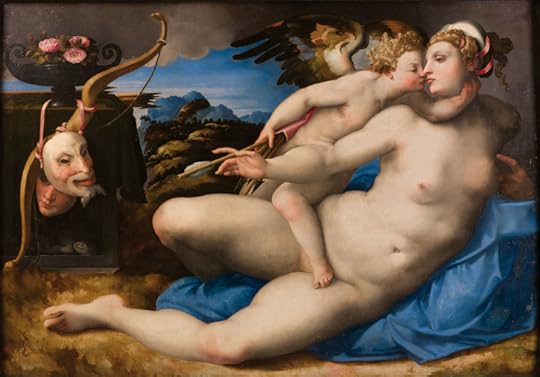
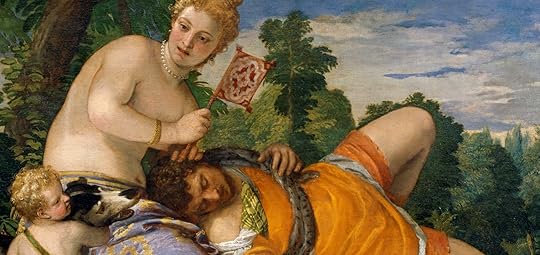
En este catálogo se ilustran y se estudian en profundidad pinturas mitológicas de Tiziano, Veronese, Allori, Rubens, Poussin, Ribera, Van Dyck y Velázquez. Guiados en unos casos por el afán de emulación y en otros por la rivalidad, todos ellos protagonizaron una fascinante secuencia interpretativa que responde a una característica de la tradición mitológica: su adaptabilidad y constante renovación.
El libro incluye textos de Sheila Barker, Miguel Falomir, Javier Moscoso y Alejandro Vergara en los que se analiza la importancia de la mitología para la cultura artística del Renacimiento y el Barroco, la forma en que los europeos de la época entendieron las pasiones y la relación de las mujeres con la pintura mitológica como espectadoras, coleccionistas y artistas. Esta publicación incluye también unos «comentarios apasionados y eruditos» de las veintinueve obras de arte presentes en la exposición.
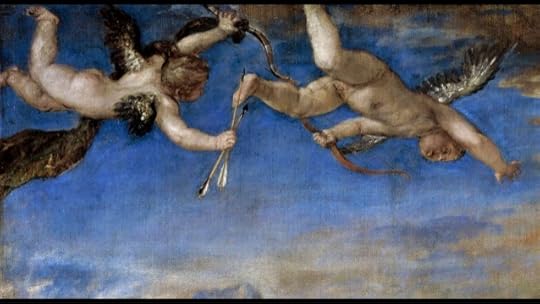
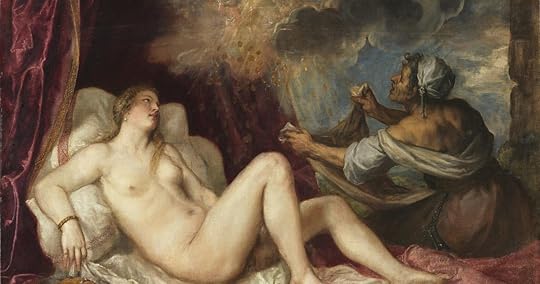
This is the catalogue for the exhibition currently at the Prado and which prior to arriving here was confined in the London National Gallery. In London they exhibited only the six paintings that form this mythological series that king Felipe II commissioned Titian when he was not yet king, that is around 1551, in Augsburg, where both the Venetian painter and the crown prince met. Felipe was around 24 years old, a widower from his first wife already. In the Prado they have expanded the exhibition along the theme of mythology and passion, which means that they also included other works by Veronese, Ribera, Poussin, Van Dyck, and of course, Rubens and Velázquez.
The catalogue includes only two essays, one by Miguel Falomir, director of the Museum and a specialist on Italian Renaissance and one by Sheila Barker concentrating on gender issues. Mythological paintings, which often show violence against women as very enticing scenes, are embarrassing museums and they are fighting to find a presentation that is both historical, aseptic and somewhat consciously apologetic for their role in perpetuating prejudices – all of this while trying to help us admire their utter beauty. Then the paintings, in the section that would be the catalogue proper, are accompanied not by the usual scholarly “fiche” that trace their provenance and physical details, but by personal commentaries written by Alejandro Vergara, a specialist in Rubens. This is a curious novelty and makes a more entertaining reading than the traditional “fiches” or catalogue entries, but I wonder how well they will age, for example, whether Vergara’s account of his conversation with Falomir over a film will seem relevant a few years from now (or even today!!). I also found somewhat frustrating not been able to read the precise provenance of each painting. For example, out of these six paintings made to hang in Madrid, only one is still in the Prado collection (formerly the royal collection), the other five are in: Apsley House in London; Wallace Collection; two in a co-ownership of the London National Gallery and the National Galleries of Scotland; and the last one (and one of the most formidable) in the Isabella Stewart Gardner Museum in Boston . I understand that for this information the London catalogue, which I own but have not read yet, will be more satisfying.
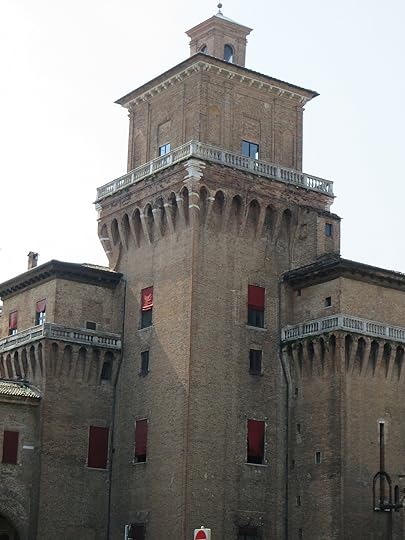
This series of paintings followed in the tradition of the “studiolo” commissions that prior to Felipe, Isabella d’Este had commissioned for her room in the Mantua castle, and by her brother Francesco d’Este for his Alabaster camera in the Ferrara castle to a younger Titian (two of which are now in the Prado and one in the London National Gallery). As Falomir explains, it tends to surprise non-Spaniards that Felipe, who epitomizes the Spanish Black Legend, would have asked for such erotic canvases. But apart from the problem with all political legends, that they tend to be fabricated by the enemies, there is also the question of Felipe’s age. Indeed, later, in 1568--the annus horribilis for the monarch (his beloved third wife, Isabelle of Valois, died; his maniac son had to be imprisoned; and the Lowlands rebelled) --, when he was already in his forties, Felipe, who had been such an avid collector of art stopped commissioning actively and even got rid of one of these six paintings (Wallace).
The series are called “Poesie” or “Fabule” by Titian himself. This denomination put them apart from Historia paintings, which had to be faithful to the texts from which they originated – religion or history. Instead, even if the painter relied on texts, as these were mythological, they entitled the artist to interpret them freely. And in so doing the painter rose socially above the level of the craftsman and ranked with the poets and intellectuals. The texts on which Titian relied are a mix. There is Ovid’s Metamorphoses, but also Os Amores de Leucipe e Clitofonte, and most fascinating, Titian also made up episodes such as the Farewell scene between Venus and Adonis, scene that in its turn would inspire Shakespeare in his 1593 Venus and Adonis. Not only was this particular painting delivered to Felipe in London, when he was married to Mary Tudor, but there were engravings that circulated, and that Shakespeare would have easily seen.
I enjoyed reading Sheila Barker’s essay. She fleshes out the gender complexities when examining erotic mythological paintings from the Renaissance. Violent scenes were included in the cassone for a woman’s marriage trousseau; female monarchs (Isabelle de France) demanded some paintings to be covered when they were to be present; while other notorious women, whether courtesans or noble women (Countess of Arundel) commissioned erotic pictures for their boudoirs; mythology interested many women writers (Christine de Pizan, Vittoria Colonna); some women of the high nobility (Leonor de Toledo, Isabella d’Este, Maria de Medici) liked to impersonate mythological figures; women regents (Maria of Hungary) commissioned mythological scenes of naked men for political purposes; everyone expected paintings to arouse emotions (erotic or spiritual), and we have a letter by Artemisia to her lover telling him not to masturbate in front of her self-portrait. We therefore have to be careful when dealing with objects that had a very particular and often personal role, but which are now in very public spaces, and not emasculate them with our current, very modern, possibly temporal, concerns. We cannot change history, but we can learn from it, without condemning it.
Next I will read the catalogue from the National Gallery – richer in essays than this one.