

What do you think?

The Physics of Climate Change
An illustrated book that attempts to dives beneath the mystery of climate change in search of the truth. 'Brilliant and fundamental, this is the necessary book about our prime global emergency' Ian McEwan The news is full of hotly debated and divergent claims about the impacts and risks of climate change. Lawrence Krauss, one of the world's most respected physicists and science popularizers, cuts through the confusion by succinctly presenting the underlying science of climate change.The Physics of Climate Change provides a clear, accurate and accessible perspective of climate science and the risks of global inaction. Krauss's narrative explores the history of how scientists progressed to our current understanding of the Earth's climate and its future. Its generous complement of informative diagrams and illustrations allows readers to assess which climate predictions are securely based on analysis of empirical data, and which are more speculative.The Physics of Climate Change is required reading for anyone interested in understanding humanity's role in the future of our planet.
224 pages, Hardcover
First published January 1, 2021
About the author
Lawrence M. Krauss
42 books1,765 followersLawrence Maxwell Krauss is a Canadian-American theoretical physicist and cosmologist who taught at Arizona State University (ASU), Yale University, and Case Western Reserve University. He founded ASU's Origins Project in 2008 to investigate fundamental questions about the universe and served as the project's director.
Krauss is an advocate for public understanding of science, public policy based on sound empirical data, scientific skepticism, and science education. An anti-theist, Krauss seeks to reduce the influence of what he regards as superstition and religious dogma in popular culture. Krauss is the author of several bestselling books, including The Physics of Star Trek (1995) and A Universe from Nothing (2012), and chaired the Bulletin of the Atomic Scientists Board of Sponsors.
Upon investigating allegations about sexual misconduct by Krauss, ASU determined that Krauss had violated university policy, and did not renew his Origins Project directorship for a third term in July 2018. Krauss retired as a professor at ASU in May 2019, at the end of the following academic year. He currently serves as president of The Origins Project Foundation. Krauss hosts The Origins Podcast with Lawrence Krauss and publishes a blog titled Critical Mass.
Krauss is an advocate for public understanding of science, public policy based on sound empirical data, scientific skepticism, and science education. An anti-theist, Krauss seeks to reduce the influence of what he regards as superstition and religious dogma in popular culture. Krauss is the author of several bestselling books, including The Physics of Star Trek (1995) and A Universe from Nothing (2012), and chaired the Bulletin of the Atomic Scientists Board of Sponsors.
Upon investigating allegations about sexual misconduct by Krauss, ASU determined that Krauss had violated university policy, and did not renew his Origins Project directorship for a third term in July 2018. Krauss retired as a professor at ASU in May 2019, at the end of the following academic year. He currently serves as president of The Origins Project Foundation. Krauss hosts The Origins Podcast with Lawrence Krauss and publishes a blog titled Critical Mass.
Ratings & Reviews
Friends & Following
Create a free account to discover what your friends think of this book!
Community Reviews
Displaying 1 - 30 of 149 reviews

October 10, 2021
When I write this review, it's Horror Week at Goodreads. This is quite appropriate because the contents of this book are quite horrifying if you care about the future of the planet we all inhabit.
Mr Krauss is not preaching to us, he's presenting the facts and then drawing conclusions from those facts. If people think Covid leaves the world in a terrible place then heaven knows what they'll make of climate change. The lack of global cooperation regarding Covid can't be repeated in regard to Climate Change.
As you might expect, the people who least contribute to Climate Change will be the first ones to feel the full effects, namely the people in Bangladesh, the lower-lying areas of India, and the millions who live in the Mekong Delta where as the land sinks and the South China Sea rises, the land will be inundated with saltwater on a daily basis, destroying the world's largest area of rice paddies.
There are so many tipping points and once these destabilising processes start, there's no going back - even our greatest technology can't refreeze the Greenland Ice Cap. If that melts you're looking at sea levels rising by up to seven metres - imagine the effect this would have on London, New York, Shanghai, Lagos, and other coastal cities of the world. This could well happen, if we don't start doing something now, by the end of the century and possibly well before.
Arctic sea-ice loss is amplifying regional warming and Arctic warming and Greenland melting are driving an influx of fresh water into the North Atlantic. This could have contributed to a 15% slowdown since the mid-20th Century of the Atlantic Meridional Overturning Circulation (AMOC), a key part of global heat and salt transport by the ocean. The part of the AMOC most people will have heard of is The Gulf Stream.
Rapid melting of the Greenland ice sheet and further slowdown of the AMOC could destabilise the West African monsoon, triggering drought in Africa's Sahel region. This slowdown could also dry The Amazon, disrupt the East Asia monsoon, cause heat to build in the southern oceans (further melting Antarctic ice), dry South America, and incredibly dry Australia even more.
None of this can be reversed.
The reason I didn't give the book 5 stars is because of the graphs which are slightly difficult to read in my opinion.
Mr Krauss is not preaching to us, he's presenting the facts and then drawing conclusions from those facts. If people think Covid leaves the world in a terrible place then heaven knows what they'll make of climate change. The lack of global cooperation regarding Covid can't be repeated in regard to Climate Change.
As you might expect, the people who least contribute to Climate Change will be the first ones to feel the full effects, namely the people in Bangladesh, the lower-lying areas of India, and the millions who live in the Mekong Delta where as the land sinks and the South China Sea rises, the land will be inundated with saltwater on a daily basis, destroying the world's largest area of rice paddies.
There are so many tipping points and once these destabilising processes start, there's no going back - even our greatest technology can't refreeze the Greenland Ice Cap. If that melts you're looking at sea levels rising by up to seven metres - imagine the effect this would have on London, New York, Shanghai, Lagos, and other coastal cities of the world. This could well happen, if we don't start doing something now, by the end of the century and possibly well before.
Arctic sea-ice loss is amplifying regional warming and Arctic warming and Greenland melting are driving an influx of fresh water into the North Atlantic. This could have contributed to a 15% slowdown since the mid-20th Century of the Atlantic Meridional Overturning Circulation (AMOC), a key part of global heat and salt transport by the ocean. The part of the AMOC most people will have heard of is The Gulf Stream.
Rapid melting of the Greenland ice sheet and further slowdown of the AMOC could destabilise the West African monsoon, triggering drought in Africa's Sahel region. This slowdown could also dry The Amazon, disrupt the East Asia monsoon, cause heat to build in the southern oceans (further melting Antarctic ice), dry South America, and incredibly dry Australia even more.
None of this can be reversed.
The reason I didn't give the book 5 stars is because of the graphs which are slightly difficult to read in my opinion.

February 12, 2021
Nothing really new, but it's a clear, up-to-date summary and a starting point on a climate change discussion.
It's scientific enough but well explained in human language as long as you're good with basics.
Also, it's dense with graphs and charts, so if you're getting an audio version, get ready to spend some time with the screen.
p.s. Close by the idea, but more broad and personal, great recent book by David Attenborough - "A Life on Our Planet".
It's scientific enough but well explained in human language as long as you're good with basics.
Also, it's dense with graphs and charts, so if you're getting an audio version, get ready to spend some time with the screen.
p.s. Close by the idea, but more broad and personal, great recent book by David Attenborough - "A Life on Our Planet".

November 15, 2024
Krause insider knowledge of a physicist elucidates on the factors that influence global warming. All in all a very useful book to understand the physical underpinnings of how temperature is controlled by the our planet.

July 26, 2021
An interesting book to read to learn about the physics behind global warming. It combines a historical look at the science behind global warming with the physics and evidence for it. In closing, the book does not mince words and shows that the world is already changing, and we had better adapt to a changing world while working to reduce the effects of global warming.
Chapter One starts with a look at the Mekong River and the Delta it forms. Much of the Delta is nearly at sea level, and it is only the amount of water the Mekong River discharges that prevents seawater from inundating the Delta. But this may change when global warming occurs.
Chapter Two looks at the history of CO2 measurements. Starting with the measurements started at Mauna Loa Observatory in the 1950s and mixing on to ice core measurements, the current atmospheric concentration is shown to be at an unprecedented high, exceeding even levels recorded in Earth's history.
Chapter Three look at how carbon and carbon dioxide is recycled by the Earth both geologically and by living organisms and shows how humans are affecting the balance by digging up and releasing carbon that has been locked away geologically for millions of years.
Chapter Four takes a look at what keeps the Earth warm. Using some mathematics, it is shown that, without an atmosphere, the Earth's surface temperate would be below freezing. Adding an atmosphere, and doing some simplified calculations, it can be shown that the atmosphere helps retain heat, absorbing some energy that would be lost to space, and radiating it back to the surface.
Chapter Five looks at the work is scientists like John Tyndall (who determined which parts of the atmosphere helps to retain heat) and Svante August Arrhenius (who calculated the effects of increasing carbon dioxide would have on global temperatures) who helped to determine the effects humans would have on the Climate in the future.
Chapter Six looks at the topic of 'radiative forcing', which is the increase in the amount of thermal energy being retained by the atmosphere due to the increase in Carbon Dioxide. This increase is due to the increase in the range of wavelengths of infrared energy being absorbed, but also by the increase in height before the energy is released into space by the atmosphere, which means even more of the atmosphere is retaining heat.
Chapter Seven brings things to the present, by stating what climate scientists are already saying through climate simulations: that global temperatures are rising and at a rate that matches climate simulations. The simulation results can also be verified by comparing them to temperatures in the past inferred through ice cores and found to be in agreement.
Chapter Eight looks at current conditions and shows that even if we were to stop all emissions now, some effects of global warming will continue and parts of the world will still continue to warm for centuries. Also shown is how as we delay making reductions in emissions, the amount of emissions that need to be reduced each year to meet targets get bigger.
Chapter Nine looks at what might be in store for the world when major sources of ice like Greenland and the Antarctic start to melt. While current sea level rise may be in the centimetre range for now, data from ice cores and other sources show that when large amounts of carbon dioxide was present or absent in the atmosphere, the sea level can change by meters in just centuries based on data from the Mediterranean and Red seas.
Chapter Ten looks at whether it is possible to detect global warming from daily weather. As it turns out, it may be possible from a study. The study also shows that tropical countries are the first to feel the effects of rising temperatures, even though their carbon dioxide contributions are among the smallest.
Chapter Eleven looks at uncertainties in global warming over possible tipping points that may affect glaciers, weather patterns, corals and forests.
Chapter Twelve returns to the Mekong Delta featured in Chapter One. Only now, using the information presented in the other chapters, the author shows that global warming will have a devastating impact on the area, displacing millions of people and submerging a huge rice producing area. Other visual areas and cities around the world are also briefly mentioned. And this is probably the world we have to prepare to live in.
Chapter One starts with a look at the Mekong River and the Delta it forms. Much of the Delta is nearly at sea level, and it is only the amount of water the Mekong River discharges that prevents seawater from inundating the Delta. But this may change when global warming occurs.
Chapter Two looks at the history of CO2 measurements. Starting with the measurements started at Mauna Loa Observatory in the 1950s and mixing on to ice core measurements, the current atmospheric concentration is shown to be at an unprecedented high, exceeding even levels recorded in Earth's history.
Chapter Three look at how carbon and carbon dioxide is recycled by the Earth both geologically and by living organisms and shows how humans are affecting the balance by digging up and releasing carbon that has been locked away geologically for millions of years.
Chapter Four takes a look at what keeps the Earth warm. Using some mathematics, it is shown that, without an atmosphere, the Earth's surface temperate would be below freezing. Adding an atmosphere, and doing some simplified calculations, it can be shown that the atmosphere helps retain heat, absorbing some energy that would be lost to space, and radiating it back to the surface.
Chapter Five looks at the work is scientists like John Tyndall (who determined which parts of the atmosphere helps to retain heat) and Svante August Arrhenius (who calculated the effects of increasing carbon dioxide would have on global temperatures) who helped to determine the effects humans would have on the Climate in the future.
Chapter Six looks at the topic of 'radiative forcing', which is the increase in the amount of thermal energy being retained by the atmosphere due to the increase in Carbon Dioxide. This increase is due to the increase in the range of wavelengths of infrared energy being absorbed, but also by the increase in height before the energy is released into space by the atmosphere, which means even more of the atmosphere is retaining heat.
Chapter Seven brings things to the present, by stating what climate scientists are already saying through climate simulations: that global temperatures are rising and at a rate that matches climate simulations. The simulation results can also be verified by comparing them to temperatures in the past inferred through ice cores and found to be in agreement.
Chapter Eight looks at current conditions and shows that even if we were to stop all emissions now, some effects of global warming will continue and parts of the world will still continue to warm for centuries. Also shown is how as we delay making reductions in emissions, the amount of emissions that need to be reduced each year to meet targets get bigger.
Chapter Nine looks at what might be in store for the world when major sources of ice like Greenland and the Antarctic start to melt. While current sea level rise may be in the centimetre range for now, data from ice cores and other sources show that when large amounts of carbon dioxide was present or absent in the atmosphere, the sea level can change by meters in just centuries based on data from the Mediterranean and Red seas.
Chapter Ten looks at whether it is possible to detect global warming from daily weather. As it turns out, it may be possible from a study. The study also shows that tropical countries are the first to feel the effects of rising temperatures, even though their carbon dioxide contributions are among the smallest.
Chapter Eleven looks at uncertainties in global warming over possible tipping points that may affect glaciers, weather patterns, corals and forests.
Chapter Twelve returns to the Mekong Delta featured in Chapter One. Only now, using the information presented in the other chapters, the author shows that global warming will have a devastating impact on the area, displacing millions of people and submerging a huge rice producing area. Other visual areas and cities around the world are also briefly mentioned. And this is probably the world we have to prepare to live in.

February 12, 2023
Представете си земи, на които живеят близо 1 млрд. души, да станат несъвместими с живота до 100 години. Вашите деца и хората от бъдещето вероятно няма да имат нужда от въображение. Те може да го видят с очите си, ако продължим, както обикновено, да даваме път на комфортното невежество и пожелателното мислене, задвижвани в немалка степен от говорещи глави и политически активисти в медийното пространство.
Трябва да действаме сега. Първата стъпка е да започнем да слушаме, четем и разбираме чиста наука, за да не бъдем лъгани от сладкодумци на екрана. За съжаление, те са много, но пролиферацията им се дължи до голяма степен на неистовата нужда да се чувстваме добре и да мислим като запалянковци на футболни отбори за обективни обстоятелства. Реалността не е мач.
Лорънс Краус, макар и не климатолог, решава да напише фундаментална книга, която досега липсваше на пазара. Искате да знаете как климатът работи? "Науката за климатичните промени" е като учебник, написан за всеки. Няма как човек, който е минал адекватен курс по физика в основно и средно училище, да не прозре истината за климатичните промени, причинени от човешка дейност. За несполучилите с физиката – поне ще разберете, че не е толкова лесно и глупаво, колкото пелтеченето на красиви лъжи в медиен ефир и спускането на опорки в интернет.
Искат се фундаментални знания и книгата ги предлага. Знания, които никой политически активист или говореща глава, не може нито да предостави, нито да обори. Представете си да имате базовата наука на една ръка разстояние, дори с формули и графики. Интересува ви как се образува парниковият ефект, как знаем какъв е бил климатът стотици милиони години назад, как знаем, че хората са основният причинител на климатични промени, как знаем какво ще е положението след стотици и хиляди години – разгръщате и виждате факти и чиста наука по всяко време, а троловете и говорещите глави мигновено стават смешни във вашите очи.
Освен ако не сте плоскоземец, то вече сте разбрали. Комфортът е удоволствие, но действителността е сурова. Трябва да действаме.
Трябва да действаме сега. Първата стъпка е да започнем да слушаме, четем и разбираме чиста наука, за да не бъдем лъгани от сладкодумци на екрана. За съжаление, те са много, но пролиферацията им се дължи до голяма степен на неистовата нужда да се чувстваме добре и да мислим като запалянковци на футболни отбори за обективни обстоятелства. Реалността не е мач.
Лорънс Краус, макар и не климатолог, решава да напише фундаментална книга, която досега липсваше на пазара. Искате да знаете как климатът работи? "Науката за климатичните промени" е като учебник, написан за всеки. Няма как човек, който е минал адекватен курс по физика в основно и средно училище, да не прозре истината за климатичните промени, причинени от човешка дейност. За несполучилите с физиката – поне ще разберете, че не е толкова лесно и глупаво, колкото пелтеченето на красиви лъжи в медиен ефир и спускането на опорки в интернет.
Искат се фундаментални знания и книгата ги предлага. Знания, които никой политически активист или говореща глава, не може нито да предостави, нито да обори. Представете си да имате базовата наука на една ръка разстояние, дори с формули и графики. Интересува ви как се образува парниковият ефект, как знаем какъв е бил климатът стотици милиони години назад, как знаем, че хората са основният причинител на климатични промени, как знаем какво ще е положението след стотици и хиляди години – разгръщате и виждате факти и чиста наука по всяко време, а троловете и говорещите глави мигновено стават смешни във вашите очи.
Освен ако не сте плоскоземец, то вече сте разбрали. Комфортът е удоволствие, но действителността е сурова. Трябва да действаме.
May 15, 2021
As Krauss mentions in preface, it is true that there is not popular layman book on fundamentals of climate change. How did we get from a popular graph showing increasing CO2 to Sea levels will rise, storms will intensify...etc etc.
This book in reasonable volume does a good job of covering that. Shows how we measure CO2 in atmosphere, how we know that means more heating, how we know how much heating it is and how that translates to temperature and then to a variety of impacts. Its also commendable that Krauss stayed away from all politics (could have stayed away from even hints of his stance, but that he didn't) and stuck with Just above.
Having read IPCC report in detail (not from cover to cover though), I had a rough idea of Climate change mechanics. A geology text book also covers some of this. But this book did tie a lot more together. It was a worthy read.
As for the failings of book, I will point few things.
1 . I wish a climate scientist has written it or shared authorship. Its strange that no climate scientist thought such a book is necessary. That will give both an extra dose of authenticity. Krauss mentions he got this reviewed by some but not sure who. This is nitpicking though. None of this made the book any less valuable, just nags me if any of nuances necessary were omitted.
2. While i appreciated equations, esoteric graphs, the explanations are not exactly lucid. They require some google searches, may be a pen and paper to absorb what it means. I like that, but even with my good engineering background, i felt the explanations were not seamless and one has to figure how Krauss went from A to B. The pages where radiative forcing is being expounded and how net energy balance works....it got quite convoluted. I googled and found a harvard paper on this subject which got into more details, it was more orderly and that helped a bit. Even that paper didn't explain it clearly.
For example this quote
"Since (1-b) < 1, this means the power radiated at the surface of the Earth would have to be greater than it would be if b were 0. Since the power radiated is proportional to the fourth power of its temperature, this in turn means the Earth’s temperature would have to be greater than it would otherwise be if some of the energy it would otherwise radiate into space didn’t get trapped in the atmosphere first"
Lawrence should have provided a more accessible phrasing. You see, he did not clarify what is Pa. Then you see it later and circle back to original equation and it still doesn't add up.
The simpler detail is this. When you add a gas blanket, it grabs and gives some of the outgoing radiating heat back to earth. This extra heat warms ground. That increases its temperature. So in long run, when a new equilibrium is established , you have a warmer ground than an earth without gas blanket. Again no different from you using a blanket at night.
As analogy (pretty close one) this is all okay, but as soon as he gets into more than 100% of energy being radiated back to earth, and then from earth to atmosphere....How is it more than 100% in each case when only 60% or so is the net energy received.
In another page he says
"35 percent of the solar heat it absorbs up to the atmosphere via evaporation and convection, as well as depositing"
Again, this was 60% before. it doesn't explain the 50% before mismatch to 35% now.
May be,the answer lies in long term equilibrium. The stored energy over a period radiating something back. But the its not energy in the equation its power?!!. So i couldn't fully follow and get the percentages right. This is a key failure as this section is key to everything that follows.
3. Similarly broadening of CO2 lines is not clearly explained.
4. Another case of haphazard presentation is with determining temperature change from CO2 concentration using simple intuitive math:
"the predicted range, and that the original radiated power from the Earth and atmosphere into space at equilibrium is about 245 W/m2, then we would find that the predicted change in surface temperature for a doubling of CO2 would be about 1°C. Another way of expressing this is that for small changes in radiated power by the Earth, the factor relating radiative forcing in W/m2 to change in surface temperature in degrees Celsius, using this very simple approximation, is about 0.3"
Why would you use so many words for expressing simple math. Why is 1/4 th and not 4th root? Something is amiss here.
After writing everything down, i figured out a slightly alternative way of doing a simpler math from same Harvard paper:
Doubling the CO2 concentration produces 3C temperature rise. Now this is used as basis for simple math. Using this, we establish 3.7 w/m2 radiative forcing produces 3c rise.
Now how much would temperature rise when ppm level goes from 278 to 415.
This uses earlier radiative forcing equation. We find this change in ppm translates to 2.14 W/m2.
Therefore the amount of radiative forcing change factor compared to doubling of CO2 is about 2.14/3.7 = 0.57.
Corresponding temperature change is 0.57 x 3 = 1.5 C
He is using some other "naive" method but the error is about the same.
5. When talking about temperature increases again, there are multiple places where the prefixes such as "an additional" , "further rise of" are used before say 2C or 3C.
its not clear whether this is a gross increase or really an "additional" increase on top of something.
Luckily you just need IPCC report graphs to clarify this. But what is the point of this book if one has to do this extra research.
6. The section where drying intensity across low northern latitudes were mentioned, it was too short and without a clear explanation. This book is supposed to be about making a connection. In this case, why a differential heating will lead to this
"the differential long-term heating of the Southern Hemisphere versus a cooling of the Northern Hemisphere after emissions cease. The net impact of this temperature shift is predicted to produce a consequent precipitation change: continued drying in the low latitudes of North Africa, South America, and Australia"
There is no explanation given on why this is the case. Its complex, sure......but the how and why are important.
7. Figure 8.11 has incorrect scale on the graph. Y axis shows all curves peak below 30GT but we are at 40GT already. Compare with previous graphs Figure 8.10 , you can see the mistake is obvious. Why nitpick on it? Well, how difficult is to make an important graph error free?
8. On permafrost, he says " they contain huge stores of CO2 and methane". No, that is not accurate. they don't contain anything. They are frozen organic carbon which when thaws , gets processed by awakened bacteria generating methane as waste. its not a difficult explanation. But strangely it got overlooked. The new land that opens up for plants to grow will eventually sequester some CO2, but that is a much slower process and so the immediate impact of thawing is an accelerated warming.
I listed all above misgivings because I found the book to be quite useful and important for it fills a void thats unattended too long. Therefore, i wished it was completely clear and error free..
these are a small list of issues but the rest of it is pretty good.
This book in reasonable volume does a good job of covering that. Shows how we measure CO2 in atmosphere, how we know that means more heating, how we know how much heating it is and how that translates to temperature and then to a variety of impacts. Its also commendable that Krauss stayed away from all politics (could have stayed away from even hints of his stance, but that he didn't) and stuck with Just above.
Having read IPCC report in detail (not from cover to cover though), I had a rough idea of Climate change mechanics. A geology text book also covers some of this. But this book did tie a lot more together. It was a worthy read.
As for the failings of book, I will point few things.
1 . I wish a climate scientist has written it or shared authorship. Its strange that no climate scientist thought such a book is necessary. That will give both an extra dose of authenticity. Krauss mentions he got this reviewed by some but not sure who. This is nitpicking though. None of this made the book any less valuable, just nags me if any of nuances necessary were omitted.
2. While i appreciated equations, esoteric graphs, the explanations are not exactly lucid. They require some google searches, may be a pen and paper to absorb what it means. I like that, but even with my good engineering background, i felt the explanations were not seamless and one has to figure how Krauss went from A to B. The pages where radiative forcing is being expounded and how net energy balance works....it got quite convoluted. I googled and found a harvard paper on this subject which got into more details, it was more orderly and that helped a bit. Even that paper didn't explain it clearly.
For example this quote
"Since (1-b) < 1, this means the power radiated at the surface of the Earth would have to be greater than it would be if b were 0. Since the power radiated is proportional to the fourth power of its temperature, this in turn means the Earth’s temperature would have to be greater than it would otherwise be if some of the energy it would otherwise radiate into space didn’t get trapped in the atmosphere first"
Lawrence should have provided a more accessible phrasing. You see, he did not clarify what is Pa. Then you see it later and circle back to original equation and it still doesn't add up.
The simpler detail is this. When you add a gas blanket, it grabs and gives some of the outgoing radiating heat back to earth. This extra heat warms ground. That increases its temperature. So in long run, when a new equilibrium is established , you have a warmer ground than an earth without gas blanket. Again no different from you using a blanket at night.
As analogy (pretty close one) this is all okay, but as soon as he gets into more than 100% of energy being radiated back to earth, and then from earth to atmosphere....How is it more than 100% in each case when only 60% or so is the net energy received.
In another page he says
"35 percent of the solar heat it absorbs up to the atmosphere via evaporation and convection, as well as depositing"
Again, this was 60% before. it doesn't explain the 50% before mismatch to 35% now.
May be,the answer lies in long term equilibrium. The stored energy over a period radiating something back. But the its not energy in the equation its power?!!. So i couldn't fully follow and get the percentages right. This is a key failure as this section is key to everything that follows.
3. Similarly broadening of CO2 lines is not clearly explained.
4. Another case of haphazard presentation is with determining temperature change from CO2 concentration using simple intuitive math:
"the predicted range, and that the original radiated power from the Earth and atmosphere into space at equilibrium is about 245 W/m2, then we would find that the predicted change in surface temperature for a doubling of CO2 would be about 1°C. Another way of expressing this is that for small changes in radiated power by the Earth, the factor relating radiative forcing in W/m2 to change in surface temperature in degrees Celsius, using this very simple approximation, is about 0.3"
Why would you use so many words for expressing simple math. Why is 1/4 th and not 4th root? Something is amiss here.
After writing everything down, i figured out a slightly alternative way of doing a simpler math from same Harvard paper:
Doubling the CO2 concentration produces 3C temperature rise. Now this is used as basis for simple math. Using this, we establish 3.7 w/m2 radiative forcing produces 3c rise.
Now how much would temperature rise when ppm level goes from 278 to 415.
This uses earlier radiative forcing equation. We find this change in ppm translates to 2.14 W/m2.
Therefore the amount of radiative forcing change factor compared to doubling of CO2 is about 2.14/3.7 = 0.57.
Corresponding temperature change is 0.57 x 3 = 1.5 C
He is using some other "naive" method but the error is about the same.
5. When talking about temperature increases again, there are multiple places where the prefixes such as "an additional" , "further rise of" are used before say 2C or 3C.
its not clear whether this is a gross increase or really an "additional" increase on top of something.
Luckily you just need IPCC report graphs to clarify this. But what is the point of this book if one has to do this extra research.
6. The section where drying intensity across low northern latitudes were mentioned, it was too short and without a clear explanation. This book is supposed to be about making a connection. In this case, why a differential heating will lead to this
"the differential long-term heating of the Southern Hemisphere versus a cooling of the Northern Hemisphere after emissions cease. The net impact of this temperature shift is predicted to produce a consequent precipitation change: continued drying in the low latitudes of North Africa, South America, and Australia"
There is no explanation given on why this is the case. Its complex, sure......but the how and why are important.
7. Figure 8.11 has incorrect scale on the graph. Y axis shows all curves peak below 30GT but we are at 40GT already. Compare with previous graphs Figure 8.10 , you can see the mistake is obvious. Why nitpick on it? Well, how difficult is to make an important graph error free?
8. On permafrost, he says " they contain huge stores of CO2 and methane". No, that is not accurate. they don't contain anything. They are frozen organic carbon which when thaws , gets processed by awakened bacteria generating methane as waste. its not a difficult explanation. But strangely it got overlooked. The new land that opens up for plants to grow will eventually sequester some CO2, but that is a much slower process and so the immediate impact of thawing is an accelerated warming.
I listed all above misgivings because I found the book to be quite useful and important for it fills a void thats unattended too long. Therefore, i wished it was completely clear and error free..
these are a small list of issues but the rest of it is pretty good.

April 20, 2021
A sobering read focussing on the MEKONG DELTA
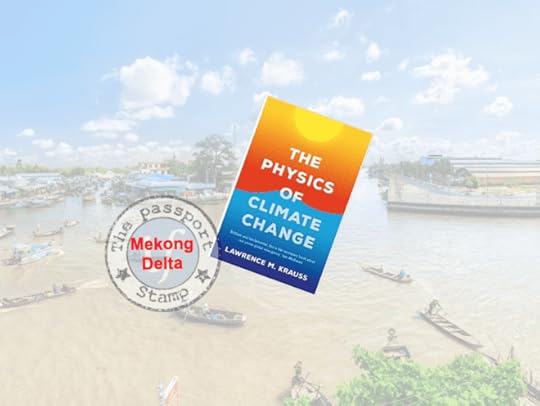
"The Mekong has the richest density of freshwater fish in the world and is home to what is estimated to be over one thousand species of fish" Just let that sink in for a moment. The Mekong supports over fourteen million people along its length. The Mekong's delta - because it is so flat - is at the mercy of the slightest change in climate and the concomitant rise in sea levels. The author says it is like the canary in a coal mine, it is even now urgently waving a red flag at the world. Changes there will impact the world beyond South East Asia. Climate change is a global issue and we can never forget that.
Strong words from the author, indeed. He ponders the notion that the earth has survived much and will continue to do so, Mother Nature being more powerful than humans. And yet...Exponentially humans are releasing CO2 into the atmosphere which is upsetting the natural order and destabilising a very robust and harmonious system. CO2, he stresses, has risen as human production has grown.
The author ventured on a trip by boat along the Mekong, and in Vietnam, in the Delta, his thoughts gained sharp focus and coalesced.
In the Mekong Delta it is a constant battle to keep the salty waters of the South China Sea at bay. If seawater encroaches far up the Mekong River, then large scale destruction of rice crops will take place, and livelihoods will be under threat. The freshwater fish - mentioned at the beginning - will die. The inevitability of this happening is almost certain and the author suggests that the daily battle has already - depressingly - been lost.
"..the Mekong Delta represents, in microcosm, the threat facing much of the world's population from sea level rise"
Vietnam is not alone. Without intervention much of Bangladesh, Indonesia, Malaysia, Papua New Guinea as well as several countries in Europe (the Netherlands as a prime example, of course) will disappear. Sobering!
This is an interesting if not altogether original look at what is happening around the world. There is a lot of scientific data in the book, with diagrams and formulae and I have to be honest that my eyes glazed over at times because I am unfamiliar with many of the technical details. A good read for anyone with a scientific penchant.
"The Mekong has the richest density of freshwater fish in the world and is home to what is estimated to be over one thousand species of fish" Just let that sink in for a moment. The Mekong supports over fourteen million people along its length. The Mekong's delta - because it is so flat - is at the mercy of the slightest change in climate and the concomitant rise in sea levels. The author says it is like the canary in a coal mine, it is even now urgently waving a red flag at the world. Changes there will impact the world beyond South East Asia. Climate change is a global issue and we can never forget that.
Strong words from the author, indeed. He ponders the notion that the earth has survived much and will continue to do so, Mother Nature being more powerful than humans. And yet...Exponentially humans are releasing CO2 into the atmosphere which is upsetting the natural order and destabilising a very robust and harmonious system. CO2, he stresses, has risen as human production has grown.
The author ventured on a trip by boat along the Mekong, and in Vietnam, in the Delta, his thoughts gained sharp focus and coalesced.
In the Mekong Delta it is a constant battle to keep the salty waters of the South China Sea at bay. If seawater encroaches far up the Mekong River, then large scale destruction of rice crops will take place, and livelihoods will be under threat. The freshwater fish - mentioned at the beginning - will die. The inevitability of this happening is almost certain and the author suggests that the daily battle has already - depressingly - been lost.
"..the Mekong Delta represents, in microcosm, the threat facing much of the world's population from sea level rise"
Vietnam is not alone. Without intervention much of Bangladesh, Indonesia, Malaysia, Papua New Guinea as well as several countries in Europe (the Netherlands as a prime example, of course) will disappear. Sobering!
This is an interesting if not altogether original look at what is happening around the world. There is a lot of scientific data in the book, with diagrams and formulae and I have to be honest that my eyes glazed over at times because I am unfamiliar with many of the technical details. A good read for anyone with a scientific penchant.

July 29, 2021
For the less-technically advanced reader (I raise my hand!!), there are discontinuities in the reading of this fine book, where one has to put it down and study selected topics more deeply. As a result, I took several weeks to navigate its 170 odd pages. On finishing the book, I am pleased with my deeper understanding of the underlying drivers of climate change (global warming) due to CO2 buildup in the atmosphere, radiative forcing, the physics of the increase in surface / atmospheric temperatures, etc. The use of the Mekong Delta as a tragic victim of mankind’s (the developed economy part….) reckless behaviour today creating catastrophic negative externalities for future generations reinforces the book’s policy message.

June 18, 2025
I’ve read three other science books by Lawrence Krauss and rated them all highly so I thought his book about climate change would be interesting. I’ve found Krauss to be an effective and interesting science communicator and think he’s good at dumbing complicated science-y things down to appeal to the layperson such as myself. His podcast and appearances on others’ podcasts are always enlightening, and he while he's a theoretical physicist he tackles all science-related subjects well. So, while he’s not a climate scientist per se, he has a firm grasp on the science that goes in to the analysis presented in this book.
I listened to this in Audible. Krauss narrates this himself and there is an accompanying PDF with numerous graphs, maps, and illustrations to highlight his points.
As expected, this is a sobering book. The scientific facts of CO2 buildup can’t be ignored, but all is not lost. The climate has always changed, but unfortunately humans are causing the natural cyclical change we would be experiencing to be accelerated. Krauss points out that through trapped bubbles in ice cores we know what the climate was going back hundreds of thousands of years so an accurate model of our atmosphere through time has been created. Humans in the last two hundred years have been burning carbon which took millions of years to create in the earth. Carbon would be naturally released without human intervention, but we have accelerated the process beyond any natural equilibrium. Krauss spends a lot of time explaining what the effects of warming and rising sea levels would impact critical areas like Greenland and the Mekong Delta. Luckily, we understand the science and we have the ability to react and hopefully lessen the damage which can't be undone, only lessened.
What I really liked about this book was the lack of politicization of the problem. No political leaders or parties were even mentioned! He just stuck with the facts and at hand and offered possible solutions. He didn’t do any finger pointing at countries, either, which I’ve heard in the recent past as a number of industrialized countries have leveled off their emissions or even cut them while other countries are building coal plants and burning rain forests. Truly, climate change mitigation is not a world-wide effort.
Another thing I found interesting was the story of one of the first climate scientists -Svante Arrhenius from Sweden who wrote the first climate change paper in 1896! The basic framework of his atmospheric CO2 theories still stand today. Arrhenius actually thought this would be a good thing as his beloved homeland would warm up and be a more pleasant place to live for his decedents.
As a nuclear power groupie I was hoping Krauss would offer this up as a solution to cutting greenhouse gases. The new generation plants are safer than ever and could burn stored waste, and more electricity would allow for the proliferation of electric vehicles. Krauss did talk about how the Earth is bombarded with so much solar energy that, if harnessed properly, this could supply all of our needs many times over. Technology will hopefully advance to the point where it will make economic sense to lose the coal burners and convince leaders to move away from fossil fuels and in to the future.
There were a couple times Krauss put on his physics hat and took a deep dive in to scientific theories which went over my head a bit. Overall, though, this book was understandable, and I was able to follow along. While the book was relatively short five hours it covered the main topics and I feel like I better understand the facts behind the issue.
I listened to this in Audible. Krauss narrates this himself and there is an accompanying PDF with numerous graphs, maps, and illustrations to highlight his points.
As expected, this is a sobering book. The scientific facts of CO2 buildup can’t be ignored, but all is not lost. The climate has always changed, but unfortunately humans are causing the natural cyclical change we would be experiencing to be accelerated. Krauss points out that through trapped bubbles in ice cores we know what the climate was going back hundreds of thousands of years so an accurate model of our atmosphere through time has been created. Humans in the last two hundred years have been burning carbon which took millions of years to create in the earth. Carbon would be naturally released without human intervention, but we have accelerated the process beyond any natural equilibrium. Krauss spends a lot of time explaining what the effects of warming and rising sea levels would impact critical areas like Greenland and the Mekong Delta. Luckily, we understand the science and we have the ability to react and hopefully lessen the damage which can't be undone, only lessened.
What I really liked about this book was the lack of politicization of the problem. No political leaders or parties were even mentioned! He just stuck with the facts and at hand and offered possible solutions. He didn’t do any finger pointing at countries, either, which I’ve heard in the recent past as a number of industrialized countries have leveled off their emissions or even cut them while other countries are building coal plants and burning rain forests. Truly, climate change mitigation is not a world-wide effort.
Another thing I found interesting was the story of one of the first climate scientists -Svante Arrhenius from Sweden who wrote the first climate change paper in 1896! The basic framework of his atmospheric CO2 theories still stand today. Arrhenius actually thought this would be a good thing as his beloved homeland would warm up and be a more pleasant place to live for his decedents.
As a nuclear power groupie I was hoping Krauss would offer this up as a solution to cutting greenhouse gases. The new generation plants are safer than ever and could burn stored waste, and more electricity would allow for the proliferation of electric vehicles. Krauss did talk about how the Earth is bombarded with so much solar energy that, if harnessed properly, this could supply all of our needs many times over. Technology will hopefully advance to the point where it will make economic sense to lose the coal burners and convince leaders to move away from fossil fuels and in to the future.
There were a couple times Krauss put on his physics hat and took a deep dive in to scientific theories which went over my head a bit. Overall, though, this book was understandable, and I was able to follow along. While the book was relatively short five hours it covered the main topics and I feel like I better understand the facts behind the issue.

February 2, 2021
A waste of money
There’s nothing in this book that isn’t available for free in a hundred places. It’s just a rehash of the same climate change narrative that we’ve been hearing about for years. I was hoping for some proofs or equations or other logical demonstrations of how climate predictions were derived and how the effects of co2 are really calculated. The title is misleading. This isn’t really a physics book as much as it is a sermon. Very disappointing.
There’s nothing in this book that isn’t available for free in a hundred places. It’s just a rehash of the same climate change narrative that we’ve been hearing about for years. I was hoping for some proofs or equations or other logical demonstrations of how climate predictions were derived and how the effects of co2 are really calculated. The title is misleading. This isn’t really a physics book as much as it is a sermon. Very disappointing.

February 28, 2021
There are people who don't think climate change is a real thing and we are going to witness the consequences. The book provides us with necessary data bout climate change and the physics behind it. I hope this book helps such people.

May 22, 2022
This is a great read for people who mostly want the facts without the so-called 'preachy' nature of some other climate change books.
I particularly loved the epilogue.
I particularly loved the epilogue.

October 21, 2025
I read this on a plane flight home from Tenerife - perhaps I should not have flown.
It's an interesting book giving some detailed scientific explanations of climate change, illustrated with some helpful figures.
I wouldn't say it's the most accessible account of climate change because of the way figures and text and formula get interwoven, but there are some telling descriptions of trends and scientific discoveries that make this a useful reference book for anyone who might (perhaps foolishly) want to go to social media war with climate change deniers.
Krauss's determination is to offer hard fact based evidence, to avoid being drawn into emotive arguments. However, arguably - as Oreskes and Conway described in their faux history The Collapse of Western Civilisation: A view from the future it is perhaps sciences reluctance to speak in a sufficiently emotive and urgent register that has limited the penetration of its message.
The climate crisis was never a matter of science or technology - the facts were known, the solutions already existed. The problem is combatting misinformation, apathy and vested interests.
The most telling element of Krauss's book is his explanation of what the climate crisis will mean for the Meekong river - and other lowlying but hugely important agricultural regions. The combination of even modest sea level rises and new extreme weather events will make food scarcity and water shortages a world wide issue. As I write this review DEFRA is reporting the second worst harvest in UK history. These are the urgent emotive events that need wider publicity in order to make people curious and engage with the facts of climate change - and its solutions!
It's an interesting book giving some detailed scientific explanations of climate change, illustrated with some helpful figures.
I wouldn't say it's the most accessible account of climate change because of the way figures and text and formula get interwoven, but there are some telling descriptions of trends and scientific discoveries that make this a useful reference book for anyone who might (perhaps foolishly) want to go to social media war with climate change deniers.
Krauss's determination is to offer hard fact based evidence, to avoid being drawn into emotive arguments. However, arguably - as Oreskes and Conway described in their faux history The Collapse of Western Civilisation: A view from the future it is perhaps sciences reluctance to speak in a sufficiently emotive and urgent register that has limited the penetration of its message.
The climate crisis was never a matter of science or technology - the facts were known, the solutions already existed. The problem is combatting misinformation, apathy and vested interests.
The most telling element of Krauss's book is his explanation of what the climate crisis will mean for the Meekong river - and other lowlying but hugely important agricultural regions. The combination of even modest sea level rises and new extreme weather events will make food scarcity and water shortages a world wide issue. As I write this review DEFRA is reporting the second worst harvest in UK history. These are the urgent emotive events that need wider publicity in order to make people curious and engage with the facts of climate change - and its solutions!

June 23, 2022
This book was excellent! As a physicist I thought I already had a pretty good understanding of the “Physics of Climate change” in particular the greenhouse effect. This book has shown me that my understanding was incomplete and simplistic. I would highly recommend that anyone who wants a fact based view of global warming or who wants to contribute to work relating to environmental solutions start here. This area is overlooked by physicists and offers prospects for very interesting research.
It also presents that most straightforward and convincing case for global warming that I’ve read, which is left out of a lot of books which are more focused on dealing with its ill effects instead. As I was reading it, I was explaining what I’d learned to my climate-skeptic brother and was amazed how the clear progression of graphs and illustrations in the book served at the basis for a productive discussion which ended in him agreeing that the problem was worse than he had realized and that humans had had a huge impact on the atmosphere.
I would like to write a more comprehensive review later, which deals more with the content and what I learned. This will have to do for now. Anyone who wants to read it talk to me about borrowing my copy.
It also presents that most straightforward and convincing case for global warming that I’ve read, which is left out of a lot of books which are more focused on dealing with its ill effects instead. As I was reading it, I was explaining what I’d learned to my climate-skeptic brother and was amazed how the clear progression of graphs and illustrations in the book served at the basis for a productive discussion which ended in him agreeing that the problem was worse than he had realized and that humans had had a huge impact on the atmosphere.
I would like to write a more comprehensive review later, which deals more with the content and what I learned. This will have to do for now. Anyone who wants to read it talk to me about borrowing my copy.
June 12, 2021
The most thorough to date
This book contains the information I was seeking: a scientifically sound, in-depth explanation of the processes producing current climate change. Some of the physics was over my head; however, the author's descriptions and explanations of the math were more than adequate. Better to read above one's understanding than below it, in that it gives at minimum a feel for how much research and data exist beyond one's current learning capacity. In other words...read this book if you want to seriously expand your understanding of where we are, how we got here, and the choices we will need to make as a society.
This book contains the information I was seeking: a scientifically sound, in-depth explanation of the processes producing current climate change. Some of the physics was over my head; however, the author's descriptions and explanations of the math were more than adequate. Better to read above one's understanding than below it, in that it gives at minimum a feel for how much research and data exist beyond one's current learning capacity. In other words...read this book if you want to seriously expand your understanding of where we are, how we got here, and the choices we will need to make as a society.

August 6, 2021
With basic math, Lawrence explains the physics of climate change. This is really a great book for understanding the science behind climate change. Written in a language that speaks to everyone. I can really recommend this book and there are also lectures from Lawrence that you can part in online.
I had a great conversation with Lawrence on my podcast Inside Ideas. You can find episode 118 here:https://youtu.be/AitHfqTKC-4
Or check out any of the links below:
https://www.innovatorsmag.com/the-phy...
https://medium.com/inside-ideas/prof-...
I had a great conversation with Lawrence on my podcast Inside Ideas. You can find episode 118 here:https://youtu.be/AitHfqTKC-4
Or check out any of the links below:
https://www.innovatorsmag.com/the-phy...
https://medium.com/inside-ideas/prof-...

January 23, 2023
Наука за климатичните промени, както предполага заглавието, набляга именно на наука и на какво се дължат климатичните промени. В началото може да ви се стори твърде физична и сложна, но не се отказвайте. Обяснение е научно именно за да разберем откъде идва проблемът.
Втората част от книгата обръща внимание и на самите изменения и до какво биха довели. Препоръчвам на всеки да я прочете, защото е от съществено значение да бъдем осъзнати за вредите, които оказваме на природата.
Ще завърша с едно от любимите ми изречения;
”.. съдбата е на страната на подготвените. Тя не дава гаранции, само предлага по-добри шансове.”
Втората част от книгата обръща внимание и на самите изменения и до какво биха довели. Препоръчвам на всеки да я прочете, защото е от съществено значение да бъдем осъзнати за вредите, които оказваме на природата.
Ще завърша с едно от любимите ми изречения;
”.. съдбата е на страната на подготвените. Тя не дава гаранции, само предлага по-добри шансове.”

March 16, 2021
Nothing new but would make a good first read for those just getting into climate change literature.

November 19, 2023
Krauss è riuscito molto bene nel suo intento: veicolare i principi fisici chiave che regolano il cambiamento climatico in modo semplice e diretto, anche se forse un minimo di familiarità con questi concetti è comunque richiesto. Il libro contiene molti grafici esplicativi, che aiutano a comprendere molto facilmente alcuni fenomeni che stanno interessando il nostro pianeta, e come questi possano essere correlati con il passato geologico della Terra.
Alcuni capitoli sicuramente più riusciti e azzeccati rispetto ad altri e, personalmente, avrei gradito qualche formula in più, magari relegata in un appendice a fine volume.
L'autore si concentra moltissimo anche sull'aspetto più intersezionale del cambiamento climatico, chiudendo con il racconto agghiacciante di quanto sta accadendo al delta del fiume Mekong, in Vietnam.
Consigliatissimo!
Alcuni capitoli sicuramente più riusciti e azzeccati rispetto ad altri e, personalmente, avrei gradito qualche formula in più, magari relegata in un appendice a fine volume.
L'autore si concentra moltissimo anche sull'aspetto più intersezionale del cambiamento climatico, chiudendo con il racconto agghiacciante di quanto sta accadendo al delta del fiume Mekong, in Vietnam.
Consigliatissimo!

January 27, 2022
Currently the use of fossil fuel releases millions of years of accumulated carbon into our atmosphere creating a blanket effect to rise average temperatures.
Lawrence Krauss (I didn't yet know this scientist had become quite a celebrity appearing on famous podcasts) starts off in the Mekong Delta explaining the very sensitive nature of its eco-system and how a meagre rise in the oceans would cause salt water flooding leading to the loss of fish diversity and rice production for up to 70M people. A single disaster unprecedented in anything we can imagine in human history.
But one such example of catastrophe is only a single demonstration of many varied tipping points; a 2 degree rise in average temperature will cause most of the world's coral reefs to disappear, if we continue to cut down the Amazon rain forest it will not be self sustaining and will turn, in entirety, into a savanna.
The tropical zone will continue to be affected the most by further rises in temperature. We currently see the northern hemisphere heavily affected by glacier melting and to put it in perspective, Greenland was once ice free, which if re-occurring would cause a rise in sea levels of 7 meters!
Regardless of how we imagine the impact, which is conceded to be difficult to define accurately on a large scale, this book establishes the facts around how we measure CO2 in the atmosphere, how we know more CO2 means more heating, and how that must translate into higher temperatures.
Even though the extra carbon we have added since the 1750s will not be dissipated by the atmosphere for another 1000 years and we are stuck with that whatever we do, we need to get very serious about getting together to prevent as much further impact as possible. How clear can it be?
The good news is the Sun sends us 10 times as much natural energy as we currently need. If we stop focussing our efforts on petty politics, greed, vanity, war, and tourist trips in space we might just be able to get serious about a proper collective effort to really do something.
Lawrence Krauss (I didn't yet know this scientist had become quite a celebrity appearing on famous podcasts) starts off in the Mekong Delta explaining the very sensitive nature of its eco-system and how a meagre rise in the oceans would cause salt water flooding leading to the loss of fish diversity and rice production for up to 70M people. A single disaster unprecedented in anything we can imagine in human history.
But one such example of catastrophe is only a single demonstration of many varied tipping points; a 2 degree rise in average temperature will cause most of the world's coral reefs to disappear, if we continue to cut down the Amazon rain forest it will not be self sustaining and will turn, in entirety, into a savanna.
The tropical zone will continue to be affected the most by further rises in temperature. We currently see the northern hemisphere heavily affected by glacier melting and to put it in perspective, Greenland was once ice free, which if re-occurring would cause a rise in sea levels of 7 meters!
Regardless of how we imagine the impact, which is conceded to be difficult to define accurately on a large scale, this book establishes the facts around how we measure CO2 in the atmosphere, how we know more CO2 means more heating, and how that must translate into higher temperatures.
Even though the extra carbon we have added since the 1750s will not be dissipated by the atmosphere for another 1000 years and we are stuck with that whatever we do, we need to get very serious about getting together to prevent as much further impact as possible. How clear can it be?
The good news is the Sun sends us 10 times as much natural energy as we currently need. If we stop focussing our efforts on petty politics, greed, vanity, war, and tourist trips in space we might just be able to get serious about a proper collective effort to really do something.

March 19, 2021
As always, Lawrence Krauss lays it on the line and explains clearly how climate is affected by industrial emissions and the long and short term possibilities. It is not the final word. Scientists are still on the learning curve but it is fairly clear where it's all going and the bottom line is that we have to make drastic changes to our way of life to stave off long term catastrophies and alterations of our atmosphere. In the short term we will witness the early changes and destruction which will take place and ultimitely bring on the big changes of which we will and are seeing happening now.
The final chapter on the Mekong Delta is an eye opener and set your heart into palpitations.
This book is a must read for those wanting to increase their understanding of how the Earths climate operates and the effect of our input into this fine tuned system.
The final chapter on the Mekong Delta is an eye opener and set your heart into palpitations.
This book is a must read for those wanting to increase their understanding of how the Earths climate operates and the effect of our input into this fine tuned system.
June 10, 2021
Having read other books on climate change I would recommend this book to anyone open to reading about this topic. One of the biggest challenges we face. After having read it I felt a mix of cautious optimism and the awareness of the growing elephant in the room that Climate Change is to our present day life.
I'm happy that Mr Krauss and others have put some energy in helping us, lay people, understand some of fundamentals.
Highly recommend.
I'm happy that Mr Krauss and others have put some energy in helping us, lay people, understand some of fundamentals.
Highly recommend.
July 4, 2021
Overall, I consider this to be an essential read.
The book is a good summary of climate change science...although I think that some sections probably aren't as accessible to lay people as the author hopes.
What (I think) sets this book apart from other books on climate science is that in addition to presenting information, he weighs it up and/or tests it in a variety of ways. The insight into the mind of a scientist is fascinating.
The book is a good summary of climate change science...although I think that some sections probably aren't as accessible to lay people as the author hopes.
What (I think) sets this book apart from other books on climate science is that in addition to presenting information, he weighs it up and/or tests it in a variety of ways. The insight into the mind of a scientist is fascinating.

December 25, 2021
This book makes climate physics accessible at the high school /gymnasium level (but not lower).
The book could easily be used by high school math and physics teachers to make manageable assignments for the students.
For everyone else it provides a way of understanding more than enough, and to wonder why we are mindlessly sailing the world into the sixth extinction as another Titanic - this time just with everyone on board.
The book could easily be used by high school math and physics teachers to make manageable assignments for the students.
For everyone else it provides a way of understanding more than enough, and to wonder why we are mindlessly sailing the world into the sixth extinction as another Titanic - this time just with everyone on board.
March 13, 2021
The science behind climate change
If you are concerned about climate change but don’t understand the science behind, then this book is for you. I have to admit I found some parts difficult to understand, but the effort is worth it.
If you are concerned about climate change but don’t understand the science behind, then this book is for you. I have to admit I found some parts difficult to understand, but the effort is worth it.

November 12, 2023
Decent primer on the physics of climate change; bit akward but encouraging at the same time to see the famous theoretical physicist/cosmologist fleshing out the muddled science of climatology. Don’t expect sweeping narratives and crisp explanations; just the solid, matter-of-fact and dry science.
July 28, 2021
Everyone should read this book, it is a bit technical sometimes but Lawrence does a great job of dumbing it down so that everyone gets it

September 18, 2021
this book finished me

August 5, 2021
Unsettled, by Steven E. Koonin.
The Physics of Climate Change, by Lawrence M. Krauss.
Review by Galen Weitkamp
The Earth swims through a river of energy: 1361 Watts (on average) over every square, sunlit meter. Nearly 30% of this energy is reflected by clouds, glaciers and snowfields back into space. Some of this radiative energy is converted and stored by green plants into usable chemical energy. These plants take up carbon dioxide and produce our oxygen. Lest you think the Earth is too big and a green leaf is too small to have any effect upon it, contemplate the fact that before the evolution of photosynthesis, there was no breathable oxygen at all in the atmosphere; that we mammals didn’t exist then - we couldn’t have.
Even though some of the bright, radiative energy that pours over us is used by plants, and some is reflected back into space, most of it is converted almost immediately into heat; i.e. the thermal motion uncountable jiggling and swirling atoms and molecules. These jiggling charges produce their own electromagnetic waves and consequently Earth’s Sun-warmed surface, radiates heat in the form of electromagnetic waves. The frequency of this emitted (blackbody) radiation depends on the temperature of the emitting body. Earth receives most of its energy in the visible bands and emits it in the infrared. The atmosphere is largely transparent to the incoming visible light. What isn’t reflected (or scattered, the blues get scattered) comes right through and heats the Earth’s surface. The outgoing infrared light doesn’t have it as easy. Some atmospheric gasses with just the right molecular structure (water vapor, methane, carbon dioxide and other ‘greenhouse’ gasses) capture these infrared photons and re-emit them in all directions. Instead of escaping into space, half of them get sent back toward Earth, get reabsorbed and re-emitted. The Earth is in thermal equilibrium when the rate at which the Earth gathers up the incoming solar energy equals the rate at which the outgoing energy escapes back into space in the form of emitted infrared radiation. The difference between these two rates (the direct measure of the energy imbalance) is called radiative forcing. If for some reason, too little heat escapes, the Earth will warm up. The rise in temperature will increase the rate at which the Earth radiates away its heat and its temperature will continue to rise until the rate at which energy escapes once again equals the rate at which it is received thereby establishing a new and hotter thermal equilibrium. Vice-versa, if the rate of energy loss were higher than it is now, the Earth would cool off. If, for example, we had no atmosphere at all blanketing us and slowing the rate of infrared emission into space, the Earth would be 33 degrees Celsius cooler than it is now.
It was Svante Arrhenius, the nineteenth century chemist, who discovered the greenhouse stuffings that make our atmospheric blanket good at keeping us warm. He established the mathematical relationship between thermal equilibrium and the concentration of carbon dioxide in the atmosphere showing that every time the concentration of carbon dioxide in the atmosphere doubles, the radiative forcing increases 3.7 Watts per square meter. In 1750 (often taken to be the start of the industrial revolution) the concentration of carbon dioxide was 278 ppm (parts per million). Today the figure is 416 ppm. This increase is anthropogenic. According to the U.S. Geological Survey volcanoes cough 200 million tons of carbon dioxide into the atmosphere every year; however, automotive and industrial activity spews 24 billion tons of the stuff into the atmosphere every year. Indeed the mean surface temperature of the Earth has been exponentially rising since that time as is the qualitative prediction of Arrhenius’s discovery.
All of this is well understood, tested and settled science. What is more tenuous, less settled, is the science of drawing the exact quantitative connections between concentrations of greenhouse gasses and the magnitude of the Earth’s surface temperature in the future, or amount of ocean acidity, or the direction and volumetric flow of ocean currents, or the flow of the Jet Steam, or the future patterns of drought and flood. How do we calculate the planetary consequences of human activities on individual weather and climate events? By how much, for example, will sea levels rise, where, by when and to what extent will human activity be, or not be the cause? The complexity and sizes of these systems make them very difficult to predict and the noise and their global scales make them difficult to measure.
Neither Steven E. Koonin, nor Lawrence M. Krauss are climate scientists. They are both physicists who have written books which they hope will provide laypersons with the fundamental physics needed to understand and think about the climate issues that we hear about in everyday headlines.
Koonin, as one can surmise by the title of his book, wishes to persuade his readers that the role and influence humans have on climate is little understood and certainly not settled. At first that might sound reasonable, but what he seems to maintain is that our influence is so small it’s questionable whether we have any effect at all. He agrees temperatures have been rising since the start of the industrial age, but he remains unconvinced that human activity is responsible and wishes the newspapers would stop pretending “The Science” is settled. Not only does Koonin disagree with journalists and their big scary headlines, he also has major disagreements with the IPCC and it would seem most other climate scientists. If Koonin believes our effect on climate is negligible he is also pessimistic that we can do anything about stopping climate change. He doesn’t believe adopting carbon-free energy sources will solve the problem, nor that the world is in the position to implement carbon-free programs. He favors geo-engineering solutions instead, like increasing the Earth’s albedo so that it reflects away more of the Sun’s light. Rather than solve the problem, he predicts humans will just live with a warming planet and adapt to it. “Unsettled” wouldn’t be such an aggravating book, if Koonin didn’t seem to be quite happy with adaptation strategy.
Lawrence Krauss does his best at presenting the fundamental physical principles of climate science. He opens and closes the book with the example of Mekong River. It provides fresh water to the world’s most productive ricebowl, supplying over a billion people with rice and fresh water fish. The ocean tide rushes up the delta daily and is beaten back, thwarted by the Mekong. In 2019 Dutch geographer Philip Minderhoud published new work in Nature establishing that elevations along the Mekong were much lower than previously believed. Than in 2020, LIDAR measurements from Endeavor’s Shuttle Radar Topography Mission independently confirmed Minderhoud’s paper. The mean elevation of the delta is only 8/10th of a meter above sea level. Climate models predict (as anyone can by simply extrapolating current trends) that sea levels will rise by at least 1/2 meter by 2100. Currently 12.3 million people live in the area that will by than be under the brine and a billion people will lose their food supply, making it pretty difficult to adapt.
Without a doubt, increases in concentrations of greenhouse gasses can throw the Earth out of balance. Just a few hundred parts per million can double or triple the concentrations. Recall that Arrhenius’s law is exponential. Without a doubt we’re substantially increasing those concentrations. How exactly that effects winds, rains, snows, droughts, glaciers, tides, temperatures and sea levels is difficult to model and predict. The science connecting these complex and chaotic climate systems is unsettled. Suffice it to say, if there’s an energy imbalance in favor of the incoming solar energy, then all these subsystems will somehow parse the extra energy among themselves, perhaps in unpredictable ways, and the climate will become discernibly more energetic.
The Physics of Climate Change, by Lawrence M. Krauss.
Review by Galen Weitkamp
The Earth swims through a river of energy: 1361 Watts (on average) over every square, sunlit meter. Nearly 30% of this energy is reflected by clouds, glaciers and snowfields back into space. Some of this radiative energy is converted and stored by green plants into usable chemical energy. These plants take up carbon dioxide and produce our oxygen. Lest you think the Earth is too big and a green leaf is too small to have any effect upon it, contemplate the fact that before the evolution of photosynthesis, there was no breathable oxygen at all in the atmosphere; that we mammals didn’t exist then - we couldn’t have.
Even though some of the bright, radiative energy that pours over us is used by plants, and some is reflected back into space, most of it is converted almost immediately into heat; i.e. the thermal motion uncountable jiggling and swirling atoms and molecules. These jiggling charges produce their own electromagnetic waves and consequently Earth’s Sun-warmed surface, radiates heat in the form of electromagnetic waves. The frequency of this emitted (blackbody) radiation depends on the temperature of the emitting body. Earth receives most of its energy in the visible bands and emits it in the infrared. The atmosphere is largely transparent to the incoming visible light. What isn’t reflected (or scattered, the blues get scattered) comes right through and heats the Earth’s surface. The outgoing infrared light doesn’t have it as easy. Some atmospheric gasses with just the right molecular structure (water vapor, methane, carbon dioxide and other ‘greenhouse’ gasses) capture these infrared photons and re-emit them in all directions. Instead of escaping into space, half of them get sent back toward Earth, get reabsorbed and re-emitted. The Earth is in thermal equilibrium when the rate at which the Earth gathers up the incoming solar energy equals the rate at which the outgoing energy escapes back into space in the form of emitted infrared radiation. The difference between these two rates (the direct measure of the energy imbalance) is called radiative forcing. If for some reason, too little heat escapes, the Earth will warm up. The rise in temperature will increase the rate at which the Earth radiates away its heat and its temperature will continue to rise until the rate at which energy escapes once again equals the rate at which it is received thereby establishing a new and hotter thermal equilibrium. Vice-versa, if the rate of energy loss were higher than it is now, the Earth would cool off. If, for example, we had no atmosphere at all blanketing us and slowing the rate of infrared emission into space, the Earth would be 33 degrees Celsius cooler than it is now.
It was Svante Arrhenius, the nineteenth century chemist, who discovered the greenhouse stuffings that make our atmospheric blanket good at keeping us warm. He established the mathematical relationship between thermal equilibrium and the concentration of carbon dioxide in the atmosphere showing that every time the concentration of carbon dioxide in the atmosphere doubles, the radiative forcing increases 3.7 Watts per square meter. In 1750 (often taken to be the start of the industrial revolution) the concentration of carbon dioxide was 278 ppm (parts per million). Today the figure is 416 ppm. This increase is anthropogenic. According to the U.S. Geological Survey volcanoes cough 200 million tons of carbon dioxide into the atmosphere every year; however, automotive and industrial activity spews 24 billion tons of the stuff into the atmosphere every year. Indeed the mean surface temperature of the Earth has been exponentially rising since that time as is the qualitative prediction of Arrhenius’s discovery.
All of this is well understood, tested and settled science. What is more tenuous, less settled, is the science of drawing the exact quantitative connections between concentrations of greenhouse gasses and the magnitude of the Earth’s surface temperature in the future, or amount of ocean acidity, or the direction and volumetric flow of ocean currents, or the flow of the Jet Steam, or the future patterns of drought and flood. How do we calculate the planetary consequences of human activities on individual weather and climate events? By how much, for example, will sea levels rise, where, by when and to what extent will human activity be, or not be the cause? The complexity and sizes of these systems make them very difficult to predict and the noise and their global scales make them difficult to measure.
Neither Steven E. Koonin, nor Lawrence M. Krauss are climate scientists. They are both physicists who have written books which they hope will provide laypersons with the fundamental physics needed to understand and think about the climate issues that we hear about in everyday headlines.
Koonin, as one can surmise by the title of his book, wishes to persuade his readers that the role and influence humans have on climate is little understood and certainly not settled. At first that might sound reasonable, but what he seems to maintain is that our influence is so small it’s questionable whether we have any effect at all. He agrees temperatures have been rising since the start of the industrial age, but he remains unconvinced that human activity is responsible and wishes the newspapers would stop pretending “The Science” is settled. Not only does Koonin disagree with journalists and their big scary headlines, he also has major disagreements with the IPCC and it would seem most other climate scientists. If Koonin believes our effect on climate is negligible he is also pessimistic that we can do anything about stopping climate change. He doesn’t believe adopting carbon-free energy sources will solve the problem, nor that the world is in the position to implement carbon-free programs. He favors geo-engineering solutions instead, like increasing the Earth’s albedo so that it reflects away more of the Sun’s light. Rather than solve the problem, he predicts humans will just live with a warming planet and adapt to it. “Unsettled” wouldn’t be such an aggravating book, if Koonin didn’t seem to be quite happy with adaptation strategy.
Lawrence Krauss does his best at presenting the fundamental physical principles of climate science. He opens and closes the book with the example of Mekong River. It provides fresh water to the world’s most productive ricebowl, supplying over a billion people with rice and fresh water fish. The ocean tide rushes up the delta daily and is beaten back, thwarted by the Mekong. In 2019 Dutch geographer Philip Minderhoud published new work in Nature establishing that elevations along the Mekong were much lower than previously believed. Than in 2020, LIDAR measurements from Endeavor’s Shuttle Radar Topography Mission independently confirmed Minderhoud’s paper. The mean elevation of the delta is only 8/10th of a meter above sea level. Climate models predict (as anyone can by simply extrapolating current trends) that sea levels will rise by at least 1/2 meter by 2100. Currently 12.3 million people live in the area that will by than be under the brine and a billion people will lose their food supply, making it pretty difficult to adapt.
Without a doubt, increases in concentrations of greenhouse gasses can throw the Earth out of balance. Just a few hundred parts per million can double or triple the concentrations. Recall that Arrhenius’s law is exponential. Without a doubt we’re substantially increasing those concentrations. How exactly that effects winds, rains, snows, droughts, glaciers, tides, temperatures and sea levels is difficult to model and predict. The science connecting these complex and chaotic climate systems is unsettled. Suffice it to say, if there’s an energy imbalance in favor of the incoming solar energy, then all these subsystems will somehow parse the extra energy among themselves, perhaps in unpredictable ways, and the climate will become discernibly more energetic.

June 13, 2024
I think my issue with scientific climate change discussions is very much a me issue. There are so many numbers. I think being in theoretical physics helps me escape that to an extent.
However, I did appreciate Krauss’ discussions, and I do have more of an intuition of the things that come into play when considering the greenhouse effect etc. For example, how the greenhouse effect is a misnomer, since actual greenhouses trap warm air, while the climatological greenhouse effect is all about stratifications of air compositions and density. All the radiative transfer classes I attended helped connect concepts for me. Frequency dependence etc. were interesting, in how saturation of CO2 makes it so that a larger number of frequencies are affected and can absorb.
Also helped me understand some longer term cycles like how CO2 is cycled into geological layers and how those timescales operate.
Probably my favorite aspect of this book were the discussions on nonlinear dynamics playing out. Ice sheets melting leads to more exposed dark water, which lowers the albedo etc. Interesting to know that the southern hemisphere will take longer to heat up, but that it will stay warm for longer, due to lower land surface area.
However, I did appreciate Krauss’ discussions, and I do have more of an intuition of the things that come into play when considering the greenhouse effect etc. For example, how the greenhouse effect is a misnomer, since actual greenhouses trap warm air, while the climatological greenhouse effect is all about stratifications of air compositions and density. All the radiative transfer classes I attended helped connect concepts for me. Frequency dependence etc. were interesting, in how saturation of CO2 makes it so that a larger number of frequencies are affected and can absorb.
Also helped me understand some longer term cycles like how CO2 is cycled into geological layers and how those timescales operate.
Probably my favorite aspect of this book were the discussions on nonlinear dynamics playing out. Ice sheets melting leads to more exposed dark water, which lowers the albedo etc. Interesting to know that the southern hemisphere will take longer to heat up, but that it will stay warm for longer, due to lower land surface area.
Displaying 1 - 30 of 149 reviews