

What do you think?

Louis-Ferdinand Céline: Journeys to the Extreme
The first English-language biography in more than two decades of the French writer, one of the great novelists of the twentieth century.
Louis-Ferdinand Céline was one of the most innovative novelists of the twentieth century, and his influence both in his native France and beyond remains huge. This book sheds light on Céline’s groundbreaking novels, which drew extensively on his complex he rose from humble beginnings to worldwide literary fame, then dramatically fell from grace only to return, belatedly, to the limelight. Céline’s subversive writing remains fresh and urgent today, despite his controversial political views and inflammatory pamphlets that threatened to ruin his reputation. The first English-language biography of Céline in more than two decades, this book explores new material and reminds us why the author belongs in the pantheon of modern greats.
Louis-Ferdinand Céline was one of the most innovative novelists of the twentieth century, and his influence both in his native France and beyond remains huge. This book sheds light on Céline’s groundbreaking novels, which drew extensively on his complex he rose from humble beginnings to worldwide literary fame, then dramatically fell from grace only to return, belatedly, to the limelight. Céline’s subversive writing remains fresh and urgent today, despite his controversial political views and inflammatory pamphlets that threatened to ruin his reputation. The first English-language biography of Céline in more than two decades, this book explores new material and reminds us why the author belongs in the pantheon of modern greats.
- GenresBiography21st Century
400 pages, Hardcover
First published September 13, 2021
Ratings & Reviews
Friends & Following
Create a free account to discover what your friends think of this book!
Community Reviews
Displaying 1 - 4 of 4 reviews

August 17, 2022
Another great Reaktion publication that is half bio - and half lit-crit. Céline is such a remarkable issue of a brilliant writer who was also a racist. The duality in a human being. A fascinating read.

March 6, 2023
With L-F Céline, there's both a lot of material and life experiences to get through and there is the controversy around saying anything at all about him to withstand and address. Catani does this in an admirable book, one that's well-written and generally well-organized. It won't replace Vitoux (I can't speak to other biographies of LFC), but it does bring matters up to date (2021).
If anyone has read Céline's novels and likes his style, then this book may be for you. Those disgusted (understandably) by any trace of anti-semitism and/or racism may not be impressed by some of the arguments in this book, no matter that it brings depth and nuance to vital issues. Catani doesn't shy away from the repugnant aspects of Céline's character or his writing, but he clearly isn't antagonistic towards him.
Recommended.
If anyone has read Céline's novels and likes his style, then this book may be for you. Those disgusted (understandably) by any trace of anti-semitism and/or racism may not be impressed by some of the arguments in this book, no matter that it brings depth and nuance to vital issues. Catani doesn't shy away from the repugnant aspects of Céline's character or his writing, but he clearly isn't antagonistic towards him.
Recommended.

May 6, 2024
Celine: the question
How could the man who wrote this
A room changes in a few months, even if you don’t move anything. Old and rundown as things may be, they still find the strength, the Lord knows where, to get older. Everything had changed around us. Not that anything had moved, no, of course not, the things themselves had actually changed, in depth. Things are different when you go back to them, they seem to have more power to enter into us more sadly, more deeply, more gently than before, to merge with the death which is slowly, pleasantly, sneakily growing inside us, and which we train ourselves to resist a little less each day. From moment to moment, we see life languishing, shriveling inside us, and with it the things and people who may have been commonplace or precious or imposing when we last left them. Fear of the end has marked all that with its wrinkles, while we were chasing around town in search of pleasure or bread. Soon our past will be attended only by inoffensive, pathetic, disarmed things and people, mistakes with nothing to say for themselves.
also write this?
[The Jews] are a bunch of vampires! of phenomenal pieces of filth, they must be sent to Hitler! from Palestine! from Poland! They have done us an immense wrong! They can no longer stay here! . . . What is the people’s real friend? Fascism. Who has done the most for the worker? The USSR or Hitler? It is Hitler. You only have to look without all that red shit in your eyes. Who has done the most for the small shopkeeper? It’s not Thorez, it’s Hitler! Who is preventing us from going to war? It’s Hitler! All the communists (Jewish or Jewified) think about, is resending us to our deaths, for us to croak in a crusade. Hitler is good at raising a people, he is on the side of Life. he cares about the life of peoples, and even ours. He’s an Aryan. . . Our indigenous population, already so bastardized by the negro and Afro-Asiatic cross-fertilizations, the contribution of twisted Jews, masonic confusion, racial treason, degeneration erected into a sublimely humanitarian religion won’t withstand two years of systematic killings.
That is the question every treatment of Celine should attempt to answer. Damian Catani, admitting failure in his one job in this book, puts it this way:
It still remains a mystery, . . . how such an acute observer of the human condition within his novels could get things so spectacularly wrong outside them. How can such penetrating insight and complete lack of judgement coexist in the same person? How do we reconcile the touching humanity of the fiction with the unspeakable cruelty of the pamphlets?
Celine: this book
Catani puts in endless commentary on Celine’s fiction, most of which is a waste of time. Anyone interested in Celine’s life has already read his writing. We don’t want to know more about the writing, but about his life producing it. Catani does all he can to avoid writing about the actual life. When he finally stops confusing Celine with his fictional characters, he gives us French lessons, translating every phrase into French and putting it in parentheses. He finally muddled his way to writing about Celine’s life, about 80 pages in.
He confirmed what I suspected, that the sale of Celine’s antisemitic pamphlets was symptomatic of the rotten, impotent state of France, before and during World War II. They did not increase the suffering visited on French Jews. Both the Vichy government and the German occupiers considered Celine a fringe lunatic, whose ‘help’ they did not need or want. After the war, Celine attempted to walk back his vile pamphlets:
When I was attacking Jews, when I was writing Trifles for a Massacre, I did not mean or recommend that Jews should be massacred. Bollocks, quite the opposite! I was pleading with the Jews that they shouldn't hysterically drag us into another massacre more disastrous than the one of [19] 14-18! It is quite different. The meaning of my pamphlets has been distorted in the most underhand way. There is a persistent attempt to label me as someone who massacres Jews. I am a staunchly patriotic preserver of French people and Aryans – and also, as it happens, of Jews! I did not want Auschwitz, Buchenwald.
Notice he still blames Jews for manipulating international relations and planning to profit from a war, parroting Hitler and Goebbels. A more ridiculous accusation can scarcely be imagined. Notice also he does not directly condemn the Holocaust, but merely says he didn’t agitate for that level of oppression. Celine’s hatred so dominates him, he can’t even lie his way out of prison effectively.
Catani never offers an answer to the big question above; we are left to make our own guesses. I now know more about Celine's life, but not about what drove him to hate Jews.
Celine and me
I discovered Journey to the End of the Night and Death on the Installment Plan (also translated Death on Credit) in my twenties. He captured my despair, the desire to make art, throttled by the necessity of making a living. Almost no one writes on this subject with any feeling, but Celine knew it first hand:
The worst part is wondering how you’ll find the strength tomorrow, to go on doing what you did today and have been doing for much too long, where you’ll find the strength for all that stupid running around, those projects that come to nothing, those attempts to escape from crushing necessity, which always founder and serve only to convince you one more time that destiny is implacable, that every night will find you down and out, crushed by the dread of more and more sordid and insecure tomorrows.
For my personal needs, Journey remains the greatest single book I’ve read, after 40 years of competition. His second book, Death on the Installment Plan, drifted into the ‘stream of consciousness’ writing prized by Henry Miller, and thus was barely readable. Everything Celine wrote after that is completely unreadable and worthless to me. He flamed out early, and buried his youthful brilliance under a landfill of chaotic garbage.
Celine was a thoroughly miserable human being. We could attribute some of his misery to his injuries in World War I, which hurt for the rest of his life, and some to simple insanity. He wrote an abusive letter to his first wife, causing her to divorce him. I can’t help wondering if that’s my failing in art, I’m not miserable enough to make great work.
Depressing conclusion: great artists are sometimes horrible human beings
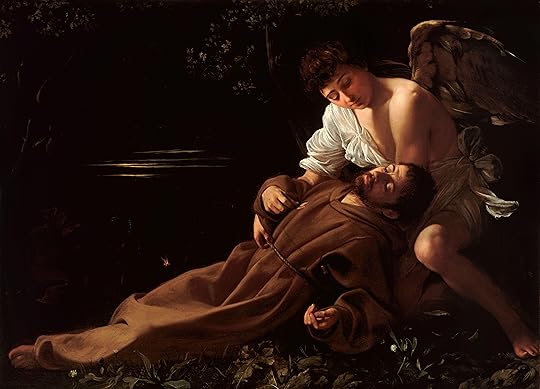
When we look at this masterpiece by Caravaggio, it’s hard to believe the man who painted it was a murderer. And yet many of the very people who planned and executed the Holocaust were artists.
In 1919 the Surrealists had called for a ‘government of artists’. Now they had one. Of the Nazi bosses, Hitler was not the only ‘Bohemian’, as Hindenburg put it. Funk wrote music, Baldar von Schirach and Hans Frank poetry, Goebbels novels; Rosenberg was an architect, Dietrich Eckart a painter. —Paul Johnson, Modern Times
How could the man who wrote this
A room changes in a few months, even if you don’t move anything. Old and rundown as things may be, they still find the strength, the Lord knows where, to get older. Everything had changed around us. Not that anything had moved, no, of course not, the things themselves had actually changed, in depth. Things are different when you go back to them, they seem to have more power to enter into us more sadly, more deeply, more gently than before, to merge with the death which is slowly, pleasantly, sneakily growing inside us, and which we train ourselves to resist a little less each day. From moment to moment, we see life languishing, shriveling inside us, and with it the things and people who may have been commonplace or precious or imposing when we last left them. Fear of the end has marked all that with its wrinkles, while we were chasing around town in search of pleasure or bread. Soon our past will be attended only by inoffensive, pathetic, disarmed things and people, mistakes with nothing to say for themselves.
also write this?
[The Jews] are a bunch of vampires! of phenomenal pieces of filth, they must be sent to Hitler! from Palestine! from Poland! They have done us an immense wrong! They can no longer stay here! . . . What is the people’s real friend? Fascism. Who has done the most for the worker? The USSR or Hitler? It is Hitler. You only have to look without all that red shit in your eyes. Who has done the most for the small shopkeeper? It’s not Thorez, it’s Hitler! Who is preventing us from going to war? It’s Hitler! All the communists (Jewish or Jewified) think about, is resending us to our deaths, for us to croak in a crusade. Hitler is good at raising a people, he is on the side of Life. he cares about the life of peoples, and even ours. He’s an Aryan. . . Our indigenous population, already so bastardized by the negro and Afro-Asiatic cross-fertilizations, the contribution of twisted Jews, masonic confusion, racial treason, degeneration erected into a sublimely humanitarian religion won’t withstand two years of systematic killings.
That is the question every treatment of Celine should attempt to answer. Damian Catani, admitting failure in his one job in this book, puts it this way:
It still remains a mystery, . . . how such an acute observer of the human condition within his novels could get things so spectacularly wrong outside them. How can such penetrating insight and complete lack of judgement coexist in the same person? How do we reconcile the touching humanity of the fiction with the unspeakable cruelty of the pamphlets?
Celine: this book
Catani puts in endless commentary on Celine’s fiction, most of which is a waste of time. Anyone interested in Celine’s life has already read his writing. We don’t want to know more about the writing, but about his life producing it. Catani does all he can to avoid writing about the actual life. When he finally stops confusing Celine with his fictional characters, he gives us French lessons, translating every phrase into French and putting it in parentheses. He finally muddled his way to writing about Celine’s life, about 80 pages in.
He confirmed what I suspected, that the sale of Celine’s antisemitic pamphlets was symptomatic of the rotten, impotent state of France, before and during World War II. They did not increase the suffering visited on French Jews. Both the Vichy government and the German occupiers considered Celine a fringe lunatic, whose ‘help’ they did not need or want. After the war, Celine attempted to walk back his vile pamphlets:
When I was attacking Jews, when I was writing Trifles for a Massacre, I did not mean or recommend that Jews should be massacred. Bollocks, quite the opposite! I was pleading with the Jews that they shouldn't hysterically drag us into another massacre more disastrous than the one of [19] 14-18! It is quite different. The meaning of my pamphlets has been distorted in the most underhand way. There is a persistent attempt to label me as someone who massacres Jews. I am a staunchly patriotic preserver of French people and Aryans – and also, as it happens, of Jews! I did not want Auschwitz, Buchenwald.
Notice he still blames Jews for manipulating international relations and planning to profit from a war, parroting Hitler and Goebbels. A more ridiculous accusation can scarcely be imagined. Notice also he does not directly condemn the Holocaust, but merely says he didn’t agitate for that level of oppression. Celine’s hatred so dominates him, he can’t even lie his way out of prison effectively.
Catani never offers an answer to the big question above; we are left to make our own guesses. I now know more about Celine's life, but not about what drove him to hate Jews.
Celine and me
I discovered Journey to the End of the Night and Death on the Installment Plan (also translated Death on Credit) in my twenties. He captured my despair, the desire to make art, throttled by the necessity of making a living. Almost no one writes on this subject with any feeling, but Celine knew it first hand:
The worst part is wondering how you’ll find the strength tomorrow, to go on doing what you did today and have been doing for much too long, where you’ll find the strength for all that stupid running around, those projects that come to nothing, those attempts to escape from crushing necessity, which always founder and serve only to convince you one more time that destiny is implacable, that every night will find you down and out, crushed by the dread of more and more sordid and insecure tomorrows.
For my personal needs, Journey remains the greatest single book I’ve read, after 40 years of competition. His second book, Death on the Installment Plan, drifted into the ‘stream of consciousness’ writing prized by Henry Miller, and thus was barely readable. Everything Celine wrote after that is completely unreadable and worthless to me. He flamed out early, and buried his youthful brilliance under a landfill of chaotic garbage.
Celine was a thoroughly miserable human being. We could attribute some of his misery to his injuries in World War I, which hurt for the rest of his life, and some to simple insanity. He wrote an abusive letter to his first wife, causing her to divorce him. I can’t help wondering if that’s my failing in art, I’m not miserable enough to make great work.
Depressing conclusion: great artists are sometimes horrible human beings
When we look at this masterpiece by Caravaggio, it’s hard to believe the man who painted it was a murderer. And yet many of the very people who planned and executed the Holocaust were artists.
In 1919 the Surrealists had called for a ‘government of artists’. Now they had one. Of the Nazi bosses, Hitler was not the only ‘Bohemian’, as Hindenburg put it. Funk wrote music, Baldar von Schirach and Hans Frank poetry, Goebbels novels; Rosenberg was an architect, Dietrich Eckart a painter. —Paul Johnson, Modern Times

October 9, 2022
Libro interessante, completo, documentato. Non sorvola su Céline antisemita, ma considera diverse interpretazioni. Mentre ricostruisce le varie fasi della vita di Céline esamina anche i suoi libri, strettamente legati alla biografia, con approfondite analisi.
Displaying 1 - 4 of 4 reviews