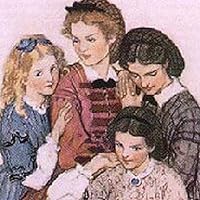
Ruth Erskine, the sole daughter of the wealthiest family in town, a girl who had no idea of life except as a place in which to have a serenely good time.
Eureka J. Mitchell, Ruth's most intimate friend. Lighthearted and indifferent, Eurie knew how to laugh and chat merrily in any and all circumstances.
Flossy Shipley, born to a wealthy family to be loved and cherished and allowed to have her own sweet and precious way.
Marion Wilbur, a young woman of poor, yet hard working stock. She dressed in severely plain black or brown suits with almost--and sometimes quite--no trimmings at all on them. And yet, for all her apparent plainness, she ruled them all.
Though they didn't know it, all four were about to embark on the adventure of their lives!
Heartwarming stories of faith and love by Grace Livingston Hill's aunt—Isabella Alden. Each book is similar in style and tone to Hill's and is set in the late 1800s and early 1900s.
The sixth of seven children born to Isaac and Myra Spafford Macdonald, of Rochester, New York, Isabella Macdonald received her early education from her father, who home-schooled her, and gave her a nickname - "Pansy" - that she would use for many of her publications. As a girl, she kept a daily journal, critiqued by her father, and she published her first story - The Old Clock - in a village paper when she was ten years old.
Macdonald's education continued at the Oneida Seminary, the Seneca Collegiate Institute, and the Young Ladies Institute, all in New York. It was at the Oneida Seminary that she met her long-time friend (and eventual co-author), Theodosia Toll, who secretly submitted one of Macdonald's manuscripts in a competition, setting in motion a chain of events that would lead to the publication of her first book, Helen Lester, in 1865.
Macdonald also met her future husband, the Rev. Gustavus Rossenberg Alden, at the Oneida Seminary, and the two were married in 1866. Now Isabella Macdonald Alden, the newly-married minister's wife followed her husband as his postings took them around the country, dividing her time between writing, church duties, and raising her son Raymond (born 1873).
A prolific author, who wrote approximately one hundred novels from 1865 to 1929, and co-authored ten more, Alden was also actively involved in the world of children's and religious periodicals, publishing numerous short stories, editing the Sunday Juvenile Pansy from 1874-1894, producing Sunday School lessons for The Westminster Teacher for twenty years, and working on the editorial staff of various other magazines (Trained Motherhood, The Christian Endeavor).
Highly influenced by her Christian beliefs, much of Alden's work was explicitly moral and didactic, and often found its way into Sunday School libraries. It was also immensely popular, in the late 19th and early 20th centuries, with an estimated 100,000 copies of Alden's books sold, in 1900.
2024 Reread I needed this book. This isn't just some fun story, there is so much depth to it if you look. Things I'd read before hit me in a different way than before, and I was challenged and encouraged all over again. I highly recommend this book!
Whenever I read this book, I want to pack my things and head off to Chautauqua! I want to live in a tent, eat at the long tables, attend the meetings, listen to Bliss sing, wander "Palestine," and mingle with others who are of like minded faith! I love how this author was able to bring the old meetings at Chautauqua to life. I'm encouraged, challenged, and inspired. Each of the characters in this story face their own struggles in such a real way. There are moments of laughter, and moments of tears.
I found this book in an Amazon referral from LT Meade's titles of the same period. Meade was an English author and Alden an American and Alden is more openly Evangelical in her stories; other than that, the two are very similar. Another review I noted on Amazon for Meade's work is that it would be appreciated by fans of LM Montgomery and LM Alcott. This gives you a rough idea of the genre and, in fact, Alden's books are mentioned in Alcott's as the "Pansy" books which her heroines are often fond of reading.
"Four Girls" is the first of six novels Alden wrote about the same quartet of young women who attend a "Christian retreat" in northern New York at Chautauqua. (Regular listeners of NPR in the '80s and '90s will think of the lecture series.) Readers of any "improving" nineteenth century children's literature -- especially that written for girls or young women -- will be familiar with the characters who appear here: the heartless society girl, the wealthy girl only interested in dress, the "common" and cheery doctor's daughter, and the unbelieving orphan schoolteacher.
It seems unlikely that Alden meant her readers to be in any real suspense as to whether or not her four heroines would "come to Christ" over the course of the two weeks' sojourn in the woods. There is more thought given to each girl's individual conversion experience than might be expected and certainly the entire story is more quiet and less revivalist than might be expected. The girls each experience a significant period of doubt before coming to their triumphant conclusion. Modern readers may find Marion's conversion particularly interesting to read about since this character is intended as the type of the modern working girl, too busy and too hardened to find room in her life for belief. Her conversion, therefore, must include a deep understanding of the necessity of belief for understanding (in her case, in terms of the Bible.) Given the siting of the story at the end of the nineteenth century in a particularly turbulent time for the inter-relationship between science, medicine, and religion, Marion's internal debates are fascinating.
Alden's work will be fascinating to students of late nineteenth century American religion. Her Evangelical approach to personal religious experience includes a number of difficult ideas including the relationship between spirituality and religion and between religion and wealth.
This is first book in 6 part series. I was surprised that first book deals with the girls (~17 years old) not yet being Christians. Fun to see how God captures each of their attention during those two weeks that this book covers.
This book is on librivox.org and on gutenburg.org. I've spent the last few days listening to the librivox reader while doing chores. I've been crying like I've been at a wedding, and in a sense I have. The historical setting is real, on August 15, 1875, Ulysses S. Grant attended the Chautauqua Assembly, and the speakers mentioned in the book were there. Critics may pan the 4 girls as "the usual suspects" for religious literature of the period. I felt like I made four new friends. I identified the most with Marion (in the old fashioned sense, not the modern nonsense). My impression is that Marion is the most like the author, as well.
The narrator is "omniscient", and lays bare the thoughts and intents of the heart of these four girls. So many of the joys and temptations they experience ring true to my 58 years - for in Christ there is no male or female, or rather, we are all His Bride. The rest, I see in others. The author paints the issues the girls struggle with from a position of evident deep thought. There is a rich mix of seeking after rest, seeking after greatness, seeking after truth, issues of sincerity, intellect, feeling, honesty. I've half a mind to invent practical time travel just to meet this "Pansy"! But no need, for we will meet soon enough.
Reading the story was in its own way a practical means of time travel. While I never saw what the gentlemen did in private, I saw the limited wardrobes, the expense of replacing a torn or dirtied dress, and travel by foot, train, and steamer (the latter two including cinders to threaten a nice dress). No wonder brown was a popular color! I appreciated the introductions, a social form that should be brought back. "Calling" meant walking to a house, as there was no telephone. Telegrams and letters were common. Box lunches could be packed at home, or purchased from the rail company.
The doctrines hinted at are handled with perfect orthodoxy - and yet never entangling with tricky issues that have divided (such as Baptism or Predestination). "Have you done the very best that you could your whole life to obey your Father?" asks Flossie (in the 2nd book). If not (and the question is rhetorical), then such questions are moot, and we are in need of His grace. (Perhaps the Rich Young Ruler will come up later.)
I am still misty eyed as I write this, having started the second book., and can look forward to several more weeks of following my four new friends on the inter-dimensional facebook that Pansy is so kind to update for me. Already, book 2 is such deja vu! I could so relate when Flossie comes home from Chautauqua and doesn't know how to tell her own family why her life is suddenly and drastically changed. Well, more will have to wait for another review.
I enjoyed it very much. I got it from Librivox so the reader was an amateur, but she did a nice job. I found the characters convincing, and I identified with their experiences as they attended the Christian camp at which they all accepted Christ. I'm going to get the second in the series right now.
Touches every aspect of doubters and skeptics and dissolves all their many arguments. Even if it is old fashioned the old old story is still true today.
A light escape read for a Sunday sick-day at home, 278. pages of Victorian-era New York girls at evangelical camp meetings. It's a bit of history, a bit of nostalgia, a bit of girl fluf, a bit of theology (occasionally of the wobbly sort) and a lot of sentiment.
If you've ever been to a Christian camp experience, the nostalgia is familiar, yet datedly different, as camp attire in 1875 means having a dress with fewer flounces and leaving the kid gloves at home, and nobody had a guitar or a water bottle. The whole aura and style of the meetings in eloquence, sentiment, and song selections is part of that era, and much of it would be considered maudlin or kind of hokey today, together with the temperance movement, and Arminian theology. But it's sweet, fresh, and Christ-loving, and it breathes the world and air of my great grandmother (who belonged to a temperance society, always dressed like a lady, and would remind me in her letters about the love of Jesus). .....
"...But ever and anon that leading voice took up words of song. Still the song that best seemed to suit all hearts was that tender "By and by," and as the lights along the Chautauqua shore grew dim it rose again in swelling volume-
"We shall meet, we shall sing, we shall reign, In the land where the saved never die. We shall rest free from sorrow and pain. Safe at home in the sweet by and by."
Then the refrain, repeated and re-repeated, until, as the last lingering note of it died away, the boat touched at the wharf, and looking back, they saw that the Chautauqua lights were out, and silence and darkness had Fairpoint.
"Good-bye." Marion said. and she bowed towards the distant shore; she was smiling, but her lips were quivering.
"We shall meet in the sweet by and by,' Flossy quoted, but her voice trembled.
"There is a chance to do grand work first, that the final meeting may be infinitely larger, because of us."
This the leading voice in the singing said, as he held out his hand to say good-bye..."
Four young ladies, all very different from one another but still close friends, decide to spend two weeks at a well-known Bible meeting. They look forward to sleeping in a tent and generally roughing it out in the woods, but plan to avoid most of the sermons and classes, because none of them were believers. They each have their own way of responding to the messages they hear and the Christians they meet. The internal debates and rationalizations they each ponder as to whether to believe or not are all quite intelligent and interesting. A thought-provoking novel. I listened to this as a free download from LibriVox.org by a delightful reader.
This is one of my favorite books. I love reading books that were written in a different time period but written for that time. It allows insight in ways that historical fiction does not.
My favorite character in this book is Flossy. The way she comes to trust Christ and walk with him is such a beautiful story. I'm currently rereading this book after several years and it hits me again how beautiful the story truly is.
This is the book that introduced me to Pansy and her many, many books. I love the hymn "Day is Dying in the West" which is set to the tune Chautauqua. So the title immediately caught my attention.
Not keen on this narrator but the story is so good I have listened to this book many timess - as well as every other Pansy book available at Librivox!
While I didn’t enjoy Four Girls at Chautauqua as much as Ester Ried, which is by the same author, it was still a good book. The personalities of the four girls, and how different circumstances affected them was interesting to see. As is always the case from what I’ve read so far from this author, the faith content was great. There were many lessons woven throughout the story. The Four Girls at Chautauqua was a little slow during certain instances and the whole setting of Chautauqua seemed somewhat idealistic, but it was nonetheless still enjoyable. Overall, I would recommend this book.
I read this ages ago, and just picked it up again while browsing newly-organized bookshelves. The story centers on the conversion experiences of 4 young friends at a Christian conference, and I think does a better job than most fictional conversion accounts of making their coming to Christ seem authentic and believable, treating each girl's experience differently (according to their personalities and issues!) and avoiding too much silliness and cliche-ism. Definitely old-fashioned, but still a sweet story.