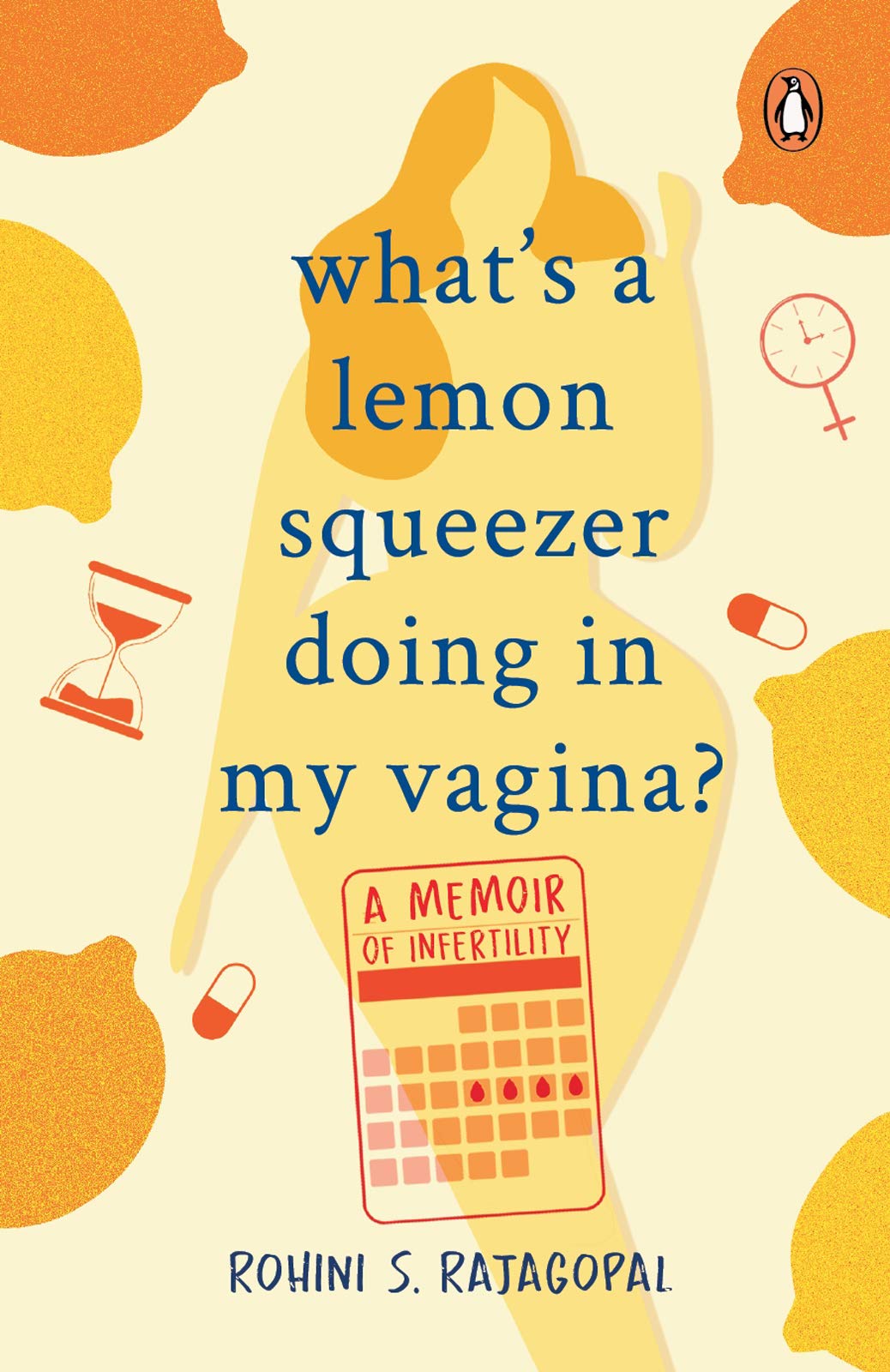
When you are denied something, its value is grossly overestimated in your mind. I rejected all the gifts in our life and dwelled on its single deficiency. Pregnancy was an exclusive club and I wanted to break in.When Rohini married Ranjith and moved to the 'big city', they had already planned the next five years of their job, home, and then child. After three years of marriage and amidst increasing pressure from family, they decided to seek medical help to conceive. But they weren't prepared for what came next-not only in terms of the invasive, gruelling and deeply uncomfortable nature of infertility treatment but also the financial and emotional strain it would put on their marriage, and the gnawing shame and feeling of inadequacy that she would experience as a woman unable to bear a child. What's a Lemon Squeezer Doing in My Vagina? is a witty, moving and intensely personal retelling of Rohini's five-year-long battle with infertility, capturing the indignities of medical procedures, the sting of prying questions from friends and strangers, the disproportionate burden of treatment on the woman, the everyday anxieties about wayward hormones, follicles and embryos and the overarching anxiety about the outcome of the treatment. It offers a no-holds-barred view of her circuitous and highly bumpy road to motherhood.
Rohini S. Rajagopal was leading a fairly humdrum life in Bangalore when an encounter with infertility stopped her in her tracks. In a temporary suspension of good sense, she quit her well-paying, flexible-hours job to write this book that narrates her journey from infertility to motherhood. But for her current penury, she has no regrets about that move. She has a master's degree in English (media and communication). Her special talents include fitting dishes inside overfilled refrigerators and taking three-hour-long afternoon naps without the slightest trace of guilt. You can find her on Instagram at rajagopal.rohini.
Review The book is a mixture of a blow-by-blow of what happens to the author going through fertility treatment, and inner musings of some depth on her situation as unable to have a baby and how she feels about it, and how family and the wider world view it. Which is to put the pressure of their expectations that she, as a married woman will of course have a child. Should have by now...
The book succeeds because of the depth, it seemed to go along with her, as this happened she felt x an that brought to mind y, it had the effect of I was really able to identify with the author, as a friend going through this and talking to me at length over regular lunches. It was a nice intimacy for me, the reader. __________
Reading notes "Lemon squeezer" written by a somewhat neurotic-seeming author who has an emotional breakdown at only getting 76.6% in an exam because most of her friends got 80% because she was, as she says, an above average student, and anyway it was the physics that held her back, she was still top in English.
The book is interesting and somewhat informative of Indian medical practices and modern arranged marriages. And how to get out of them - make yourself very unappealing to the man, be tall and be old - over 25 - so he will reject you, you rejecting him is out of the question. Girls just aren't expected to do that). The author is not afraid to show her vulnerabilities and there is a lot of analysis of her feelings brought on by the constant failure of treatment for the sheer misery of infertility.
For a woman, having a visit from auntie Flo each month is an absolutlely defnining moment. We all are freaked when it is four or five days or a week late, no matter what birth control we have(n't) been using. And for a woman with fertility issues, those four or five days represent hope, dashed each month, for years and years on end.
It didn't help that the author seems to have an utterly stoical, emotionally-uninvolved husband and some doctors, female, who seem to have no warmth or humanity about them but instead expect the patient to kowtow to what they wants.
I can identify with the author as woman, and all the trauma, miscarriages, failed pregnancies and treatments she had to go through, the pain, the expense, the frustration, the disappointment, the family - blood and in-laws who subtly and not so subtly make remarks about her inability to produce a grandchild. But I can't identify with her situation at all. I got pregnant when I wanted to. I wish all women could. __________
What's A Lemon Squeezer Doing In My Vagina? - A Memoir of Infertility by Rohini S. Rajagopal is author's story and a five year long battle with infertility. The book is a witty and moving story which elaborates on medical procedures, societal burden, friends and family, etc.
Firstly, hats off to the author for putting out her raw and painful story into such great words and adding slight of humor and wit to it. Secondly, the cover designed by Devangana Dash is just so aesthetically pleasing and explains the book so perfectly.
The story is full of ups and downs and takes us to high bumpy road of authors journey to motherhood. What I liked the most about the book was the ending chapter "Why Have Children" as well as the epilogue. Going through the pain while reading and then ending it on a sweet and beautiful note was something exactly needed.
I'm sure we have heard stories like these or even of women's pregnancy in our families, with faraway relatives or even with neighbours. I just wish to end on one note - it's okay to take measures which our modern science and medicine has to offer, it's not a taboo to go to a fertility clinic, and it's totally not okay for aunties and uncles to meddle in a couple's private life.
What's a lemon squeezer doing in my vagina - Rohini s rajagopal.
ಪ್ರಾಮಾಣಿಕವಾಗಿ ಹೇಳುತ್ತೇನೆ.ಈ ವರ್ಷ ಓದಿದ ಪುಸ್ತಕಗಳಲ್ಲಿ ಅತ್ಯಂತ ಕಷ್ಟಪಟ್ಟು ಓದಿದ ಪುಸ್ತಕ ಇದು. ಇದಕ್ಕೆ ಪುಸ್ತಕದ ಭಾಷೆ ಕಾರಣವಲ್ಲ. ಅತ್ಯಂತ ಸರಳವಾಗಿ ಗೋಳಾಗದ ಹಾಗೆ ಬರೆದ ರೀತಿ ಬಹಳ ಘನತೆಯದ್ದು. ಆದರೆ ಪುಸ್ತಕದ ವಿಷಯ ಇದೆಯಲ್ಲ ಅದು. ಬಹುಶಃ ನಮಗೆ ಗಂಡಸರಿಗೆ ಅರ್ಥವಾಗುವುದಿಲ್ಲ. ಅರ್ಥವಾದರೂ ಹೆಣ್ಮಕ್ಕಳಿಗೆ ನಾಟಿದಷ್ಟು ನಾಟುವುದಿಲ್ಲ. ಮದುವೆಯಾಗಿ ಕೆಲ ದಿನಗಳಲ್ಲೇ ಕಂಡವರೆಲ್ಲ ಕೇಳುವ ಪ್ರಶ್ನೆ ' ಏನಾದರೂ ಗುಡ್ ನ್ಯೂಸ್? ' ಅದು ತಿಂಗಳುಗಳಾಗಿ ವರ್ಷಗಳಾದ ಬಳಿಕ ನಗೆಯಿಂದ ಕೇಳುವ ಪ್ರಶ್ನೆ ,ನಗೆ ಮಾಸಿ ಗಂಭೀರವಾಗಿ ಕನಿಕರವಾಗಿ ಕೊನೆಗೆ ಅನುಮಾನದ ಪ್ರಶ್ನೆಯಾಗುವಾಗ ಇರಿಯುವ ನೋವು ಅದು ಕೇವಲ ಹೆಣ್ಮಕ್ಕಳೇ ಬಲ್ಲರು. ಅದರ ಜೊತೆಗೇ ಸಾವಿರದೆಂಟು ಸಲಹೆಗಳು, ಉಚಿತ ಔಷಧೀಯ ಸಹಾಯಗಳ ಹಾರೈಕೆಗಳು, ಕೊಲ್ಲುವ ನೋಟಗಳು ಉಹೂಂ ಅದೊಂದು ಹಿಂಸೆ ಶತ್ರುವಿಗೂ ಬೇಡ.
ರೋಹಿಣಿಯವರ ಈ ಪುಸ್ತಕ ಅದೆಲ್ಲದರ ಕಡಲು. ನೈಸರ್ಗಿಕವಾಗಿ ಗರ್ಭ ಧರಿಸಲು ಕಷ್ಟವಾದಾಗ ಅವರ ಕೃತಕ ಗರ್ಭಧಾರಣಾ ಪ್ರಯತ್ನಗಳು, ಅದನ್ನು ಹಾದುಹೋಗುವಾಗಿನ ಮನಸ್ಥಿತಿ, ನೆಂಟರ ಚುಚ್ಚುಮಾತು, ಪ್ರತೀ ಸಲ ವಿಫಲತೆ ಭೂತಾಕಾರವಾಗಿ ಎದೆಯ ಮೇಲಿನ ಕಲ್ಲಾದಾಗ ಅವರ ಮನಸ್ಥಿತಿ ಒಂದೇ ಎರಡೇ.
ಇದರ ಜೊತೆಗೇ ರೋಹಿಣಿಯವರ ಬದುಕಿನ ಕಥೆಯೂ ಬಿಚ್ಚಿಕೊಳ್ಳುತ್ತದೆ. ಕೇರಳ ಮೂಲದ ಬೆಂಗಳೂರು ಸೆಟಲ್ಡ್ ದಂಪತಿಯ ಕಥೆ ಎಲ್ಲಾ ನಮ್ಮ ನಿಮ್ಮೆಲ್ಲರ ಹಾಗೆ.. ಓದು ಕೆಲಸ ಕೆರಿಯರ್ ಮದುವೆ ಕೆರಿಯರ್ ನಿಟ್ಟಿನಲ್ಲಿ ಸ್ವಲ್ಪ ತಡ ನಿರ್ಧಾರ ಆಮೇಲೆ ಅದು ಕೊರೆವ ಸಮಸ್ಯೆ.
ಇಲ್ಲ.ಹೆಚ್ಚೇನೂ ಹೇಳಲು ಹೋಗುವುದಿಲ್ಲ. ಇದನ್ನು ಗಂಡಸರೆಲ್ಲ ಓದಬೇಕು. ಓದಿ ಮನೆಯ ಹೆಣ್ಮಕ್ಕಳ ಕಡೆ ನೋಡಬೇಕು.
ಈ ಹಾದಿ ಕಷ್ಟದ್ದು. ಇದನ್ನು ಓದಿದ ಮೇಲೆ ನಿಮ್ಮ ದೃಷ್ಟಿಕೋನ ಬದಲಾಗುತ್ತದೆ ಎಂದೇನೂ ಹೇಳುವುದಿಲ್ಲ. ಆದರೆ ಕಂಡ ಕಂಡ ದಂಪತಿಗಳ ಬಳಿ ನಾಲಗೆ ಹರಿಬಿಟ್ಟು 'ಯಾವಾಗ ಮಗು? ' ಎಂಬ ನಿಮ್ಮ ನಮ್ಮ ಅಧಿಕಪ್ರಸಂಗ ಕಡಿಮೆಯಾದರೆ ಅದೇ ಸಂತೋಷ. ಯಾರ ಒಳಗೆ ಯಾವ ಸಮುದ್ರ ಭೋರ್ಗರೆಯುತ್ತಿದೆಯೋ ಯಾರಿಗೆ ಗೊತ್ತು?
What's A Lemon Squeezer Doing In My Vagina? - A Memoir of Infertility by Rohini S. Rajagopal is author's story and a five year long battle with infertility. The book is a witty and moving story which elaborates on medical procedures, societal burden, friends and family, etc.
Firstly, hats off to the author for putting out her raw and painful story into such great words and adding slight of humor and wit to it. Secondly, the cover designed by Devangana Dash is just so aesthetically pleasing and explains the book so perfectly.
The story is full of ups and downs and takes us to high bumpy road of authors journey to motherhood. What I liked the most about the book was the ending chapter "Why Have Children" as well as the epilogue. Going through the pain while reading and then ending it on a sweet and beautiful note was something exactly needed.
I'm sure we have heard stories like these or even of women's pregnancy in our families, with faraway relatives or even with neighbours. I just wish to end on one note - it's okay to take measures which our modern science and medicine has to offer, it's not a taboo to go to a fertility clinic, and it's totally not okay for aunties and uncles to meddle in a couple's private life.
What's A Lemon Squeezer Doing In My Vagina? - A Memoir of Infertility by Rohini S. Rajagopal is the author's story of a five-year-long battle with infertility. The witty and moving story elaborates on medical procedures, self-worth, societal burdens, friends and family, etc.
In a candid and absolutely honest account, Rohini narrates how her upbringing in Trivandrum shaped her attitude that led her to Hyderabad - a place where she found her freedom. Eventually, she got married to Ranjith and life seemed a smooth ride with a loving husband and a dependable job.
However, it was only when she thought of having children that her life started going haywire. This memoir puts together Rohini's tumultuous journey of going through multiple IVF procedures and the failure of not being able to conceive after repeated mechanical and natural attempts.
It is a heartfelt account that sheds light on the reality of medical procedures and lays bare what a woman goes through while trying to have it all. I loved Rohini's writing which is smooth, nuanced, and witty.
Why should one read a memoir chronicling the journey that many women in India go through to become a child-bearing mother? The answer is simple: because the onus of child bearing is on women with other women being party to obsessively monitoring when a woman is going to be a mother and if not, why. It is a book that lays bare the many ways in which women’s bodies are relegated to being a child bearing vehicle: after all, a man is never described as infertile but a woman is.
Rohini S. Rajagopal’s memoir of her many attempts at pregnancy including IVF is a raw examination of social pressures, individual concerns and the toll on a woman’s body when it comes to reproductive health and well being. That she does so with a quiet dignity despite the ebb and flow of emotions and technicalities is a testimony of how the tone of writing is equally important.
Rohini takes readers through a maze of medical processes and therapies, injections and laboratory tests, through a gamut of clinics and what happens inside them but it is the intimate portrayals that make a reader invested. She puts her hopes and anxieties, her desperation and aching despair when things go off track, the guilt and recriminations. This book is not just Rohini’s book but a testimony of what women go through when they are on the other side of 30 and childless. Written with both humour and candour, this is an important read.
Of late, I have been drawn to memoirs. Reading someone else's story feels like a form of companionship, of support and solidarity. Within seconds of reading the blurb of this book, I was convinced that this book would be well worth my time. Fertility and childbearing rest rather heavily on women due to societal constructs. As I grow older and closer to the infamous 30, I hear many of my female friends getting anxious about having a child. And why wouldn't they? The familial and societal pressure on having a child within "x" years of marriage is just short of insane. Add infertility to this already stressful mix, and you have a whole section of women going through the heartbreaking struggle that is infertility treatment, and not even being able to talk about it to their nearest ones thanks to the taboo that it is. This author deserves a standing ovation for being courageous enough to open up about her arduous journey to motherhood without mincing words, so much so that it can make the reader uncomfortable. But this discomfort is a small price to pay, because these stories need to be told, and heard. Honest, witty and powerful. Highly recommend this!
"Why then did I want children?" Rohini Rajagopal asks, in *What's a Lemon Squeezer Doing in My Vagina?" "It is the biggest contradiction of my infertility experience that I had no single, personal, unassailable answer to the question. I was a racehorse with blinkers on, eyeing only the finish line, blind to what rewards and trials awaited me after that."
Before the internet, the only exposure I had to concerns with pregnancy, miscarriages and fertility was from The Bold and The Beautiful. I was Team Taylor over Team Brooke, and pregnancy was, at the time, a storytelling tool to either introduce more drama or future characters. I knew more about motherhood and the difficulty of becoming a mother, or a parent, from television than from real life.
We don't talk about it.
My first real life brush with someone's pain at not being a parent was an online friend who wrote to me once about how he and his wife were childless, how much it hurt him, how he was afraid he would never be a father. I hope the response I sent back gave him comfort, and in any case they then proceeded to have three children of their own so in the long run it's a happy story.
The internet has changed a lot of this. I've read more, talked more, seen more. I've grown more, and am able to empathise more with this need and this yearning that I don't share myself.
But really, we don't talk about it. Not enough? Or not with enough delicacy and openness, as opposed to brutal shame and hiding.
I read this book expecting to be drawn into a complete stranger's world, to be honest. I don't have this need, and I don't have a partner, and my personal roadmap doesn't bake in time for babies. But by Page 13 when Rajagopal muses on scenarios for finding out she is pregnant, drawn directly from movies, tv and books ("... it's not brain tumour or blood cancer... I am just PREGNANT!") I realised that I too am steeped and over-brewed in the Baby-Maker tea pot cis women are made to stew in.
So much of her journey is familiar. The dehumanising journey with doctors and medical tests. The complete and overbearing, frightening authority your doctor wields over you, a coercive control that you submit to for invasive tests, pain and hopeful gain. How our bodies are weird. Our bodies are weird! If nothing is wrong, why was Rajagopal infertile?
Answer: because there's nothing wrong with being infertile, except that we have made it so.
As women (as dalits, adivasis, trans persons, queer and asexual and kinky persons), we are judged. All the time. The soul-destroying apartheid of merit and the course we study relegates to us rations of social respect, and too bad if we needed another serving. The journey to motherhood, Rajagopal implies, is more of the same, only worse because you can do everything right - everything - and still 'fail', still be blamed for failure.
The story of trying to get pregnant when plain ol' sex (which Rajagopal depersonalised at one point to plain ol' "intercourse") doesn't work is one of multiple invasions. The Lemon Squeezer of the title is pushed up your vagina because - hey you want to be a mother. You need to be a warrior first, a woman who can take the pain, and invasion, survive it, and come back for more. Best yet to be a woman who doesn't care or feel it at all, but if you can't, ignore it.
Rajagopal's story takes us through multiple attempts. Multiple miscarriages. You know, going in, that this narrative ends in motherhood, but Rajagopal didn't get to skip to the end of the book and we don't either. Her husband floats through this journey, unable to help in any concrete way, processing his emotions differently, learning to be present, to be emotional, with her. I went through half the book wondering if he was going to be around by the end - but there's a forgiveness for him, and his needs and incompatibilities, along with an appreciation for the support, the immovable steadfastness, he brought to the table when that was all there was he could offer.
How do you support someone when there is nothing you can do to help? How do you see though the cloud of pain you are both walking through together, to *see* together? To see each other? There is a grace in this story for his pain, much more than Rajagopal gives to hers. (She also puts him at the bottom of a list of useful people to have around after they do finally have a baby. It's hilarious but also sad?)
Around Rajagopal, life went on as she tried, multiple times, to get pregnant. Other women became pregnant, carried to term, came back with baby pictures, relatives who supported child care, baby pictures of beautiful babies. We don't know their stories but from the outside it is a borderline cruelty - how easily you can be pregnant, again and again, how often we see a new baby, while here Rajagopal is trying the first time, the second time, obsessively taking care of herself and her organs for implantation, gestation and birth.
One of the differences that gets touted in the India versus the West culture wars is that families stay together here. Not just men and women who can't get divorced but the other side, the community side, where your family is there to support you, love you, help you with the daily routine, to share responsibility. But as with doctors who don't show care or respect or patience, families aren't necessarily supportive or demonstrative of care - families can become part of a conspiracy of pressure and silence, and the silence is only broken to add more pressure, to invade an enforced privacy and poison comfort. We see this over and over not just in toxic families who later lose all contact with their sons and daughters but in our families where we do love each other, where we do care and are hurt for each other's pain. Rajagopal's quest to become pregnant is owned, without care or consideration, by her whole family - this book is her chance to appropriate her story back to herself. "Because this is *my* story and *I* am going to tell it.*
The tunnel vision of hope and obduracy Rohini Rajagopal exercises through multiple procedures and resulted in this space where she could tell her story, share her journey, and acknowledge the many people who have not been as fortunate, who took different parts. In many ways, Rajagopal exercises a delicacy for the reader that she wasn't spared for herself. There is Science, explanation, and enough distance and humour that at no point will the sensitive reader need to worry about gore and horror - we are drawn in to an emotional pain and horror with a lot of tenderness, wit and delicacy.
Women are starting to talk about things; we need to make sure we are listening.
A very honest and straight forward book. Infertility, choices about having kids, IVF and many such taboo topics are brought up in a brutally honest way in this book.
IVF treatment time ಅಲ್ಲಿ ವ್ಯಕ್ತಿಯ ಮನಸ್ಥಿತಿ, ಸಮಾಜ ಹೇಗೆ accept ಮಾಡತ್ತೆ ಇನ್ನೂ ಹಲವು ವಿಚಾರಗಳನ್ನ ಬಹಳ ಸೂಕ್ಷ್ಮವಾಗಿ ವಿವರಿಸಿದ್ದಾರೆ.
Our people have this nose poking habit in general. I wish all such irritating people are made to read this book and get it rightly registered in their heads about stopping asking people "any good news" "ಮಗು ಯಾವಾಗ" etc....
We never know what the person is going through unless we walk in their shoes.
I read many memoirs but very rarely can I nod my head every few pages and say “I have felt exactly the same way”. This is one such memoir. Rohini’s chronicle of infertility transported me to a time (25 years ago) and a place (Washington DC) where I had experienced many of the medical interventions and procedures that she describes so vividly in her witty, yet moving memoir.
The pressure to have children is an undeniable one. It is everywhere - outside and inside, through biology, through society, through subliminal messaging that you have internalised growing up in a society that believes that the purpose (not outcome) of marriage is procreation. No matter how you slice it, a married woman who hasn’t produced a child five years after marriage is given ‘the look’. Even when people don’t openly pry, there is gossip, innuendo, and sly questions about “are you on treatment”?
What Rohini has managed to do through her detailed account of struggle with infertility is to shine a clear light on what happens at the personal, psychological and marital level when a couple commits to the harrowing journey that is infertility treatment. The burden and consequence of the choice is disproportionally allocated to the woman.
The title of the book is an indicator that Rohini will use words that make us uncomfortable, explain terms that are unfamiliar and take us into a territory that most couples who worry about birth control may not understand. Yet, there is so much that is endearing, not just for Rohini’s self-deprecating humour where you are constantly rooting for her but also for her no-details-spared descriptions when you want to hold her hand as her losses mount and her dedication to the cause occasionally falters.
For anyone who is undergoing infertility or is curious about the difficult journey to motherhood that some women face, I highly recommend this book.
Infertility is a seldom-discussed topic in India. Most couples and particularly women continue to suffer in silence due to the stigma associated with this subject in India. Rajagopal's book is therefore ground-breaking - it's a frank, intimate, witty and moving account of her struggle with infertility. The chapter An Egg and A Sperm are not equal highlights the burden placed on women's bodies and minds by infertility treatments. The procedures are invasive with no room left for the dignity of the body. Your body ceases to be yours and one feels like one is at war with one's body - alternatively imploring it to produce a viable egg that can be transferred into a petri dish for conception, angry when it doesn't, grateful when the ovaries produce the required eggs but feeling devastated again with first-trimester miscarriages, which are alarmingly common in IVF pregnancies. We learn everything about hormone levels and the pain-staking research around IVF that Rajagopal has conducted will be of great utility for any couple or woman on the fertility treadmill. The segues into her family life are important and give readers a sense of Rajagopal as a person, and why she responded in the ways she did. I would highly recommend this book to women who are considering or on fertility treatments as well as their partners and families. Even those who have been lucky to not encounter infertility will find this book to be helpful so they can be allies to friends and families who are going through this. The lack of psycho-social support for women going through fertility treatment implies that this is also essential reading for husbands/partners/families.
I am usually not a fan of memoirs but this one I absolutely loved reading. With every line, paragraph and page, I was. waiting for some miracle to happen.
This book covers Rohini's journey of infertility. Her stints with IUIs and IVFs. you can literally feel the pain, the anticipation, the wait and the disappointment after going through all through Rohini's engaging writing.
What I loved about the book?
- I absolutely loved the cover of the book. - Second is the title that actually made me pick this book in the first place. There is a misconception that getting pregnant is the most natural thing and so when Rohini found herself in a situation, she asked herself "What am I doing here, in this infertility clinic?" - Thirdly, I loved the topic it covered. Infertility in India is the most frowned upon topic. The judging eyes start right from the time you step into a fertility clinic to get checked. This is a bold topic and I love how Rohini covered this. - Lastly, I loved Rohini's writing. It is just so witty for such a heavy book that I could not put this book down.
What do I want from the author?
I want her to write another memoir of her parenthood and her relationship with her child. She has just given a glimpse of what it is but I want more.
Some books remain with you for life. For me, this is one. Where do I begin? Right from the title to the acknowledgements, this book is a winner. Rohini writes with such clarity of both thought and emotion that there is no second guessing what she is trying to say about her long battle with infertility. She addresses various aspects like societal stigma, insensitivity rooting from one’s own extended family, the toll that infertility takes on the couple, the skewed perception of conception and the preservation of self.
So many times during the course of reading the book, I had to stop and reflect. All credit goes to her very powerful writing. When she talks about why she wrote this memoir, she says “This book is an attempt to appropriate my own history, to take back my own narrative. Because this is my story and I am going to tell it. With all the gore and grime”.
This book was even more meaningful to me because having worked in an IVF group of clinics, we often tend to focus more on statistics rather than the patient. For the clinic a failed cycle is a statistic but for the couple and especially the woman going through it, it is her life.
Thank you Rohini, for sharing your story - a perfect balance of sensitivity and courage.
Week 40 Book 44 What is a lemon squeezer doing in my vagina by Rohini Rajagopal Rating:3/5
This was a book that I picked up for the title. And didn't regret. This is the author's memoir, a narration of her personal experience with infertility and loss.
Although I have two naturally conceived children, I have struggled with issues of my own. From worrying about my biological clock, to trying to conceive without success for years, from having a chemical pregnancy and loss, to enduring high risk pregnancies... Reading this book felt cathartic. I felt heard, I felt represented.
The writing style is simple and elegant. It may be upsetting for some to learn about the very financially physically emotionally draining fertility treatments. And all the emotional rollercoaster of failures. But for those looking for some strength and support, it's a good read. Only negative: it's sometimes too long, with unnecessary detailing about other things about her life. Still definitely worth a read.
this book is everything a one-sitting read should be. You actually cannot put this book down as each and every line is 😘 entertaining and even though you would probably cry out or feel a pain deep inside, this book just hits correctly. Infertility and India (that's gossips for years) and the entire procedure, the mental drainage and the taboo regarding everything women health-related here, the journey that the couple went through is scary. More than feeling happy or proud, I felt an invisible terror asking me various what-ifs
When my colleague Malini Menon handed me Rohini S Rajagopal’s book ‘What’s a Lemon Squeezer Doing in my Vagina?' to write a few lines of comments about it, I took it with inflated interest just as a matter of courtesy, as literary criticism was not my cup of tea. Being nothing more than a general reader, I found myself in a tight spot taking up the arduous task of critically reading a book and writing a commentary on it. Howsoever critically I start reading a book, I often find myself levitating and then floating along with the flow of the writer. But this book was an exception. One cursory glance at the title, the defunct, so-called ‘critic’ in me got a fresh lease of life and rose with unbridled energy and screamed: ‘This is a rookie writer’s sleazy, ingenious attempt to evoke a voyeuristic interest just aimed at a spike in her sales index.' Now I was a shark that smelt blood. A hound that got the scent of its helpless quarry. With a murderous glee, I took my pen and a wad of paper to jot down each flaw of the book and got ready to eviscerate the author with a butcher’s nonchalance.
Turning a few pages, I realized, to my utter disappointment, that my initial judgement was abysmally flawed and I soon had to rephrase the age-old maxim to ‘You cannot judge a book by its title.’ I relinquished the awfully unsuitable armour of David and took his sling and stones instead, and decided to bide for the most opportune moment.
Before long, I could feel that I was holding a simmering cauldron of the author’s ‘nebulous hope’ with a generous brew of poignancy, gore, and grime seasoned with an occasional pinch of wit- a candid narrative of her traumatic on-again-off-again journey to motherhood. Though it boldly lays bare before the readers the hope and horrors of intrusive medical treatment for infertility, it also triggers in them an all-pervasive empathy for the one who is being put through the harrowing experience. The book is also a glowing testament of the author’s limpet-like tenacity to get hold of the ever-elusive 'fruit' even after years of dogged attempts. It is rich in sensory language and evocative images and it was a pleasure to see the masterly use of language that effectively accentuated every twang and tenor of the author’s emotions and feelings throughout the book.
Though the book is a memoir of the author’s arduous journey to motherhood, there seems to be an underlying iconoclastic attempt to burst the highly inflated archetypal social and religious mores dictating the position of a woman in a society, the custom-made roles she has to play, the ‘acceptable’ social behavior she is expected to show, and so on and so forth. Clothed in the garb of a woman with an inordinate longing for motherhood, the author is viciously lashing at a society that has been trying to straightjacket female sexuality from time immemorial and thereby sending an unequivocally clear message to society every time she was asked to lie down on the doctor’s diagnosing table: ‘ The more you try to cover my body and soul the more I bare them.’ The author fiercely and fearlessly proclaims the sole ownership of her body and mind.
The success of the author’s main purpose of this work ‘ to throw a chink of light’ on the world of infertility can be validated even by a non-specialist reader. She has, in fact, thrown more 'beams of light' than even for an expert to handle. However, as medical science is progressing by leaps and bounds creating a kaleidoscope of newfangled treating patterns, the techniques used a decade back may have become obsolete by now. Only an expert can have the final say in this regard.
The writer has also succeeded in ‘telling her story' with all the ‘gore and grime’ often dragging the dazed reader through her meandering, potholed path to fertility. Finally, the author heaves a great sigh of relief in ‘releasing the big wooly knot of unease through writing’. Though she has mercifully been unburdened, the work may have passed the same frisson of fear and alarm inadvertently to some readers who are also caught in the same infertility vortex as her. They may be intimidated by the labyrinthine and mind-numbing, soul-draining process that gains them technology-assisted motherhood. Who knows? But that is not a reader's job to find out. Medical technology is waiting with an inviting smile and outstretched arms to pull back and embrace those ‘sisters’ teetering to the abyss of despair.
As a male reader, keeping pace with the author’s high-speed emotional roller-coaster was next to impossible. However hard one tries, one can, at the most, march in lockstep with her letters but her spirit sprints forth at a blistering pace. With a different biological system and set of hormones, one could never comprehend the depth of the high-octane moments she went through during each passing phase of her see-saw existence: now skyrocketing to the zenith of frenzied exhilaration, then slumping to the slough of searing self-pity and misery. This tearing torment on the body and mind repeats with benumbing frequency all through the book.
Needless to say, this book is a blinding reflection of the writer's burnished strength and resilience, single-minded devotion, and the HOPE that was churned out of hopelessness.
Disappointingly, the ‘sling and stones’ remained unused, throughout the whole course of reading this book but I have kept them away for another occasion.
Trigger warning: This is not a Lemon Squeezer but a branding iron; it will leave lasting, indelible marks on your soul.
I am truly impressed with Rohini S Rajagopal's writing skills, perfect usage of words and the marvellous feel as a reader that I get in reading the memoir.. "Whats a lemon squeezer doing in my vagina?"
I am overwhelmed to see that she could write this with such ease and effect in a touchy manner.The narration is very engaging, natural and lively as the incidents are explained . The caption of the book is very illustrative and suits the theme and I do love the humour in her words, the sequence of events that definitely turns to engage the readers. I must admit that what I have read from the book comes from a place of truth... the truth of the inner self, family, relationships, values, trauma etc. I enjoyed the way she described the marriage rituals in the southern part of India in a very subtle way. Wishing more power to her and to her upcoming writings.This memoir deserves a huge applause and is definitely a commendable piece of work...
I enjoy memoirs and this one especially because it is so raw and makes you uncomfortable. This is a story about a young woman who is trying to get pregnant and in the process is undergoing IUI and IVF treatments. The author writes in detail about all the challenges she faces, her failures and the small milestones that she celebrates.
While i enjoyed the book I would have liked for the author to delve more into the relationship that she and her husband shared during this entire process - I felt there was a gap in that bit. What does this do to couples? Does it tear them apart? Bring them closer? What did it do to Rohini, I'd like to know.
All that apart - this book pulled me in and kept me hooked. Thank you for writing it, Rohini.
This book will not be for everyone. But if you resonate with the topic this book will be everything. I often tell this, women don’t always say things the way it is to forewarn their own kinds. Maybe if we did know, we would have been mentally prepared. This book is all about calling a spade a spade, relatable, lows are taken as lows and all the mental anguish that comes with it! I loved it! No frills, all heart and definitely beautifully written! Thank you so much for writing this! So many women will benefit from knowing what they are going through is true even if difficult!
Pretty good. Fascinating to learn about the medical system in India and common protocols from 5-7 years ago. It was highly relatable and a nice companion for the last two weeks.
By judging the title of the book you could straightaway judge saying it could be another feminist whining about her ( not so ) problems just bcz she can. Or if you have read the blurb could decide and put away that this is for a married, trying to have a child Women or somebody who underwent similar experience. No judgement bcz I was the part of second category until I randomly decided to place a order for the book and read it right away( hadn't read the single review on this before )
First of anything, huge respect for author's audacity to put all her experience in these pages for us, so it could show the hard reality of infertility and pregnancy. having very less or almost no knowledge on either of the top, reading this book drilled up those emotions I thought I didn't have in me.
This book brought me in tears at multiple pages but what truly made me feel terrible is the fact that how ignorant and carefree and judgemental I was at the fact that the having a child and it's care is mere burden instead of joy while there are women just like author and others who are struggling with infertility and waking up each day in a hope that something magical gonna happen today. Hence yes this book is for everybody.
The whole facts and infos given in the book by the author is something I genuinely haven't even heard about and something I so wished everybody should know, not just a women but a man too. Also when a women get pregnant and have a child, world only sees the happy side of the part where there is a baby happily smiling but not the tearful, painful and hopeless days a mother went through to get where they stand now.
When there is a infertility in the picture, its so obvious and easy to point out at a women and say she is having a problem but not a man. As author beautifully explained that infertility truly is a scenario when a man and women fail to create that baby they hoped for. For once and for all stop making assumptions and stop blaming and questioning women when the family doesn't have a child. Also respect them when regardless of all the years they have no child bcz only they know wat they went through and what made them finally decide that it's okay to not have. And also it's okay not want to have.
You will be at shock how a person could go through all that they have gone through yet be hopeful. I can't even imagine putting myself in any women who undergone such phases. it take patience, strong state of mind and ounces and ounces of energy to face that.
You are single / married / man / women / under plan for baby / under stages of infertility, this book is for you. It fills you with the strength you thought you didn't need in life!
Avoid if you seriously think that topics around failed IUI / IVF or miscarriages might put you in a serious mental trauma.
Thank you @author for writing this piece of your heart for us. Grateful indeed!
As with many women in their 30s, I did pause briefly to regard infertility after my first miscarriage.I was pregnant again before I knew it and it was something I dwelled on only after a dear friend struggled with it. However it was Rohini Rajagopal's ‘What’s a Lemon Squeezer Doing in My Vagina?’ that really took me down that tunnel.The title had me amused instantly but the real heroine is the prose, a body of gripping work from cover to cover!
Rohini is the girl next door who takes you through her life's journey and accompanying emotions unapologetically-the unbearable sense of defeat, the encircling grief, the accompanied guilt of feeling flawed, the passive jealousy at being incapable of something that came so naturally to others. Her unembellished narration of familial equations through this ordeal exhibits in equal measure both her vulnerability and her strength. Through it all never once did she slip the victim card. My hope is that memoir’s like Rohini’s may open our minds to a definite shift from sympathy to solidarity for those battling such medical conditions.She throws light on the shame and stigma we impose as a society. Also makes one wonder about the extent of deep rooted conditioning even amongst urban, educated, independent women about the boxes they tick in natural progression, as have women before them, unquestioningly.
I finished the book smiling through her self deprecating humor, falling in love when she breaks down her walls, tearing up through her travails and heaving a sigh of relief when you know the baby’s first cries were heard. I believe this all consuming book is essential reading for families who have survived or are still struggling with infertility, and for their friends and extended families to know what the journey looks like from the inside. It may give closure to some, be infinitely healing for others and most certainly give hope and voice to millions of others.At no point in the book do you feel you have to dig through the debris of heartbreak for a stroke of hope. Her narration is tight with the joys and sorrows knit together beautifully against the backdrop of the toils and moils of a full time job, a marriage where cracks have suddenly appeared, and holding the suspense on society second guessing the state of her ovaries.
Am I only to be a mother? A wife? A procreator? A partner? Am I not a woman? An individual? Do I not merit respect and privacy?
Why is it that after the pressure of ‘still not married tcch tcch you won’t get a good boy’ refrain the next is already upon you “ any good news? Don’t delay ! A woman is not complete till she is a mother” (hell! You’ve just about moved families and the mehendi still has to wear off) .
And if for reasons beyond your control you are unable to conceive, woebetide, you are the harbinger of bad luck. You have committed a crime . You should be ashamed of yourself. You should hide!
Really? Yes, really this is what the average Indian woman goes through ( irrespective of social and economic status).
If you think of adoption you have to pretend you had your baby far away. If you opt for infertility treatment you are walking face down, hiding your giveaway file under a cover. Why? Silly! These subjects are taboo. Did you not know that?
After all this, you may be successful in getting pregnant. But the tension of keeping the pregnancy healthy doesn’t allow you to relax. If you don’t get pregnant then you have to allow your body to be invaded with medicines, injections, hormones, implant techniques and constant insertion of the speculum ( the Lemon Squeezer) up your vagina.
What a journey you say! Yes, that is exactly what Rohini Rajagopal went through. Today she is a happy parent but to arrive there , pain, humiliation, insecurity and stress is what she underwent month after month. Rohini talks with candour, sensitivity, honesty, humour in her memoir as she lays her life (and her body!) bare . She doesn’t shy of any detail, of any terminology because she feels it important for others to know they are not alone. That there is hope. That there are possibilities. But equally, that the journey is not a bed of roses as made out in TV commercials.
This is an important read for any person embarking on a journey of motherhood and contemplating IVF. It outlines the treatment in detail and, in the process, endeavours to initiate conversation and do away with stigma. A one of a kind read which questions standards set by society on which a woman is judged not just by others but equally by her own self.
Amid all the hype on Bookstagram and personal recommendation from my reader friends, I picked up this book with expectations of reading about how a woman dodge frequent questions of society about having a baby, or how she came out empowered out of this sinking feeling of being unable to produce a child, a process so natural for others. But when I read the book, I realised its much of writer’s personal journey about medications, physical and psychological torment, balancing work and family, her fear, envy, adamancy, hope and hopelessness, along with all the other things I expected in the beginning. And this all connected me more to her story, more to her pain and I wanted nothing but just to hear more about her 5 years long battle with infertility. The honesty of it all, is what impressed me the most. Because being kind and hopeful for a while is easy, but building all your hopes up after being hopeless and seeing hopelessness around your, in a loop; that’s what brave hearts are made up of. And Rohini Rajagopal is one of them. This memoir is a stroke of realisation, majorly for all but specially for women. How can we feel absence of something so abysmally, which was not even there in the first place? Or how can just the experience of a journey can fascinate you so much, that you forget about destination? Well, that’s what makes us humans. Medical procedures for people who can’t have baby naturally, are shown like a flick of hand in movies, but the reality hit me hard after reading this book. Physical, psychological, financial, all aspects were clear. Millions of empowering messages and quotes for women these days, most of these calls a working, professional or job hunting woman empowered. This book vividly elaborated the whole meaning of women empowerment, which is not only limited to modern, classy, professional women, but to each and every woman who make her own choice and live by it, who takes decisions, who is determined and who doesn’t give up, no matter what.
Infertility is a seldom-discussed topic in India. Most couples and particularly women continue to suffer in silence due to the stigma associated with this subject in India. Rajagopal's book is therefore ground-breaking - it's a frank, intimate, witty and moving account of her struggle with infertility. The chapter An Egg and A Sperm are not equal highlights the burden placed on women's bodies and minds by infertility treatments. The procedures are invasive with no room left for the dignity of the body. Your body ceases to be yours and one feels like one is at war with one's body - alternatively imploring it to produce a viable egg that can be transferred into a petri dish for conception, angry when it doesn't, grateful when the ovaries produce the required eggs but feeling devastated again with first-trimester miscarriages, which are alarmingly common in IVF pregnancies. We learn everything about hormone levels and the pain-staking research around IVF that Rajagopal has conducted will be of great utility for any couple or woman on the fertility treadmill. The segues into her family life are important and give readers a sense of Rajagopal as a person, and why she responded in the ways she did. I would highly recommend this book to women who are considering or on fertility treatments as well as their partners and families. Even those who have been lucky to not encounter infertility will find this book to be helpful so they can be allies to friends and families who are going through this. The lack of psycho-social support for women going through fertility treatment implies that this is also essential reading for husbands/partners/families.
"I went into shock. How could this have failed? I had two grade-A blastocysts transferred on day five. It was a textbook case, a classic example of embryo perfection, a reproductive specialist's dream come true. But the star embryos, backed by science and research to grow into chubby-cheeked gurgling babies, had failed at the very first step. They had turned back, unwilling to travel any further."
This story is about Rohini, the author of this book. She gets married to Ranjith. Just like most of the newly wed couples, they think of having a career and home at first and then think of a baby, so that they get time to understand each other well.
When they felt that the time has come for them to enter the phase of parenthood, they were upset as Rohini wasn't able to conceive naturally. Though adoption was an option, they planned to have their own kid. So, they try out IUI. When that failed, they opted for IVF. To know what happens later, you need to read the book.
The very first aspect that attracted me to this book was the topic and mostly the title. Rohini has spoken her heart out in the book. She talks about the physical and the mental stress that she underwent for almost seven years after her marriage in order to have a baby, which eventually took a toll on their lives. She even explains every process in layman terms, which makes the terms relatable. I would tell that she was really courageous throughout the journey and I really liked her "Never give up" attitude.
No matter at what stage of life you are in currently, go pick this up.
'What's a lemon squeezer doing in my vagina?' is a brilliant personal account about the author Rohini Rajagopal account on dealing with infertility for 5 long years. This book is written with utmost honesty, wherein the author puts her bare self and recollects the multiple crashing of hope.
Rohini writes a moving memoir that covers not only her journey as a woman from being infertile to being a mother but also a detailed picturesque about her family and friends. Rohini puts her heart to pen this book. It is not only witty but heart-wrenching at some phases.
I dove into the book with no expectations but was certainly hooked and felt really hopeful for a sweet ending. Considering the ups and downs alongside the societal pressure, I couldn't help but relate when there were failures in conceiving. I'm just glad Rohini had the guts to share her vulnerabilities so nakedly. Going through multiple IVF procedures and getting negative results always makes you weak not only physically but also emotionally. But you know what, you never know what's in store for you. That's when a miracle happens.
I don't know if it would be helpful for anyone going through something like this, but it surely will give you hope at the end of every chapter. It will give you the courage to deal with ordeals.
Reading this book, you'll have a journey into Rohini's life and her witty, simple yet captivating words.