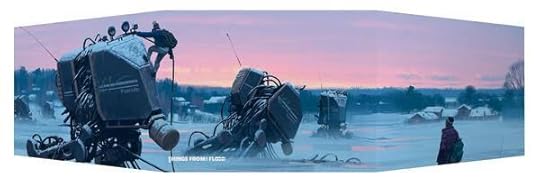
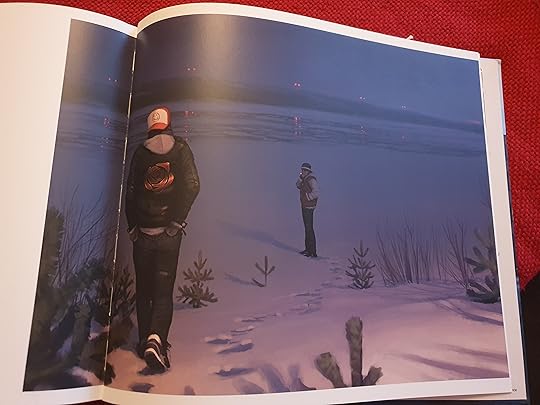
The Loop is closed. Life is returning to normal when the pastoral countryside is suddenly flooded by dark water from the huge abandoned underground facility. Rumors spread in classrooms and schoolyards, stories about the flood and how it has brought something with it. One thing is clear: the past is not ready to be forgotten.
Now in development to be an Amazon Studios series! Simon Stålenhag is back. In his new artbook Things from the Flood, Stålenhag continues the stories of Tales from the Loop, memories of a Nordic childhood infused with strange machines and weird creatures from other dimensions. In Things from the Flood, Stålenhag moves his focus from the '80s to the '90s, the decade of great change when the outside world truly came to Scandinavia. These are tales of the trials of youth, of schoolyard hazings, of first kisses, of finding yourself—and robots.
Konstnären och författaren Simon Stålenhag är mest känd för sina digitala målningar som ofta visar vardagliga scener med fantastiska inslag. Efter sitt genombrott 2013 har Stålenhag publicerat två böcker om ett alternativt 1980- och 90-tal på Mälaröarna utanför Stockholm. Ur varselklotet (2014) och Flodskörden (2016) har hyllats både i Sverige och utomlands. Den ansedda tidningen The Guardian korade Ur varselklotet till en av tidernas bästa dystopier, i sällskap med Franz Kafkas Processen och Andrew Niccols Gattaca.
Simon Stålenhags evokativa och filmlika bildspråk har väckt uppmärksamhet även i film- och datorspelsvärlden. Han har verkat som konceptillustratör och manusförfattare i ett flertal projekt. Stålenhag har medverkat i Searching for Sugarman (regisserad av Malik Bendjeloull) och i datorspel så som Ripple Dot Zero (2013).
Reading Stålenhag after midnight in the dark is becoming a weekend tradition, I guess. But since this book starts to veer into horror territory at times - Machine Cancer, trust me, it’s something else - that might have been nightmare food recipe. Let’s just say my dreams were a bit odd last night.
Look at your own stomach-churning risk:
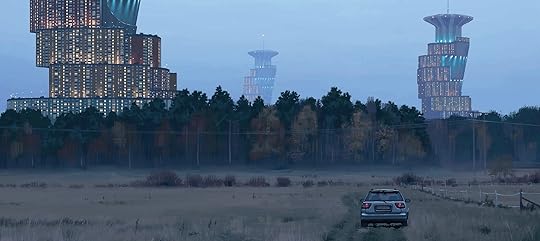
This is a sequel to the brilliant Tales from the Loop, set a few years later in a small Swedish community around the remains of the world’s largest particle accelerator which now has been decommissioned but yet caused a few rifts in the (alternate) reality as we know it, with vagabond robots, machine cancers, cat-eating dinosaurs, and enormous futuristic buildings superimposed on rural and small-town landscapes.
Lovely colors and great contrasts.
And the pages that aren’t body horror are amazing.
As always, it’s the magic of the artwork which is creepy and moody and unsettling. But I did prefer the mood of Tales from the Lööp (yes, I’m adding Umlaute because well, who wouldn’t?) with creepy eerie being on the subtler side.
But then vagabond robots appear and I’m in love with it again…
The story in this one is a bit more cohesive than the bits and snippets that set the atmosphere in the previous book, and I do think I prefer the memory collection that the Lööp was, but this one is still pretty great. There’s a nice juxtaposition of the end of the Lööp era and the end of childhood there at the end, and it works.
Because Stalenhag’s newest beauty, and my supposed Christmas present to myself, arrived here damaged (twice!) - thank you, German bookstores - I turned to the one remaining work of his that had still been sitting on my shelves unread.
Things from the Flood continues the story of Tales from the Loop, kind of. The narrative has moved from the 80s to the 90s and we are back in a rural Swedish town that happens to be home to the world’s largest particle accelerator. The Loop has been decommissioned but holds one last(?) surprise for the townsfolk when the countryside is suddenly flooded by dark water from the huge underground facility.
The first-person narrator, a middle school kid, has to leave his home and bounces around town a bit while he is experiencing some weird encounters that seem to be related to the derelict industrial complex.
Like Tales from the Loop the story is told in fragmented memories and snapshots which lets the reader fill in some gaps using their imagination, stimulated by Stalenhag’s artwork. It’s been a while since I read its predecessor, so I might be wrong about this, but it felt to me like the snippets were less loosely connected here, albeit still not as close to a traditional storytelling as we later got in The Electric State.
The artwork is once again breathtaking. Stalenhag really is a master craftsman, and his unique style is something that speaks to me on many levels. His writing is good too and all his books have this moody tone that I very much enjoy, if life provides me with the necessary quiet and alone-time that I need to fully get lost in his worlds.
Why only 4 stars this time? Well, first of all, it’s more like a 4.5. Both the quality of the writing and the artwork are on the same level as in his other works. It’s just that I was hoping he would take the story in another direction.
I love the setting of an industrial accident juxtaposed against the beautiful rural landscape, and all of it infused with some elements of science-fiction. But this book was tilting slightly too much towards horror for me. I was simply wishing for something else. But that’s only personal preference. And, frankly, it might be down to mood more than anything, as I quite like horror. But I very much enjoyed the eerie little details in his other works, that leave a lot more to the imagination, and I was hoping for something just as subtle, I guess. Nevertheless, the quality is still exceptionally high and would deserve 5 stars. But such are the limitations of the rating system that this time I’m rounding down to 4.
This is a markedly disturbing collection of illustrated episodes around the aftermath of the termination of the Loop. Tales from the Loop, to be read someday...
In this book between graphic novel and art book, we are witnessing the events following an unforeseen flood in an alternative 90s timeline, and the severe, widespread effects it has on a whole region in Sweden, Especially on the decaying machines.
Both art and story mingle horror and sense of wonder as new life forms emerge from the initial monumental blunder... This book is an invitation to meditate on the essential strangeness of life.
As such, it reminds me of a couple of SF works, written along similar lines:
Esta es la continuación de ‘Tales from the Loop’. Se trata de unas memorias de la adolescencia del autor, pero unas memorias ficticias, ambientadas en un universo alternativo, en Suecia. En este libro se trata concretamente sobre finales de los 90, con la desmantelación del Bucle debido a una extraña inundación, que trae un virus que ataca a las máquinas. Es un libro ilustrado, con imágenes fascinantes, acompañadas de textos que explican lo que va sucediendo. Me ha gustado, aunque no tanto como el primer volumen.
Things from the Flood picks up where Tales from the Loop left off. When I originally decided to buy these two books via Kickstarter, I didn't expect them to contain any sort of narrative, but they do, and it works.
When I first saw Simon Stålenhag's pictures combining science fiction elements with rural 70s or 80s Sweden, I fell for the enigmatic atmosphere. What sort of world was this? Clearly not historical Sweden, but still uncannily recognisable.
Usually, when I find myself drawn to the inexplicable, I find that the more details I learn, the more it takes away the magic. (The movie Highlander II must be the defining example of that phenomenon.)
In Simon Stålenhag's books, we get glimpses of a memoir to accompany the pictures, and while they may remove a bit of the mystic, the narrative (if it can be called that) adds an extra dimension.
In Things from the Flood, the text seems to resemble the pictures more closely than in the first book. In general, I find the text stronger, but the art weaker, in this sequel. The result is still enthralling, but I'm also happy that it all seems to end here.
The artwork starts out bleak and dreary, but seem to progress towards slightly warmer and more hopeful motives as the book draws to an end.
A gratifying reading experience spread over 4-5 afternoons sittings. You can read it all in an hour or so, but I wanted to savour the art, so I deliberately slowed myself down.
As the artwork got brighter and more colourful, the mood of this book darkened and took a turn for the disturbing. It's more urban and wider in scope than the first collection - rather than silent and abandoned monoliths in snow-muffled, empty landscapes, almost everything in this book was drawn while life (in whatever form) was still present. Losing a star is purely down to personal preference - the artwork and the writing quality remained absolutely stellar.
Continuano, in questo secondo volume, le disavventure dell'autore nel corso della sua infanzia nel luogo della sua vita, influenzata dal Loop: un centro di ricerca con mastondontici macchinari, robot e strani misteri. Il protagonista (l'autore) ora è nell'età di transito fra l'infanzia e l'adolescenza e siamo alla fine degli anni '90. I paesaggi cyberpunk decadenti creati dall'autore sono a dir poco evocativi e di uno straniamento raro. Il tocco nei disegni in digitale, rendono alla perfezione quell'atmosfera a metà tra il post-apocalittico e di un futuro costellato di rifiuti meccanici ed elettronici che testimonierebbero un approccio troppo entusiastico e soprattutto troppo ansioso e schizofrenico, delle tecnologie cibernetiche!
"Somewhere out there beyond the cordons, beyond the fields and marshes, abandoned machines roamed like stray dogs. They wandered about impatiently, restless in the new wind sweeping through the country."
I'm torn between wanting to binge-read all of Stålenhag's books and trying to savour them slowly. I just found out my local library grants access to all of them, so I really couldn't wait with this one after loving Tales from the Loop so much.
Things from the Flood picks up where we left off – whereas the first book focusses on a secret governmental project in the 80s, this one is concerned with the aftermath: in the late 90s the project was discontinued and our narrator is in his teenage years when the Swedish countryside is flooded by dark water from the huge abandoned facility. We're now exploring how the inhabitants are trying to go on about their daily lives with all these shadows lurking.
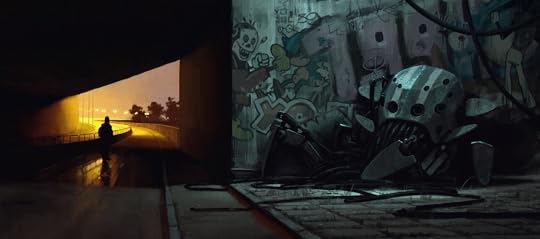
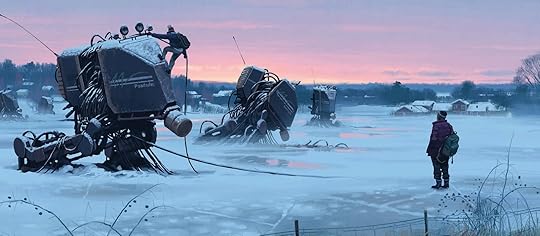
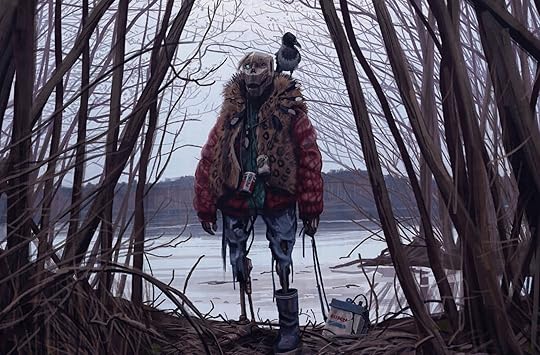
It's different in tone and definitely darker and more haunting. I wasn't quite expecting this to go that sort of way, there's a way more explicit horror element to this one. The machines that seemed to have been thriving (after all, we never quite find out the details) ten years earlier are now abandoned corpses and empty shells – but still alive. We're introduced to vagabonds as they're called, machines that started to create their own kind of culture and aren't necessarily sympathetic judging by the way they look:
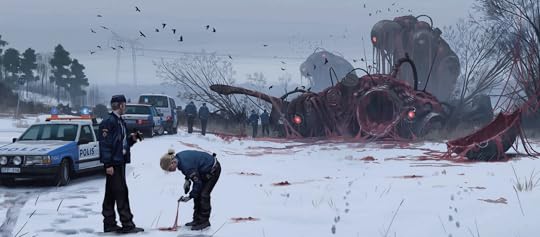
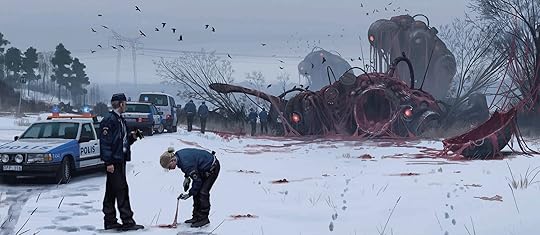
But this thing called machine cancer is the truly scary thing. The robots that were left are compared to "sick animals" as they roam around and the images that Stålenhag created to accompany that section are rather... impactful. Maybe think twice about reading this before bedtime! It feels a lot colder and more depressing than Tales from the Loop did, but the artwork is equally stunning and atmospheric.
The writing feels more linear and there's more of a story to it. Whereas the predecessor used stories sparsely and left a lot to the imagination of the reader, the text passages accompanying the images here felt chattier and more detailed. It makes for a change in tone and the narrative feels a little less mysterious because of that, but it makes sense that the narrator would remember more of his teenage years than of his earlier childhood as well. Instead of kids playing we get boys dating this time and it's again quite unsettling with all these dystopian elements surrounding them (and this time even bloody things!)
So I do admit I liked this a little less than Tales from the Loop partly because I personally preferred the rural, 80s vibes over the dark, industrial images that Stålenhag explored in this volume and I also just enjoyed the mystery more than the horror, but this is still really good and it's great getting a continuation of the story. That angle was definitely worth exploring.
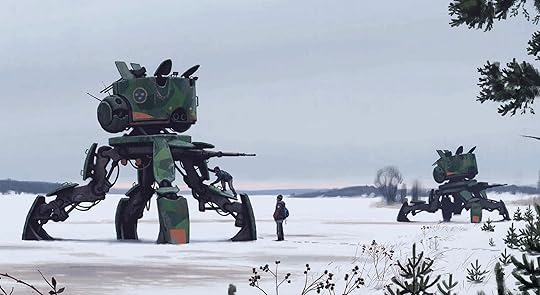
This is Stålenhag’s sequel to Tales from the Loop, and follows the same format as the original: a series of wonderfully evocative paintings of machines, vehicles, robots and landscape-sized structures abandoned among the dank or frosty scenery of rural Sweden. As before, most are linked by explanatory text—but not all, allowing your own imagination to fill in some of the gaps. It is now the mid-1990s and the region’s underground particle accelerator has been decommissioned—but that isn’t the end of the story; there’s been a flood of contaminated water from below, which has brought something strange with it: an unknown microbe which, as ‘Machine Cancer’, attacks plastic and metal, limb joints and circuit-boards, causing intelligent devices to lurch about the countryside like terminally sick animals. In the woods, meanwhile, there are bands of ‘vagabond’ androids, refugees from anti-AI pogroms across the border in northern Russia. By now too, the author has become a teenager and is exploring a new world of clothes and girls—and as the Swedish government finally begins a clear-up of all the rusting abandoned tech, we realise that what’s disappearing forever, along with the giant cooling towers and half-sentient scrap, is his own childhood.
This is another instalment of the fictitious memoirs of the author. The mixture of atmospheric images and haunting text make for an extremely memorable book.
The story really carries on from the first book Tales from the Loop - where now it has been decided that the loop is to be shut down. However this brings all sorts of unexpected complications which the author reminisces. To a certain extent it reads like a rites of passage as he changes his home, his friends and even his school.
The artwork is fascinating as you can see the rough blurred edges - photo-realistic its certainly not however if anything it gives a feeling of age and almost authority I think any other style of painting would ruin.
This is one of those books which like the works of Syd Mead will stand the test of time. I just hope we get to read more tales from the familiar but strange land.
Kommt an den ersten Teil nicht ran, der übrigens großartig verfilmt wurde. Dennoch habe ich das Lesen und Abtauchen in dieses so besondere Genre "Retro-Science-Fiction" total genossen.
Unlike any other book I've seen. It is hard to say whether this is an "art book" or a set of short stories, a graphic novel, or a picture book for adults. That sort of ambiguity always attracts me!
Ultimately, I'd have to say this is an "art book" because the artwork comes first. The artist created the digital paintings first. They all mix images of Swedish countryside in the 1980s with robots and other futuristic apparatus. But there wasn't originally any real backstory. He later wrote stories based on the paintings, which flesh-out the background story. Once I realized that, I didn't feel compelled to read all the stories. I prefer to come up with my own interpretations of the pictures, which are very cool pictures.
Il libro Flood di Simon Stålenhag è un art book suggestivo che unisce illustrazioni evocative a una narrazione minimalista e inquietante. Ambientato in un mondo alternativo segnato da tecnologia e mistero, il libro crea un’atmosfera sospesa e malinconica. Nel complesso è un’opera affascinante e visivamente potente, più da contemplare che da leggere in modo tradizionale.
Like my review of Tales from the Loop, this has superb artwork in it (which is the main point of the book I think) but it lacks the great narrative that his first book had. Amazing artist - apparently he goes back to the narrative form in the latest book so i'll be looking out for that one.
I saw the cover of this book and flashed back to the album cover for Kula Shaker's "Peasants, Pigs, and Astronauts"--and in true human brain fashion, I misremembered the album cover as resembling the book's artwork far more than it actually does.
FLOOD continues the high bar set by this artist in its dreamlike, sinister imagery of an imagined alternate history. It perfectly captures the creeping dread of how bad things happen on a society-wide scale.
A continuation of Tales from the Loop that dramatically ups the creep factor. The first book (maybe) had dinosaurs roaming around. Now, we've got alien blob monsters taking over the old robots? Um, yikes.
The gentle storytelling style of the author recalling some favored memories helps cover up much of the fear factor, but this book is a clear lead-in to Stalenhag's next few works, all of which are much darker.
Stunning to look at, as always, just with a lot less of the fuzzy optimism we saw in Tales from the Loop.
just perfect. everything about it is great. i love this setting and the way the story unfolds through a series of not necessarily interconnected childhood memories. perfection, 10/10, read it in one sitting
This was just what I needed in my life! And it was so, so good. But I did prefer Tales From The Loop, if I'm being honest. Stålenhag's art quality has increased, I'm sure, but the vignettes didn't come together in the way I hoped. There was falling action without a climax, which could be fine since they are vignettes, but the entire book built wonderfully to a sense of RISING tension and stakes. For that to cut out in the last 30 pages, accompanied with some panels that I really wished were explained (you just gonna leave giant centipedes in there for 1 panel and never bring it up again?) Anyway, I loved the growth of these characters and some of the vignettes (the Russian AI bear? The parish house and the hacker? Wow!)
Again, Stålenhag has done it with the art. The use of soft colors, perfect blue hours/nights, and lighting of surfaces amazes me. I read this in one sitting to the Stranger Things 2 soundtrack and you should do the same. 9/10
The artwork even better in this one. Some are so detailed and life like, I have to remind myself that it's not a picture. My favorite were the vagabonds, and I really hope they get their own book someday. This is perfect blend of surrealism and body horror (sorta? robot body horror?) that I love.
Detta är Simon Stålenhags andra bok som är en blandning av konstbok och en berättelse som en tid som har flytt, barndomsminnen som kommer upp till ytan. Det är en värld som kanske inte är den som vi är van vid.
Denna bok tar vid direkt efter den första boken, Ur Varselklot, så jag tycker att man skall titta och läsa i den först för att förstå allt bättre. Och när första boken är så snygg som den är så skall man självklart inte missa den.
Precis som i försa boken innehåller denna helt otroliga och fantasieggande bilder. Det är bilder som tar en tillbaka till en annan tid, det är fullt med nostalgisaker. Men det är även något som inte stämmer med bilderna, det är en annan verklighet som vi möter här, men den blandas så bra med vår verklighet att man köper hela bilden.
Texten knyter ihop bilderna på ett bra sätt. Minnen målas upp med små berättelser och de tar en dit till en annan plats och tid. I den första boken så fick bilderna en text som löst hängde ihop, de skapade olika minnen. I denna så hänger texterna till bilderna mera ihop med varandra och det blir ett mera flyt i berättelsen, istället för små nedsteg i minnenas värld så blir det en längre berättelse med små hopp i berättelsen.
Jag sa det om första boken och säger det igen. Det känns som att vissa bitar av texten måste nästan vara riktiga händelser, i alla fall så har Stålenhag fått till känslan bra i texten och i vissa bilder så det känns att det är självupplevt att skaparen, om inte så är det riktigt bra gjort.
I vissa bitar av boken så är stämningen mera hotfull än vad den var i första boken. Något har kommit upp ur den nedlagda förläggningen som finns under marken. Vad är det? Och vad gör det med alla?
Jag hoppas verkligen att detta inte är den sista i denna serie, vet att det finns en bok till som utspelar sig i USA istället för Sverige. Vad jag förstått så skall den boken vara ännu mera av en sammanhängande berättelse. Men i förordet så nämns en händelse som skedde 2001 så jag hoppas på att det finns planer på att det kommer att bli fler böcker.
Denna och den tidigare Ur Varselklotet är båda helt otroliga och är ett givet köp om man gillar snygga böcker och bilder samt är svag för fantastik.
Wie bereits im 1. Teil zeichnet und fabuliert Simon Stalenhag in seiner Alternative History eine eindringliche Dystopie eines gescheiterten Wissenschaftsexperiments. Nachdem der Loop stillgelegt wurde, vagabundieren immer noch die Gerätschaften auf den Inseln herum, für die Kinder sind dies wunderbare Eindrücke und Geschichten. Irgendwie wurde durch den Loop Portale geföffnet, aus der Wasser eines Exoplaneten herausströmt, das zu einer Flut auf den Inseln führt. Dieses Wasser führt auch zu den sonderbarsten und verstörendsten Erlebnisse der jugendlichen Erforschern ihrer Insel. Wieder ein wunderbarer Band mit fast fotorealistischen, phanstastischen Bildern und mit einer passenden Prosa dazu....
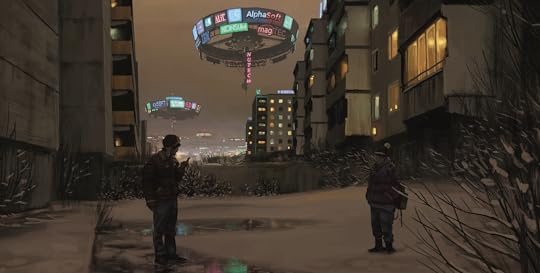
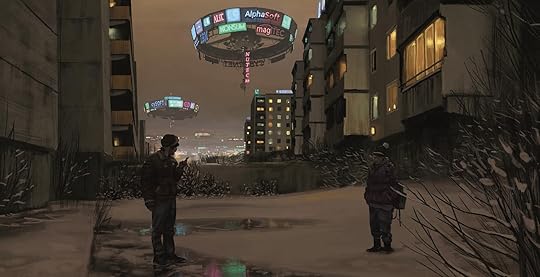
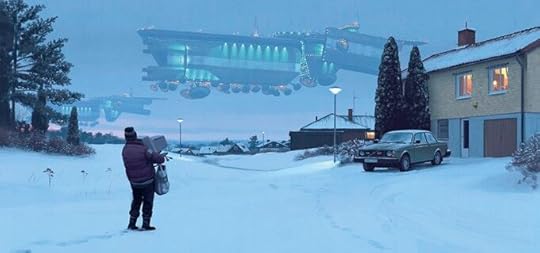
Probably won’t be giving Stålenhag anything less than 5 stars anytime soon. Another great collection of art here, paired with evocative snippets - intriguing on their own - that craft a small-town story with a sort of pre-post-apocalypse backdrop. An aspect I love of Stålenhag’s art is the juxtaposition between childhood innocence and corporate indifference. Jalopies sputter past wreckages of AI-controlled machines, people carry groceries in paper bags beneath a fleet of airships, neon lights of towering corporate offices fuzz in the fog and snow of another cold winter in the village. Tales from the Flood takes this further, depicting machines that - in some sense - emerged from the flooded ruins of a mysterious old facility. This art stirs something in me that’s old, new, foreign, familiar. I understand what it’s like to not be able to explain art and it’s a wonderful feeling.
Fantastic! Things from the Flood ties perfectly with Tales from the Loop. It addresses the shortcomings I had with Tales and closes out the Swedish chapter of this alternative past perfectly. The short stories are a little longer, they're a little darker, and they really make the imagination run with all the new things introduced in this book. The artwork likewise, embraces cooler hues and darker tones, giving everything a feeling of foreboding and danger which felt absent from the first book.
Both Things from the Flood and Tales from the Loop should be read together and if possible in physical format to really enjoy the layout/design.
Fascinating follow-up and direct sequel to Stålenhag's first book, Tales from the Loop. This one has a bit more of an actual plot than Loop, but is still more focused on mood and world-building than strict storytelling, ( tålenhag doesn’t truly go there until his next book, the jaw-dropping The Electric State).
Stålenhag does a great job of creating a world that is like ours yet totally different. While I continue to insist that Electric is most definitely not set in the same universe as the first two books (despite being listed that way on Goodreads), they are all set in the same late-20th century time period, and all contain subtle references to our own reality — Burger King, Safeway and other recognizable logos buried in some of Electric's backgrounds; and the barely-recognizable "Jurassic Park" blanket in which this feral robot has wrapped himself on the cover here in Flood.