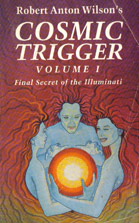
Deals with a process of deliberating induced brain change. This book explores Sirius, Synchronicities, and Secret Societies; Crowley, Christ and Karma; Dope, Death and Divinity; and The Illuminati.
Robert Anton Wilson was an American author, futurist, psychologist, and self-described agnostic mystic. Recognized within Discordianism as an Episkopos, pope and saint, Wilson helped publicize Discordianism through his writings and interviews. In 1999 he described his work as an "attempt to break down conditioned associations, to look at the world in a new way, with many models recognized as models or maps, and no one model elevated to the truth". Wilson's goal was "to try to get people into a state of generalized agnosticism, not agnosticism about God alone but agnosticism about everything." In addition to writing several science-fiction novels, Wilson also wrote non-fiction books on extrasensory perception, mental telepathy, metaphysics, paranormal experiences, conspiracy theory, sex, drugs, and what Wilson called "quantum psychology". Following a career in journalism and as an editor, notably for Playboy, Wilson emerged as a major countercultural figure in the mid-1970s, comparable to one of his coauthors, Timothy Leary, as well as Terence McKenna.
This is another of those books that would've gotten a five-star rating when I first read it, in late High School or early college, but today doesn't hold up as well. While there's a lot of interesting possibilities suggested, by way of deliberate speculation on synchronicity and technological advances, there's also a LOT of really wacky unfounded psuedo-science and wishful thinking. Writing in 1977, Wilson made a number of predictions about the future here, and not one of them even remotely came true. I don't think this review will really benefit from enumerating and contradicting them; suffice to say that the author was under the influence of some rather dubious scientific renegades at the time.
Where I think the book has value, actually, is in an area most people probably miss - its narrative structure and the way it builds towards a profound personal revelation of tragedy on the part of the author. It has been suggested to me that this book was kind of a way for RAW to work through his grief at the time, and, in that sense, I find that it pulls me along with him. I remember crying myself the first time I read the sentence "It is absurd for a 45-year-old man to sit at a typewriter weeping over the words 'foot doot'." Now I'm closer to that age myself, and I still find that sentence a powerful piece of poetry. This prefaces what he calls the "final secret" of the Illuminati - which is essentially a code for the power of positive thinking. It's nice to know that he was able to work through his feelings this way, but I actually think the power of the book comes more from his willingness to lay bare his own pain so openly than from his attempt to write a meaning on to that pain.
The other interesting aspect of all this is what it may tell those who wish to consider themselves Magicians in this day and age about the dangers of Magic. Magic, when done seriously and not as sort of a Sunday-evening amusement, means re-shaping your experience of the world through deliberately altering your Subjective Universe. In other words, it means playing with your mind for fun and profit. This can be a dangerous game to play, and there is probably nothing more important than attention to the two elements Leary first suggested for the use of LSD for psychological therapy: Set and Setting. Without proper understanding of these elements, it is all too possible to end up believing in the wildest ideas and predictions, losing sight of the Objective Universe along the way.
I used to refer to Robert Anton Wilson as a "crackprophet"-- his writings are totally off the wall and indiscriminate, embracing both silly ideas and deeply profound ones, trying to unify scientific, historical, metaphysical, and, well, downright psychotic concepts. What this book challenged me to do, way back when, was to approach things with as open a mind and as little "contempt prior to investigation" as I could muster. I must have assembled and read several dozen books as the result of reading this, everything from "Tao of Physics" and "Dancing Wu-Li Masters" to "Journeys Out of the Body" and "A History of Secret Societies." Wilson spurred me to investigate Alan Watts and Gurdjieff, Buddhism and Hinduism, particle physics and Einstein, early Christianity and the Knights Templar, Colin Wilson and David Foster... and that just scratches the surface. Wilson's books are a good test-- as he himself often stated-- of just how willing the reader is to explore and be challenged. And yes, he was nuts. But God bless him for being nuts as well as so deeply full of humanity.
Cosmic Trigger is an excellent companion piece for the RAW reader, essential but also part of a larger picture. Obviously, read Illuminatus! first. And if you want to utilize metaprogramming 'magikal' powers, Prometheus Rising may be more useful.
But for a summary and rehash of all the essential philosophical takes by the great Robert Anton Wilson, enjoy this. All over the place, it covers Crowley and telepathy theories and much autobiography (sad at the end, but is what it is). Learn about the Timothy Leary 8 circuit model and how all psychedelics fit in that. Tragically, when the book gets into life-extension medical optimism the book sure feels dated as we've definitely not made the progress that was expected.
In a way, the book is a window into what was cutting edge in the 1970s, and there is value in that.
Perhaps it's still too ahead of its time, and perhaps it's not always best to be that ahead of your time that 40 years later readers are still waiting for the world to catch up to all those post-2012 space migration theories.
It is fun to refresh on Wilson every so often, because there's still no mind quite like his after all this time!
Zany, unique, and wittily written, Wilson weaves a web of seemingly random connections between information as he playfully proposes the wildest conspiracy theories. Even as he runs away with your imagination and succeeds in convincing you, at the same time he mocks himself and reveals his own cynicism towards his assertions.
”It seems to be a hangover of the medieval Catholic era that causes most people, even the educated, to think that everybody must believe something or other, that if one is not a theist, one must be a dogmatic atheist, and if one does not think capitalism is perfect one must believe fervently in socialism, and if one does not have blind faith in X, one must alternatively have blind faith in Not X or the reverse of X. My own opinion is that belief is the death of intelligence . As soon as one believe a doctrine of any sort or assumes certitude, one stops thinking about that aspect of existence. The more certitude one assumes the less there is left to think about, and a person sure of everything would never have any need to think about anything, and might be considered clinically dead under current medical standards where the absence of brain activity is taken to mean that life has ended.”
The above quotes are the essence of Cosmic Trigger. They are what I remembered and retained across the thirty plus years since I last read this book. These quotes, that appear in the very first pages, tell you the book’s true theme and purpose: to break your rigidity of thought, to divorce you from the the disease of dogma, cure you from the curse of certitude.
Wilson front loaded his book with his intent, knowing that many would become lost in the flash bang whizz of the frankly fringe ideas that he goes on to explore. This is high octane weirdness and crackpot crazy, investigated and considered seriously. The Illuminati, UFOLOGISTS, dancing peyote nature spirits, astral pancakes from space, Wilhelm Reich’s Orgone, Alister Crowley Sex Magick, interstellar messages from the Dog Star Sirius — these and so many more ideas our consensus reality considers insane and not worth serious study — Wilson studied them, experimented with them, and presents them here for our examination. He writes:
”What my experiments demonstrate, what all such experiments throughout history have demonstrated, is simply that our models of reality are very small and tidy, universe of experience is huge and untidy, and no model of reality can ever include all the huge untidiness perceived by uncensored consciousness.”
This book blew my mind when I first read it over 30 years ago. Wilson became my guide through “Chapel Perilous” (that place from which you emerge either a stone cold paranoid or an agnostic) and forever changed the way I would perceive consensus reality. It was from Cosmic Trigger that I first discovered the Copenhagen Interpretation which Niels Bohr proposed to explain quantum mechanics, and which can be expanded into a general view of reality as Model Agnosticism. (Alan W. Watts popularized Model Agnosticism with his phrase “The Menu is not the Meal.”) This book profoundly changed the way I went on to view the world and reality.
Reading it now, after decades of practicing the no belief necessary model of looking at the world, it didn’t pack the same punch. Radical revelations are only fresh when they are new. So this time I noticed the scatter shot structure of the book, picked out how some parts were far less effective than others. But Wilson’s trickster wink and a grin humor was still sharp, and I still heard the echo of the thunder that so resonated in my younger mind.
Cosmic Trigger is a book that will be most effective for the young. Past a certain age it’s likely that a rigidity of mind has set in that will make you incapable of appreciating it. Yet, if you are honestly struggling to keep your mind open to possibilities, if you are actively resisting become that old, “Stay off my lawn!” guy, you could do worse that expose yourself to the shenanigans that Wilson here presents.
Wilson makes a point to note at the beginning, "Belief is the death of intelligence." Carry that thought with you as you read, the menagerie of strange ideas he puts forward throughout are meant to strip away our preconceived notions of what is acceptable opinion - but that does not mean that he endorses or fully believes any hypothesis. The meat of this book, and what makes it staggering and appealing, is the idea that science and mysticism both confirm that reality is entirely subjective. While science and skepticism are the most adequate tools we have for understanding the world, they are still only a byproduct of consciousness. You don't need drugs to have your mind expanded (although he also endorses this as an option)- you just need to have the willingness to walk the tightrope of skepticism and open mindedness, and happiness becomes a choice, not a reaction to your environment.
With a title like Final Secrets of the Illuminati, I was expecting a fictional story akin to Illuminatus!: while I wasn't disappointed, the book is instead a chronology of Robert Anton Wilson's spiritual and philosophical journey over the course of his life.
Reading Wilson is almost like taking a drug: if you let it, his writing puts you almost in another consciousness. This is neither an inherently good or bad thing, but I have had thoughts and ideas while reading his work that I never would have otherwise. I'm never really sure if he believes what he's saying or is only saying it to mess with peoples' minds, but in the end that doesn't matter. In Cosmic Trigger he's not trying to get you to follow his life -- as big a fan of his as I am, I don't plan on taking hallucinogenic substances -- but is instead trying to pass along what he's gotten out of his life. He admits that he doesn't always agree with his prior assertions (like the messages he was receiving from Sirius), and as such neither should you. If Wilson has taught me anything, it's that Truth -- hard, finite and irrefutable -- is hard to come by.
Some of his predictions for the future, with Timothy Leary's SMIILE program especially, look dated: we're living his future, and it doesn't look like either of them had hoped. Don't read this book expecting to agree with everything, or most, or possibly anything Wilson says. I don't think he would have wanted everyone to agree with him; thinking about what he wrote, and forming your own assumptions, seems a more likely goal.
On the surface, a book about drugs and magic and contact with aliens. On a deeper level, a book about philosophical agnosticism and the practice of deliberate mental metaprogramming. Entertaining and illuminating on either level.
The most interesting book I've ever read. It's taken me a long time to get Bob Wilson, but it's been worth the wait. Here is the most succinct distillation of all matters illuminated I have had the fortune to stumble upon. He is an extremely humble author, and introduces all the esoteric in a manner intended to make sense to the average reader. His privileged position within the old counter-culture, friendship with Timothy Leary, and status as an investigator of the unusual make him the perfect guide to the world of synchronicity, the paranormal, and consciousness increase.
With a final poignant twist that lifts this work above even the general milieu of New Age masterpieces, Cosmic Trigger I brings it all back home. I wonder what Cosmic Trigger II does...
Wilson has written a book that you just can't take in all at once. One of the deeper "surface" lessons, the one Wilson shouts the loudest and at the same time refuses to do any more than tease you with, is that you have to decide for yourself what to believe -- but that deciding to believe anything limits what you will be able to observe in the world around you. This is heavy stuff, and ground-breaking to the average reader. This is a work that has earned a place on my bookshelf ... although I might have to wait a while to re-read it. "Cosmic Trigger" is a great foil to dogma of all stripes, but going through it too many times in succession makes it a piece of dogma itself, and the message gets lost.
This is a book I read often. It is as eye-opening as a great hit of acid, without that annoying nebulousness that keeps you from expressing all the things you've learned when you touch back down on the runway.
This is the natural partner to his trilogy Illuminatus! (which I suspect is far more fact-based than it appears, based on the parallel tale of its creation told within this book), and this is where my acquaintance with RAW began. Though he was not actually my contemporary (older than my older brother, who was actually my "bad" influence at the time and introduced me to things like The Mothers of Invention and Conan the Barbarian novels when my older sister was listening to AM radio and swooning over the Monkees), I am a child of the '60s and was influenced heavily by this book.
Yes, he was one of a group of people leading the way to mind expansion (Leary the one people always think of because he was more of a celebrity, but he also became a sell-out and somewhat of a caricature), but Wilson was the one who best communicated it--not just as an intellectual giant, but because he didn't take himself too seriously. He was flying by the seat of his pants, making it up as he went, open to new revelations, and just plain having a blast figuring out the WHY of it all--if that is even possible. He can tell a tale, and I suspect even he couldn't keep straight where reality ended and fantasy kicked in. Indeed, I suspect he considered them flip sides of the same coin. It's all about perception and expectations, right?
Though this is autobiographical (and not always funny), there is still his sense of fun, ridiculousness, paranoia, and freewheeling willingness to try anything and everything. . . and then take what he liked and move on to the next thing. Who else would think to embrace everything from acid to the OTO to meditation and telepathically communicating with aliens from Sirius and simultaneously support himself by writing for Playboy?
There is a treasure trove of RAW quotes out there and he is famous for asserting that "I don't believe anything, but I have many suspicions," "Certitude belongs exclusively to those who only own one encyclopedia," and "There is no complete theory of anything." I think that sums up his appeal for anyone who is a perpetual student.
This book pretty much details what was going on behind the scenes of the era when Leary told us all to "Turn on, tune in, drop out," and popular culture was trying to figure out what he meant. The drugs were only one means of that and a lot of what these pioneers were groping around in is still unfolding. Jailing them didn't stop it and the weirdness of the aging Baby Boomer generation can't undo it. I, for one, am curious to know what's to come from the Starseed Transmissions and if Leary and Wilson are laughing their arses off now that they have a better vantage point. I suspect if they're looking in, it's only briefly because they're gleefully flitting off to the next step in their evolution and seeing what other answers are out there for questions that haven't even occurred to them yet.
Back when I was in deep study of the freemasons I was contacted by a mysterious individual who said that he had many secrets to tell, but I could not talk to him again until I read this book. I tried to order it off line, I never received it. I tried retrieving it from the library, it was mysterious missing. Every avenue I took, it was unavailable. Year when by and my friend and business partner at the time Jarmo gave me a present. Said it was the Techo-virus, said not to open it for a year, not until my birthday august 7th, 2008. So i waited and it was during this time that I was transitioning to Chicago. On the day of my birthday I woke up at 4 in the morning and drove 8 hours from Kentucky to Michigan, to finished cleaning my apartment. Jarmo was there. We took the present he gave me, the techno virus and soaked it kerosene for 8 hours. Then, we lit it on fire in the parking lot in a plastic bin full or kerosene. We waited for it to burn it self out. When the fire had finally died out, I scooped the ashes off the pavement, and what did I find, well, this book, the book we've been searching for. And somehow, the book remained unburned. It smelled of sulfur as if from hell itself. It may very well have been. I read it alone in my economy apartment in Chicago. It must have made an impression, I sited in a book I was writing, I Hate Chicago. After I finished it I emailed the mysterious figure who years earlier told me to read the book...his email had been disconnected.
this book... i mean wow. right up there with pkd and mckenna, you'll start having synchronicities like crazy when you read it. it led me to meet a very strange older man in san francisco; the babbling, hippy type who loves the sound of his own voice and might also be mentally unstable enough to kidnap you at the top of a cigar shaped-tower whose interior was painted by frida kahlo's lover... yes, he tried to lure me there after following me around all day talking about the cosmic trigger. the ending of this book is dreadfully sad and makes me cry every time. the poem written by his daughter about the stars also makes me cry. this book got me into the sirius mysteries (for which i am forever grateful) and poses many mysteries of antiquity. the sirius mysteries i would recommend over reading this book, in combination with aleister crowley. there's a bit too much pseudoscience in this book as it has aged, but still many takeaways worth the read if you're into a mindfuck initiation.
I was ready to put this book in the 2-3. star range - at first glance, it’s filled with overly optimistic predictions of the future based on little more than conjecture and pontification. I did enjoy the imaginative tributaries of human potential that Wilson explores, but it eventually started to come across as naive. That all changed in the last section of the book when Wilson reveals it was written during a period of extreme grief due to very tragic circumstances. I realized I was reading a personal diary of a person navigating loss, and all the starry eyed hopes for the future was really form of negotiation. It humanizes the whole experience, and you immediately connect with Wilson’s vulnerability.
insufferable lead-paint-addled boomer "guru" solipsism. turns out any banal coincidence can be "synchronicity" if you take enough acid... two stars because the writing is often quite funny with endearing puns and exotic coinages throughout. i also appreciate that the author at least doesn't pretend to be scientific and objective too much, unlike the absolute nonsense presented as hard scientific fact that was 'Dragons of Eden' by Carl Sagan.
Quite a naive story about the 60s simulacra with a great deal of hero worshiping of Temple's Sirius Mystery, published a short time before. The most real thing about the book is the incredibly sad retelling of the death of Wilson's daughter near to the end.
This entire review has been hidden because of spoilers.
Robert Anton Wilson's positivity shines through as always. A joy to read. Fascinating subject matter dealing with his occult experiments to ever expand his reality tunnel and raise his consciousness. Most of the book has to do with his growing awareness of a connection to the Dog Star, Sirius, and the coincidences that abound in his life around it. RAW always manages to attract interesting and intriguing people into his life (Tim Leary is a prominent figure in the book, and although he doesn't appear in person, so is Aleister Crowley) mostly through his own wide reading and scientific querying. And so we encounter a number of scientists and other figures working on such projects as SMI2LE - Tim Leary's term for Space Migration, Intelligence Increase, and Life Extension - and unexplained phenomena. These are all faves of Wilson's and he's covered them in other books, along with Leary's 8 circuit model of higher consciousness (see Wilson's 'Prometheus Rising') and this is why it felt to me that he goes on a bit long about this stuff here. Though if you haven't encountered these ideas before, they're all very interesting. Most striking was RAW writing about his youngest daughter Luna, a loving peaceful child with Right-On ideas, a beacon of Light, who was beaten to death at age 16 during a robbery of the store she worked at after school. Wilson's portrayal of her (and how he and his wife dealt with such an awful tragedy) is very touching. RAW's life was never easy, and he pursued much that wouldn't make it so, but he did it all to bring positivity and love to a world much in need of it. And thus reading this, as with his other work, is very inspiring. And a lot of fun.
In this work, a discussion of the paraphysical and the parapsychological, Wilson writes about topics like UFO sightings, coincidence (or Jungian synchronicity), Discordianism, magic, chemically-altered states of consciousness, and immortality. For Wilson, such “fringe” phenomena (and the work of fringe thinkers such as Timothy Leary, Aleister Crowley and Wilhelm Reich) supply different ways of understanding our notions about the structure of reality, the structure of the mind, and the structure of the interactions between the two. In addition to challenging conventional views of reality and the mind, Wilson’s exploration of things like extraterrestrial intelligence, the 23 Enigma (http://en.wikipedia.org/wiki/23_enigma) and Sufism is part of a bigger question: can the mind “reprogram” itself? Wilson describes some of his own experiments and experiences with respect to this latter, and in this regard the work is partly autobiographical.
My own experience of the book included one coincidence worth mentioning--I finished reading it on July 23, a date that has some significance in the context of Wilson's discussion.
Acquired May 3, 2010 Powell's City of Books, Portland, OR
The Cosmic Trigger series is my favorite RAW material. One of those books I turn to when my faith wavers, it reminds me of the greatness of a world self-created.
This book was my introduction to so many rabbit holes, back when I first read it almost 20 years ago. I got it from the LA public library in my 20s, read it and Promethus Rising on the weekends when I should have been working on my PhD.
So many rabbit holes! The Illuminati. Space colonization. Ancient aliens. JFK conspiracies. LSD/ Peyote / Mushrooms. Hero worship of Leary / Castenada/ Crowley. Synchronicity. UFOlogy. Alien abduction. Heart chakras. Sufis. Remote Viewing. Precognition. Immortality.
The new foreword, beautifully written, claims that the book continues to pass the test of time. I'd say that was true 20 years ago, and not the case now.
The reason I returned to this book NOW was that it was also my first introduction to the idea of reality tunnels constructed by news outlets; gurreilla ontology; deep agnosticism; and how to cope with living in America amid the downfall of an unbelievably corrupt presidency. This book's critique of the American polity amid Watergate - and RAW's refusal to hold any party line on ANYTHING related to politics - influenced my idea of reality very deeply as I built my foundations in both science and weird science. So I wondered if there would be any value in today's 20 year olds reading this as their own entre' into gurreilla ontology and magick.
Actually, not so much.
I'm really glad I re-read this before recommending it to the 20 year olds in my life now. It doesn't serve that purpose, but circling back to it really does help me appreciate my own journey the past couple decades. It's very well written and Operation Mind Fuck is terribly funny. Moreover it's a really interesting inside view on some famous people of a certain era - and on the optimism they never knew they had back then in a time they all considered themselves to be cynics.
That said, I think this one is going to get more cringey every year for a while. The test of time will not be kind.
The numerology stuff goes from funny to stupid much faster this time around. I just read McKenna's True Hallucinations, which Wilson uses as an actually credible source text - even though McKenna himself admits that it's likely what he documents at La Chorrera is very likely a psychotic break. Of course psychosis is an adventure in confirmation bias, in pattern recognition gone awry. Wilson is hilarious and self-aware around much of his theories, and adds an extra-agnostic (and extremely funny) introduction to my copy of this text to underline the fallability of his numerological claims, but dude. It's actually the hero worship thing that leads to the book's hardest cringe. He takes seriously old boys who don't even take themselves seriously.
A slim majority of the text here comes down to that - unchecked praise of Leary and friends. No wonder these guys thought their theories were so special. The egomania and hero worship in esoteric subcultures from the OTO through high weirdness are ASTONISHING... of a kind I don't see elsewhere in these eras. Ironic for a bunch of men who thought they were on the leading edge of enlightenment.
This would be fine now if it were just this adolescent D&D vibe that Crowley worship gives off. But the book is actually insanely racist and misogynist. I guess this is what the new Foreword is hedging agaist. For his time, Wilson has some really lovely critiques of the racism, sexism and other bigotry of the day - his critical mind is in good working order.
But let's be real - he was a Playboy writer, and tis book features throw-away lines he clearly wrote with that readership in mind. I won't quote them because they're so bad. The narrative through-line and climax of the book isn't all the egomaniac magick men he's obsessed with: it's his own family life, and his effort to make some sense of the horrible murder of his wonderful daughter. And yet, knowing this time around that this is what the book is really about, I was astonished at how little we ever hear about his family life here. There are just a couple of tiny scenes in which the characters are introduced. Arlen his wife shows up as a companion on some outings, but not as a character except in the most important scene of the book, when they learn of their daughter's murder and indeed we see that Arlen is a bonafide hero in action and in her husband's eyes. I so wish that the publisher, the readership and the author in these times would have seen fit to write a book about these real people. It's not Wilson's misogyny and egomania on display here, so much as his uncritical acceptance of the biases of his context - something he was SO brilliantly able to resist when it comes to meta-theory, epistemology and electoral politics.
About the racism. Wilson is really sensitive to bigotry, in ways I think are worth reading in context. The racism is way more subtle - it's in what's taken for granted in the whole long section on Sirius and Africa. Like, his imagination isn't big enough to consider that African people advanced enough to study the stars - so the RATIONAL explanation MUST be.... ALIENS. It's incredibly painful to see where his critical and broad-thinking mind DOES NOT go when it comes to the Sirius thesis. At this point we're all pretty clear on the racism of the Ancient Aliens thesis, but because it's such a big part of this book - THIS is the main reason I'd never recommend it to kids just starting out in the world of esoterica. Maybe instead I'd recommend Starships, Gordon White's take on the aliens thesis, which clarifies its colonial mindset while also introducing all kinds of weirdness and magick to young readers.
One of the most striking impressions this book leaves is its optimism. Towards the end, there is a long section on futurism, and even after the ultimate tragedy of the story, it's Wilson's openness to scientific + supernormal advances in human consciousness that gets us through.
I don't think this futurism dates the text in a bad way. It is interesting to remember how optimistic humans were in the 60s and 70s about where the species was going. That gives a different feeling to my own interpretation of what the 80s and 90s were. Not a big disappointment from my perspective as a child, but so much less than our forbearers expected. Most of the predictions were already wrong when I read this book in the early 2000s; now they're just a great way to illuminate how far we have declined. And oh, if only Watergate were the worst crimes a president could commit. If only CBS Evening News were the propaganda that were brainwashing our masses.
All in all, a REALLY timely and interesting re-read for those who have been around the magickal world a long time and probably started in this genre. But definitely not the doorway-to-the-weird that it once was for so many.
Many of the things I loved about Illuminatus! And Prometheus Rising can be found in Cosmic Trigger as well, with the addition of more insight into the personal life of R.A.W and how the ideas I’ve known and loved came to be.
Also an exceptional resource of important names and books in occultism, quantum physics, and consciousness science of the early 70’s, much of which is only more interesting read today (though the optimism Leary & Wilson shared of believing our exponential growth would yield near immortality by 2012 deserves a chuckle in Death-fearing hindsight.)
If you’re at all interested in consciousness, psychedelics, occultism, magick, tantra, yoga, psychic phenomena, synchronicities, extraterrestrials, the Illuminati, quantum mechanics, ancient aliens, or other ‘weird’ stuff, get turned on to Robert Anton Wilson - you won’t be disappointed.
Much of the data in the book could be mere coincidence and apocrypha. Much of it could even be made up wholesale (but then again, what isn't?)
Some of it went over my head, though I'm perversely pleased that I seem to have understood most of it (which no doubt means I've understood none of it).
I don't know how much I agree with what's being said, but I love the optimism. It's easy to look back and sneer at sentiments like 'human longevity or immortality will be developed by the year 2000' or 'we will have space cities orbiting earth by the 1990s' - but remember: this is a time before Reagan and the shift into late stage capitalism that prioritises production and consumption over anything else.
After reading "The Postmodern Condition" and finding it tedious and convoluted, I decided to re-read a book that, as far as I can tell, describes "the postmodern condition" a million times more effectively and enjoyably.
Wilson opens the book by telling the reader "I do not believe anything". He evidently, uh... feels that human cognition is so overwhelmed by confirmation bias, the Baader-Meinhof effect, etc. that it's absurd to imagine that one can analyze things from an objective, impartial perspective without falling into the trap of motivated cognition. Instead, one should be able adopt several different views similar to how one adopts different outfits, and let these views become lenses to distort one's reality. Wilson's word for this concept is "reality tunnels". Our biases, he says, shape how we see the world to such an extent that it is as if we create the reality we live in. A Freudian sees sexual repression everywhere, a Marxist sees class struggle, a Catholic sees original sin. If, on the other hand, you are able to adopt all three of these world views without committing, then you'll be able to pick up on whatever nebulous patterns all three of these people are picking up, rather than having a limited understanding of just one. By contrast, if you are a firm skeptic who refuses to get caught up in any such thing, all of this experience will remain outside of your understanding.
Imho this is actually an extremely sensible epistemology, but one feels like the book Wilson ends up writing inadvertently makes the case against it. The perceived danger of this sort of postmodern thought is that it's an excuse for total relativism - you'll become so open minded your brains will fall out and end up believing something entirely crazy. As the book goes on, Wilson ends up making the case that aliens from the planet Sirius have been guiding our development as a species via the chemical LSD, so...
The book follows a sort of autobiography format. Wilson describes how throughout his life he experimented with belief systems that seem crazy to most - magic, mysticism, conspiracy, aliens - as hypotheses for his "reality tunnels", allowing him to pick up on patterns that remain outside of almost everyone's awareness. The most straightforward example of this is Wilson's "belief" that the number 23 has some sort of mystical property. Wilson never claims that this is anything other than arbitrary confirmation bias, but instead uses this to show just how powerful arbitrary confirmation bias can be, as he unveils a staggering amount of "significant" meanings of the number throughout human history. In this vein, vast amounts of impressive connections between quantum mechanics, ancient religions, UFO cults, drug experiences, conspiracy theories, occult practices are made, until the reader has no choice but to admit that, as Wilson puts it, "something is going on".
Wilson constantly proclaims that despite all of this craziness, he is a skeptic at heart, but it's hard to believe him entirely when he says this. He brings up so many tidbits from both personal anecdote and the news that "couldn't possibly be coincidence, right?" that one feels he has to be exaggerating most, if not all of it. It also seems that while he believes that no one theory can fully explain the connections he brings up, at the end of the day I think he truly feels that the Sirius hypothesis he advocates is the strongest explanation. This is a little too un-skeptical for me. Personally, it seems like everything Wilson writes is pointing to something profoundly mysterious and important in the human mind, and I would really love to read a version of this book which dialed up the skepticism several notches so we could dive into what that could possibly be rather than entertain the idea that it's aliens.
Ultimately this book brings up more questions than answers, but it's a truly fantastic tool for blowing your mind wide open in precisely the same way as the psychedelic drugs Wilson advocates, and probably the closest thing that exists in book form (as well as an entertaining look into the general zeitgeist of the 60s counterculture).
There's a part in the book where Wilson discusses The Miracle of the Sun, an event in which 100,000 people (apparently) simultaneously witnessed an appearance of a celestial entity. Wilson reflects that no matter your take on this event, it must force you to consider your perception of reality. Either something resembling celestial beings truly do exist, or thousands of people can experience shared hallucinations, and what does that say about the social construction of our reality?
This book is the same way. Either we are forced to admit that the visions of "crazy" people such as mystics, occultists, drug users, paranoid freaks, cultists, and conspiracy theorists are not just random noise and are, to a certain extent, converging towards some vast, hard-to-describe thing, OR that the human tendency towards confirmation bias and the creation of patterns is powerful enough to create vast amounts of evidence towards such a phenomenon where none exists, and in that case, what does it say about the standard narratives we use to describe our reality?
Either way, mind = blown.
(Recommended further reading: Julian Jaynes' The Origin of Consciousness in the Breakdown of the Bicameral Mind.)
Original. Hilarious. Stretches minds. To be read with a healthy dose of skepticism.
Four stars because some parts were a bit tedious to get through; lots of speculation on the nature of reality and what the future holds (many of which didn’t pan out). It however, paints an excellent picture of the vibrant 1960-70’s psychedelics era. Also interesting to note that some of the hot themes at the time are still popular today, they’re just being tackled differently (eg longevity).
This entire review has been hidden because of spoilers.
Interesting read, follows RWA's interactions with many familiar names throughout his life.
Reading this after Prometheus Rising made it somewhat underwhelming but nonetheless, it's still a great book, especially Part 2 of the book.
One thing I didn't like and feel it made the book tiresome at times was the author's choice of "scatter" writing style, it definitely prolonged my reading.