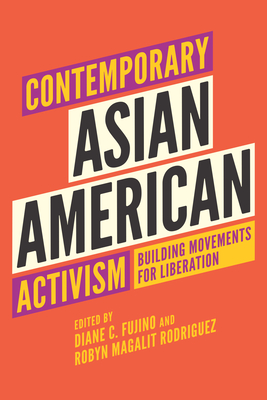
In the struggles for prison abolition, global anti-imperialism, immigrant rights, affordable housing, environmental justice, fair labor, and more, twenty-first-century Asian American activists are speaking out and standing up to systems of oppression. Creating emancipatory futures requires collective action and reciprocal relationships that are nurtured over time and forged through cross-racial solidarity and intergenerational connections, leading to a range of on-the-ground experiences.
Bringing together grassroots organizers and scholar-activists, Contemporary Asian American Activism presents lived experiences of the fight for transformative justice and offers lessons to ensure the longevity and sustainability of organizing. In the face of imperialism, white supremacy, racial capitalism, heteropatriarchy, ableism, and more, the contributors celebrate victories and assess failures, reflect on the trials of activist life, critically examine long-term movement building, and inspire continued mobilization for coming generations.
Diane C. Fujino's research and teaching interests center on Asian American social movements, Japanese American radicalism, Afro-Asian solidarities, race and gender studies, and biography and oral history. Her study of legendary activist Yuri Kochiyama developed into the first biography of an Asian American woman activist, Heartbeat of Struggle: The Revolutionary Life of Yuri Kochiyama (Minnesota Press, 2005), and a gendered analysis of leadership in an essay in Want to Start a Revolution: Radical Women in the Black Freedom Struggle. Her edited book, Wicked Theory, Naked Practice (Minnesota Press, 2009), examines the Afro-Asian influences on the music and Left politics of Fred Ho. Fujino's current project, Samurai Among Panthers, studies the life of Richard Aoki, a leader of the Black Panther Party, Third World strike at UC Berkeley, and Asian American Political Alliance. She published the first historiography of Asian American social movement studies in The Journal of Asian American Studies (2008). She has also published essays in a range of scholarly and activist journals and anthologies, including Social Justice, Journal of Men's Studies, AFRO/ASIA, Teaching Asian America, Dragon Ladies, and Legacy to Liberation.
Fujino is associate professor and chairof Asian American studies and an affiliate faculty member of Black studies at UC Santa Barbara. Before coming to UCSB, she earned her Ph.D. in psychology from UCLA, was an Institute of American Cultures postdoctoral fellow at UCLA Asian American studies, and a postdoctoral fellow at the National Research Center on Asian American Mental Heath.
This book is a really comprehensive overview and reflections of Asian American activists over the past 20-30 years. As the book's editors Diane Fujino and Robyn Magalit Rodriguez point out, there's a lack of research/literature done on Asian American activism post the 1960s/70s Asian American Movement.
Because of this, this anthology attempts to bridge that gap and build an archive of intergenerational knowledge by drawing on the diverse organizing experiences of many different people and communities. But because it is an anthology and has many diverse voices, it is harder to see an overall "narrative" throughout the entire text. Sometimes, it also felt like I was reading about pockets of activism scattered throughout the country that were loosely related, rather than a unified movement with a singular goal - which I guess isn't what the book was arguing for, but this still stood out to me nevertheless.
I also noticed that despite contextualizing modern day Asian American activism within the legacy of the Asian American Movement, some of the activists who the contributors interview/work with don't necessarily consider themselves as carrying the legacy of the 60s/70s Movement. I thought this was understandable because the Movement and the term Asian American today can still center East Asians, so people who aren't East Asian might not necessarily identify with the Asian American Movement.
Despite this, I thought most of the chapters in this collection were really good, and I felt they demonstrated the diversity and depth of Asian American activism since the 60s/70s, and how today's movement work can draw upon intergenerational knowledge. For example, I really liked the chapter about how Filipino activists in the SoMa district in San Francisco learned from elders who were part of the I-Hotel struggle in the 60s/70s to fight against the tech gentrification happening in the city. I also appreciated just reading the stories of activists like Eddy Zheng, whose story of advocating for Asian American prisoners while being incarcerated was so inspiring. The connections to international activism in the BAYAN USA chapter captured my attention as well, and I wished there were more chapters on the international connections! The reflection chapters near the end of the book by older activists felt grounding, and informative on how to continue movement building in a sustainable and community-driven way.
Overall, I'm very glad I read this book! It really does a good job demonstrating how current Asian American activism draws from the past to advocate for a more just and sustainable world today. I felt it really opens up the potential for more research to be done on Asian American activism in the current day.
I appreciated that this anthology covers actually contemporary Asian American activism. As someone who didn't understand the importance of ethnic studies until well after college, I was familiar with the AAM only in the concept of the coalition-building of the 1960s and 1970s, so reading these essays — which focus on the 1990s as well as on developments through the 2020s — has been extraordinarily informative.
Like any anthology, there are strong chapters and not-so-strong chapters. Highlights for me include:
・Chapter 1: Prison-to-Leadership Pipeline: Asian American Prisoner Activism by Eddy Zheng ・Chapter 3: The Streets of SoMa: Building Community and Displacement in San Francisco by Angelica Cabande ・Chapter 4: Dismantling the "Undocumented Korean Box": Race, Education, and Undocumented Korean Immigrant Activism for Liberation by Ga Young Chung ・Chapter 9: How Does It Feel to Be on the Precipice? ChangeLab, A Racial Justice Experiment by Soya Jung ・Chapter 10: On Movement Praxis in the Era of Trumpism by Alex T. Tom
The concept for this anthology originated at a 2019 symposium at the University of California, Santa Barbara, and so consequently, the movements and organizing that are highlighted are very primarily in California, with occasional instances in Hawaii, the Philippines, Chicago, and the East Coast (New York, Virginia). As an Asian American from and in Texas who has worked in Missouri and Georgia, I'm aware that AAPI organizing movements in the South, Southeast, and Midwest aren't as strong or as documented as those in the West and East Coasts. Without knowing what (if any) efforts were made to broaden the spread to ensure wider representation, it's disappointing to see these large swaths of the United States — where large and vibrant, as well as smaller yet mighty, AAPI communities exist — are left out. If anything, our being excluded further perpetuates our being overlooked or being misunderstood (e.g., as being complicit in sociopolitical dynamics stereotypical of our regions).
The work is important, and despite this continued state of being overlooked, I know progress is more important than perfection — a mindset well-articulated in Chapter 10. I hope that a future anthology is more inclusive.
great collection of stories from a handful of asian american activists. they reflect on their experience, their doubts and hardships of having a dissenting voice while having to work in this current economic system in order to survive, and what motivated their calls to action.
like this book points out at first, these are stories that mainly go untold. i appreciated this and look to use it as guidance/a resource in the future
thoroughly enjoyed this book, each chapter is written by an activist from a Asian American social justice movement. I would have loved more queer perspectives but overall it was a great, eye opening book that taught me more about movement building.