Set in New York City after the melting of the polar ice caps, an independent loner along with his cat and only friend, navigates the flooded city as he tries to live another day.
Each morning he sails in search of food, crossing paths with others from this makeshift community--from outsiders like himself to the depraved and ruthless elite--all struggling to maintain a sense of normalcy in a city drowned in its past. But everything changes when he encounters both a mysterious woman and a trapped blue whale. Will they be each other's salvation . . . or destruction?
An eco-fiction fable of epic proportions, POST YORK is an expansion of the Eisner nominated one-shot, and includes an environmental fact sheet, and other bonus material.
JAMES ROMBERGER is an Eisner-nominated cartoonist, fine artist and artist of the graphic novels 7 Miles a Second, The Late Child and Other Animals, Bronx Kill and Aaron and Ahmed.
"James Romberger...is in the highest horror-comics tradition."--The New York Times Book Review
"Romberger's art is a fine version of bony realism - his figures are so casually realistic, you can almost see the joints moving."--Entertainment Weekly
"James Romberger's Post York is a set of three alluvial nightmares that talk about what small changes can do in the New York we are heading to all too quickly. It makes one aspect of climate change distressingly real... it's good to see a fine artist drawing about it seriously."--Samuel R. Delany, Dhalgren and Through the Valley of the Nest of Spiders
"Told in a brutal use of light and shadow, this desolate tale of post-apocalypse sucker-punches you with...of all things...hope."-- Matt Kindt, Bang!, Ether, Dept.H
"Post York casts deep human drama against an epic canvas with wonderful artwork by James Romberger. Highy recommended."--Jeff Lemire, Sweet Tooth, Black Hammer and Old Man Logan
"(Post York is) beautiful on multiple levels. It shouldn't be this rare to see sequential art be so precise and open-hearted at the same time. We also shouldn't be seeing this world burn and drown, but here we are."--Ales Kot, Zero, Winter Soldier and Material
A short story about a young man living in a New York City flooded by melting polar ice caps. The story is told how three minor alterations could cause the story to veer in drastically different directions.
I didn't think the sequential art flowed that well. It was sometimes hard to pick up was happening between the panels or the intentions of the characters in the story themselves.
Received a review copy from Dark Horse and Edelweiss. all thoughts are my own and in no way influenced by the aforementioned.
Post York tells the story of Crosby, a young man, trying to survive a post-apocalyptic New York that has flooded because of climate change.
While he tries to find food, he comes across someone elses hiding place. That person isn't there, so he quickly steals some of their food, when he is attacked by the returning owner, a woman. In self-defense he kills her, and there the story splits - we get to read another the way the story could've played out, and even a third way.
I'm not entirely sure why this splitting the narrative occurs, my best guess would be it's a sort of faint echo of our time, when we could still make better choices to avoid the worst climate change-related damage (if that is even still possible..).
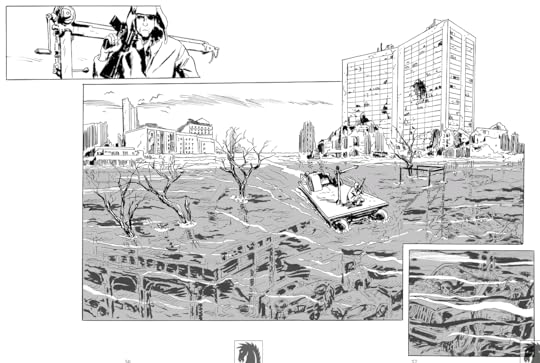
In the end, the story is not that interesting, it's the art that shines. Beautiful vistas of a drowned New York in stark black and white.
In the back of the book we find a pretty detailed fact-based projection what will happen to New York if we keep going down the path we are.
It also becomes clear that the character of Crosby is based on the artist's son of the same name. And here I found it to get a bit cringey.. Crosby, a visual artist himself, has written and recorded a rap track about the pending ecological doom, which you can find on Bandcamp. Personally, I thought it was kind of terrible, but of course your mileage may vary.
(Received an ARC from Berger Books/Dark Horse Books through Edelweis)
More art piece than actual work of literature, Post York explores one event in post-apocalyptic New York through three different timelines. The book felt like more of an excuse to illustrate a drowned city and work out a few downer plot ideas than anything substantial.
The afterword includes the author's interview with a climate change study regarding whether New York will survive another 100 years. Their conclusion seems to be an emphatic "No, we're all doomed as hell," which just adds to the general bummerness of the book.
So, we have three stories that are alternate versions of one story, about people living in New York City after the ice caps have melted. The constants in the stories are a young man whose only companion is his cat, who discovers someone's hideout in an old movie theater while out scavenging, the young woman that lives in said theater hideout, and a whale that becomes trapped within the city, as well as various secondary characters. Two of the stories involve the young man getting caught swiping canned food from the young woman's stash, with the story splitting off into two different endings, and the third story centers more on the other characters. The stories aren't bad, but they're not great either- they're okay. The art is nice; the stark black and white illustrations convey the desolation and decay of the crumbling city well. I'm not entirely sure why the narrative split into different takes, but I think it has to do with the publication history, a new ending for each publication, perhaps the author trying out alternate story lines. In the notes following the stories, we get a detailed explanation of the studies Romberger based his post-climate-change-disaster New York on, and find out the young man's character was based on the author's son. Tl;dr version: good, not great, but worth reading, with good art.
Set in a submerged, post-environmental apocalyptic New York, the slim book offers three parallel stories, variant takes diverging from a single situation. The artist has some skill, but there were many passages I found difficult to interpret, and the decision to offer divergent possibilities rather than developing a single story only left me detached from the narrative.
Well-intentioned as a warning about climate change, not as successful as a narrative.
A quick read with great black-and-white art. Set in a flooded New York City, a loner encounters a group of young people. There are no villains, but bad things happen in the struggle to survive.
There is such a great premise to explore here, but it is squandered on a gratuitous branching narrative that just takes up space, and a stifling feeling of self-importance.
(A version of this review was published, in German, in the Swiss comics journal STRAPAZIN.)
It’s probably not fair to impose our desires on the writers and artists whose work we love, but there are more than a few of them that I wish were more prolific. In comics my list includes, among many others, Martin tom Dieck, Anke Feuchtenberger, James Romberger, Max, David Mazzuchelli, Dave McKean, Anna Sommer, Art Spiegelman, and James Sturm. (Who’s on your list?)
Romberger may be the least familiar name of the above. He is best known for Seven Miles a Second, the superb memoir he created nearly thirty years ago with and about his friend the artist and activist David Wojnarowicz, originally published by DC’s Vertigo imprint. While graphic novels about artists almost make up their own sub-genre these days, in 1996 Seven Miles a Second was a daring book (especially coming from an imprint mostly know for horror comics) that not only showed how remarkable Wojnarowicz was as an artist and person but also stood in its own right as a beautiful and daring work of visual art by Romberger.
For years Romberger has been teasing his latest work, Post York, on Instagram, with a panel here or some news about the production process there, but creator maintained an air of mystery around what the book was about. Sections apparently appeared in 2009 as part of a piece of performance art (I didn’t see it), and it wasn’t until earlier this year that the full graphic novel appeared from Dark Horse Comics.
I’m not going to spoil the story, but then there’s not really much of story and the story isn’t really the point. Post York, as the title suggests, take place in post-apocalypse New York City at some unnamed time in the (near) future, when climate change and rising sea levels have nearly sunk Gotham. However, a detailed appendix showing his research sources notwithstanding, Romberger seems less interested in the grand scale of such a disaster and more in what everyday life might be like for a few survivors in this new world. And, in fewer than 100 pages and via a nifty narrative trick, Romberger imagines how his characters’ choices and actions might lead to different outcomes—and in doing so perhaps subtly asks his readers to reflect on how our own choices as a society might or might not place us into the terrible future of the graphic novel.
In Post York Romberger imagines that potential future in poetic comics pages with little text and no consistent or ordered structure. Panels float across pages like sheets of paper across the surface of water, often challenging the reader to decide the reading order. And the drawings themselves are as gestural, evocative, and liquid as anything this side of Edmond Baudoin, with expert use of grey tone often deployed in unexpected ways. Even if you’ve been dulled to “disaster porn,” some of these images of Manhattan barely keeping its head above water will stick with you long after you close the book.
Post York reminded me why Romberger earned his place on my list of favorite unprolific cartoonists, and this one was worth the wait.
8+ Climate change is changing the world as we speak (and not for the better). For the past decades we knew it happened, but as the consequences were not catastrophic yet (plants flowered earlier and some polar bears drowned) and far right think tanks and oil companies spread fake information, collectively the world didn't think it worth taking action. This year, seemingly suddenly, there are forest fires everywhere, extreme ocean temperatures, giant hail in Italy, heat domes in Asia and the US. It is made worse by other weather events, but it's clear this year a threshold has been passed. Will our society take action now? To combat the misinformation spread by the aforementioned climate change deniers (and their stories that a) this is natural or b) it's too late to do something anyway), we need powerful storytelling to convince people of the impact climate change has on ecosystems and society and of the importance of taking action (even to prevent 0.1 degree of temperature rise will save lives - and species). In literature there is cli-fi to be found and especially in SF climate change features regularly, but in comic books, TV-series, movies and computergames climate change is not yet featured regularly. Even in indie comic books I don't often encounter stories seriously dealing with climate change (the absolutely fantastic The Massive by Brian Wood is an exception). So I was glad to find this story, 'Post York', that deals with young people surviving in a flooded New York. The artist gives us three possible stories that all divert from the same point in time and feature the same elements (like a trapped whale). None of the three stories have a truly happy ending. The stark black and white art conveys the bleakness of the situation. The bleak sense is helped by the negative space on most pages, suggesting a future where story and the possibility of meaning is leaking out of the world (there's no longer place for art, only survival). A young artist makes a mural of a woman with a baby (that will be flooded soon and suggests hope for the future is illusory) while rich people come together in destructive 'performance art' - destroying even more of the life and meaning that's left in the world. At the end there's an interview about climate change and how that would affect New York - and reality is even more bleak than the story itself. This may not be a masterpiece, but I applaud the conviction of the artist to deal with climate change. I would hope more creatives would start to tell stories about the most imporant threat our world faces (and it's fertile ground for imagination, as it is coupled with other subjects like extreme right ideology, late stage capitalism and wealth distribution across the world).
Multiverses are so hot right now! I'm always in for alternate endings/realities in stories. I spend way too much time pondering what ifs: what if I hadn't parked there and gotten a ticket? What if I wasn't where I was when I met my partner? What if I hadn't had that whole pizza for lunch?
When this story gets twenty pages (or so) in, and the page turn has a large "OR?" on the facing page, I was fully engaged. Unfortunately, I feel like the story doesn't fully come together in the end. It really bothered me that we spend so many pages following the dead body of what is for the majority of book the lone female character who is murdered, dismembered and disrobed, and it just felt exploitative. From there I felt like the story took a turn that seemingly betrays the premise I was so excited for. A murder-revenge and animal abuse story was not it.
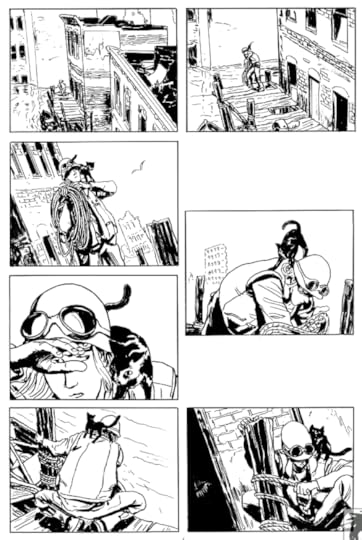
But the art is spectacular in its detail and also in its messiness. I think with a story in a flooded world, the term "muddy" isn't necessarily a perjorative to describe the artwork. We spend so much time -- almost that entire first twenty pages -- without there being any dialogue and wide panoramas of the skeletons of high-rises protruding from the mire of a flooded planet. That, I think, makes this book recommendable.
This entire review has been hidden because of spoilers.
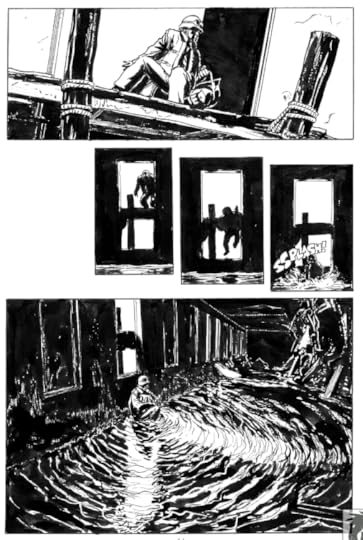
James Romberger criou está história pensando em seu filho Crosby. Com uma preocupação genuína com o futuro do nosso planeta e das próximas gerações, Romberger constrói uma Nova York pós-apocaliptica, devastada por uma catástrofe climática, onde o protagonista Crosby tenta sobreviver em uma cidade destruída pela invasão de água das calotas polares que derreteram. O que achei interessante nessa graphic novel é que ela não é uma narrativa única, mas uma reunião de hipóteses, onde cada capítulo mostra como seria em futuros alternativos ou com algumas escolhas diferentes. Também é muito interessante que o Crosby real, que é um designer e músico, mais precisamente um rapper, fez a arte conceitual que inspirou a arte da graphic, além de compôr um trap inspirado na obra. A hq traz a letra da música de Crosby e ela complementa e torna a experiência mais completa. Os traços lembram esboços da realidade. É uma graphic em preto-e-branco, mas que usa muito sombreado e a coloração preta, o que escurece os quadros e dificulta a visualização de algumas imagens. O inglês não é muito difícil e a história não traz muitos diálogos, então uma pessoa com inglês intermediário consegue ler de boa.
Vamos começar pelo óbvio; é em preto e branco, tem pouquíssimos diálogos. Nova Iorque, pós apocalipse ambiental, a cidade inundada, pessoas sobrevivem andando de barquinho, saqueando o que restou da cidade e, claro, pescando. Até aí, tudo bem. Um carinha sai a procura de algo útil e, dentro de um cinema, encontra um gerador e umas barrinhas de comida; no cinema, mora uma menina, os dois se encontram e saem na porrada. Ela morre, ele se culpa, uns amigos dela buscam vingança. Dá uma merda geral. "Ou..." Aí ele conta a história de novo, com uma pequena diferença, quase como um "What If" da Marvel. E de novo. E de novo. Acho que umas quatro ou cinco vezes, com pequenas diferenças no seu desenvolvimento que nos mostram quem ele é e quem ela é, também envolve uma baleia e um gato, mas eu não vou dar spoiler. O traço é muita mais fino e fluído do que a primeira referência que eu tive - um guri num barco de madeira navegando por uma cidade inundade é o Kamandi do Velho Jack. O traço, os detalhes, a maneira como um quadro - e uma história - se envolve com a anterior é muito bem feito, realmente impressionante. E tava por uns dois reais, então não tem muito erro.
The Ice Caps have melted and flooded New York city. Now the remaining survivors have to navigate through this post apocalyptic world.
I kind of picked this up on a whim after thumbing through it and liking the art style. And while I still do like the sketchy and semi messy line work - because it does really add to the overall tone of the story - I feel like the art was not good enough to make this good an interesting read for me. I mean don't get me wrong, its not absolutely terrible, but to me, there was no point in this book other than to show you the state of things after the ice caps melt. I mean, there's kind of a goal that our main protagonist tries to achieve, but for the most part its just a glimpse into the life of these people.
And while I did like the style of the art in the book - its just too messy at times. And it's not the artwork itself per say, it was the positioning of the panels sometimes. The order of how you were supposed to read things is not clear - and it really broke me out of the story.
This book certainly had potential, but completely missed the mark for me personally.
Post York features a post-apocalyptic version of New York City, where the various skyscrapers emerge above the flooding waters that have now submerged the populace. Amidst the ruins is Crosby, a loner who uses his boat and scuba gear to navigate the treacherous ruins and scavenge for resources. Crosby's journey quickly turns violent leading to Crosby killing someone in self-defense. The narrative switches to alternate events, a choice which remains fairly obscured all the way until the end.
There really isn't much meat to this comic though Romberger's illustrations are quite enticing. There are moments where things appear a bit unclear, but overall Romberger does a great job crafting the environment of Post York. The mostly wordless sequence is the highlight for sure, as the remaining story that follows doesn't really captivate as much. The end warns of the impending doom imposed upon us by climate change - a sentiment I whole-heartedly agree with - but here was very preachy in execution.
Conceptually phenomenal, I was blown away by the storyline then OR, then storyline, then OR, as the it went in the varied ways that we all wish things could be rewound and done again whether intentionally or unintentionally which is the case with our protagonist, living in a post-apocalyptic New York that has been overrun with water and survival is important. The intersection of animal (the whale) and man (and woman) was captivating and while some of the black and white scenes were thickly drawn are thus harder to make out, as a whole I will love recommending this scifi action/adventure and commentary on the human condition.
This comic focuses on Crosby, a survivor in a flooded, apocalyptic NYC. He finds the hideout of another survivor in an abandoned movie theater and from there the comic diverges into three different timelines from this singular event. I like the art style and I think the world building is very interesting. However, that’s probably about it. I think it was a missed opportunity to not pick one storyline and really dig into it, especially since this comic is so short. I read it in less than an hour. Also, the layout is a bit confusing. I wasn’t really sure which order to read the panels at times. Overall, not bad, definitely some great potential here, but mostly skippable.
I believe the multiple diverging narratives here are symbolic of how climate change, and how every action can have long reaching, often unintended consequences. However it didn't work for me as well as I hoped as I wasn't really invested in any particular character or storyline.
Great artwork & visual storytelling though. I really enjoyed the first story that featured very little dialog and was told mainly through imagery.
Definitely cool. Good black-and-white art. Pretty decent afterword, which kind of rescues the book. Because the story is mostly incoherent. And that's before you consider that it has at least two, maybe three paths - which is hard to tell. There is casual and accidental violence. And a whale. And a cat. I liked this perhaps a bit more than it deserved. But it definitely wasn't a working whole. 3.5 of 5
"Man is an invention of recent date. And one perhaps nearing its end. . . to be erased, like a face drawn in sand at the edge of the sea”--Michel Foucault
A black and white comic book that expands from a one-shot that had been nominated for an Eisner, written and drawn by James Romberger (7 Miles a Second, that I was impressed by). I'm impressed by this one, too, but it's a little confusing to me (so far? or is it done?). It's pen and ink, and opens with 18 pages with no words--which I always love in a comics series--focused on one survivor of the climate apocalypse that became fully ignited with the complete meltdown of the polar icecaps and unprecedented sea rise (I mean, as if that will ever happen, ha!).
It features three different dystopian endings of a story involving several survivors sometimes interacting, sometimes less than usefully, even violently, and sometimes usefully and hopefully. There's lots of sea creatures like whales and other big fish and mammals in it. I found out it is also a multi-media production, so there's a song connected to it by Crosby (not David Crosby, RIP!):
Fantastic concept, but poor execution. It was several versions of similar events and was just confusing overall and hard to really connect with the characters. The illustration style needed more text or more panels to get the feeling of what was happening.
Interesting to read during the pandemic when NYC is experiencing flooding in subways and beyond…
Romberger is a terrific, moody artist, as always. The story itself - all three of them, actually - are just okay. I'm terrified by the impending reality of a flooded NYC, but the survivors depicted here struggling to get by aren't really very compelling, which sort of loses the desperation of preventing their future from coming to pass.
Romberger makes such great use of white space and gutters to create a sense of movement and the passage of time. Loved the forked, open structure of the story and the way that injects a sense of hope and possibility into a pretty dire story.
Aventuras numa Nova Iorque semi-submersa pelo aquecimento global. As personagens passam um pouco ao lado, não conseguimos estabelecer empatia com elas, o livro fica-se pelas paisagens urbanas arruinadas no oceano.
Not what I thought it was going to be. It's very indie and more experimental than just telling a "post-flood" future. Not totally sure I'd recommend this full-stop, but the end fact sheet is definitely worth a read.
Artwork is dark and gloomy, by design, but also messy which makes it hard to work out what is happening. I found the story cliched and didn't really enjoy it very much.