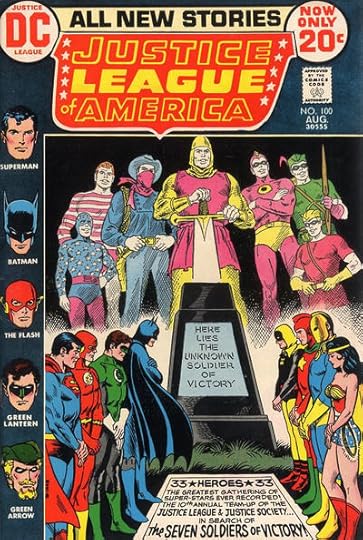
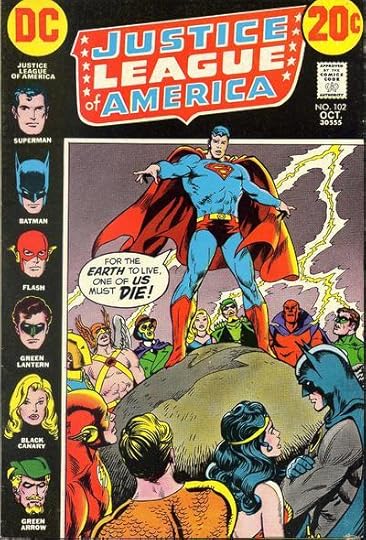
And so we come to the annual JLA/JSA cross-overs of 1971 through to 1974. The first of these four crossovers is written by Mike Friedrich, while the other three are from the pen of Len Wein. Having read all of these crisis/crossover books, it is a relief and a pleasure to be able to say that the quality established by Denny O'Neil is, if not equalled exactly, then at least not dropped back to Gardner Fox levels of inane.
Are these stories slight and silly? They sure are, but there is finally a differentiation between characters, and a sense that the Justice League exists within a wider DC universe that can be engaged in outside of these particular books.
As background (repeating a paragraph I wrote for Volume 2), the superhero craze of the ‘30s and ‘40s had died out by the onset of the ‘50s except for a few of the big hitters like Superman and Batman. Comics had largely moved on to westerns, romance and other genres. But DC editor Julius “Julie” Schwartz had the idea to revive the old superhero line and in 1956 started to bring them back but in new garb. He kept the name and general idea (Flash is the fastest man alive) but otherwise started anew. Audiences were once again introduced to these powered vigilantes and somehow, it worked a treat and superheroes took off again.
The Justice League was formed and then in 1961 writer Gardner Fox added a brilliant new twist when he had the Flash vibrate through the dimensional barrier to “Earth Two”. There all the original heroes of the '30s and '40s were alive and kicking as the Justice Society of America and readers learned that those old 1930/40s adventures weren’t wiped away - they had happened on another earth which our current heroes could go visit.
These days, multiverse stories are so common (Gardner Fox has a lot to answer for), it may seem hard to understand what the fascination was but there was a big audience for these crossovers; people loved seeing the old iterations team-up with their familiar Justice League heroes as these cross-overs became an annual event between 1963 and 1984.
Why did they end?
As writers kept adding more and more earths to play in, partly to find new angles and partly as DC bought other publishers like Fawcett and the rights to their characters, the whole edifice became unwieldy and it was resolved to shrink it down to one earth through 1984’s "Crisis on Infinite Earths".
The need for this re-boot is clearly planted here. Mike Friedrich's two-parter from 1971 ("Earth - The Monster Maker" and "Solomon Grundy - The One And Only") is the weakest of the bunch - an alien race which has co-evolved with another species so that they must be in constant contact or they each will die - sort of like a pet you really can't be away from. A child of this species and their pet are each thrown into Earth One and Earth Two and the countdown is on to find them. It's terribly silly but Friedrich just about gets away with it by infusing some rudimentary character beats (LIke the two Robins feeling like they always need to prove themselves) and a weak attempt at profundity in his narration which talks through all of the things which have found a partner or balance in our world. You can see how writers were struggling to come up with new reasons for the League and Society to interact and struggling to develope anything meaningful from interactions which only occurred once per year.
Wein writes the remaining three crossovers ('72 to '74) and his immediate answer to this is to inject more forgotten super-teams. The three part story from 1971 (Which included the 100th issue so had to be big) ("The Unknown Soldier of Victory", "The Hand That Shook The World", and "And One Of Us Must Die!") (re)introduces the Seven Soldiers of Victory who had appeared in DC's "Leading Comics" in 1941 and combined some of DC's lesser known heroes like The Shining Knight and The Vigilante. Wein makes it work because the plot embraces, as a central element, that no one remembers the Seven Soldiers though the summoning of the cosmic being, Oracle, to explain things is an incredibly easy out for a writer who should have worked harder to get the super-teams up and running.
The use of the Seven Soldier's original first nemesis is.a nice touch but the eye-rolling I did when I realised that the "hand that shook the world" is not a metaphorical one but an actual hand was hard. (Where the does hand end?)
1973's two parter attempts to repeat the trick by introducing us to The Freedom Fighters - a bunch of heroes from a publisher called Quality Comics who had folded in the early 1950s and which had been bought by DC. The Freedom Fighters were a group dedicated to fighting the nazi menace, even after it had won World War II and taken over the globe. None of the Freedom Fighters gets much to do here. All we really learn is that Uncle Sam speaks like a distinguished Southern gentleman , and Black Condor can be kind of a dick. But that's it. There was a moment where I thought they were going to do something interesting and make the Freedom Fighters the bad guys - or at least heroes who had lost their way after fighting evil for so long - but no, that was just the Hitler android with another trick up it's sleeve. These guys were popular enough to get their own comic series a few years later though, based on the evidence here, it was surely the hook of a world after a victorious Germany had conquered it that got people curious, and not these anonymous empty costumes. Wikipedia tells met that that series had them cross over into Earth One in the first issues and spend the remaining issues on the run. They wasted the hook!
The final crossover, from 1973, is a one issue story ("The Creature in the Velvet Cage") and it actually works pretty well. It's small in scale, delaing with a secret that Earth Two hero The Sandman has been keeping; namely that he has been his former ward and sidekick, Sandy, (I know) imprisoned due to his having been exposed to some crazy substance in an explosion and becoming a monster. Sure, there's some silly fighting with the super team members mixing it up so we can see them interact but it is the guilt that The Sandman feels which is what sticks in the mind after reading. Proof again that the stakes don't always have to be the universe; a man's view of himself is more than enough.
Overall, this was a fun and pleasant read. Reading these old comics is part of my own project to understand more of the history of the characters, the DC universe and how comics evolved and it is certainly good for that. Although the writing and the awareness of the medium's strengths and limitations continues to grow, these stories remain fairly slight and inconsequential - if amusing. It is their historical value that makes them most interesting.
Though maybe a four or five year old would find them gripping. Hmmmm.