

What do you think?

Female Husbands
Long before people identified as transgender or lesbian, there were female husbands and the women who loved them. Female husbands - people assigned female who transed gender, lived as men, and married women - were true queer pioneers. Moving deftly from the colonial era to just before the First World War, Jen Manion uncovers the riveting and very personal stories of ordinary people who lived as men despite tremendous risk, danger, violence, and threat of punishment. Female Husbands weaves the story of their lives in relation to broader social, economic, and political developments in the United States and the United Kingdom while also exploring how attitudes towards female husbands shifted in relation to transformations in gender politics and women's rights, ultimately leading to the demise of the category of 'female husband' in the early twentieth century. Groundbreaking and influential, Female Husbands offers a dynamic, varied, and complex history of the LGBTQ past.
342 pages, Paperback
First published February 28, 2020
About the author
Jen Manion
5 books19 followersJen Manion is a social and cultural historian, author, and professor of History and Sexuality, Women's and Gender Studies at Amherst College. Manion is the author of Female Husbands: A Trans History and Liberty's Prisoners: Carceral Culture in Early America.
Ratings & Reviews
Friends & Following
Create a free account to discover what your friends think of this book!
Community Reviews
Displaying 1 - 30 of 189 reviews

March 18, 2020
Jen Manion gives us a fresh and meticulous reconstruction of the lives, heartbreaks, and resistance of the group of people best known in the 18th and 19th Centuries as female husbands. Female Husbands: a Trans History follows on smoothly from the work of excellent recent trans history studies books like Emily Skidmore's True Sex: The Lives of Trans Men at the Turn of the 20th Century, Clare Sears' Arresting Dress: Cross-Dressing, Law, and Fascination in Nineteenth Century San Francisco, and C. Riley Snorton's Black On Both Sides: a Racial History of Trans Identity, which have done a huge amount of work pushing back beyond the earlier histories of trans people that situation trans as a post-1930s, largely white phenomenon.
As a trans historian, I'll be referring back to Female Husbands a great deal. My only critique is the author's choice to use they/them pronouns for all female husbands throughout the book. Manion gives detailed explanation as to why this choice was made, and in some cases it makes a lot of sense, but as a reader you're left feeling as though the book misgenders quite a number of the people studied by disregarding the male identity they fought so hard to embody. Still, this highlights how the question of pronouns with trans people backwards in time is contentious even among queer and trans scholars, and I don't think this is a reason to disregard what is otherwise a fantastic, perhaps even canonical, addition to historical trans studies.
As a trans historian, I'll be referring back to Female Husbands a great deal. My only critique is the author's choice to use they/them pronouns for all female husbands throughout the book. Manion gives detailed explanation as to why this choice was made, and in some cases it makes a lot of sense, but as a reader you're left feeling as though the book misgenders quite a number of the people studied by disregarding the male identity they fought so hard to embody. Still, this highlights how the question of pronouns with trans people backwards in time is contentious even among queer and trans scholars, and I don't think this is a reason to disregard what is otherwise a fantastic, perhaps even canonical, addition to historical trans studies.
January 2, 2021
To be honest... I didn’t finish. I got about 30 pages in and then skipped ahead to see if it got any better and realized it didn’t.
The title is misleading. Maybe “Female Husband: A Queer History” or “Female Husband: What women had to do to get ahead” or “Female Husband: History of Breaking gender norms”
The use of They/Them pronouns is only because the author cannot assume how these people preferred as there seems to be nothing she found from the perspective of her topic of research. It seems she only found outsider (wives, in laws, courts, media) but nothing directly from a “female husband”. Which.... is a term that makes my blood boil as a trans man (and husband). I understand it was a term coined in THE LATE 1700s but.... we are centuries past that time now... there’s got to be something better.
This read like a college thesis: a lot of “in this book/section/chapter I will discuss ....”
“here’s kind of a thing but we’ll get to that later in the book/I’ll discuss further later” so if you like that sort of thing, dig in, college lectures were not my cup of tea.
I found it to be more about how females felt the only way they could get ahead was to “pretend” to be male. There is no evidence in the sections I read (and I skipped around quite a bit to check) that says any of these people were actually transgender (as would be implied by the title of the book). Just, as the author says, “transing genders” to get what they want, which is not the same and paints a very bad picture for real transgender people.
If you want to learn about actual transgender history... look elsewhere.
The title is misleading. Maybe “Female Husband: A Queer History” or “Female Husband: What women had to do to get ahead” or “Female Husband: History of Breaking gender norms”
The use of They/Them pronouns is only because the author cannot assume how these people preferred as there seems to be nothing she found from the perspective of her topic of research. It seems she only found outsider (wives, in laws, courts, media) but nothing directly from a “female husband”. Which.... is a term that makes my blood boil as a trans man (and husband). I understand it was a term coined in THE LATE 1700s but.... we are centuries past that time now... there’s got to be something better.
This read like a college thesis: a lot of “in this book/section/chapter I will discuss ....”
“here’s kind of a thing but we’ll get to that later in the book/I’ll discuss further later” so if you like that sort of thing, dig in, college lectures were not my cup of tea.
I found it to be more about how females felt the only way they could get ahead was to “pretend” to be male. There is no evidence in the sections I read (and I skipped around quite a bit to check) that says any of these people were actually transgender (as would be implied by the title of the book). Just, as the author says, “transing genders” to get what they want, which is not the same and paints a very bad picture for real transgender people.
If you want to learn about actual transgender history... look elsewhere.

August 2, 2022
interesting examination and overview of European and American cases of “female husbands” and the delineation of lesbian, transmasculine, and other LGBTQ identities through a specific framework. A bit too general and unspecific at certain points

May 16, 2022
Well researched and goes into a lot of detail regarding the subjects of the book, but I was uncomfortable with some of the stylistic choices the author made.
The author is a non-binary butch lesbian, which was originally one of the things that drew me to this book, but after reading it’s clear that the author’s own gender identity results in a bias regarding the way they present the historical figures. The author chose to exusively use they/them pronouns for all the subjects, which may be a good choice in cases where we’re looking at historical figures from the 1800s and our only sources are fragmented third person accounts of their lives, but the author also uses they/them for people who were very clearly trans men. Among others the author misgenders Alan Hart who died in the 60s and was the first trans man to have a hysterectomy, or the Czechoslovak athlete Zdenek Koubek who was one of the more famous czech trans people and died in 1984. And the author dares to cite Leslie Feinberg to support this choice!
Also, a minor point, but the constant repetition of the phrase “transing gender” drove me slightly up the wall. To rely on this phrase so heavily felt quite lazy.
I recently read another book on transmasc people in the 1800s called True Sex by Emily Skidmore who took a different approach to the subjects of her book, refering to them all with he/him pronouns which were their pronouns of choice, but noting that of course in the present day they might have chosen to identify with a different gender. True Sex was written by a cis woman but honestly felt more respectful and less awkwardly worded than Female Husbands.
The author is a non-binary butch lesbian, which was originally one of the things that drew me to this book, but after reading it’s clear that the author’s own gender identity results in a bias regarding the way they present the historical figures. The author chose to exusively use they/them pronouns for all the subjects, which may be a good choice in cases where we’re looking at historical figures from the 1800s and our only sources are fragmented third person accounts of their lives, but the author also uses they/them for people who were very clearly trans men. Among others the author misgenders Alan Hart who died in the 60s and was the first trans man to have a hysterectomy, or the Czechoslovak athlete Zdenek Koubek who was one of the more famous czech trans people and died in 1984. And the author dares to cite Leslie Feinberg to support this choice!
Also, a minor point, but the constant repetition of the phrase “transing gender” drove me slightly up the wall. To rely on this phrase so heavily felt quite lazy.
I recently read another book on transmasc people in the 1800s called True Sex by Emily Skidmore who took a different approach to the subjects of her book, refering to them all with he/him pronouns which were their pronouns of choice, but noting that of course in the present day they might have chosen to identify with a different gender. True Sex was written by a cis woman but honestly felt more respectful and less awkwardly worded than Female Husbands.

May 14, 2023
we have always existed!!! ♡ ♡ ♡
yeah i transed my gender. what about it?
yeah i transed my gender. what about it?

October 11, 2020
Jen Manion’s Female Husbands: A Trans History is truly a great piece of research on a too underexplored part of history. Focusing on cases of individuals who were born as women and then lived as men in England and the United States throughout the 1700s to the early 1900s, there is a great deal of content to unpack.
Expressions of gender and sexuality in the 1700s were something altogether different from gender and sexuality in each subsequent century. This reality in and of itself makes it challenging to ascertain motivations for trans-ing gender, let alone what past individuals’ identities actually were. A woman (or someone assigned as a woman at birth) could dress and live as a man for so many reasons beyond gender affirmation. This includes seeking economic autonomy and mobility, wanting to marry a woman in peace, and even simply not wanting to marry a man. For so much of history, a woman’s entire livelihood was linked to the man she was married to, and the circumstances of a marriage were more often an imposition than a clear choice that women were privileged enough to get to make on their own. So for so many reasons, you could see women living as men.
Manion does great work that is respectful of these vague circumstances, delves into the complicated context of these choices, and does not rely on baseless speculation. Overall, this is a great book filled with fascinating stories, and I definitely recommend it if this is a topic you want to know more about.
Expressions of gender and sexuality in the 1700s were something altogether different from gender and sexuality in each subsequent century. This reality in and of itself makes it challenging to ascertain motivations for trans-ing gender, let alone what past individuals’ identities actually were. A woman (or someone assigned as a woman at birth) could dress and live as a man for so many reasons beyond gender affirmation. This includes seeking economic autonomy and mobility, wanting to marry a woman in peace, and even simply not wanting to marry a man. For so much of history, a woman’s entire livelihood was linked to the man she was married to, and the circumstances of a marriage were more often an imposition than a clear choice that women were privileged enough to get to make on their own. So for so many reasons, you could see women living as men.
Manion does great work that is respectful of these vague circumstances, delves into the complicated context of these choices, and does not rely on baseless speculation. Overall, this is a great book filled with fascinating stories, and I definitely recommend it if this is a topic you want to know more about.

April 7, 2025
Content warnings: transphobia, homophobia, misogyny, outing, forced institutionalisation, medical trauma, police brutality
A thoroughly informative and compelling read. Hands down my favourite part was the discussion of a trans man who joined the navy and all the other sailors on his ship were like "Shit, dude, what happened to your dick??" and he was like "Oh, it got bitten off by a shark in the South Pacific" and they were like "Fuuuuuuuuck, that's CRAZY TOWN. Sucks to be you... Anyway, welcome aboard!" Absolutely iconic.
A thoroughly informative and compelling read. Hands down my favourite part was the discussion of a trans man who joined the navy and all the other sailors on his ship were like "Shit, dude, what happened to your dick??" and he was like "Oh, it got bitten off by a shark in the South Pacific" and they were like "Fuuuuuuuuck, that's CRAZY TOWN. Sucks to be you... Anyway, welcome aboard!" Absolutely iconic.

November 18, 2021
When I saw the title of the book, I was reminded of an incident in my state, here in India, where a young woman transitioned to a man so that they can be with their lover.
I found the book very sometimes dragged which hindered my reading experience. Otherwise, it was an informative read.
I found the book very sometimes dragged which hindered my reading experience. Otherwise, it was an informative read.

March 27, 2025
Minus a star because at one point the author referred to corsets as restrictive. Otherwise, very thorough

February 8, 2020
I received this ARC from NetGalley in exchange for an honest review.
A fascinating look at a certain part of LGBTQIA+ history. It's easy in the Tumblr age to read short posts about certain historical figures and say "well they must've been trans" or "they must've been gay", but it's actually a lot more complicated than that. Manion delves into the relationship between gender and sexuality in an era when the terminology was very different - and a lot more restrictive.
The writing is quite academic, but Manion makes it easy to connect with each "female husband" by following their lives and making them feel very real. The chronological set-up also allows Manion to easily link the past to the present. A dense book, but well worth reading.
A fascinating look at a certain part of LGBTQIA+ history. It's easy in the Tumblr age to read short posts about certain historical figures and say "well they must've been trans" or "they must've been gay", but it's actually a lot more complicated than that. Manion delves into the relationship between gender and sexuality in an era when the terminology was very different - and a lot more restrictive.
The writing is quite academic, but Manion makes it easy to connect with each "female husband" by following their lives and making them feel very real. The chronological set-up also allows Manion to easily link the past to the present. A dense book, but well worth reading.

September 5, 2022
This is a thorough document of a number of historical cases of people assigned female at birth (AFAB) who chose to live as men. The author relies mostly on news articles and court records, and a few instances where the "female husband" wrote a book about his/her/their experience "transing gender."
The subject is complex -- while we don't necessarily get strong insights into whether the "female husbands" experienced gender dysphoria or how they felt about gender, it's clear from their behavior after exposure in many cases. For example, the punishment for transing gender was often to require the offender to resume the clothing and roles of the gender assigned at birth.
In many cases -- the "female husbands" went right back to their assumed gender identity, clothing, life, business and community. In some cases, the "female husbands" made multiple transitions.
Manion analyzes the strategies for defense utilized by both the female husbands and their wives when death, divorce or other incidents exposed the anatomy of the female husband to official, medical or juridical scrutiny. In some cases, the wives claimed "ignorance" as a way to reestablish their reputation -- but in at least one case, the female husband, possibly with support of community, ensured that the wife was granted her share of their accumulated wealth/savings. In many cases, yes, going to war or work as a man granted people more financial opportunity and personal freedom -- but if it was as simple as wearing men's clothing to earn more money, more people would have done it.
The "female husband" permitted the pursuit of a specifically white male privilege -- AFAB people of color who transed gender often received much different treatment by the press, law and medical establishment.
Manion's work is an important review of mostly "non primary" resources -- that's to say, the inner thoughts and feelings of the "female husbands" are not available for review and therefore not included. Manion can't possibly know what these men believed or felt. The reactions of the press in the US and UK seem to have alternated and shifted as much as the tides of public opinion. As you will learn, gender, however, was not entirely determined based on anatomy as many of the female husbands were viewed as "male" due to the external factors of work, marriage (legal marriages), and clothing.
Early in the book, Manion states a decision to utilize "they/them" pronouns for the female husbands as a way of encompassing many aspects of gender -- presentation by the female husbands, as referred by the community / law / media which would use "she/her" in some cases but not in others.
Overall, I'm given the impression that the solidification of gender along a male/female binary was part of the growing dominance of a white, male overclass in the US & UK. As we face the challenges of white supremacy as a culture -- those arbitrary structures of gender are also being cast in a critical light. I've personally been confused by the way many people cling to gender as something important. As an AFAB person -- I cannot truly claim to feel strongly about any particular gender, but I know when I am being misgendered as a method of insulting and undermining who I am. Personally, I would prefer to not have to choose any gender and just ignore it altogether. A lot of people don't have that choice and many people don't question the choice. This book offers a lens on historical attitudes and perceptions of gender and provides a well researched number of subjects and their experiences, as best as the author can gather.
The subject is complex -- while we don't necessarily get strong insights into whether the "female husbands" experienced gender dysphoria or how they felt about gender, it's clear from their behavior after exposure in many cases. For example, the punishment for transing gender was often to require the offender to resume the clothing and roles of the gender assigned at birth.
In many cases -- the "female husbands" went right back to their assumed gender identity, clothing, life, business and community. In some cases, the "female husbands" made multiple transitions.
Manion analyzes the strategies for defense utilized by both the female husbands and their wives when death, divorce or other incidents exposed the anatomy of the female husband to official, medical or juridical scrutiny. In some cases, the wives claimed "ignorance" as a way to reestablish their reputation -- but in at least one case, the female husband, possibly with support of community, ensured that the wife was granted her share of their accumulated wealth/savings. In many cases, yes, going to war or work as a man granted people more financial opportunity and personal freedom -- but if it was as simple as wearing men's clothing to earn more money, more people would have done it.
The "female husband" permitted the pursuit of a specifically white male privilege -- AFAB people of color who transed gender often received much different treatment by the press, law and medical establishment.
Manion's work is an important review of mostly "non primary" resources -- that's to say, the inner thoughts and feelings of the "female husbands" are not available for review and therefore not included. Manion can't possibly know what these men believed or felt. The reactions of the press in the US and UK seem to have alternated and shifted as much as the tides of public opinion. As you will learn, gender, however, was not entirely determined based on anatomy as many of the female husbands were viewed as "male" due to the external factors of work, marriage (legal marriages), and clothing.
Early in the book, Manion states a decision to utilize "they/them" pronouns for the female husbands as a way of encompassing many aspects of gender -- presentation by the female husbands, as referred by the community / law / media which would use "she/her" in some cases but not in others.
Overall, I'm given the impression that the solidification of gender along a male/female binary was part of the growing dominance of a white, male overclass in the US & UK. As we face the challenges of white supremacy as a culture -- those arbitrary structures of gender are also being cast in a critical light. I've personally been confused by the way many people cling to gender as something important. As an AFAB person -- I cannot truly claim to feel strongly about any particular gender, but I know when I am being misgendered as a method of insulting and undermining who I am. Personally, I would prefer to not have to choose any gender and just ignore it altogether. A lot of people don't have that choice and many people don't question the choice. This book offers a lens on historical attitudes and perceptions of gender and provides a well researched number of subjects and their experiences, as best as the author can gather.

April 4, 2020
I was disappointed by this book. Yes, it is a history of female husbands; however, I had hoped for more insight into the husbands themselves instead of second hand external views of them. Story after story were about how they were viewed in court trials, by newspapers, and sometimes by individuals around them. Never by the female husband themselves. The author states at one point that "We are left to read between the lines and draw conclusions." Later she states that she chose to focus "on the perceptions and views of others" regarding female husbands. Ms. Manion states she did that because gender is constituted by those around them. I disagree. I would rather have empowered them and known how they felt and their motivation. Additionally, I finished the book feeling that these people assigned as females at birth but presenting as males were doing so more for economic reasons rather than a gender disparity. I can not recall anyone in the book stating they were born the wrong gender. A lot of assumptions were made in this book like a lot of assumptions are made now. I was hoping for something more.
Thanks to NetGalley and Cambridge University Press for a copy of the book. This review is my own opinion.
Thanks to NetGalley and Cambridge University Press for a copy of the book. This review is my own opinion.
December 23, 2025
this one took me so long to finish—not because it was bad or uninteresting, but because there was so much on each page. this was so dense. but what a highly researched, immaculate piece of writing on trans history. despite this being a work of nonfiction, manion’s voice came through, and i feel like i know them. manion is always one to treat these historical figures with kindness, care, and understanding for the social, political, and economic forces acting upon them and to never impose modern modes of categorization (lesbian, transgender, nonbinary, etc) on these figures for whom these categories did not exist yet. required reading!!!
i leave you with this:
“These accounts—like our lives—are marked not only by resilience, love, and joy but also vulnerability, loneliness, and conflict. This piece of LGBTQ history has been written and cannot be erased. It is true and it belongs to us.”
i leave you with this:
“These accounts—like our lives—are marked not only by resilience, love, and joy but also vulnerability, loneliness, and conflict. This piece of LGBTQ history has been written and cannot be erased. It is true and it belongs to us.”

January 7, 2022
To see more reviews check out MI Book Reviews.
I got an ARC of this book.
I have studied gender both professionally and personally for most of my life. Gender and sexuality are my two biggest research loves. I have never hidden this and I never will. This book sounded perfect for me. The title promises a TRANS history of something that has always been talked about as a lesbian history in the LGBTQ focused classes I was able to take and in the text books those classes assigned. Lesbian and trans are not mutual exclusive, but there has been friction in the communities for various reasons for decades. So I was interested to see this. I thought it would be a lot like True Sex.
Instead, the author took every chance to make this about lesbian history. If this were titled “Female Husbands: A Lesbian History” I would be ALL OVER IT. It would be a great lesbian history. The author even goes a step further and talks about the wives of female husbands which I have never seen before. This was so cool. Instead I was left thinking the author had no idea what she was talking about quite often since the title is not represented in the book whatsoever. The author self identified in the middle of a history book by saying she was a butch lesbian, which 100% cool. I get that having an identity that is relevant can be important, so now I must say I am a trans man. I have an identity that according to the title is more closely aligned with the book’s content. This book is not a trans history. This is a lesbian history that often has places where it could and should be a trans history, but it is not a trans history.
The author uses trans as a verb, which didn’t sit right with me for various reasons. She explained this away by citing someone else who came up with the idea, but it still did not sit well with me. I am asked by cis people if I am transing when they mean transitioning. So the term is already loaded for me as a trans person. To then have it applied to gender role non-conformity for what the author repeatedly implies and flat out says are lesbians makes me even less comfortable with the world choice.
Pronouns in the book were also a bit weird. The author explains the use of they/them which I can really get behind, but then in the chapter that is about a trans man in a more modern time who explicitly said they were a man and lived stealth for many years, continues to use they/them felt a bit disrespectful. I did some digging and the author also says that asking for someone’s pronouns is harmful in a piece they published in 2018. She mentions how it is harmful to trans people to misgender them, but then says that asking for pronouns and making it safe for someone to say their pronouns should not happen. The more I read the less I want to know.
This book could have been amazing. It could have been a great history, instead is just read as transphobic. Yes, there is no way to know for sure if the female husbands reported are trans or lesbian or bi or whatever else they possibly identified as. But saying a book is a trans history then repeatedly denying the chance that there is trans in the history doesn’t sit right. The epilogue literally uses outdated language to refer to a trans man. The author repeatedly refers to the wives of the female husbands as being the hidden lesbian history that no one talks about. Some of the female husbands were very probably not binary in their gender, but the majority of the ones mentioned appeared based on reading the source materiel as binary. So there is no reason to keep insisting that the wives of these very potentially trans men are lesbians, except to erase the possibility of trans men. If trans was ever really allowed as an option for these female husbands, I could overlook so much of this. The idea that they could be trans comes up a few times, but then the author doubles down on the idea of lesbian for everyone involved.
This would be a one star book, but the history and the depth that the history of the female husbands’ stories are told is impressive. The two stars is literally just for the gathering of information of a biographer. The rest of the book is just awful. I feel bad even giving it two stars.
I got an ARC of this book.
I have studied gender both professionally and personally for most of my life. Gender and sexuality are my two biggest research loves. I have never hidden this and I never will. This book sounded perfect for me. The title promises a TRANS history of something that has always been talked about as a lesbian history in the LGBTQ focused classes I was able to take and in the text books those classes assigned. Lesbian and trans are not mutual exclusive, but there has been friction in the communities for various reasons for decades. So I was interested to see this. I thought it would be a lot like True Sex.
Instead, the author took every chance to make this about lesbian history. If this were titled “Female Husbands: A Lesbian History” I would be ALL OVER IT. It would be a great lesbian history. The author even goes a step further and talks about the wives of female husbands which I have never seen before. This was so cool. Instead I was left thinking the author had no idea what she was talking about quite often since the title is not represented in the book whatsoever. The author self identified in the middle of a history book by saying she was a butch lesbian, which 100% cool. I get that having an identity that is relevant can be important, so now I must say I am a trans man. I have an identity that according to the title is more closely aligned with the book’s content. This book is not a trans history. This is a lesbian history that often has places where it could and should be a trans history, but it is not a trans history.
The author uses trans as a verb, which didn’t sit right with me for various reasons. She explained this away by citing someone else who came up with the idea, but it still did not sit well with me. I am asked by cis people if I am transing when they mean transitioning. So the term is already loaded for me as a trans person. To then have it applied to gender role non-conformity for what the author repeatedly implies and flat out says are lesbians makes me even less comfortable with the world choice.
Pronouns in the book were also a bit weird. The author explains the use of they/them which I can really get behind, but then in the chapter that is about a trans man in a more modern time who explicitly said they were a man and lived stealth for many years, continues to use they/them felt a bit disrespectful. I did some digging and the author also says that asking for someone’s pronouns is harmful in a piece they published in 2018. She mentions how it is harmful to trans people to misgender them, but then says that asking for pronouns and making it safe for someone to say their pronouns should not happen. The more I read the less I want to know.
This book could have been amazing. It could have been a great history, instead is just read as transphobic. Yes, there is no way to know for sure if the female husbands reported are trans or lesbian or bi or whatever else they possibly identified as. But saying a book is a trans history then repeatedly denying the chance that there is trans in the history doesn’t sit right. The epilogue literally uses outdated language to refer to a trans man. The author repeatedly refers to the wives of the female husbands as being the hidden lesbian history that no one talks about. Some of the female husbands were very probably not binary in their gender, but the majority of the ones mentioned appeared based on reading the source materiel as binary. So there is no reason to keep insisting that the wives of these very potentially trans men are lesbians, except to erase the possibility of trans men. If trans was ever really allowed as an option for these female husbands, I could overlook so much of this. The idea that they could be trans comes up a few times, but then the author doubles down on the idea of lesbian for everyone involved.
This would be a one star book, but the history and the depth that the history of the female husbands’ stories are told is impressive. The two stars is literally just for the gathering of information of a biographer. The rest of the book is just awful. I feel bad even giving it two stars.
November 1, 2021
A truly incredible work of queer history, written with great academic rigor and a deep compassion for the historical figures discussed. I have a great respect for Manion's refusal to apply contemporary understandings/terminology to people of the past who transed gender. We simply don't know how these people would identify now, and the author's use of neutral pronouns throughout allowed for a respectful retelling of their stories. I am so glad the crucial work of queer history is being done by such a wonderful writer and researcher. A truly moving piece of writing.

July 29, 2024
Lipiec 2024 w moim koleżankowym klubie czytelniczym. Autorka śledzi artykuły prasowe XIX w., a dokładniej - notatki na temat żyjących wspólnie kobiet, z których jedna chce funkcjonować w społeczeństwie jak mężczyzna. Najczęściej podawany powód to właśnie ten: "chcę żyć jak mężczyzna, bo tak jest łatwiej". Okazuje się, że ludzi XIX w. ten argument był raczej zrozumiały, bo choć artykułu miały czasem charakter "michałków", to jednak dało się z nich wyczytać, że ludzie dawali im żyć.
Czy to książka o transach, czy o lesbijkach? Jedne historie przypominają to pierwsze, inne - to drugie. Czy jest to książka o gender? Jak powiedziała Kalina, to był XIX w., nie wiemy nic o ich życiu wewnętrznym. Mogli mieć je całkowicie inne od naszego, trudno tu zatem mówić o gender, czy o odkrywaniu queerów przeszłości.
A, jeszcze jedno! Poruszyło mnie to, że dość częstą krytyką wobec Female Husbands było: "bo wy próbujecie tak oszukać wszystkich. Przebrać się za kobietę lub mężczyznę, uniknąć więzienia, wyjechać nielegalnie". To jest dokładnie ten sam zarzut, który daje dzisiejsza prawica: "wystarczy, że chłop poczuje się babą i już może na wcześniejszą emeryturę". Sad.
Czy to książka o transach, czy o lesbijkach? Jedne historie przypominają to pierwsze, inne - to drugie. Czy jest to książka o gender? Jak powiedziała Kalina, to był XIX w., nie wiemy nic o ich życiu wewnętrznym. Mogli mieć je całkowicie inne od naszego, trudno tu zatem mówić o gender, czy o odkrywaniu queerów przeszłości.
A, jeszcze jedno! Poruszyło mnie to, że dość częstą krytyką wobec Female Husbands było: "bo wy próbujecie tak oszukać wszystkich. Przebrać się za kobietę lub mężczyznę, uniknąć więzienia, wyjechać nielegalnie". To jest dokładnie ten sam zarzut, który daje dzisiejsza prawica: "wystarczy, że chłop poczuje się babą i już może na wcześniejszą emeryturę". Sad.

November 6, 2023
This was heartbreaking and amazing at once. The cycle of people assigned female at birth choosing to trans and become men, while also choosing to marry women, living their lives, and then being discovered, usually in terrible circumstances, really depressed me after awhile. Honestly, I emailed the author, asking, “isn’t it plausible that a number of other people successfully transed until their deaths rather than all of them being discovered?” And the author conceded my point. Thank goodness. Otherwise this would have all been rather depressing.
Well written and I really enjoyed it.
More — > I especially liked the author’s focus upon treating gender as a *practice*. There were certainly narratives where people shifted situationally from one gender to another and backs again. The historiography of female husbands was thought provoking also. Is it historically accurate for lesbians to claim these people as their own? The 18th and 19th century heteronormative cultures wanted to put these people in certain categories (deviants, sexual inverts, et cetera), and where do we in the 21st century want to put them?
Well written and I really enjoyed it.
More — > I especially liked the author’s focus upon treating gender as a *practice*. There were certainly narratives where people shifted situationally from one gender to another and backs again. The historiography of female husbands was thought provoking also. Is it historically accurate for lesbians to claim these people as their own? The 18th and 19th century heteronormative cultures wanted to put these people in certain categories (deviants, sexual inverts, et cetera), and where do we in the 21st century want to put them?

August 14, 2023
Very interesting.
A deep and serious study that treats the subject with care and respect.
A deep and serious study that treats the subject with care and respect.

April 12, 2025
As a rule of thumb, academic writing can be difficult to understand because the author assumes the reader has a basic understanding of the material. This makes it harder to follow for those who are new to the topic. Despite my unfamiliarity with transgender history, I found the writing generally accessible. I rarely found myself unable to follow the logic or note the conclusion. Given this text’s academic nature I feel under-qualified to give praise or criticism. Instead, I will highlight the places where I think I learned the most.
Manion presents compelling examples of gender nonconforming people who lived long before “transgender” was a recognized term. Drawing from news articles and court transcripts, she highlights how female husbands were often arrested after being discovered to be biologically female. While no law explicitly forbade this, religious, legal, and social structures enforced punishment. Charges like disorderly conduct or vagrancy were deliberately vague enough to be applied in this way. Still, some individuals, even after public punishment and humiliation, chose to rebuild their lives elsewhere–demonstrating resilience and conviction in their identity. This is all to say that transgender people have always existed, even if they weren’t described using modern terms.
The book also explores how activist movements often excluded those who didn’t fit neatly into a particular cause. White feminism, for instance, sidelined gender nonconformity, despite the fact that female husbands broke the very same barriers that feminists targeted. At the same time, Manion acknowledges the ways some female husbands participated in colonial projects that reinforced the gender binaries they resisted. Anyone can work against their own interest.
In some cases, I found the use of they/them pronouns for all historical subjects somewhat limiting and rooted in the author’s own identity rather than an objective point of view. While intended to avoid imposing modern labels, this choice blurred how individuals understood themselves or were seen in their time. Applying this language retroactively risks reducing historical accuracy in favor of present-day frameworks, the exact thing Manion was trying to avoid. On the other hand, given that most transgender people were forced to detransition when they were discovered, it is understandable that the author avoids assigning identities that might not have aligned with how these individuals would have identified if they had been allowed to live freely.
[4 stars, hardcopy read]
[#15 of 2025 New Reads]
Manion presents compelling examples of gender nonconforming people who lived long before “transgender” was a recognized term. Drawing from news articles and court transcripts, she highlights how female husbands were often arrested after being discovered to be biologically female. While no law explicitly forbade this, religious, legal, and social structures enforced punishment. Charges like disorderly conduct or vagrancy were deliberately vague enough to be applied in this way. Still, some individuals, even after public punishment and humiliation, chose to rebuild their lives elsewhere–demonstrating resilience and conviction in their identity. This is all to say that transgender people have always existed, even if they weren’t described using modern terms.
The book also explores how activist movements often excluded those who didn’t fit neatly into a particular cause. White feminism, for instance, sidelined gender nonconformity, despite the fact that female husbands broke the very same barriers that feminists targeted. At the same time, Manion acknowledges the ways some female husbands participated in colonial projects that reinforced the gender binaries they resisted. Anyone can work against their own interest.
In some cases, I found the use of they/them pronouns for all historical subjects somewhat limiting and rooted in the author’s own identity rather than an objective point of view. While intended to avoid imposing modern labels, this choice blurred how individuals understood themselves or were seen in their time. Applying this language retroactively risks reducing historical accuracy in favor of present-day frameworks, the exact thing Manion was trying to avoid. On the other hand, given that most transgender people were forced to detransition when they were discovered, it is understandable that the author avoids assigning identities that might not have aligned with how these individuals would have identified if they had been allowed to live freely.
[4 stars, hardcopy read]
[#15 of 2025 New Reads]

March 3, 2020
This book is engrossing. It is a fascinating academic work on queer pioneers in the UK and US from the 18th to early 20th century. For a brief moment upon finishing, I had to remind myself I am in the 21st century.
Female Husbands reconstructed the life stories of female husbands, their wives, and others who were assigned female at birth and donned male attire without imposing modern terminologies or assumptions. The particular use of 'them/them' pronouns for these remarkable pioneers has made space for ambiguity since no modern person could ever be sure of their gender identity.
In addition to the life stories of Charles Hamilton, James Howe, James Allen, Albert Guelph, Joseph Lobdell, etc., the book supplied backgrounds of laws, social systems, and political aspects during the time. These details certainly helped paint a more complete picture of what it was like back then.
Though the structure could be more streamlined at times for a smoother read and clearer theme connections between consecutive chapters, Manion has done a wonderful job of piecing together the history. It is a book I did not know I needed.
Since all the iconic people mentioned have been outed at some point of their lives so as to fall under public scrutiny, I would like to think that there were a fair amount of female husbands and their wives who lived in relative peace and happiness until their deaths. I really hope there were. If not, at least we have fictional stories of Backwards to Oregon and Hidden Truths from Jae.
I received an e-ARC from Cambridge University Press via NetGalley in exchange for an honest review.
Female Husbands reconstructed the life stories of female husbands, their wives, and others who were assigned female at birth and donned male attire without imposing modern terminologies or assumptions. The particular use of 'them/them' pronouns for these remarkable pioneers has made space for ambiguity since no modern person could ever be sure of their gender identity.
In addition to the life stories of Charles Hamilton, James Howe, James Allen, Albert Guelph, Joseph Lobdell, etc., the book supplied backgrounds of laws, social systems, and political aspects during the time. These details certainly helped paint a more complete picture of what it was like back then.
Though the structure could be more streamlined at times for a smoother read and clearer theme connections between consecutive chapters, Manion has done a wonderful job of piecing together the history. It is a book I did not know I needed.
The transgression of a gender norm always opened the door to the threat of a sexual transgression.
Since all the iconic people mentioned have been outed at some point of their lives so as to fall under public scrutiny, I would like to think that there were a fair amount of female husbands and their wives who lived in relative peace and happiness until their deaths. I really hope there were. If not, at least we have fictional stories of Backwards to Oregon and Hidden Truths from Jae.
I received an e-ARC from Cambridge University Press via NetGalley in exchange for an honest review.

May 24, 2020
I enjoyed this book more than I had anticipated. I wanted to read it for the education, not because I thought it would be entertaining, but I was pleasantly surprised. This is the history of people who were assigned the female gender at birth but lived their lives as men and married women. "Female husbands" was the term that was used in the 18th and 19th centuries that pre-dated the labels "transgender" and even "lesbian." Manion is a historian by profession and has an interesting take on gender and its relationship to sexuality. The book is very academic, but if you have an interest in LGBTQ+ history, this would be a great addition to your library. *Advance copy provided by the publisher in exchange for my honest review.

Did Not Finish
January 18, 2020Unfortunately, I am DNF'in this at about 50%. While I find this subject fascinated and something I will certainly research more, I couldn't really connect with this particular book. It could be because the author's style doesn't work for me or because it was a badly formatted e-ARC.
August 4, 2024
A transatlantic (hehe) cultural history of transmasculine (and/or lesbian) individuals and their portrayals in (anglophone) press and the popular consciousness throughout the 1750-1900s. Manion's own term for what the titular subjects of their work did is "transing gender." I like it for its uncompromising acknowledgment of innate transgressiveness, the performance of gender asserted almost as its own self-defining. It can, however, get a bit repetitive and limiting as a term, and it creates a lot of confusion in verbal communications (a lot of confusion I realized, stumbling on an online talk that had Manion among its participants.)
Queer history allows for no unambiguous mapping; the just desire to document the erased has to contend with the limited historical record with its gaps and bias and the inconstant conceptions of gender/sex/sexuality, then and now. You have to interpret, to impose a reading. Something will be lost, this is an inevitability. The fluidity Jen Manion accents by their use of gender-neutral pronouns can read as erasive - perhaps egregiously so, towards its epilogue, where the same is applied to Alan L. Hart, who implacably identified himself as a man, lived for decades and was buried as such in 1962, which is basically yesterday.
Female Husbands felt analytically watery(?) to me. Manion kept pointing out occasions where the contemporary understanding of sex and gender were, the paradigms existing at the time breaking down, caught in paradoxes, when faced with living contradictions to them. Yet they never go far into them. Furthermore, the text keeps flirting with politic critique and acknowledgment of colonial context. At some points, as when delving into intersections between gender and economic relations through the Industrial revolution, Manion's insights can be incisive. Often, they struck me as vague gestures at broader critical scholarship lurking somewhere off stage left, acknowledgment that went nowhere.
Queer history allows for no unambiguous mapping; the just desire to document the erased has to contend with the limited historical record with its gaps and bias and the inconstant conceptions of gender/sex/sexuality, then and now. You have to interpret, to impose a reading. Something will be lost, this is an inevitability. The fluidity Jen Manion accents by their use of gender-neutral pronouns can read as erasive - perhaps egregiously so, towards its epilogue, where the same is applied to Alan L. Hart, who implacably identified himself as a man, lived for decades and was buried as such in 1962, which is basically yesterday.
Female Husbands felt analytically watery(?) to me. Manion kept pointing out occasions where the contemporary understanding of sex and gender were, the paradigms existing at the time breaking down, caught in paradoxes, when faced with living contradictions to them. Yet they never go far into them. Furthermore, the text keeps flirting with politic critique and acknowledgment of colonial context. At some points, as when delving into intersections between gender and economic relations through the Industrial revolution, Manion's insights can be incisive. Often, they struck me as vague gestures at broader critical scholarship lurking somewhere off stage left, acknowledgment that went nowhere.

December 5, 2024
I wasn't entirely immersed, but I enjoyed how informative this was. I didn't love the structure and I found in the audiobook format that I was thrown around a bit and had a difficult time keeping track of the era and location I was in. This book may be better suited for a physical read.
I did enjoy seeing how people of the past treated those who did not conform to gender roles and how hard people would try to fit people into boxes. I particularly loved seeing how ideas of what makes a man or a woman have changed over time. I love the fluidity of gender and how arbitrary it all is. One sequence stood out: a man is called a female husband by his newly wedded wife because he is poor and disabled and she wishes to cause a stir to divorce him. He wasn't AFAB, but his lack of characteristic "male" traits made him "female".
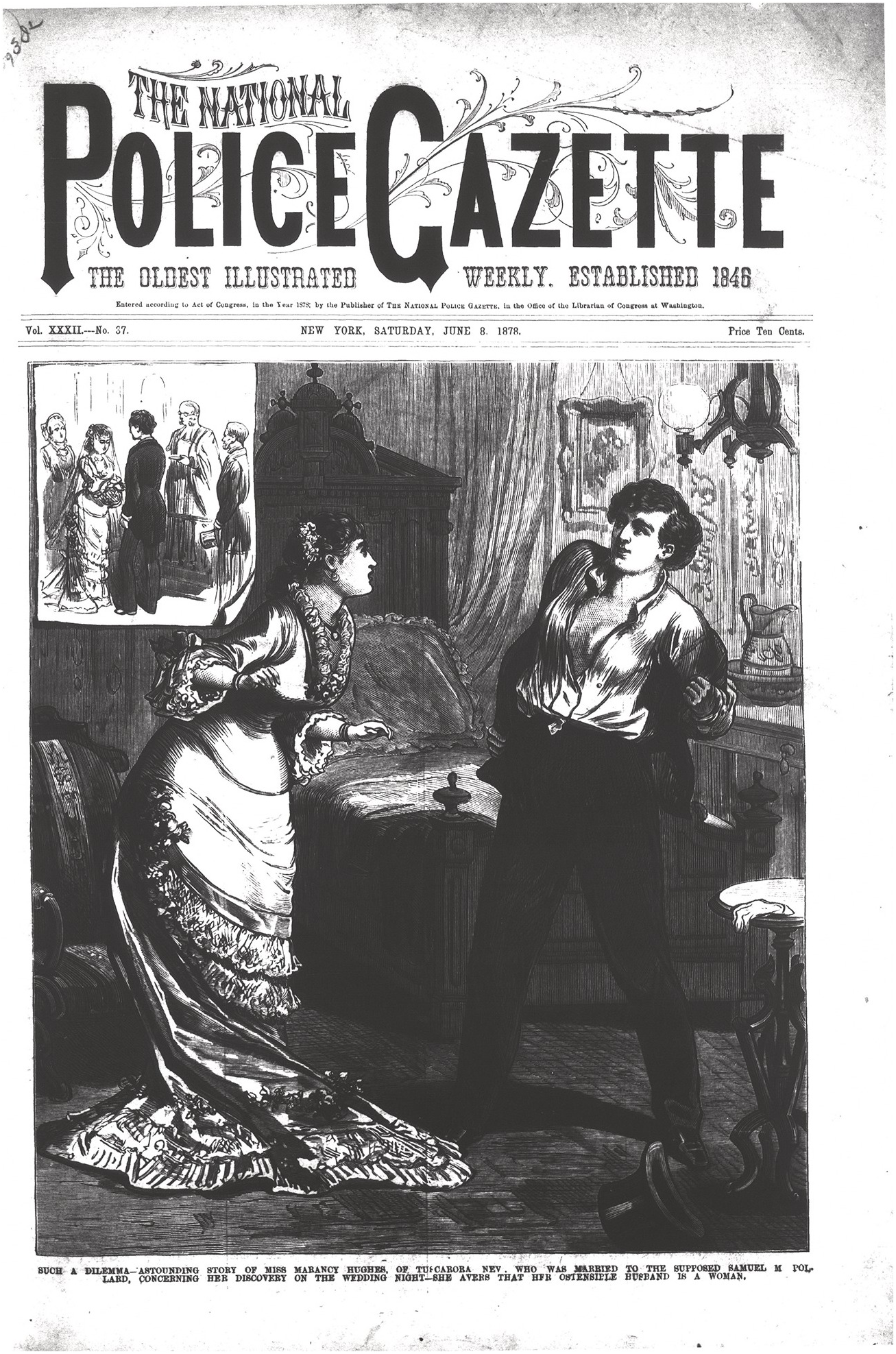
I love how this book emphasizes that the stories we have are not based upon the true feelings and words of its subjects, but rather the words and newspapers created after a female husband was outed. The reception and its variety was fascinating, and I particularly loved the part with the National Police Gazette and Samuel Pollard. It's meant to be shocking, but Pollard just looks so sexy LMAO. Love how art and its interpretation changes over time. I found it especially interesting that in the hierarchy of power, a female wife had more leverage and power than she did in most other occasions. A fascinating exploration of power and gender.
The demographic is very limited in this study--ie poor and middle class UK/US white people--and I want to seek out more information. It's not really on the fault of the writer, more attributed to the racism of history, but disappointing nonetheless. Stories became very repetitive.
I did enjoy seeing how people of the past treated those who did not conform to gender roles and how hard people would try to fit people into boxes. I particularly loved seeing how ideas of what makes a man or a woman have changed over time. I love the fluidity of gender and how arbitrary it all is. One sequence stood out: a man is called a female husband by his newly wedded wife because he is poor and disabled and she wishes to cause a stir to divorce him. He wasn't AFAB, but his lack of characteristic "male" traits made him "female".
I love how this book emphasizes that the stories we have are not based upon the true feelings and words of its subjects, but rather the words and newspapers created after a female husband was outed. The reception and its variety was fascinating, and I particularly loved the part with the National Police Gazette and Samuel Pollard. It's meant to be shocking, but Pollard just looks so sexy LMAO. Love how art and its interpretation changes over time. I found it especially interesting that in the hierarchy of power, a female wife had more leverage and power than she did in most other occasions. A fascinating exploration of power and gender.
The demographic is very limited in this study--ie poor and middle class UK/US white people--and I want to seek out more information. It's not really on the fault of the writer, more attributed to the racism of history, but disappointing nonetheless. Stories became very repetitive.

November 5, 2025
A very readable academic work on a really interesting era of US and UK history. Thanks to advancements in digital humanities research, academics such as the author can document a phenomenon existing in newspapers and court cases for a huge geographical area.
The individuals are fascinating. I was especially struck by the portrait of James Gray/Hannah Snell. It's rare to see images of fat trans people in modern media. But here is a person who could be mistaken for me, living a full 200 years previously.
What really stands out is Manion's coverage of Joseph Lobdell, whose life so clearly documents changes in perceptions of gender. They start out being lauded for the work they can do in the wilds of Upstate NY to eventually being confined to a mental hospital, used as an example of inversion by American psychiatrists. The author spends a chapter going over all of the changes of their life and how other people's conceptions of their gender shaped their life.
The author also does an excellent job putting these queer ancestors in context, taking the time to explain the burgeoning naval industry and first wave feminism and how economic factors affected who chose to trans their gender, and why.
My main criticism of the author is one I frequently have for historians: using images and then only referring to them in passing. I'm also not sure of the real relevancy of some of the images. Why show a picture of a random cis tinkerer? Flavor? Images should be more integrated into the text, not an incidental inclusion.
The individuals are fascinating. I was especially struck by the portrait of James Gray/Hannah Snell. It's rare to see images of fat trans people in modern media. But here is a person who could be mistaken for me, living a full 200 years previously.
What really stands out is Manion's coverage of Joseph Lobdell, whose life so clearly documents changes in perceptions of gender. They start out being lauded for the work they can do in the wilds of Upstate NY to eventually being confined to a mental hospital, used as an example of inversion by American psychiatrists. The author spends a chapter going over all of the changes of their life and how other people's conceptions of their gender shaped their life.
The author also does an excellent job putting these queer ancestors in context, taking the time to explain the burgeoning naval industry and first wave feminism and how economic factors affected who chose to trans their gender, and why.
My main criticism of the author is one I frequently have for historians: using images and then only referring to them in passing. I'm also not sure of the real relevancy of some of the images. Why show a picture of a random cis tinkerer? Flavor? Images should be more integrated into the text, not an incidental inclusion.

August 9, 2020
A most important piece of historical research

June 15, 2025
I liked that the author didn’t want to identify their subjects in any way, and they just said that female husbands transed gender. It left place for interpretation.
July 31, 2026
this sealed the deal for me: i absolutely need to make a hard pivot into queer history.

February 26, 2025
interesting!

Read
September 30, 2023I don't want to rate this, but I very much enjoyed this book. Very informative and well researched.
Displaying 1 - 30 of 189 reviews