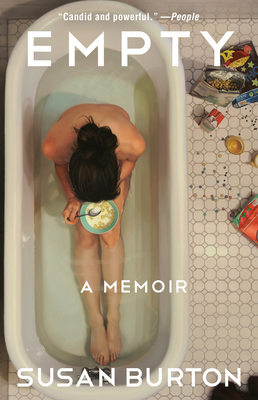
An editor at This American Life reveals the searing story of the secret binge-eating that dominated her adolescence and shapes her still.
"Her tale of compulsion and healing is candid and powerful."--People
NAMED ONE OF THE BEST BOOKS OF THE YEAR BY MARIE CLAIRE
For almost thirty years, Susan Burton hid her obsession with food and the secret life of compulsive eating and starving that dominated her adolescence. This is the relentlessly honest, fiercely intelligent story of living with both anorexia and binge-eating disorder, moving past her shame, and learning to tell her secret.
When Burton was thirteen, her stable life in suburban Michigan was turned upside down by her parents' abrupt divorce, and she moved to Colorado with her mother and sister. She seized on this move west as an adventure and an opportunity to reinvent herself from middle-school nerd to popular teenage girl. But in the fallout from her parents' breakup, an inherited fixation on thinness went from "peculiarity to pathology."
Susan entered into a painful cycle of anorexia and binge eating that formed a subterranean layer to her sunny life. She went from success to success--she went to Yale, scored a dream job at a magazine right out of college, and married her college boyfriend. But in college the compulsive eating got worse--she'd binge, swear it would be the last time, and then, hours later, do it again--and after she graduated she descended into anorexia, her attempt to "quit food."
Binge eating is more prevalent than anorexia or bulimia, but there is less research and little storytelling to help us understand it. In tart, soulful prose Susan Burton strikes a blow for the importance of this kind of narrative and tells an exhilarating story of longing, compulsion and hard-earned self-revelation.
Susan Burton is the author of Empty, published by Random House, and the host of The Retrievals, a podcast from Serial and the New York Times. She is an editor at This American Life, where the episodes she’s produced include Ten Sessions, Five Women, and Tell Me I’m Fat. Her writing has appeared in the New York Times Magazine, Slate, The New Yorker, and others, and she is a former editor of Harper's. The film Unaccompanied Minors, which was directed by Freaks and Geeks creator Paul Feig, is based on one of her personal essays. Susan grew up in Michigan and Colorado, and she graduated from Yale in 1995. She lives in Brooklyn with her husband and their two sons.
I always think how incredibly brave a person has to be, to put their personal struggle down in words. Eating disorder, anorexia, bulemia, binge eating, struggles with body image, all issues with which many struggle. The author dealt with some of these, and it made her life a struggle on a daily basis. Always afraid to let others know what was going on, she became an expert at hiding her troubles. She never felt good about herself, hated the way her body looked. It colored every aspect of her life.
She has come to terms with her illness with the help of others, but this will be an issue with which she always needs to be aware. A very readable and honest look at a very personal matter, but something that is at the forefront of our current culture. Body image is something many young girls struggle with and images in magazines and television add to their confusion. Susan's story will hopefully help others with these same issues.
જ⁀➴dnf: this actually was such a good read but im just not in the mood for memoirs rn and i tried forcing myself but a slump + memoir = my death. so this is not an official DNF but the type of book i'll hold for now and definitely come back to later.
In galley, will be published in June. Brilliant, absolutely brilliant. Full disclosure, this memoir was written by a friend—but that's not coloring my judgment. It's brilliant. About struggles with food, growing up, self-knowledge, identity...
I’m not a memoir person. Memoirs and I have never really clicked, but I'm trying to branch out, diversify, be more literate, become a better version of me, become a more enlightened reader, etc etc etc. So I picked up Empty, nd now I’m like, fantastic, I've been psychologically evaluated by a book.
This isn’t a memoir that eases you in. It just opens a wound and makes you stare at it. There’s no dramatic framing or attempt to soften anything. It’s just brutal, intelligent clarity the whole way through.
“The fact that I was ashamed of my own story was among the reasons I finally decided to tell it." That line feels like the core of the entire book. Everything radiates out from the conflict between wanting to hide versus needing to speak.
I love that this is written through an adult lens. There’s no “I grew out of it” narrative or comforting arc where everything resolves once you hit adulthood. It’s more like: I was 41 and still dealing with this, which feels important, because eating disorders are so often framed as a teenage issue, as something you leave behind once you have a job and a mortgage and kids and a functioning adult life. This book dismantles that idea.
The author talks a lot about her hatred of food. How she was a picky child, how avoidance came naturally. And I found that fascinating because so much of this book resonated with me, but not that. And I had this brief, absolutely unhinged moment of thinking: well, it’s easier to restrict when you hate everything, Susan, come back when you love food. And then immediately I was like, oh, oh no, why are you like this, why is this your internal dialogue?? reading eating disorder memoirs is supposed to make you empathetic and force you to look at yourself, not… competitive???
Anyway, the book really said “you thought you were reading? no, you're also being judged.” There’s a passage near the end that completely wrecked me: “I found hollowness extremely satisfying. Like a straw, something you could blow through.” She captures that feeling of lightness and emptiness so precisely, and then she follows it with “Empty amounts to nothing.” And it just collapses. The illusion and the reality, right next to each other.
The memoir's very much centered on how eating disorders affect women. I get it, when people think of anorexia or bulimia or whatever, the default image is a young woman. And the author's writing from her lived experience as a woman dealing with anorexia and binge eating disorder. But I found myself wishing for a slightly broader perspective. Eating disorders don’t only affect women, and men’s experiences are often overlooked. Even a small acknowledgement would have added something. Similarly, there’s definitely a cultural notion that eating disorders primarily affect white, upper-middle-class women, and this book doesn’t really challenge that perception either.
As well written as it is (it's sharp and thoughtful and never indulgent) my attention wandered. A lot. The family sections felt so slow to me. And there are SO MANY of them. Even once we get into her adulthood, the narrative keeps circling back to family in ways that, for me anyway, just dragged the pacing down. It felt like constant interruptions to the more immediate, interior exploration. And I kept waiting for those sections to tie more directly into the eating disorder narrative in a way that added new insight, but they didn’t quite land. They didn’t always explain more, and they didn’t always deepen what was already there. They just slowed everything down.
I don't know if I enjoyed this. I don't think "enjoy" is the right word. It affected me, it made me think, it also frustrated me.
In the end, this book was not for me. I hesitate to give a negative review when I know she is completely putting herself out there…that part, I totally admire. But honestly, I wish she had spent a few chapters outlining her struggles and then the second half of the book talking about how she overcame them. It was mainly one big long diatribe of her circular behavior between not getting her emotional needs met and then going back to food every time. Then, repeat. Over and over and over ad nauseam (literally). Again, I so admire her for putting this out there and her writing is strong but I just kept waiting for her to talk about her turning point. Also, how was she maintaining these incredibly destructive eating habits and still managing to be a successful student? (and not just at any school, at Yale for Pete’s sake) And then she goes on to be a successful writer and work at NPR. Towards the end she mentions it was a gradual recovery (and hints that she is still struggling in some ways). But honestly, I still wanted to hear more about that part...since I suffered through the dark and low bits, I wanted to hear more about the light. This was an incredibly well-written and interesting look at eating disorders, a subject we don’t often hear about, that would have been infinitely better as an essay instead of in the form of a book.
If I wasn't a psychologist, I might have hated this book because I would have read it as whiney, monotonous, and even pity seeking. Although truth is, this is what many dysregulated eaters sound like.
Being a psychologist and a cognitive scientist, one who has studied disordered eating, I had a hard time with the surface level of detail the author provides.
Then I got to the end, where the author acknowledges each of these points. I almost wondered if this should have been a preface. That is, "Dear reader, you are about to read a story that I am still living through. The difficulty I will detail remains a challenge and one I am still working to realize. Living with an eating disorder involves thought suppression and thought distraction - of which I have mastered. Some of these habits are hard to break..."
The book is well written, interesting, and important. Indeed, despite its many flaws, I liked it more upon finishing - when she acknowledges that this is simply the beginning of the healing process. I suspect many reader put the book down well beforehand.
Burton is indeed an insightful writer. Unfortunately, what frequently comes across as lazy, is in my opinion, remnants of her guardedness and experienced shame.
My life is to dig. I dig into the mind. I dig into the brain. I dig into data. I am driven both by "what" and “why.” Burton gives the average, analytically untrained reader, very little of the "why."
There is a deep irony in her story that I wish she had expanded on. Burton describes herself as a weary, unregulated, defective, and ineffective person who simultaneously gains acceptance to two of the most prestigious academic institutions in the county. As a psychologist, this is the Susan Burton I want to understand - both of them. Specifically, how does someone manage (or fail to manage) both being profoundly dysregulated (indeed, at times psychotic) and simultaneously completely in control? How are we to reconcile this? This is the Susan Burton I want to hear more about.
The prose of this book was lovely. The story was not. Although difficult to read, I saw myself in the pages and if anything, felt soliditary with Susan- a book that shows you that you are not the only one in the world who feels these kinds of things.
Now I was drowning out nothing. That's what you needed to muffle most, all that was missing.
First things first: For me, this book was truly transformative. I feel as if, to an extent, someone has opened a window to my mind, spoken of those things I never had the words to describe. People love to speak of the ordeal of being seen, but in this case I felt seen in an utterly positive way (despite the subject manner) because, in a way, I have found permission to not be ashamed of my reality within the pages of this book.
As someone who herself has suffered/is still suffering from eating disorders, I have no proper words for this book - it was beautifully haunting, with Susan Burton's struggle palpable as I tried to process those words that seemed to hit almost too close to home. The book itself takes us on a journey through Susan Burton's adolescence, describing in great detail her struggle with her eating, but also many other aspects of her life which either influence or are influenced by it. Relationships, school, family. Whilst some may perceive the book as too clinical for a memoir (which I can somewhat understand), I personally think it perfectly mirrors the author's more 'scientific' connection to her disorders, her attempt at regarding her struggles in an empiric way. In the epilogue, she even goes as far as mentioning that she hoped scientists would find her writing, would find her - so they might even be able to provide her with a conclusion, a "paragraph that makes sense of this for you". That being said, her story does not lack emotion - how could it, with eating disorders so deeply rooted for many in exactly that. The author even goes as far es describing an eating disorder as a "physical manifestation of emotion", which I have found to be scarily accurate.
I love this book and will no doubt re-read it at some point, because it was such a cathartic experience for me. In general, I would recommend it to those struggling with eating disorders themselves, or those who would like certain insight into the struggle that comes with the territory of EDs.
I found that this book was a little hard to get into. I was expecting a memoir type book about a woman who was going through an eating disorder however the book felt more clinical and colder than memoirs usually do. I found our main character very hard to relate to and the story didn't help much because it made our main character seem almost cold instead of a real person who went through real problems. I also found the main character to be very cold and almost robotic at times. Even when they were talking about things that happened in her past she still didn't seem like a real human to me. I did feel for her a bit but it was almost like an alien describing what they think needs to be said. I struggled to finish that book and considering the subject that is something that rarely happens. Interesting idea in concept however I think that the delivery of it was a bit lacking. It wasn't until about half way through the novel that it really started to pick up. I got more insight into the author and what she was going through so that was very nice. Much more of what I was expecting when I picked up the book in the first place. There were lots of things that I would change about this book but it did have its redeeming qualities. So I would say that this book was about fifty-fifty in my opinions of it.
this book was tough. it wasn't hard to read, per se, but it made me hyper-aware of my own body, my own eating habits, my own insecurities. i kept pausing because i would get too deep in my own head and it would pull me out of the book.
but once i got that out of the way, it was a great read. susan writes wonderfully, and you really felt for her and her lifelong struggles with her body, food, and self-image. she's so thorough, namely her descriptions of past memories and experiences. it made sense to read that she kept all of her childhood journals and planners.
good memoir!! i've read a lot more memoirs as of late and it's been interesting.
This is a very relatable memoir of what it’s like to live with an an eating disorder. I wouldn’t recommend it if you are struggling or easily triggered.
What I liked about this book is that, although it did recount the teenage experience, it also showed how her eating disorder carried on all the way into mid-life and explained that she was still struggling.
Too often we read about the teen girl’s experience and then it’s all wrapped up in a nice bow at the end “I got better and never struggled again” when the reality is that many people will struggle with the disorder throughout their lives and every single day they must make the conscience decision to choose recovery.
I deeply related to this book as someone who has cycled between bulimia and anorexia throughout my lifetime. There is no magic pill to make things better. This wasn’t the most horrifying account of an ED that I’ve read, but it made me think over my own experience and how lucky I am to be alive and to have lived through the things I put my body through.
I loved the end where she talked about the ED voice like a soundtrack and instead of deleting the ED voice, she could only turn the volume down and turn up the volume of the other tracks. The ED voice will always be there but it doesn’t have to be the loudest.
I think there is always a danger in writing about eating disorders because often they seem to be romanticized, but that’s the problem. Eating disorders, like anorexia, seduce the suffers’ minds with lies and feelings of perfection and euphoria, so it’s almost impossible to write about these disorders without conveying that. But Susan was very careful not to share numbers or “tips” throughout her writing and I think she did the best she could while still expressing the way she felt.
I received a copy of this book in a Goodreads giveaway.
While I can certainly see the value of this book to someone who has experienced or is currently experiencing living with an eating disorder, I cannot recommend it for those who are just looking to read a memoir. This book reads more like a textbook or a medical journal than a memoir, and in my opinion it lacked a personal feel. I definitely think it could be a useful resource for a particular audience, but it was not at all something I wanted to continue reading.
I empathize with her illness, but the privilege and lack of acknowledging it really stuck out. She got into an elite boarding school but couldn't go, won all sorts of writing awards and received endless compliments from her teachers, flew to New England to tour colleges with her mom (is this a regular thing Americans do?), her aunt and uncle are philanthropists, she went to Yale (I checked and the admission rate is like 5%), her dad went to Yale (her dad called to get her college switched when they denied her a year or so later), her boyfriend played Twister with someone whose dad had art in the MOMA, her mom fedexed her shirts across the country when was in an accident as an adult and couldn't do up she buttons, and she always had money available to purchase expensive foods to binge (that couldn't have come solely from working OT at the gourmet food store and attending fancy summer camps). Despite having divorced parents with their own issues (alcoholism) and untreated binge eating disorder, and writing a silly answer once on an exam at Yale, she was extremely "successful" her entire childhood and adulthood with very few setbacks. It also rubbed me the wrong way that she was careful to specify that she was not bulimic and did not threw up food, as though this set her not only apart but above other people with eating disorders.
That being said... it was written well enough that I finished it, so there's that. I hoped she was healing at the end but she is still a young adult until almost the last chapter. This book is ~280 pages long and she doesn't go to therapy until page ~270.
"Ask yourself why you are trying so hard to be a child again." This is a question posed by Susan's mother after she observes her daughter in the grip of anorexia.
Susan Burton's memoir explores her adolescence through adulthood via her struggles with food. She first develops anorexia during high school, a difficult time in any teenage girl's life, but her life has also recently been uprooted by her parents' divorce and a move halfway across the country. Susan's eating issues swing from not eating to binge eating.
Binge eating disorder is the most common eating disorder, but is rarely highlighted in books, so this was a rare insight into binge eating that was not a part of bulimia. When Susan was dealing with her binge eating issues, there was very little information out there on the condition. She does highlight several facts about the disorder as she learns more about it and begins to recover.
While this memoir reads very similarly to other memoirs I've read of individuals struggling with eating disorders (e.g., childhood upheaval, beginning of eating issues while young, intensifying troubles in adolescence/college, recovery), I did appreciate the highlighting of an eating disorder that does not get as much attention and the author also writes well, and gives the reader nice insight into her thoughts and behaviors.
Thank you to Random House via NetGalley for the opportunity to read and review this ebook.
Raw, honest and moving. I attended high school and graduated the same year as the author. I was always in awe of her intelligence, her classy demeanor and beauty. While those things remain true, this book explains it was not all as it appeared. Brave book.
Many thanks to NetGalley, Random House, and Susan Burton for the opportunity to read and review her memoir about her eating disorder.
Susan takes us on her journey to wellness, from a fairly-typical childhood, to parents divorcing and moving from Michigan to Colorado, where the need to reinvent herself began in her early teens. She loved the empty feeling that starving herself brought on; later, her switch to binge eating brought out self-loathing and a desire to do better the next day. Through all her internal struggles, Susan achieved much; however, she could never reveal her secrets to anyone and therefore continued to be "less than."
This is such a brave and powerful book. In the days of social media, I can't imagine raising a teenage girl. It's hard enough as an adult to see the images projected that cause us to question our own self-image. And food is the one addiction that you can't get away from. We have to eat to live; therein, lies the problem. There probably isn't a woman alive who can't relate to these struggles of the number on the scale being equal to how we feel about ourselves.
Thank you to Susan for speaking out. Hopefully, someone will be where you were and find your book that will speak to them and their struggles.
I don't think any female human can say they haven't at some point or another in their lives been food obsessed. It's baked into our culture that we must look a certain way in order to be successful, happy, or fulfilled. Whether you get it from your parents or absorb it from friends and pop culture/social media, it's a non-stop, never ending barrage of insistence on being slim to the point of skinny lest you risk being ostracized or worse. Ms. Burton opens up her life to the reader to share how she coped with this by yo-yo-ing between binging and starving. It's a hard read at many points since, while my lifelong food obsession did not manifest itself as severely, I can 100% identify with that college student who eats all day long in order to feel ... something. And then turns around and starves it off in a fit of remorse and self-loathing that is primal and painful. I highly recommend this book especially since it does not claim that you can be cured of this. You must simply learn different ways of coping with it.
Empty brings you into a teenager’s world of feeling out of control, as her parents struggle to keep things together, and eventually divorce. Susan finds herself struggling with anorexia and binge eating. As many teens, young women, middle aged women, older women struggle with body dysmorphia as they see photoshopped images everywhere, Susan’s story is difficult, but connections to some thoughts are evident. She is open and honest about her struggles and gives hope of breaking the cycle. As I moved more deeply into her story, I was hopeful for her to love herself. Deep, emotional read,
This is not a road to recovery story. It’s a “telling”. Does a person ever recover from a eating disorder? You can’t quit food like you can alcohol or drugs. “If you wait until you understand everything, you never say anything at all.” I promise you will find yourself somewhere in these pages. No matter what your relationship with food is. A sentence might trigger a awkward memory of growing up. A chapter might make you remember feelings surrounding food. Guilt. Self-loathing. Emptiness. You’ll find yourself disgusted for her, sad for her and hopeful that she’s going to be ok.
I have no idea how to rate this book because it is such a deeply personal writing. But, at times it felt a bit disjointed and like something was missing... if that makes sense. I think I’m leaning more towards a 3-3.5 star rating bc in the end, I suppose, it was interesting / intriguing. There was just something missing and I can’t put my finger on it.
I couldn’t finish it. I found it to be repetitive. I was 55% done and decided I didn’t care how her story ends. It’s surprising to me because I generally enjoy memoirs.
Wow - as a huge Fresh Air fan, I was curious to read Empty after Susan Burton appeared as a radio guest with host Terry Gross.
Quite simply, Empty was beautiful. Burton has a profound ability to analyze seemingly minute life experiences and turn them into worldly reflections about the human experience and addiction.
I thought one of the most fascinating aspects of Empty was Burton's relationship with her mother; Burton struggled with binge eating while her mom struggled with alcoholism. At night, when their addictions would typically manifest, Burton's mother would first enter the kitchen, drink heavily, and then stumble into her bedroom. Afterward, Burton would replace her mother in the kitchen, finding refugee in her form of struggle: compulsive eating. Both Burton and her mother stayed silent about their respective addictions, but the symbolism of daughter following mother is profound.
I also thought Burton's reflection on Seventeen Magazine (and other forms of teenage-directed content) was fascinating. In Empty, she argued that these magazines did not directly set a precedent for how women were supposed to look; they set an image for how women were supposed to act: bubbly, airy, open, and fun.
While reading Empty, I could not help but see the similarities between the book and Prozac Nation by Elizabeth Wurtzel. Both books are written by extremely intelligent female authors that struggle to live full lives. Wurtzel and Burton were both praised at a young age for their writing aptitude: Wurtzel's college recommender suggested that she would go on to write for The New Yorker; Burton's teachers often pulled her aside after class and commented on the beauty of her writing. Both women went on to attend prestigious Universities; however, they both struggle in obtaining their diplomas due to crippling mental health issues, deteriorating friendships, anger, and secrecy. Finally, after pushing through tenuous circumstances, both women write brutally honest memoirs, paving the way for a generation of women to say unabashedly: "this happened to me too."
One of my favorite quotes from the entire book was the following, found on page 252, "I felt like I'd been in a coma, not to the culture but to myself. I'd disrupted the process of becoming." When I read this line, I read it again, and again, and again. I thought the parallel between comas, the absence of brain cognition, and Burton's internal struggle, the absence of normality, created a fascinating metaphor.
I read this book in two days straight. I felt immersed in a world I never knew about - the world of hidden eating. I felt like I was reading parts of Burton's secret self, a part I wasn't supposed to know. A part that she hid for so long. I felt deeply entrenched in her thoughts, and I became absorbed in her unfamiliar narrative.
Burton's writing makes readers feel intelligent. She perfectly meshes short, punchy sentences with long, willowy ones. Her words are so effortless, but her experience raw and turbulent.
A sad but ultimately hopeful memoir about a woman with a severe eating disorder that develops in her teens and will probably never completely loosen its grip on her psyche. Susan Burton's relationship to eating swung from anorexia to bingeing and back. She writes colorfully and honestly about her attachment to controlled and uncontrolled consumption of food. There was in the story an overabundance of detail about her life in Boulder (and I say that as a Colorado native who is familiar with everything she's writing about), the names of the streets and stores that might not have been necessary, stretching out the story. But all in all it's a strong memoir about addiction and steps toward recovery and "normal" life, whatever that may be.
Burton is a great writer and she's able to break down her coming of age with an eating disorder story into pretty insightful nuggets. She suffered from both anorexia and binge eating (though not bulimia) throughout her life and I guess is still dealing with it and also the normal teen angst and the transitions into adulthood. She glosses over her adult years and I wish she'd have spent more time on that because it does seem like she's still in the midst of a disorder (though not as bad as it was I guess?). I enjoyed reading it because her prose is good and she has a good gift for observing the process of sense-making in others and herself.
The story started strong, with a Yale pre-orientation exercise of everyone writing down a fear, and someone admits they’re afraid they’re going to go crazy — but the story then settles down into quite an ordinary life. Her parents divorce, and she is a typical type A personality: attractive, competitive swimmer straight A student who attends Andover and Yale. She has a number of eating disorders, and I know this sounds callous, but i just didn’t find it very interesting.
This entire review has been hidden because of spoilers.
4.5 stars Well-written, thought-provoking, and descriptive. Anecdotes and personal reflection spotlight the acute and chronic turmoil of an eating disorder. Having actively struggled with an eating disorder as an adolescent and adult I appreciate the author's vulnerability and honesty. My attention waned at times due to the redundancy of passages involving the physical act of eating and ensuing emotions. In hindsight, I wonder if placing the reader in this 'hamster wheel' was intentional and symbolic of her experience? It certainly mirrors my own fight. The epilogue effectively pulled me from the malaise. Susan's recognition of the power sharing her secret has on moving forward brought hope to me as a reader. I look forward to reading more about her next "chapter" should Susan choose to write another memoir.
“…the most relief I could get in life, was being empty. That was a way I knew I could be open to sensation, when I was diminished, slim. And when I was: It was a gliding feeling. I could do a bridge; I could do a backbend…”
“Veganism was intended to fix me. It offered limits as well as the promise of a higher plane”
I really read this at the most ironic time in my life.
So much self-awareness, so little insight. She says as much in the epilogue, but it was striking. Like hearing an observant teenager talk about someone else’s problems: plenty of judgment and detail, but not even a hint of the connections or explanations an adult might generate.