Jump to ratings and reviews
Rate this book

The Lion and the Unicorn - Socialism and the English Genius: With the Introductory Essay 'Notes on Nationalism'

Rate this book
"The Lion and the Unicorn - Socialism and the English Genius" is a 1941 essay by English writer George Orwell. Within it, Orwell explores the subject of English life and puts forth his thoughts on how to make the country a better place for all strata of society. Many of his ideas draw their inspiration from his personal experiences living on the streets of both Paris and London, as well as his familiarity with life in the industrial north. A fascinating essay by one of the greatest 20th century British writers that will appeal to those with a keen interest in sociology and politics. Contents include: "England Your England", "Shopkeepers at War", and "The English Revolution". Eric Arthur Blair (1903-1950), more commonly known by his pen name George Orwell, was an English journalist, essayist, critic, and novelist most famous for his novel "Nineteen Eighty-Four" (1949) and allegorical novella "Animal Farm" (1945). His work is characterised by an opposition to totalitarianism and biting social commentary, and remains influential in popular culture today. Many of his neologisms have forever entered the English language, including "Thought Police", "Big Brother", "Room 101", "doublethink", "thoughtcrime", and "Newspeak" to name but a few. Other notable works by this author include: "Keep the Aspidistra Flying" (1936) and "Coming Up for Air" (1939). Read & Co. Great Essays is proudly republishing this classic essay now in a brand new edition complete with the introductory essay 'Notes on Nationalism'.

100 pages, Paperback

First published February 19, 1941

167 people are currently reading
3665 people want to read

About the author

George Orwell

1,280 books50.6k followers
Eric Arthur Blair was an English novelist, poet, essayist, journalist and critic who wrote under the pen name of George Orwell. His work is characterised by lucid prose, social criticism, opposition to all totalitarianism (both fascism and stalinism), and support of democratic socialism.

Orwell is best known for his allegorical novella Animal Farm (1945) and the dystopian novel Nineteen Eighty-Four (1949), although his works also encompass literary criticism, poetry, fiction and polemical journalism. His non-fiction works, including The Road to Wigan Pier (1937), documenting his experience of working-class life in the industrial north of England, and Homage to Catalonia (1938), an account of his experiences soldiering for the Republican faction of the Spanish Civil War (1936–1939), are as critically respected as his essays on politics, literature, language and culture.

Orwell's work remains influential in popular culture and in political culture, and the adjective "Orwellian"—describing totalitarian and authoritarian social practices—is part of the English language, like many of his neologisms, such as "Big Brother", "Thought Police", "Room 101", "Newspeak", "memory hole", "doublethink", and "thoughtcrime". In 2008, The Times named Orwell the second-greatest British writer since 1945.

Ratings & Reviews

What do you think?
Rate this book

Friends & Following

Create a free account to discover what your friends think of this book!

Community Reviews

5 stars
672 (27%)
4 stars
1,070 (43%)
3 stars
594 (24%)
2 stars
86 (3%)
1 star
25 (1%)
Displaying 1 - 30 of 251 reviews
Profile Image for Paul Bryant.
2,412 reviews12.6k followers
December 21, 2015
This is an awkward 100 page essay to hack your way through. It was written in the winter of 1941 and published in February, so at that point Stalin was still in bed with Hitler - the invasion of Russia happened in June. Bombs were raining down all over England and especially over London – this was the Blitz which happened between September 1940 and May 1941 - 43,000 people killed, or around 163 people a day for 9 months.

This was the darkest point of the war for Britain. Orwell is saying here that the war will not be won if the same old upper class fools are in charge, and that a socialist revolution is needed to get the right ruthlessness into the fight.

It’s all a bit stodgy because half of what he says is right and the other half either wrong or so localised to 1941 England that you can’t tell.
One thing which is worth mentioning is that he hates Communists and Marxists in general only slightly less than he hates fascists, partly because they’ve tainted socialism in the eyes of a great many otherwise well-meaning people.

You always get some salt-and-vinegary phrasemaking with Orwell which makes the political turgidity readable (just). Here he is having a go at the rich who thought they could deal with Hitler :

after the French collapse there came something that could not be laughed away, something that neither cheque-books nor policemen were any use against - the bombing. Zweee - BOOM! What’s that? Oh, only a bomb on the Stock Exchange. Zweee - BOOM! Another acre of somebody’s valuable slum-property gone west. Hitler will at any rate go down in history as the man who made the City of London laugh on the wrong side of its face. For the first time in their lives the comfortable were uncomfortable.

He spends a lot of time bemoaning the idiots who are still in charge:

in general we are still commanded by people who managed to live through the years 1931-9 without even discovering that Hitler was dangerous. A generation of the unteachable is hanging upon us like a necklace of corpses.

Orwell lived until to 1950 & so witnessed the victory over fascism and a kind of socialist revolution in Britain caused by the war – this was the Labour government of 1945 which created the famous welfare state, including the National Health Service, an organisation which is the 4th largest employer in the world (1st 3 are – US department of defence, Peoples Liberation Army of China, and Walmart). He would surely have concluded that it was a job half done (I may find out if I ever get to the end of his vast collection of essays). But if he'd stuck around longer (and isn't it a dreadful shame he didn't? - almost as bad as Buddy Holly) he'd have seen bits of his agenda for revolution gradually added - independence for the colonies, comprehensive schools, legalisation of homosexuality, and so on.

Does this make Britain a socialist utopia? Does it heck. But it's better than some places I could think of.
Profile Image for Steven Godin.
2,782 reviews3,393 followers
April 7, 2019
"I began this book to the tune of German bombs, and I begin this second chapter in the added racket of the barrage. The yellow gun-flashes are lighting the sky, the splinters are rattling on the house-tops, and London Bridge is falling down, falling down, falling down. Anyone able to read a map knows that we are in deadly danger. I do not mean that we are beaten or need be beaten. Almost certainly the outcome depends on our own will. But at this moment we are in the soup, full fathom five, and we have been brought there by follies which we are still committing and which will drown us altogether if we do not mend our ways quickly."

Writing through the Blitz must have been quite challenging, but it didn't put off Orwell from putting together this interesting three-part essay which carries with it a clarity unlike the chaos that was raining down outside. Generally, folk tend to think of Orwell as an anti-Communist and a defender of liberal democracy. Although true, it should be noted he was also a hardened socialist, but one of the old school. In The Lion & The Unicorn he attacks both the class system of England and its capitalist economic system. In a nutshell -

1. England Your England - Orwell describe the essence of Englishness and records changes in English society over the previous thirty years or so. Thought-provoking, powerful and passionate its the longest of the three. In its affection for all aspects of England it continued the nostalgia for an older, less commercialised, more decent England which marked his previous book.

2. Shopkeepers at War - He makes the case for a socialist system in England and declares that the old ruling class and their capitalism must be overthrown for the simple reason that private capitalism, that is, an economic system in which land, factories, mines and transport are owned privately and operated solely for profit- does not work.

3. The English Revolution - The argument is made for an English democratic socialism, sharply distinct from the totalitarian communism of Stalin. Orwell gives a sweeping trenchant review of the current political scene in England then in 1941. All the parties of the left are incapable of reform, the Labour Party most of all since it is the party of the trade unions and therefore has a vested interest in the maintenance and flourishing of capitalism. The tiny communist party appeals to deracinated individuals, but has done more to put the man in the street off socialism than any other influence.

He comes up with a six-point programme, the kind of thing in his eyes would make a positive difference -

Nationalisation of land, mines, railways, banks and major industries.
Limitation of incomes, on such a scale that the highest tax free income in Britain does not exceed the lowest by more than ten to one.
Reform of the educational system along democratic lines.
Immediate Dominion status for India, with power to secede when the war is over.
Formation of an Imperial General Council, in which the coloured peoples are to be represented.
Declaration of formal alliance with China, Abyssinia and all other victims of the Fascist powers.

An interesting read, regardless of my own views. He was a master at writing essays, and clearly took to it like a duck to water.

Profile Image for Julian Worker.
Author 44 books453 followers
August 18, 2025
This is an excellent long essay on Orwell's solution for making England / the UK a more decent place to live for all of us, a fairer place, a more equal place. The ideas still need to be implemented and it says a lot about the political development in the UK that the suggested reforms are further away than ever.

One phrase that really stuck in my mind was:

"The totalitarian idea that there is no such thing as law, there is only power, has never taken root (in Britain)". The part in brackets is my addition as this statement applies in other countries in the world right now, countries that profess to be democratic but aren't really.
Profile Image for Rubell.
189 reviews23 followers
April 20, 2024
অরওয়েলের যুদ্ধকালের রচনা। প্রকাশকাল ফেব্রুয়ারি ১৯৪১।
বইয়ে তিনটা অধ্যায় আছে। প্রথম অধ্যায় শুরু হয়েছে এভাবে- "As I write, highly civilized human beings are flying overhead, trying to kill me."
ইংল্যান্ডে বিমান হামলা চালাচ্ছে জার্মান। চার্চিল তখন প্রধানমন্ত্রী। ইংল্যান্ডের বিমানবাহিনী একেবারে খারাপ জবাব দিচ্ছে না, ইতিহাস পড়লে বোঝা যায়, রীতিমতো দাঁতভাঙা জবাব দিচ্ছে।
কিন্তু যুদ্ধের এখনও অনেক বাকি। আর হিটলারের দাপট তখনও কমেনি। তাই পরাজয়ের শঙ্কা তখনও কাটেনি। এই সময়টাতে জাতীয় ঐক্যের সবচেয়ে বেশি প্রয়োজন। দেশপ্রেমে অনুপ্রাণিত হয়ে জীবনবাজি রাখা বীরদের সবসময় উজ্জীবিত রাখা প্রয়োজন।
অরওয়েল দেশপ্রমের গুরুত্ব লিখেছেন। ইংরেজ জাতির ইউনিক বৈশিষ্ট্য নিয়ে লিখেছেন, তাদের শ্রেষ্ঠ গুণাবলি হাইলাইট করেছেন, তাদের অর্জন নিয়ে লিখেছেন, একইসাথে তাদের ত্রুটি-বিচ্যুতিও কিছু উল্লেখ করতে ভোলেন নি।

দ্বিতীয় অধ্যায়ে সোসালিজম, ক্যাপিটালিজম, ফ্যাসিজম, নাজিজম নিয়ে আলোচনা হয়েছে।
যুদ্ধের সময়ে ক্যাপিটালিজমের নেতিবাচকতা নগ্নভাবে ধরা পড়ে। হিটলার যে যুদ্ধবাজ ও ব্রিটেনের জন্য ভয়ংকর সেটা জানা সত্ত্বেও ব্রিটিশ ক্যাপিটালিস্টরা ঠিকই জার্মানিতে টিন, রাবার, কপারসহ বিভিন্ন রাসায়নিক রপ্তানি করেছিল। ক্যাপিটালিস্ট সিস্টেমের আরও নানারকমের ত্রুটির কথা প্রবন্ধে আলোচিত হয়েছে।
আলোচিত হয়েছে ইংল্যান্ড রাষ্ট্র পরিচালনায় অভিজাততন্ত্রের অসুবিধা। অরওয়েল বলছেন অভিজাতরা নিজেদের স্বার্থ রক্ষা করতে গিয়ে দেশকে ঝুঁকির মুখে ফেলে দিচ্ছে। জন্মসূত্রে রাষ্ট্রের গুরুত্বপূর্ণ পদে আসীন হওয়া এসব লোকজনের যোগ্যতা মূল্যায়ন করেছেন- এই অভিজাতরা যুদ্ধে নেতৃত্ব দেবে কি! তারা তো জাতির বোঝা হয়ে গলায় ঝুলে আছে। তবে রাজা-রানিকে বিদায় করার পক্ষে অরওয়েল মতামত দেননি।
(তারা ব্রিটেনের শ্রেষ্ঠত্বের সিম্বল, যুদ্ধকালে জাতিগত শ্রেষ্ঠত্বের অনুভূতি একটা উদ্দীপনা হিসেবে কাজ করে।)

অরওয়েল যেমন ব্রিটেন দেখতে চান, তৃতীয় অধ্যায়ে তার একটা রূপরেখা উপস্থাপন করেছেন। অর্থনৈতিক ব্যবস্থা, শিক্ষাব্যবস্থা, রাষ্ট্রনীতি কেমন হওয়া উচিত সেসব নিয়ে আলাপ করেছেন। তিনি আগেই প্রকাশ করেছেন ক্যাপিটালিজমের ভক্ত তিনি নন। এখানে লেখক প্রস্তাব করেছেন ডেমোক্রেটিক সোস্যালিজম। সোভিয়েতের তথাকথিত সোস্যালিজম না। অরওয়েলের পাঠক মাত্রই জানেন যে অরওয়েল সোভিয়েত ইউনিয়নের শাসনব্যবস্থা সম্পর্কে কেমন ধারণা পোষণ করেন। রুশপন্থী ব্রিটিশদের ভণ্ডামি নিয়েও তিনি আলাপ করেছেন, তাদেরও দেশপ্রেম আছে, তবে সেটা সোভিয়েতের প্রতি। ইংল্যান্ড যখন জার্মানির সাথে যুদ্ধে জড়িয়ে পড়েছে, ইংলিশ রুশপন্থীরা শান্তির কথা বলেছে। সোজাসাপ্টা বললে তাদের জাতীয় বেঈমান বলা যায়।

প্রবন্ধে প্রস্তাবিত সোস্যালিজমে ভূমি, খনিজ সম্পদ, ব্যাংক, এবং বড় বড় শিল্পের মালিকানা থাকবে রাষ্ট্রের। জনগণের আয়ের নির্ধারিত সীমা থাকবে, তবে যোগ্যতা অনুসারে বেতনের কমবেশি হবে। নাগরিকদের শিক্ষার দায়িত্ব নেবে রাষ্ট্র, তাই সরকারি শিক্ষা প্রতিষ্ঠানের উন্নয়ন করতে হবে। অরওয়েল মনে করেন, যুদ্ধ চলাকালীন এই নীতিগুলো সরকার যদি ঘোষণা করে এবং বাস্তবায়নের পদক্ষেপ শুরু করে দেয় তাহলে ইংল্যান্ডের জন্য যারা যুদ্ধ করেছেন তারা আরও অনুপ্রাণিত হবে। কারণ যুদ্ধে অংশগ্রহণকারীদের বেশিরভাগ মধ্যবিত্ত ও নিম্নবিত্ত।

লেখকের প্রস্তাবিত কিছু পয়েন্ট ইউটোপিয়ান মনে হয়েছে। ��িনি নিজেও অবশ্য ব্যাপারটা আংশিক উল্লেখ করেছেন, কিন্তু তিনি বলছেন সবটা তো বাস্তবায়ন সম্ভব হবে না, যতটুকু করা সম্ভব হয়, তবে নিয়তটা থাকতে ���বে ভালো।
যুদ্ধের সময় রাষ্ট্রায়ত্তকরণ সুফল বয়ে আনতে পারে, এ ব্যাপারে একমত। কিন্তু যুদ্ধের পর ক্যাপিটালিজমের দরকার আছে। অবশ্যই রাষ্ট্র তাদের ব্যবসায়িক কার্যক্রম পর্যবেক্ষণ করবে, ও হিসাব-নিকাশ অডিট করবে। একইসাথে সকল নাগরিকদের শিক্ষা, স্বাস্থ্য ও অন্যান্য মৌলিক চাহিদাগুলো পূরণে রাষ্ট্রকে দায়িত্ব নিতে হবে, ক্যাপিটালিস্টদের হাতে তাদের ছেড়ে দেওয়া যাবে না।

দ্বিতীয় বিশ্বযুদ্ধের পর ইংল্যান্ডে রাষ্ট্রীয়ভাবে চিকিৎসা সুবিধা, সবার জন্য শিক্ষা, বয়স্ক ভাতাসহ আরও বিভিন্ন সুবিধা চালু হয়েছে। অরওয়েলের চাওয়া কমবেশি পূরণ হয়েছে বলা যায়।

লেখক এই প্রবন্ধে মূলত ইংল্যান্ডের অভ্যন্তরীণ বিষয়েই বলেছেন। যুদ্ধজয়ের জন্য ব্রিটিশদের দেশপ্রেম দরকার, বুকচিতিয়ে লড়াই করা দরকার, তাদের উৎসাহ দেওয়া দরকার- অরওয়েলের আলাপ হচ্ছে ব্রিটিশদের ভূমি ব্রিটিশদেরই রক্ষা করতে হবে। অন্য কেউ এসে তাদের সাহায্য করতে আসবে না।
যুদ্ধজয়ের জন্য বিদেশি শক্তির সাথে জোটগঠনের গুরুত্ব নিয়ে কিছু বলেন নি। হয়তো জোটের আলাপ করার পরিস্থিতিও তখন ছিল না।


ব্রিটিশ সাম্রাজ্যের ব্যাপারেও মতামত আছে এখানে। ভারত শাসন নিয়ে অরওয়েল প্রস্তাব দিয়েছেন - যুদ্ধকালে তাদের স্বাধীনতা দিতে চাইলে জাপান অথবা রাশিয়া তাদের দখলে নিতে পারে, তাই আপাতত ভারতীয়দের ভারত শাসনের অধিকার দেওয়া হবে (Dominion Status), ব্রিটেন ভারতকে প্রয়োজনীয় সহায়তা দেবে (প্রতিরক্ষা, কারিগরি, প্রযুক্তি,...), এবং কৃতজ্ঞতাস্বরূপ যুদ্ধে ভারতীয়দের সমর্থন আশা করবে। ভারত যখন চাইবে তারা ব্রিটিশ সাম্রাজ্য থেকে বিচ্ছিন্ন হতে পারবে (যুদ্ধের পরের আলাপ)। উপনিবেশবাদের শিকার রাষ্ট্রগুলো যে শোষণের ভিকটিম হয়েছে সেটা সবসময়ই অরওয়েল উল্লেখ করে থাকেন।

তবে দুঃখজনকভাবে অরওয়েলের চাওয়া পূরণ হয়নি। চার্চিল কোন উদারতা দেখায় নি। যুদ্ধকালে ব্রিটিশরা ভারতের সম্পদ লুট করেছিল, খাদ্যশস্য লুট করেছিল। এবং কৃত্রিমভাবে সৃষ্টি করেছিল ভয়াবহ দুর্ভিক্ষ "পঞ্চাশের মন্বন্তর"।

পরিহাসের বিষয় হচ্ছে, অরওয়েল নিজেও ভারতে দুর্ভিক্ষের আশংকা করেছিলেন, কিন্তু একটু ভিন্নভাবে:
If India were simply ‘liberated’, i.e. deprived of British military protection, the first result would be a fresh foreign conquest, and the second a series of enormous famines which would kill millions of people within a few years.
Profile Image for W.D. Clarke.
Author 3 books352 followers
June 27, 2025
On the one hand, Orwell writes sublimely, as always, and the first sections of this book, anatomizing the peculiarities and anachronisms (and antimonies) of the English and their deuced Englishness is fully worth the price of admission here.

On the other hand (and in its What is to be done, latter sections, this is very much a book of its time (1941) and milieu (fighting the blasted Jerries while shit-stirring for his brand of socialist revolution to save that war effort from the self-interest of the plutocrats), and may be of more interest to WWII heads and students of 20thC left history than it was to me.

There were still some parallels with an age like our own, though, where a new generation (cf. the NYC mayoral race) is struggling to be born while the old keeps hanging on, both in relatively competent (cf. the conservative's liberal, PM Mark Carney here in Canada) as well as incompetent guises (most things south of the border, where the Republicans are bringing on their apocalypse, while the Gerontodemocrats cling to their disability scooters of power
...they have been artificially stupefied. Quite apart from anything else, the rule of money sees to it that we shall be governed largely by the old – that is, by people utterly unable to grasp what age they are living in or what enemy they are fighting.[...] like a tea-party of ghosts. [...] A generation of the unteachable is hanging upon us like a necklace of corpses.
Otherwise, though he was prescient on the need for solidarity with Colonial movements, and though I think Orwell would approve of someone like Mr. Mamdani's practical socialism today (and seems understandably appalled by the pretensions of the English pseudo-left and Stalinist/pacifist crowd of 1941), Orwell also demonstrates a parrochial attitude toward Marx himself, dismissing him as (in an un-Orwellesque, rather meaningless bit of triteness as so-last-century), and mistakenly declares "laissez-faire capitalism dead", unaware that Hayek and von Mises had only recently commenced their neoliberal longgame—whose whirlwind we now reap, ofc...


Still, simply a delight to read his sentences again, after some years away from them...I'll be reading a few more of these shorties before trying to tackle the 4-volume set of his nonfic :)
Profile Image for Argos.
1,262 reviews496 followers
March 9, 2023

Bu kitap “Hayvanlar Çiftliği” ve “1984” gibi distopik romanların yazarı G. Orwell’den
İngiltere (Britanya, Büyük Britanya, Britanya Adaları, Birleşik Krallık ve çok heyecanlı durumlarda Albion) hakkında yazılmış üç denemeden oluşuyor. Kendi ülkesine ve toplumuna çok sert eleştiriler yönelten Orwell, sosyalist dünya görüşüne sahip bir birey olarak ülkesinin sol aydın sınıfına da özeleştiri yapmaktan kaçınmıyor.

Başta Chemberlain olmak üzere devlet adamları, bürokrasi, politikacılar topun ağzında. Özellikle İspanya İç Savaşı’nda Franco yanlısı muhafazakar politikacılar, 2. Dünya Savaşı öncesi İtalya’yı silahlandıran ve Hitler’den zarar gelmeyeceğine inanan dönemin devlet yönetimini hedefine alıyor. Yurtseverliğin ve ulusal bağlılığın karşı konulmaz gücü tanınmaksızın modem dünya kavranamaz diyen Orvell, milliyetçilik belirli çevrelerde yok olabilir, uygarlığın belirli düzeylerinde var olmamış olabilir, fakat pozitif bir güç olarak onun yanında yer alabilecek hiç bir şey yoktur hatta Hıristiyanlık ve Uluslararası Sosyalizm onun yanında bir zerre kadar zayıf kalır düşüncesini savunuyor.

Özel bir konu olduğu için fazla ilgi çekici bulmadım, hele romancı Orwell’den eser yok. Okunmasa da olacaklardan.
Profile Image for Cagdas Akdemir.
43 reviews11 followers
May 21, 2018
Orwell’i nedense sevemiyorum bir türlü. 1984 ve Hayvan Çiftliği çok iyi kitaplar olsa da bir şeyler eksik geldi bana ama bu kitabı pek tutmadım.
Profile Image for Graham  Power .
118 reviews32 followers
June 13, 2024
I don’t intend to discuss this at great length, or attempt a detailed analysis of the many strands of argument it contains, but having just reread it for the first time in many years, I would like to make a few general observations.

The Lion and the Unicorn is an extended essay written during the Battle of Britain and the Blitz. Following an exploration of the English ‘national character’, and a description of the class-ridden and grossly unequal nature of English society, Orwell proceeds to argue, in a clear echo of his transformative experience in revolutionary Barcelona which finally converted him to socialism, that the war against fascism can only be won by turning it into a revolutionary war. He then outlines a six-point programme (including nationalisation of land, banks, railways and major industries; limitation of incomes; and democratic reform of the education system) for the transformation of Britain into a democratic socialist society. It’s an essay which tells you a lot about the England of the time, much of which remains astonishingly and depressingly true, but it also tells you a lot about Orwell, and a knowledge of it can help correct a distorted perception of his work that has been created over the years.

In his essay on Dickens Orwell said: ‘Dickens is one of those writers who are well worth stealing’. The same applies to Orwell who has been stolen by Cold War warriors, libertarians, social democrats, and conservatives. He spent so much time criticising socialists that some have concluded he wasn’t really a socialist at all. This essay, the most complete articulation of Orwell’s political philosophy, leaves no doubt that he was a radical socialist and egalitarian, an uncompromising anti-capitalist who detested privilege, inequality, militarism, imperialism, and injustice. His faith in ordinary people as representing what he felt to be the true, semi-submerged values of England, comes across strongly, and the roots of his patriotism in the radical English dissenting tradition made clear. It’s also evident that Orwell’s antagonism towards the left-wing intelligentsia of the 1930s had nothing to do with either distrust of socialism or intellectuals. He simply thought they were hopelessly separated from the common culture and, ultimately, not serious about radical social change: ‘There is little in them except the irresponsible carping of people who have never been and never expect to be in a position of power’.

Not surprisingly, those who revere Orwell for his anti-communism, or his vigorous defence of personal liberty and intellectual freedom, but run a mile from his socialism, have tended to downplay this essay with its call for revolutionary change, or even dismiss it as an aberration brought about by the stresses of war. Bernard Crick, however, in his introduction to the 1982 Penguin edition I read, argues convincingly that it is a key Orwell text, an expression of fundamental beliefs that he continued to hold for the rest of his short life. Viewed in the context of this essay, and many others written from the late ‘30s to the mid ‘40s, interpretations of Animal Farm as anti-revolutionary or Nineteen Eighty-Four as anti-socialist, become untenable. As Crick observes: ‘the values in it are those that Nineteen Eighty-Four warns us we could lose, and it is written in basically the same mood and mental framework as his next work, Animal Farm - the allegory of revolution betrayed, not of its impossibility’.

Orwell once said that he wanted to turn political writing into an art form. The Lion and the Unicorn is one of the works in which he did just that. You might disagree with what he says, but the way he says it can’t be faulted. It is urgent, passionate, angry and pungent. It is also at times imbued with a lyricism not usually associated with Orwell. And it’s full of stinging and resonant one-liners. The one about England being ‘a family with the wrong members in control’, is probably the most famous, but there are many others. This is a magnificent piece of writing and one of the most inspiring polemical and visionary essays ever written.

Profile Image for Sidharth Vardhan.
Author 23 books772 followers
August 9, 2016
A very good read. Such clarity of thoughts.

George Orwell's views on Political atmosphere are most sober in nature. There is no clouding that generally exists because of political motivations and jargon.

Though he himself is a nationalist, he honestly talks about the paradox of otherwise meaningless fights that nationalism brings with it:

"As I write, highly civilized human beings are flying overhead, trying to kill me.
They do not feel any enmity against me as an individual, nor I against them. They are ‘only doing their duty’, as the saying goes. Most of them, I have no doubt, are kind-hearted law-abiding men who would never dream of committing murder in private life. On the other hand, if one of them succeeds in blowing me to pieces with a well-placed bomb, he will never sleep any the worse for it. He is serving his country, which has the power to absolve him from evil.”

He believes in nationalism (as against a world government which he considers not viable) but concludes that a nation is beyond political or military cultures. He would rather drive his nationality in England's law, literature and commercial culture (a nation of shopkeepers).

He is also critical of many political movements, among which, his statement on pacifism stands out even today.:

"Pacifism is a psychological curiosity rather than a political movement. Some of the extremer pacifists, starting out with a complete renunciation of violence, have ended by warmly championing Hitler and even toying with antisemitism. This is interesting, but it is not important. ‘Pure’ pacifism, which is a by-product of naval power, can only appeal to people in very sheltered positions. Moreover, being negative and irresponsible, it does not inspire much devotion."

He argues that it is fatal to be pacifist in world full of wicked powers.

He argues that for any country to hold a difficult war over long time, a kind of minimum socialism is must - Here, by socialism he meant an economic system and not a one-party political system (for later apt word is communism -the two concepts are often confused). There is also, among other demands, demand for merit based education system.
Profile Image for Not Well Read.
256 reviews35 followers
May 11, 2020
Orwell acknowledges this elusive ‘commonality’ to English culture, but I disagree that so much has changed with the times (“What can the England of 1940 have in common with the England of 1840?” – p.13). I think something of the spirit of a country must stay the same. For England in particular, although our history is turbulent, it is a continuous one – the island has never been deserted or undergone a genocide that would rub out the previous population completely (traces of the Britons, Celts, and Anglo-Saxons have all survived despite the historical adversity against them). The ‘fundamental’ personality, whatever it is, stays the same.

Orwell tends to talk down the English intellectual culture, and continues this in the second and third parts with his disdain for the ‘intelligensia’, the class of which he was originally a member. However, some of his generalisations are objectionable: we do have notable philosophers (More, Hobbes, Hume, Locke), in conjunction with our true talent: English people specialise as writers that’s where we excel in creativity. However, Orwell does address this later on. I strongly disagree that literature can’t cross frontiers (p.26) – how could Orwell have believed this given the widespread reception and applicability of his own work? So many books deal with political and social issues that span multiple countries, and any serious literature dealing with the human condition is necessarily cross-culturally applicable. The cynosure of English literature – Shakespeare – is often called ‘the universal poet’, and his works have been shown to adapt extremely well to settings in every culture and time period imaginable. Although any work of art may be susceptible to its cultural context, ultimately all you need is a translation, if that.

Even small characteristics can be telling of common mentality. Cruelty to animals is a distinct difference between nations that Orwell downplays, but probably seems more significant to the modern reader. His point about the English as hobbyists is true – crosswords specifically are still very popular. We resist regimentation, unlike the French and Germans (although the common dilemma of the acceptability of murder ‘for your country’ still applies to us). ‘Gentleness’ gets a mention, and I think this is a valid point. We still don’t learn foreign languages, and lean towards the old comfort of ‘splendid isolation’. I think that, as Orwell says on p.12, it’s fine and warranted to identify general differences between countries – we are very distinct, especially in Europe. However, Orwell’s view makes Englishmen at large seem simple-minded, which is not the case – even where we’re overly concerned with the trivial over the practical, it’s still better to be engaged than idle, and doesn’t match up with our merits and achievements on paper.

Orwell also downplays our history a little too much: of course we should avoid the mentality of the jingoistic minority he describes (p.18), who sound like UKIPpers to me, but I think most people could still name a military victory – Waterloo and Trafalgar come to mind, or Agincourt if you want a land battle specifically. (He’s right about Tennyson’s Charge of the Light Brigade though – the same poem would not have found popularity in another country.) Although the navy has always been important to us, we don’t place them in the same esteem as Americans do with their servicemen: though I think this is a modern phenomenon over there, we can see that military men get a bad rap in Austen (General and Captain Tilney in Northanger Abbey, and in Pride and Prejudice, Colonel Fitzwilliam and, of course, George Wickham), excepting Colonel Brandon.

He points out that naval victories are marked out in our history, but that there’s no such thing as a ‘naval dictatorship’; I’m inclined to say he’s right with a view to ‘recent’ history (I mean the last two or three centuries), but I would cite the Athenians’ Delian League (in the 5th century BC) as a counter-example – naval dictatorships are possible; they’re just uncommon. Maybe a better point would be that naval dictatorships tend to be more about imposition of authority on other states than in one’s homeland – a point about thalassocracy and colonialism (both British and Athenian) could work here. His points about the rule of law are sound, though I fear more rich people are willing to sell us out now (as the Russia-Brexit connection sadly demonstrates).

In times of crisis, we band together, but this is not always enough to avert crisis, let alone to incite real change (the cause that Orwell champions in the latter parts of this mega-essay). We do the same thing, not the right thing (p.27) – this is a problem when the people in charge don’t have public interests in mind (a problem Orwell addresses later). I agree with his problems about ‘mentality’, but I think Orwell may be selling us short because of his aversion to class differences: he wishes to celebrate the working class (which is understandable) but this leads him to diminish the middle and upper classes, almost to the point of pretending that that’s all there is. He shouldn’t disregard the historical achievements of high culture, or of the learned mentality, and we shouldn’t either – we should call England ‘Albion’ more often.

On the bright side, our sense of togetherness saves us from overt hostility. It also means that we’re mostly tolerant of others, and that differences of opinion don’t have to carry too much resentment at the end of the day.

On the other hand, the rich, even if they’re not deliberately hostile, are primarily interested in their own advantages, and are not afraid to sabotage their own people to get them: they were (and are) self-interested, but not necessarily pro-Fascist. His complaints about the rich and their lack of scruples over their business decisions (see the quote above) reminds me a little of today’s fiasco over selling arms to Saudi Arabia, even if they are purportedly allies to the west. However, once war is imminent, surely businesses will opt to focus on arms and metal industries, and the government can become ‘patrons’ of sort and commission what’s needed out of the military budget, so this needn’t be an insurmountable problem. Orwell’s solution is not the only solution. However, he also notes problems with the media (p.52): “the press…lives on its advertisements and therefore is interested in keeping trade conditions normal”: this is still very much a problem today.

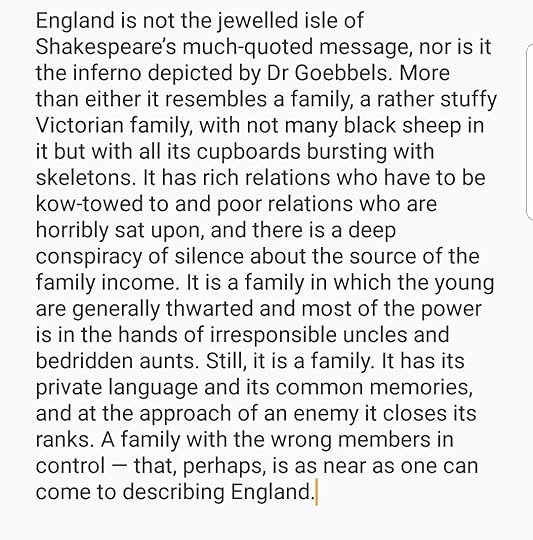
Orwell compares England to a Victorian family (p.30): everyone has a right to feel included, but the wrong ‘relatives’ hold sway, in a difficult, stiff, awkward environment. The ‘good’ people, in Orwell’s eyes (generally young, always working-class) have little to no power. I think this is a critical but mostly fair assessment of British culture: then and now, we were really ‘made’ by the Victorians and their mores, and as a naturally (small-‘c’) conservative country not much has changed. In fact, this sort of structure may have worked rather well in the 18th and 19th centuries, before (according to Orwell) the ruling class qualitatively deteriorated as they became less relevant. In Ancient Greece, aristocratic influence declined as democracy became popular; similarly, as the English middle class gained political influence through votes, the aristocracy’s importance declined, combined with the ‘social decay’ of businessmen entering the upper class and ruining their exclusivity. It doesn’t help that the older people who dominate the ‘Victorian family’ structure (p.54-5) tend to be rather clueless about change, and with the passing of time they don’t know what’s going on (and this has never become clearer than today, when so many MPs are clueless about how the Internet works, and the role it plays in people’s lives). It’s only natural that they become Conservatives who long for the ‘good old days’.

However, Orwell sees the classes as static, which I feel may be an oversimplification that favours his own view of the classes ‘at war’: the working class become middle-class over time, in habits and economically, so they don’t take political action as one might expect – they either work for the prospect of a better life, or don’t care enough to do so – but that isn’t in line with most socialist discourse.

Leading on to the relationship between the economy and the war effort, there’s much focus on weapons manufacturing and how to stimulate it: however, I feel like Orwell slightly twists the narrative again for his own argument. We were undeniably old-fashioned in our tactics in 1914, especially in the use of horses, bayonets, and the like, but by the end of the war we’d progressed remarkably, inventing tracer bullets, aircraft carries, and the tank. (This is not to mention perhaps the most significant invention, radar, which was not conceived until the Second World War.) There was a big difference between 1914 and 1918: we learned our lesson, although we would have to learn it again in the Second World War. Orwell’s criticism is fair, but I feel he was neglectful on the point of adaptation.

Another point that could use elaboration is the navy: part of our disadvantage was that, militarily speaking, seapower was less relevant by that time than it had been in the 18th and 19th centuries, and is still in decline today. This inevitably threw the empire (and its governing class) into imbalance, creating another obstacle for the aristocracy. In conjunction with this, I disagree that, as Orwell says, the navy is less aristocratic than the army – it’s definitely favoured by the wealthier classes, then and now, and generally considered more specialised, but this may have changed over time (today the working class dominates the army). Since this, again, demonstrates the relationship between military activity and social class, I think this a relevant point. There have always been at least a handful of wealthy patriots, and it has historically never been abnormal for noblemen to die in battle (although, for obvious reasons, they tend to have a lower mortality rate than foot soldiers).

Given all of this context, we generally expect the rich to be free market conservatives (then and now), but their position does not necessarily lend to a proclivity for the far right. The Nazis provided government-funded public projects (p.49), showcasing their collectivist wartime streak (or, controversially, the ‘socialism’ in the ‘national socialism’ misnomer), but the rich liked that they remained rich. Fascism is alien to the upper class (p.35) because they’re not disciplinarian or, indeed, ideological in general, though it’s worth noting Edward VIII’s Hitlerian sympathies, not mentioned here. This may not have been the long-term state of affairs, but perhaps in wartime people are more prone to take things one day at a time. Fascism is efficient through state control, and benefits from showcasing this, but doesn’t need to interfere with the rich, although there are cases where this can and does happen. I’m inclined to think that the Conservative Party today, despite appearances, may not be so partial to fascism either, but more motivated by an opportunistic desire to ‘stick it to the left’, as with the American Republican Party (demonstrated by their cosying up to the DUP), perhaps spurred on by a false sense of security, accustomed to being the ones in power themselves. Even in the war the upper class wouldn’t give up their privileges (p.57), which is quite sad. I can understand Orwell’s concerns here, and it almost makes me glad that the hardships of the war forced things to turn around.

Orwell is right that one of our great weaknesses as a country is our anti-intellectual streak (pp.39-40), particularly in the working class: we’ve never had ‘room’ for intellectuals, in contrast with France, and we treat ‘cleverness’ as a cause for suspicion. I don’t think many would find this assessment surprising: the common culture is never intellectual, and intellectual life is inherently isolating (involving lots of quiet reading and lectures with only the like-minded in attendance). They have more in common with their European counterparts, although the latter are generally far less ostracised.

On the positive side, despite this problem, we still manage reasonable self-awareness about our own collective flaws, often where other countries tend to self-aggrandise. In fact, I would link this trait to the pacifistic misjudgements of Orwell’s time: I find it hard to believe that some pacifists were really pro-Hitler (p.62) when the image of fascism relies so heavily on militarism, but if we take Orwell at his word this corroborates my theory. I think the British were aware of their own militaristic shortcomings, paired with the guilty conscience borne by an imperial history, and, although I make no excuse for them, this may have produced the disastrous foreign policy of the time.

This is where things become more difficult for reviewing purposes: I can see Orwell’s logic, and how the socialist system could have worked, but this doesn’t make it the only effective path (and we know with hindsight it proved not to be), or that, if it had been established, it would have provided a successful system after the war. His points about socialism in wartime are valid, but a capitalist government can achieve the same things by demanding production (or offering money in return for it) quite easily. We live in a capitalist state, but not an entirely free-market one – the government still has leverage, albeit through capitalistic means, and ultimately this is in large part the approach that they actually implemented.

Orwell’s p.92 point about the distinction between being defeated and accepting defeat is extremely powerful, but also distinctly Churchillian – a figure he neglects to mention. I don’t expect him to predict the future, but I wonder where Orwell would have fit him into all this: like Nelson, he exemplifies the upper-class naval officer leading Britain through the war, despite being the opposite of a socialist, and despite typifying the old ruling class that Orwell argued was dying out. He seems to be the main weakness to the argument. So, why was Churchill ultimately the one who took down the Nazis? I’m not sure if there’s a consensus among historians, but it seems to me he simply did what needed to be done while the war was ongoing, but was not necessarily concerned with working towards a more egalitarian society, and certainly didn’t share Orwell’s views (on the economy or on, say, the liberation of India). This attitude worked spectacularly in wartime, but did not make him popular PM after the fact. Ultimately, I think it came down to strategy rather than ideology, though Orwell would probably not be happy with that conclusion.
Profile Image for Stephen Curran.
Author 1 book24 followers
December 2, 2020
“As I write, highly civilised human beings are flying overhead, trying to kill me.” Beat that for an opening line.

I picked up The Lion and the Unicorn having listened to Billy Bragg speaking effusively about it on the Backlisted podcast and realising that I had never read it, even though I thought I had. The activist and singer credits it with forming his long held political viewpoint, which he describes on the podcast as ‘patriotic socialism’: two positions that he maintains are not incompatible. For Orwell, patriotism is in truth the opposite of Conservatism, it being a devotion to something that is always changing (but felt mystically to be the same).

I won’t summarize the arguments made, just to say that Orwell writes with such clarity that, while reading him, it’s impossible not to nod in assent. Dispiritingly, the many of the observations he makes about the English at a time of war (the pamphlet was written at the height of the Blitz) still hold true today: we are still “a family with the wrong members in control”, still “governed by the rich, and by people who step into positions of command by right of birth”; a “land of snobbery and privilege, ruled largely by the old and silly.” Orwell’s one big mistake as he wrote these pages was being overly optimistic.
Profile Image for blueisthenewpink.
540 reviews45 followers
August 16, 2021
Man, this one did not age well. It had really good points and the usual wry sense of humour, but I will stick to the ones he could write keeping a healthy distance that makes his fiction just perfect.
Profile Image for Geoff.
23 reviews1 follower
September 22, 2018
So much of this is still relevant today. Sad how little so many things have stayed the same.
Profile Image for Amelia.
31 reviews
May 7, 2019
Funny how fuck all's changed xoxo
Profile Image for Luthfi Ferizqi.
452 reviews14 followers
July 23, 2025
Out of curiosity, I read one of Orwell’s short essays, it turns out to be his view during World War II on how Britain should adopt socialism as its future ideology.

It’s an interesting take, but I personally find it not very relevant to today’s context, especially as someone living in a developing country.
Profile Image for Andy.
1,176 reviews225 followers
July 5, 2019
Moments of startling insight, beautifully written, but some parts a little dated.
Profile Image for Andrés Cabrera.
447 reviews86 followers
January 18, 2018
Llevaba mucho tiempo sin leer un libro completo de ensayos. Aunque el género me agrada, estaba destinando mi tiempo libre para abordar algunos textos filosóficos y literarios (me refiero a ficción y poesía) que me llamaban la atención. Ahora, aprovechando la oportunidad de dictar un curso de Ensayos de opinión en la universidad en la que trabajo, decidí abordar algunos textos que había comprado hace tiempo.

El libro de Orwell que aquí comento fue uno de ellos. En sus páginas, supe encontrarme con un Orwell que no conocía: más reflexivo, menos adoctrinante, capaz más crítico (con todo y que Rebelión en la granja y 1984 son dos grandes textos críticos), preocupado por sus problemas tanto materiales como existenciales; en síntesis, alguien capaz de abrir su vida a sus lectores, no sin los titubeos propios del que reconoce que es susceptible a fallar. De sus ensayos, tres me resultaron especialmente iluminadores: 1) Raffles y Miss Blandish, un estudio en el que se aventuran un par de tesis sobre la literatura y su relación con los intereses de las personas inmiscuidas en la guerra; 2) El león y el unicornio, una reflexión profunda sobre las posibilidades del socialismo a partir de la Segunda Guerra a partir del análisis del carácter y cultura inglesa; 3) Por qué escribo, texto violento en el que se desgranan las ambiciones y precariedades de aquel que decide someter su vida a las palabras. Con esto, no quiero decir que el resto de ensayos que componen este compilado sean de menor calidad que los que he mencionado; por el contrario, están a la altura. El análisis sobre la obra de Henry Miller y la literatura inglesa de 1920 y 30 resulta ser interesante; sobre todo por la capacidad que tiene Orwell para valorar las cosas en su justa proporción. A pesar de los problemas que puede entrever en las obras de Miller o de Kipling, por citar dos ejemplos, Orwell es capaz de reconocer los aciertos y errores que, a su juicio, se encuentran presentes.

Ahora bien, sólo me queda reconocer un último ensayo, de corte eminentemente biógrafico; esto es, ¡Ay, alegrías aquellas!, que termina por ser una bella reflexión sobre el papel de la educación en la formación de los niños y sus aspiraciones. Y es que, al final de estas páginas, me impresiona la capacidad que tiene Orwell para comprender la cultura en la que vive y ser capaz de reflexionar sobre la misma a partir de diferentes géneros y registros narrativos. Ahora entiendo bien a las personas que afirman, sin titubeos, que Orwell es un genio: lo es, pero su genialidad es humilde y sincera. No es esa llama que, parafraseando a Poe, termina por apagarse en la miseria.
Profile Image for Stephen McQuiggan.
Author 85 books25 followers
May 3, 2018
Written during the onslaught of the Second World War, Orwell builds up a treatise on how that conflict could be used to bring forth a quiet English revolution. He argues, and argues convincingly, that patriotism, far being the sole reserve of the conservative or scoundrel, is a natural and integral part of democratic socialism; that the present democracy is nothing more than private capitalism; that the cowardly intellectuals of the Left who wanted Britain to lose the war are the same individuals who have only helped the growth of the Far Right. Obviously, this has dated in places and a lot of his predictions, what he saw as inevitabilities, have failed to come to pass - but there will be other wars, other political systems; will there ever be another Orwell?
Profile Image for Odile.
166 reviews8 followers
February 22, 2025
Est-ce qu’Orwell peut revenir parmi nous et clasher les politiciens du monde entier svp ?

On parle souvent d’Orwell aujourd’hui, et que le monde est devenu comme Nineteen Eighty-Four. Les gens utilisent trop cette comparaison, et déforment souvent ses propos (les fachos s’approprient ses idées par exemple). On a tendance à oublier qu’Orwell a écrit des essais sur ce qu’il démontre dans son roman. The Lion and the Unicorn est l’un d’entre eux, et la claque ! Pas de fiction, pas de symbolisme, simplement sa pensée pure et renseignée sur le monde des années 40. Tout ce qu’il dit, sur la montée du fascisme, sur la lutte des classes, sur les riches, les hommes politiques, tout est applicable aujourd’hui. Personne n’a appris des erreurs du passé. On ne peut pas dire qu’on a rien vu venir…

“One cannot see the modern world as it is unless one recognizes the overwhelming strength of patriotism, national loyalty. In certain circumstances it can break down, at certain levels of civilization it does not exist, but as a positive force there is nothing to set beside it. Christianity and international Socialism are as weak as straw in comparison with it. Hitler and Mussolini rose to power in their own countries very largely because they could grasp this fact and their opponents could not.” (3)

“England is a family with the wrong members in control.
Almost entirely we are governed by the rich, and by people who step into positions of command by right of birth. Few if any of these people are consciously treacherous, some of them are not even fools, but as a class they are quite incapable of leading us to victory. They could not do it, even if their material interests did not constantly trip them up. As I pointed out earlier, they have been artificially stupefied. Quite apart from anything else, the rule of money sees to it that we shall be governed largely by the old - that is, by people utterly unable to grasp what age they are living in or what enemy they are fighting.” (44-5)
Profile Image for Soner Turgay.
101 reviews19 followers
February 7, 2019

İkinci dünya savaşı üzerine bir araştırma yapsanız ve "acaba 1941 yılında İngiltere'nin halet-i ruhiyesi nasıl acaba?" diye bir soruya meraklansanız direk başvuracağınız bir kitap Aslan ve Unicorn.

Orwell genel büyüleyici genel bakış açısı yerine bu kez sosyoloji ve siyaset içeren uzunca bir makale yazmış. Hakkındaki türlü dedikodulara karşın Sosyalizme ne kadar inandığını, katıksız bir anti-faşist olduğunu net olarak görebilirsiniz.

Bazı tartışmalı noktaları yok değil, tüm dünyanın kaos içerisinde olduğu ve de geleceğin pek belirsiz olduğu bir tarih döneminde yazıldığı unutulmamalı. Enternasyonalizm eleştirisi, yurtseverlik övgüsü ve İşçi Partisi'nin aslında kapitalizmle uzlaşmak için var olduğu yönündeki tespitleri radikal solcuları rahatsız edebilir. İşçi Partisi hakkındaki tespiti sanırım 50 sene sonra Blair yönetimi ile ispatlandı. Enternasyonalizm- Yurtseverlik konusu ise hiç bitmeyen bir tartışma.

Bu kitabı klasik Orwell külliyatına koymak zor, dediğim gibi bir konuya odaklanmış bir makale olarak okumakta fayda var. Kısa olduğu için başlayıp bitirmiş bulundum, diğer kitaplarına öncelik verebilirsiniz.
Profile Image for Jackson.
307 reviews7 followers
January 18, 2021
'Orwellian Socialism is rather neat and tidy' says the unforgivable bloke who reads Animal Farm as an allegory about the Cold War.

Scathing and helpful insight into the English identity as it came under more cracking pressure than ever before!
Profile Image for Marieke.
194 reviews43 followers
September 11, 2022
Interesting piece of history; though a little awkward/sad (?) that the core of what he so strongly believed in (e.g. England will only win WOII if a socialist revolution takes place) was so far off from the truth.
Profile Image for SADIK BAYDERE.
109 reviews3 followers
July 4, 2023
Orwell, 2. Dünya savaşında Hitler'in Londra'yı bombaladığı günlerde kaleme aldığı bu uzun makalesinde; İngiliz, İrlandalı, Galli ve İskoçlardan oluşan Birleşik Krallık halklarının, kısaca Britanyalıların analizini yaparken, 19. yüzyılın sonlarından beri kendini yenileyemeyen, dış politikada zayıf kalan, 1931-40 arası faşist ve ırkçı Hitler'in yükselişini ve savaş hazırlıklarını adeta seyreden, hatta onu tehdit olarak görmek yerine Komünist Rusya'ya karşı bir koruyucu addeden, Franco ve Mussolini'yi destekleyen Muhafazakar Tory yönetimini, ülkedeki kapitalist ekonomik sistemi, gelir eşitsizliği ve toplumsal refah dengesizliğini ateşli bir şekilde eleştiriyor, kapitalizm, faşizm, komünizm ve sosyalizmin açık ve net tanımını yaptıktan sonra savaşı kazanmanın ve geleceğe güvenle bakmanın sembolü Aslan ve Tekboynuzlu At olan "Demokratik Sosyalist bir İngiltere" ile mümkün olacağını savunuyor.

80-90'lı yıllarda İngiltere'de yaşamış biri olarak Orwell'in Britanyalı/İngiliz toplumunu çok iyi analiz ettiğini ve toplumsal yapı ile ilgili öngörülerinin tutarlı olduğunu düşünüyorum. Arzuladığı; büyük stratejik sanayi kuruluşlarının ve arazilerin ulusallaştırıldığı, minimum ile maksimum gelir farkının 10 katı aşmadığı, eğitim sisteminin devletleştirildiği demokratik sosyalist sistem gerçekleşmese bile savaş sonrası iktidar olan İşçi Partisinin sosyal güvenlik ve sağlık sistemini güçlendirdiğini ve eğitim sistemini bir nebze iyileştirdiğini 1950'deki ölümünden önce kendisi de görmüş oldu. Lakin, sömürgeleri olan Hindistan, Güney Doğu Asya ve Afrika ülkeleri bağımsızlıklarına kavuşmasına rağmen, ne yazık ki kapitalizm odaklı emperyalist muhafazakar yönetim aynı elitler tarafından hala devam ettirilmektedir.

Bağımsızlığını kazandıktan sonra çökeceğini, Japonya ve Rusya tarafından işgal edileceğini düşündüğü Hindistan ile ilgili öngörülerinde ise maalesef sınıfta kaldı diyebiliriz. Evet, Hindistan, Pakistan ve Hindistan olarak ikiye bölündü ama o da İngilizlerin yüzyıllar boyunca sürdürdüğü Hindu ve müslüman halkları kışkırtma politikası sonucu olmadı mı?..

Güzel bir okumaydı. Tavsiye ederim...
Profile Image for Sophy H.
1,905 reviews110 followers
September 19, 2018
George Orwell offers forth another gem of genius in this brief (80 odd page) essay written during the Second world war. It offers amongst other things a review and critique of the differing political parties at play during that time with references to Hitler, Oswald Moseley's brownshirts and Churchill's administration.

The best point that Orwell makes is how this country was then and always had been (as indeed it is now) run by the richest, most far removed from reality, stuffy bigots. Think of the red nosed pot bellied buffoons embedded in The House of Lords and you're pretty much there!

He calls for a post war revolution which would see the nationalisation of public services, the equalization of education for all and the implementation of a national minimum wage with the disparity between the highest and lowest paid being no more than tenfold.

Luckily for Orwell, we have had an NHS (in all its various forms) since 1948, education has progressed for all and the minimum wage has been in place for some years. Sadly the disparity between rich and poor that irked Orwell is more apparent than ever now, with food banks aplenty and people holding down 3 or 4 jobs whilst paying extortionate rents or struggling to get a mortgage. Patriotism, which at the time of the war pulled the country together against a common sociopath enemy has now mutated into shirtless beer bellies mooching about in the height of summer, looking for a deal on a 12 pack of Stella to be able to watch the match in a man cave, under a St George's flag of course!

The best sentence I took away from this book is this:-

"A generation of the unteachable is hanging upon us like a necklace of corpses".

Fabulous. True. Relevant to now.

We have learned everything and nothing and whilst so much has changed since the Second world war, in some ways nothing has changed.
Profile Image for Dominick.
Author 16 books32 followers
June 22, 2014
This is an interesting historical artefact: Orwell's 1941 argument for the necessity of a socialist revolution in England, if the war was to be won. He ended up being fundamentally wrong about that, of course, even if he is really right about many another point (e.g. the inherent problems in capitalism). Nevertheless, he offers up a lucid and insightful critique of the then-current political environment, and some of what he says remains depressingly true today--indeed, perhaps even more true than it was in 1941. He does have a something of a tendency to rely on gambits such as "anyone with eyes can see" that a certain argument is irrefutable, without doing the legwork necessary to actually make the case. I can sympathize with someone who thinks a certain point is so obvious it doesn't need to be argued, but as a polemical strategy, it is ineffective, as it really only works on those who already see what you do. Nevertheless, the pleasures of Orwell's strong and pellucid prose style make this worth reading on a purely aesthetic level, never mind the political.
Profile Image for Oğuzhan.
33 reviews8 followers
May 20, 2018
1941'de Almanların Avrupayı işgal ettiği ve henüz Sovyet ve Amerikan desteğinin ortada gözükmediği sıralarda İngiltereye dair gözlemleri kavramak için okunabilir. Orwell, İngiliz milletinin biraz incelemesini yaptıktan sonra ona savaşı kazandıracak bir reçete öneriyor. Bu reçete sosyalizm. Ancak bu sosyalizm Stalinin Bolşevizmi ya da İngilteredeki millet karşıtı komünistlerin programı değil, yurtseverliğin verimini en üst seviyeye çıkartacak bir program. Orwell sık sık Almanlara karşı savaşın, Münich de taviz veren ve faşizme, komünizmi engellediği için içten içe sempati besleyen egemen sınıflar ile yürütülemeyeceğini ve Rolls-Royce arabalara binenlerin yurtseverliği baltaladığına dikkati çekiyor. Yazarın ideolojik tezleri bir yana bu kitap 1941 İngilteresinin psikolojisini anlamak için birebir.
Displaying 1 - 30 of 251 reviews

Can't find what you're looking for?

Get help and learn more about the design.