

What do you think?

The Franklin Delano Roosevelt Memorial
Book by Lawrence Halprin
137 pages, Paperback
First published October 1, 1997
Ratings & Reviews
Friends & Following
Create a free account to discover what your friends think of this book!
Community Reviews
Displaying 1 - 6 of 6 reviews

April 25, 2015
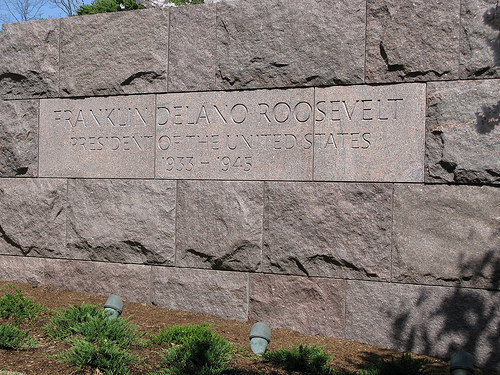
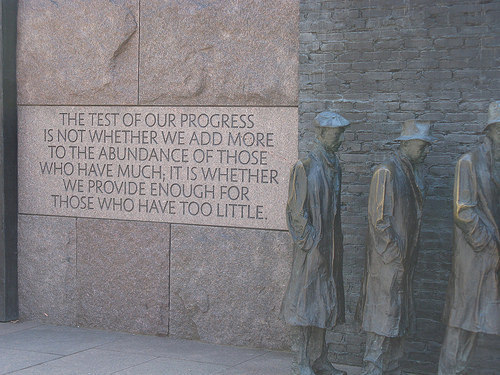
I have visited the Franklin Delano Memorial Site in Washington DC a number of times over the years and continue to find it a very beautiful, distinctive, and contemplative area. It gives dignity to the most outstanding U.S. President of the 20th Century.
This book complements the Memorial and explains how it took several decades to progress from discussion and design to a physical presence. The concept was started in 1955. There were designs chosen in the 1960’s – and finally the author’s proposal was accepted in 1974. The Memorial opened in 1997.
It really is a multi-faceted site – so different from most of the more traditional Memorials in Washington which reflect more a Greco-Roman motif.
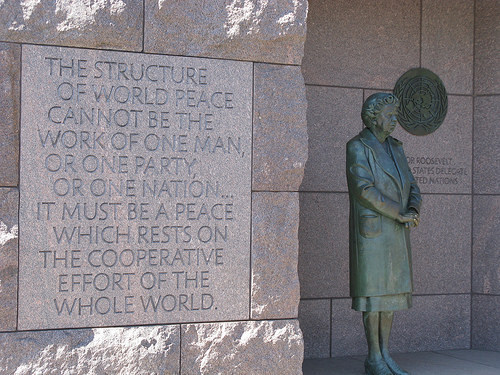
The FDR Memorial is a combination of huge granite blocks, waterfalls, sculptures representing the turbulent era of Franklin Roosevelt, and etchings from many of his historic speeches. All this is enveloped by an array of deciduous and coniferous trees.
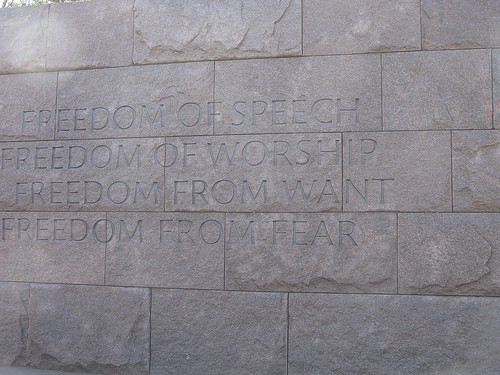
It is divided into four large areas each representing the four different terms of FDR’s Presidency. The author and many of the artists and sculptors lived during the Great Depression and World War II, so their creativity is based directly on those turbulent days.
The book has many pictures of the designs in progress and the sculptures. I would have liked to know how the huge granite blocks were transported to the Memorial site from South Dakota.
The waterfall arrangements provide a very soothing feeling. One reason for the waterfalls was FDR’s love of water. But another reason was to mask the noise of the airplanes constantly flying overhead from nearby National Airport (at the rate of about one every 1-2 minutes).

The first large waterfall reflects the work legislation (like the Tennessee Valley Authority) introduced during the 1930’s. The waterfall in the Third term room, for 1940-44, is more chaotic with huge granite rocks strewn about and is suppose to, as per the author/creator, reflect the increasingly chaotic world situation. But for me it provided a very relaxing and natural area to ponder; it looked more like forested waterfall to me.
The book is a wonderful accompaniment to this very unique and varied Memorial.
Page 6 (my book)
Memorials are archetypal. They speak of life’s meanings, of value systems held in common, of significant challenges and events in the history of a tribe or nation. Memorials speak to us over the ages. They transmit universal truths and experience; they pass the torch of meaning from one generation to the next.

August 8, 2026
I have visited FDR memorial many times. This book is a great supplement to learning an out the memorial and FDR’s life.

February 1, 2023
This book isn't what I expected it to be. Usually books about moments have pictures of them from different angles and some simplified history. This book, by the architect of the memorial, walks us through the process of conception and creation, from choosing the stones, to the sculptors of the figures and the bas reliefs, to the choices made about how to present both the man and the time in which he lived.
I used to advise students and those who weren't English majors often said that they didn't need to write for their chosen profession. Here's a wonderful example of why someone in the creative arts needs to be able to write to explain why he did what he did so that people won't just look at the monument, but be affected by the atmosphere and the tone of the memorial as a whole.
Highly recommended, especially for those interested in FDR and the creation of memorials. My only quibble is that I would have liked to see more photos at the end of the completed piece.
I used to advise students and those who weren't English majors often said that they didn't need to write for their chosen profession. Here's a wonderful example of why someone in the creative arts needs to be able to write to explain why he did what he did so that people won't just look at the monument, but be affected by the atmosphere and the tone of the memorial as a whole.
Highly recommended, especially for those interested in FDR and the creation of memorials. My only quibble is that I would have liked to see more photos at the end of the completed piece.

October 4, 2017
After visiting the FDR Memorial in Washington DC, I wanted to know more. It was obvious that so much was specifically chosen as part of the design: why are the rocks shaped & placed where they are, what is the meaning behind the various waterfalls. This book answers all those questions. The Memorial is a masterwork of art and remembrance. I'm eager to visit again, now with the information from this book.
August 31, 2025
I have visited this memorial. If I had read this book before seeing it I would have had a greater appreciation for the memorial. I do wish the book had more photos of the finished memorial.
January 6, 2026
A nice companion to the memorial
Displaying 1 - 6 of 6 reviews