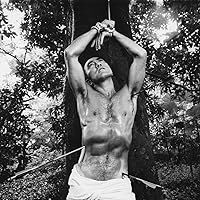
Wayne Koestenbaum's first book of short fiction: a collection of whimsical, surreal, baroque, ribald, and heartbreaking fables.
In Koestenbaum's first book of short fiction--a collection of whimsical, surreal, baroque, ribald, and heartbreaking fables--Koestenbaum takes the gloom and melancholy of our own terrifying political moment and finds subversive solace by overturning the customary protocols of tale-telling. Characters and narrators wander into strange locales; the difference between action and thinking, between reality and dream, grows moot in a heightened yet burlesque manner. The activities in The Cheerful Scapegoat are a cross between a comedy of manners and a Sadean orgy. Language has its own desires: figures of speech carry an erotic charge that straddles the line between slapstick and vertigo. Punishment hangs over every dialogue--but in the fable-world of The Cheerful Scapegoat, abjection comes with an undertaste of contentment. The tchotchkes of queer culture--codes and signifiers--get scrambled together in these stories and then blown up into an improbable souffle.
Koestenbaum's fables travel in circles, slipping away from their original point and leading the reader to a paradisiacal suspension of fixed categories. Intensified sentences and curlicue narratives scheme together mesmerically to convince the reader to abandon old ways of thinking and to take on a commitment to the polymorphous, the wandering, the tangential. Koestenbaum's fables--emergency bulletins uttered in a perverse vernacular of syntactic pirouettes--alert us to the necessity of pushing language into new contortions of exactitude and ecstatic excess.
Wayne Koestenbaum has published five books of critical prose, including The Queen’s Throat: Opera, Homosexuality, and the Mystery of Desire, which was a National Book Critics Circle Award finalist; and three books of poetry, including Ode to Anna Moffo and Other Poems. He is a Professor of English at the Graduate Center of the City University of New York.
Rimbaudian grammar police fight on two fronts: In syntax pareidolian, Scapegoat’s fables whistle toe-tappers in the heat of battle, past the pictographs of The Illuminations, where imagery layers-then-dynamites slabs of disorientation, like jumbly backgrounds of alternate Mona Lisas. Conversely – or is it polyamorously? – a kind of make-up of cut-up, with context not smudged but adroitly applied, creates Koestenbaumian salami-slices of mock-rhetoric, more like the knee-slapping lyricism of John Ashbery, say, than William Burroughs or Gerturde Stein.
I read most of this book aloud, in bed, reclining on the couch. It affirms Lisa Robertson's blurb, that "Each sentence has a fabulous mouthfeel." As always, WK revels in words, voluptuous, arcane ones, and associations made in his unparalleled imagination. These 'fables' are nonsensical linguistic collages with erotic edges. It may be sort of helpful to note that a good portion of them are related to specific artists work, that were catalog essays or something similar. But the relation to those works are a launching point, as though the writer is ignited by the artist. There is so much evident pleasure in WK's writing, in the ease in which he rolls from one thought, one delirious phrase to the next, and you feel it, you are caught up in the absurdities, you swim in it. Or as is the title of my favorite short section, "the schmatte engulfs me." I was thrilled to be up in there.
finished in (almost literally) one sitting during and after a slowly eaten spagetti al arrabbiata with baked salmon while listening to algebra suicide's 1987 album "the secret like crazy", fievel is glauque's "god's trashmen sent to right the mess", boys age's "music for micro fishing", then anadol's "uzun havalar" sandwiched between s. maharba's "cold friend" and "pure eternal light". to a culturally deep diving maze of a work i responded in kind. this falls in the lineage of astonishingly surreal playful on the tongue incendiary in the brain all while hard to read without becoming adrift unmoored from your own particular grasp of the language , hard to read period but worth it if you feel like being frenzied cut up tradition of rene crevel, then burroughs, then acker. reminded me too of genesis p orridge , guy maddin , and a burbling concoction composed of mckenzie wark, andrea lawlor, and maggie nelson. my light burnt out writing this review.
Koestenbaum is in my personal canon of fragment writers. The form is tricky and can easily be misconstrued as lazy (or one of those situations where avant garde form is masking a lack of technical ability) but Koestenbaum usually strikes a nice balance, leaving these pieces somewhere in the serenity of arrested development. Logic in fiction usually works pretty tightly when nothing needs to be explained.
“Darling, I’m trying to reproduce, in words, the time we pressed our groins together on the beacn. You were attempting to console me; I’d been fired from Vogue.”