BE THE FIRST TO READ DAVID WILSON'S NEW TRUE CRIME BOOK "A PLOT TO KILL" BY PRE-ORDERING NOWThe definitive account of a national by the journalist who broke the story and the UK's 'Number One Expert on Serial Killing' - with full details of the January 08 trialThe murder of five women in late 2006 shocked the nation and kept many of us glued to our TV screens, horrified by the unfolding tragedy. For the quiet town of Ipswich it was fifty days of fear and soul searching, from the disappearance of the first victim to the dramatic arrest of the lead suspect, Steve Wright.Journalist Paul Harrison and Professor of Criminology David Wilson arrived in Ipswich just as the first body was discovered. Their on-the-scene access, and Professor Wilson's first-hand experience as a profiler, meant that they were first to put forward the explosive theory that a serial killer was at large.In Hunting Evil , Harrison and Wilson take the reader to the heart of the story. Both visited the sites where the killer disposed of his victims' bodies; both walked the red light area of Ipswich; and both talked to those closest to the victims.They explore the reasons why someone will kill and kill again, and perhaps most important of all explain how serial killers target the must vulnerable in our society, and what can be done to make our communities safer for everyone.
Ipswich is a smallish town of 140,000 in the county of Suffolk in eastern England. It was here in 2006 that five prostitutes were murdered harking back to the gruesome times of Jack the Ripper. The serial killer was a 48-year-old man called Steve Wright. Was he also responsible for other unsolved murders dating back to the 1990’s? Sky news reporter, Paul Harrison, was sent to Ipswich to report on the murders.
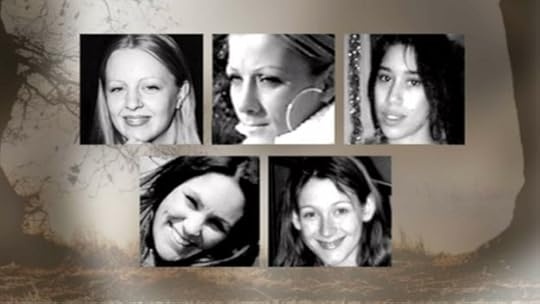
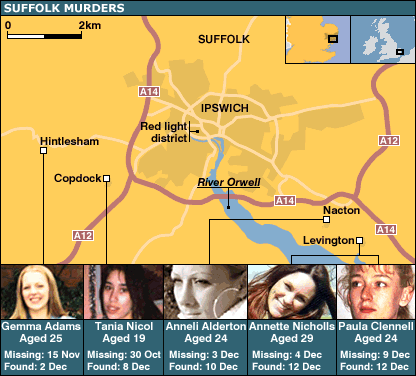
Harrison goes over the red-light district area of Ipswich, how the street walkers work and the five women, who were all prostitutes, were murdered. Tania Nicol. Gemma Adam, Anneli Alderton, Annette Nicholls and Paula Clennell. They were all drug addicts on heroin or crack or both. Harrison analyses prostitution – ‘it has been calculated that as many as 95% of those involved in street prostitution are using crack or heroin’. It is very sad indeed.
The book is interesting in that it veers off into what constitutes a serial killer and their motivating factor which is where David Wilson’s expertise comes to the fore. It looks at profiling. It is not a biography of the killer although there is a short one there (what a complete waste of space this man is). It is looking more at the journalists take on events. How it was reported and what they had to do and their involvement in the actual case. He says .‘The media falling into the role of detective is easily done’. It flipped back and forward which was a little disconcerting as one minute your reading that the actual killer has been caught and then it flies back to when another man was suspected.
The way prostitution works in Britain especially street walkers means the girls are so vulnerable. Harrison makes a case for having laws changed. Also, he looks at the draconian drug laws. These girls need help. They are drug addicts and that is why the street walk. Harrison is purporting the same changes to the drug laws as Johann Hari pit forward in ‘Chasing the Scream’ and I agree.
All in all the book is rather a dry read but interesting nonetheless.
'Hunting Evil' is as first-hand an account as one could get, apart from the killer himself telling his story. Paul Harrison and Professor David Wilson were on the scene most of the time; they visited the sites where bodies were found; they walked the red-light district of Ipswich; they chatted to colleagues of the dead girls and they were at the forefront of police interviews and investigations. As such this chilling tale is gripping throughout, tragic though it may be.
The five bodies were all found in a relative short space of time and it was obvious that the killer knew how to destroy forensic evidence. However, he failed to clean up properly after his final two killings and DNA was removed from the scene. As the perpetrator of the crimes, Steve Wright, had been previously arrested and DNA samples taken at that time, a match was found and the police had their man.
But this was after they had arrested another local man who had boasted that he not only knew the five girls but he drove them around and had sex with them. The police thought him a worthwhile suspect ... that is until the new DNA evidence, which brought to account a man who could undoubtedly have gone on to commit further crimes.
Movingly and sympathetically told the book not only details the case itself, but, using Professor Wilson's knowledge of serial killers, there are interspersed chapters on how a serial killer's mind works, what should be done to protect sex workers and other interesting technical background.
This book caught my eye initially as I like the true crime genre, and being based in the UK made it more interesting to me, especially as I have had family vacations in the Norwich and Great Yarmouth area; some of the locations were familiar to me, for example I remember seeing signs for Nacton.
The first part of the book reads almost in real time, with the journalist travelling to Ipswich thinking he is going to do some follow up on an earlier piece about prostitution, unaware of the events about to unfold which would keep him in Ipswich for weeks. Once the killer is under arrest, the book shifts to more of a text book style, covering different subject matter as DNA, evidence, the trial itself etc. It appears to be well researched, with Paul Harrison talking to practically everyone possible with a connection to the tragic events, barring the killer himself, who spoke to no one. The book also delves into the social and economic atmosphere at the time, and how they contributed to the events that took place. The victims are treated with some sympathy, and not written off as expendable or deserving of what happened to them. Ideas for improving so-called red light districts are also discussed, such as whether increased CCTV in the area improves the safety of sex-workers or sends them underground, potentially putting them in more danger?
A book by a tv news journalist with analysis from a Professor of criminology. The main account of the events leading up to the discovery of the bodies of five young women in Ipswich is written in a lazy tabloid style. There are lots of comments like: 'Little did her mother know that would be the last conversation she had with her daughter.' 'Little did the girls know their mobile phones would be used to trace their last movements.' I would have preferred a more factual account that an emotive one but at least the parts written by Professor Wilson do add some understanding both to the 'science' of offender profiling and to what may or may not constitute the reasons and motives behind serial killing. As Steve Wright the killer in this case never gave any reasons as to why he committed these heinous crimes, the book cannot give any information about his motivation other than speculation but it does include interviews with both Wright's then partner and his father. There is also some good information about the links between prostitution, drugs and crime and how societies need to tackle this.
I bought this book after seeing Professor David Wilson on 'Killers behind bars'. So some of this material was familiar to me. The book reads as the story of what happened as events unfolded. Then the book changes style and has each chapter focus on certain aspects eg the medias involvement or criminal profiling. I liked this because I wanted to get into the 'nitty gritty' of it, but others might not like the change in style.
Fascinating. This isn't so much a book about the murders as a book examining how the story developed and a detailed look at prostitution and serial killing from an academic viewpoint. There are careful, sensitive portraits of each victim and all are regularly named throughout to remind us all that they were people like us......daughters, partners and mothers.
This isn't for you if you're looking for gore but if you're interested in why some people kill, and a really well thought out discussion on prostitution then you'll find this well worth the time
Having lived in Ipswich during these 5 horrific murders, I could visualise the roads mentioned, the deposition sites of all 5 women and remember the fear that was in all of us.
The book goes through each stage of the investigation and gives the reader a taster of the psychology behind criminal investigations.
I thoroughly enjoyed enjoyed reading this, as much as you can enjoy reading about 5 real-life and VERY close to home murders.
An excellent insight into the Ipswich Murders and importantly the women who were murdered. I found the writing to be excellent with a great deal of time taken to explain the stories of these women and how they came to find themselves facing their ultimate fate. It is also interesting to read from a different or unusual perspective, I’ve read many books on similar subjects written by former police or law enforcement officers or from biographies of these killers but this book is written from a media viewpoint and necessarily feels a bit more distant.
The title says it - this was evil. Five murders of five prostitutes over a period of about 2 months. A complete town in despair and fear, an extensive manhunt. The book is well-written and by a journalist who followed the case from start to finish. I could not put it down. Scariest thing is that this is a non-fiction book.
An interesting read. I struggled with the chronology (which couldn't be helped as it's real life & the poor women weren't found in the order that they'd been murdered). I also found the two different voices of Harrison & Wilson difficult at times but a journalists viewpoint of covering a series of murders was very interesting
A very unsettling book about the Suffolk Serial Killer Steve Wright, I am generally interested in True Crime but hadn’t chosen to read this genre for quite some time so as I used to live not to far away I was drawn to read this. It’s very well written, gripping and I only found it a little boring right at the end … but it’s a really good book
An interesting book about, not only the Ipswich murders, but the conditions surrounding and leading to the murders. The discussion of prostitution, drug abuse and poverty is well balanced and informative.
Fascinating book as it not only covers the murders but goes into details about profiling, DNA and forensics, the role of the media in a major criminal case as well as details about how a murder trial is conducted. Well written too. Recommended for anyone who enjoys true crime.
not bad, not much stuff written about steve wright and the crimes he commited interesting in the theory he might have been responsible for suzy lamplugh and several other murders .and perhaps he wasnt alone. Otherwise interesting but a bit wordy.