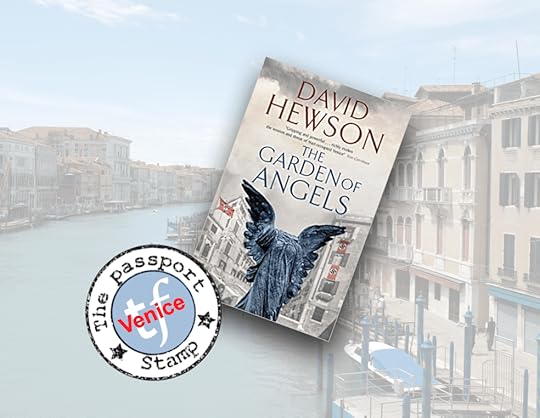
At the start of The Garden of Angels, fifteen-year-old Nico Uccello has been suspended from school for a week after watching bullies attack a Jewish classmate. He reluctantly goes to visit his ailing grandfather, Nonno Paolo in hospital, wishing he could be elsewhere instead. However, his thoughts of a day on the beach at the Lido, chasing girls or pursuing his photography hobby begin to be usurped by the letters his grandfather says are a story he has been saving for only him.
These letters allow the novel's dual time frame to shift between 1999 and 1943 as Nico reads about the events that will determine the then eighteen-year-old Paolo's whole life. As Nico is transported to the uncertain, dangerous days of Mussolini's Italy and Nazi Occupation, David Hewson's intimate descriptions of the city are unsettlingly vivid. Venetians have perhaps been able to carry on more normally than other parts of the country so far but there is change in the air and the labyrinthine streets and waterways provide an atmospheric backdrop to the increasingly tense story.
The young Paolo has recently been orphaned and is struggling to continue his family's weaving business. It's a chance moment that changes everything when he happens to witness a murdered Jewish woman being pulled from the canal. From here, his fate appears to be sealed as he is approached by the local priest, who has a request. When he agrees to shelter two wanted Partisans - Jewish brother and sister, Vanni and Mika Artom - the stage is set for dramatic revelations that change everything Nico thought he knew about his grandfather.
Although The Garden of Angels is an affecting portrait of Venetian life under Occupation, it is also a tender character study and a coming-of-age tale that finds the young Paolo recognising his hermit-like existence is perhaps not just due to the Uccello family being considered outsiders. The tentative relationship that develops between Paolo and Vanni is achingly poignant, not least for the reaction it induces in Nico. As they work together on the old weaving looms, desperate to fulfil an important order, the beauty of the velvet they produce is soured by its meaning, and though Paolo is finally able to accept who he is, others are quick to remind him that it's not just Jews who are being rounded-up by the Nazis.
Nico is far more forgiving of Mika, although her behaviour is more openly reckless and there is the suggestion that she thrives on the adrenaline and bloodshed, although whether that is entirely fair is debatable. One of the most interesting aspects of The Garden of Angels is its awareness of the human condition. There are few outwardly evil characters here; even Oberg, the city's Hauptscharführer, is a man you sense is not entirely at ease with his position. The friendship between local priest, Garzone and Jewish doctor, Diamante allows for a few moments of hope that humanity and understanding must prevail but still, the weight of history bears down on the two men who acknowledge their mistakes even as others may call them heroes.
It's former police officer, Luca Alberti, who now openly collaborates with the Crucchi invaders who is perhaps the most intriguing character, however. Understandably viewed with contempt by many Venetians, as the novel progresses we begin to question whether his motivations are entirely self-serving or if he wasn't quite the villain that he will be remembered as. It's ultimately left to each reader to decide for themselves but he is a striking reminder that history is made by ordinary people who are rarely fully good or bad.
Back in 1999, Nico realises that few people want to talk about the war, preferring to consign it to the past and the latter part of the book finds him attempting to come to terms with Paolo's shocking disclosures. Although the tension in the novel comes from the dramatic, melancholic wartime chapters, it's the conclusion which I found to be the most moving. Set years later, and with Brexit and the concurrent move towards right-wing totalitarianism across much of Europe casting an ominous shadow of racism and intolerance once more, Nico finally comprehends why Paolo gave him the letters. It moved me to tears and as much as I can and do recommend it for its superb sense of time and place, the excellent characterisation and taut, thrilling plot, it's the necessary reminder of what human beings are capable of which make The Garden of Angels such a compelling, memorable read. Very highly recommended.