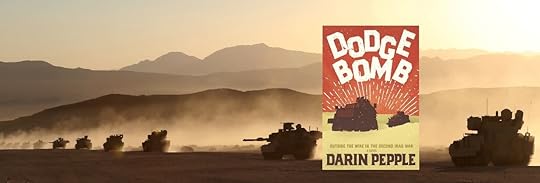
A powerful, compelling account of modern military life that is vividly told and utterly gripping! During the height of the Global War on Terrorism, Lieutenant Eddie Fitzgerald (Fitz) is sent straight from West Point to the front line in Iraq. He is immediately thrown into combat and has to quickly overcome his naivety to earn the trust of other soldiers. However, if hunting Al Qaeda isn’t enough he’s pulled into Arab tribal politics and army officer rivalries. As Fitz gets accustomed to living a spartan, foreign life-style his confidence grows and over time he becomes one with his unit. At first, he is detached from the brutal reality of the results of war, but there will come a time when he will have to question his idealism, allow dread to replace numbness, and face his emotions. For those who seek realistic books on war that are impossible to put down, this is the book for you. It is compelling and entertaining as well as educational and honest. The author has a deft hand and a keen eye for detail, bringing understanding to 21st century combat. Book includes illustrations and Professional Military Education section in the appendix. Buy Dodgebomb today, for an authentic, honest and unvarnished experience of being on the ground in Iraq. For people who enjoyed Scott A Huesing’s Echoes in Ramadi Mark Boal’s The Hurt Locker James Patterson’s Walk in my Combat Boots Sean Parnell’s Outlaw Platoon
Darin Pepple is a veteran of fifteen years’ service in the US Army, advancing from private to captain. He enlisted in 2000, graduated West Point in 2007, served two tours in Iraq, and led soldiers on hundreds of combat patrols. His debut novel, Dodgebomb, was inspired by his transition out of the military in 2015 and his attempts to explain his Iraq War experience to average Americans. He currently works and resides near Washington, DC.
Captain Pepple has written a fictional account based on his tour of duty in Iraq. Americans are very siloed from what our armed services personnel experience and Pepple’s book gives great insight to those of us who never fought. The story moves along at a very good pace. Pepple’s description of battles, patrols, decision making, chain of command, Iraqi culture, characters, etc. are all engaging without getting bogged down and distracting from the story. I read it in a single sitting and highly recommend it.
Absolutely loved this book. Darin Pepple does an incredible job of capturing the experiences of being a brand new Lieutenant in the Army and taking over a platoon in combat. He really does an amazing job of capturing the subtle nuances of the conversations and experiences that occur in a deployed environment. The growth the protagonist experiences from being the FNG (fu*%ing new guy) to an experienced combat leader is captured so poignantly. I really enjoyed this read and highly recommend it to anyone who has ever wondered what our Armed Forces experience being deployed in a combat environment.
Vivid flashes of Iraq tingled every nerve as I poured over Darin Pepple’s page-turner about a combat tour south of Baghdad. I heard the rumbling generators, smelled the stench of burning trash and felt the stifling heat inside the armored vehicles.
Intending to glance over the book for just a few minutes, I reluctantly put it down ten hours later when my blurry eyes could take no more. The writing was so surprisingly spell-binding and true to life. The book focuses on a second lieutenant fresh out of West Point and the Armor Officer Basic course who is assigned as a replacement platoon leader at a patrol base along the Tigris River. Oddly, Pepple makes a cameo appearance in the book as a fire support officer for Bushmaster Troop, 8-6 Cavalry, but the plot focuses on 2nd Lt. Eddie Fitzgerald. His platoon’s advance on an Al Qaeda stronghold in the village of Zambraynia was the most compelling part of the tale for me.
A warning though: despite the novel’s cartoonish cover and easy flow, parts of it can be graphic and even depressing, especially for those with similar memories. From the echoing din of an incoming alarm in the first chapter to the unit’s redeployment, Pepple brings alive his tour during the 2008 surge in Iraq. Those who served during that time will inevitably be transported back, and those who didn’t will get an accurate sense of what those rigorous times were like in this must-read.
Dodgebomb provides a captivating writing style and symbolism that brings the reader into the battlefield and the unceasing monotony of a deployment in the Second Iraq War. I thoroughly enjoyed following LT Fitzgerald as he navigated his role within Bushmaster and his glow up as a leader.
The book was enjoyable to read and only leaves you desiring more stories and anecdotes about LT Fitzgerald's journey and interactions. I am looking forward to Darin Pepple's next book being released and will have to re-read Dodgebomb in the meantime.
True depiction of the internal thoughts of a soldier
Darin has an impeccable ability to convey the internal thoughts of the soldier/Jr officer with such realism. I felt those things. I had those internal discussions in my head. He nails it.
This is a creative, bitter and sarcastically funny American perspective of deployment into the cultural minefield of Iraq. It's a fantastic, no-fluff, contribution to war texts that tell it like it is - soldiers navigating the monster of bureaucracy, egos and orders, all while trying to stay alive during the flaring chaos that is sandwiched between weeks of chronic, suffocating routine.
Simplified, the creation of Butter is usually achieved from churning pasteurized cow's milk, separating the fat content from the buttermilk. Typically split about 80/15 on the percent scale between butterfat and water, butter in the US can also contain undeclared food coloring as butter is the only food item that need not have it on the label. Mostly, however, feed based yellow pigment beta-carotene is responsible for butter's color, irrespective if the pound is found in four equal sticks west of the Rocky Mountains, or two long bars east of the Rocky Mountains. Languishing without insignia other than a sleeve braid for 142 years, the US Army's O-1 finally received their due in 1917, just shy of the end of World War I. Copying the silver bar of the first lieutenant, 2LT was thenceforth decorated with the single bar of gold, the butterbar. The lowest of the commissioned officer ranks in the Army, 2LTs are usually entrusted with platoon-sized units of about 16 to 44 soldiers. Armed with heavy theoretic knowledge earned the hard way at West Point, 2LT Fitz is looking to take the obligatory "Don't Die Within 24 Hours of getting to Iraq" one week course to heart during his deployment and hoping to DODGEBOMB.
Iraq in 2008. The sun was a blinding, omnipresent amber blaze. It looked like unimpressive brown earth with garbage strewn about. Everything appeared a drab, monochromatic tan, as if the heat had cooked off the other colors. Either the fierce sun or the dust limited visibility, but no one could tell which. It was the reeking armpit of the world where the environment dripped with hostility. And 2LT Fitzgerald was finally there after West Point, Armor Officer Basic Course and a short stint at Fort Stewart, in the midst of things, joining 8th Squadron 6th Cavalry, 4th Brigade, 3rd Infantry Division--a cavalry squadron. Boy that's a mouthful. Mustangs, 8-6 Cavalry had their own COP or patrol base, Army terms for temporary fortified outposts, though to a newbie it sounded a lot like an Old West stockade surrounded by Indians. This translated into maintaining security at all times outside the wire. The new LT would do alright, just as long as he didn't do anything stupid. Easier said than done in a combat zone, right?
While every West Point leadership exercise had preached 'The Hard Right over the Easy Wrong', there was no mention of the realities of active war, which was much like life in the Army deployed the world over, hurry up and wait. Once outside the wire, the strict protocols of the base didn't seem so bad, even when returning to base meant refueling trucks, downloading ammunition, unloading equipment, accounting for sensitive items, writing patrol briefs, parking vehicles in line, and cleaning weapons. No one would get respite till it was done. DODGEBOMB asserts that next to maintenance, three rules will guide you in the Sandbox; take care of your team, squad, platoon, troop, make rational rather than emotional decisions and once you're out of the unit, you're out. That would require to DODGEBOMB and make it out, thoughts that sometimes preoccupied the new LT. What would happen if he didn't? Surely, his parents would be devastated, but everyone else? Grief for a day, and then back to work? As such, DODGEBOMB poses an interesting question that can easily be asked anywhere in the world but was ultimately relevant to those in the midst of things in Iraq. What was life worth over there?
Laced with humorous observations about the Army, war, and war in Iraq, DODGEBOMB interestingly has the protagonist sometimes hampered by another LT's ineptness, aptly named in the author's likeness. Plus, the narrative has one of the best camel jokes you'll find this side of the ending of DUMB AND DUMBER. Laughter seems vitally important, as LT Fitz, like almost anyone, felt mostly numbness and anger as time marched on, least of all because an egotistical and conceited LTC could ruin a career with a stroke of his pen, or because the Army had perfected taking away a soldier's human need, return it, and then label it a reward for good performance. Since one good deed deserves another, DODGEBOMB does a superb job chronicling a lot of days in the life of a deployed soldier in Iraq, including natural lines of drift, River City, shake and bake, and the uniqueness of each and every Iraqi door, plus emphasizing that vital link of sergeants in the middle, translating organizational goals into action, checking details, and giving that much needed kick in the ass. Written with deep experiential knowledge, narrated with elan, charm, and a relatable humorous twist, DODGEBOMB is one of the best novels to experience the Iraq War firsthand, relive the experience, and chronicle for America what soldiers went through. DODGEBOMB makes for a stunning, harrowing, frustrating, and often fascinating trip into life in and around a patrol base, Iraq 2008.
The Iraq War is still a bit abstract to me, even though I spent many months training to deploy there. When I was coming up in the Army, still a wet-behind-the-ears Second Lieutenant, Iraq was all the rage. In the parlance of our times, Afghanistan was tired and Iraq was wired. Everybody who was anybody was going to Iraq. But not me. After months of training up in 2008, my Brigade’s deployment orders were switched from Iraq to Afghanistan and the rest is history. Now, years later, I still seek out novels and memoirs that will give me an accurate account of the Iraq experience to better understand my close friends who deployed there and the day-to-day of the young leaders on the ground. I recently had the privilege of readying Darin Pepple’s debut novel, Dodgebomb: Outside The Wire In The Second Iraq War, which is an excellent depiction of exactly these things from the perspective of a junior officer in the most excellent type of combat unit: the Cavalry.
Dodgebomb focuses on the deployment of 2nd Lieutenant Eddie Fitzgerald, a fresh-faced Cavalry Officer, who is deployed to Iraq to serve as a replacement Platoon Leader in a Troop operating from a remote Patrol Base in Iraq. After a long, tedious journey from the States to his new unit in Iraq, Fitzgerald first meets his Squadron Commander, a brash and egotistical, Lieutenant Colonel who is eager to show everyone just how smart he is about war. This seems to be the predominant trope for officers of that rank in GWOT literature and it’s satisfying every time. As Fitz gets closer to his ultimate destination, Patrol Base Murray, he meets an array of Soldiers who view him with annoyance and skepticism, at having to risk life, limb, and eyesight ferrying this new officer to his post, where he will, in their minds, probably be just another worthless “butter bar”. Even before they reach PB Murray, Fitz experiences his first of many tragedies in the war, as one of the convoy’s trucks strikes an IED, killing an American Soldier. This sudden trauma sets a tone of uncertainty for the rest of the book, which is perfect given how fast things can change in a warzone. The rest of Pepple’s Dodgebomb follows Fitz through the remainder of his Squadron’s deployment, where he earns the respect of his soldiers and peers, experiences victories in combat, endures no shortage of tragedies, continues to be plagued by the pompous pageantry of his superior officers, faces awkward interaction with weirdly over-eager local nationals, and endures his first-ever Squadron staff meeting, a hellish nightmare I know all too well.
What I enjoyed most about Dodgebomb was the way Pepple captured the subtle nuances of deployed life, especially for a first-time deployment. Pepple starts the novel with an excellent example of this as the reader accompanies Fitz on the last part of his long, awkward trip from the States to his assigned Troop, all the while only vaguely knowing where he’s supposed to go and how he’s supposed to act around other soldiers who’ve already been around the block a time or two. Fitz’s introductions to his Platoon Sergeant and other Platoon Leaders are perfect. As several very different personalities collide, you can almost feel the men measuring each other up and gauging each other's level of competence and professionalism. These morph beautifully into ever-progressing relationships throughout the book. Fitz is thrown into action almost immediately upon arrival and he is again measured up by this Commander, fellow Platoon Leaders, and soldiers. For anyone who has ever arrived at a new military unit, you understand this behavior well.
I highly recommend Dodgebomb to anyone looking to understand what life was like for veterans of Iraq or to any veterans looking for a trip down memory lane (which was recently cleared of IEDs). For me, it painted a much clearer picture of what day-to-day life was like there and I am continually surprised by how different the Iraq experience was from an Afghanistan deployment. It’s strange how two Army Officers of the same rank and similar dates of service, could have two dramatically different experiences in two very different wars, serving under the command of nearly identical personalities. This, in itself, highlights the importance of novels like Dodgebomb. I’m grateful to Pepple for writing this and to all veteran authors who share their stories, helping us to better understand each other as we figure out where to go from here.
Dodgebomb is a good book. It does a good job of communicating the (un)reality of war in Iraq and Afghanistan, and provides a much more realistic view of veterans than some other War on Terror fiction.
War at the tactical level is an odd thing, especially when one isn’t being shot at but is close to combat. My last deployment was as a staff officer. In my role, I was primarily responsible for planning and administration. Forcing people to do those things while they were frequently—and appropriately—pre-occupied with firefights was an uncomfortable position to be in. It is this sort of (un)real experience that Dodgebomb does a good job of recreating. The most memorable example of this is in Dodgebomb is when the main character, having just returned from an exhausting patrol, gets an absurd request via phone from his battalion. The scene leaves the reader aghast, thinking, “I can’t even explain what I’m thinking, what Fitz is thinking, or what I’d do in this situation.” Such events probably seem absurd to readers without a military background, but that absurdity merely reinforces the oddity of war.
When I deployed to Afghanistan we were in an AO that was pretty exciting at the start of our deployment. Our line units were in regular, if not constant, contact. Observing indirect fire, CAS, and HCAS on a video screen but hearing it in real life is an oddly disconnected and disconnecting experience. Dodgebomb brought me back to Afghanistan. Especially notable was the seizure of Zambraniya (sp?). That section read a great deal like a World War II-era battle, which I think is necessary. Because I sometimes find myself in this position, I suspect that much of the US thinks that the War on Terror has been either IEDs or handshakes. It is easy to forget that “low-intensity conflict” is often high intensity conflict at the small unit level.
The characters in Dodgebomb are realistic. LTC Gute is a standard “tool,” especially as viewed from the perspective of a junior officer. He is smart and successful, but often focused on things his junior officers find silly and irrelevant. The junior Soldiers are realistic, the NCOs are professional, and when Bushmaster Troop faces adversity, they look to their leaders in exactly the same way Soldiers everywhere do.
“Fitz,” however, is the star of the book, and not just because he is the main character. His arc is carefully crafted and realistic. He deploys as a hard charging young officer, ready to take the fight to the bad guys and protect America. Throughout the deployment, his enthusiasm is gradually ground down, and by the end he is indifferent. One of his allies, and Iraqi he worked with, is murdered in the middle of the night, but the episode is presented as an aside, meriting less than half a page. That isn’t an oversight on the author’s part, it’s indicative of Fitz’s ennui: even the murder of someone he knew well and fought beside barely registers.
When Fitz redeploys, he finally lets his emotions out to his First Sergeant, providing the emotional catharsis of the book. What is critical about this scene though is not Fitz’s emotional vulnerability, but the lack of permanent scarring he shows. The “damaged veteran” trope is common, with some reason, but also over-sold. In my experience, relatively few people return from Iraq and Afghanistan with deep and everlasting emotional scars. Many, even most, are just spent. Fitz won’t redeploy and kill the neighbor’s pet in cold blood because he is damaged, as happens in another Long War story. He will go home and drink—sometimes to celebrate his survival, sometimes to mourn the dead, and sometimes irresponsibly—reconnect with his family and friends, do his duty at work, and move on with his life, in the same way almost everyone does.
There are a few issues with the book. The jacket sells “tribal rivalries,” but those don’t really exist in a way that impacts the story. Sometimes descriptions of standard Army life are wordy and other times they’re heavily reliant on acronyms, but such are the difficulties of writing military fiction for a mixed military-civilian audience. All in all, it’s an excellent book.
Dodge Bomb is a great story that follows a young Lieutenant as he joins his unit in Iraq, experiences battle and many other things for the first time. It’s not a Hollywood depiction of soldiering, it is real and gritty. Darin Peppal weaves the ebb & flow of adrenalin fueled action with the grinding exhaustion of everyday life on a long combat tour, interspersed by almost bazar events which jar your reality. The emotional journey the young officer follows is instructive to us all.
My experience is in a different army in a different generation, but I felt at home with this book. I’ve been to the same places but on a different continuant, met the same locals but with a different language, been to the same bazar meetings and meals with different people and met the same types of soldiers and officers but in different uniforms. Darin tells a good story, a real story.
Sent to the strange and hostile land of Iraq, Eddie Fitzgerald must quickly learn to navigate the complex landscape of modern war. Through the eyes of “Fitz,”readers are immersed in the frustrations, fears, and banalities of life in combat as a rookie officer.
Written with sardonic humor, raw emotion, and military acumen, Dodgebomb is honest to its core—an authentic lens into a world shaped by sun and sand, brutality and bureaucracy, and the American soldier’s ever-evasive search for meaning in a forgotten war.
The war novel we all needed. It captures the ugly side, boredom, despair and unshakeable doubt. After 20 years many are questioning it all. LT Fitz goes into a fit of dialogue with top that hits so close to home it gave me goosebumps.
To understand what soldiers and leaders faced in the gwot this book needs to be on the list. The ending was perfect, but I don’t want to spoil it. Just that bad times become good times.
I had high hopes for this, but ultimately it fell short. This reads more like a memoir, with very little plot to keep the reader interested. I respect that he wrote the book, but if interested in novels about the Iraq War there are far better ones out there.
Phenomenal fictional portrayal of a unit’s deployment to Iraq. The author’s wrestling with the purpose and meaning of his deployment and time in Army resonated deeply.
It's not just a war story it's more than that. You follow a clueless kid just graduated from West Point to a foreign land where people want to kill him.
Dodgebomb gave me a whole new sense of what the war in Iraq was like for many soldiers. The detailed descriptions of the bases and the daily activities gave me a vivid picture of the experience for our service members overseas. We have all heard the blockbuster stories of the war that were more exception than the rule. This story gives a representative experience of what the majority experienced rather than the outliers. The level of intensity that grabs the reader during dangerous situations is real and also frightening to think that these situations played out hundreds of times throughout the war. I appreciate the honest look at the life of a soldier and feel this book helps me better understand the thoughts and emotions that impact our heroes abroad. Enjoyed the read.