

What do you think?

Zazen
Somewhere in Della’s consumptive, industrial wasteland of a city, a bomb goes off. It is not the first, and will not be the last.
Reactions to the attacks are polarized. Police activity intensifies. Della’s revolutionary parents welcome the upheaval but are trapped within their own insular beliefs. Her activist restaurant co-workers, who would rather change their identities than the world around them, resume a shallow rebellion of hair-dye, sex parties, and self-absorption. As those bombs keep inching closer, thudding deep and real between the sounds of katydids fluttering in the still of the city night, and the destruction begins to excite her. What begins as terror threats called in to greasy bro-bars across the block boils over into a desperate plot, intoxicating and captivating Della and leaving her little chance for escape.
Zazen unfolds as a search for clarity soured by irresolution and catastrophe, yet made vital by the thin, wild veins of imagination run through each escalating moment, tensing and relaxing, unfurling and ensnaring. Vanessa Veselka renders Della and her world with beautiful, freighting, and phantasmagorically intelligent accuracy, crafting from their shattered constitutions a perversely perfect mirror for our own selves and state.
Reactions to the attacks are polarized. Police activity intensifies. Della’s revolutionary parents welcome the upheaval but are trapped within their own insular beliefs. Her activist restaurant co-workers, who would rather change their identities than the world around them, resume a shallow rebellion of hair-dye, sex parties, and self-absorption. As those bombs keep inching closer, thudding deep and real between the sounds of katydids fluttering in the still of the city night, and the destruction begins to excite her. What begins as terror threats called in to greasy bro-bars across the block boils over into a desperate plot, intoxicating and captivating Della and leaving her little chance for escape.
Zazen unfolds as a search for clarity soured by irresolution and catastrophe, yet made vital by the thin, wild veins of imagination run through each escalating moment, tensing and relaxing, unfurling and ensnaring. Vanessa Veselka renders Della and her world with beautiful, freighting, and phantasmagorically intelligent accuracy, crafting from their shattered constitutions a perversely perfect mirror for our own selves and state.
264 pages, Paperback
First published May 22, 2011
About the author
Vanessa Veselka
9 books300 followersVanessa Veselka is a writer and musician living in Portland, Oregon. She has been, at various times, a teenage runaway, a sex-worker, a union organizer, a student of paleontology, an expatriate, an independent record label owner, a train-hopper, a waitress, and a mother. Her work has appeared in Bust, Bitch, Maxmum Rock ’n’ Roll, Yeti Magazine and Tin House. Zazen is her first novel.
A special note for the Goodreads community... I am not a critic. I leave that task to others. Writing books is something like trying to catch a handful of water in a stream; we get what we get at that moment. I only post books I like and I give everyone five stars.
A special note for the Goodreads community... I am not a critic. I leave that task to others. Writing books is something like trying to catch a handful of water in a stream; we get what we get at that moment. I only post books I like and I give everyone five stars.
Ratings & Reviews
Friends & Following
Create a free account to discover what your friends think of this book!
Community Reviews
Displaying 1 - 30 of 284 reviews

February 11, 2015
”It’s about how much fear you hide in your cells: blue cells, red cells, sickle cells, sleeper cells, jail cells--people are shot through with it. But I don’t hold my fear there. Everybody needs a place where they’re fearless or they’d never survive, at least I wouldn’t. Sometimes I hate this world. Especially when it’s more beautiful than I can imagine.”
Della Mylinek is slinging tofu scrambles and other vegan concoctions at a local diner. The world is destabilizing with a series of wars against unnamed foes. Ultimately does it matter who they are? She has a Ph.D. in Geology, but sees the world not just through a scientific lens, but also through a romantic counter culture kaleidoscope. I’m not sure I’ve ever met anyone in fiction or real life that sees the world more clearly, more expansively, than Della Mylinek.
”I feel different when I believe different things. Only I don’t know how to go back to feeling how I did because I can’t re-believe.”
That’s what life does to us, right? It keeps hitting us. We see our shield go spinning away from us. We can’t breath so we pull off our helmet. Chunks of our armor fall down around us. We hold our sword with two hands and wonder if we should parry another blow or just drive the sword up into our own throat. Please, everyone, continue to parry.
Once the apple has been eaten. Once the gossamer has been swept from our eyes. Once we see the world in all it’s violent colors we can not re-believe.
”Save your fucking pennies for a gun and a history book.” If our leaders had read more history we wouldn’t need to buy the gun.
People are leaving, jumping ship, escaping before the last pretenses of civilization have become nothing more than a tattered flag. They are going to exotic locals, extended eco tourism, thinking simplicity will save them from the ravages of an unraveling technology based world. The people who are staying are embracing more hedonistic behavior such as orgy parties, drug experimentation, and using alcohol to excess.
Interesting what we decide to do with our last days.
”What would Scooby Doo do?
Della has a ticket, a cowardly ticket, but it feels like the last vestiges of a defendable world are crumbling and she believes that soon she will be overrun, trampled by the revolution of the new world. Her parents who are die hard radicals will be so disappointed. The anarchy of this new future is their drug choice.
”It was all suffering, all torque, a seamless garment of misery.” Bombs are going off in the city. The explosions remind me of the hunts when they use noise from beaters to move the game towards the guns. The bombs are convincing more and more people it is time to go. Those that have hunkered down are hearing the screams of their biology to flee. Della is caught ”between moments”.
She starts calling in fake bomb threats just to see the reactions of the people. She presses her finger into the oozing wound of their fear. She feels herself descending into an amalgam of her parents, terrorists, and prophets. ”I felt the part of me that couldn’t be moved, moving, a glacial shift in all my horrible pride.” Is she moving away from herself or towards her real self?
Vanessa Veselka was a teenage runaway. She has worked as a union organizer, a sex-worker, and a student of paleontology. Her past has been fused into this novel creating a future that is so real that after reading it I walked outside just to make sure my world was still there. There are condemnations of the recent wars that we’ve found ourselves mired in. She exposes the unnatural conspiratory fears that people are capable of embracing that were so prevalent with the Tea Party recently (as one example) and how real those fears become to those that wish to believe. The left doesn’t get off the hook either as she casts a jaundiced eye at what they choose to feel is important as well. Of course she doesn’t name names or party affiliations or even countries, but she shows a recent past that could have been so much worse and a future that could be our own.
There is brilliance throughout the book. Lines that can not be ignored. ”The world is a violent child none of us will get to see grow up.” This is a thoughtful book. Every person that reads this novel will see pieces of their past and future selves shining like beacons of truth. It is relatively easy for us to roll through life with dashes of tragedy or pain or joy or unbridled happiness when the safety net of society is there to break the fall or keep us from growing Icarus wings. When the safety net is gone that is when we all will find out who we really are.
***HIGHLY RECOMMENDED***
If you wish to see more of my most recent book and movie reviews, visit http://www.jeffreykeeten.com
I also have a Facebook blogger page at:https://www.facebook.com/JeffreyKeeten
Della Mylinek is slinging tofu scrambles and other vegan concoctions at a local diner. The world is destabilizing with a series of wars against unnamed foes. Ultimately does it matter who they are? She has a Ph.D. in Geology, but sees the world not just through a scientific lens, but also through a romantic counter culture kaleidoscope. I’m not sure I’ve ever met anyone in fiction or real life that sees the world more clearly, more expansively, than Della Mylinek.
”I feel different when I believe different things. Only I don’t know how to go back to feeling how I did because I can’t re-believe.”
That’s what life does to us, right? It keeps hitting us. We see our shield go spinning away from us. We can’t breath so we pull off our helmet. Chunks of our armor fall down around us. We hold our sword with two hands and wonder if we should parry another blow or just drive the sword up into our own throat. Please, everyone, continue to parry.
Once the apple has been eaten. Once the gossamer has been swept from our eyes. Once we see the world in all it’s violent colors we can not re-believe.
”Save your fucking pennies for a gun and a history book.” If our leaders had read more history we wouldn’t need to buy the gun.
People are leaving, jumping ship, escaping before the last pretenses of civilization have become nothing more than a tattered flag. They are going to exotic locals, extended eco tourism, thinking simplicity will save them from the ravages of an unraveling technology based world. The people who are staying are embracing more hedonistic behavior such as orgy parties, drug experimentation, and using alcohol to excess.
Interesting what we decide to do with our last days.
”What would Scooby Doo do?
Della has a ticket, a cowardly ticket, but it feels like the last vestiges of a defendable world are crumbling and she believes that soon she will be overrun, trampled by the revolution of the new world. Her parents who are die hard radicals will be so disappointed. The anarchy of this new future is their drug choice.
”It was all suffering, all torque, a seamless garment of misery.” Bombs are going off in the city. The explosions remind me of the hunts when they use noise from beaters to move the game towards the guns. The bombs are convincing more and more people it is time to go. Those that have hunkered down are hearing the screams of their biology to flee. Della is caught ”between moments”.
She starts calling in fake bomb threats just to see the reactions of the people. She presses her finger into the oozing wound of their fear. She feels herself descending into an amalgam of her parents, terrorists, and prophets. ”I felt the part of me that couldn’t be moved, moving, a glacial shift in all my horrible pride.” Is she moving away from herself or towards her real self?
Vanessa Veselka was a teenage runaway. She has worked as a union organizer, a sex-worker, and a student of paleontology. Her past has been fused into this novel creating a future that is so real that after reading it I walked outside just to make sure my world was still there. There are condemnations of the recent wars that we’ve found ourselves mired in. She exposes the unnatural conspiratory fears that people are capable of embracing that were so prevalent with the Tea Party recently (as one example) and how real those fears become to those that wish to believe. The left doesn’t get off the hook either as she casts a jaundiced eye at what they choose to feel is important as well. Of course she doesn’t name names or party affiliations or even countries, but she shows a recent past that could have been so much worse and a future that could be our own.
There is brilliance throughout the book. Lines that can not be ignored. ”The world is a violent child none of us will get to see grow up.” This is a thoughtful book. Every person that reads this novel will see pieces of their past and future selves shining like beacons of truth. It is relatively easy for us to roll through life with dashes of tragedy or pain or joy or unbridled happiness when the safety net of society is there to break the fall or keep us from growing Icarus wings. When the safety net is gone that is when we all will find out who we really are.
***HIGHLY RECOMMENDED***
If you wish to see more of my most recent book and movie reviews, visit http://www.jeffreykeeten.com
I also have a Facebook blogger page at:https://www.facebook.com/JeffreyKeeten

November 21, 2012
I went to work and a guy I wait on said he was leaving. He said everyone he knew was pulling out.
“Canada is just not far enough. Mostly Mexico. A bunch to Thailand. Some to Bali.”
He always orders a Tofu Scramble and makes me write a fucking essay to the cook. No soy sauce in the oil mix, no garlic, extra tomato, no green pepper. Add feta. Potatoes crispy and when are we going to get spelt. He holds me personally responsible for his continued patronage. I hope he dies. I’d like to read about it.
My brother Credence says people who leave are deluding themselves about what’s out there. I just think they’re cowards. Mr. Tofu Scramble says I should go anyway, that it’s too late. I want to but I can’t. Maybe when the bombs stop, or at least let up. Nobody thinks it’ll stay like this. I call it a war but Credence says it isn’t one. Not yet. I say they just haven’t picked a day to market it. Soft opens being all the rage. My last few weeks down at grad school it was so bad I thought everything was going to shake itself apart. I tried to focus on my dissertation, follow the diaspora of clamshells but every night it got worse. It’s not any better here—here, there, now, tomorrow, next Wednesday—geologically speaking it’s all the same millisecond. The gentle rustle of armies crawling the planet like ants. Anybody with any sense knows what’s coming.
With these opening sentences, Vanessa Veselka drew me into the world she created in her debut novel Zazen, through the eyes of its narrator/protagonist Della Mylinek. Della's voice is original and compelling. A recent recipient of a Ph.D. in geology, the daughter of New Left radicals who judge their children’s actions according to political optics, Della is working in a vegan restaurant as she struggles to put past traumas behind her. In this world, the United States is enmeshed in numerous wars and conflicts, citizens live in fear of bombings, and people are torn between leaving the US before it’s too late, or remaining at the mercy of the unnamed enemies who fill their lives with terror and chaos.
Although Zazen depicts bombings, riots, and murders, the novel also represents a world in which slogans, labels, and messages are ominpresent, and take the place of any concerted action for real change. Della has a keen eye and ear for people who substitute a pre-packaged identity for any deep sense of who they are. The novel is filled with her wry observations of friends, family, acquaintances, and passers-by who seem to devote more time to what their clothing and food choices signify, than to any real impact they might have on the world:
I signed up for yoga classes the week I found the rat. I got a six-month membership. Credence said the consistency would be good. The woman behind the counter was wearing a tank top that had “Namaste!” written across the front of it like the Coca Cola logo. Her hair was red and wrapped in an orange scarf. Her nails were pink glitter and she had a pendant of Guadalupe hanging from her neck.
“Can I help you?” she asked.
Yes. I want to look like you. I want to be so thoroughly anchored into some sort of pop culture aesthetic that nothing can knock me over or wash me away or make me hate everyone. I want to sleep again.
“I’d like to take some yoga classes,” I said.
In these passages, Zazen reads almost as a political, social, and cultural satire. However, Veselka does not limit herself to satirical prose. There are moments of pure poetry, and others of deep insight, that anchor the novel and give it power:
I would tell them tomorrow. I would say: I am a pool of light, then flicker like sun on a swimming pool. I would say: It has already erupted. And then, dancing through the braided shadows on the basin, wait for the foliage to land in the pool water and make galleons and cutters out of oak leaves and elm. Then they would have to understand.
The next day a second bomb went off at an auto shop down the street from Rise Up Singing. Everyone was running. But you can’t outrun it. I know. I’ve tried. You just come to the same place again and again. The return is so fast now for me that from the outside it looks like stillness. Like nothing is happening at all. But beyond that stillness is an unmappable topography, an endless stream of content.
And in the heart of the novel, at all times, is Della.
Throughout Zazen, Della struggles to determine where she belongs, who she is, and whether her actions can make any difference in the chaos and fear that surround her. As a geologist, she is trained in mapping the terrain and delving deep into the earth’s layers, so she turns this skill to her attempts to understand the terrain of the city she lives in, sometimes mapping small areas such as the yoga studio where she takes classes, sometimes mapping larger areas:
Out of a desire to understand, I began collecting maps and putting them on the walls. Gift shop maps with sea monsters on them and beveled, unfamiliar coastlines, cold war maps with the Soviet Menace spreading like leprosy. Pink East Germany. Red China. Maps of Pangaea and Gondwanaland from back before the seams pulled apart when we were still all one big continent—Deep Time, where countries turn to silt, silt turns to stone and we can now tell time by comparing the rates of nations collapsing—Biostratigraphy? Patriastratigraphy? Following the law of superposition, one thing always follows another: map of the Trail of Tears, bike map, subway map, and one I drew when I was twelve and wrote “Della’s world” in scented marker at the top. Historical, geological, topographical, ideological and imaginary. Sitting in Credence’s attic I tried to figure out if culture was just geology. Maybe Rwanda was caused by mountain building. And the Russo-Japanese War by glacial till. Maybe you need pirated rivers in the headlands before you can have a Paris Commune.
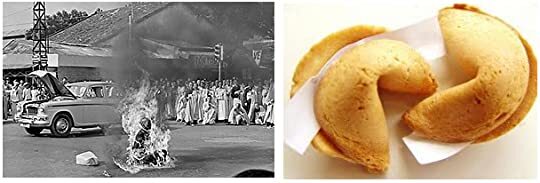
In times of stress, Della focuses on slow geologic changes and repeats, almost as a mantra, “Nothing personal.” She turns to fortune cookies to honor the memories of people who died through self immolation as a form of protest. As she tacks these fortunes to the maps she has collected, the juxtaposition of the original fortune and magic numbers with the person’s name underlines the ultimate futility of their gesture. Any messages they hoped to convey through their actions dissipate quickly:
I started putting them up on the walls too. I bought a bag of fortune cookies and raided the fortunes. On the back of each I wrote, underneath their lucky numbers in red, the name of the burned.
Jan Palach
Your warmth encourages honesty at home:
718253741.10
Thich Quang Duc
Magic will be created when an unconventional friend comes to visit:
816223141.24
Elizabeth Shin
Your future is as boundless as the lofty heaven:
811283645.15
Norman Morrison
You will be reunited with old friends:
615213840.12
Kathy Change
Your nature is intense, magnetic and passionate:
712293644.27
I taped the fortunes to pins like flags and stuck them in the maps. Each city that inspires immolation gets a tiny white flag to flutter. Tiny little surrender. Tiny little surrenders. Supposedly, the heart of the Vietnamese monk from ’63 never burned but shriveled to a tiny liver. It is held hostage (kept safe as a national treasure) by the Reserve Bank of Vietnam. Tiny liver hearts. I pinned them to the walls. Katydids flutter all around.
I hesitate to tell you much more about Zazen, because part of the joy of reading it comes from the feeling of surprise as Veselka’s prose takes turn after turn away from the expected. Her style and voice are original, but she is not writing simply to shock. The novel, and Della, crept up on me as I was reading, and I saw more and more points of similarity between Della’s concerns and mine. Although Zazen clearly is set in a US in the future, it’s a US that bears striking similarities to the US in 2012. This is a world where capitalist slogans and symbols overtake any changes that radicals hoped to make along the way. It’s a world where shopping becomes a patriotic act for some, echoing George W. Bush’s call for Americans to go shopping after 9/11 as a way to fight back against terrorism. It’s a world full of distractions of our own making, which too often dehumanize us and separate us from each other. And it’s a world where we helplessly ask whether change is possible, whether we can make a difference, and fear to hear the answer.
I had a very personal reaction to Zazen, and one which stemmed from only a very small part of the novel. Among the names of protesters who self-immolated Veselka includes Kathy Change, an activist and performance artist who set herself on fire in front of a peace symbol statue on the campus of the University of Pennsylvania in 1996. I was a graduate student writing my dissertation at Penn at the time. I remember Kathy Change well. She would dress in rainbow-colored leotards and dance in front of the main library on campus, waving hand-made flags with peace symbols on them, trying to forward a cause of peace that only she really understood. People saw her only in terms of her struggles with mental illness -- they let that label drown out any other message she was trying to convey. Some people would heckle her, while others would walk by, shaking our heads and averting our eyes. Kathy Change didn’t fit into any of the neat boxes we had for acceptable forms of political protest. I am not certain that a different reaction from us would have changed her decision, but I do know that any message she was trying to impart, whether by dancing or setting herself on fire, was lost in a sea of labels and symbols and distractions. As I read Zazen, I reflected on the profound failure that represents, considered my part in it, and wondered how to find a way forward, a way to make a difference.
“Canada is just not far enough. Mostly Mexico. A bunch to Thailand. Some to Bali.”
He always orders a Tofu Scramble and makes me write a fucking essay to the cook. No soy sauce in the oil mix, no garlic, extra tomato, no green pepper. Add feta. Potatoes crispy and when are we going to get spelt. He holds me personally responsible for his continued patronage. I hope he dies. I’d like to read about it.
My brother Credence says people who leave are deluding themselves about what’s out there. I just think they’re cowards. Mr. Tofu Scramble says I should go anyway, that it’s too late. I want to but I can’t. Maybe when the bombs stop, or at least let up. Nobody thinks it’ll stay like this. I call it a war but Credence says it isn’t one. Not yet. I say they just haven’t picked a day to market it. Soft opens being all the rage. My last few weeks down at grad school it was so bad I thought everything was going to shake itself apart. I tried to focus on my dissertation, follow the diaspora of clamshells but every night it got worse. It’s not any better here—here, there, now, tomorrow, next Wednesday—geologically speaking it’s all the same millisecond. The gentle rustle of armies crawling the planet like ants. Anybody with any sense knows what’s coming.
With these opening sentences, Vanessa Veselka drew me into the world she created in her debut novel Zazen, through the eyes of its narrator/protagonist Della Mylinek. Della's voice is original and compelling. A recent recipient of a Ph.D. in geology, the daughter of New Left radicals who judge their children’s actions according to political optics, Della is working in a vegan restaurant as she struggles to put past traumas behind her. In this world, the United States is enmeshed in numerous wars and conflicts, citizens live in fear of bombings, and people are torn between leaving the US before it’s too late, or remaining at the mercy of the unnamed enemies who fill their lives with terror and chaos.
Although Zazen depicts bombings, riots, and murders, the novel also represents a world in which slogans, labels, and messages are ominpresent, and take the place of any concerted action for real change. Della has a keen eye and ear for people who substitute a pre-packaged identity for any deep sense of who they are. The novel is filled with her wry observations of friends, family, acquaintances, and passers-by who seem to devote more time to what their clothing and food choices signify, than to any real impact they might have on the world:
I signed up for yoga classes the week I found the rat. I got a six-month membership. Credence said the consistency would be good. The woman behind the counter was wearing a tank top that had “Namaste!” written across the front of it like the Coca Cola logo. Her hair was red and wrapped in an orange scarf. Her nails were pink glitter and she had a pendant of Guadalupe hanging from her neck.
“Can I help you?” she asked.
Yes. I want to look like you. I want to be so thoroughly anchored into some sort of pop culture aesthetic that nothing can knock me over or wash me away or make me hate everyone. I want to sleep again.
“I’d like to take some yoga classes,” I said.
In these passages, Zazen reads almost as a political, social, and cultural satire. However, Veselka does not limit herself to satirical prose. There are moments of pure poetry, and others of deep insight, that anchor the novel and give it power:
I would tell them tomorrow. I would say: I am a pool of light, then flicker like sun on a swimming pool. I would say: It has already erupted. And then, dancing through the braided shadows on the basin, wait for the foliage to land in the pool water and make galleons and cutters out of oak leaves and elm. Then they would have to understand.
The next day a second bomb went off at an auto shop down the street from Rise Up Singing. Everyone was running. But you can’t outrun it. I know. I’ve tried. You just come to the same place again and again. The return is so fast now for me that from the outside it looks like stillness. Like nothing is happening at all. But beyond that stillness is an unmappable topography, an endless stream of content.
And in the heart of the novel, at all times, is Della.
Throughout Zazen, Della struggles to determine where she belongs, who she is, and whether her actions can make any difference in the chaos and fear that surround her. As a geologist, she is trained in mapping the terrain and delving deep into the earth’s layers, so she turns this skill to her attempts to understand the terrain of the city she lives in, sometimes mapping small areas such as the yoga studio where she takes classes, sometimes mapping larger areas:
Out of a desire to understand, I began collecting maps and putting them on the walls. Gift shop maps with sea monsters on them and beveled, unfamiliar coastlines, cold war maps with the Soviet Menace spreading like leprosy. Pink East Germany. Red China. Maps of Pangaea and Gondwanaland from back before the seams pulled apart when we were still all one big continent—Deep Time, where countries turn to silt, silt turns to stone and we can now tell time by comparing the rates of nations collapsing—Biostratigraphy? Patriastratigraphy? Following the law of superposition, one thing always follows another: map of the Trail of Tears, bike map, subway map, and one I drew when I was twelve and wrote “Della’s world” in scented marker at the top. Historical, geological, topographical, ideological and imaginary. Sitting in Credence’s attic I tried to figure out if culture was just geology. Maybe Rwanda was caused by mountain building. And the Russo-Japanese War by glacial till. Maybe you need pirated rivers in the headlands before you can have a Paris Commune.
In times of stress, Della focuses on slow geologic changes and repeats, almost as a mantra, “Nothing personal.” She turns to fortune cookies to honor the memories of people who died through self immolation as a form of protest. As she tacks these fortunes to the maps she has collected, the juxtaposition of the original fortune and magic numbers with the person’s name underlines the ultimate futility of their gesture. Any messages they hoped to convey through their actions dissipate quickly:
I started putting them up on the walls too. I bought a bag of fortune cookies and raided the fortunes. On the back of each I wrote, underneath their lucky numbers in red, the name of the burned.
Jan Palach
Your warmth encourages honesty at home:
718253741.10
Thich Quang Duc
Magic will be created when an unconventional friend comes to visit:
816223141.24
Elizabeth Shin
Your future is as boundless as the lofty heaven:
811283645.15
Norman Morrison
You will be reunited with old friends:
615213840.12
Kathy Change
Your nature is intense, magnetic and passionate:
712293644.27
I taped the fortunes to pins like flags and stuck them in the maps. Each city that inspires immolation gets a tiny white flag to flutter. Tiny little surrender. Tiny little surrenders. Supposedly, the heart of the Vietnamese monk from ’63 never burned but shriveled to a tiny liver. It is held hostage (kept safe as a national treasure) by the Reserve Bank of Vietnam. Tiny liver hearts. I pinned them to the walls. Katydids flutter all around.
I hesitate to tell you much more about Zazen, because part of the joy of reading it comes from the feeling of surprise as Veselka’s prose takes turn after turn away from the expected. Her style and voice are original, but she is not writing simply to shock. The novel, and Della, crept up on me as I was reading, and I saw more and more points of similarity between Della’s concerns and mine. Although Zazen clearly is set in a US in the future, it’s a US that bears striking similarities to the US in 2012. This is a world where capitalist slogans and symbols overtake any changes that radicals hoped to make along the way. It’s a world where shopping becomes a patriotic act for some, echoing George W. Bush’s call for Americans to go shopping after 9/11 as a way to fight back against terrorism. It’s a world full of distractions of our own making, which too often dehumanize us and separate us from each other. And it’s a world where we helplessly ask whether change is possible, whether we can make a difference, and fear to hear the answer.
I had a very personal reaction to Zazen, and one which stemmed from only a very small part of the novel. Among the names of protesters who self-immolated Veselka includes Kathy Change, an activist and performance artist who set herself on fire in front of a peace symbol statue on the campus of the University of Pennsylvania in 1996. I was a graduate student writing my dissertation at Penn at the time. I remember Kathy Change well. She would dress in rainbow-colored leotards and dance in front of the main library on campus, waving hand-made flags with peace symbols on them, trying to forward a cause of peace that only she really understood. People saw her only in terms of her struggles with mental illness -- they let that label drown out any other message she was trying to convey. Some people would heckle her, while others would walk by, shaking our heads and averting our eyes. Kathy Change didn’t fit into any of the neat boxes we had for acceptable forms of political protest. I am not certain that a different reaction from us would have changed her decision, but I do know that any message she was trying to impart, whether by dancing or setting herself on fire, was lost in a sea of labels and symbols and distractions. As I read Zazen, I reflected on the profound failure that represents, considered my part in it, and wondered how to find a way forward, a way to make a difference.

November 25, 2012
"Sometimes you just need to be someone else, someone who doesn’t care about anything at all. I know I do. I want emptiness but I can’t have it."
I read this book because of the amazing review Kris wrote, and she truly has an impeccable taste in books. The memory of her praise of this slim volume was what kept me from giving up through the first third of the story, until finally the book gripped my heart and insisted that I continue with it, until I finally was powerless to put it down.
"Lately, I’ve become afraid that the feeling I used to feel, like something good was waiting, is what people mean when they say “young” and that it is nothing more than a chemical associated with a metabolic process and not anything real at all."The core of this book hinges not on the plot but on the metaphor-laden emotions and feelings - desperate and overpowering ones. It's very internally oriented - which eventually becomes its strongest point.
“I wish it were enough just to be alive.”Narrated by a character who recently has gone through a significant (even if not much alluded to) mental breakdown and is in the utmost fragile mental state ("my wiring was shot and I cried all the time"), Zazen is filled to the brim with trembling tense panic, raw staccato emotions, disdain of conformity and nonconformity alike, loss and isolation and alienation, suffocating fear and anger, deep intense longing for something that at last can be real, and overpowering desire to run away from it all - to the place where something will somehow be better.
I knew what she meant more than anything I had ever known.
"I’d like to see something happen. Something big that wasn’t scary, just beautiful. Some kind of wonderful surprise. Like how fireworks used to feel."Della, emotionally fragile paleontologist turned waitress at a vegan restaurant, is very isolated and quite misanthropic, secretly harboring a "hidden desire for things not to be fucked, to belong somewhere". A child of the radical revolutionary parents, she exists in a world of the contrasts and divides.

On one side there is the suffocating fakeness of the all-is-hunky-dory culture venerating mass consumerism, worshiping it in the box-mall-church. On another side, there is the counterculture of rejection and resistance, bordering on hatred and destruction. And somewhere - place them yourself - are those "so thoroughly anchored into some sort of pop culture aesthetic that nothing can knock me over or wash me away or make me hate everyone".
But is any of that *real* in a sense we perceive real? Real as in 'free from fake', free of the pre-packaged ready-to-consume one-size-fits-most roles and identities that are so easily doled out by the culture where patriotism and shopping are intertwined? Is is any wonder Della is angry and confused? Is it any wonder she feels lost? Is it any wonder she notices that "...Everyone had a pretty good reason to blow up a building. I agreed with most of them."?
"War A is going well and no longer a threat, small and mature. Like a bonsai. War B is in full flower. Its thin green shoots reaching across the ocean floor like fiber optic cable. Our only defense is attack."Is it any wonder she feels trapped in a world perpetually on a brink of war, where bombs go off, children die, and there are people who in protest set themselves on fire?
"And they were all like that, macrobiotic Belgian trust-fund junkies, park bench anarchists, mean white lesbians in canvas clothing and dreadlocks—each ready to denounce you as a cop at the slightest sign of dissent. My dirty little secret was that I only liked militants at a distance. Up close I couldn’t stand them. Their targets were always the same, a cow path from the cell to the Great Reactionary Dawn. I wanted something more creative than dead clerks."
A child of radicals, a sister of an activist, a friend (or at least an associate) of those who can be easily called domestic terrorists, Della strikes me as first of all a pacifist. She may be fascinated with bombs and self-immolation and such - but, after all, all she really wants is for "everything to be okay, everything to change, and no one to get hurt." And the world does not work that way, sadly.
"That’s the problem with symbolic gestures. People never take them far enough."And the world does not run on symbolic gestures only. But *real* gestures - Della eventually comes to see that they are not an alternative - not for her, at least.
--------------
The tense panic, the longing, the fear of passivity and fear of violence, the need for acceptance, the search for real identity - all those things screaming from the pages of this metaphor-laden book, and try as hard as I can I'm unable to stop thinking about it.
"I also knew what it was like to be somewhere foreign, waiting for the person you used to be to show up."I have spent a few days trying to come to terms with what I feel about this book. I've never really felt that lost or desperate or that lonely as Della does - so why did it ultimately begin to resonate with me this hard? Because it plays on our inner essential desire for things to be fine, for the world to be *real*, for love instead of hatred?
Maybe so. I don't know - maybe I need a few more years on my shoulders to understand everything that is going through my own head right now. What I do know is that this book still hasn't let me go - and for this I can give it 4.5 stars without much hesitation.
"Annette says I’m too hard on the world, that I only see one side.
Grace says I’m afraid of my own longing.
I looked around at the smoke and people. I couldn’t find any hate in me anywhere. The world is a violent child none of us will get to see grow up.
I decided to love it anyway."
——————
Recommended by: Kris

June 17, 2012
The world is a violent child none of us will get to see grow up.
The writing in this book is unlike anything else I can think of. Veselka has her own style, her own voice. And it’s awesome.
This book is like a constant panic attack. The tension chokes you.
Della, our protagonist, is sharply observant and enjoyably critical of all these things in the world today. You know, tofu and de-caf and soy and vegan and
yoga.
The woman behind the counter was wearing a tank top that had “Namaste!” written across the front of it like the Coca Cola logo. Her hair was red and wrapped in an orange scarf. Her nails were pink glitter and she had a pendant of Guadalupe hanging from her neck.
“Can I help you?” she asked.
Yes. I want to look like you. I want to be so thoroughly anchored into some sort of pop culture aesthetic that nothing can knock me over or wash me away or make me hate everyone. I want to sleep again.
“I’d like to take some yoga classes,” I said.
This is how this book goes. Calling out the douchebaggery of people while slowly but surely building up to this incredible, serious, scary climax.
And I like everything I just made fun of, except for de-caf.
Zazen is just that wickedly funny.
To say more would be risking ruining the strange apocalyptic stressful dark world and what happens in the end and how lonely and scary and beautiful it all turns out.
The writing in this book is unlike anything else I can think of. Veselka has her own style, her own voice. And it’s awesome.
This book is like a constant panic attack. The tension chokes you.
Della, our protagonist, is sharply observant and enjoyably critical of all these things in the world today. You know, tofu and de-caf and soy and vegan and
yoga.
The woman behind the counter was wearing a tank top that had “Namaste!” written across the front of it like the Coca Cola logo. Her hair was red and wrapped in an orange scarf. Her nails were pink glitter and she had a pendant of Guadalupe hanging from her neck.
“Can I help you?” she asked.
Yes. I want to look like you. I want to be so thoroughly anchored into some sort of pop culture aesthetic that nothing can knock me over or wash me away or make me hate everyone. I want to sleep again.
“I’d like to take some yoga classes,” I said.
This is how this book goes. Calling out the douchebaggery of people while slowly but surely building up to this incredible, serious, scary climax.
And I like everything I just made fun of, except for de-caf.
Zazen is just that wickedly funny.
To say more would be risking ruining the strange apocalyptic stressful dark world and what happens in the end and how lonely and scary and beautiful it all turns out.

November 30, 2012
Nearly every review of this that I skimmed through is glowing, but I didn't think it was that great. For one thing, it's populated almost solely by hippies and wannabe eco-terrorists, and Veselka crams it with so many hippie buzzwords that it makes one gag. Yoga, yerba mate, "namaste," rallies, leaflets, community organizing, veganism, artisan craft movements, indigenous medicine, co-ops, biodynamic farming, and other hippie affectations pervade throughout. This is clearly no accident but it grates. The characters aren't aware of the extent to which they unconsciously endorse the consumerism they so ardently claim to fight against. Is Veselka? I'd like to think so, but if so, what's the purpose of such contempt for her characters?
She's obviously a good writer; among the things that made me almost rate this three stars were little gems like the following: "On the water, the city upon the hill wavered, an inverted reflection, and broke into scallops of stuttering light as the sun set." Or this: "The sun was everywhere and the leaves were just turning gold and red and falling like open palms to the waving grass." But on the other hand, when Veselka gets topical, you have stuff like this:
Mr. Tofu Scramble: So, Della, is this your first day? By the way, do you know if Franklin has ordered spelt yet?
Ed, Logic's Only Son: So what's wrong with butter and cheese? It's not like you have to slaughter a cow to get cheese.
Call me pedantic, but if Ed is logic's only son, and if he is as knowledgeable as he's portrayed (though unflatteringly so), wouldn't he know that most cheese production involves rennet, which is derived from calves' livers? Meaning that in fact you do have to slaughter a cow (a baby one, no less) to get cheese?
People praise the fierce activist impulse of this novel, but I don't see it. All I see is a furious impotence, encapsulated by the characters' whining, cursing, and meaningless rebellions (hair dye, etc.). E.g. this:
"I picked it up and thought about buying it and throwing it through the glass door of the box-mall-church. But that door wouldn't break no matter how hard I threw it. I couldn't do it anyway. I'd be afraid I'd hit someone or scare some kid so I put it back. I'm sick of how they always win."
Boo hoo! Della is a PhD and she can't think of any better way to effect social change than to think about throwing rocks at windows, and to not do so. That's pathetic. Am I supposed to sympathize, or should I have the same contempt Veselka seems to? Is the book just supposed to infuriate me? Because that's what it did.
She's obviously a good writer; among the things that made me almost rate this three stars were little gems like the following: "On the water, the city upon the hill wavered, an inverted reflection, and broke into scallops of stuttering light as the sun set." Or this: "The sun was everywhere and the leaves were just turning gold and red and falling like open palms to the waving grass." But on the other hand, when Veselka gets topical, you have stuff like this:
Mr. Tofu Scramble: So, Della, is this your first day? By the way, do you know if Franklin has ordered spelt yet?
Ed, Logic's Only Son: So what's wrong with butter and cheese? It's not like you have to slaughter a cow to get cheese.
Call me pedantic, but if Ed is logic's only son, and if he is as knowledgeable as he's portrayed (though unflatteringly so), wouldn't he know that most cheese production involves rennet, which is derived from calves' livers? Meaning that in fact you do have to slaughter a cow (a baby one, no less) to get cheese?
People praise the fierce activist impulse of this novel, but I don't see it. All I see is a furious impotence, encapsulated by the characters' whining, cursing, and meaningless rebellions (hair dye, etc.). E.g. this:
"I picked it up and thought about buying it and throwing it through the glass door of the box-mall-church. But that door wouldn't break no matter how hard I threw it. I couldn't do it anyway. I'd be afraid I'd hit someone or scare some kid so I put it back. I'm sick of how they always win."
Boo hoo! Della is a PhD and she can't think of any better way to effect social change than to think about throwing rocks at windows, and to not do so. That's pathetic. Am I supposed to sympathize, or should I have the same contempt Veselka seems to? Is the book just supposed to infuriate me? Because that's what it did.

June 22, 2011
i'm going to do something i never thought i'd have cause to do.
ready?
i'm going to publicly declare unadulterated book love. if i could marry this book, i would, but human-biblio marriages are not yet on the public radar. if i could have this book's baby, i would. if it were my life or this book's life, i would throw mine down gladly. five stars is not enough; if i could adorn this book with the night sky, i'd do it.
it's Zazen. it's probably not in your library, but if you live in one of those fortunate states that still funds their libraries, make them order it. if you can't, buy it. if you can't buy it at your local indie bookstore, buy it online at Powell's, that's where i got it. if you have to get on a plane and fly to Portland and sit outside Powell's until they get a new shipment, do it.
you can read the summary of the book above. the summary does not do it justice, not at all. and the whole alternate-world thing isn't really relevant to the guts of this story. doesn't hurt it either, but it's not at all what makes this story work so gorgeously.
it's the voice, the voice of the narrator. it is so stunningly unique, diamond-hard and silk at the same time. this book's rhythms slide between pounding hot iron at a forge and sleepy, half-remembered dreams in a perfect, seamless weld.
the book asks what any sentient human in these times must: what do you do with all this pain? how can we live day to day with all these wars, and our blue planet's unraveling, and all the endless sound and fury we collectively endure while achieving, seemingly, so little progress toward any sort of nirvana?
and the real thrill of it is, this book pulls it off and often makes you laugh yourself senseless.
on a weird whim, i bought an autographed copy. it's going on my shelves next to my autographed vonnegut and my autographed studs terkel, two writers who also looked clear-eyed at our times and our species and found, despite it all, cause for hope.
and bittersweet, but undeniably sweet, laughter.
ready?
i'm going to publicly declare unadulterated book love. if i could marry this book, i would, but human-biblio marriages are not yet on the public radar. if i could have this book's baby, i would. if it were my life or this book's life, i would throw mine down gladly. five stars is not enough; if i could adorn this book with the night sky, i'd do it.
it's Zazen. it's probably not in your library, but if you live in one of those fortunate states that still funds their libraries, make them order it. if you can't, buy it. if you can't buy it at your local indie bookstore, buy it online at Powell's, that's where i got it. if you have to get on a plane and fly to Portland and sit outside Powell's until they get a new shipment, do it.
you can read the summary of the book above. the summary does not do it justice, not at all. and the whole alternate-world thing isn't really relevant to the guts of this story. doesn't hurt it either, but it's not at all what makes this story work so gorgeously.
it's the voice, the voice of the narrator. it is so stunningly unique, diamond-hard and silk at the same time. this book's rhythms slide between pounding hot iron at a forge and sleepy, half-remembered dreams in a perfect, seamless weld.
the book asks what any sentient human in these times must: what do you do with all this pain? how can we live day to day with all these wars, and our blue planet's unraveling, and all the endless sound and fury we collectively endure while achieving, seemingly, so little progress toward any sort of nirvana?
and the real thrill of it is, this book pulls it off and often makes you laugh yourself senseless.
on a weird whim, i bought an autographed copy. it's going on my shelves next to my autographed vonnegut and my autographed studs terkel, two writers who also looked clear-eyed at our times and our species and found, despite it all, cause for hope.
and bittersweet, but undeniably sweet, laughter.

August 6, 2025
“So, Mirror says you’re a scientist.”
“I’m a waitress.”
“What do you study?”
“Patterns of extinction.”
Della Mylinek has a degree in geology, but it hasn’t helped her much, career-wise. She makes ends meet by working in an off-beat vegetarian restaurant with several other off-beat friends from her lost generation, while the city around them (Seattle, apparently) becomes more violent, more intransigent, more of a generic late capitalism wasteland. Bombs go off at emblematic sites around town, and the restaurant crew debates whether to join the revolution or to cut their losses and run.
War A is going well and no longer a threat, small and mature. Like a bonsai. War B is in full flower. Its thin green shoots reaching across the ocean floor like fiber-optic cable. The TVs are on all the time now. The lights dim and everyone moves in amber. They flicker like votives. That’s what we will all be one day, insects in sap, strange jewels.
The term Zazen has been used informally to include all forms of seated Buddhist meditation [wiki]. For Vanessa Veselka, this first person account of a society on the brink of extinction is a journey of self-discovery, a struggle to find meaning in a world gone mad, a free-form poem about the need of hope in a landscape that lacks any meaningful direction signs.
Flashing before me were new index fossils, like Taco Bell and Payless Shoes. And beyond that a shifting cartography, not like a series of snapshots but like a hidden camera that never stops, never plays back, and plays all the time, a living map.
The novel is described as dystopian and post-apocalyptic, as if all the signs of doom weren’t already present in the world we live in today. One only needs to turn the TV on to the news and watch War A (Israel) and War B (Ukraine) updates in between commercials for fast-food chains or naturist remedies for prostate. Even the street violence described in the novel has become a daily occurrence in our lives – terrorist attacks, mass shootings, protesters beaten up.
I see glittering incongruities. I see people on fire. says Della, as she pushes pins on her maps for the people who have chosen self-immolation over the pain of living in this hate-filled world. Her friends are all planning to flee, or take refuge in recreational drugs, sex parties and pointless political debates. Her generation no longer believes they have any chance of changing the world, so what’s the point of the struggle?
“Credence says it’s like leaving the scene of a crime.”
“So have you ever thought about leaving?”
“No. Never,” I lied.
Della’s parents are old-school revolutionaries, on the government terrorist list for past violent actions. She tries to be inspired by them, but she doesn’t want to add to the bloodshed already staining the city streets. But when her fake bomb calls are mirrored in actual explosions at sites from her personal target list (mall churches, employment agencies, news chain, army recruiters, etc) Della feels both vindicated and betrayed.
I did want someone to do something, and I didn’t want it to be my fault. I wanted everything to be okay, everything to change, and no one to get hurt. I was ashamed of myself.
Her journey takes Della from where her parents hide in a mountain lodge to an orgy organized by a co-worker, from her restaurant debates to a hippie commune run by a friend. ( Creeping past my hidden desire for things not to be f_cked, to belong somewhere, I made up other reasons for my trip... ) . More important than the actual journey of the girl is for me the heady mix of poetry, empathy and clear-sighted analysis of the geological strata Della is mapping, so terribly and depressingly familiar to me.
Veselka is brilliantly describing the plight of her generation (her debut novel was published in 2011). Reading some snippets from the author’s biography, one can see that she speaks with an authoritative voice from some of her direct experiences. Like Della, I get the impression that Veselka feels all of the world’s pain as something personal.
I felt that horrible empathy again like a fever.
Numbers ran across the bottom of the screen and I couldn’t tell if it was the Dow rising or the death toll or the temperature.
Sometime you just need to be someone else, someone who doesn’t care about anything at all. I know I do. I want emptiness but I can’t have it.
It was like the world had broken open and nothing was hidden anymore. We were all crawling over it like salamanders. I felt my own life, a minnow in a brook silvered and fleet. I was alive for no reason at all, finally unindentured.
Every generation somehow gets to the point where it asks: what am I doing here? I didn’t ask for this world that my parents shoved in on me. Is there anything I can do to change it? If not, what can I do with my despair and my uselessness?
In Della’s imaginary city, some people set off bombs, others go to orgies. Some go on crusades to eat healthy food, save the whales or outlaw circus shows. Some try to change their identity, trying to distance themselves from their parents generation in clothes, food or sex partners. If drugs cannot help them escape from reality, they buy tickets to places where it seems possible to live decently, like Canada or Guatemala or the Far East.
Some people get angry, some tell jokes, some join the latest fashionable outrage wave.
Just like in our real world.
Every generation gets to decide its own relationship with the universe. And whether I liked it or not, this was my generation.
This is the quote that made me raise the novel from four to five stars. It is indeed a manifesto and it follows in the footsteps of so many previous generations. From the artists who self-exiled themselves in Paris after World War I and formed the Lost Generation. Or Nathanael West, who saw in Hollywood’s dream machine a place where people come to see hope die, in The Day of the Locust. From Michelangelo Antonioni blowing the whole world up in Zabriskie Point , to a suicidal David Foster Wallace looking at the world as a sad Infinite Jest.
I do not throw lightly these big names in my review in an attempt to show off. I was in fact planning to start my review by referencing Gravity’s Rainbow, because I feel Veselka has a similar flair to Thomas Pynchon for satire and metaphor and sharp observation:
“Would you prefer igneous, metamorphic, or sedimentary rock structures on your card, ma’am?”
“Do you have the Deccan Traps? ‘Cause I’d like the Deccan Traps if you have it. They’re in India. You know, a lot of people believe that eruption caused the extinction of fifty percent of life on earth.”
... how symbols matter more than anything because it’s the only real language we have left. How it’s the only thing with any poetry in it and how history is really just a map of the creation and the destruction of symbols.
The novel blends admirably black humour with irreverent lampooning of social norms, despair and longing, action and contemplation, a call to arms and a call to mutual support and understanding. After all, we must admit, at some point of the journey, that we are in this debacle together and that something must be done about it.
“People are on their own learning curve and outrage is a personal thing. We’re short on it already.” [...] “And,” she said, “when people do figure it out, they need something on the other end that they can be a part of.”
Della, doesn’t have an easy answer to these problems that have been settling like geological layers over the whole span of human history. She is the mapmaker who sees the signs of doom and cries to the universe for help.
Hello! Imbue me with meaning! I’m a little piece of gender identification. Crack! I’m a down-in-the-gutter art intellectual. Thwizzz ... (the tiniest of voices) I’m a nineteen-century neoclassical vagabond. Phit. I’m a spaceship. It just didn’t matter.
She is asked, in one of the final chapters, to substitute in a school and teach the kids something about her favorite subject. Maybe they will have a better chance than our own generation?
I don’t have a god or a country hiding in my hands. I don’t even have a saying or some kind of joke. Consider the lilies ... (voiceover to be drowned in howling winds of the holocaust). So I decided to bring in a bunch of concretions and some rock hammers and let the kids bash the hell out of them. It seemed like as good a finale as anything else.
Vanessa Veselka is not a prolific writer. She took ten years to publish her second novel but, based on my enthusiasm over her debut, I really want to find out how her world view changed in this period.
“I’m a waitress.”
“What do you study?”
“Patterns of extinction.”
Della Mylinek has a degree in geology, but it hasn’t helped her much, career-wise. She makes ends meet by working in an off-beat vegetarian restaurant with several other off-beat friends from her lost generation, while the city around them (Seattle, apparently) becomes more violent, more intransigent, more of a generic late capitalism wasteland. Bombs go off at emblematic sites around town, and the restaurant crew debates whether to join the revolution or to cut their losses and run.
War A is going well and no longer a threat, small and mature. Like a bonsai. War B is in full flower. Its thin green shoots reaching across the ocean floor like fiber-optic cable. The TVs are on all the time now. The lights dim and everyone moves in amber. They flicker like votives. That’s what we will all be one day, insects in sap, strange jewels.
The term Zazen has been used informally to include all forms of seated Buddhist meditation [wiki]. For Vanessa Veselka, this first person account of a society on the brink of extinction is a journey of self-discovery, a struggle to find meaning in a world gone mad, a free-form poem about the need of hope in a landscape that lacks any meaningful direction signs.
Flashing before me were new index fossils, like Taco Bell and Payless Shoes. And beyond that a shifting cartography, not like a series of snapshots but like a hidden camera that never stops, never plays back, and plays all the time, a living map.
The novel is described as dystopian and post-apocalyptic, as if all the signs of doom weren’t already present in the world we live in today. One only needs to turn the TV on to the news and watch War A (Israel) and War B (Ukraine) updates in between commercials for fast-food chains or naturist remedies for prostate. Even the street violence described in the novel has become a daily occurrence in our lives – terrorist attacks, mass shootings, protesters beaten up.
I see glittering incongruities. I see people on fire. says Della, as she pushes pins on her maps for the people who have chosen self-immolation over the pain of living in this hate-filled world. Her friends are all planning to flee, or take refuge in recreational drugs, sex parties and pointless political debates. Her generation no longer believes they have any chance of changing the world, so what’s the point of the struggle?
“Credence says it’s like leaving the scene of a crime.”
“So have you ever thought about leaving?”
“No. Never,” I lied.
Della’s parents are old-school revolutionaries, on the government terrorist list for past violent actions. She tries to be inspired by them, but she doesn’t want to add to the bloodshed already staining the city streets. But when her fake bomb calls are mirrored in actual explosions at sites from her personal target list (mall churches, employment agencies, news chain, army recruiters, etc) Della feels both vindicated and betrayed.
I did want someone to do something, and I didn’t want it to be my fault. I wanted everything to be okay, everything to change, and no one to get hurt. I was ashamed of myself.
Her journey takes Della from where her parents hide in a mountain lodge to an orgy organized by a co-worker, from her restaurant debates to a hippie commune run by a friend. ( Creeping past my hidden desire for things not to be f_cked, to belong somewhere, I made up other reasons for my trip... ) . More important than the actual journey of the girl is for me the heady mix of poetry, empathy and clear-sighted analysis of the geological strata Della is mapping, so terribly and depressingly familiar to me.
Veselka is brilliantly describing the plight of her generation (her debut novel was published in 2011). Reading some snippets from the author’s biography, one can see that she speaks with an authoritative voice from some of her direct experiences. Like Della, I get the impression that Veselka feels all of the world’s pain as something personal.
I felt that horrible empathy again like a fever.
Numbers ran across the bottom of the screen and I couldn’t tell if it was the Dow rising or the death toll or the temperature.
Sometime you just need to be someone else, someone who doesn’t care about anything at all. I know I do. I want emptiness but I can’t have it.
It was like the world had broken open and nothing was hidden anymore. We were all crawling over it like salamanders. I felt my own life, a minnow in a brook silvered and fleet. I was alive for no reason at all, finally unindentured.
Every generation somehow gets to the point where it asks: what am I doing here? I didn’t ask for this world that my parents shoved in on me. Is there anything I can do to change it? If not, what can I do with my despair and my uselessness?
In Della’s imaginary city, some people set off bombs, others go to orgies. Some go on crusades to eat healthy food, save the whales or outlaw circus shows. Some try to change their identity, trying to distance themselves from their parents generation in clothes, food or sex partners. If drugs cannot help them escape from reality, they buy tickets to places where it seems possible to live decently, like Canada or Guatemala or the Far East.
Some people get angry, some tell jokes, some join the latest fashionable outrage wave.
Just like in our real world.
Every generation gets to decide its own relationship with the universe. And whether I liked it or not, this was my generation.
This is the quote that made me raise the novel from four to five stars. It is indeed a manifesto and it follows in the footsteps of so many previous generations. From the artists who self-exiled themselves in Paris after World War I and formed the Lost Generation. Or Nathanael West, who saw in Hollywood’s dream machine a place where people come to see hope die, in The Day of the Locust. From Michelangelo Antonioni blowing the whole world up in Zabriskie Point , to a suicidal David Foster Wallace looking at the world as a sad Infinite Jest.
I do not throw lightly these big names in my review in an attempt to show off. I was in fact planning to start my review by referencing Gravity’s Rainbow, because I feel Veselka has a similar flair to Thomas Pynchon for satire and metaphor and sharp observation:
“Would you prefer igneous, metamorphic, or sedimentary rock structures on your card, ma’am?”
“Do you have the Deccan Traps? ‘Cause I’d like the Deccan Traps if you have it. They’re in India. You know, a lot of people believe that eruption caused the extinction of fifty percent of life on earth.”
... how symbols matter more than anything because it’s the only real language we have left. How it’s the only thing with any poetry in it and how history is really just a map of the creation and the destruction of symbols.
The novel blends admirably black humour with irreverent lampooning of social norms, despair and longing, action and contemplation, a call to arms and a call to mutual support and understanding. After all, we must admit, at some point of the journey, that we are in this debacle together and that something must be done about it.
“People are on their own learning curve and outrage is a personal thing. We’re short on it already.” [...] “And,” she said, “when people do figure it out, they need something on the other end that they can be a part of.”
Della, doesn’t have an easy answer to these problems that have been settling like geological layers over the whole span of human history. She is the mapmaker who sees the signs of doom and cries to the universe for help.
Hello! Imbue me with meaning! I’m a little piece of gender identification. Crack! I’m a down-in-the-gutter art intellectual. Thwizzz ... (the tiniest of voices) I’m a nineteen-century neoclassical vagabond. Phit. I’m a spaceship. It just didn’t matter.
She is asked, in one of the final chapters, to substitute in a school and teach the kids something about her favorite subject. Maybe they will have a better chance than our own generation?
I don’t have a god or a country hiding in my hands. I don’t even have a saying or some kind of joke. Consider the lilies ... (voiceover to be drowned in howling winds of the holocaust). So I decided to bring in a bunch of concretions and some rock hammers and let the kids bash the hell out of them. It seemed like as good a finale as anything else.
Vanessa Veselka is not a prolific writer. She took ten years to publish her second novel but, based on my enthusiasm over her debut, I really want to find out how her world view changed in this period.

August 5, 2025
Published in 2011, in the wake of the Occupy Wall Street movement, Veselka’s debut novel continues to be relevant as a meditation on the means and motivations for resistance in the age of late capitalism and its handler neoliberalism. In fact, at this point in time, the book’s potential audience has surely grown, as the public social consciousness expands further in the midst of Trump 2.0, Gaza genocide, war in Ukraine, continuing ecological destruction, and countless other repeated failures of humanity to live in peace and harmony with each other and the planet. If anything, the book now feels more immediate and its worldbuilding (and decaying) closer to our own present, when more people are aware, connected, and raising their voices in the streets than they were at the time of its publication.
Veselka’s knowing portrayal of the contemporary leftist milieu rings true. Attuned to the gradations of commitment within activist culture, she traverses a jagged border between cynical mockery and celebratory affinity toward both scenesters and true believers. Her first-person narrator manages to float above it all; she’s neither completely jaded nor fully invested in any particular approach to effecting social change. As a result, she struggles to connect with most of the people in her life: her old-school hippie parents now in seclusion during dangerous times, her pragmatic labor activist brother, her various coworkers at the vegan-friendly café, and the woman she starts seeing, whom she considers leaving the country with, as so many others are doing. For much of the book she is wrestling with the options open to her. Does she go underground like her parents, continue working for worker justice with her brother, escape with her paramour, or stay and employ direct action to make a bigger statement? And, if the latter, at what point, if ever, does violence become necessary? Can even that make a difference?
The book does not always succeed as a cohesive narrative. For the first two-thirds or so, the plot moves in fits and starts: a messy stew of complex family dynamics, romantic drama, and left-wing radical politics. As a result, I had trouble getting into a reading groove and found myself only picking it up for short stints before putting it down again. Eventually, the momentum that had been intermittently building finally breaks and drives the plot to the end. While I appreciated the acceleration of the pace, I felt ambivalence toward the ending, which seemed to offer attempts at both resolution and ambiguity. I also found the frequent missing or duplicate words throughout the text to be distracting. (Seriously, I see this way too often, to the point where I’m willing to proofread pro bono for small publishers.)
That said, most of the criticism I have about the book can be attributed to first novel issues, primarily the attempt to cover too much ground within too confined of a narrative. Veselka clearly put a lot of work in, though, having revised and expanded this from what was originally a short story. The writing is smart, funny, and engaging. I don’t often (ever?) encounter such astute commentary on this specific sociopolitical milieu in fiction, and certainly not in a way that so successfully marries satire with sincerity. It offers reflective reading in this time of severe global polycrisis. (3.5)
Veselka’s knowing portrayal of the contemporary leftist milieu rings true. Attuned to the gradations of commitment within activist culture, she traverses a jagged border between cynical mockery and celebratory affinity toward both scenesters and true believers. Her first-person narrator manages to float above it all; she’s neither completely jaded nor fully invested in any particular approach to effecting social change. As a result, she struggles to connect with most of the people in her life: her old-school hippie parents now in seclusion during dangerous times, her pragmatic labor activist brother, her various coworkers at the vegan-friendly café, and the woman she starts seeing, whom she considers leaving the country with, as so many others are doing. For much of the book she is wrestling with the options open to her. Does she go underground like her parents, continue working for worker justice with her brother, escape with her paramour, or stay and employ direct action to make a bigger statement? And, if the latter, at what point, if ever, does violence become necessary? Can even that make a difference?
The book does not always succeed as a cohesive narrative. For the first two-thirds or so, the plot moves in fits and starts: a messy stew of complex family dynamics, romantic drama, and left-wing radical politics. As a result, I had trouble getting into a reading groove and found myself only picking it up for short stints before putting it down again. Eventually, the momentum that had been intermittently building finally breaks and drives the plot to the end. While I appreciated the acceleration of the pace, I felt ambivalence toward the ending, which seemed to offer attempts at both resolution and ambiguity. I also found the frequent missing or duplicate words throughout the text to be distracting. (Seriously, I see this way too often, to the point where I’m willing to proofread pro bono for small publishers.)
That said, most of the criticism I have about the book can be attributed to first novel issues, primarily the attempt to cover too much ground within too confined of a narrative. Veselka clearly put a lot of work in, though, having revised and expanded this from what was originally a short story. The writing is smart, funny, and engaging. I don’t often (ever?) encounter such astute commentary on this specific sociopolitical milieu in fiction, and certainly not in a way that so successfully marries satire with sincerity. It offers reflective reading in this time of severe global polycrisis. (3.5)
I sat there because there was nowhere left to go. I was at the spine of the world. Turning away was as bad as leaving, or hiding in a college, or a restaurant, or clutching the torn shred of a failed movement or pretending to build one out of spectacle. It was all the same.

January 11, 2017
Unfortunately timely: a consideration of the options and failures of the radical left in a dystopian political present. But Zazen was written five years ago, and given the actual dystopian present facing 2017, unstoppable capitalism, Wallmart, and ongoing overseas wars seem like a much more manageable menu of frustrations. And what to make of the actual progression? The novel opens with and is awash in the details of ineffectual personal rebellions of young progressives: spelt, veganism, piercings, sex parties, yoga, and other annoyingly obvious details, which are probably meant to annoy, especially in juxtaposition with an older generation of militants who I'd've liked to hear more about, or less sarcastic things about. On the whole, this feels deeply cynical, then almost naive with a sense of possibility, all of which later falls into deep disillusionment, finally to give way to an unearned resolution and sense of holism and hope (granted, this is a personal trajectory, not a proposed solution). There's no easy answer provided, nor expected, but I'm not sure that the analysis of the issues, in such a politically plotted novel, really goes deep enough.
But on the other hand, Zazen truly is as timely as ever, urgent even, and raises worthwhile questions. And Veselka has a brilliant facility for juggling her interconnected systems of symbol and thought with pyrotechnic prose. Prose pyrotechnics and narrative bombs, but is there real fire beneath the smoke, or any that doesn't dissipate under scrutiny? I hope so, and I want to read Veselka's next book, whatever that may be.
But on the other hand, Zazen truly is as timely as ever, urgent even, and raises worthwhile questions. And Veselka has a brilliant facility for juggling her interconnected systems of symbol and thought with pyrotechnic prose. Prose pyrotechnics and narrative bombs, but is there real fire beneath the smoke, or any that doesn't dissipate under scrutiny? I hope so, and I want to read Veselka's next book, whatever that may be.

May 8, 2014
Brilliant writing flaring into bursts of flame and explosion of wildfire. This is a first novel, eye opening, jaw dropping for the apparent talent and promise. When she is soon able to corral the kindling of associations leading to other brilliant associations, not to limit, but to organize the lightning into a clearer sense of what she wants to say, she will be at the top of current literary writers.

April 26, 2011
Portlandia meets Children of Men for a third wave feminist Fight Club. Veselka excels at satirizing the escapist antics of organic radicals in an age of perceived U.S. decline. But in doing so, does she paint herself into a corner? The resolution - to make peace with our absurd and symptomatic reactions, to perhaps even love them - hazards a rescue of the titular stance from irony to the best mode of response.
It is still easy to fall for Veselka's prose. The final lines stunned me. But I am ambivalent (and admittedly uncertain) about what is ultimately proposed. Stay, avoid the escapism of ex-pats and foodie ascetics, and try to come to grips with crumbling America? Or "accept things" (i.e., avoid action) and love a planet and a people that are doomed?
It is still easy to fall for Veselka's prose. The final lines stunned me. But I am ambivalent (and admittedly uncertain) about what is ultimately proposed. Stay, avoid the escapism of ex-pats and foodie ascetics, and try to come to grips with crumbling America? Or "accept things" (i.e., avoid action) and love a planet and a people that are doomed?

July 12, 2011
[This review was originally published at The Nervous Breakdown.]
“From each according to his ability, to each according to his need.”
—Karl Marx
One of the first books released by Red Lemonade, the visionary new press brought to life by ex-Soft Skull patriarch Richard Nash, Zazen by Vanessa Veselka is a powerful, political, sometimes humorous, often frightening portrait of a parallel world that lurks in the near future in all of its dystopian glory. Della is caught in an emotional battle, deciding whether or not she should leave the country that is dissolving around her, or help to bring it down faster. Bombs are going off, but capitalism continues unabated. Unsure of what to do, Della starts calling in bomb threats of her own, targeting the companies and locations that offend her the most. When the threats start turning into actual destruction, she questions the her role in these events, the universe wrapping around her, burning martyrs and rat queens shimmering at the edge of her vision.
We start with the bombings. Communities often rally together to keep big-box bullies from pushing out small, independent businesses, but would you really wish destruction on them? How about death? Della considers the possibilities:
“When the first box-mall-church went up in the blackberry field I wanted some kind of rampant mass stigmata with blackberry juice for blood. It didn’t happen. It’s not going to. They win; they just roll, pave and drive over everything that’s beautiful: babies, love and small birds. On summer nights with the windows open I hear joints cracking like crickets.”
As her story progresses, she interacts with a motley crew of eco-terrorists, lesbians, hippies, vegans and posers. Della tries to come to grips with the changes all around her and the sense that something is happening, the world around her calling out, asking her to get involved. She questions her feelings and intuition:
“I wake up sometimes and feel the nearness of something but then it’s gone and I’ve started to wonder if it was ever there. Lately, I’ve become afraid that the feeling I used to feel, like something good was waiting, is what people mean when they say ‘young’ and that it is nothing more than a chemical associated with a metabolic process and not anything real at all.”
It takes her back to her childhood. She wonders if she has the courage to act, or if her words are as hollow as everyone else. She studies film clips and articles on self-immolation, the idea of a Buddhist setting himself on fire, unmoving as the flames engulf him, a noble act, but possibly a myth. War is ugly, death is never pretty, and the romance that is often associated with such actions, misplaced and false. Her memory:
“Once I burned an ant with a magnifying glass. It moved when it caught fire because it wasn’t trained to sit there. The straw it crawled on, its very own Popsicle stick palace, blackened and burned. You have to sit there or it doesn’t count. But it moved. That’s how I knew it was alive; that’s how I knew what I did was wrong. Little ant? Little ant? And me crying all night long with ash on my hands. Popsicle sticks. Matted straw. Grassroots. Hallelujah.”
Della has a conscience, as it turns out—a foreshadowing of future events.
Part of what fractures Della’s thoughts, feelings, and memories is the death of her sister, Cady, at a young age. When Della gets together with her family to honor her sister’s life and tragic death, we witness that moment in painstaking detail:
“There was a whirr of trees when the bus went off the cliff. I put my hand against the glass and green blurry streaks raced beneath my fingers. I imagine her in the thorny arms of wild blackberries singing. Mom used to say that we should look sadness right in the eye. I look Cady right in the eye, my older sister, thirteen, crying, tangled in metal, shining. I cannot turn away.”
The ghost of her sister would haunt her forever, shaping her decisions—a complicated tug-of-war ensuing between her mother’s calls to activism, her sister’s brutal honesty, her friends and lovers telling her what is expected, and her own belief system short-circuiting under the strain.
One of the reasons that this story resonates on the page is Veselka’s lyrical prose, her ability to ground the events in a place and time while also slipping into surreal moments (without explanation), events and scenes unfolding into emotional, dimensional tapestries. Take this moment with her brother, Credence:
“Credence sets his coffee cup in the sink where it turns into a silk moth, flies into a
light fixture, and rains down in a cascade of ash.”
And this longer example, speaking of her desire to leave, and how impossible it is for her to voice these feelings to her family, to explain her longing to go:
“…I don’t want to watch anymore. I can’t stop the bus from running off the cliff and the sea is already filled with lights. I don’t know why I can’t be one. I’m going to try. If I stay here I won’t be anything the Bellyfish could lean on, I’ll just be something they have to prop up…
… I would say: I am a pool of light, then flicker like sun on a swimming pool. I would say: It has already erupted. And then, dancing through the braided shadows on the basin, wait for the foliage to land in the pool water and make galleons and cutters out of oak leaves and elm. Then they would have to understand.”
But this novel is not without humor. Even if Della is laughing on the outside while crying on the inside, she and her friends find a way to joke about serious matters, to laugh as the city burns, striving for moments of normality while surrounded by chaos and threats. This, for example, her friend, Mirror, speaking:
“‘You know, that stupid cat never came back. I spent the whole morning shaking a bowl of Meow Mix like a fucking shaman.’”
There is a farm waiting for her, a friend named Tamara encouraging her to come and be a part of something bigger. Della considers it. She attends a sex party, and opts for the red bracelet, the one that means “all access, open to anything”. She buys plane tickets and considers fleeing the country. She doesn’t. In the end, the farm wins out. Her time there is spent doing mundane tasks—helping the commune to live off the grid. Eventually she is drawn into a smaller group of activists, and put to work utilizing her background as a scientist to help take down several electrical towers, finally acting on her desires.
But not everything goes according to the plans. There is betrayal and confusion, mistakes made, more tickets bought, passports stolen, and alliances broken. In the end, Della comes to terms with the war that is erupting around her:
“I looked around at the smoke and people. I couldn’t find any hate in me anywhere. The world is a violent child none of us will get to see grow up.
I decided to love it anyway.”
Vanessa Veselka has written an engaging, touching book in Zazen, one that leaves the reader saddened by the unnecessary loss and destruction. But there is still a grain of hope buried in the ash. Even in the face of such despair and loss, the human spirit can be retained—the love and kindness that separates us from being nothing more than simple, hungry beasts, a more powerful and lasting force than our base desires and endless wants. Written in a layered, poetic voice, Veselka has helped to launch a new press in Red Lemonade, creating a unique and lasting work of art.
“From each according to his ability, to each according to his need.”
—Karl Marx
One of the first books released by Red Lemonade, the visionary new press brought to life by ex-Soft Skull patriarch Richard Nash, Zazen by Vanessa Veselka is a powerful, political, sometimes humorous, often frightening portrait of a parallel world that lurks in the near future in all of its dystopian glory. Della is caught in an emotional battle, deciding whether or not she should leave the country that is dissolving around her, or help to bring it down faster. Bombs are going off, but capitalism continues unabated. Unsure of what to do, Della starts calling in bomb threats of her own, targeting the companies and locations that offend her the most. When the threats start turning into actual destruction, she questions the her role in these events, the universe wrapping around her, burning martyrs and rat queens shimmering at the edge of her vision.
We start with the bombings. Communities often rally together to keep big-box bullies from pushing out small, independent businesses, but would you really wish destruction on them? How about death? Della considers the possibilities:
“When the first box-mall-church went up in the blackberry field I wanted some kind of rampant mass stigmata with blackberry juice for blood. It didn’t happen. It’s not going to. They win; they just roll, pave and drive over everything that’s beautiful: babies, love and small birds. On summer nights with the windows open I hear joints cracking like crickets.”
As her story progresses, she interacts with a motley crew of eco-terrorists, lesbians, hippies, vegans and posers. Della tries to come to grips with the changes all around her and the sense that something is happening, the world around her calling out, asking her to get involved. She questions her feelings and intuition:
“I wake up sometimes and feel the nearness of something but then it’s gone and I’ve started to wonder if it was ever there. Lately, I’ve become afraid that the feeling I used to feel, like something good was waiting, is what people mean when they say ‘young’ and that it is nothing more than a chemical associated with a metabolic process and not anything real at all.”
It takes her back to her childhood. She wonders if she has the courage to act, or if her words are as hollow as everyone else. She studies film clips and articles on self-immolation, the idea of a Buddhist setting himself on fire, unmoving as the flames engulf him, a noble act, but possibly a myth. War is ugly, death is never pretty, and the romance that is often associated with such actions, misplaced and false. Her memory:
“Once I burned an ant with a magnifying glass. It moved when it caught fire because it wasn’t trained to sit there. The straw it crawled on, its very own Popsicle stick palace, blackened and burned. You have to sit there or it doesn’t count. But it moved. That’s how I knew it was alive; that’s how I knew what I did was wrong. Little ant? Little ant? And me crying all night long with ash on my hands. Popsicle sticks. Matted straw. Grassroots. Hallelujah.”
Della has a conscience, as it turns out—a foreshadowing of future events.
Part of what fractures Della’s thoughts, feelings, and memories is the death of her sister, Cady, at a young age. When Della gets together with her family to honor her sister’s life and tragic death, we witness that moment in painstaking detail:
“There was a whirr of trees when the bus went off the cliff. I put my hand against the glass and green blurry streaks raced beneath my fingers. I imagine her in the thorny arms of wild blackberries singing. Mom used to say that we should look sadness right in the eye. I look Cady right in the eye, my older sister, thirteen, crying, tangled in metal, shining. I cannot turn away.”
The ghost of her sister would haunt her forever, shaping her decisions—a complicated tug-of-war ensuing between her mother’s calls to activism, her sister’s brutal honesty, her friends and lovers telling her what is expected, and her own belief system short-circuiting under the strain.
One of the reasons that this story resonates on the page is Veselka’s lyrical prose, her ability to ground the events in a place and time while also slipping into surreal moments (without explanation), events and scenes unfolding into emotional, dimensional tapestries. Take this moment with her brother, Credence:
“Credence sets his coffee cup in the sink where it turns into a silk moth, flies into a
light fixture, and rains down in a cascade of ash.”
And this longer example, speaking of her desire to leave, and how impossible it is for her to voice these feelings to her family, to explain her longing to go:
“…I don’t want to watch anymore. I can’t stop the bus from running off the cliff and the sea is already filled with lights. I don’t know why I can’t be one. I’m going to try. If I stay here I won’t be anything the Bellyfish could lean on, I’ll just be something they have to prop up…
… I would say: I am a pool of light, then flicker like sun on a swimming pool. I would say: It has already erupted. And then, dancing through the braided shadows on the basin, wait for the foliage to land in the pool water and make galleons and cutters out of oak leaves and elm. Then they would have to understand.”
But this novel is not without humor. Even if Della is laughing on the outside while crying on the inside, she and her friends find a way to joke about serious matters, to laugh as the city burns, striving for moments of normality while surrounded by chaos and threats. This, for example, her friend, Mirror, speaking:
“‘You know, that stupid cat never came back. I spent the whole morning shaking a bowl of Meow Mix like a fucking shaman.’”
There is a farm waiting for her, a friend named Tamara encouraging her to come and be a part of something bigger. Della considers it. She attends a sex party, and opts for the red bracelet, the one that means “all access, open to anything”. She buys plane tickets and considers fleeing the country. She doesn’t. In the end, the farm wins out. Her time there is spent doing mundane tasks—helping the commune to live off the grid. Eventually she is drawn into a smaller group of activists, and put to work utilizing her background as a scientist to help take down several electrical towers, finally acting on her desires.
But not everything goes according to the plans. There is betrayal and confusion, mistakes made, more tickets bought, passports stolen, and alliances broken. In the end, Della comes to terms with the war that is erupting around her:
“I looked around at the smoke and people. I couldn’t find any hate in me anywhere. The world is a violent child none of us will get to see grow up.
I decided to love it anyway.”
Vanessa Veselka has written an engaging, touching book in Zazen, one that leaves the reader saddened by the unnecessary loss and destruction. But there is still a grain of hope buried in the ash. Even in the face of such despair and loss, the human spirit can be retained—the love and kindness that separates us from being nothing more than simple, hungry beasts, a more powerful and lasting force than our base desires and endless wants. Written in a layered, poetic voice, Veselka has helped to launch a new press in Red Lemonade, creating a unique and lasting work of art.

November 24, 2012
-----------------------------------------
Almost anything I say will insufficiently describe this book. But I will say a few things that will, hopefully, do this book some justice.
Vanessa Veselka is one of those priceless writers who speak their own language with skill, wit, compassion, and vision. I have read no other writers who write like she does. As far as I can tell, she imitates no one. But she may, indeed, inspire imitators.
Vaselka's prose is a treat. She repeatedly teases us with humor, hopes, snide judgements, poetic absurdities, fears, panics, despairs, and then circles us around again the way we came. She keeps us disoriented, but like her numerous perverted characters we keep coming back, unashamed, for more.
As this book progresses, the ambiance and the tone shifts many times surprising the reader, and charting its course in an unexpected new direction. In retrospect, it is clear to me at least, that she is creating emotional and intuitive platforms onto which she is continually adding--a stage of sorts for the story to play out upon. The reader is lead through and onto these platforms blindfolded, it feels. An unspoiled reader will find him/herself continually turning unexpected corners; and arriving repeatedly into new understandings. These "surprises" serve to keep the reader off-guard and ready for unimagined perspectives. It is these unimagined perspectives that are at the heart of Zazen
Veselka swims us through many, many of the terrors and repugnant experiences of our times. She waves under our collective noses the odious pretensions we live through; and has us laughing so hard that we begin to think this book is a comedy. She sets us up against the eternal despair that our daily experiences incline us to fall into--and for good reason.
But Vaselka is not so foolish as to let us draw escapist or cynical conclusions from her alarming observations. She wants more. And she wants us to want more.
I will not belabor this writing with psychological analyses of the endearing protagonist, Della. Nor will I examine the numerous political questions debated by a host of other characters. I will not debate whether this book is science fiction, dystopian, gender politics, moral fable, or revolutionary screed.
As I have said, I feel that Vanessa Veselka wants more. And she has trained me to want more.
Bless you, Vanessa.
Almost anything I say will insufficiently describe this book. But I will say a few things that will, hopefully, do this book some justice.
Vanessa Veselka is one of those priceless writers who speak their own language with skill, wit, compassion, and vision. I have read no other writers who write like she does. As far as I can tell, she imitates no one. But she may, indeed, inspire imitators.
Vaselka's prose is a treat. She repeatedly teases us with humor, hopes, snide judgements, poetic absurdities, fears, panics, despairs, and then circles us around again the way we came. She keeps us disoriented, but like her numerous perverted characters we keep coming back, unashamed, for more.
As this book progresses, the ambiance and the tone shifts many times surprising the reader, and charting its course in an unexpected new direction. In retrospect, it is clear to me at least, that she is creating emotional and intuitive platforms onto which she is continually adding--a stage of sorts for the story to play out upon. The reader is lead through and onto these platforms blindfolded, it feels. An unspoiled reader will find him/herself continually turning unexpected corners; and arriving repeatedly into new understandings. These "surprises" serve to keep the reader off-guard and ready for unimagined perspectives. It is these unimagined perspectives that are at the heart of Zazen
Veselka swims us through many, many of the terrors and repugnant experiences of our times. She waves under our collective noses the odious pretensions we live through; and has us laughing so hard that we begin to think this book is a comedy. She sets us up against the eternal despair that our daily experiences incline us to fall into--and for good reason.
But Vaselka is not so foolish as to let us draw escapist or cynical conclusions from her alarming observations. She wants more. And she wants us to want more.
I will not belabor this writing with psychological analyses of the endearing protagonist, Della. Nor will I examine the numerous political questions debated by a host of other characters. I will not debate whether this book is science fiction, dystopian, gender politics, moral fable, or revolutionary screed.
As I have said, I feel that Vanessa Veselka wants more. And she has trained me to want more.
Bless you, Vanessa.

June 20, 2011
Reread in September 2021
Audiobook
RTC
~~~~~~~~~~~~~~~~~~~~~~~~~~~~~~~~~~~~~~~~~~~
Read 7/21/11 - 7/29/11
5 Stars - Highly Recommended / The Next Best Book
Pgs: 257
Publisher: Red Lemonade
The first title published under Richard Nash's newest publishing platform is a poetic, obsessive, unsettling novel that details the chaotic small town life of Della, a twenty seven year old waitress dealing with the fear and anxiety of a country on the edge of war.
Zazen, by Vanessa Veselka, is a powerful look at what society could do to itself in uncertain times. In dystopian America, where it's remaining citizens wait for the real bombs to inch closer and closer, Della calls in bomb threats to pass the time. But when the businesses she targets with her pranks suddenly begin exploding, she is sucked into a situation that may be very difficult to escape.
An incredible first time novel that knocks the wind out of you, Zazen is unapologetic and honest. Veselka creates a world where emotions appear more real than the actual situations her characters find themselves in. It's a story that ebbs and flows, that's felt rather than read. It's impossible and totally plausible at the same time.
It is, without a doubt, one of the most beautiful novels I've read this year. It was also one of the biggest buzz books within my indie circle (and rightly so). Did you know that I was apparently within shoulder-bumping distance of it's author at one of the BEA after-parties? Neither did I, and I have been smartly kicking myself in my ass since discovering this fact.
Audiobook
RTC
~~~~~~~~~~~~~~~~~~~~~~~~~~~~~~~~~~~~~~~~~~~
Read 7/21/11 - 7/29/11
5 Stars - Highly Recommended / The Next Best Book
Pgs: 257
Publisher: Red Lemonade
The first title published under Richard Nash's newest publishing platform is a poetic, obsessive, unsettling novel that details the chaotic small town life of Della, a twenty seven year old waitress dealing with the fear and anxiety of a country on the edge of war.
Zazen, by Vanessa Veselka, is a powerful look at what society could do to itself in uncertain times. In dystopian America, where it's remaining citizens wait for the real bombs to inch closer and closer, Della calls in bomb threats to pass the time. But when the businesses she targets with her pranks suddenly begin exploding, she is sucked into a situation that may be very difficult to escape.
An incredible first time novel that knocks the wind out of you, Zazen is unapologetic and honest. Veselka creates a world where emotions appear more real than the actual situations her characters find themselves in. It's a story that ebbs and flows, that's felt rather than read. It's impossible and totally plausible at the same time.
It is, without a doubt, one of the most beautiful novels I've read this year. It was also one of the biggest buzz books within my indie circle (and rightly so). Did you know that I was apparently within shoulder-bumping distance of it's author at one of the BEA after-parties? Neither did I, and I have been smartly kicking myself in my ass since discovering this fact.

October 20, 2011
this is like a queer feminist fight club, a million times more complicated and interesting. i have not seen contemporary radical/anarchist politics handled so effectively in fiction, except in scifi, and i guess there's a touch of that here. this future is near, though. it's like, tomorrow. i am particularly impressed by how veselka sets up different ideological systems via character, with some systems/characters rendered unstable by della's limited knowledge and changing allegiances. people appearing one way, then revealing their underground selves... just like in pretty little liars. <3
also della's double-vision -- seeing her mother with "tiny creeks" flowing from each finger, envisioning "the real map...a living map" on top of the topography of box-malls. anyway a lot of blazingly good prose. here's della's description of the kitchen on the collective farm:
"I had been with Grace and Miro [her parents] in a hundred kitchens like that. Everything was wood, metal, paper or glass; nothing was disposable. I knew where to look for cloth filters, tea, compost buckets and co-op containers of peanut butter, honey and tahini. I knew how the bread would taste, how the clay mugs would feel and how cold the kitchen would be until people came and it got warm from the bodies. ... And if you couldn't feel the despair that was in everything, if you were numb to the intense loss at the center of it all, it was like stepping right into a children's story. Fresh milk and cozy fires on the cusp of a wild wood." (169)
also della's double-vision -- seeing her mother with "tiny creeks" flowing from each finger, envisioning "the real map...a living map" on top of the topography of box-malls. anyway a lot of blazingly good prose. here's della's description of the kitchen on the collective farm:
"I had been with Grace and Miro [her parents] in a hundred kitchens like that. Everything was wood, metal, paper or glass; nothing was disposable. I knew where to look for cloth filters, tea, compost buckets and co-op containers of peanut butter, honey and tahini. I knew how the bread would taste, how the clay mugs would feel and how cold the kitchen would be until people came and it got warm from the bodies. ... And if you couldn't feel the despair that was in everything, if you were numb to the intense loss at the center of it all, it was like stepping right into a children's story. Fresh milk and cozy fires on the cusp of a wild wood." (169)

Read
March 11, 2017I'll keep it as short as possible [should be shorter]. Because I don't like this kind of Review. I'm not here to tell you what books to avoid ; you're good enough about that without me. I'm here to tell you what books you should read or could read but that you've never heard of them.
This one is like not much more than Portlandia. See? I can insult a book too.
Which is disappointing because it came so highly rec'd several years back while making the gr rounds and I was interested in getting a copy and finally did and then just got through it as fast as I could. Just an awful lot of cheap shots.
And it suffers an extreme case of Holden Caulfield Syndrome. Now I've read and enjoyed and promoted manymany first pov novels but they all did something to ameliorate the insufferability of that pov. But not here. It's just a cheap pov done to death. Let's get back to that gods=eye pov if our novels' going to do god=like things. I dunno.
File this one along with Blindness and The Museum of Unconditional Surrender -- highly rec'd sorely disappointing.
Read Kay Boyle instead.
This one is like not much more than Portlandia. See? I can insult a book too.
Which is disappointing because it came so highly rec'd several years back while making the gr rounds and I was interested in getting a copy and finally did and then just got through it as fast as I could. Just an awful lot of cheap shots.
And it suffers an extreme case of Holden Caulfield Syndrome. Now I've read and enjoyed and promoted manymany first pov novels but they all did something to ameliorate the insufferability of that pov. But not here. It's just a cheap pov done to death. Let's get back to that gods=eye pov if our novels' going to do god=like things. I dunno.
File this one along with Blindness and The Museum of Unconditional Surrender -- highly rec'd sorely disappointing.
Read Kay Boyle instead.

July 18, 2011
dystopian new/now future novel of usa after haliburton does truly take over. or was it wal mart? Main character Della has gotten her phd in geology (i think she got it) but is traumatized by a school bombing, so is chilling in the city working at a cafe. when bombs and threats of bombs start going off in the city, Della starts freaking out a bit, but meets some off-the-griders and so moves out to the country to chill. But then THEY turn out to be bombers too. etc etc
why 5 stars? author's turn of phraze are incredibly coy and beautiful both, some of the characters too are fascinating (though some are introduced, then jettisoned) and Della's feverish thoughts are just so off beat yet very phd'y. It's a fast read and publisher http://redlemona.de seems to be serious and cool both.
why 5 stars? author's turn of phraze are incredibly coy and beautiful both, some of the characters too are fascinating (though some are introduced, then jettisoned) and Della's feverish thoughts are just so off beat yet very phd'y. It's a fast read and publisher http://redlemona.de seems to be serious and cool both.

May 5, 2013
What a stunning debut novel. I hope to give a full review soon - the last 30 pages are amazing, the final 100 words are some of the best to finish a novel I've read in a long time.

March 8, 2015
This obscure American novel has been on my to-read list for at least six years and damned if I can remember how it got there. I finally bought an ex-library copy off eBay out of curiosity. Published in 2011, it depicts a nameless post-industrial urban America plagued by acts of domestic terrorism. Oddly to the 2018 reader, these acts involve neither white supremacists nor firearms, but consist of bomb threats and actual bombings. The narrator is a recovering PhD student, not entirely mentally stable and unsure what to do with her life. While I can relate to that experience, I often found Nella’s narration frustratingly obscure to the point of excessive pretentiousness. This is clearly a matter of taste and perhaps I am just not well enough versed in the conventions of US literature. Be that as it may, I found that many paragraphs started clearly then descended into a muddle of imagery that I couldn’t extract any meaning from. An example:
Stylistically, ‘Zazen’ reminded me of Don Delillo’s White Noise, which I found much funnier and more acutely observed, crossed with Nell Zink’s weakest novel Nicotine. It also has echoes of a more recent book, Rules for Werewolves, which likewise tried to say something about subcultures and drop-outs in contemporary US society that I couldn’t quite put my finger on. ‘Zazen’ has a distinctive atmosphere and thus seems to be set in an alternate universe. I wanted to sympathise with Nella’s confusion and frustration, but struggled with her opaque narrative voice and the obscure imagery. The plot meandered rather, although there were moments of genuine suspense. Nella’s realisation about the bandanna was a particularly powerful moment. At times ‘Zazen’ could also be quite funny, in a rather waspish and mean-spirited way that reminded me of Nell Zink. The pinata shaped like John the Baptist’s head was certainly a memorable image. Although I found the characters, themes, and settings appealing, I struggled with the style. It was simply too self-consciously literary for my taste.
I crossed back over the river. On the water, the city upon the hill wavered, an inverted reflection, and broke into scallops of stuttering light as the sun set. I went to a de-paving party once and watched people tear up a parking lot. I cried and cried because I’m a sap and it was so fucking hopeful I felt ashamed to even be there. I never let myself believe things like that can happen but I finally admitted that hidden in my scientist’s mind was a dancehall that I had kept shuttered. I forgot the prettiest fossils are worthless. All the important material eaten by crystals. I felt like that was happening to me.
Stylistically, ‘Zazen’ reminded me of Don Delillo’s White Noise, which I found much funnier and more acutely observed, crossed with Nell Zink’s weakest novel Nicotine. It also has echoes of a more recent book, Rules for Werewolves, which likewise tried to say something about subcultures and drop-outs in contemporary US society that I couldn’t quite put my finger on. ‘Zazen’ has a distinctive atmosphere and thus seems to be set in an alternate universe. I wanted to sympathise with Nella’s confusion and frustration, but struggled with her opaque narrative voice and the obscure imagery. The plot meandered rather, although there were moments of genuine suspense. Nella’s realisation about the bandanna was a particularly powerful moment. At times ‘Zazen’ could also be quite funny, in a rather waspish and mean-spirited way that reminded me of Nell Zink. The pinata shaped like John the Baptist’s head was certainly a memorable image. Although I found the characters, themes, and settings appealing, I struggled with the style. It was simply too self-consciously literary for my taste.

October 15, 2018
Reread. Still flawed, but the brilliant moments stood out more sharply this time. And it may be the 2020 of it all, but the whole book packed a helluva bigger punch now that its world and our world feel even more closely aligned. WHICH IS NOT GOOD, FOLKS.
Original review:
There's some good writing in this, but it's painfully too long. Pretty much every character is repellent, and while it's clear that Veselka hasn't crafted them that way without purpose, it is very difficult to spend over 250 pages with them. The satire of crunchy granola activism gets strained and tired after about fifty pages too. I feel like this might have been a more effective short story.
Original review:
There's some good writing in this, but it's painfully too long. Pretty much every character is repellent, and while it's clear that Veselka hasn't crafted them that way without purpose, it is very difficult to spend over 250 pages with them. The satire of crunchy granola activism gets strained and tired after about fifty pages too. I feel like this might have been a more effective short story.

August 4, 2014
Capsule review from first read, 25 Jan 2012, edited to add link to Kris's review:
A fantastic debut that makes me less worried about the future of fiction. This is a book like no other, and Veselka's prose is raw, poetic, gritty, and tapped in to social anxieties and political unrest in almost prophetic ways.
Kris's review is well worth reading, so I will direct you there.
A fantastic debut that makes me less worried about the future of fiction. This is a book like no other, and Veselka's prose is raw, poetic, gritty, and tapped in to social anxieties and political unrest in almost prophetic ways.
Kris's review is well worth reading, so I will direct you there.

June 9, 2026
The 2010s get more out of touch the further I away I get: the Book Riot, the indie pub before the fever hysteria of BookTok, liberal aspirations pre-George Floyd, and the associated matters that made the publisher link provided at the end of this book lead to a WayBackMachine entry and not much else. How fitting, then, that this work turned out to be Dostoevsky's 'Demons' meets post 9/11 liberal meets Man in the Holocene: I understood the "difficult" well enough but couldn't be bothered to care for the equivocation. You see, more well connected trans folks are currently fleeing the country, so I understand both the stakes as well as the motivations. I just refuse to be another disaffected white person, too precious to work in Walmart and yet believes themselves capable of both starting anew in a land long smoothed over by Euro capitalism and understanding the roots of 'terrorism'. One star more for the times it forget itself long enough to follow the character development, but otherwise, I'm not saying I'm glad that there isn't enough left of the Red Lemonade imprint to even scrape together for a ten-item minimum Listopia entry, but if I'm going to read some moderate's mid life crisis, at least give me some academic credibility as payout.

March 24, 2022
Couldn’t finish - stopped 2/3 in.
And at first, given that I’m listening to this surreal wartime story in the early days of Putin’s war on Ukraine, I thought the parallels would be illuminating.
Then I thought my general confusion about what is going on in this story might mirror how life is lived under siege - bizarrely normal?
But after an honest try, I just couldn’t give it 2 more hours of my life.
I usually love stories that show people being imperfect people, even in the most extraordinary circumstances. It highlights our humanity. But I never cared enough about any of this to watch that happen.
And at first, given that I’m listening to this surreal wartime story in the early days of Putin’s war on Ukraine, I thought the parallels would be illuminating.
Then I thought my general confusion about what is going on in this story might mirror how life is lived under siege - bizarrely normal?
But after an honest try, I just couldn’t give it 2 more hours of my life.
I usually love stories that show people being imperfect people, even in the most extraordinary circumstances. It highlights our humanity. But I never cared enough about any of this to watch that happen.

June 3, 2011
It took me a while to get involved in Zazen, and there was a pronounced difference between my investment in the first half of the novel and the second. The second half was so strong, though, that I ended up really liking it, and being challenged in the ways I like fiction to challenge me: it made me think, and not just abstractly. I was reminded quite a bit of both Joy Williams and and Helen Garner, especially Garner's Monkey Grip which is also set deeply within a particular countercultural milieu of a particular city (Melbourne, in that case). The constant tension of Zazen, the way neither narrator or narrative ever relax for a moment, was gripping if anxious, and the way protagonist Della is overwhelmed and mostly paralyzed by that tension was relatable and familiar and all the more uncomfortable for it. And there are some phenomenal, subtle descriptions of that alienation, a simultaneous, contradictory desire to be engaged in and removed from the world, like this one:
While I wouldn't want to sap that tension, though, I did wonder if there was room in the novel to broaden its perspective at times. Being so entrenched in a particular socio-political set, and most of the characters from that set seeming fairly one-dimensional, became wearing after a while so I really appreciated the rare moment when we got a glimpse of an authorial perspective larger than character perspective. The most powerful of these was when a mother breaks down after buying a doll she can't really afford for her daughter then losing it in an evacuation from the mall. There's an acknowledgement that other people, the less radical and less hip and less "enlightened" (in the eyes of these characters), are also suffering and anxious and leading complicated lives. That insularity of political POV lessened quite a bit in the second half, and I think that — even more than the more active plot later on — is why I found it more engaging than the first, and why ultimately I liked the novel as much as I did.
I crossed back over the river. On the water, the city upon the hill wavered, an inverted reflection, and broke into scallops of stuttering light as the sun set. I went to de-paving party once and watched people tear up a parking lot. I cried and cried because I’m a sap and it was so fucking hopeful I felt ashamed to even be there. I never let myself believe things like that can happen but I finally admitted that hidden in my scientist’s mind was a dancehall that I had kept shuttered. I forgot the prettiest fossils are worthless. All the important material eaten by crystals. I felt like that was what was happening to me.
While I wouldn't want to sap that tension, though, I did wonder if there was room in the novel to broaden its perspective at times. Being so entrenched in a particular socio-political set, and most of the characters from that set seeming fairly one-dimensional, became wearing after a while so I really appreciated the rare moment when we got a glimpse of an authorial perspective larger than character perspective. The most powerful of these was when a mother breaks down after buying a doll she can't really afford for her daughter then losing it in an evacuation from the mall. There's an acknowledgement that other people, the less radical and less hip and less "enlightened" (in the eyes of these characters), are also suffering and anxious and leading complicated lives. That insularity of political POV lessened quite a bit in the second half, and I think that — even more than the more active plot later on — is why I found it more engaging than the first, and why ultimately I liked the novel as much as I did.

March 19, 2012
Zazen is a novel set in an slightly alternate reality, a place where Portlandia quirkiness takes on a dark edge in a nation bracing for the onslaught of an impending war.
The story is told to us by Della, a PhD paleontologist who, after leaving school under unexplained circumstances, finds herself living with her brother and his pregnant partner in a rainy, bridge crossed city where consumerism has been elevated to a religion and riot police and curfews are used primarily to ensure shopping can continue uninterrupted.
Della attempts to anchor herself in this new reality of bomb threats and rapidly emigrating fellow citizens by taking a job at a vegetarian restaurant. It is here that the book starts and we first get a sense of Della's astoundingly unique voice.
That voice is what drew me into this book. Della is unlike any narrator I have had before - sharp and witty, very smart, tinged with sadness and a hint of instability. As she becomes more involved with the people she meets through the restaurant and gets deeper in with a group of countercultural radicals who are interested in doing more about the destruction of their civilization than sitting idly by, Della brings us a perspective we are unlikely to get anywhere else.
"I wasn't paying that much attention to the conversation. It was the kind of talk you could get anywhere over spelt cookies and a microbrew."
Despite the surreal nature of this book, the radical left the author skewers could not be more spot on in its depiction. Across the pages, Veselka raises useful questions about activism, surrender and other ways of coping when the reality around you is screaming out of control. At the same time, she paints a startling portrait of a world none of us hope we will actually live in, but know uncomfortably is not that far from where we are now.
The story is told to us by Della, a PhD paleontologist who, after leaving school under unexplained circumstances, finds herself living with her brother and his pregnant partner in a rainy, bridge crossed city where consumerism has been elevated to a religion and riot police and curfews are used primarily to ensure shopping can continue uninterrupted.
Della attempts to anchor herself in this new reality of bomb threats and rapidly emigrating fellow citizens by taking a job at a vegetarian restaurant. It is here that the book starts and we first get a sense of Della's astoundingly unique voice.
That voice is what drew me into this book. Della is unlike any narrator I have had before - sharp and witty, very smart, tinged with sadness and a hint of instability. As she becomes more involved with the people she meets through the restaurant and gets deeper in with a group of countercultural radicals who are interested in doing more about the destruction of their civilization than sitting idly by, Della brings us a perspective we are unlikely to get anywhere else.
"I wasn't paying that much attention to the conversation. It was the kind of talk you could get anywhere over spelt cookies and a microbrew."
Despite the surreal nature of this book, the radical left the author skewers could not be more spot on in its depiction. Across the pages, Veselka raises useful questions about activism, surrender and other ways of coping when the reality around you is screaming out of control. At the same time, she paints a startling portrait of a world none of us hope we will actually live in, but know uncomfortably is not that far from where we are now.
January 25, 2011
On a very rare occasion do you open a book and know after the first few lines that you’ve stumbled on a new species, something fresh and unapologetic and completely wild. Such is Vanessa Veselka’s iconoclastic debut novel Zazen. It is a work that not only challenges world views, but one that pushes you through to the other side—through the prison bars of Old Honduras—where everyday injustices, as seen on a shopping trip to Walmart, take on a stark new dimension.
Keep reading at nthWORD Shorts
Keep reading at nthWORD Shorts

Did Not Finish
March 15, 2013Another one I'm giving up on, knowing the fault is mine. This seems like a great book, but it's just not doing it for me right now. I seem to be in a weird space, having a hard time reading, and choosing books to read.

November 20, 2025
Very meandering, was funny at some points. The politics seem pretty shallow - it maybe is going for satire but the tone doesn't fit that.

August 8, 2011
I think this is the type of book that people will either love or hate. It has the distinction of being the only book I can think of that involves twenty-something angst, domestic terrorism, hipper-than-thou vegans with names like Mirror and Devadatta, BDSM sex parties, paleontology, and a papier-mâché bust of John the Baptist constructed out of junk mail. It's also full of ridiculous conversations like this:
And this:
If you've ever been a part of any counterculture scene, you know all the characters here. They're the people you love and the people you love to hate. I identified so much with the protagonist, Della, even though we don't actually have much in common. Having recently finished grad school, she's now a waitress who is just trying to figure her shit out in a present-day America on the verge of a war. It's one of those books that is mostly contemporary but also a little bit science fiction-y, and Vanessa Veselka intentionally keeps the political climate a bit vague. Della's past is similarly shrouded -- we see her super-revolutionary family ("Jimmy says your parents are pretty fringe. Were they like total hippies?" "No. My parents blew up hippies."), we learn about her sister who died in a tragic accident as a teenager -- but while some type of recent breakdown is implied, we don't get too many details. Her mental health--or lack thereof--informs the story, which is a bit stream-of-consciousness at times.
There are so many mixed emotions here. The writing is raw and honest. Della is completely apathetic and nihilistic at times, then filled with rage, then passionately idealistic. I love it. Though it mostly consisted of tragic events and biting sarcasm, I found this novel ultimately very uplifting.
'It's supposed to be sexy," she screamed, "not some hippy soft porn garden scene. Nobody wants to look up and see ferns."
'And what you've got won't hold a person?'
'Not with the kind of torque we're going to be putting on it.'
'Post a weight limit,' I said.
'The fucking fat chicks would slay me. Slain. I would be dead. No more parties. Ever. I would actually have to slit my throat to have an afterlife.' She kicked a box of glassware. 'This rain sucks and I'm totally going to get a yeast infection if I keep eating this much sugar.' She threw the cupcake in the trash.
And this:
'Star Bank Plaza One Visa, how may I help you?'
'I'd like to take advantage of a recent credit card offer.' I told them I was a full tenured professor with no kids. They loved me. I could have bought a plane.
'Would you prefer igneous, metamorphic or sedimentary rock structures on your card, ma'am?'
'Do you have the Deccan Traps? 'Cause I'd like the Deccan Traps if you have it. They're in India. You know, a lot of people believe that eruption caused the extinction of fifty percent of life on earth.'
'No ma'am. We have the Grand Canyon, one with some jewels on it and a Hawaiian volcano.'
'Or if you have a comet smashing into the planet. I'd like that too.'
'Canyon, jewels, volcano.'
'Rim of fire?'
If you've ever been a part of any counterculture scene, you know all the characters here. They're the people you love and the people you love to hate. I identified so much with the protagonist, Della, even though we don't actually have much in common. Having recently finished grad school, she's now a waitress who is just trying to figure her shit out in a present-day America on the verge of a war. It's one of those books that is mostly contemporary but also a little bit science fiction-y, and Vanessa Veselka intentionally keeps the political climate a bit vague. Della's past is similarly shrouded -- we see her super-revolutionary family ("Jimmy says your parents are pretty fringe. Were they like total hippies?" "No. My parents blew up hippies."), we learn about her sister who died in a tragic accident as a teenager -- but while some type of recent breakdown is implied, we don't get too many details. Her mental health--or lack thereof--informs the story, which is a bit stream-of-consciousness at times.
There are so many mixed emotions here. The writing is raw and honest. Della is completely apathetic and nihilistic at times, then filled with rage, then passionately idealistic. I love it. Though it mostly consisted of tragic events and biting sarcasm, I found this novel ultimately very uplifting.

April 5, 2011
"Zazen" is a central part of the Zen Buddhist practice, and refers to the act of literally just sitting still. You're supposed to suspend "all judgmental thinking and let words, ideas, images and thoughts pass by without getting involved in them." (thanks Wikipedia!)
I'm gathering that this (and the book itself) is a shot at what the author perceives to be the total ineffectualness of modern youth culture's activism. There are so many "buzzwords" used: vegan, organic, gluten-free, yoga, co-ops, communes, eco-terrorism, etc etc etc. Every third word is an -ic or -ism.
I can relate to the feeling of uselessness of a lot of these things. I can relate to thinking that none of these things make a real, tangible difference, and that if we were to really "revolt" and "overthrow the system," the people behind the "new order" would be just as bad, if not worse. I can relate to the feeling that many young people just take up these buzzword "causes" for appearances sake, but then go right back to Starbucks or McDonald's.
I can't relate to the main character, however, who just whines the entire time. I don't really need to read what is essentially a long rant about why you hate everything. Her fear and inner turmoil, while conveyed well, was not at all interesting. The relentless cynicism was just too much, and the lame attempt at "hope" at the end wasn't at all believable or inspiring. There are no solutions here.
Making matters worse was some of the worst copy-editing I've ever seen in a novel. There were so many glaring mistakes, I had a hard time believing that anyone actually read over this before it was published.
Veselka definitely has some talent, and a very unique prose style, but this just read like an essay by an angry college student.
I'm gathering that this (and the book itself) is a shot at what the author perceives to be the total ineffectualness of modern youth culture's activism. There are so many "buzzwords" used: vegan, organic, gluten-free, yoga, co-ops, communes, eco-terrorism, etc etc etc. Every third word is an -ic or -ism.
I can relate to the feeling of uselessness of a lot of these things. I can relate to thinking that none of these things make a real, tangible difference, and that if we were to really "revolt" and "overthrow the system," the people behind the "new order" would be just as bad, if not worse. I can relate to the feeling that many young people just take up these buzzword "causes" for appearances sake, but then go right back to Starbucks or McDonald's.
I can't relate to the main character, however, who just whines the entire time. I don't really need to read what is essentially a long rant about why you hate everything. Her fear and inner turmoil, while conveyed well, was not at all interesting. The relentless cynicism was just too much, and the lame attempt at "hope" at the end wasn't at all believable or inspiring. There are no solutions here.
Making matters worse was some of the worst copy-editing I've ever seen in a novel. There were so many glaring mistakes, I had a hard time believing that anyone actually read over this before it was published.
Veselka definitely has some talent, and a very unique prose style, but this just read like an essay by an angry college student.
Displaying 1 - 30 of 284 reviews