

What do you think?

El cementerio de Barnes
Era joven, traductor, vivía en un barrio de Londres. Dice que se mudó a París cuando su mujer —la primera— murió. Allí siguió traduciendo, en el último piso de un edificio cochambroso pero con características únicas. Era feliz, asegura, a su manera. Todo esto y más —qué ocurrió antes y después, qué hizo durante sus años en París— se cuenta en esta novela. Lo cuenta Gabriel Josipovici con una delicadeza que obliga a repetir, a descubrir más cosas suyas y a releer una y otra vez este sublime Cementerio de Barnes, acaso su mejor obra.
“Lo hermoso del oficio de traductor, decía, es que puedes trabajar en cualquier sitio sin jamás tener que ver a quien te paga. Una vez acabado un libro lo envías y cuando proceda recibes el resto de tus honorarios. Entretanto, ya has comenzado el siguiente.
Estaba chapado a la antigua, aún se ponía chaqueta y corbata antes de sentarse a trabajar, y abrigo y sombrero para salir. Ni en pleno verano parisino pisaba la calle sin su sombrero. A mi edad, decía, es demasiado tarde para cambiar. Además, soy un animal de costumbres, siempre lo he sido.”
The Cemetery in Barnes (2018)
“Lo hermoso del oficio de traductor, decía, es que puedes trabajar en cualquier sitio sin jamás tener que ver a quien te paga. Una vez acabado un libro lo envías y cuando proceda recibes el resto de tus honorarios. Entretanto, ya has comenzado el siguiente.
Estaba chapado a la antigua, aún se ponía chaqueta y corbata antes de sentarse a trabajar, y abrigo y sombrero para salir. Ni en pleno verano parisino pisaba la calle sin su sombrero. A mi edad, decía, es demasiado tarde para cambiar. Además, soy un animal de costumbres, siempre lo he sido.”
The Cemetery in Barnes (2018)
126 pages, Paperback
First published June 1, 2018
About the author
Gabriel Josipovici
55 books76 followersGabriel Josipovici was born in Nice in 1940 of Russo-Italian, Romano-Levantine parents. He lived in Egypt from 1945 to 1956, when he came to Britain. He read English at St Edmund Hall, Oxford, graduating with a First in 1961. From 1963 to 1998 he taught at the University of Sussex. He is the author of seventeen novels, three volumes of short stories, eight critical works, and numerous stage and radio plays, and is a regular contributor to the Times Literary Supplement. His plays have been performed throughout Britain and on radio in Britain, France and Germany, and his work has been translated into the major European languages and Arabic. In 2001 he published A Life, a biographical memoir of his mother, the translator and poet Sacha Rabinovitch (London Magazine editions). His most recent works are Two Novels: 'After' and 'Making Mistakes' (Carcanet), What Ever Happened to Modernism? (Yale University Press), Heart's Wings (Carcanet, 2010) and Infinity (Carcanet, 2012).
Ratings & Reviews
Friends & Following
Create a free account to discover what your friends think of this book!
Community Reviews
Displaying 1 - 30 of 113 reviews

April 28, 2020
We live in the forests of our dreams and desires.
How is it possible to put such a multitude of themes and thoughts into just one slender novel and still create a work that is as ethereal and elusive as music, as lucid as it is obscure, as frothy as it is dark and onerous, as melancholic as it is evoking quite a few smiles? Reading this novel I recalled wondering as a child how clouds would feel when touching them, day-dreaming about their woolly haziness, unaware of their coldness and ungraspability. The cemetery in Barnes equalled such a magnificent, mysterious cloud from childhood to me. Like when reading Josipovici’s Infinity: The Story of a Moment (twice) last year, I was enchanted again by his brilliant blending of inventive narrative technique, essayistic ruminations on poetry and music, art and language and the depth underneath the elegant, spare and breezy writing.
The world of the happy man is other than the world of the unhappy man.
Three closely connected plots, told by three voices from three different locations – London, Paris and Wales revolve around an unnamed translator.
We all try to protect ourselves against reality.
Following the unnamed translator who has moved from London to Paris after the death of his first wife and is traipsing through the streets of Paris, Patrick Modiano’s novels come to mind. Unlike Modiano however Josipovici doesn’t focus on the narrator or the protagonist who detective-wise gets lost into memories and the secrets of the past, it is the reader who by little clues, hints and suggestive repetitions and references will get intrigued about the translator and his real or imagined enigmatic lives. What seems a life of habits in which an established routine is sought and minutely described as an order carefully established to protect one from the darkness, to learn to live again, to take one’s place in the world again after the death of the first wife, might hide unsettlement, if not hideous truth.
There is a kind of sorrow in solitude, he would say. The sweetness and the sadness are conjoined. And Monteverdi is the artist of that mood. It is, he would say, the mood of our times, for however close we are to another human being we always know, deep down, that we are alone.
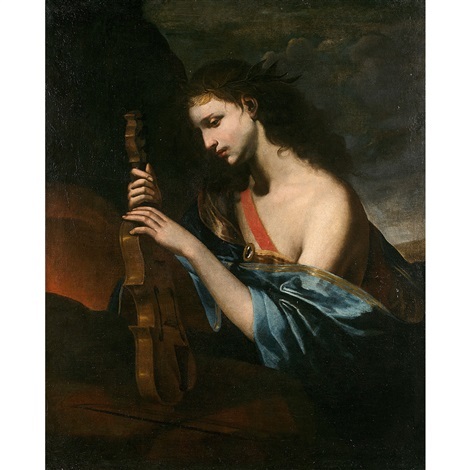
(Assigned to Lorenzo Lippi (1606-1665), Orphée à l'entrée des enfers)
Thinking of the numerous ways the Orpheus myth has been used as a theme in poetry, novels, painting and music, it is by weaving circuitous variations on the Orpheus motif through the narrative that Josipovici’s storytelling turns into delight. First the fascination for the myth takes the shape of the protagaonist developing a habit of listening to Claudio Monteverdi’s L’Orfeo at night, ruminating on the libretto, which is, to a person who has lost his spouse to death, particularly poignant:
You are dead, my life, and I breathe on?
You have left me
Never to return, while I remain?
No…
While such habit at first comes across as a comprehensible disposition when mourning, a much darker interpretation of the bleeding of the myth into his life emerges, particularly when the translator – making a living by translating novels which utterly bore him by the sameness in their plots and characters - starts to translate ‘purely for amusing himself’ a collection of sonnets of Joachim Du Bellay titled Les Regrets. Is there anything the translator regrets having done or not done? Or maybe doesn’t regret, just like he doesn’t manage to translate the sonnets in a way that satisfies him?
Peace comes with happiness, he would say, and who can say where happiness comes from?
On a personal note, some of the habits of the protagonist hit home, as did his sense of solitude coping with loss, and his musings on what knowledge is balm to the troubled spirit.
His head was always buried in a book, his wife – his second wife – would say. He had difficulty lifting it up to look at the world.
Just like the wife, the second wife of the main character of this eerie novel points at her unnamed husband having a morbid streak always haunting cemeteries, I have had the habit of wandering to a town’s cemetery whenever I saw the chance. The revisit of the one of Montparnasse, one of the favourite places of the protagonist, touched a chord. Last summer, walking the towpath near Richmond, we must have been close to the cemetery in Barnes.
Having a penchant for cemeteries however doesn’t mean that one is tired of life, it can perfectly rime with a desire for living, even living for multiple lives: "After all, everyone has fantasies. In the one life there are many lives. Alternative lives. Some are lived and others imagined. That is the absurdity of biographies, he would say, of novels. They never take account of the alternative lives casting their shadows over us as we move slowly, as though in a dream, from birth to maturity to death."
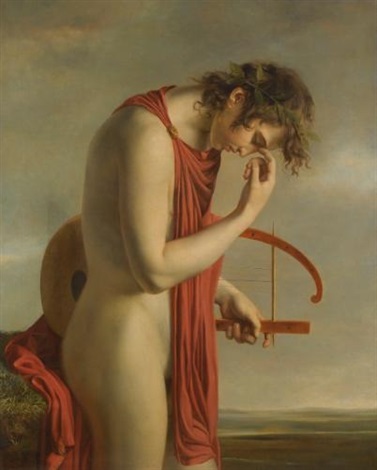
(Assigned to Hugues Jean François Paul Duqueylard (1771-1845), Orpheus)
The musical motifs and poetry citations with which Josipovici peppers his novel aren’t merely erudite play nor braggart but can be related to the state of mind of the main character or are functional in sowing little kernels of meaning throughout one of the three interwoven narratives, which for instance will shed quite a different light upon a stanza of Shakespeare’s Venus and Adonis encountered early in the novel (She is red and hot as coals of glowing fire, He red for shame, and frosty in desire). Nevertheless, the mind and emotions of the translator, despite all his talking, stay elusive: "We walk in the labyrinth of our lives, he would say, and we do not know if we are lost or not, do not know if we are happy or not.”
Fire, water, death, murder, suicide, conflagration. Parallel times, parallel lives, real and imagined. Touching on any of the enigma’s this novel poses in more detail would spoil the charm of it. As reading this in many respect echoed the enchanting reading experience that was Infinity, many pages in my copy again carry the traces left by reading elation, having marked thoughts and sentences I will return to with a pencil.
It might be too early and thus unwise to decide so after reading only two of his books, but it my current state of reading bliss it seems likely Gabriel Josipovici might in the end come to dethrone Patrick Modiano and Julian Barnes as my favourite living authors at least for a while.
There was so much to regret, so much that could have been different.
How is it possible to put such a multitude of themes and thoughts into just one slender novel and still create a work that is as ethereal and elusive as music, as lucid as it is obscure, as frothy as it is dark and onerous, as melancholic as it is evoking quite a few smiles? Reading this novel I recalled wondering as a child how clouds would feel when touching them, day-dreaming about their woolly haziness, unaware of their coldness and ungraspability. The cemetery in Barnes equalled such a magnificent, mysterious cloud from childhood to me. Like when reading Josipovici’s Infinity: The Story of a Moment (twice) last year, I was enchanted again by his brilliant blending of inventive narrative technique, essayistic ruminations on poetry and music, art and language and the depth underneath the elegant, spare and breezy writing.
The world of the happy man is other than the world of the unhappy man.
Three closely connected plots, told by three voices from three different locations – London, Paris and Wales revolve around an unnamed translator.
We all try to protect ourselves against reality.
Following the unnamed translator who has moved from London to Paris after the death of his first wife and is traipsing through the streets of Paris, Patrick Modiano’s novels come to mind. Unlike Modiano however Josipovici doesn’t focus on the narrator or the protagonist who detective-wise gets lost into memories and the secrets of the past, it is the reader who by little clues, hints and suggestive repetitions and references will get intrigued about the translator and his real or imagined enigmatic lives. What seems a life of habits in which an established routine is sought and minutely described as an order carefully established to protect one from the darkness, to learn to live again, to take one’s place in the world again after the death of the first wife, might hide unsettlement, if not hideous truth.
There is a kind of sorrow in solitude, he would say. The sweetness and the sadness are conjoined. And Monteverdi is the artist of that mood. It is, he would say, the mood of our times, for however close we are to another human being we always know, deep down, that we are alone.
(Assigned to Lorenzo Lippi (1606-1665), Orphée à l'entrée des enfers)
Thinking of the numerous ways the Orpheus myth has been used as a theme in poetry, novels, painting and music, it is by weaving circuitous variations on the Orpheus motif through the narrative that Josipovici’s storytelling turns into delight. First the fascination for the myth takes the shape of the protagaonist developing a habit of listening to Claudio Monteverdi’s L’Orfeo at night, ruminating on the libretto, which is, to a person who has lost his spouse to death, particularly poignant:
You are dead, my life, and I breathe on?
You have left me
Never to return, while I remain?
No…
While such habit at first comes across as a comprehensible disposition when mourning, a much darker interpretation of the bleeding of the myth into his life emerges, particularly when the translator – making a living by translating novels which utterly bore him by the sameness in their plots and characters - starts to translate ‘purely for amusing himself’ a collection of sonnets of Joachim Du Bellay titled Les Regrets. Is there anything the translator regrets having done or not done? Or maybe doesn’t regret, just like he doesn’t manage to translate the sonnets in a way that satisfies him?
Peace comes with happiness, he would say, and who can say where happiness comes from?
On a personal note, some of the habits of the protagonist hit home, as did his sense of solitude coping with loss, and his musings on what knowledge is balm to the troubled spirit.
His head was always buried in a book, his wife – his second wife – would say. He had difficulty lifting it up to look at the world.
Just like the wife, the second wife of the main character of this eerie novel points at her unnamed husband having a morbid streak always haunting cemeteries, I have had the habit of wandering to a town’s cemetery whenever I saw the chance. The revisit of the one of Montparnasse, one of the favourite places of the protagonist, touched a chord. Last summer, walking the towpath near Richmond, we must have been close to the cemetery in Barnes.
Having a penchant for cemeteries however doesn’t mean that one is tired of life, it can perfectly rime with a desire for living, even living for multiple lives: "After all, everyone has fantasies. In the one life there are many lives. Alternative lives. Some are lived and others imagined. That is the absurdity of biographies, he would say, of novels. They never take account of the alternative lives casting their shadows over us as we move slowly, as though in a dream, from birth to maturity to death."
(Assigned to Hugues Jean François Paul Duqueylard (1771-1845), Orpheus)
The musical motifs and poetry citations with which Josipovici peppers his novel aren’t merely erudite play nor braggart but can be related to the state of mind of the main character or are functional in sowing little kernels of meaning throughout one of the three interwoven narratives, which for instance will shed quite a different light upon a stanza of Shakespeare’s Venus and Adonis encountered early in the novel (She is red and hot as coals of glowing fire, He red for shame, and frosty in desire). Nevertheless, the mind and emotions of the translator, despite all his talking, stay elusive: "We walk in the labyrinth of our lives, he would say, and we do not know if we are lost or not, do not know if we are happy or not.”
Fire, water, death, murder, suicide, conflagration. Parallel times, parallel lives, real and imagined. Touching on any of the enigma’s this novel poses in more detail would spoil the charm of it. As reading this in many respect echoed the enchanting reading experience that was Infinity, many pages in my copy again carry the traces left by reading elation, having marked thoughts and sentences I will return to with a pencil.
It might be too early and thus unwise to decide so after reading only two of his books, but it my current state of reading bliss it seems likely Gabriel Josipovici might in the end come to dethrone Patrick Modiano and Julian Barnes as my favourite living authors at least for a while.
There was so much to regret, so much that could have been different.

July 7, 2021
We live in the forests of our dreams and desires.
A unique and enterprising exercise, writing has evolved over the years like other vocations, perhaps in the same spirit, some authors have gone to the extreme, they envisaged and crafted some unfathomable, uncommon and exceptional creations of art, which we savor with admiration and wonder; Gabriel Josipovici is of those authors who took the innovation to another level and mend their pens to come up with outrageous pieces of literature. And yet there are so many who have tried to explore the word ‘outrageous’ through their oeuvre but there are so few who have managed to graduate into the elite league.
Though the novel by Gabriel Josipovici may be short, just hundred-odd pages, as per words count but the kind of literary atmosphere it manages to create, the rich and lavish prose it carries, is second to none. A book exploring the classical Greek myth of Orpheus through the themes of Monteverdi’s Opera L’Orfeo, alluding to Dickinson’s poem- A Narrow Fellow in grass and passionately embodying and personalizing the Bellay’s The Regrets, and that too with just enough words that superfluidity may feel embarrassed, makes you agape at it in awe. Such a multitude of themes is woven intricately to produce this intense, rich but highly entertaining novel.

link: source
Imagine ornately woven prose wherein multiple narratives are entwined around each other in which the reader is made to jump from one point to view to another but it is so well crafted and arranged that the reader only sees beauty in it. The reader moves on while inebriating the hallucinating prose of the book, only gradually he realizes that three plots are simultaneously occurring at different locations at different times, interweaved in a heteroglossic narrative that hops back and forth over years. It is somewhat like parallel universes which coexist in the same cocoon, multiple realities or rather possibilities that occur across different worlds separated by time and space.
We see an unnamed narrator, who is incidentally a translator, moves from England to Paris to run away from the phantoms of his first wife, the phantom which he is actually chasing, unconsciously. The flat he lives in, links to the world perhaps, in the same manner, we follow the locations as images in our mind. We have been taken through the intricacies of the life of a translator, the beauty of his job as he could live in a heaven on earth having books surrounding himself. He desires a change and an opportunity to let time heal his emotional and psychological wounds which his past keeps inflicting upon him.
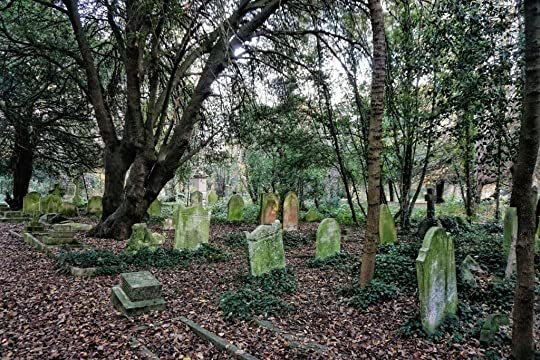
link: source
The orderly existence of his provides him solace from the probing eyes of the past and uneasy stare from the future as he keeps himself in the mundanity of life since he doesn’t want to prod the inner self. Could this orderly existence save him the darkness of the world, the anxiety, anguish of the existence? Don’t we know that universe is utterly random in nature and life itself is an arbitrary outcome of that randomness so could our existence be ordered in such a universe? It is actually the graveyards where his anxious soul finds solace, cemeteries of the people he admires, he frequently visits, to get an intimate and emotional feeling about them and their works, which ranges from Montparnasse to Barnes to Desnos. Of all, the cemetery of Barnes exudes a sense of peace and serenity to the extent that he, who profoundly enjoys the company of books, would not bother to carry a book at all on his way to it.
He lives life in an intoxicating dream and does not have a grip on reality, which raises an important apprehension- do we lose our hold on reality as we plunge ourselves into pure imagination? So, do we need not to dip our cerebral buds into a sea of imagination since all our creations took birth due to it? It forces us to ponder upon another great question – is the reality too powerful to bear? We all try to protect ourselves from reality, why do we need to protect ourselves from it? Though, we see, that literature, music, and art seem to safeguard us from the vagaries of life. However, could the change of place free us from the haunting ghosts of the past, the greyness of loss? Don’t we always carry our past, no matter wherever we may go?
The novel is essentially about how we handle our grief, sorrow, and remorse which reminds me of another superb book I read recently- The Body Artist by Don Delillo though the themes and treatment of both the books are different. We see that the novel seems to conjoin a kind of sorrow in solitude with sweetness and sadness, we may be close to other people but deep we are essentially alone. Words, are they attractively deceiving, could they provide solace to our unstable and disquieted heart? Our nameless narrator tries to find solace in words and art, he seldom raises his head to look at the world as he is always buried in the text; however, he faces an intriguing dilemma associated with translators or rather his inability to produce the text which reproduces the tone, connotation, rhythm, and rhyme of the original text. We see that he hops from Putney, London to Paris and then to Wales wherein he marries again, but grief, regret, and remorse seem to enjoy his company; the man of simple ordinary pleasures fails to break this concoction of sorrow, remorse, and assiduity.
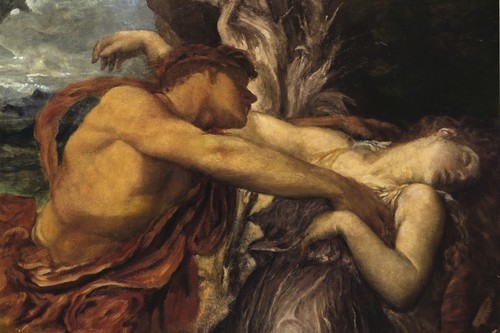
link: source
The narrative style is in the third person but not an ordinary one, here characters are allowed to express themselves through embedded first-person voices in the third person narrative. The prose is poetic, to say the least, but even mundane acts like sipping coffee have been poignantly and beautifully crafted through the plethora of words without any signs of superfluousness. The unnamed narrator finds the combination of surprising details and general reflection fascinating in DuBelley. He makes headway to form his own prose, tries to find the delicate balance between the strict formality of sonnet, its metre and rhyme, and the urgent seemingly artless content; the great tension between form and content, rhythm and simplicity continues to haunt him. We see that sentences are constructed with a sort of post-object inundation, which produces a late impact on the readers keeping them feeling their reverberating silence. Repetitions have been used invariably in the text with the deft of a surgeon to convey the confusing thoughts of the narrator through moving back and forth on time frame.
Beauty is as much a part of life as sadness is, the Shakespearean quote underlines the truth of life. We live on the fringes of existence, we realize it through the eyes of ‘others’ who have the ‘taste’ of literature, music, and cinema. The richness of life is living in present with swaying away from the demons of the past and anxiety of the future, however, more often than not, we see that the past springs up from the graveyard of time, the feelings and thoughts of the past emanates from the cemetery of time-space. The modernist traits could be felt from the narrative, as we see the details about the narrator’s life are revealed gradually as we traverse through the plot, much is being left to the imagination of the reader who also has to actively participate in the creation of the plot. Though the plot cuts back and forth in time in every a few lines but you never have to strain yourself, throughout the book, you feel the serene and calm vibes emanating from the ethereal world of the book. The author manages to create an extraordinary experience through ordinary but meticulously chosen words. The novel is tinged with melancholy, however, the reader, like the translator, becomes comforted by these rituals in a way that is almost hypnotic.
You are dead
And though seem to be alive
I am dead too.
You moved to the other world
I transcended to the nether world.
You left unfulfilled existence
I remain suspended here
Lingering between life and death.
The orderly existence of mine
Seems to me be divine
The great loss of you
Still dominating my mind
Though I tried
But unable to find
How to be unconfined.
A unique and enterprising exercise, writing has evolved over the years like other vocations, perhaps in the same spirit, some authors have gone to the extreme, they envisaged and crafted some unfathomable, uncommon and exceptional creations of art, which we savor with admiration and wonder; Gabriel Josipovici is of those authors who took the innovation to another level and mend their pens to come up with outrageous pieces of literature. And yet there are so many who have tried to explore the word ‘outrageous’ through their oeuvre but there are so few who have managed to graduate into the elite league.
Though the novel by Gabriel Josipovici may be short, just hundred-odd pages, as per words count but the kind of literary atmosphere it manages to create, the rich and lavish prose it carries, is second to none. A book exploring the classical Greek myth of Orpheus through the themes of Monteverdi’s Opera L’Orfeo, alluding to Dickinson’s poem- A Narrow Fellow in grass and passionately embodying and personalizing the Bellay’s The Regrets, and that too with just enough words that superfluidity may feel embarrassed, makes you agape at it in awe. Such a multitude of themes is woven intricately to produce this intense, rich but highly entertaining novel.
link: source
Imagine ornately woven prose wherein multiple narratives are entwined around each other in which the reader is made to jump from one point to view to another but it is so well crafted and arranged that the reader only sees beauty in it. The reader moves on while inebriating the hallucinating prose of the book, only gradually he realizes that three plots are simultaneously occurring at different locations at different times, interweaved in a heteroglossic narrative that hops back and forth over years. It is somewhat like parallel universes which coexist in the same cocoon, multiple realities or rather possibilities that occur across different worlds separated by time and space.
We see an unnamed narrator, who is incidentally a translator, moves from England to Paris to run away from the phantoms of his first wife, the phantom which he is actually chasing, unconsciously. The flat he lives in, links to the world perhaps, in the same manner, we follow the locations as images in our mind. We have been taken through the intricacies of the life of a translator, the beauty of his job as he could live in a heaven on earth having books surrounding himself. He desires a change and an opportunity to let time heal his emotional and psychological wounds which his past keeps inflicting upon him.
link: source
The orderly existence of his provides him solace from the probing eyes of the past and uneasy stare from the future as he keeps himself in the mundanity of life since he doesn’t want to prod the inner self. Could this orderly existence save him the darkness of the world, the anxiety, anguish of the existence? Don’t we know that universe is utterly random in nature and life itself is an arbitrary outcome of that randomness so could our existence be ordered in such a universe? It is actually the graveyards where his anxious soul finds solace, cemeteries of the people he admires, he frequently visits, to get an intimate and emotional feeling about them and their works, which ranges from Montparnasse to Barnes to Desnos. Of all, the cemetery of Barnes exudes a sense of peace and serenity to the extent that he, who profoundly enjoys the company of books, would not bother to carry a book at all on his way to it.
He lives life in an intoxicating dream and does not have a grip on reality, which raises an important apprehension- do we lose our hold on reality as we plunge ourselves into pure imagination? So, do we need not to dip our cerebral buds into a sea of imagination since all our creations took birth due to it? It forces us to ponder upon another great question – is the reality too powerful to bear? We all try to protect ourselves from reality, why do we need to protect ourselves from it? Though, we see, that literature, music, and art seem to safeguard us from the vagaries of life. However, could the change of place free us from the haunting ghosts of the past, the greyness of loss? Don’t we always carry our past, no matter wherever we may go?
The novel is essentially about how we handle our grief, sorrow, and remorse which reminds me of another superb book I read recently- The Body Artist by Don Delillo though the themes and treatment of both the books are different. We see that the novel seems to conjoin a kind of sorrow in solitude with sweetness and sadness, we may be close to other people but deep we are essentially alone. Words, are they attractively deceiving, could they provide solace to our unstable and disquieted heart? Our nameless narrator tries to find solace in words and art, he seldom raises his head to look at the world as he is always buried in the text; however, he faces an intriguing dilemma associated with translators or rather his inability to produce the text which reproduces the tone, connotation, rhythm, and rhyme of the original text. We see that he hops from Putney, London to Paris and then to Wales wherein he marries again, but grief, regret, and remorse seem to enjoy his company; the man of simple ordinary pleasures fails to break this concoction of sorrow, remorse, and assiduity.
link: source
The narrative style is in the third person but not an ordinary one, here characters are allowed to express themselves through embedded first-person voices in the third person narrative. The prose is poetic, to say the least, but even mundane acts like sipping coffee have been poignantly and beautifully crafted through the plethora of words without any signs of superfluousness. The unnamed narrator finds the combination of surprising details and general reflection fascinating in DuBelley. He makes headway to form his own prose, tries to find the delicate balance between the strict formality of sonnet, its metre and rhyme, and the urgent seemingly artless content; the great tension between form and content, rhythm and simplicity continues to haunt him. We see that sentences are constructed with a sort of post-object inundation, which produces a late impact on the readers keeping them feeling their reverberating silence. Repetitions have been used invariably in the text with the deft of a surgeon to convey the confusing thoughts of the narrator through moving back and forth on time frame.
Beauty is as much a part of life as sadness is, the Shakespearean quote underlines the truth of life. We live on the fringes of existence, we realize it through the eyes of ‘others’ who have the ‘taste’ of literature, music, and cinema. The richness of life is living in present with swaying away from the demons of the past and anxiety of the future, however, more often than not, we see that the past springs up from the graveyard of time, the feelings and thoughts of the past emanates from the cemetery of time-space. The modernist traits could be felt from the narrative, as we see the details about the narrator’s life are revealed gradually as we traverse through the plot, much is being left to the imagination of the reader who also has to actively participate in the creation of the plot. Though the plot cuts back and forth in time in every a few lines but you never have to strain yourself, throughout the book, you feel the serene and calm vibes emanating from the ethereal world of the book. The author manages to create an extraordinary experience through ordinary but meticulously chosen words. The novel is tinged with melancholy, however, the reader, like the translator, becomes comforted by these rituals in a way that is almost hypnotic.
You are dead
And though seem to be alive
I am dead too.
You moved to the other world
I transcended to the nether world.
You left unfulfilled existence
I remain suspended here
Lingering between life and death.
The orderly existence of mine
Seems to me be divine
The great loss of you
Still dominating my mind
Though I tried
But unable to find
How to be unconfined.

May 3, 2020
Extraordinary. Bewitching. Bemusing. Intense.
This novella has the beauty of the sonnets and opera it quotes but has subtly sinister undercurrents as well. The effect is beguiling: the threads are disorientingly dissolved and then crystallised from the rippling waters.
Watery words
The narrative swishes almost imperceptibly between three timelines of the main, unnamed, character's life. It’s like watching waves crash on a beach, then sink back a fair way, before being overtaken by another wave, or of ripples merging, distorting, reforming.
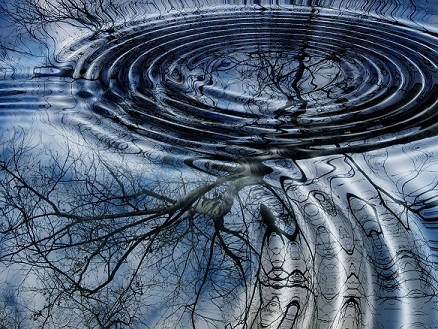
Image: Ripples rippling ripples (Source.)
It opens in Paris, detailing the daily routine of a music-loving widowed literary translator, in the third person. Then, at the bottom of the third page:
Sometimes you also went to concerts, his wife - his second wife - would interrupt him.
A sudden, seamless jump in time, place, and point of view, without even quotation marks.
Thus it continues: his Putney days with his first wife, his solitary time in Paris, and living in Wales with his wife - his second wife. A paragraph about his male neighbour in Wales is followed by one where he refers to the translator in Paris.
Rinse and repeat - but tweak
Recurring phrases in both the narrative and between the translator and his wife - his second wife - are like the chorus of a hymn and lend a liturgical, ritualistic reverence, like a repetition of their marriage vows, but also like a performance. Guests at their converted farmhouse high up in the Black Mountains above Abergavenny… were sometimes tempted to clap at a particularly pithy exchange.

Image: Transverse and longitudinal waves, fluctuating in prominence like the time periods of the story (Source.)
Amid the apparent beauty, truth and imagination interleave and blur, as shadow gather and darken.
Everyone has fantasies. In the one life there are many lives. Alternative lives. Some are lived and others are imagined.
When whole scenes are repeated, they change in each telling, like the variations of musical themes in an orchestral work. Where lies the truth? Which life is the one lived?
One sprouts so many lives… One is a murderer. One an incendiary. One a suicide. One lives in London. One in Paris. One in New York.
Tardis?
Josipovici is a literary magician who clearly loves language as much as the central character. In under 100, generously-spaced, very readable pages that include excerpts of poems and libretto and a magical-realist or dream episode (bartender and silver token), he weaves a story that explores sociability and solitude, clarity and opacity, fire and water, words and music, a scar of unclear significance, friends who barely know each other, truth and lies, life and death.
It is bigger on the inside. The reader has to find the story, the true story, becoming the translator – the second translator - along the way.
I wondered about a central, dramatic, event that is described as happening in several different ways, and decided the mystery was not meant to be confidently solvable. That was later confirmed in a comment on Paul's review, where he said:
"It was fascinating to ask the author in person if he knew what happened and to be told 'no, if I knew that I wouldn’t have written the book'."
Quotes
• It was the combination of surprising detail and general reflection he found so satisfying in du Bellay…
The combination of quiet precision… and profound despair that never failed to move him. (I felt the same.)
• They never called each other by name… Friends of theirs wondered if they used the same formula when they were alone, but no one really knew them well enough to ask.
• Turning the words over in his mouth as though to suck the last ounce of sweetness from them. (On rereading beloved and familiar erotic epyllia by Shakespeare.)
• Nothing comes to an end. You never leave anything behind. It always catches up with you. (Like the waves of the story washing over the reader.)
• The formal gardens and general air of symmetry which made parts of the city so elegant and so depressing at the same time. (Paris)
• Thinking frequently and long enough about something makes it seem at first possible, then even probably, and, finally, necessary.
Links
Read this novella once to be immersed. Then brush up on some of the many cultural references that are tightly sewn to its canvas, and read it again to understand it more deeply. Rinse and repeat.
• Monteverdi’s opera, L'Orfeo, is the classical Greek myth of Orpheus descending to the underworld to bring back his beloved Euridice, a story where music is integral. While writing this review, I listened to a performance from Gran Teatre del Liceu, Barcelona, 2002: here.
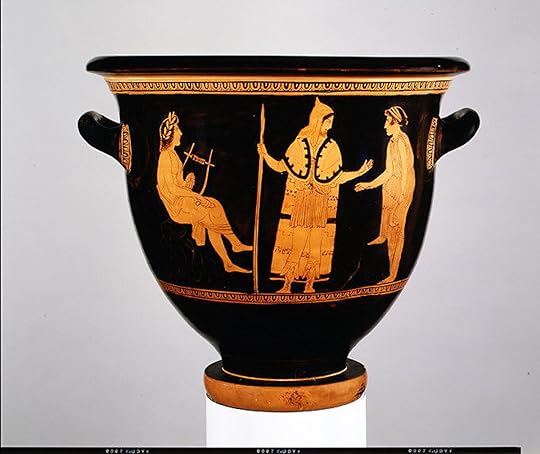
Image: Orpheus (with lyre) among the Thracians c440 BC (Source.)
• Emily Dickinson’s poem, A Narrow Fellow in the Grass, refers to a snake, which links back to the story of Euridice.
• French poet Joachim du Bellay published The Regrets: sonnets about his travels in Italy in the 1550s. You can read some of them with French and English adjacent, here.
• Shakespeare’s early works include erotic epyllia like Venus and Adonis, which is mentioned, including the lovely line, ‘The sea hath bounds, but deep desire hath none’.
• The (old) Barnes Cemetery in London has the grave of poet William Palgrave.
• The Père Lachaise Cemetery in Paris is the only cemetery I‘ve visited for its architecture and atmosphere.
• The Black Mountains, near Abergavenny in Wales, are beautiful.
• It’s also worth polishing your French and Italian pronunciation! Many of the poems and lyrics are immediately followed by their English translation, but to appreciate the translator’s job, you need to hear the difference, to feel the loss of rhyme and wordplay between ‘Infelice Euridice’ and ‘Unhappy Eurydice’, for example.
This novella has the beauty of the sonnets and opera it quotes but has subtly sinister undercurrents as well. The effect is beguiling: the threads are disorientingly dissolved and then crystallised from the rippling waters.
Watery words
The narrative swishes almost imperceptibly between three timelines of the main, unnamed, character's life. It’s like watching waves crash on a beach, then sink back a fair way, before being overtaken by another wave, or of ripples merging, distorting, reforming.
Image: Ripples rippling ripples (Source.)
It opens in Paris, detailing the daily routine of a music-loving widowed literary translator, in the third person. Then, at the bottom of the third page:
Sometimes you also went to concerts, his wife - his second wife - would interrupt him.
A sudden, seamless jump in time, place, and point of view, without even quotation marks.
Thus it continues: his Putney days with his first wife, his solitary time in Paris, and living in Wales with his wife - his second wife. A paragraph about his male neighbour in Wales is followed by one where he refers to the translator in Paris.
Rinse and repeat - but tweak
Recurring phrases in both the narrative and between the translator and his wife - his second wife - are like the chorus of a hymn and lend a liturgical, ritualistic reverence, like a repetition of their marriage vows, but also like a performance. Guests at their converted farmhouse high up in the Black Mountains above Abergavenny… were sometimes tempted to clap at a particularly pithy exchange.
Image: Transverse and longitudinal waves, fluctuating in prominence like the time periods of the story (Source.)
Amid the apparent beauty, truth and imagination interleave and blur, as shadow gather and darken.
Everyone has fantasies. In the one life there are many lives. Alternative lives. Some are lived and others are imagined.
When whole scenes are repeated, they change in each telling, like the variations of musical themes in an orchestral work. Where lies the truth? Which life is the one lived?
One sprouts so many lives… One is a murderer. One an incendiary. One a suicide. One lives in London. One in Paris. One in New York.
Tardis?
Josipovici is a literary magician who clearly loves language as much as the central character. In under 100, generously-spaced, very readable pages that include excerpts of poems and libretto and a magical-realist or dream episode (bartender and silver token), he weaves a story that explores sociability and solitude, clarity and opacity, fire and water, words and music, a scar of unclear significance, friends who barely know each other, truth and lies, life and death.
It is bigger on the inside. The reader has to find the story, the true story, becoming the translator – the second translator - along the way.
I wondered about a central, dramatic, event that is described as happening in several different ways, and decided the mystery was not meant to be confidently solvable. That was later confirmed in a comment on Paul's review, where he said:
"It was fascinating to ask the author in person if he knew what happened and to be told 'no, if I knew that I wouldn’t have written the book'."
Quotes
• It was the combination of surprising detail and general reflection he found so satisfying in du Bellay…
The combination of quiet precision… and profound despair that never failed to move him. (I felt the same.)
• They never called each other by name… Friends of theirs wondered if they used the same formula when they were alone, but no one really knew them well enough to ask.
• Turning the words over in his mouth as though to suck the last ounce of sweetness from them. (On rereading beloved and familiar erotic epyllia by Shakespeare.)
• Nothing comes to an end. You never leave anything behind. It always catches up with you. (Like the waves of the story washing over the reader.)
• The formal gardens and general air of symmetry which made parts of the city so elegant and so depressing at the same time. (Paris)
• Thinking frequently and long enough about something makes it seem at first possible, then even probably, and, finally, necessary.
Links
Read this novella once to be immersed. Then brush up on some of the many cultural references that are tightly sewn to its canvas, and read it again to understand it more deeply. Rinse and repeat.
• Monteverdi’s opera, L'Orfeo, is the classical Greek myth of Orpheus descending to the underworld to bring back his beloved Euridice, a story where music is integral. While writing this review, I listened to a performance from Gran Teatre del Liceu, Barcelona, 2002: here.
Image: Orpheus (with lyre) among the Thracians c440 BC (Source.)
• Emily Dickinson’s poem, A Narrow Fellow in the Grass, refers to a snake, which links back to the story of Euridice.
• French poet Joachim du Bellay published The Regrets: sonnets about his travels in Italy in the 1550s. You can read some of them with French and English adjacent, here.
• Shakespeare’s early works include erotic epyllia like Venus and Adonis, which is mentioned, including the lovely line, ‘The sea hath bounds, but deep desire hath none’.
• The (old) Barnes Cemetery in London has the grave of poet William Palgrave.
• The Père Lachaise Cemetery in Paris is the only cemetery I‘ve visited for its architecture and atmosphere.
• The Black Mountains, near Abergavenny in Wales, are beautiful.
• It’s also worth polishing your French and Italian pronunciation! Many of the poems and lyrics are immediately followed by their English translation, but to appreciate the translator’s job, you need to hear the difference, to feel the loss of rhyme and wordplay between ‘Infelice Euridice’ and ‘Unhappy Eurydice’, for example.

Read
February 6, 2019Early in this short novel, the first line of an Emily Dickinson poem is mentioned, A narrow Fellow in the Grass. It is only a brief mention but I was curious about the rest of the poem, so I looked it up and was impressed by how concise it is yet how much allusion it contains.
The same could be said for Gabriel Josipovici's writing. From the beginning of this novel, it is clear that he chooses his words very carefully, and that not one of them is surplus to his needs. Yet for all his precision, there is still room for layers of interpretation. He frequently repeats his carefully chosen words, the repetition serving as a useful refrain, reinforcing certain allusions as well as building rhythm into the prose so that we almost think we are reading poetry.
Indeed poetry is constantly woven through the prose in any case. Not only Emily Dickinson, but Shakespeare's erotic poetry, and most frequently, the sixteenth century French poet, Joachim du Bellay, whose Regrets sonnets constantly haunt the nameless main character (I'm going to call him Orpheus for convenience because when he's not reading Shakespeare or du Bellay, he likes to listen to Monteverdi's opera, Orfeo).
Most of the novel consists of long soliloquies about his past life which our Orpheus delivers whenever he has guests—in much the same way that Joachim du Bellay and Monteverdi's Orfeo like to sing their woes to an audience. But our Orpheus's 'song' is punctuated by his (second) wife's refrain-like comments on his words, and by occasional context-setting phrases from a nameless narrator who seems to be one of his guests.
As our Orpheus recounts his life, we realise how obsessed he still is with his first wife. He gives various versions of how he found her, and various versions of how he lost her. Like Orfeo's Eurydice, she seems to have died twice; in one version of the account, she drowns; in another version, she dies of a chill.
The more he tells us about her, the more this reader began to question his tale. I remembered that his favourite lines from Orfeo are about the power of ire to inflame the coldest mind. Then I remembered Emily Dickinson's narrow fellow in the grass. And finally I remembered that Eurydice died of a snake bite.
But all of this is just one interpretation of Gabriel Josipovici's brilliantly enigmatic novel. Yours may be entirely different.
…………………………………………………………
A narrow Fellow in the Grass
A narrow Fellow in the Grass
Occasionally rides -
You may have met him? Did you not
His notice instant is -
The Grass divides as with a Comb,
A spotted Shaft is seen,
And then it closes at your Feet
And opens further on -
He likes a Boggy Acre -
A Floor too cool for Corn -
But when a Boy and Barefoot
I more than once at Noon
Have passed I thought a Whip Lash
Unbraiding in the Sun
When stooping to secure it
It wrinkled And was gone -
Several of Nature’s People
I know, and they know me
I feel for them a transport
Of Cordiality
But never met this Fellow
Attended or alone
Without a tighter Breathing
And Zero at the Bone.
Emily Dickinson
The same could be said for Gabriel Josipovici's writing. From the beginning of this novel, it is clear that he chooses his words very carefully, and that not one of them is surplus to his needs. Yet for all his precision, there is still room for layers of interpretation. He frequently repeats his carefully chosen words, the repetition serving as a useful refrain, reinforcing certain allusions as well as building rhythm into the prose so that we almost think we are reading poetry.
Indeed poetry is constantly woven through the prose in any case. Not only Emily Dickinson, but Shakespeare's erotic poetry, and most frequently, the sixteenth century French poet, Joachim du Bellay, whose Regrets sonnets constantly haunt the nameless main character (I'm going to call him Orpheus for convenience because when he's not reading Shakespeare or du Bellay, he likes to listen to Monteverdi's opera, Orfeo).
Most of the novel consists of long soliloquies about his past life which our Orpheus delivers whenever he has guests—in much the same way that Joachim du Bellay and Monteverdi's Orfeo like to sing their woes to an audience. But our Orpheus's 'song' is punctuated by his (second) wife's refrain-like comments on his words, and by occasional context-setting phrases from a nameless narrator who seems to be one of his guests.
As our Orpheus recounts his life, we realise how obsessed he still is with his first wife. He gives various versions of how he found her, and various versions of how he lost her. Like Orfeo's Eurydice, she seems to have died twice; in one version of the account, she drowns; in another version, she dies of a chill.
The more he tells us about her, the more this reader began to question his tale. I remembered that his favourite lines from Orfeo are about the power of ire to inflame the coldest mind. Then I remembered Emily Dickinson's narrow fellow in the grass. And finally I remembered that Eurydice died of a snake bite.
But all of this is just one interpretation of Gabriel Josipovici's brilliantly enigmatic novel. Yours may be entirely different.
…………………………………………………………
A narrow Fellow in the Grass
A narrow Fellow in the Grass
Occasionally rides -
You may have met him? Did you not
His notice instant is -
The Grass divides as with a Comb,
A spotted Shaft is seen,
And then it closes at your Feet
And opens further on -
He likes a Boggy Acre -
A Floor too cool for Corn -
But when a Boy and Barefoot
I more than once at Noon
Have passed I thought a Whip Lash
Unbraiding in the Sun
When stooping to secure it
It wrinkled And was gone -
Several of Nature’s People
I know, and they know me
I feel for them a transport
Of Cordiality
But never met this Fellow
Attended or alone
Without a tighter Breathing
And Zero at the Bone.
Emily Dickinson

September 2, 2019
Shortlisted for the 2018 Goldsmiths prize...
My 2nd read out of the 6 books shortlisted for 2018, and wow I am not disappointed. The Cemetery in Barnes is subtle, dark, and lightly disturbing. The author keeps you thinking as he leaves hints as to where he might be going with his words. A matter of perspective. All his words have meaning.
A short book with a finely spun ending.
4 out of 5 stars
My 2nd read out of the 6 books shortlisted for 2018, and wow I am not disappointed. The Cemetery in Barnes is subtle, dark, and lightly disturbing. The author keeps you thinking as he leaves hints as to where he might be going with his words. A matter of perspective. All his words have meaning.
A short book with a finely spun ending.
4 out of 5 stars

September 3, 2019
Rhyme and Rhythm vs. Meaning
As with poetry in translation, in life we can have aesthetic orderliness or we can have significance, but not both simultaneously. Finding the right mix is an awkward business; and the issue is never finally resolved. We commit ourselves imaginatively to contrary things: independence and stability; romance and monogamy; adventure and habit. But whatever commitments these are - to spouses, to jobs, to careers, to places, to interests, even commitments to oneself - they ultimately will breed familiarity, then routine, then boredom, then disgust, and end in abandonment, possibly murder. Or their consequences will be accepted as just and necessary compensation for a more orderly and predictable life, and simply endured.
Whatever choices we might think we make “They never take account of the alternative lives casting their shadows over us as we move slowly, as though in a dream, from birth to maturity to death.” Whatever makes sense momentarily because of its poetic appeal may simply lose the meaning of our circumstances. “There are times when the order you have so carefully established seems suddenly unable to protect you from the darkness.” The unnamed protagonist understands the source of this darkness. “Darkness is a part of each one of us,” he says. It consists of wanting but not knowing what we want. And whatever it is we think we want will change. Hence “the absurdity of biographies.” Where can he go for advice but to Shakespeare, who knows every human feeling?
There are few others who know how to compress rhyme, rhythm, and meaning so concisely, and with such durability.
As with poetry in translation, in life we can have aesthetic orderliness or we can have significance, but not both simultaneously. Finding the right mix is an awkward business; and the issue is never finally resolved. We commit ourselves imaginatively to contrary things: independence and stability; romance and monogamy; adventure and habit. But whatever commitments these are - to spouses, to jobs, to careers, to places, to interests, even commitments to oneself - they ultimately will breed familiarity, then routine, then boredom, then disgust, and end in abandonment, possibly murder. Or their consequences will be accepted as just and necessary compensation for a more orderly and predictable life, and simply endured.
Whatever choices we might think we make “They never take account of the alternative lives casting their shadows over us as we move slowly, as though in a dream, from birth to maturity to death.” Whatever makes sense momentarily because of its poetic appeal may simply lose the meaning of our circumstances. “There are times when the order you have so carefully established seems suddenly unable to protect you from the darkness.” The unnamed protagonist understands the source of this darkness. “Darkness is a part of each one of us,” he says. It consists of wanting but not knowing what we want. And whatever it is we think we want will change. Hence “the absurdity of biographies.” Where can he go for advice but to Shakespeare, who knows every human feeling?
“Affection is a coal that must be cooled
Else, suffered, it will set the heart on fire.
The sea hath bounds, but deep desire hath none;
Therefore no marvel though thy hope be gone.”
There are few others who know how to compress rhyme, rhythm, and meaning so concisely, and with such durability.

October 1, 2018
"We walk in the labyrinth of our lives, he would say, and we do not know if we are lost or not, do not know if we are happy or not."
Here, a set of three timespans intersect, overlap, deviate, and converge back in a single narrational whole that might be called stream-of-remembrance, if there ever was such a thing, reminiscent of Patrick Modiano’s novels, in the grip of an existential puzzle the reader puzzles over long after turning the last page.
The narrative proceeds in a series of abrupt images, like a noirish sequence of events, that flit back and forth between the three points in time in the life of our protagonist who, having moved to Paris after the death of wife – his first wife – is trying not to mourn or cope but to figure anew the fundamentals of his dull existence.
He works as a freelance book translator in Paris and spends his time listening to Monteverdi's Orfeo; and out of personal interest attempts to translate du Bellay’s French poems which, for their perfect rhyme and rhythm cannot be rendered adequately into English. This might work as a symbol of his life in Paris, where an Englishman is trying unsuccessfully to translate his own life into a new setting and no matter how well he does it he can't get it right, despite his dubious claims of finding peace and happiness in loneliness.
And sure enough, in time we find him remarried and relocated to a farmhouse perched on the hills in Wales, only to find himself in the grip of an overbearing wife – his second wife – who completely negates, with words and in practice, the raison d'être of his past lives. At the end the burning farmhouse might be seen as another symbol of the frailty of human existence and its ultimate journey on the road to nothingness. The various cemeteries he frequents in Paris and London serve as a metaphor for the inevitability of death and the self’s relentless desire to make sense of life.
"We all try to protect ourselves against reality."
It is one of those amorphous novels in which the reader becomes the co-creator through the very act of reading. We project our interpretations and come up with a final picture consistent with our own experience of life. Be it unreliable narration or authorial ambiguity, the reader must penetrate deeper to discover the subcutaneous depths of the story, but without the confidence and hope of finding definitive answers, for there are no definitive answers to be had.
"In the one life there are many lives. Alternate lives. Some are lived and others imagined."
October '18
Here, a set of three timespans intersect, overlap, deviate, and converge back in a single narrational whole that might be called stream-of-remembrance, if there ever was such a thing, reminiscent of Patrick Modiano’s novels, in the grip of an existential puzzle the reader puzzles over long after turning the last page.
The narrative proceeds in a series of abrupt images, like a noirish sequence of events, that flit back and forth between the three points in time in the life of our protagonist who, having moved to Paris after the death of wife – his first wife – is trying not to mourn or cope but to figure anew the fundamentals of his dull existence.
He works as a freelance book translator in Paris and spends his time listening to Monteverdi's Orfeo; and out of personal interest attempts to translate du Bellay’s French poems which, for their perfect rhyme and rhythm cannot be rendered adequately into English. This might work as a symbol of his life in Paris, where an Englishman is trying unsuccessfully to translate his own life into a new setting and no matter how well he does it he can't get it right, despite his dubious claims of finding peace and happiness in loneliness.
And sure enough, in time we find him remarried and relocated to a farmhouse perched on the hills in Wales, only to find himself in the grip of an overbearing wife – his second wife – who completely negates, with words and in practice, the raison d'être of his past lives. At the end the burning farmhouse might be seen as another symbol of the frailty of human existence and its ultimate journey on the road to nothingness. The various cemeteries he frequents in Paris and London serve as a metaphor for the inevitability of death and the self’s relentless desire to make sense of life.
"We all try to protect ourselves against reality."
It is one of those amorphous novels in which the reader becomes the co-creator through the very act of reading. We project our interpretations and come up with a final picture consistent with our own experience of life. Be it unreliable narration or authorial ambiguity, the reader must penetrate deeper to discover the subcutaneous depths of the story, but without the confidence and hope of finding definitive answers, for there are no definitive answers to be had.
"In the one life there are many lives. Alternate lives. Some are lived and others imagined."
October '18

October 9, 2018
Shortlisted for the Goldsmiths Prize 2018
Longlisted for the Republic of Consciousness Prize 2019
I must admit that I knew nothing of Josipovici before the Goldsmiths shortlist was announced but this cryptic, allusive, reflective and slippery portrait of a translator and his secrets is a little gem.
Told in the third person, the main protagonist is never named. The narrative, which often repeats itself with subtle variations, frequently switches between the three phases of his life, first in Putney with his first wife, then alone in Paris and finally in the foothills of the Brecon Beacons with his second. Intertwined with this are reflections on the 16th Century French poet du Bellay and the impossibility of translating his work, and the music of Monteverdi, specifically his opera Orfeo, which parallels the main narrative.
Much of the book reads as a philosophical meditation, but darker secrets emerge occasionally, hinted at and later clarified.
I suspect that I missed quite a lot, and that this book would reward a close rereading. It would certainly make a worthy winner of the prize.
Longlisted for the Republic of Consciousness Prize 2019
I must admit that I knew nothing of Josipovici before the Goldsmiths shortlist was announced but this cryptic, allusive, reflective and slippery portrait of a translator and his secrets is a little gem.
Told in the third person, the main protagonist is never named. The narrative, which often repeats itself with subtle variations, frequently switches between the three phases of his life, first in Putney with his first wife, then alone in Paris and finally in the foothills of the Brecon Beacons with his second. Intertwined with this are reflections on the 16th Century French poet du Bellay and the impossibility of translating his work, and the music of Monteverdi, specifically his opera Orfeo, which parallels the main narrative.
Much of the book reads as a philosophical meditation, but darker secrets emerge occasionally, hinted at and later clarified.
I suspect that I missed quite a lot, and that this book would reward a close rereading. It would certainly make a worthy winner of the prize.

September 28, 2018
Shortlisted for the 2018 Goldsmiths Prize
Longlisted for the 2019 Republic of Consciousness Prize
The judges' citation:
Da questi amati orrori
Mal mio grado mi tragge e mi conduce
A l’odiosa luce?
(Monteverdi's Orfeo, libretto by Striggio, Act 4)
What occult powers among these horrors,
drags me against my will
from these horrors I love and leads me
to the loathsome light?
(translation by the protagonist of this novel)
Cemetery in Barnes: A Novel by Gabriel Josipovici was also shortlisted for the 2018 Goldsmith's Prize and would have been a worthy winner, just 93 pages long, but with so much to unpack and ponder.
The head judge of the Goldsmiths summarised the book:
He had been living in Paris for many years. Longer, he used to say, than he cared to remember.
When my first wife died, he would explain, there no longer seemed to be any reason to stay in England. So he moved to Paris and earned his living as a translator.
immediately highlighting the unusual narrative style. The story is told by an unidentified narrator, seemingly a friend of the unnamed translator, and relayed via reported tales told by the translator, tales that were told and re-told in counterpoint with his second wife at the home they shared in Wales, a converted farmhouse in the Black Mountains high up above Abergavenny:
His wife - his second wife - would interrupt him. And he seemed to need these interruptions, was adept at incorporating them into his discourse, using them as stepping stones to the development of his theme.
His tales circle around detailed reminiscences of two other locations: the Southwest of London and particularly the Thames and East Putney where he lived on Carlton Drive with his wife, his first wife; and Paris, close to the Pantheon, where he lived alone after her death. Both locations, ones close to my own heart, are described evocatively via Walser-like strolls through them.
However, that things may be amiss is revealed early on, when he describes how, when strolling through Paris of an afternoon, he would occasionally have fantasies of drowning ...
He knew such feelings were neurotic, dangerous even, but he was not unduly worried, sensing that it was better to indulge them than to try and eliminate them altogether. After all, everyone has fantasies. In the one life there are many lives. Alternative lives. Some are lived and others imagined. That is the absurdity of biographies, he would say, of novels. They never take account of the alternative lives casting their shadows over us as we move slowly, as though in a dream, from birth to maturity to death.
He also has a fascination with cemeteries, one his wife, his second wife, labels as macabre, particularly those housing famous authors. Although towards the novel's end we learned how he and his wife - his first wife - stumbled across the abandoned and eponymous cemetery in Barnes:
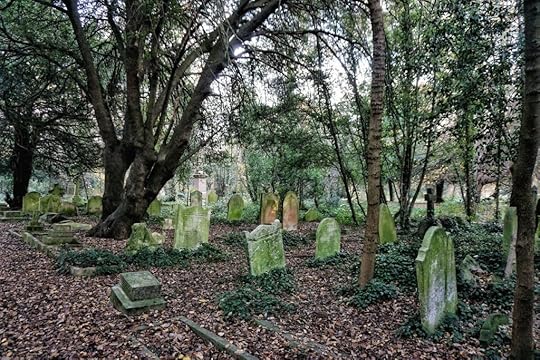
And equally, if not even more disturbingly, how sometimes, rather than greet his wife at East Putney station on her return from work, he would instead hide at the station and, unseen, follow her through the streets to their house.
The 'banter' between he and his wife - his second wife (as she is repeatedly described in the novel) is one that is hard to diagnose - love or contempt? affection or fighting? - as the narrator observes:
They seemed to be at such times to be completely unaware of the fact that there were other people there, carrying on a conversation which had no doubt been going on between them for years.
...
Their banter, which in other couples might have been a way of fighting private battles in public, was with them always loving and always half ironic. It was also deeply ritualistic. You felt it was their way of expressing pride in each other.
And yet we are also told several times how, per their friends, peace and calm was so palpable the moment one entered the house.
One source of this 'banter' is between his either-or views of things - 'Perhaps it is, and perhaps it isn't'. 'I did and I didn't, he would say.' 'It depends what you mean by happy.' are typical phrases - and her more definitive statements, particularly on her view of his life in Paris (Perhaps, perhaps, perhaps, she would say mockingly. Always perhaps.)
He became after his wife's, his first wife, death a lover of early music and the Baroque period and the novel also circles around three key works of art: Monteverdi's Orfeo (often labelled the first opera) from 1607, Joachim du Pellay's Le Regrets poems from 1558, and Shakespeare's erotic poem Venus and Adonis from 1593. The first two are quoted frequently in the novel both in the originals and in his attempts to translate them into English, and he also attempts to translate Shakespeare into French. Attempts which frustrate him in his inability to perfectly capture the original, but which provides a diversion from his day-job of translating those identical cardboard novels with their identical cardboard plots.
Intellectually his Mike-Tyson quoting second-wife claims, rather self-deprecatingly, not to be his equal, for example, proclaiming that until they met she assumed a baroque suite was an elaborate dessert. You had other qualities, he would say, in response.
And the only - but seemingly important - similarity to his first wife, a professional as well as a violinist in a string quartet, and physically very different, is their hair, his wife, his second wife having a mass of red hair piled up high on her head. Given the Monteverdi motif, one could assume that as Orfeo for Eurydice, that he was searching for his first wife in his second, and in a coincidental link to another shortlisted book, Olivia Laing's Crudo, I found this quote from Kathy Acker's Eurydice in the Underworld: “Eurydice sits alone on a red bed. She has flaming red hair, so flaming that you can't see anything else of her, much less anything else around her.”
Other potential references to Orfeo - although I may be reaching too far - are the discussion of the snake in Emily Dickenson's A Narrow Fellow in the Grass, and the many pursuits in the novel, where the protagonist seems to fill the role of both Orfeo and Aristaeus to his Eurydice.
There is a very rhythmic feel to the novel. The tales told by the couple are, as described, ones retold many times, and certain phrases (e.g. 'You had other qualities, he would say') frequently repeated. Something of a contrast to Monteverdi's music which he admires because it did not pause and repeat for emphasis but let his music, like life itself, flow on.
Yet, as in the later music with which he contrast Orfeo, the repetition in his stories comes with variation, and here lies the novel's enigma. The reader is left - deliberately - uncertain as to what actually happened, what is real and what perhaps fantasy.
We know, for example, that his wife fell into the river Thames near to the Harrods Depository and was swept away - but did she die by drowning, or of a pulmonary infection brought on by the experience, or neither, and why did the police, when he reported the accident, advise him to contact a lawyer? And was the burning building in Wales a barn he and his wife - his second wife - happened to walk past, or their own farmhouse, and if the latter who, if anyone, died in the fire? And did the mysterious red-haired woman who approached him in Paris become his second wife, and the women he stalked along the Thames towpath his first, or are either encounter, or indeed marriage, imagined? What is the significance of the long, straight cut, like the scratch of a cat, and ran all the way from the top of his right knee to the thigh that he acquired, seemingly without realising in Paris, and which is a common cause of the 'banter' between him and his wife, his second wife? What colour actually was his first wife's hair - flaming red, corn-blond with touches of red, blond or pale blond? Did he first encounter du Bellay's poems at Putney Library or at a stall in the Parisian Quais? Why, in a novel where there are very few proper names, single out one of the string quartet as a bearded maths teacher called Frederick Aspinall and are Wilfred and Mabel, whose names appear without explanation the retired civil-servant and his buck-toothed wife who are the most frequent visitors to the farmhouse, or someone else entirely. And indeed who exactly is the narrator?
Indeed another enigma lies in the inspiration for the novel itself. It is dedicated to a prestigious literary translator, Bernard Hœpffner, perhaps best known for translating the 2000 pages of Robert Burton’s The Anatomy of Melancholy but who also translated Josipovici's own books into French. Hœpffner died in June 2017, drowning rather mysteriously in the Irish sea. See: https://www.asymptotejournal.com/nonf... and Josipovici's own tribute: https://www.pnreview.co.uk/cgi-bin/sc...
So one may easily assume the idea of a novel about a translator circling around the idea of drowning would have been the inspiration for this novel, but as pointed out in this wonderful review: http://this-space.blogspot.com/2018/0...
As I sank I would feel quite relieved, he would say. I would think: There goes another life - and know I had not finished with this one.
One sprouts so many lives, he would say, and look at her and smile. One is a murderer. One an incidendary. One a suicide. One lives in London. One in Paris.
Highly recommended.
Longlisted for the 2019 Republic of Consciousness Prize
The judges' citation:
Gabriel Josipovici has been writing short, modernist-inflected novels for a long time. This beautifully patterned work, both playful and serious, reminds us that he is one of our great writers. To be as elegant and clever as this without ever being cold is a rare skill.Qual occulto poter di questi orrori,
Da questi amati orrori
Mal mio grado mi tragge e mi conduce
A l’odiosa luce?
(Monteverdi's Orfeo, libretto by Striggio, Act 4)
What occult powers among these horrors,
drags me against my will
from these horrors I love and leads me
to the loathsome light?
(translation by the protagonist of this novel)
Cemetery in Barnes: A Novel by Gabriel Josipovici was also shortlisted for the 2018 Goldsmith's Prize and would have been a worthy winner, just 93 pages long, but with so much to unpack and ponder.
The head judge of the Goldsmiths summarised the book:
There couldn’t be a greater contrast between Gunaratne’s book (*) and the quiet unspooling of Gabriel Josipovici’s The Cemetery in Barnes, which shows the powerful effects that can be achieved without ever raising your voice. In one way this is the most “literary” of the books on the list, with its deceptively serene progress and wide range of reference, but it is also charged with awareness of last things, all the threats to culture and happiness.And the novel is published by a small independent publisher Carcanet Press, best known for their poetry and whose name is taken from Shakespeare's Sonnet 52:
(* the also shortlisted In Our Mad and Furious City)
Therefore are feasts so solemn and so rare,Cemetery in Barnes: A Novel tells the story of an unnamed literary translator and begins:
Since, seldom coming in the long year set,
Like stones of worth they thinly placed are,
Or captain jewels in the carcanet.
In an age teased by post-Modern relativism and post-millennial uncertainty, where literary value sometimes plays second fiddle to the demon profit and that other demon of ephemeral political imperatives, Carcanet takes its bearing from Modernism. It bases its activities on the best practice of the last century, during which great lists were forged -- some of which did not survive as independents into the changing twenty-first century.
(from https://www.carcanet.co.uk/cgi-bin/sc...)
He had been living in Paris for many years. Longer, he used to say, than he cared to remember.
When my first wife died, he would explain, there no longer seemed to be any reason to stay in England. So he moved to Paris and earned his living as a translator.
immediately highlighting the unusual narrative style. The story is told by an unidentified narrator, seemingly a friend of the unnamed translator, and relayed via reported tales told by the translator, tales that were told and re-told in counterpoint with his second wife at the home they shared in Wales, a converted farmhouse in the Black Mountains high up above Abergavenny:
His wife - his second wife - would interrupt him. And he seemed to need these interruptions, was adept at incorporating them into his discourse, using them as stepping stones to the development of his theme.
His tales circle around detailed reminiscences of two other locations: the Southwest of London and particularly the Thames and East Putney where he lived on Carlton Drive with his wife, his first wife; and Paris, close to the Pantheon, where he lived alone after her death. Both locations, ones close to my own heart, are described evocatively via Walser-like strolls through them.
However, that things may be amiss is revealed early on, when he describes how, when strolling through Paris of an afternoon, he would occasionally have fantasies of drowning ...
He knew such feelings were neurotic, dangerous even, but he was not unduly worried, sensing that it was better to indulge them than to try and eliminate them altogether. After all, everyone has fantasies. In the one life there are many lives. Alternative lives. Some are lived and others imagined. That is the absurdity of biographies, he would say, of novels. They never take account of the alternative lives casting their shadows over us as we move slowly, as though in a dream, from birth to maturity to death.
He also has a fascination with cemeteries, one his wife, his second wife, labels as macabre, particularly those housing famous authors. Although towards the novel's end we learned how he and his wife - his first wife - stumbled across the abandoned and eponymous cemetery in Barnes:
And equally, if not even more disturbingly, how sometimes, rather than greet his wife at East Putney station on her return from work, he would instead hide at the station and, unseen, follow her through the streets to their house.
The 'banter' between he and his wife - his second wife (as she is repeatedly described in the novel) is one that is hard to diagnose - love or contempt? affection or fighting? - as the narrator observes:
They seemed to be at such times to be completely unaware of the fact that there were other people there, carrying on a conversation which had no doubt been going on between them for years.
...
Their banter, which in other couples might have been a way of fighting private battles in public, was with them always loving and always half ironic. It was also deeply ritualistic. You felt it was their way of expressing pride in each other.
And yet we are also told several times how, per their friends, peace and calm was so palpable the moment one entered the house.
One source of this 'banter' is between his either-or views of things - 'Perhaps it is, and perhaps it isn't'. 'I did and I didn't, he would say.' 'It depends what you mean by happy.' are typical phrases - and her more definitive statements, particularly on her view of his life in Paris (Perhaps, perhaps, perhaps, she would say mockingly. Always perhaps.)
He became after his wife's, his first wife, death a lover of early music and the Baroque period and the novel also circles around three key works of art: Monteverdi's Orfeo (often labelled the first opera) from 1607, Joachim du Pellay's Le Regrets poems from 1558, and Shakespeare's erotic poem Venus and Adonis from 1593. The first two are quoted frequently in the novel both in the originals and in his attempts to translate them into English, and he also attempts to translate Shakespeare into French. Attempts which frustrate him in his inability to perfectly capture the original, but which provides a diversion from his day-job of translating those identical cardboard novels with their identical cardboard plots.
Intellectually his Mike-Tyson quoting second-wife claims, rather self-deprecatingly, not to be his equal, for example, proclaiming that until they met she assumed a baroque suite was an elaborate dessert. You had other qualities, he would say, in response.
And the only - but seemingly important - similarity to his first wife, a professional as well as a violinist in a string quartet, and physically very different, is their hair, his wife, his second wife having a mass of red hair piled up high on her head. Given the Monteverdi motif, one could assume that as Orfeo for Eurydice, that he was searching for his first wife in his second, and in a coincidental link to another shortlisted book, Olivia Laing's Crudo, I found this quote from Kathy Acker's Eurydice in the Underworld: “Eurydice sits alone on a red bed. She has flaming red hair, so flaming that you can't see anything else of her, much less anything else around her.”
Other potential references to Orfeo - although I may be reaching too far - are the discussion of the snake in Emily Dickenson's A Narrow Fellow in the Grass, and the many pursuits in the novel, where the protagonist seems to fill the role of both Orfeo and Aristaeus to his Eurydice.
There is a very rhythmic feel to the novel. The tales told by the couple are, as described, ones retold many times, and certain phrases (e.g. 'You had other qualities, he would say') frequently repeated. Something of a contrast to Monteverdi's music which he admires because it did not pause and repeat for emphasis but let his music, like life itself, flow on.
Yet, as in the later music with which he contrast Orfeo, the repetition in his stories comes with variation, and here lies the novel's enigma. The reader is left - deliberately - uncertain as to what actually happened, what is real and what perhaps fantasy.
We know, for example, that his wife fell into the river Thames near to the Harrods Depository and was swept away - but did she die by drowning, or of a pulmonary infection brought on by the experience, or neither, and why did the police, when he reported the accident, advise him to contact a lawyer? And was the burning building in Wales a barn he and his wife - his second wife - happened to walk past, or their own farmhouse, and if the latter who, if anyone, died in the fire? And did the mysterious red-haired woman who approached him in Paris become his second wife, and the women he stalked along the Thames towpath his first, or are either encounter, or indeed marriage, imagined? What is the significance of the long, straight cut, like the scratch of a cat, and ran all the way from the top of his right knee to the thigh that he acquired, seemingly without realising in Paris, and which is a common cause of the 'banter' between him and his wife, his second wife? What colour actually was his first wife's hair - flaming red, corn-blond with touches of red, blond or pale blond? Did he first encounter du Bellay's poems at Putney Library or at a stall in the Parisian Quais? Why, in a novel where there are very few proper names, single out one of the string quartet as a bearded maths teacher called Frederick Aspinall and are Wilfred and Mabel, whose names appear without explanation the retired civil-servant and his buck-toothed wife who are the most frequent visitors to the farmhouse, or someone else entirely. And indeed who exactly is the narrator?
Indeed another enigma lies in the inspiration for the novel itself. It is dedicated to a prestigious literary translator, Bernard Hœpffner, perhaps best known for translating the 2000 pages of Robert Burton’s The Anatomy of Melancholy but who also translated Josipovici's own books into French. Hœpffner died in June 2017, drowning rather mysteriously in the Irish sea. See: https://www.asymptotejournal.com/nonf... and Josipovici's own tribute: https://www.pnreview.co.uk/cgi-bin/sc...
So one may easily assume the idea of a novel about a translator circling around the idea of drowning would have been the inspiration for this novel, but as pointed out in this wonderful review: http://this-space.blogspot.com/2018/0...
What is uncanny here is that the novel is based on the short story Steps about the same unnamed translator, in which Paris, Wales and fantasies of drowning all feature, that was first published in 1984.The novel ends with our unnamed translator again recalling his fantasies of drowning:
As I sank I would feel quite relieved, he would say. I would think: There goes another life - and know I had not finished with this one.
One sprouts so many lives, he would say, and look at her and smile. One is a murderer. One an incidendary. One a suicide. One lives in London. One in Paris.
Highly recommended.

November 13, 2022
Sometimes before I go to sleep, I like to turn the light on and off, on and off, on and off six times, because there are six other switches on the board. It's a habit I picked up in childhood. And for years I could sleep peacefully only after this little ritual. I had to perform it if I wanted to sleep without the aid of medications.
Sleep is a weird thing, a weird state to be in. It used to scare me so much that I used to consume excessive amounts of coffee just to drive it away or keep it bay. But then, sleep, when you do it right, feels like returning to your mother. I don't know what it means to sleep peacefully. I only know turbulent sleep, but I draw comfort from that. After all, everything in this world is so turbulent. One could wonder if turbulence itself is a natural state, if some other entity dreamed us up in a state of somnambulance.
Sometimes, during my waking hours, I love to stare at carpets and lights. It gives me a sense of tranquility that I only otherwise find close to the sea. I like drowning, you see. I don't know what others make of it. Sometimes you need turbulence to feel still, and sometimes you need tranquility to feel like you're a moving body within this world.
I went home last month just to feel afresh on returning. A professor of mine used to ask his students 'why do you come to college? Just to go back home?' It is only now that the question makes sense to me. And the answer is yes. We do everything just to go back home. We seem to pass life just waiting to return home.
Sometimes when I wake up in the mornings I want to scream. It's the silence of it all that profoundly perturbs me. Especially now, in the winter silence, when even a dropped pin sounds like the clanging of a death knoll, I want to tear asunder my pillows.
This book made me want to sleep peacefully and scream all at once.
Sleep is a weird thing, a weird state to be in. It used to scare me so much that I used to consume excessive amounts of coffee just to drive it away or keep it bay. But then, sleep, when you do it right, feels like returning to your mother. I don't know what it means to sleep peacefully. I only know turbulent sleep, but I draw comfort from that. After all, everything in this world is so turbulent. One could wonder if turbulence itself is a natural state, if some other entity dreamed us up in a state of somnambulance.
Sometimes, during my waking hours, I love to stare at carpets and lights. It gives me a sense of tranquility that I only otherwise find close to the sea. I like drowning, you see. I don't know what others make of it. Sometimes you need turbulence to feel still, and sometimes you need tranquility to feel like you're a moving body within this world.
I went home last month just to feel afresh on returning. A professor of mine used to ask his students 'why do you come to college? Just to go back home?' It is only now that the question makes sense to me. And the answer is yes. We do everything just to go back home. We seem to pass life just waiting to return home.
Sometimes when I wake up in the mornings I want to scream. It's the silence of it all that profoundly perturbs me. Especially now, in the winter silence, when even a dropped pin sounds like the clanging of a death knoll, I want to tear asunder my pillows.
This book made me want to sleep peacefully and scream all at once.

October 16, 2018
In the one life are many lives. Alternative lives. Some are lived and others imagined. That is the absurdity of biographies he would say, of novels. They never take account of the alternative lives casting their shadows over us as we move slowly, as though in a dream, from birth to maturity to death
Now longlisted for the 2019 Republic of Consciousness Prize
This book is published by the UK small press Carnacet, “Now in its fifth decade, Carcanet publishes the most comprehensive and diverse list available of modern and classic poetry in English and in translation, as well as a range of inventive fiction, Lives and Letters and literary criticism”
And is written by Gabriel Josipovici – whose own literary output includes “sixteen novels, three volumes of short stories, eight critical works, and numerous stage and radio plays” as well as regular articles in the TLS.
He was a judge in the inaugural year of the Goldsmith Prize – alongside the novelist Nicola Barker, and with the latter winning the prize itself in 2017 now, with his shortlisting for the 2018 prize, has the possibility to join her.
The author has said that the book came to him as an intense feeling that he wanted to describe and explore in fiction, and then an opening line.
The feeling was of a man walking down a delightful country road but with the sense that at any moment he could fall into a huge abyss.
The first line was: "He had been living in Paris for many years. Longer, he used to say, than he cared to remember"
So (in the author's words): a very simple set up; the idea that perhaps a second voice is reporting on the stories the first used to tell; a hint in the phrasing used that the "he" is old-fashioned, prissy and formal; an element of uncertainty and shadow.
The book therefore opens with an unidentified narrator, recounting how a second, unnamed, man talked of his life in Paris. That man moved there after the death of his first wife in England and is working as a translator (of identikit genre novels whose paucity depresses him) in a small apartment in the streets behind the Pantheon – discussing the routine of his daily life including his afternoon tea ritual.
The style is gentle and the story seems simple, but after only two pages a third voice joins:
Sometimes you also went to concerts, his wife - his second wife - would interrupt him. And he seemed to need these interruptions, was adept at incorporating them into his discourse, using them as stepping stones to the development of his theme.
And we are in Wales - “a converted farmhouse in the Black Mountains high up above Abergavenny”- and the narration appears to be being told to friends visiting the couple there, the second wife’s voice and that of the main voice acting in counterpoint and our third voice perhaps one of the close friends who visited them there and listened as the translator reminisces on his time in Paris – his tale by now as well as the bantering interactions with his wife by now seemingly well-rehearsed.
And then two pages later, as the recollections start to circle round, what seemed to me the first anomaly in the tale emerged – on one level a minor one (suddenly he is taking his tea early in the morning) and possibly not even an anomaly (perhaps he also drank tea with breakfast as well as at tea) but enough to cast doubts in my mind (his Paris routine seems so fixed, his description if it so precise, its conventionality – morning coffee, lunchtime sandwich and beer, afternoon tea, bistro dinner – so prescribed, that any departure is immediately odd).
And suddenly we are into the world of unreliable narration – perhaps an overfamiliar trope in literature but done in a much more subtle way here.
The translator continues to reminisce in Wales, both of his time in Paris, and increasingly also of his life with his first wife in the suburbs of South West London.
Threaded through are his perambulations around both areas, including local cemeteries. Artistic elements start to emerge and are incorporate in the text, as he reproduces the Italian libretto of Monteverdi’s opera Orfeo, and the French poetry of Joachim du Pellay's Le Regrets, as well as his attempts to render both into English; plus the sonnets of Shakespeare's “Venus and Adonis from 1593 and his thoughts on how to translate from the English.
As an aside – these parts were my least favourite on my first read of the novel – the person I second most identified with in the novel was the second wife “I’m so uneducated, she would say. When I met him I thought a saraband was something you wore around your waist” . The first clearly being the Marxist student he fails to tutor in London (“I’m going to Cambridge. They make you think in Cambridge, in Oxford they only make you read books” ).
I was very much reminded of my reservations about the Goldsmith shortlisted “The Long Take”. I really don’t like French poetry or Italian opera any more than I like Film Noir and Jazz; and much as I like Paris I don’t really want a list of Paris street names/districts anymore than a list of Los Angeles streets/districts; and a list of the names of people buried in cemeteries is about as interesting as a list of film directors.
However just as the second wife repeatedly emphasises that her tastes and appreciation for the arts has been refined by her husband, I found on a second read that I gained a greater appreciation of the relevance of the opera and poetry to the themes of the book.
Gabriel Josipovici has said that Orfeo is “crucially for my novel, a profound exploration of the story of Oprheus and Eurydice, loss and the impossibility of retrieval”
You are dead, oh my life, and I breathe on?
You have left me
Never to return and I remain
No…
And of Bellay I saw the importance of ...
“By talking to his absent friends, du Bellay begins to understand who he is. Without them there would have been no Regrets. Without them he would have remained mute. For you never talk to yourself. You have to have another to talk to, even when you are alone”
I enjoyed the threefold aspect to the book – three voices, three languages, three countries and three pieces of art.
More anomalies emerge – for example translations of stanzas are reproduced but with minor alterations: again not on the face of it that odd, but odd given the precision of the initial translation and the pains taken to reproduce the sense of the ancient French in English. A seemingly important couple who visit the Welsh farmhouse swap their washing up/tiding up roles within pages.
And further what first seems an unremarkable life and retelling has elements which are anything but: an almost magic realism style encounter in a Paris bar; a scar of uncertain provenance but great significance; a sexual encounter by the Seine; what initially could be optimistically viewed as the loving observation of his wife from a distance but soon turns into sinister stalking; his wife falling into the Thames; an obsession in Paris with visions of drowning and in Wales with a fire he and his second wife observed.
“Unlike later opera composers, Monteverdi did not pause and repeat himself for emphasis but let his music, like life itself, move on”
But the narrator and translator take a third approach – pausing often, circling around, repeating himself but not to achieve emphasis, in fact precisely its opposite – creating doubt and uncertainty as different elements of the stories seem to metamorphosis over time.
In fact the threefold idea resurfaces again – we have three apparent versions of various incidents which range from the mundane:
Did the translator first borrow du Pellay’s regrets from a London library and renew on many occasions until embarrassed into buying a copy; did he re-read it many times on the first borrowing and buy his own copy before returning it the first time: or did he in fact first encounter it in a Seine quayside book stall? Even did he open the book in the library and know immediately it was the book for him, or take it home unopened and not knowing what to expect?
To the sinister:
Did his first wife survive her fall into the water, or did she later die of a chill/pneumonia induced by the fall, or did she actually drown (and if she did was it an accident or a push that induced the fall).
Was the Welsh fire of someone else’s barn and just witnessed by the translator and his second wife; was it their own house and both survived and were questioned by the police on who could have caused the fire; or did in fact the man’s second wife and a second person die in the fire?
Other anomalies and mysteries are included:
Is a London encounter with a girl in a café actually with his first wife.
Is the Seine side sexual encounter with his second wife?
Why do people say his first wife and second are similar when they have different appearances (or do they?) and vastly different musical knowledge.
Who are the role swapping couple who linger to clear up in Wales – is one the narrator, is he having an affair with the second wife, is he part of the first wife’s musical quartet? Is he the other victim of the fire and did the narrator or the other half of the couple (his wife) start the fire?
And the book ends, where it spends most of its brief sojourn in our memory, in gentle but chilling ambiguity.
One sprouts so many lives, he would say, and look at her and smile. One is a murderer. One an incendiary. One a suicide. One lives in London. One in Paris. One in New York”
(itself a quote narrowly changed from the first rendering earlier in the book – the insertion of incendiary, the substitution of New York for Bombay – the re-ordering of the cities)
Is that a key to the book – the translator having killed his first wife and burnt his second home, perhaps commits suicide (or attempted it earlier in Paris – hence the scar): is the ultimate narrator now living with the second wife in New York, their affair having become official – or is the translator living with his now third wife - the theme of three reappearing once more.
Or is some of the book, perhaps even the whole book simply imagined by the lonely narrator in Paris, consider the quote about Bellay above and his “conversations” with his absent friends.
Further early on in the book we read: Steps are conducive to fantasy, he would say. Going up and down lets the mind run free.
And the book concludes: “With his grey hat pulled low over his eyes he climbs the stairs out of the rue Saint Julien”
None of this is a spoiler in my view – as this is a book which is all about ambiguity and uncertainty and not around resolution. And speaking to the author at the Goldsmith readings he emphatically confirmed that there is no correct interpretation - and that he does not have one himself.
Overall a fascinating novella. On my first reading I concluded it was though one which I think would have been a fantastic shorter story (perhaps with less translation and tadophilia).
But on a second reading I think it makes an amazing novella also – remarkable for how much of life is contained in such a slim volume, or as the translator says of Du Bellay
“It was the quiet precision in the writing and profound despair in what was being written about that never failed to move him …… despair and love and resignation all yoked together in fourteen lines ..”
Perhaps in line with the theme of the book - to really appreciate it a third reading is needed.

July 29, 2020
I did not understand the ‘ending’ of the novel (BUT SEE BELOW). And that was a disappointment to me. And so unfortunately 3 stars from me (BUT SEE BELOW). I think if there was just one more hint where I could have tied up all the pieces of the puzzle it would have been 4 stars for me because of the writing being very good, and the plot being interesting. The story held my attention throughout and I was waiting for the denouement and it never came, or if it did, I was left standing at the station as the clue train roared by me. ☹
It's a slim novel, only 100 pages as a soft cover book. All of the characters in the novel are unnamed. It is told in the third person. The main protagonist is a translator of books and a devotee of the poet du Bellay— he originally worked in London (and lived in the Putney area) and then in Paris. After that, he lived in Wales in a converted farmhouse in Wales with his second wife.
Ah, his second wife. What happened to his first wife? I do not know. I do not know if he even had a first wife. I think he did. Or maybe he just followed her, a perfect stranger, around the streets of Putney. We are told she had red hair and was a trainee solicitor, and on the side played for a quartet as an amateur violinist. We are told she died but I am not sure if foul play was involved. She fell in the river. Maybe she got out and died of pneumonia weeks later or maybe she drowned. Or maybe she was pushed into the river.
OK, so tell us about his second wife. Well, supposedly she looked like his first wife — she had red hair too. The translator and his second wife seemed to get along very well according to people they invited to their home. But people in the grocery store saw/heard them arguing with each other. And it is not clear if he every listened to her. Oh, and the farmhouse they lived in might have burned down. But I’m not sure. And maybe somebody was inside when it burned down. I’m not sure.
And the main protagonist, the translator, had fantasies of drowning. But isn’t that how his first wife died? And in Paris after taking a long walk he sat down on a bench as it was getting dark, and a girl with red hair, a complete stranger, fell asleep with her head in his lap on a park bench. And the next day he woke up with a scar from the top of his right thigh to his knee, and he had no remembrance of how that happened. Am I making any sense here? Well if I am not, imagine how I felt after reading the last sentence of the novel and being clueless as to what happened. ☹
After I read the reviews and if I get a firmer grasp of what-happened to whom in this novel, I would be glad to try some of his other works (he wrote 18 novels and three collections of short stories) As I say, Josipovici certainly knows how to write and the story line was very clever, weaving back and forth between three cities and what transpired there (or what maybe transpired there) and what transpired in the translator’s head, but I was left in the dark at the end. Oh yeah, he liked visiting a cemetery in Putney (it was named the Old Barnes Cemetery) and in Paris (the Montparnasse).
I learned a couple of new words for me: ‘plainsong’ (a body of chants used in the liturgies of the Western Church, and monophonic, consisting of a single, unaccompanied melodic line) and ‘alexandrine’ (verse form that is the leading measure in French poetry. It consists of a line of 12 syllables with major stresses on the 6th syllable (which precedes the medial caesura [pause]) and on the last syllable, and one secondary accent in each half line). I am not sure how I will work these words into my everyday conversations. I’ll get back to you on that.
Here are the reviews:
https://www.thelondonmagazine.org/rev... (Jim: I am not sure this reviewer ‘got’ what I got out of the novel…which worries me again I missed the plot)
(I think I am not the only one who Is not sure what went on…..although the reviewer liked the novel a lot): https://sebald.wordpress.com/2018/08/...
https://www.the-tls.co.uk/articles/a-...
http://this-space.blogspot.com/2018/0...
A NEAR-FINAL ASSESSMENT FROM ME: I read the book last night, and I took notes. I took another look at some parts of the book this morning and I think I have a pretty good idea of some things that happened. Let’s say I have an overall big picture of things, although I could not describe with pinpoint accuracy any one particular event. I have come to the conclusion that the main protagonist, the translator, scares the sh+t out of me. 😮
A FINAL ASSESSMENT: Now after reading all the reviews I am not so sure whether my overall big picture is accurate. But I am still giving it 4 stars. I would like to have a cup of coffee with Mr. Josipovoci and ask him how it ended. 😊
It's a slim novel, only 100 pages as a soft cover book. All of the characters in the novel are unnamed. It is told in the third person. The main protagonist is a translator of books and a devotee of the poet du Bellay— he originally worked in London (and lived in the Putney area) and then in Paris. After that, he lived in Wales in a converted farmhouse in Wales with his second wife.
Ah, his second wife. What happened to his first wife? I do not know. I do not know if he even had a first wife. I think he did. Or maybe he just followed her, a perfect stranger, around the streets of Putney. We are told she had red hair and was a trainee solicitor, and on the side played for a quartet as an amateur violinist. We are told she died but I am not sure if foul play was involved. She fell in the river. Maybe she got out and died of pneumonia weeks later or maybe she drowned. Or maybe she was pushed into the river.
OK, so tell us about his second wife. Well, supposedly she looked like his first wife — she had red hair too. The translator and his second wife seemed to get along very well according to people they invited to their home. But people in the grocery store saw/heard them arguing with each other. And it is not clear if he every listened to her. Oh, and the farmhouse they lived in might have burned down. But I’m not sure. And maybe somebody was inside when it burned down. I’m not sure.
And the main protagonist, the translator, had fantasies of drowning. But isn’t that how his first wife died? And in Paris after taking a long walk he sat down on a bench as it was getting dark, and a girl with red hair, a complete stranger, fell asleep with her head in his lap on a park bench. And the next day he woke up with a scar from the top of his right thigh to his knee, and he had no remembrance of how that happened. Am I making any sense here? Well if I am not, imagine how I felt after reading the last sentence of the novel and being clueless as to what happened. ☹
After I read the reviews and if I get a firmer grasp of what-happened to whom in this novel, I would be glad to try some of his other works (he wrote 18 novels and three collections of short stories) As I say, Josipovici certainly knows how to write and the story line was very clever, weaving back and forth between three cities and what transpired there (or what maybe transpired there) and what transpired in the translator’s head, but I was left in the dark at the end. Oh yeah, he liked visiting a cemetery in Putney (it was named the Old Barnes Cemetery) and in Paris (the Montparnasse).
I learned a couple of new words for me: ‘plainsong’ (a body of chants used in the liturgies of the Western Church, and monophonic, consisting of a single, unaccompanied melodic line) and ‘alexandrine’ (verse form that is the leading measure in French poetry. It consists of a line of 12 syllables with major stresses on the 6th syllable (which precedes the medial caesura [pause]) and on the last syllable, and one secondary accent in each half line). I am not sure how I will work these words into my everyday conversations. I’ll get back to you on that.
Here are the reviews:
https://www.thelondonmagazine.org/rev... (Jim: I am not sure this reviewer ‘got’ what I got out of the novel…which worries me again I missed the plot)
(I think I am not the only one who Is not sure what went on…..although the reviewer liked the novel a lot): https://sebald.wordpress.com/2018/08/...
https://www.the-tls.co.uk/articles/a-...
http://this-space.blogspot.com/2018/0...
A NEAR-FINAL ASSESSMENT FROM ME: I read the book last night, and I took notes. I took another look at some parts of the book this morning and I think I have a pretty good idea of some things that happened. Let’s say I have an overall big picture of things, although I could not describe with pinpoint accuracy any one particular event. I have come to the conclusion that the main protagonist, the translator, scares the sh+t out of me. 😮
A FINAL ASSESSMENT: Now after reading all the reviews I am not so sure whether my overall big picture is accurate. But I am still giving it 4 stars. I would like to have a cup of coffee with Mr. Josipovoci and ask him how it ended. 😊

October 9, 2018
UPDATE: Warning - there are spoilers ahead in this update, so don't read it if you have not read the book. You can skip to the original review below the line, or just look away now.
A re-read confirms this as a clear 5-star read and one of (in my view) two outstanding books on this year's Goldsmith's shortlist (Murmur being the other). Re-reading this book does not make everything clear (both this and Murmur share sense of confusion about what is actually happening), but it does become a much darker and threatening book. Or, at least, it did for me. There are three stories progressing, all mixed together: a man living in London with his wife - his first wife - who mysteriously dies; a man living in Paris on his own after the death of his wife; a man living in Abergavenny with his wife - his second wife - who recounts stories of his time in Paris to friends and neighbours with interjections from his wife (these interjections gradually become more forceful and caustic). In this last plot line, there is a conflagration where a barn burns to the ground and the police pull two bodies from the ruins.
It is hard to escape the suspicion that the main protagonist has murdered his first wife by drowning and then murdered his second wife by arson while she was in their home with her lover. There are two neighbours who often stay for lunch and the woman in that couple is suspicious of her husband and our protagonist's wife. She says he must do something about it, and the reader gradually comes to the thought that maybe he does do something and something fairly drastic at that!
But that's just one possible interpretation. There are others. The end of the book suggests that the protagonist is still in Paris, for example.
There is much mention of "alternate lives", of "avoiding reality". It is left to the reader to imagine which parts of the book are real and which are fantasies. You can almost build your own adventure out of the building blocks that the narrative presents.
This is a fascinating, dark and beautifully written novella (I still can't agree with the front cover that calls it a novel when it is less than 100 pages long!) that will stay with the reader for a long, long time.
---------------
ORIGINAL REVIEW
---------------
“After all, everyone has fantasies. In the one life there are many lives. Alternative lives. Some are lived and others imagined. That is the absurdity of biographies, he would say, of novels. They never take account of the alternative lives casting their shadow over us as we move slowly, as though in a dream, from birth to maturity to death.”
Carcanet Press is a new publisher to me. On their website, it says
Welcome to Carcanet Press, one of the outstanding independent literary publishers of our time. Now in its fifth decade, Carcanet publishes the most comprehensive and diverse list available of modern and classic poetry in English and in translation, as well as a range of inventive fiction, Lives and Letters and literary criticism.
The Cemetery in Barnes falls into the “inventive fiction” category and this also explains its inclusion on the Goldsmiths shortlist this year which is how I came to read it.
This is a very calm, but very unsettling book (if that’s not a contradiction). The actual narrative never raises its voice (phrase borrowed from the Goldsmiths head judge’s summary). It includes a fair amount of repetition and rhythm that can lull the reader into a false sense of security. But beneath all of that, there is a sense that all is not quite right. Music is important in the book and there is a sense that the narrative is structured like a piece of music with recurring phrases leading into variations on a previous theme.
We are reading the story of an unnamed translator who is now living in a ”converted farmhouse in the Black Mountains, high up above Abergavenny” (one of the repeated phrases). He lives there with ”his wife - his second wife” (another repeated phrase) and the two of them tell their visitors stories about the translator’s life: he tells the stories and she interjects:
His wife - his second wife - would interrupt him. And he seemed to need these interruptions, was adept at incorporating them into his discourse, using them as stepping stones to the development of his theme.
These stories focus on his time in London where he lived with his wife - his first wife - and Paris, where he moved after his wife - his first wife - died.
There are several points where the narrative takes an unexpected turn suggesting that all is not well. For a start, our protagonist has fantasies of drowning. Then there is a strange encounter with a patron in a bar in Paris. Then we read about how the translator sometimes, instead of meeting his wife - his first wife - at Putney station and walking home with her, hides himself so that he can follow her home. Then the stories he is telling start to apparently contradict one another. How did his first wife actually die? Which building in Wales actually burned down? What is the mysterious scar that runs down his leg?
This is not a book to read if you like loose ends to be tied up when you reach the final page. In fact, as the book closes, you will be wondering even more what you have just read. But it IS a book to read if you like a mystery and enjoy the thought of having to think about it further and draw your own conclusions. My only conclusion at this point is that I will re-read this book again soon. Given that I said exactly the same thing about Crudo earlier today, my TBR pile is currently not shrinking when I finish a book! But I am not complaining about that - it is always a good sign when you finish a book and immediately think “I want to read that again”.
I loved this. It is less than 100 pages long and I didn't move from my seat between the first and last pages.
A re-read confirms this as a clear 5-star read and one of (in my view) two outstanding books on this year's Goldsmith's shortlist (Murmur being the other). Re-reading this book does not make everything clear (both this and Murmur share sense of confusion about what is actually happening), but it does become a much darker and threatening book. Or, at least, it did for me. There are three stories progressing, all mixed together: a man living in London with his wife - his first wife - who mysteriously dies; a man living in Paris on his own after the death of his wife; a man living in Abergavenny with his wife - his second wife - who recounts stories of his time in Paris to friends and neighbours with interjections from his wife (these interjections gradually become more forceful and caustic). In this last plot line, there is a conflagration where a barn burns to the ground and the police pull two bodies from the ruins.
It is hard to escape the suspicion that the main protagonist has murdered his first wife by drowning and then murdered his second wife by arson while she was in their home with her lover. There are two neighbours who often stay for lunch and the woman in that couple is suspicious of her husband and our protagonist's wife. She says he must do something about it, and the reader gradually comes to the thought that maybe he does do something and something fairly drastic at that!
But that's just one possible interpretation. There are others. The end of the book suggests that the protagonist is still in Paris, for example.
There is much mention of "alternate lives", of "avoiding reality". It is left to the reader to imagine which parts of the book are real and which are fantasies. You can almost build your own adventure out of the building blocks that the narrative presents.
This is a fascinating, dark and beautifully written novella (I still can't agree with the front cover that calls it a novel when it is less than 100 pages long!) that will stay with the reader for a long, long time.
---------------
ORIGINAL REVIEW
---------------
“After all, everyone has fantasies. In the one life there are many lives. Alternative lives. Some are lived and others imagined. That is the absurdity of biographies, he would say, of novels. They never take account of the alternative lives casting their shadow over us as we move slowly, as though in a dream, from birth to maturity to death.”
Carcanet Press is a new publisher to me. On their website, it says
Welcome to Carcanet Press, one of the outstanding independent literary publishers of our time. Now in its fifth decade, Carcanet publishes the most comprehensive and diverse list available of modern and classic poetry in English and in translation, as well as a range of inventive fiction, Lives and Letters and literary criticism.
The Cemetery in Barnes falls into the “inventive fiction” category and this also explains its inclusion on the Goldsmiths shortlist this year which is how I came to read it.
This is a very calm, but very unsettling book (if that’s not a contradiction). The actual narrative never raises its voice (phrase borrowed from the Goldsmiths head judge’s summary). It includes a fair amount of repetition and rhythm that can lull the reader into a false sense of security. But beneath all of that, there is a sense that all is not quite right. Music is important in the book and there is a sense that the narrative is structured like a piece of music with recurring phrases leading into variations on a previous theme.
We are reading the story of an unnamed translator who is now living in a ”converted farmhouse in the Black Mountains, high up above Abergavenny” (one of the repeated phrases). He lives there with ”his wife - his second wife” (another repeated phrase) and the two of them tell their visitors stories about the translator’s life: he tells the stories and she interjects:
His wife - his second wife - would interrupt him. And he seemed to need these interruptions, was adept at incorporating them into his discourse, using them as stepping stones to the development of his theme.
These stories focus on his time in London where he lived with his wife - his first wife - and Paris, where he moved after his wife - his first wife - died.
There are several points where the narrative takes an unexpected turn suggesting that all is not well. For a start, our protagonist has fantasies of drowning. Then there is a strange encounter with a patron in a bar in Paris. Then we read about how the translator sometimes, instead of meeting his wife - his first wife - at Putney station and walking home with her, hides himself so that he can follow her home. Then the stories he is telling start to apparently contradict one another. How did his first wife actually die? Which building in Wales actually burned down? What is the mysterious scar that runs down his leg?
This is not a book to read if you like loose ends to be tied up when you reach the final page. In fact, as the book closes, you will be wondering even more what you have just read. But it IS a book to read if you like a mystery and enjoy the thought of having to think about it further and draw your own conclusions. My only conclusion at this point is that I will re-read this book again soon. Given that I said exactly the same thing about Crudo earlier today, my TBR pile is currently not shrinking when I finish a book! But I am not complaining about that - it is always a good sign when you finish a book and immediately think “I want to read that again”.
I loved this. It is less than 100 pages long and I didn't move from my seat between the first and last pages.

January 14, 2021
One, one, one, she would echo, mocking him.
London, Paris, Wales.
First wife, no wife, second wife.
Water, fire, earth (cemeteries).
In the book I finished right before this one, Toni Morrison’s Tar Baby, there’s a reference to Black Orpheus and Eurydice. Valerian’s dismissive comment to his wife is “Chee, Margaret, chee…Eurydichee.” Here it’s the wife who’s dismissive of the husband and he’s all for it, agreeing with her at every turn, at least in company. I bring the Morrison up because Monteverdi’s Orfeo is central to this novella. The unnamed main-character’s wife—his first wife— descends into the depths a la Eurydice, where the husband, unlike Orpheus, doesn’t follow. The husband (narrator?) does “sing” his story though, multiple times, with variations each time, perhaps in order to not face the truth because he was responsible for what happened. (For sure, he’s a stalker, unless that’s all in his head too.)
At times my enjoyment of this could be only rated as what I’d usually give three stars, but my active engagement with it, even afterward, belies that. Perhaps I didn’t give this work my best attention, because I read it to figure out Tony’s comment in his review about this word I’ve bolded. Without that nudge, perhaps I wouldn’t have read it at all. At one point, I forgot about the perhaps and then anticipated it anyway with a note of frustration—not again, I thought. But that led to a chuckle, as I realized, like the houseguests of the narrator and his wife—his second wife—, I was already in the presence of a much-viewed performance, knowing what was coming.
One, one, one, she would echo, mocking him.
At the last iteration of the word ‘echo’ (in the penultimate sentence), I thought of another mythological story; it reminded me that myths echo throughout the ages—ever-present, neither past nor future.
London, Paris, Wales.
First wife, no wife, second wife.
Water, fire, earth (cemeteries).
In the book I finished right before this one, Toni Morrison’s Tar Baby, there’s a reference to Black Orpheus and Eurydice. Valerian’s dismissive comment to his wife is “Chee, Margaret, chee…Eurydichee.” Here it’s the wife who’s dismissive of the husband and he’s all for it, agreeing with her at every turn, at least in company. I bring the Morrison up because Monteverdi’s Orfeo is central to this novella. The unnamed main-character’s wife—his first wife— descends into the depths a la Eurydice, where the husband, unlike Orpheus, doesn’t follow. The husband (narrator?) does “sing” his story though, multiple times, with variations each time, perhaps in order to not face the truth because he was responsible for what happened. (For sure, he’s a stalker, unless that’s all in his head too.)
At times my enjoyment of this could be only rated as what I’d usually give three stars, but my active engagement with it, even afterward, belies that. Perhaps I didn’t give this work my best attention, because I read it to figure out Tony’s comment in his review about this word I’ve bolded. Without that nudge, perhaps I wouldn’t have read it at all. At one point, I forgot about the perhaps and then anticipated it anyway with a note of frustration—not again, I thought. But that led to a chuckle, as I realized, like the houseguests of the narrator and his wife—his second wife—, I was already in the presence of a much-viewed performance, knowing what was coming.
One, one, one, she would echo, mocking him.
At the last iteration of the word ‘echo’ (in the penultimate sentence), I thought of another mythological story; it reminded me that myths echo throughout the ages—ever-present, neither past nor future.

June 22, 2021
“As long as I have questions and no answers I’ll keep on writing”--Clarice Lispector
Thanks to Ilse for raving about this quiet little enigma of a book that I will undoubtedly read again to take a closer look at how he does it. But on the surface it is about an unnamed man, a translator, whose wife dies, who moves from London to Paris, and then remarries and moves to Wales. The man loves the repetition of the work, and he’s a man of regular habits, as if he were living life to a metronome, which is not so far-fetched an analogy in that he is most comforted by music.
He loves language: “Turning the words over in his mouth as though to suck the last ounce of sweetness from them,” reading the Orphesus/Eurydice story (about the loss of his wife) through Monteverdi's Orfeo; he likes the poetry of Joachim du Bellay and the early verses of Shakespeare, "Venus and Adonis," and so much more. But he also can get tired of the novels he translates, as they are often too simplistic, not reflecting even his own experience with, for example, occasional fantasies about drowning he has:
“After all, everyone has fantasies. In the one life there are many lives. Alternative lives. Some are lived and others imagined. That is the absurdity of biographies, he would say, of novels. They never take account of the alternative lives casting their shadows over us as we move slowly, as though in a dream, from birth to maturity to death.”
He is still haunted by the death of his first wife, though when she was alive he sometimes followed her around without her knowing it. On a walk with her one day in London she fell into the Thames and he didn’t jump in to save her, as she was a better swimmer, and sure enough she swims out, though (apparently) dies from catching cold there.
It is the word “apparently” that continues to complicate this simple story. This is a word he uses often. In a way it feels like Ishiguro’s Remains of the Day--what is going on beneath that cool and stolid exterior, let’s dig deeper, but the difference in the digging in The Cemetery in Barnes is that we are not sure what the story is and who is telling it; the narrator is unreliable (even as helped in the telling but his second wife). Josipovici has written about modernism and writes of assumptions it makes about a stable, knowable self and what that entails about narratives. As this telling proceeds, we wonder how his first wife actually died! Joseph Heller wrote a funny/disturbing book told by an increasingly unreliable narrator, possibly a madman. Is the translator going mad?
And the marriage to his second wife seems fine, we learn that everyone thinks they are great together, but they also disagree all the time. What’s up with that? If he is a rational introvert, she is an extrovert: Live your life! He likes to visit cemeteries, but she thinks he’s “having a morbid streak always haunting cemeteries.”
On another level, this short, 101 page novel or novella works like a three act opera, as in Orfeo, with lots of repeated phrases, and motifs, with three main characters, three locations--London with first wife, Paris alone, Wales with second wife. And on any given page, we might slip back and forth between one place or time to another:
“Nothing comes to an end. You never leave anything behind. It always catches up with you. “
He loves his first wife but doesn’t know if he really understands her: “She was there and yet not there. He held her and yet did not hold her."
There are other strange moments, too, such as when he is out and having a cup of coffee and he appears to have a kind of panic attack. As he asks the barista for a token so he can make a call, the barista grinning bizarrely, seems to be doing doing coin tricks, but then reveals he has a coin-sized hole in the back of his hand, and it is burning. Surrealism? Madness? But we have to question the veracity of the telling at some moments, clearly.
The first wife had red hair, and so does the second; what does this mean? Is it like du Maurier’s Rebecca, where he is trying to recreate his first wife through his second? He meets the second wife during this strange interlude of the coin; where does this take place, and when, really? “Alternate lives.”
And what is that scar he refers to on his leg? How did it happen? Why is it important?
As he says later: “One sprouts so many lives, he would say, and look at her and smile. One is a murderer. One a suicide. One loves in Paris. One in Bombay. One in New York.” Imaginary lives, or just different stages of life?
Ilse mentioned him in her review but I thought of Patrick Modiano’s pursuit of a Paris past, his father, unknowable, unsolvable mysteries.
And can literature help you make sense of life? “It seemed to him that, hidden in these little sonnets, seemingly so perfunctory, so matter-of-fact, lay the secret of life, if he could only find it.” But to translate from one language to another, to translate from text to life, it doesn’t always work.
“We walk in the labyrinth of our lives, he would say, and we do not know if we are lost or not, do not know if we are happy or not.”
The myth of the modernist idea of the knowable self and the illusion that life "makes sense."
Anyway, that’s where I am right now. Fascinated, intrigued, puzzled, in a little bit of wonder/admiration. The translator says, "Some [lives] are lived and others imagined." Which ones are lived and which imagined in this (imagined) novel?!
Thanks to Ilse for raving about this quiet little enigma of a book that I will undoubtedly read again to take a closer look at how he does it. But on the surface it is about an unnamed man, a translator, whose wife dies, who moves from London to Paris, and then remarries and moves to Wales. The man loves the repetition of the work, and he’s a man of regular habits, as if he were living life to a metronome, which is not so far-fetched an analogy in that he is most comforted by music.
He loves language: “Turning the words over in his mouth as though to suck the last ounce of sweetness from them,” reading the Orphesus/Eurydice story (about the loss of his wife) through Monteverdi's Orfeo; he likes the poetry of Joachim du Bellay and the early verses of Shakespeare, "Venus and Adonis," and so much more. But he also can get tired of the novels he translates, as they are often too simplistic, not reflecting even his own experience with, for example, occasional fantasies about drowning he has:
“After all, everyone has fantasies. In the one life there are many lives. Alternative lives. Some are lived and others imagined. That is the absurdity of biographies, he would say, of novels. They never take account of the alternative lives casting their shadows over us as we move slowly, as though in a dream, from birth to maturity to death.”
He is still haunted by the death of his first wife, though when she was alive he sometimes followed her around without her knowing it. On a walk with her one day in London she fell into the Thames and he didn’t jump in to save her, as she was a better swimmer, and sure enough she swims out, though (apparently) dies from catching cold there.
It is the word “apparently” that continues to complicate this simple story. This is a word he uses often. In a way it feels like Ishiguro’s Remains of the Day--what is going on beneath that cool and stolid exterior, let’s dig deeper, but the difference in the digging in The Cemetery in Barnes is that we are not sure what the story is and who is telling it; the narrator is unreliable (even as helped in the telling but his second wife). Josipovici has written about modernism and writes of assumptions it makes about a stable, knowable self and what that entails about narratives. As this telling proceeds, we wonder how his first wife actually died! Joseph Heller wrote a funny/disturbing book told by an increasingly unreliable narrator, possibly a madman. Is the translator going mad?
And the marriage to his second wife seems fine, we learn that everyone thinks they are great together, but they also disagree all the time. What’s up with that? If he is a rational introvert, she is an extrovert: Live your life! He likes to visit cemeteries, but she thinks he’s “having a morbid streak always haunting cemeteries.”
On another level, this short, 101 page novel or novella works like a three act opera, as in Orfeo, with lots of repeated phrases, and motifs, with three main characters, three locations--London with first wife, Paris alone, Wales with second wife. And on any given page, we might slip back and forth between one place or time to another:
“Nothing comes to an end. You never leave anything behind. It always catches up with you. “
He loves his first wife but doesn’t know if he really understands her: “She was there and yet not there. He held her and yet did not hold her."
There are other strange moments, too, such as when he is out and having a cup of coffee and he appears to have a kind of panic attack. As he asks the barista for a token so he can make a call, the barista grinning bizarrely, seems to be doing doing coin tricks, but then reveals he has a coin-sized hole in the back of his hand, and it is burning. Surrealism? Madness? But we have to question the veracity of the telling at some moments, clearly.
The first wife had red hair, and so does the second; what does this mean? Is it like du Maurier’s Rebecca, where he is trying to recreate his first wife through his second? He meets the second wife during this strange interlude of the coin; where does this take place, and when, really? “Alternate lives.”
And what is that scar he refers to on his leg? How did it happen? Why is it important?
As he says later: “One sprouts so many lives, he would say, and look at her and smile. One is a murderer. One a suicide. One loves in Paris. One in Bombay. One in New York.” Imaginary lives, or just different stages of life?
Ilse mentioned him in her review but I thought of Patrick Modiano’s pursuit of a Paris past, his father, unknowable, unsolvable mysteries.
And can literature help you make sense of life? “It seemed to him that, hidden in these little sonnets, seemingly so perfunctory, so matter-of-fact, lay the secret of life, if he could only find it.” But to translate from one language to another, to translate from text to life, it doesn’t always work.
“We walk in the labyrinth of our lives, he would say, and we do not know if we are lost or not, do not know if we are happy or not.”
The myth of the modernist idea of the knowable self and the illusion that life "makes sense."
Anyway, that’s where I am right now. Fascinated, intrigued, puzzled, in a little bit of wonder/admiration. The translator says, "Some [lives] are lived and others imagined." Which ones are lived and which imagined in this (imagined) novel?!

October 6, 2020
This short book has an intricate story without a plot. And yet it entices. Josipovici’s style is not spectacular; he uses an almost careless, gently rippling tone, and many repetitive elements. And yet this book contains a richness that arises out of an ingenious interaction between of appearance and reality.
The unnamed narrator of this book is a professional translator. He's a seemingly phlegmatic man with no remarkable personality, but one obsessed with the tragic verses of Monteverdi's Orfeo and the languorous poetry of Joachim du Bellay. He has settled into a sluggish bourgeois existence, with a lot of attention for the good things in life, but clearly also on the verge of depression or even over it. He is still traumatised by the death of his first wife, who was everything to him, but who he constantly shadowed when she returned from work and who he did not try to save when she fell into the Thames. And the marriage to his second wife seems perfectly harmonious, but their constant ultra-polite bickering reveals a yawning chasm between the two.
In other words, Josipovici presents an intriguing game of contradictions, in which he regularly casts doubt on the truthfulness of the above-mentioned elements and refers to the possibility of imaginary lives. “After all, everyone has fantasies. In the one life there are many lives. Alternative lives. Some are lived and others imagined. That is the absurdity of biographies, he would say, of novels. They never take account of the alternative lives casting their shadows over us as we move slowly, as though in a dream, from birth to maturity to death.” Does this mean that we have to take the whole story with a grain of salt?
Josipovici reinforces this sense of elusiveness by constantly jumping through time and place. Almost imperceptibly, we pass from the protagonist's life with his second wife in a farmhouse in Wales, to his first marriage and residence in London, and to his lonely existence in Paris after the death of his first wife. This play with time and place constantly unbalances the reader. On top of that the author regularly repeats the same events and actions, but each time with small variations and an occasional sinister accent, in which death comes into play. Also the male protagonist himself almost unnoticed introduces these small variations in his story, by regularly repeating the original texts of Monteverdi and du Bellay, but each time translating them slightly different, shifting the meaning of the verses.
In this way, Josipovici seems to ingeniously link modernism and postmodernism, confusing his reader, while at the same time addressing a very rich palette of existential themes. It was my first acquaintance with this author, but it certainly won't be my last. (rating 3.5 stars)
The unnamed narrator of this book is a professional translator. He's a seemingly phlegmatic man with no remarkable personality, but one obsessed with the tragic verses of Monteverdi's Orfeo and the languorous poetry of Joachim du Bellay. He has settled into a sluggish bourgeois existence, with a lot of attention for the good things in life, but clearly also on the verge of depression or even over it. He is still traumatised by the death of his first wife, who was everything to him, but who he constantly shadowed when she returned from work and who he did not try to save when she fell into the Thames. And the marriage to his second wife seems perfectly harmonious, but their constant ultra-polite bickering reveals a yawning chasm between the two.
In other words, Josipovici presents an intriguing game of contradictions, in which he regularly casts doubt on the truthfulness of the above-mentioned elements and refers to the possibility of imaginary lives. “After all, everyone has fantasies. In the one life there are many lives. Alternative lives. Some are lived and others imagined. That is the absurdity of biographies, he would say, of novels. They never take account of the alternative lives casting their shadows over us as we move slowly, as though in a dream, from birth to maturity to death.” Does this mean that we have to take the whole story with a grain of salt?
Josipovici reinforces this sense of elusiveness by constantly jumping through time and place. Almost imperceptibly, we pass from the protagonist's life with his second wife in a farmhouse in Wales, to his first marriage and residence in London, and to his lonely existence in Paris after the death of his first wife. This play with time and place constantly unbalances the reader. On top of that the author regularly repeats the same events and actions, but each time with small variations and an occasional sinister accent, in which death comes into play. Also the male protagonist himself almost unnoticed introduces these small variations in his story, by regularly repeating the original texts of Monteverdi and du Bellay, but each time translating them slightly different, shifting the meaning of the verses.
In this way, Josipovici seems to ingeniously link modernism and postmodernism, confusing his reader, while at the same time addressing a very rich palette of existential themes. It was my first acquaintance with this author, but it certainly won't be my last. (rating 3.5 stars)

June 12, 2020
This may be the first book of fiction I have read in which translations are used as part of the story telling, to express character, a state of mind, a theme.
Our protagonist translates from French to English. He knows translation is unsatisfactory. As do we. Translation is like memory, while it brings out the story trapped in another language, it’s an elusive, never exact, version of the original.
There are three timeframes, easy enough to follow (as far as I can tell there are three anyway). In the present, the protagonist lives with his second wife in the Welsh countryside. They have friends who visit for lunches, one of which may be the person to whom this story is told and he in turn is retelling it. (I find such narrative mechanics deeply satisfying since they allow for a range of inconsistencies to exist in the story and also, we are in a state where we can only know what we are told: delicious for the literarily speculative among us.)
There is the time of the first wife to whom something happens, and that event, like a trauma, loss, is relived over and over.
The third time frame is the long period of isolation in a Paris apartment between first wife and second wife (or so I think it is). The protagonist talks about translating, being good at it and getting jobs done easily and quickly. This is also the time when the action focuses on the 17thC French poet Joachim Du Bellay much loved by the protagonist, particularly a series of sonnets around the theme of regret. He walks the Paris streets, he lives in an unchanging regime taking small delights from small things, and tea; routine, and the needs of the body are few and easily satisfied.
These three time frames are brought together by repetition of phrasing, which in prose is much like the repetition in music, so at times it can be mesmerizing, reminding us of some presence and returning us to an idea, a previous moment in the story.
Return is a theme: the protagonist talks about life with the first wife, lost in the river, he couldn’t help her he says; the imagery bobbing up, like someone trying not to drown or memory, popping up out of the depths. But only certain details about this life together are clear, mostly it’s a kind of blurred by tragedy.
Orpheus wants Eurydice back, but I’m not sure our unnamed protagonist does, or did. Most of the life with the first wife is hazy, incomplete, in the process of being forgotten.
But the Orpheus story is compelling in the way it, too, returns. Our protagonist sits in his Paris apartment bath listening to Claudio Monteverdi’s L’Orfeo. He plays back the libretto in his mind. This retelling of the libretto is like the retelling of the story of the first wife. In playing it over, something new is created, like music, like art, out of desperation to recall, Orpheus and our protagonist recreates.
The Orpheus story is constant. I’ve always thought the story of Orpheus was the story of recollection, remembering and returning to something lost, that cannot return. Orpheus wants Eurydice to return so much he can recreate her in his mind. His musical skill is tethered to the art of recollecting. Music is committed to memory, like the thoughts of those we loved. The moment Orpheus looks back to find Eurydice, she has started to disappear, is the moment of all memories, intangible, fleeting, lost.
Inconclusive, elusive. That is the entire story.
NOTE: I wrote this review four years ago and forgot it floating in my computer files, it bobbed up like ... um a memory?
Our protagonist translates from French to English. He knows translation is unsatisfactory. As do we. Translation is like memory, while it brings out the story trapped in another language, it’s an elusive, never exact, version of the original.
There are three timeframes, easy enough to follow (as far as I can tell there are three anyway). In the present, the protagonist lives with his second wife in the Welsh countryside. They have friends who visit for lunches, one of which may be the person to whom this story is told and he in turn is retelling it. (I find such narrative mechanics deeply satisfying since they allow for a range of inconsistencies to exist in the story and also, we are in a state where we can only know what we are told: delicious for the literarily speculative among us.)
There is the time of the first wife to whom something happens, and that event, like a trauma, loss, is relived over and over.
The third time frame is the long period of isolation in a Paris apartment between first wife and second wife (or so I think it is). The protagonist talks about translating, being good at it and getting jobs done easily and quickly. This is also the time when the action focuses on the 17thC French poet Joachim Du Bellay much loved by the protagonist, particularly a series of sonnets around the theme of regret. He walks the Paris streets, he lives in an unchanging regime taking small delights from small things, and tea; routine, and the needs of the body are few and easily satisfied.
These three time frames are brought together by repetition of phrasing, which in prose is much like the repetition in music, so at times it can be mesmerizing, reminding us of some presence and returning us to an idea, a previous moment in the story.
Return is a theme: the protagonist talks about life with the first wife, lost in the river, he couldn’t help her he says; the imagery bobbing up, like someone trying not to drown or memory, popping up out of the depths. But only certain details about this life together are clear, mostly it’s a kind of blurred by tragedy.
Orpheus wants Eurydice back, but I’m not sure our unnamed protagonist does, or did. Most of the life with the first wife is hazy, incomplete, in the process of being forgotten.
But the Orpheus story is compelling in the way it, too, returns. Our protagonist sits in his Paris apartment bath listening to Claudio Monteverdi’s L’Orfeo. He plays back the libretto in his mind. This retelling of the libretto is like the retelling of the story of the first wife. In playing it over, something new is created, like music, like art, out of desperation to recall, Orpheus and our protagonist recreates.
The Orpheus story is constant. I’ve always thought the story of Orpheus was the story of recollection, remembering and returning to something lost, that cannot return. Orpheus wants Eurydice to return so much he can recreate her in his mind. His musical skill is tethered to the art of recollecting. Music is committed to memory, like the thoughts of those we loved. The moment Orpheus looks back to find Eurydice, she has started to disappear, is the moment of all memories, intangible, fleeting, lost.
Inconclusive, elusive. That is the entire story.
NOTE: I wrote this review four years ago and forgot it floating in my computer files, it bobbed up like ... um a memory?
November 19, 2018
I spent the last week reading a few of Josipovici's novels. All of them were a total pleasure to read. The form of this one reminded me of a ball dance. Imagine the ball room when the pairs are moving in a concentric circles - getting closer to the centre forming a tight circle only to step back and recede like a wave again. This is how this novella is structured: the story takes place in 3 separate locations in 3 separate time frames. The main character is translator who tells his story either directly (the author is using a narrator but he is clearly shadowing the main character) or through the voice of his second wife. And the narrative moves backwards and forwards in time and space. The writing is light and elegant.
I could not quite tell why he needed to create a darker undertones in the story. In fact, is spite of the clearly identifiable sinister twists, the novella did not resonate with me as something sinister with at all. But maybe, the idea was to show how blur is the line between the imagination and the reality and how quick something imagined might become real.
Both in the form and subject matter, it reminded me another modernist, Nobel prize winner, Patrick Modiano. He also writes about the illusiveness of what we remember, long walks and disappearing female characters. However, if Modiano is classicism, then Josipovici is more towards baroque in this novel. And i found Modiano's work slightly more authentic and profound.
I could not quite tell why he needed to create a darker undertones in the story. In fact, is spite of the clearly identifiable sinister twists, the novella did not resonate with me as something sinister with at all. But maybe, the idea was to show how blur is the line between the imagination and the reality and how quick something imagined might become real.
Both in the form and subject matter, it reminded me another modernist, Nobel prize winner, Patrick Modiano. He also writes about the illusiveness of what we remember, long walks and disappearing female characters. However, if Modiano is classicism, then Josipovici is more towards baroque in this novel. And i found Modiano's work slightly more authentic and profound.

May 16, 2026
As Britney Spears once memorably put it, “oops, I did it again!” After moaning on about the repetitions and is-it-real-or-what in the last novel I read The Man Who Saw Everything, blow me down, here’s ANOTHER novel where there are endless repetitions (sometimes of identical sentences) and retellings of events differently and did this happen or is he fantasizing or what is going on.
This one is not as annoying as the last one because a) it’s shorter and b) it’s hypnotic and kind of soothing like watching ducks on a pond doing the same thing for an hour. But still, during the course of this novel, eyes were being rolled. My eyes.
HE BEGS TO DIFFER
The story is about this toffee nosed guy who is the kind of people who try not to notice that the twentieth century ever happened – his thing is ancient French poetry or ancient opera. Ancient anything. He’s a translator working with books he hates but he loves the warm bath of trance-like translator rituals that he does every day in his teensy Paris flat alone with his HB pencil and his skylight view of the Pantheon – all of which we get described to us about 70 times in this 100 page novel.
Gradually we find this guy mournfully regretting the death of his first wife who is referred to throughout as “his first wife” – no names please. Three versions of how she died bubble up, choose your favourite. Then we’re flash forwarding into the time when he’s living in Wales in a lovely old converted farmhouse with his second wife, referred to throughout as “his second wife”, no names please. Most of the novel, when it’s not recounting his peregrinations round Paris or his page long contemplations of his favourite poems, takes place as they entertain their guests and he and his second wife genteelly bicker with each other in public, as couples will do.
He always had a morbid streak, his wife – his second wife – would say. He was always haunting cemeteries.
Not at all, he would say. I merely wanted to pay homage to the artists I admired.
You can pay homage by reading their books, she would respond. Not by going and sobbing on their graves.
I did not sob, he would say. I gazed.
It’s the same thing.
I beg to differ.
Then beg.
And for fans of passive aggression here’s some more for you :
His head was always in a book, his wife – his second wife – would say. He had difficulty lifting it up to look at the world.
That is an exaggeration, he would say, and you know it.
He would have developed premature curvature of the spine if I had not come along, she would explain.
Another exaggeration, he would say.
He would have ended up completely bent in two.
Listen to her.
I would have had to lie down on the floor to talk to him.
You are continually hoping the wife will grab a frying pan and knock this smug effete cultured buffoon out cold. Spoiler alert : this does not happen.
AUTHORIAL STRIPTEASE
Gradually, something more jarring gets stirred into the mix, which might be a spoiler so I will leave it like that.
There are novels in which the actual events of the story can only be perceived by peering under the surface – Flaubert’s Parrot by Julian Barnes is one – and there are novels where only gradually do we approach nearer and nearer to some final revelation - Maribou Stork Nightmares by Irvine Welsh is one, but really all mystery and detective stories are like that too. There’s the gradual revelation of the fate of the bombardier in the movie Catch-22; and there’s this
She told me she worked in the morning and started to laugh
I told her I didn't and crawled off to sleep in the bath
And when I awoke I was alone, this bird had flown
So I lit a fire - isn't it good, Norwegian wood
Well some people think he burned the place down.
I think in this novel Gabriel Josipovici is treading on rather thin ice, but okay, he doesn’t fall through. Recommended if you don’t mind feeling slightly irritated.
This one is not as annoying as the last one because a) it’s shorter and b) it’s hypnotic and kind of soothing like watching ducks on a pond doing the same thing for an hour. But still, during the course of this novel, eyes were being rolled. My eyes.
HE BEGS TO DIFFER
The story is about this toffee nosed guy who is the kind of people who try not to notice that the twentieth century ever happened – his thing is ancient French poetry or ancient opera. Ancient anything. He’s a translator working with books he hates but he loves the warm bath of trance-like translator rituals that he does every day in his teensy Paris flat alone with his HB pencil and his skylight view of the Pantheon – all of which we get described to us about 70 times in this 100 page novel.
Gradually we find this guy mournfully regretting the death of his first wife who is referred to throughout as “his first wife” – no names please. Three versions of how she died bubble up, choose your favourite. Then we’re flash forwarding into the time when he’s living in Wales in a lovely old converted farmhouse with his second wife, referred to throughout as “his second wife”, no names please. Most of the novel, when it’s not recounting his peregrinations round Paris or his page long contemplations of his favourite poems, takes place as they entertain their guests and he and his second wife genteelly bicker with each other in public, as couples will do.
He always had a morbid streak, his wife – his second wife – would say. He was always haunting cemeteries.
Not at all, he would say. I merely wanted to pay homage to the artists I admired.
You can pay homage by reading their books, she would respond. Not by going and sobbing on their graves.
I did not sob, he would say. I gazed.
It’s the same thing.
I beg to differ.
Then beg.
And for fans of passive aggression here’s some more for you :
His head was always in a book, his wife – his second wife – would say. He had difficulty lifting it up to look at the world.
That is an exaggeration, he would say, and you know it.
He would have developed premature curvature of the spine if I had not come along, she would explain.
Another exaggeration, he would say.
He would have ended up completely bent in two.
Listen to her.
I would have had to lie down on the floor to talk to him.
You are continually hoping the wife will grab a frying pan and knock this smug effete cultured buffoon out cold. Spoiler alert : this does not happen.
AUTHORIAL STRIPTEASE
Gradually, something more jarring gets stirred into the mix, which might be a spoiler so I will leave it like that.
There are novels in which the actual events of the story can only be perceived by peering under the surface – Flaubert’s Parrot by Julian Barnes is one – and there are novels where only gradually do we approach nearer and nearer to some final revelation - Maribou Stork Nightmares by Irvine Welsh is one, but really all mystery and detective stories are like that too. There’s the gradual revelation of the fate of the bombardier in the movie Catch-22; and there’s this
She told me she worked in the morning and started to laugh
I told her I didn't and crawled off to sleep in the bath
And when I awoke I was alone, this bird had flown
So I lit a fire - isn't it good, Norwegian wood
Well some people think he burned the place down.
I think in this novel Gabriel Josipovici is treading on rather thin ice, but okay, he doesn’t fall through. Recommended if you don’t mind feeling slightly irritated.

Read
January 4, 2021After all, everyone has fantasies.
Wait, what . . .?
----- ----- ----- -----
This book had been on my to-read list for a couple of years, and I forgot whose review landed it there. Thank you, anonymous. But this book was included on virtually every one of the annual 2020 book re-caps that I've read. And Goodreaders gushed.
Not a follower - (indeed, I have recently been accused, unfairly, of being a snob) - I nevertheless felt pushed to read this.
I was not as blown away as the masses. In fact I was annoyed, through much of this book, at the repetitions, at the lack of story. But I think I got it, or got enough of it by book's end, to say this is something special.
It is a book about Regrets. And the protagonist's regrets are more subtle than mine, perhaps.*
We walk in the labyrinth of our lives . . . and we do not know if we are lost or not, do not know if we are happy or not. And I thought about that. Yes, our lives are labyrinths. And we are lost, mostly. There is no exit, except the obvious. But we are happy, sometimes, and we know when we are.
(Maybe this was the wrong time to read this book).
But as is the way with the imagination, thinking frequently and long enough about something makes it seem at first possible, then even probable, and, finally, necessary.
Until it's gone.
Could I have saved her, I think the protagonist asks. I think the protagonist asks.
_______________
*Readers of this book, I hope, will appreciate the "perhaps."
Wait, what . . .?
----- ----- ----- -----
This book had been on my to-read list for a couple of years, and I forgot whose review landed it there. Thank you, anonymous. But this book was included on virtually every one of the annual 2020 book re-caps that I've read. And Goodreaders gushed.
Not a follower - (indeed, I have recently been accused, unfairly, of being a snob) - I nevertheless felt pushed to read this.
I was not as blown away as the masses. In fact I was annoyed, through much of this book, at the repetitions, at the lack of story. But I think I got it, or got enough of it by book's end, to say this is something special.
It is a book about Regrets. And the protagonist's regrets are more subtle than mine, perhaps.*
We walk in the labyrinth of our lives . . . and we do not know if we are lost or not, do not know if we are happy or not. And I thought about that. Yes, our lives are labyrinths. And we are lost, mostly. There is no exit, except the obvious. But we are happy, sometimes, and we know when we are.
(Maybe this was the wrong time to read this book).
But as is the way with the imagination, thinking frequently and long enough about something makes it seem at first possible, then even probable, and, finally, necessary.
Until it's gone.
Could I have saved her, I think the protagonist asks. I think the protagonist asks.
_______________
*Readers of this book, I hope, will appreciate the "perhaps."
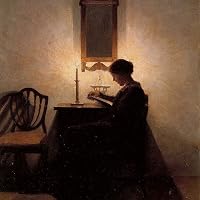
July 30, 2025
kitap, üç farklı hikâyeyle ilerliyor: genç bir adamın müezzinlikten koro şefliğine geçişi, genç yaşta eşini kaybeden bir adamın yas süreci ve ikinci evliliği, bir de fransa’da geçen huzurlu ancak bir o kadar da sessiz bir yaşam. bu üç hikâye başta birbirinden bağımsız gibi görünse de, josipovici bunları bir müzikalin parçaları gibi iç içe geçiriyor..
josipovici’nin dili oldukça sade. sanki fazlalık olan her şeyi törpülemiş de geriye yalnızca özü kalmış gibi. cümleler kısa ve yer yer şiirsel bir tona sahip. özellikle ölüm ve hafıza temaları çok etkileyiciydi. birini kaybettikten sonra insan gerçekten yaşamıyor, yalnızca devam ediyor sessizce.. josipovici bu sessizliği o kadar içten anlatıyor ki, ben de kendi yaslarımı düşündüm okurken. müzikle kurulan ilişki de çok etkileyiciydi. müzik, yalnızca bir meslek değil bu kitapta, bir yaşam biçimi. özellikle monteverdi’nin etrafında dönen satırlar, kitabın o müzikal yapısını yansıtan birer aynaya dönüşüyor.
josipovici’yi daha önce okumamıştım, hatta ismini bile duymamıştım ancak bu kitapla birlikte onun dünyasına adım atmaktan mutluyum.
josipovici’nin dili oldukça sade. sanki fazlalık olan her şeyi törpülemiş de geriye yalnızca özü kalmış gibi. cümleler kısa ve yer yer şiirsel bir tona sahip. özellikle ölüm ve hafıza temaları çok etkileyiciydi. birini kaybettikten sonra insan gerçekten yaşamıyor, yalnızca devam ediyor sessizce.. josipovici bu sessizliği o kadar içten anlatıyor ki, ben de kendi yaslarımı düşündüm okurken. müzikle kurulan ilişki de çok etkileyiciydi. müzik, yalnızca bir meslek değil bu kitapta, bir yaşam biçimi. özellikle monteverdi’nin etrafında dönen satırlar, kitabın o müzikal yapısını yansıtan birer aynaya dönüşüyor.
josipovici’yi daha önce okumamıştım, hatta ismini bile duymamıştım ancak bu kitapla birlikte onun dünyasına adım atmaktan mutluyum.

October 7, 2018
This is the type of book that makes it hard for me to appreciate perfectly good books with more dialogue and more action. In only 101 pages Josipovici tells a complete story with insights into the past and future of the well defined protagonist. The prose is lean, yet still creates an unsettling mood without explicitly telling the reader exactly what happened.
The repetition of sentences and retelling of episodes is mesmerizing and the slow build of tension and suspicions as the couple’s brief exchanges get ever so slightly more ironic makes this story a page turner even though not much happens.
This is a 5 star novel and I need to read more by Gabriel Josipovici.
Highly recommend.
The repetition of sentences and retelling of episodes is mesmerizing and the slow build of tension and suspicions as the couple’s brief exchanges get ever so slightly more ironic makes this story a page turner even though not much happens.
This is a 5 star novel and I need to read more by Gabriel Josipovici.
Highly recommend.
September 7, 2020
After all, everyone has fantasies. In the one life there are many lives. Alternative lives. Some are lived and others imagined.
(Non-review)
Why a 104 page book is 'a novel' (as it has been proudly declared on the cover and title page) and NOT 'a novella', she would say, this is beyond my understanding!
(Sort of review)
This is one of those little, clever (too clever?) books that should be read twice for better undestanding. I could've read it again but, at present, I have no spare time for it.
Non-intelligent as it may sound, I couldn't really figure out the head or tail of it (if there's any) - I mean, I know about events and episodes that happened but can't tell their sequence. The narrative jumps quickly, and with flashbacks, I felt disoriented. There are a lot of things I am not certain about- if they are real or mere figments of imagination. I've also not understood what to make of the ending. I suppose this ambiguity was created 'on purpose' by the author and perhaps, we are not meant to 'solve' the mystery. These are not really 'complaints' - but more of my 'impressions'.
Loved the word-play and repetition which made it rhythmical. I particularly liked how the translator translates French poetry into English and notices how meaning and nuances are lost in translations ( even though I can't understand French). I've also tried to translate Urdu poetry into English and it doesn't turn out quite well or seems awkward. (I am not much good at comprehending poetry let alone translate it into other language, anyway.) Still, it's an interesting hobby.
Anyway, whatever it was, It's an amazing novella even though I haven't completely understood everything. Definitely a worthy read.
(Non-review)
Why a 104 page book is 'a novel' (as it has been proudly declared on the cover and title page) and NOT 'a novella', she would say, this is beyond my understanding!
(Sort of review)
This is one of those little, clever (too clever?) books that should be read twice for better undestanding. I could've read it again but, at present, I have no spare time for it.
Non-intelligent as it may sound, I couldn't really figure out the head or tail of it (if there's any) - I mean, I know about events and episodes that happened but can't tell their sequence. The narrative jumps quickly, and with flashbacks, I felt disoriented. There are a lot of things I am not certain about- if they are real or mere figments of imagination. I've also not understood what to make of the ending. I suppose this ambiguity was created 'on purpose' by the author and perhaps, we are not meant to 'solve' the mystery. These are not really 'complaints' - but more of my 'impressions'.
Loved the word-play and repetition which made it rhythmical. I particularly liked how the translator translates French poetry into English and notices how meaning and nuances are lost in translations ( even though I can't understand French). I've also tried to translate Urdu poetry into English and it doesn't turn out quite well or seems awkward. (I am not much good at comprehending poetry let alone translate it into other language, anyway.) Still, it's an interesting hobby.
Anyway, whatever it was, It's an amazing novella even though I haven't completely understood everything. Definitely a worthy read.

June 30, 2019
As there are already several excellent reviews of this remarkable short novel, I'll simply leave you with a short extract:
"There is a kind of sorrow in solitude, he would say. The sweetness and the sadness are conjoined. And Monteverdi is the artist of that mood. It is, he would say, the mood of our times, for however close we are to another human being we always know, deep down, that we are alone."
The more I think about it, the more I like this book.
"There is a kind of sorrow in solitude, he would say. The sweetness and the sadness are conjoined. And Monteverdi is the artist of that mood. It is, he would say, the mood of our times, for however close we are to another human being we always know, deep down, that we are alone."
The more I think about it, the more I like this book.

January 6, 2019
Monteverdi's 1607 opera, "Orfeo", is still recognized as a turning point for vocal art in public performance. Josipovici uses it - and the heartbreaking myth of Orpheus and Eurydice which inspired it - as a flashpoint for transformations of all sorts. This slim book is itself Orphic in that it contemplates loss, recovery, and matters of the heart. It is also a reflection on the power of musical language to soothe angry gods and move Nature itself.
Lovers of poetry will certainly appreciate this book. Shakespeare, du Bellay, Striggio, and others are well-represented. There is a meditative quality to the way the story unfolds. Those who find classical performance of ancient Greek plays hypnotic and profound will also enjoy it, with its choral repetitions, cautionary voices, and didactic explanations. The author has carefully attended to ritual, gesture, and stylized movement in both language and action. While a reading knowledge of Italian and French are not necessary, there is a moderate amount of both and those passages are particularly beautiful.
Threaded throughout all this sensuousness and romance is a disconcerting pulse of danger. A variety of sinister threats gradually make themselves known. It is never clear whether what is being described is intended to be taken as historical fact, dark fantasy, or some combination of the two. Does Eurydice die an accidental death or has Orpheus acted out his marital regrets? Like the eponymous Old Barnes Cemetery, this story contains hideaways that can be peaceful bowers one moment and creepy haunts the next.
As for what it all means, I think this book can be viewed variously by individual readers. I see several metaphors, such as an Orpheus trying to bring his Eurydice back from Hades only to discover that you can never really recapture what was lost. Our unnamed narrator is so busy mourning a former love that it takes time for him to understand that he is, in many ways, happier alone. This Orpheus does gradually realize that the price of marriage includes the loss of extended solitude - that wedded duality excludes unbounded singularity - but what is life for an artist without his muse?
Lovers of poetry will certainly appreciate this book. Shakespeare, du Bellay, Striggio, and others are well-represented. There is a meditative quality to the way the story unfolds. Those who find classical performance of ancient Greek plays hypnotic and profound will also enjoy it, with its choral repetitions, cautionary voices, and didactic explanations. The author has carefully attended to ritual, gesture, and stylized movement in both language and action. While a reading knowledge of Italian and French are not necessary, there is a moderate amount of both and those passages are particularly beautiful.
Threaded throughout all this sensuousness and romance is a disconcerting pulse of danger. A variety of sinister threats gradually make themselves known. It is never clear whether what is being described is intended to be taken as historical fact, dark fantasy, or some combination of the two. Does Eurydice die an accidental death or has Orpheus acted out his marital regrets? Like the eponymous Old Barnes Cemetery, this story contains hideaways that can be peaceful bowers one moment and creepy haunts the next.
As for what it all means, I think this book can be viewed variously by individual readers. I see several metaphors, such as an Orpheus trying to bring his Eurydice back from Hades only to discover that you can never really recapture what was lost. Our unnamed narrator is so busy mourning a former love that it takes time for him to understand that he is, in many ways, happier alone. This Orpheus does gradually realize that the price of marriage includes the loss of extended solitude - that wedded duality excludes unbounded singularity - but what is life for an artist without his muse?

December 24, 2020
The protagonist of this novel is a nameless translator, only ever referred to as 'he' by his wife, so we're told, but also by the narrator. It's never made clear who the narrator is either. He/she seems to be someone who has known the translator for many years. Josipovici knows all about translators and their work since his mother was a translator also.
Three narratives are woven in and out of each other, sometimes within the same paragraph, set at different times in the translator's adult life. The first takes place in Putney and concerns his marriage to his first wife. The second describes the time he spent alone in an attic studio in Paris. The third finds him remarried and living in the Welsh Black Mountains. There's much use in the third narrative of the conditional tense when reporting speech, 'he would say' and so on, suggesting that the translator and his wife often recount the two preceding periods in his life and do so in a received format. It captures perfectly the myth-building and imposed narrative that we deploy to make sense of the chaos from which our lives are constructed. As the narratives unwind, it becomes clear that the translator is a very odd fellow indeed.
We know that the translator left Putney for Paris to be alone and to forget. With restraint, Josipovici lets us wait until we're a quarter of the way through the book to reveal what it is 'he' is trying to forget.
On the surface, The Cemetery in Barnes is a very different book to Hotel Andromeda. So what is it they have in common? Well, there's the bold approach to narrative. One detects a modernist sensibility at work in both, uninterested in the confines of the conventional novel. Each is also concerned with art, the former with poetry (and the French Renaissance poet, Joachim du Bellay, in particular), the latter with visual art. It's here that we find him at his most Bernhardian, as the narrator recounts the protagonist's insights into art (which we suspect are the author's own):
There is a kind of sorrow in solitude, he would say. The sweetness and the sadness are conjoined. And Monteverdi is the artist of that mood. It is, he would say, the mood of our times, for however close we are to another human being we always know, deep down, that we are alone.
It could almost be Thomas the Irascible, could it not? The former contains much use of repeated phrases, to great cumulative effect. Indeed, I can see more of the 'English Bernhard' in this novel than in Hotel Andromeda. There's the repeated use of 'he recalled', etc. in indirect reported speech, for example. Speaking of which, the dialogue is presented using an entirely different technique to that in the former novel. Interesting...
The novel possesses mystique. As the narrative proceeds, the three time periods more frequently intermesh. There's a distinct suggestion that the protagonist has entirely imagined his first marriage. He sometimes follows her unseen back to their flat in a Victorian villa, which is curious enough in itself. One day he begins following another woman, apparently, one who also lives in a Victorian building. The two women appear to conflate. There is a further hint that he actually always lived alone in Putney. Was he grieving in Paris for a love that he'd been too timid to enact? His second wife tells us:
He lived his life in a dream, his wife - his second wife - would say. He did not have a firm grasp of reality.
Do both of his wives die, one by water, the other by fire, or is it all imagination? It's deliberately opaque. The narrator tells us that the translator discovered Du Bellay's Regrets in Putney library, yet on the penultimate page, he apparently finds it on a bookstall in Paris. Perhaps, he never lived in Paris either, then. Perhaps that's why he's so fond of saying 'perhaps'... One sprouts so many lives, he would say... And then there's the final line:
With his grey hat pulled low over his eyes he climbs the stairs out of the rue Saint Julien.
The translator may have lived any of the lives the narrator ascribes to him, the perfect metaphor for Josipovici's craft, a slowly unravelling metafiction.
On another note, the translator becomes an aficionado of the recent vogue (then) for early music and muses upon the libretto to Monteverdi's Orfeo. This struck a personal chord. My father took an interest in early music in the 1970s, inspired by the weekly BBC Radio 3 programme dedicated to it.
It's truly inspiring that Josipovici was 78 years old when this book was published. You'd never suspect it from its connectedness to the world and the intellect behind it. I visited Edward Upward when he was in his nineties and came away similarly awe-struck. My father, also in his nineties, is still reading books in four foreign languages. There's hope for us all. Stay away from TV and WhatFaceGram, keep reading books and who knows?
Three narratives are woven in and out of each other, sometimes within the same paragraph, set at different times in the translator's adult life. The first takes place in Putney and concerns his marriage to his first wife. The second describes the time he spent alone in an attic studio in Paris. The third finds him remarried and living in the Welsh Black Mountains. There's much use in the third narrative of the conditional tense when reporting speech, 'he would say' and so on, suggesting that the translator and his wife often recount the two preceding periods in his life and do so in a received format. It captures perfectly the myth-building and imposed narrative that we deploy to make sense of the chaos from which our lives are constructed. As the narratives unwind, it becomes clear that the translator is a very odd fellow indeed.
We know that the translator left Putney for Paris to be alone and to forget. With restraint, Josipovici lets us wait until we're a quarter of the way through the book to reveal what it is 'he' is trying to forget.
On the surface, The Cemetery in Barnes is a very different book to Hotel Andromeda. So what is it they have in common? Well, there's the bold approach to narrative. One detects a modernist sensibility at work in both, uninterested in the confines of the conventional novel. Each is also concerned with art, the former with poetry (and the French Renaissance poet, Joachim du Bellay, in particular), the latter with visual art. It's here that we find him at his most Bernhardian, as the narrator recounts the protagonist's insights into art (which we suspect are the author's own):
There is a kind of sorrow in solitude, he would say. The sweetness and the sadness are conjoined. And Monteverdi is the artist of that mood. It is, he would say, the mood of our times, for however close we are to another human being we always know, deep down, that we are alone.
It could almost be Thomas the Irascible, could it not? The former contains much use of repeated phrases, to great cumulative effect. Indeed, I can see more of the 'English Bernhard' in this novel than in Hotel Andromeda. There's the repeated use of 'he recalled', etc. in indirect reported speech, for example. Speaking of which, the dialogue is presented using an entirely different technique to that in the former novel. Interesting...
The novel possesses mystique. As the narrative proceeds, the three time periods more frequently intermesh. There's a distinct suggestion that the protagonist has entirely imagined his first marriage. He sometimes follows her unseen back to their flat in a Victorian villa, which is curious enough in itself. One day he begins following another woman, apparently, one who also lives in a Victorian building. The two women appear to conflate. There is a further hint that he actually always lived alone in Putney. Was he grieving in Paris for a love that he'd been too timid to enact? His second wife tells us:
He lived his life in a dream, his wife - his second wife - would say. He did not have a firm grasp of reality.
Do both of his wives die, one by water, the other by fire, or is it all imagination? It's deliberately opaque. The narrator tells us that the translator discovered Du Bellay's Regrets in Putney library, yet on the penultimate page, he apparently finds it on a bookstall in Paris. Perhaps, he never lived in Paris either, then. Perhaps that's why he's so fond of saying 'perhaps'... One sprouts so many lives, he would say... And then there's the final line:
With his grey hat pulled low over his eyes he climbs the stairs out of the rue Saint Julien.
The translator may have lived any of the lives the narrator ascribes to him, the perfect metaphor for Josipovici's craft, a slowly unravelling metafiction.
On another note, the translator becomes an aficionado of the recent vogue (then) for early music and muses upon the libretto to Monteverdi's Orfeo. This struck a personal chord. My father took an interest in early music in the 1970s, inspired by the weekly BBC Radio 3 programme dedicated to it.
It's truly inspiring that Josipovici was 78 years old when this book was published. You'd never suspect it from its connectedness to the world and the intellect behind it. I visited Edward Upward when he was in his nineties and came away similarly awe-struck. My father, also in his nineties, is still reading books in four foreign languages. There's hope for us all. Stay away from TV and WhatFaceGram, keep reading books and who knows?
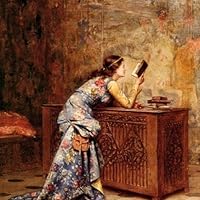
May 6, 2020
I’ve had this book on my reading list ever since it was a finalist for one of my favorite book awards, The Goldsmiths Prize for fictional work “that is deemed genuinely novel and which embodies the spirit of invention that characterizes the genre at its best.” And Josipovici’s novella surely breaks the ground in form and style that would make it a winner of all the contemporary fiction I’ve read so far this year had it not been for Ali Smith... Ilse's recent reading and fascinating review, along with Fionnuala’s as ever original commentary as well as a few others from 2018 when the book was published (see, for example, those by Paul, Katia, Hugh, or Gumble's Yard) offer plenty of inviting thoughts to read this novella that there is no need to add yet another complete overview.
I would only add to what was already written that some musical knowledge can help, especially the idea of “repeat play” in the forms of da capo and dal segno (and he used them both most originally), and not the least the repeat plays with alternate endings. Only after I had finished reading it did I realize how much Josipovici brilliantly used this musical device in telling and retelling the story of the protagonist’s two marriages. Like the best of musical variations, the repetitions in his novella were anything but superfluous, each time adding another layer to the story.
Also, since one of the protagonist’s obsessions is Monteverdi’s opera L’Orfeo, it helps to know its particular plot. There are several versions of the Orfeo myth, most importantly in terms of its ending, and the version in Monteverdi’s opera gives a clue to what might seem as an enigmatic ending to the novella .
There are so many grounds that are covered in this short book, from contemplations about literature and music, the process of translating poetry (a formidable, and perhaps impossible, task), the philosophy and psychology of life in grief, while weaving the undercurrent of a mystery. A work of a fantastic literary stylist and incredibly inventive mind. Loved it!
I would only add to what was already written that some musical knowledge can help, especially the idea of “repeat play” in the forms of da capo and dal segno (and he used them both most originally), and not the least the repeat plays with alternate endings. Only after I had finished reading it did I realize how much Josipovici brilliantly used this musical device in telling and retelling the story of the protagonist’s two marriages. Like the best of musical variations, the repetitions in his novella were anything but superfluous, each time adding another layer to the story.
Also, since one of the protagonist’s obsessions is Monteverdi’s opera L’Orfeo, it helps to know its particular plot. There are several versions of the Orfeo myth, most importantly in terms of its ending, and the version in Monteverdi’s opera gives a clue to what might seem as an enigmatic ending to the novella .
There are so many grounds that are covered in this short book, from contemplations about literature and music, the process of translating poetry (a formidable, and perhaps impossible, task), the philosophy and psychology of life in grief, while weaving the undercurrent of a mystery. A work of a fantastic literary stylist and incredibly inventive mind. Loved it!

October 19, 2018
An enigmatic novella that can, and probably should, be read in a single sitting (as I did), to appreciate the repetitions and cascading themes. Although I really enjoyed the ride, I must say my (lack of) knowledge of Monteverdi and du Bellay, meant that I probably missed a great deal ... but so much of the book relies on ambiguity, that perhaps (!) it made little difference.

February 4, 2023
https://kansasbooks.blogspot.com/2023...
"Pero como suele ocurrir con la imaginación, pensar con frecuencia y lo bastante en algo hace que parezca al principio posible, luego incluso probable,y por último, necesario.”
De verdad que pocas veces he sentido, como en esta novela, que no quería acabarla, que era demasiado corta (126 páginas) y que no había forma de alargarla porque tenía que seguir leyendo. Funciona como un hechizo, como un estímulo continuo para el lector porque es tan enigmática, tan ambigua y por momentos tan turbadora que es de esas novelas a las que califico como sonámbulas. Gabriel Josipovici construye un relato abierto a tantas interpretaciones, gracias a esta ambigüedad, que cuando la terminé, volví a empezarla, casi en un intento por escapar de este hechizo…, pero no, tras la segunda lectura, el hechizo continuaba (perturbadora por lo que sugiere más que por lo que revela), y no solo eso, sino que algunas interpretaciones de la primera lectura se habían transformado en otra novela…, de haber continuado con una tercera lectura estoy segura de que hubiera seguido transformándose en otra novela y así hasta el infinito…
"Nunca se llamaban por sus nombres. Para ella él era simplemente él y para él ella era siempre ella. Sus amigos se preguntaban si usarían la misma fórmula cuando estaban solos, pero en realidad nadie los conocía lo suficiente como para preguntarlo."
El Cementario de Barnes se estructura en torno a la vida de un traductor, sin nombre, que nos va relatando tres momentos concretos de su vida, intercalándolos sin orden (pero con concierto): su vida en Putney, Londres junto a su primera esposa, casi unos críos ambos; su vida ordenada y rutinaria en Paris, una vez que se quedó viudo; y finalmente el presente junto a su segunda esposa viviendo en una casa de campo en la zona rural de Gales. Tres momentos concretos, tres espacios firmemente asentados que se mezclan continuamente mientras fluyen hacia su recuerdo. El traductor repasa estas tres lineas temporales estableciendo conexiones con el arte, la traducción, los poemas de Shakespeare y du Bellay, y la ópera de Monteverdi, unas conexiones artisticas firmemente identificadas con él mismo y su vida, al mismo tiempo que se relaja paseando y visitando los cementerios:
"Hay una especie de pesar en la soledad, decía. La dulzura y la tristeza se unen. Y Monteverdi es el artista de ese estado de ánimo. El estado de ánimo, decía, de nuestros tiempos, pues no importa lo cerca que nos hallemos de otro ser humano que siempre, en el fondo, sabemos que estamos solos."
Lo que de verdad resulta fascinante en esta novela, joya total, es el misterio en el que Josipovici rodea la vida de este traductor, sobre todo centrado en sus fantasías. Sabemos que tuvo una primera esposa, a la que recuerda continuamente ahogándose; la rememora en la estaciones de tren, caminando por la ciudad y siendo tragada por las aguas. Diferentes versiones de la misma historia, quizás con una palabra cambiada, diferentes versiones de un ahogamiento y llegado un punto puede que incluso nos preguntemos si esta primera esposa realmente existió o solo estaba en la fantasía del traductor. Y es fascinante como la prosa de Josipivici nos envuelve de tal forma que se convierte en puro sonambulismo de un hombre que parece muerto en vida, o ¿medianamente despierto…?
"La recuerdo con toda claridad, decía él, parada totalmente quieta, esperando, mientras la gente fluía a su alrededor. La recuerdo perfectamente."
[...]
"Había momentos en que él tenía la sensación de no entenderla. La tenía delante y era como si no la tuviera delante. Estaba con ella y era como si no estuviera con ella. Cogido de su mano, a veces se sentía como si caminará con una extraña.
[...]
“Mientras caminaba pensaba en ella inclinada para meter la llave en la cerradura, enderezándose luego y entrando, cerrando la puerta después. Y pensaba también en el día que sus miradas se habían encontrado en el sendero de la ribera, y cómo le había mirado ella y había negado lentamente con la cabeza.”
La relación del traductor con su segunda esposa, a quién Josipovici recrea en diálogos aparentemente armónicos pero con una tensión soterrada, establecen esa otra parte de la tensión dramática de esta novela. Una segunda esposa que aparece siempre como un contrapunto a esa soledad en la que se quiere ver sumergido este hombre, una tensión que hace intuir un cierto poso de toxicidad latente que envuelve a la atmósfera de una inquietante corriente subterránea, nunca revelada, pero siempre en el aire. Dos contrapuntos, dos mujeres, que cuando termino la novela no termino de estar segura de si realmente existieron o solo existieron en las fantasias del traductor.
"Sabía que tales imaginaciones eran neuróticas, peligrosas incluso, pero no le preocupaban demasiado, pues le parecíaque era mejor permitirlas que tratar de suprimirlas por completo. Al fin y al cabo, todo el mundo tiene fantasía. Uno vive muchas vidas. Vidas alternativas. Eso es lo absurdo de las biografías, decía, de las novelas. Nunca se ocupan de las vidas alternativas bajo cuya sombra avanzamos despacio, como en un sueño, desde el nacimiento hasta la madurez y la muerte.”
El Cementerio de Barnes es un estimulo continuo en el que al lector le toca decidir quién es de verdad este traductor ¿qué hay en su vida que le hace rememorar ciertos momentos como un bucle continuo y recurrente? ¿por qué acechaba a esa, su primera esposa, como si de un extraño se tratara, quizás porque era precisamente eso, un extraño??? Creo que da igual cual sea nuestra interpretación, cada lector tendrá una diferente, pero está claro que Gabriel Josipovici ha construido una novela fascinante en torno a un hombre que vive sus fantasías como si fueran la pura realidad. Hay algo realmente perturbador en esta novela, quizás con una tercera lectura consiga las respuestas a ciertas preguntas…
“Uno engendra muchas personalidades, decía, y la miraba y sonreía. En una es un asesino. En una, un suicida. En una vive en Paris. En una en Bombay. En una en Nueva York. Una, una, una, repetía ella, burlándose de él.”
"Pero como suele ocurrir con la imaginación, pensar con frecuencia y lo bastante en algo hace que parezca al principio posible, luego incluso probable,y por último, necesario.”
De verdad que pocas veces he sentido, como en esta novela, que no quería acabarla, que era demasiado corta (126 páginas) y que no había forma de alargarla porque tenía que seguir leyendo. Funciona como un hechizo, como un estímulo continuo para el lector porque es tan enigmática, tan ambigua y por momentos tan turbadora que es de esas novelas a las que califico como sonámbulas. Gabriel Josipovici construye un relato abierto a tantas interpretaciones, gracias a esta ambigüedad, que cuando la terminé, volví a empezarla, casi en un intento por escapar de este hechizo…, pero no, tras la segunda lectura, el hechizo continuaba (perturbadora por lo que sugiere más que por lo que revela), y no solo eso, sino que algunas interpretaciones de la primera lectura se habían transformado en otra novela…, de haber continuado con una tercera lectura estoy segura de que hubiera seguido transformándose en otra novela y así hasta el infinito…
"Nunca se llamaban por sus nombres. Para ella él era simplemente él y para él ella era siempre ella. Sus amigos se preguntaban si usarían la misma fórmula cuando estaban solos, pero en realidad nadie los conocía lo suficiente como para preguntarlo."
El Cementario de Barnes se estructura en torno a la vida de un traductor, sin nombre, que nos va relatando tres momentos concretos de su vida, intercalándolos sin orden (pero con concierto): su vida en Putney, Londres junto a su primera esposa, casi unos críos ambos; su vida ordenada y rutinaria en Paris, una vez que se quedó viudo; y finalmente el presente junto a su segunda esposa viviendo en una casa de campo en la zona rural de Gales. Tres momentos concretos, tres espacios firmemente asentados que se mezclan continuamente mientras fluyen hacia su recuerdo. El traductor repasa estas tres lineas temporales estableciendo conexiones con el arte, la traducción, los poemas de Shakespeare y du Bellay, y la ópera de Monteverdi, unas conexiones artisticas firmemente identificadas con él mismo y su vida, al mismo tiempo que se relaja paseando y visitando los cementerios:
"Hay una especie de pesar en la soledad, decía. La dulzura y la tristeza se unen. Y Monteverdi es el artista de ese estado de ánimo. El estado de ánimo, decía, de nuestros tiempos, pues no importa lo cerca que nos hallemos de otro ser humano que siempre, en el fondo, sabemos que estamos solos."
Lo que de verdad resulta fascinante en esta novela, joya total, es el misterio en el que Josipovici rodea la vida de este traductor, sobre todo centrado en sus fantasías. Sabemos que tuvo una primera esposa, a la que recuerda continuamente ahogándose; la rememora en la estaciones de tren, caminando por la ciudad y siendo tragada por las aguas. Diferentes versiones de la misma historia, quizás con una palabra cambiada, diferentes versiones de un ahogamiento y llegado un punto puede que incluso nos preguntemos si esta primera esposa realmente existió o solo estaba en la fantasía del traductor. Y es fascinante como la prosa de Josipivici nos envuelve de tal forma que se convierte en puro sonambulismo de un hombre que parece muerto en vida, o ¿medianamente despierto…?
"La recuerdo con toda claridad, decía él, parada totalmente quieta, esperando, mientras la gente fluía a su alrededor. La recuerdo perfectamente."
[...]
"Había momentos en que él tenía la sensación de no entenderla. La tenía delante y era como si no la tuviera delante. Estaba con ella y era como si no estuviera con ella. Cogido de su mano, a veces se sentía como si caminará con una extraña.
[...]
“Mientras caminaba pensaba en ella inclinada para meter la llave en la cerradura, enderezándose luego y entrando, cerrando la puerta después. Y pensaba también en el día que sus miradas se habían encontrado en el sendero de la ribera, y cómo le había mirado ella y había negado lentamente con la cabeza.”
La relación del traductor con su segunda esposa, a quién Josipovici recrea en diálogos aparentemente armónicos pero con una tensión soterrada, establecen esa otra parte de la tensión dramática de esta novela. Una segunda esposa que aparece siempre como un contrapunto a esa soledad en la que se quiere ver sumergido este hombre, una tensión que hace intuir un cierto poso de toxicidad latente que envuelve a la atmósfera de una inquietante corriente subterránea, nunca revelada, pero siempre en el aire. Dos contrapuntos, dos mujeres, que cuando termino la novela no termino de estar segura de si realmente existieron o solo existieron en las fantasias del traductor.
"Sabía que tales imaginaciones eran neuróticas, peligrosas incluso, pero no le preocupaban demasiado, pues le parecíaque era mejor permitirlas que tratar de suprimirlas por completo. Al fin y al cabo, todo el mundo tiene fantasía. Uno vive muchas vidas. Vidas alternativas. Eso es lo absurdo de las biografías, decía, de las novelas. Nunca se ocupan de las vidas alternativas bajo cuya sombra avanzamos despacio, como en un sueño, desde el nacimiento hasta la madurez y la muerte.”
El Cementerio de Barnes es un estimulo continuo en el que al lector le toca decidir quién es de verdad este traductor ¿qué hay en su vida que le hace rememorar ciertos momentos como un bucle continuo y recurrente? ¿por qué acechaba a esa, su primera esposa, como si de un extraño se tratara, quizás porque era precisamente eso, un extraño??? Creo que da igual cual sea nuestra interpretación, cada lector tendrá una diferente, pero está claro que Gabriel Josipovici ha construido una novela fascinante en torno a un hombre que vive sus fantasías como si fueran la pura realidad. Hay algo realmente perturbador en esta novela, quizás con una tercera lectura consiga las respuestas a ciertas preguntas…
“Uno engendra muchas personalidades, decía, y la miraba y sonreía. En una es un asesino. En una, un suicida. En una vive en Paris. En una en Bombay. En una en Nueva York. Una, una, una, repetía ella, burlándose de él.”


June 24, 2022
CRITIQUE:
Other Qualities Besides Story
Like Paul Auster, Gabriel Josipovici's novels often explore some aspect of metafiction or (post-)modernism in earnest.
The difference is that, in the case of Auster, there is always a strong foundation in story or narrative.
Here, Josipovici strips his novel of narrative, and takes the risk that no story will remain. What his novel has is "other qualities". Whatever action is present is remembered, imagined, dreamed or fantasised by either the protagonist or the narrator, and therefore, indirectly, by the reader.
Words So Natural and Unforced
What remains are words, arrangements of words that sound "so natural and unforced".
Josipovici stirs them around in the crucible of his imagination, until, when he stops, they continue to spiral and swirl on the page. Needless to say, there is much repetition and circularity.
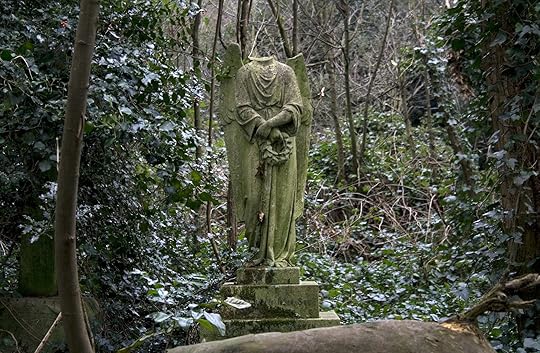
Decapitated statue of an angel at Barnes Cemetery
Alternative Lives, Alternative Wives
The anonymous protagonist, a freelance translator of French verse into English, is a man of solitude, a "creature of habit": he wakes up early, writes all morning, listens to early music and opera, drinks tea, dons his grey hat and tie, walks along the river (the Thames or the Seine), has fantasies of drowning in the manner of his first wife, and banters with his second wife (who might or might not be his imaginary wife):
Like the author and the narrator, readers of Josipovici's fiction are able to indulge in these alternative fantasy lives and deaths, as enigmatic as they might be, some being lived and some imagined.
VERSE:
A True Story of an Alternative Life
[Largely in the Words of Joachim Du Bellay
and Gabriel Josipovici]
Death itself, the poet says, is the fist life wields,
Against it, there are no effective guards or shields
I have no wish to dress up any of my woes
In the false guise of worn out verse or tired prose,
Instead I hope to convey my life's true story
In simple style that speaks plainly of its glory.
SOUNDTRACK:
Other Qualities Besides Story
Like Paul Auster, Gabriel Josipovici's novels often explore some aspect of metafiction or (post-)modernism in earnest.
The difference is that, in the case of Auster, there is always a strong foundation in story or narrative.
Here, Josipovici strips his novel of narrative, and takes the risk that no story will remain. What his novel has is "other qualities". Whatever action is present is remembered, imagined, dreamed or fantasised by either the protagonist or the narrator, and therefore, indirectly, by the reader.
Words So Natural and Unforced
What remains are words, arrangements of words that sound "so natural and unforced".
Josipovici stirs them around in the crucible of his imagination, until, when he stops, they continue to spiral and swirl on the page. Needless to say, there is much repetition and circularity.
Decapitated statue of an angel at Barnes Cemetery
Alternative Lives, Alternative Wives
The anonymous protagonist, a freelance translator of French verse into English, is a man of solitude, a "creature of habit": he wakes up early, writes all morning, listens to early music and opera, drinks tea, dons his grey hat and tie, walks along the river (the Thames or the Seine), has fantasies of drowning in the manner of his first wife, and banters with his second wife (who might or might not be his imaginary wife):
"After all, everyone has fantasies. In the one life there are many lives. Alternative lives. Some are lived and others imagined. That is the absurdity of biographies, he would say, of novels. They never take account of the alternative lives casting their shadows over us as we move slowly, as though in a dream, from birth to maturity to death."
Like the author and the narrator, readers of Josipovici's fiction are able to indulge in these alternative fantasy lives and deaths, as enigmatic as they might be, some being lived and some imagined.
VERSE:
A True Story of an Alternative Life
[Largely in the Words of Joachim Du Bellay
and Gabriel Josipovici]
Death itself, the poet says, is the fist life wields,
Against it, there are no effective guards or shields
I have no wish to dress up any of my woes
In the false guise of worn out verse or tired prose,
Instead I hope to convey my life's true story
In simple style that speaks plainly of its glory.
SOUNDTRACK:
Displaying 1 - 30 of 113 reviews