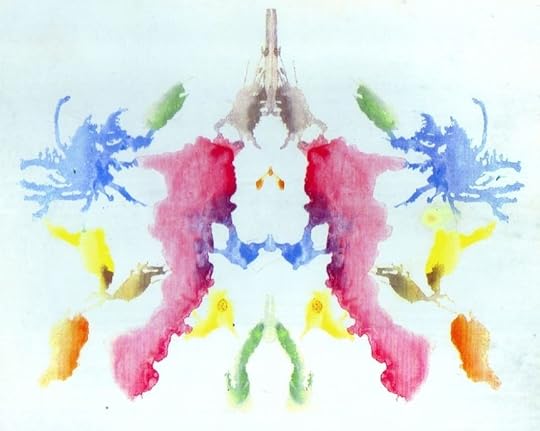
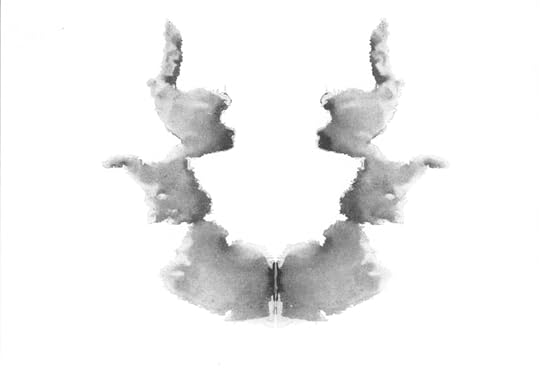
This book was a fascinating look at the man who created the iconic Inkblots and the life they took on after its inventor's demise. He didn't live to see their iconic status. He didn't live long enough to even know they would be something well-known. He put them out into the world and then disappeared like Lao Tzu after putting those verses down.
I'm so tickled that someone like him existed. I knew very little about Rorschach before picking up this book. He was fascinating and wonderful and deserves to be known as much as Freud and Einstein and he probably would be if he hadn't died so young. The first chapter that tells of him growing up was so rich. Without even knowing what was to come, his first 18 years would make an interesting novel. It was riveting and lovely and tragic.
The fact that these Inkblots are so pervasive in pop culture is why the author digs in. To get to the heart of what they are, he tells us who their creator was. I mean seriously, who was this guy and how and why and yes, I'm curious why these specific ten designs . And how do people that are poised and able to pass every other test with flying colors trip up when the Inkblots come out? Why does a pedophile or a sociopath so easily spill it when seeing those inkblots? The answer is fascinating.
How he came up with the inkblots was so interesting. One comes away knowing that no one else but him could have come up with those ten inkblots. One comes away from this book understanding the genius of the inkblots as well as the creator's genius. But like all genius, it's a product of time and environment. Rorschach's father was a deep thinker that wrote about light and form in art and in the world. It's no wonder he came up with Inkblots with his father planting the seeds early on. His father even wrote about psychology and consciousness. The inkblot game he played as a child was the impetus, but his ultimate creation was more complicated than child's play. The thought and detail that went into them is staggering and the reason they work better than any other inkblots.
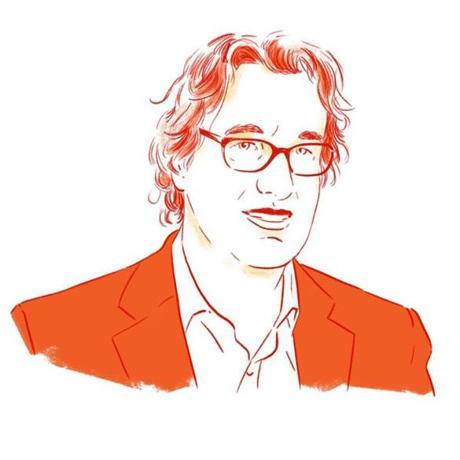
And who knew, Rorschach was kind of hot. He is one of those guys you see in old photos sometimes that could be walking around today and wouldn't look out of place. He might even be a heartthrob. Apparently he was back then too, as it was reported his patients tended to fall for him.
The times he grew up in and what and who he was exposed to is part of the story and it was really interesting. Modernity was erupting all around him. There was so much going on, it's mind blowing actually.
In Switzerland alone, during Rorschach's career there, Albert Einstein invented modern physics and Vladimir Lenin invented modern communism while working with the labor organizers in Swiss watch factories. Lenin's next door neighbor's in Zurich, the Dadaists, invented modern art, Le Corbusier modern architecture, Rudolf Steiner created Waldorf schools, and an artist named Johannes Itten invented seasonal colors (are you a spring or a winter?). In psychiatry, Carl Jung created the modern psychological test. Jung's and Sigmund Freud's explorations of the unconscious mind were battling for dominance, both among wealthy neurotic clientele and in the real world of Swiss hospitals filled past capacity. All of these revolutions crossed paths in Rorschach's life and career.
His view on Russians (he loved them) was interesting. This was pre-Stalin and all that we know now. The Russian Revolution held so much hope for so many. The excitement was akin to what the new world, the United States, felt at the time it declared freedom from royal rule. It inspired some like Rorschach at the time, but like most revolutions, the promised land was never reached.
As the story hit the midway point, I ached a bit knowing that all the discoveries Rorschach knew were to come would happen without him as he didn't have much longer. This is always true for all of us, but seemed especially poignant when it comes to an explorer and discoverer like Rorschach.
The discussion of the coinciding emergences of the concept of empathy and abstract art was absolutely fascinating. It was equally fascinating reading about the shift from perceiving character as the thing to personality being the thing. This explains pop culture so much. It also explains how generations of men with character would be replaced with cults of personality with little substance but nonetheless revered.
I would have liked to see a little more biography on those that took the Inkblots forward in the decades after Rorschach's death.
So darkly fascinating, the discussion of Nazis at Nuremberg and how they were discovered upon a closer look not to be exceptionally evil. They were like so many people: sane, intelligent, and prejudiced and having had the chance to grab power, behaved horribly. So many wanted to diagnose evil. But the thing is there is no such thing as an evil gene. There are sociopaths that are capable of doing horrible things because of their lack of empathy, and perhaps that is what they should have been looking for instead, the lack of empathy as an indicator.
Though plenty of people lack empathy that don't commit atrocities. Though, the ability to objectify others seems to be a key ingredient, although everyone on some level does just that at times even when they have empathy. The thing that was and is probably hard to understand about the Nazis - the poster boys for evil - is that while some of the higher-ups may have been sociopaths, likely not all of them were. So marking them as evil discounts the fact that some of them were very intelligent and had the capacity for empathy and kindness and love. They weren't robots or killing machines void of human emotion. In fact, a great number of them were likely just doing what they were told and didn't have the character or strength to sacrifice their life defying the powers-that-be.
The truth is, the masses that did nothing did so mostly out of fear too. Without that fear, and in some cases, complacency, there would have been no holocaust. Let's not forget, the prejudice that Hitler pandered to is the same that Trump pandered to (and a long list of others before him). Neither Hitler or Trump created that prejudice, they both saw it and manipulated it and pandered to it to get into power. That doesn't make them evil, it makes them opportunistic.
The truth is people like you and me made the holocaust possible. We prefer absolutes so we put Hitler and the Nazi's on the evil pedestal because it's easier to objectify them and pretend they are monsters instead of what they really were and that is just human beings like you and me that did horrible horrible things fueled by fear and hunger for power and riches at any cost.
In so many ways, Nazi's were no different than many in power today in how they pander to prejudice. The same racial prejudice that was in Nazi Germany is in America today. It's in cities around the world today. A Nazi-like state could exist anywhere again at anytime. Those that say "no way" don't understand human nature or human history. The latter can repeat itself at anytime if the conditions are just right. The reason history repeats itself is because too few understand that.