

What do you think?

Die Ottonen
Anregend und allgemeinverständlich erzählt Hagen Keller die Geschichte der Ottonen. Er beschreibt den Aufstieg der sächsischen Herzogs-Familie zu einem der bedeutendsten deutschen Herrschergeschlechter des Mittelalters. Zugleich erhellt er das Selbstverständnis der ottonischen Kaiser und ihr Verhältnis zum Reich und zur Kirche. Die Blüte der ottonischen Kunst, die Ausgestaltung der Bischofsstädte und die Lebensbedingungen im Reich der Ottonen sowie die Rezeption ihres Erbes sind weitere Themen dieses Buches.
128 pages, Paperback
First published January 1, 2001
About the author
Hagen Keller
23 books1 followerHagen Keller is a medieval historian specialising in the Ottonians. He was professor of Medieval History at the University of Münster from 1982 until his retirement in 2002.
Ratings & Reviews
Friends & Following
Create a free account to discover what your friends think of this book!
Community Reviews
Displaying 1 - 4 of 4 reviews

Read
June 16, 2012Hagen Keller's book is an overview account part of a series similar to the OUP very short introductions. It gives a concise run through of the reigns of Heinrich the Fowler, the three Ottos and Heinrich II covering a period of around a hundred years from the early tenth century through to 1024. The section on the art of the Ottonian era suffers inevitably because books in this series are not illustrated and some of the material I felt showed signs of being stressed for the lack of space for a fuller discussion.
Keller starts with the historiography. The Ottonians were the first largely German dynasty ruling over an area that included most of modern day Germany. The dominant interpretation in the nineteenth century in to the Nazi era was nationalistic, but the past is always understood from the perspective of the present which led more recently to the role of the Ottonians in the transformation of Europe to be stressed. Typical of this the 2001 exhibition that I visited, setting off my Ottonianphilia, was called "Otto the Great, Magdeburg and Europe".
The idea of Germany hadn't emerged in the tenth century the component tribes or might have been nations were still (arguably in places still are) the primary focus of identity. The chronicler Bishop Thietmar of Merseburg tells us that the Bavarians were greedy, the Lothringinans fickle, the Swabians cunning, and in case one had any doubt as to Thietmar's ancestry, the Saxons, he assures us, are loyal and the best fighters.
Thanks to Hrotsvit of Gandersheim we know the name of the grandfather of Heinrich the Fowler, the first of the dynasty. The family might have had a Frankish origin, however one of his series of wives (including one seized from a nunnery on account of her beautiful and broad acres of lands - this was an age when Romance was a style of architecture rather than an attitude towards potential spouses) was as Widukind von Corvey was proud to point out in his history a descendent of the Widukind who led the Saxons at the time of Charlemagne.
The Ottonians, then were a Saxon dynasty; at least in theory, Otto I married an Italian, Otto II married a Greek, so Otto III's Saxon heritage was fairly dilute. Their realm was curiously modular with snap on extensions. Starting from Saxony and neighbouring Franconia, then adding other German speaking regions, as well as Bohemia (to an extent), Northern Italy and Burgundy.
They claimed the title of King of the Romans and from Otto I onwards were crowned Holy Roman Emperors (though as the joke goes the realm they created was neither holy, nor Roman nor an empire) by successive Popes and possibly in line with an Imperial and Roman outlook Otto III worked with pope Sylvester II to establish archbishoprics in Poland and Hungary, playing a role in their emergence as Roman Catholic states.
Keller stresses the newness of the monarchy which was created under the Ottonian monarchs. The earlier Carolingian and Merovingian dynasties had a concept of a ruling family in which every male member of the royal line was a king and had their own territory to rule over. While this had its upsides it also led to splitting of territories, frequent wars with losers sent to a monastery (if they were lucky). The Ottonians changed that, overcoming some pointed disappointment to establish that there would only be one king at a time and that kingship would flow down a particular line. This led to more stable territorial states developing rather than regular reinvention.
Then the Ottonians made an effort to build up a connection between the ruler and certain places (in particular Memleben, Gandersheim, Magdeburg, and Quedlinburg)- churches and abbeys where family members had been buried, which the king would visit on ceremonial occasions, where daughters and wives would become nuns and rule over over as Abbesses or occasionally become saints. This was a marked change to the Carolingians who apparently tended to be buried near where they died. Not only were death, burial and coronations symbolic occasions for the Ottonians to demonstrate power and magnificence, so too were Church festivals including Palm Sunday and Easter.
The other Ottonian innovation was the creation a sacral monarchy. On the one hand there was the presentation of the monarch, their visits to key ceremonial monasteries, abbeys and cathedrals associated with the family and frequently governed by senior family members is made clear and there is a clear sense of how, particularly under Otto III that the notion of a sacral empire was moving into area of aspiration and lordship that would also be claimed by the Papacy.
At the same time since the Emperor was the representative of Christ, bishops and powerful prelates were his helpers. Under the Ottonians and their successors the Salians the Bishops were important military supporters of the rulers, but even after the bruising Investiture Conflict with the Papacy Bishops were to remain important and powerful lords within the Holy Roman empire down to its demise in 1806.
Keller's book is a decent summary, a good companion to the equally short The Embassy to Constantinople and Widukind von Corvey's History of the Saxons. There's a rush in the last few pages to open up some of the mysteries surrounding the logistics of the monarchy (apparently the court would consume around a thousand sheep and pigs every day as well as eight cattle), we're told the sources aren't very helpful when it comes to the economy (it was growing), violence (there was a lot of it throughout society) or transportation networks which seem surprisingly fast and effective. A longer book might help set out more thoroughly quite how inexplicable such problems are!
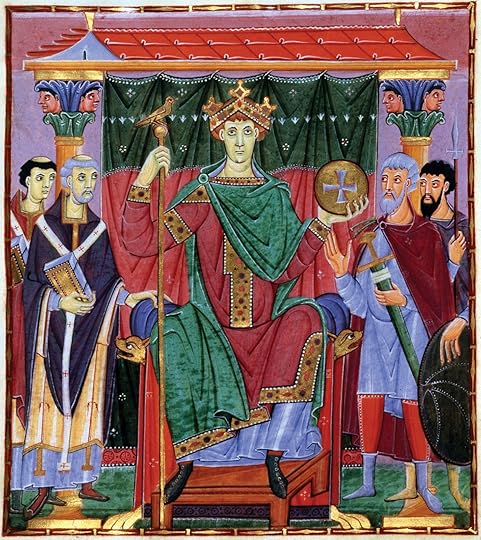
Keller starts with the historiography. The Ottonians were the first largely German dynasty ruling over an area that included most of modern day Germany. The dominant interpretation in the nineteenth century in to the Nazi era was nationalistic, but the past is always understood from the perspective of the present which led more recently to the role of the Ottonians in the transformation of Europe to be stressed. Typical of this the 2001 exhibition that I visited, setting off my Ottonianphilia, was called "Otto the Great, Magdeburg and Europe".
The idea of Germany hadn't emerged in the tenth century the component tribes or might have been nations were still (arguably in places still are) the primary focus of identity. The chronicler Bishop Thietmar of Merseburg tells us that the Bavarians were greedy, the Lothringinans fickle, the Swabians cunning, and in case one had any doubt as to Thietmar's ancestry, the Saxons, he assures us, are loyal and the best fighters.
Thanks to Hrotsvit of Gandersheim we know the name of the grandfather of Heinrich the Fowler, the first of the dynasty. The family might have had a Frankish origin, however one of his series of wives (including one seized from a nunnery on account of her beautiful and broad acres of lands - this was an age when Romance was a style of architecture rather than an attitude towards potential spouses) was as Widukind von Corvey was proud to point out in his history a descendent of the Widukind who led the Saxons at the time of Charlemagne.
The Ottonians, then were a Saxon dynasty; at least in theory, Otto I married an Italian, Otto II married a Greek, so Otto III's Saxon heritage was fairly dilute. Their realm was curiously modular with snap on extensions. Starting from Saxony and neighbouring Franconia, then adding other German speaking regions, as well as Bohemia (to an extent), Northern Italy and Burgundy.
They claimed the title of King of the Romans and from Otto I onwards were crowned Holy Roman Emperors (though as the joke goes the realm they created was neither holy, nor Roman nor an empire) by successive Popes and possibly in line with an Imperial and Roman outlook Otto III worked with pope Sylvester II to establish archbishoprics in Poland and Hungary, playing a role in their emergence as Roman Catholic states.
Keller stresses the newness of the monarchy which was created under the Ottonian monarchs. The earlier Carolingian and Merovingian dynasties had a concept of a ruling family in which every male member of the royal line was a king and had their own territory to rule over. While this had its upsides it also led to splitting of territories, frequent wars with losers sent to a monastery (if they were lucky). The Ottonians changed that, overcoming some pointed disappointment to establish that there would only be one king at a time and that kingship would flow down a particular line. This led to more stable territorial states developing rather than regular reinvention.
Then the Ottonians made an effort to build up a connection between the ruler and certain places (in particular Memleben, Gandersheim, Magdeburg, and Quedlinburg)- churches and abbeys where family members had been buried, which the king would visit on ceremonial occasions, where daughters and wives would become nuns and rule over over as Abbesses or occasionally become saints. This was a marked change to the Carolingians who apparently tended to be buried near where they died. Not only were death, burial and coronations symbolic occasions for the Ottonians to demonstrate power and magnificence, so too were Church festivals including Palm Sunday and Easter.
The other Ottonian innovation was the creation a sacral monarchy. On the one hand there was the presentation of the monarch, their visits to key ceremonial monasteries, abbeys and cathedrals associated with the family and frequently governed by senior family members is made clear and there is a clear sense of how, particularly under Otto III that the notion of a sacral empire was moving into area of aspiration and lordship that would also be claimed by the Papacy.
At the same time since the Emperor was the representative of Christ, bishops and powerful prelates were his helpers. Under the Ottonians and their successors the Salians the Bishops were important military supporters of the rulers, but even after the bruising Investiture Conflict with the Papacy Bishops were to remain important and powerful lords within the Holy Roman empire down to its demise in 1806.
Keller's book is a decent summary, a good companion to the equally short The Embassy to Constantinople and Widukind von Corvey's History of the Saxons. There's a rush in the last few pages to open up some of the mysteries surrounding the logistics of the monarchy (apparently the court would consume around a thousand sheep and pigs every day as well as eight cattle), we're told the sources aren't very helpful when it comes to the economy (it was growing), violence (there was a lot of it throughout society) or transportation networks which seem surprisingly fast and effective. A longer book might help set out more thoroughly quite how inexplicable such problems are!
July 20, 2021
Schwere Kost ! Man kann Geschichte auch anders schreiben. Aber hier hatte ich das Gefühl, dass der Autor in jedem Satz 5 Aussagen unterbringen wollte.
Für Geschichtsstudenten und -wissenschaftlet sicher brauchbar, aber nicht als Feierabendlektüre
Für Geschichtsstudenten und -wissenschaftlet sicher brauchbar, aber nicht als Feierabendlektüre

September 12, 2026
danke hagen keller
February 1, 2024
Il testo non si configura come un saggio folgorante o caratterizzato da un particolare stile e non si presenta certamente come una lettura entusiasmante. Ciò non di meno getta una luce chiara e ordinata su un'epoca che chiara e ordinata non è per nulla permettendo di riordinare le idee su alcuni punti chiave della formazione del pensiero politico medievale e moderno. La progressiva costruzione dello stesso concetto di potere imperiale e regio è ben descritta sia nella parte del testo dedicata agli eventi sia soprattutto nelle considerazioni trasversali contenute nell'ultimo capitolo.
Displaying 1 - 4 of 4 reviews