A deluxe special edition boxed set of 21 Tintin classic graphic novels, collected in seven hardcover volumes plus a bonus book featuring Tintin and Co., a closer look at favorite Tintin characters revealing their origins, inspirations, and the source of their enduring fascination. Packaged in a handsome slipcase.
Georges Prosper Remi (22 May 1907 – 3 March 1983), better known by the pen name Hergé, was a Belgian comics writer and artist. His best known and most substantial work is The Adventures of Tintin comic book series, which he wrote and illustrated from 1929 until his death in 1983, leaving the twenty-fourth Tintin adventure Tintin and Alph-Art unfinished. His work remains a strong influence on comics, particularly in Europe.
"Hergé" is the pseudonym of George Remí, making a game with the initials of his name inverted. Throughout the evolution of his star character, Tintin, we can see the progress of this author: from the first titles marked by the ultraconservative doctrine of the director of the newspaper Le Petit Vingtième, to the breaking of conventions embodied from The Blue Lotus , as well as the evolution of the society of his time. The research carried out by Hergé to historically contextualize his Adventures, as well as his implicit social criticism, have made Tintin a masterpiece of the 20th century.
According to wikipedia, the study of The Adventures of Tintin is known as Tintinology, with its followers being varyingly known as Tintinologists, Tintinophiles, Tintinolators, Tintinites or Hergélogues. An academic branch of study dedicated to a single comic book series? It isn't as far fecthed an idea as you might think. I've just come up for air after being immersed for a couple of months in the 24 canonical albums put up by Herge, and I'm ready to bear witness : there's a whole world to explore between these covers, incredibly rich and funny and full of adventure. Where have you been, Tintin when I was 8 or nine years old? Unavailable beyond the Iron Curtain, unfortunately. I can still enjoy today the thrilling tour of the world in the company of Tintin, Snowy, Haddock or Professor Calculus, but I find it more difficult to turn off the critical eye and to ignore the numerous small imperfections in the series. Reading the albums back to back was also not the best idea ever, as they tend to be repetitive in plot and in jokes.
I would like to thank Steven Spielberg for giving me the final push in buying the series, after seeing the recent movie adaptation. I think he captured the spirit of the books quite well, and I believe I detected one of the sources for the character of Indiana Jones in Tintin's Boy Scout oriented hijinks. It will be interesting to check the web for some Spielberg interviews on the subject.
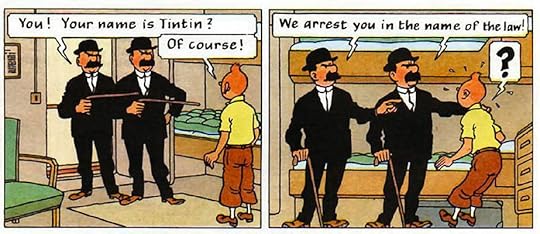
Before going into what I liked and what bothered me about the series, I will make a recommendation to start reading with album no.4 Cigars of the Pharaoh as the first three books were quite bad regarding both the drawing skills and the ethnic insensitivity of the author. They are standalones and can be read later as research material into the development of the main characters and the growing awareness of Herge regarding world issues. Plus, No4. introduces two of my favorite characters from the collection : Thomson and Thompson.
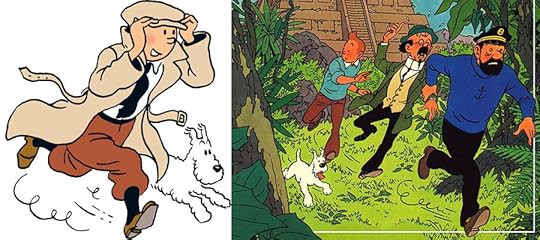
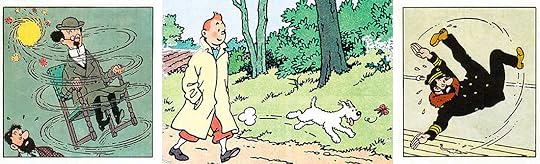
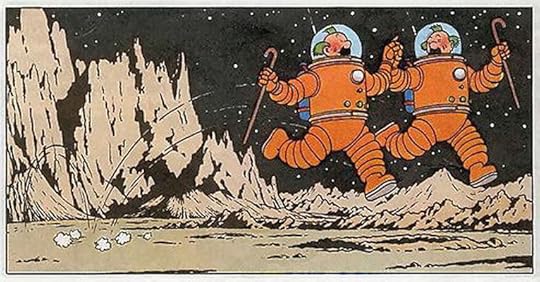
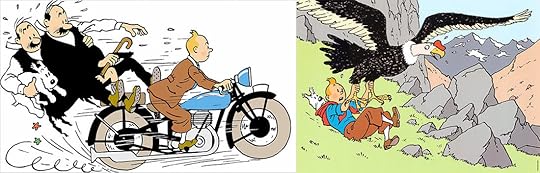
My favorites, five star albums, in this boxset are the middle ones : The Crab with the Golden Claws , The Shooting Star , The Secret of the Unicorn , Red Rackham's Treasure , The Seven Crystal Balls , Prisoners of the Sun , Destination Moon , Explorers on the Moon . Beyond the immediate satisfaction of slapstick comedy, edge of your seat escapades and exotic locations, I loved the clear, expressive drawing of each panel, the extensive research (I understand Herge and his assistants used photographs and postcards to render the backgrounds) , the attention given to the development of each character. The real talent of Herge is made evident in the last album Tintin and Alph-Art , in the difference in quality between his original drawings and the attempts by other artists to finish the story. This being a review of a comic book, I will try to present some samples of Herge "ligne claire" style and at the same time introduce my favorite characters:
To be precise, let's not forget to mention here Captain Haddock colourful language: Billions of Blue Blistering Barnacles! Ten Thousand Thundering Thyphoons! Miserable Molecule of Mildew! Troglodyte! Bashi-bazouk! Ectoplasm! Sea gherkin! Anacoluthon! Miserable slugs! Ectomorph! Freshwater swabs!
I mentioned one of my issues with series is Herge insensitivity to colonial issues. From a nasty propagandistic attack on the Soviet Union, to cringeworthy dialogues and wildlife extermination in Congo, later stereotype Indians and Chinks, even some veiled anti-semitic panels - the early albums give some credence to the Nazi collaborator allegations that have hunted the artist later in his career. I would rather choose to notice that he saw the error of his ways, and later works ( Tintin in Tibet for example) should be considered truly representative of his views.
Another shortcoming for me is the quasi-absence of girl power in the series. Right from the start, Herge has created Tintin et Co. for a Boy Scout target audience - high speed chases in boats, trains and aeroplanes, submarines, rocket ships and the occasional condor in the Andes.
Apparently girls have major Cooties in Tintin universe, and the only recurring female character is Opera diva Bianca Castafiore, whose portrait is anything but complimentary. I'm not saying a girl would not enjoy the series, especially if her name is Scout Finch , just be warned about entering into a world full of testosterone and adrenaline, with frequent whisky drinking, cigars, and guns of all types, even some psychedelic trips. Belgium appears to me more liberal in what it considered suitable subjects for children, and the world Tintin and friends evolve in is more mature in terms of danger and exposure to alcohol and violence.
I might be tempted, on future rereads, to do individual reviews for each album. For now, let me just make a glowing recommendation to read this incredible series.
Perfect size for reading in bed or traveling, glossy paper is perfect idea keeping it new all the time. Only one disadvantage which is the missing issue "Tintin In Congo" as the publisher refused to publish it in the UK as they see it as "discrimination" against Africans, I understand that human rights and racism at this time is not like now, publishing or not publishing this issue won't make Africans forget but publishing it is better to let everyone know about the past and learn from it. I hope the publisher will reconsider this.
I read most of these when I was about 7 or 8 years old. My family took a lot of trips to the library when I was growing up and somebody must have steered me towards these (I also fondly remember The Adventures of Asterix). Anyway, I absolutely loved the series as a wee lad.
I was overjoyed when this collection came out. I own three of the full-size individual titles, but buying those is expensive and the whole collection would take up a fair amount of space. So I had not read most of them since childhood.
I was so happy to find that for the most part, they absolutely lived up to my memories - nostalgia and all. The lovable cast of characters, the globe-spanning stage, the wealth of speculative science, and the clean, detailed line-art were all as I had remembered. In addition, I found myself better understanding and appreciating elements of these stories which I had not fully understood or been able to follow as a kid.
The first couple stories aren't terribly strong and don't make a great introduction to the series (though they're certainly not as bad as the Soviet and Congo stories which were the first actual Tintin episodes and are - for better or worse - not included in this set.)
I really appreciate the compactness of the box set, but the small size does render the writing quite miniscule. If your eyesight isn't that great, be prepared to hold the books close to your face or perhaps invest in a magnifying glass - ha, no, it's not that bad.
The biggest surprise for me, personally, was to find that I had actually imagined an entire episode of Tintin! I see parts of the episode in Land of Black Gold where the T(h)ompsons are afflicted with fast-growing green beards and bubbles. I think that was mixed into in my imagined visuals. But the main feature was some sort of ever-expanding pink fluffy stuff (chewing gum, perhaps?) that was filling an underground temple of some sort and slowly pushing Tintin, the Captain, and their nemesis Rastapopoulos out of the front entrance. I must have dreamed the whole thing after reading one of the books at night and had since incorporated it into my memories of the real series. I kept waiting to see that expanding pink stuff until the very end! Upon further reflection, the imagery was probably a little too fantastical to have been real. What a strange thing memory is.
I loved reading the whole series. I will undoubtedly read it again, and I look forward to passing it on.
The final volume is an interesting collection of trivia about the characters in the series. It manages to somehow include a fair bit of information about Herge and Tintin's publishing history, but it seems like a really strange way to present that information. I would have much rather had a proper retrospective, biography, and more excerpts from Tintin in the Land of the Soviets, Tintin in the Congo, and the unfinished final book: Tintin and Alph-Art.
Oh, and my favorite character? The Captain. Was ever there a more lovable drunk in a children's series? Though I did have to consider the Professor as a very strong contender as well. I love his "acting the goat" tirade in Destination Moon and consider it one of the most entertaining sequences in the entire series (as a kid and as an adult).
My all time favorite action hero! Tintin brings gangsters to justice time and time again and he still remains humble about it. It's so hard to find someone like that these days. His companion, Captain Haddock, really brings out the best in him. Plus, he's absolutely hilarious. All and all a truly remarkable series. Complete with colorful characters, colorful settings, and colorful language. "Blistering Barnacles!"
I grew up reading The Adventures of Tintin and continue to reread them to this day. One of the only comic style book series that kept me interested the whole way through. I’ve read all of them and didn’t want to make tens of entries so I’m rating this collection
A true long-weekend pleasure to dive into an old childhood favourite, which combined jet-setting worldliness with mystery and exploration. Definitely helped spark my lifelong interest in geography.
I am afraid that today’s cancel culture will read these stories, see only the stereotypes—and there are racial stereotypes! From Americans, to Italians, to Chinese, to Arabs, to “natives,” no one escapes Herge’s satirization—and add the series to their ever-growing bonfire. This would be a real shame, as Tintin is an example of positive diversity.
The most indelible and relished part of childhood. I was probably reading this series before I could decipher half the words on page!
Our fearless trio Tintin (+Snowy), Captain Haddock and Prof Calculus take on the world. They literally travel to all conceivable corners of the world facing a milieu of villains (and the occasional bigfoot and/or Aztecs). My tiny mind could barely wrap around the scope of the adventures penned by Herge -- from my favorite Scottish mystery (Black Island), and the sub-ocean search for Red Rackham's treasure, all the way to the MOON, and the eerie reveal in Flight 714. LOVE each and every story with passion (despite the obvious racial depictions). Firmly categorized as an all time collectible.
This is a wonderful looking box set, but it is a bit criminal to leave out three adventures in the series. Tintin completists will have to buy those seperately to have the entire collection - it would have been much better to have them in the 'Volume 8' included with the set rather than the retrospective, which though interesting doesn't really add anything.
A series of comic book stories about Tintin, an intrepid reporter who travels everywhere from the Moon to the inside of an ancient, cursed temple. Tintin's interesting cast of friends and foes show up in each of these adventures.
This edition's text was too small. I would have liked larger text on each of the pages.
I read this series because my 10 year old daughter has really gotten into graphic novels, and I know that this is one of the most beloved series by many, so I thought I would read them to make sure that they are appropriate. Honestly, the plot structure for each story was very repetitive, with deus ex machina playing a huge part in many of the resolutions, and limited to no character growth in the protagonist. And, for a series seemingly targeted towards a younger audience, there are quite a few plots that focus on drugs - for instance, a whole plot of one series focuses on opium dens and depicts characters trying to get high. The biggest issue, and the reason that I am not giving this series to my daughter (yet) is the stereotypical and overly racist depiction of numerous cultures and peoples: I felt uncomfortable. If these stories were published today, Herge would have been eaten alive by our (admittedly, sometimes insane) cancel culture. All of that being said, I can appreciate these comics for what they are and why they are beloved: the protagonist embodies heroism and bravery (even if he is pretty terrible at his job as a journalist, as he almost never seems to finish his stories), the drawings are vibrant, the minor characters are varied and often humorous, there are a variety of cultures, locations and even genres, I am a sucker for serialized story-telling (Dick Tracy and The Shadow for the win), and I appreciate the dialogue (which is fairly heavy). It isn’t right or fair to project my more modern values, norms and beliefs onto work from the past. I can appreciate these works for the milestones that they were in the art form of graphic novels.
Normally when I go to write a book review, I try to think of everything I enjoyed and did not enjoy about the story I read. I try to write a fair review that expresses my opinion without spoiling the plot of the story too much.
Yet when I started to write this review, all I could think about was how sad I feel. With other stories, I finish them, reflect on them, and usually move on to the next story. I adore reading and actually get cranky when I have nothing to read. For the first time, I find myself very reluctant to move on. It must sound silly, but by putting down my Tintin collection, it feels like I am saying goodbye to a good friend.
I first heard of Tintin when I saw the cartoons on television as a youngster. When I heard about the Spielberg movie, I knew immediately I had to go see it. I think it was Mr. Spielberg's movie that convinced Egmont to publish the original comics in English. Shortly after, I bought the whole box set. It took me awhile to sit down and read through all of Tintin's adventures. Once I started I was hooked.
Since this is a comic book from the 40s, I tried to overlook things such as the racism, the lack of any noticeable female characters (other than Castafiore, who is very noticeable!) and the fact that everyone bows to a white man. Since it's a comic book, I could forgive the fact that out of all the people in the world, it's a young reporter from Brussels who can put a stop to many dangerous criminals and dastardly schemes.
What I could really not forgive was the very drawn out tangents that would happen in some of the stories. I think the time I found this particularly irritating was in The Broken Ear. I can understand the need to insert humour to even out the tension of a serious plot. I get boggled when Tintin is somehow forced into joining an army, simply because he managed to get drunk before one of his many scheduled executions. Then after he was done with the army, the plot managed to get back on course. By that point, the original plot felt like an afterthought. That was the worst instance of it, but there are other times it happens. I always find these instances a bit jarring.
The stories did get good as I kept reading. Where it seemed that Herge had used a tangent at first, everything would eventually come full circle to be connected again. I really enjoyed the stories that were fully connected like that, such as Cigars of the Pharaoh, The Blue Lotus, The Seven Crystal Balls, Prisoners of the Sun, Tintin in Tibet and Tintin and the Picaros. Once I started them I had to finish them since they were so tense and action-packed!
There are several characters in the Tintin series. For this review I decided to write about my favourite character, which is Tintin himself. I have heard complaints that Tintin has little to no personality. I think the reason it seems that way is because Tintin seems like an introvert. He does have plenty of personality, it's just when he's standing next to Captain Haddock or Professor Calculus, it's harder to see it.
In The Blue Lotus, he talks to Chang about racism, and how people have an idea that Chinese people have long fingernails and are quite mean. He also points out that people have these misconceptions because they simply don't know enough about each other. I doubt someone without a personality would say this. Even in Tintin in the Congo, even if the drawings themselves are racist, Tintin himself is not. He never says anything such as "filthy nigger" or something equally stupid. He has no problems becoming an important member of a tribe. He also had no problems becoming an officer in an army, or becoming involved with an Asian society. He even stops people from harassing an Indian child or from harassing a Chinese worker. Given the time period this was written in, this says a lot about Tintin's personality. He believes in what's fair, even if it goes against popular thinking.
He's frequently cross with Snowy since Snowy is prone to misbehaving. I would be pretty concerned if my own dog was a Whiskey lover. If Tintin was truly so bland, he would probably reprimand Snowy very briefly and be done with it. However, we see Tintin become quite cross on many occassions. Not just with Snowy, either. Tintin does get annoyed when people are being roundabout or bullheaded, and has even told people where to go on occasion.
He does not actively seek out friendships or people, yet he seems fine spending time with them when they come around. A very classic introvert. It's not that he never wants company or has no opinions, he just prefers to keep to himself unless it's necessary. This results in him appearing to not have much of a personality.
I think Tintin's quiet personality does allow for the other characters to bounce off him, though. I think one of the few times Tintin instigated a story was the one he debuted in, Land of the Soviets. After that story, it's usually the supporting characters that drag him into his adventures. Once Tintin gets into his adventures, he always sees them through with his courage and wits. Tintin does get into several fist fights, but it's usually his wit that saves the day.
Like any story, The Adventures of Tintin has its good points and bad points. The tangents can be random and a little annoying, however the really good stories and characters make up for them. The characters are developed enough to enjoy without taking away from the plot too much. Generally I prefer well developed characters interwoven into the plot. For the Adventures of Tintin, I think it works better that the characters are not always personally involved.
I definitely recommend this for fans of Sherlock Holmes and Indiana Jones, or stories similar to those. There is enough action to keep the action fans satisfied with enough character development to keep readers wanting to see more adventures. I will miss reading Tintin, since I have enjoyed watching him in his adventures, even the more annoying ones. For now I move on to other stories. I will definitely come back to read them all again one day, as will any existing and future lovers of the series.
This entire review has been hidden because of spoilers.
Tintin nel paese dei soviet ⭐️⭐️ Tintin in Congo ⭐️ Tintin in America ⭐️⭐️ ½ I sigari del faraone ⭐️⭐️⭐️ Il loto blu ⭐️⭐️⭐️ L’orecchio spezzato ⭐️⭐️⭐️ L’isola nera ⭐️⭐️⭐️ ½ Lo scettro di Ottokar ⭐️⭐️ ½ Il granchio d’oro ⭐️⭐️⭐️ La stella misteriosa ⭐️⭐️ ½ Il segreto del liocorno ⭐️⭐️⭐️ Il tesoro di Rackham il rosso ⭐️⭐️⭐️ Le 7 sfere di cristallo ⭐️⭐️ ½ Il tempio del sole ⭐️⭐️ Tintin nel paese dell’oro nero ⭐️⭐️ ½ Obiettivo luna ⭐️⭐️⭐️ Uomini sulla luna ⭐️⭐️ ½ L’affare Girasole ⭐️⭐️ ½ Coke in stock ⭐️⭐️ ½ Tintin in Tibet ⭐️⭐️ ½ I gioielli della Castafiore ⭐️⭐️ ½ Volo 714 destinazione Sidney ⭐️⭐️ ½ Tintin e i Picaros ⭐️⭐️⭐️ Tintin e l’alph-art ⭐️⭐️ ½
Al netto di certi passaggi davvero problematici (di stampo razzista-colonialista, soprattutto), le avventure di Tintin riescono comunque a divertire e appassionare. Certo, spesso risultano un po’ ripetitive, ma il guizzo che manca nella scrittura è compensato dall’eleganza compositiva delle tavole e dalla presenza di personaggi decisamente iconici. La seriosità di un protagonista non particolarmente originale, si mischia con le molteplici gag comiche dei personaggi secondari che sono, forse, le parti meglio riuscite dell’opera.
It feels kind of pointless to give a rating to milestone in the history of comics like Tintin. Of course the comics are a product of their time - they ran from the 1920s to the 1970s - and the first three stories in particular are so primitive they're mainly interesting as pieces of comic book history.
The later stories - from Cigar's of the Pharaoh onward - offer some good, old fashioned globetrotting adventures, and the ligne claire-style doesn't really age; most of the issues have some really stand out panels that are great to look at.
When I deduct a point it's because the plotting occassionally requires a lot of suspension of disbelief, and the endless slapstick jokes with Captain Haddock and the police officers aren't my cup of tea. This was made back when grown men slipping on banana peels was the height of comedy.
বাচ্চামি কাজকর্ম। টানা ১ সপ্তাহ ইন্টারনেট ব্ল্যাকআউটের সময় অসহ্য অবস্থা কাটাতে পড়া শুরু করি টিনটিন কমিক। বাংলা এবং ইংরেজি, দুইটাই অনেককক আগে ডাউনলোড করে রাখছিলাম এমন কোনো একদিনের জন্যই। মোট ২৪টা চ্যাপ্টার, প্রত্যেকটা চ্যাপ্টার পুরো একটা কাহিনী কভার করেছে। নস্টালজিক ফিলিং থাকায় পড়েও মজা পেয়েছি। সোভিয়েতে টিনটিন, আমেরিকাতে টিনটিন, কঙ্গোতে টিনটিন পড়ে শকড যদিও, লেখক হার্জের হালকা রেসিজম কাউকে কাউকে অফেন্ড করবে হয়তো। কিন্তু তবুও টিনটিন, ক্যাপ্টেন হ্যাডক এবং প্রফেসর ক্যালকুলাস জুটির বিশ্ব চষে বেড়ানোর এডভেঞ্চার সেরা। সুযোগ পেলে একটা ডিলাক্স এডিশনও কিনে ফেলবো। বাচ্চামীর অভ্যাস থাকলে রেকমেন্ডেড। :3
Une Encyclopédie indispensable pour tout amateur de BD. Hergé a créé la bande dessinée avec cette œuvre. On peut ne pas aller toutes les histoires ni l'histoire de Hergé lui-même, il reste que sa BD est d'une qualité impressionnante. Les cliffhangers de succèdent méthodiquement a chaque page. Les coherences entre les albums sont étudiées. Si vous voulez mieux comprendre Tintin et Hergé, je vous recommande la biographie rédigée par Pierre Assouline, qui en taille majestueusement ainsi que de chacun de ses albums dans leur contexte.
I don't actually own the collectors gift set of all the Tintin books. In my dreams I do. Instead, I have read every Tintin book through some very legal PDFs. In doing so,I have rediscovered the stories that enchanted me so much as a child. Many of the plots don't hold up to adult level scrutiny; they are too contrived or depend on unrealistic coincidences. Still, Hergé's wonderful art, iconic characters, and brilliant sequences continue to hold up and are just as much fun today as they were to me at twelve or thirteen.
The Adventures of Tintin will always have a special place in my heart, as they were a huge part of my childhood. That being said, it is a completely different experience to read them as an adult, and it is not all the albums I will return to again in the future. They are still great adventures, but there is just some there are better and more interesting than others, and time is precious. So many books - so little time!
Holy crap is this racist. Zero stars. Made it through volume 1, includes Tintin in the land of the Soviets and Tintin in America. Really foul depictions of Native Americans. Don't get me started on the depictions of Chinese and Italians. Who is reading this offensive dreck in the 21st century? I know, some will defend it as a product representative of its time. Doesn't mean we have to embrace it today. It has not aged well. I read it out of curiosity. Curiosity appeased.
Excellent collection with two major flaws. First, the small book size does not fit to Herge's art, which has to be read in full pages like the BDs. Second and most important, this is NOT a complete collection, as it does not contain the story 'Tintin in Congo' due to representation issues. (This is strange, as 'In the land of the Soviets' is in there, and nowadays we can appreciate those stories bearing in mind the era they were written).
A great collection of all the Tintin books. It is too bad that they were not printed in the same size as the oversize softcover editions. The art looks that much better on the bigger pages.
Overall, for the price, you can't go wrong. It was an easy way to acquaint my children with some of the stories I enjoyed growing up in the 80's.
This is a smart collection, sturdy box and nice thick hard covers on the volumes. 2-3 stories to a volume depending on their length. The whole series — including "Land of the Soviets" and "Alph Art" — but excluding "Tintin in the Congo", which these days is probably for the best. By necessity the books are quite compact and the text may be a bit small for people hard of sight.
I haven't read this particular publication, but I've read all the Hergé Tintin volumes. I have fond memories of this comic :) It introduced me to illustrated stories, goofy but lovable characters and and adventurous sleuth that got to travel the world with his dog; getting into mischief and solving mysteries. Lovely for young readers, especially boys!
I loved reading these!! It deserves five stars, but there are some comments in these books that are very offensive. I only wish there was a biography of the author at the end, especially since the last book was never finished!