Larry Patrick Levis was born in Fresno, California, on September 30, 1946. His father was a grape grower, and in his youth Levis drove a tractor, pruned vines, and picked grapes in Selma, California. He earned a bachelor's degree from Fresno State College (now California State University, Fresno) in 1968, a master's degree from Syracuse University in 1970, and a Ph.D. from the University of Iowa in 1974.
Among his honors were a YM-YWHA Discovery Award, three fellowships in poetry from the National Endowment for the Arts, a Fulbright Fellowship, and a Guggenheim Fellowship.
Levis died of a heart attack in 1996, at the age of 49.
This is the poetry book that kept me writing poems, just to reach towards being this kind of writer. There is one poem with the line, "who are ashamed/by now, to have shoulders..." It's a terrible reference out of context, but you know, it has stayed with me for 18 years.
The Future of Hands To a Wall of Flame in a Steel Mill, Syracuse, NY, 1969 Overhearing the Dollmaker's Ghost on the Riverbank To a Woman Glancing Up from the River Picking Grapes in an Abandoned Vineyard The Wish to Be Picked Clean
Conjures eloquent, surrealistic images of death and decay. Hallucinatory in nature these poems are soul transforming in that they practically hum with the forlorn quality of life when hope has flown away...Especially meaningful for me (among all the others) was the last poem in the book, "The Spirit Says, You Are Nothing:
Were I guessing, late summer 1980 would be my dating the first poem in The Dollmaker's Ghost, in which Larry Levis tells us something deceptively simple. "Picking Grapes in an Abandoned Vinyard," he is using a kind of knife he used from fifteen years before when he worked on a grape-picking crew in the Central Valley, and so he remembers the crew women and two men, specifically, Tea, "an alcoholic giant whom the women loved," and Angel Dominguez, who'd been a crewman for the speaker's grandfather and who parlayed his earnings into a small vinyard of diseased vines that fail to fruit, for which Angel blames himself and his own illness, compensation found only in "Johnny Palores East Front Pool Hall," where the young speaker would "watch the room fill with tobacco smoke, as the sun set, | through one window." The vines rustling as the speaker cuts the grapes signals for the town what must be inevitable about that silence that seems, in the vineyards' abandonment, what the town (Salem) enacts each fall. This is the poem's close:
What the men who worked here wanted was A drink strong enough To let out what laughter they had. I can still see the two of them: Tea smiles and lets his yellow teeth shine -- While Angel, the serious one, for whom Death was a rare disease, Purses his lips, and looks down, as if He is already mourning himself -- A soft, gray hat between his hands. Today, in honor of them, I press my thumb against the flat part of this blade, And steady a bunch of red, Màlagra grapes With one hand, The way they showed me, and cut -- And close my eyes to hear them laugh at me again, And then, hearing nothing, no one, Carry the grapes up into the solemn house, Where I was born.
I would say the poem conveys both the narrative singularity and dignified variance of these failed lives, but most sensitively, the sublime majesty of indifference in the subculture of Central Valley that wants the escape-valve laughter offers and will use laughing at the speaker's younger version of himself to get it, a gallows punchline the reader's stuck with as they finish the poem realizing -- because Levis's copping to it -- the speaker's family owns the farm, and turning back, then, to the poem's title, gathers that the inheritance is repudiated without those failed lives being at all salvaged. This is Central Valley pastoral -- what it has become in the aftermath of Robinson Jeffers' The Loving Shepherdess or Robert Duncan's "Toward the Shaman." Larry Levis gives this literary (if not agricultural) tradition an elegiac conclusion, and redeems the whole trajectory.
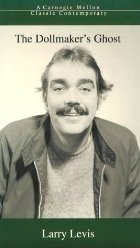
HIS THIRD BOOK, first published by Dutton in 1981. The edition I read is a "Carnegie Mellon Classic Contemporary" reprint, which appeared in 1992. My copy must be later than that, though, as the back cover copy refers to Levis's death in 1996. The book is still in print, which means it must still be finding readers twenty-eight years after Levis's passing--good to know.
The collection previous to this one, The Afterlife (1977), was the first of Levis's books I read, and the difference between that book and this one felt large. The Afterlife was by no means a light-hearted or sunny book, but it had streaks of whimsy and spots of hope in it. The Dollmaker's Ghost feels bleaker. A lot of it seems to inhabit rural spaces or those small, nearly deserted towns scattered on the highways between Iowa City and Fresno. It feels lonely.
From the reading around I have done since I read The Afterlife, I know that Levis wrote much of it in the happier years of his marriage to poet Marcia Southwick. But something seems to have already gone awry in Part One, which finds Levis back on his parents' grape-growing operation, haunted by memories of his growing up and wondering where he lost the plot.
The book has a lot of retrospection in it. Levis's last, posthumously published work is mainly retrospection, I would say--all those elegies--but it's a little different here, more about being haunted by old photographs and drifting smoke as well as by actual ghosts, who show up often in Part Four (e.g., the dollmaker of the title).
Here are some lines from one of the poems in Part Four, "Some Ashes Drifting Above Piedra, California":
And now, if we listen for their laughter, Which vanished fifteen years ago Into the cleft wood of these boards, Into the night and the rain, It will sound like cold jewels spilling together, It will sound like snow... We will never have any money, either, And we will go on staring past the sink, Past the curtain, And into a field which is not even white anymore, Not even an orchard, But simply this mud, And always, Over that, a hard sky.
The "they" are the farm workers who used to live in the shack the speaker is describing. I'm not sure who the "we" could be, but I suspect the other person acknowledged in that "we" is not actually physically present in the shack with the speaker, because he seems really, really alone.
I came back to him the day before my first day of the second semester of the MFA, feeling so anxious and unsure about poetry and needing a familiar and beloved presence, and obviously he saved me. I love you larry
Levis, of course, is always great; this is his first book, however, and his coming-of-age and the presence of Phil Levine as a mentor is pretty obvious. Fascinating to see the germs of Levis's later (and lasting) voice in some of these early pieces.