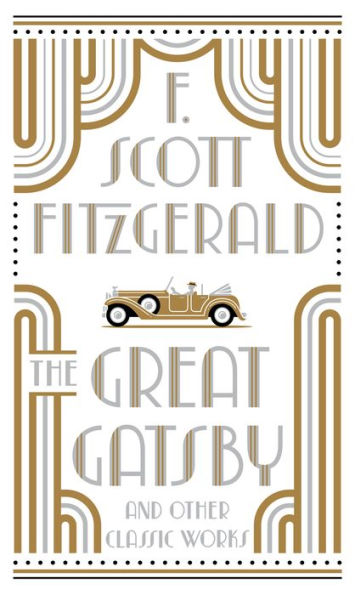
No writer portrayed America's Jazz Age as vividly as F. Scott Fitzgerald. In his effervescent tales of ingenues on the prowl for husbands, Ivy League heirs en route to futures of idle entitlement, and endless alcohol-fueled dance parties at ritzy country clubs, he limned a culture giddy with excess and as reckless as it was refined. Gifted with remarkable powers of observation and a witty way with words, Fitzgerald wrote stories that seem as fresh and modern today as they did when published a century ago.
This Great Gatsby and Other Classic Works features Fitzgerald’s first two published novels—This Side of Paradise and The Beautiful and Damned—and 19 short stories, including the classics "Bernice Bobs Her Hair," "The Diamond as Big as the Ritz," and "The Curious Case of Benjamin Button."
The volume also includes Fitzgerald’s landmark short novel The Great Gatsby.
Francis Scott Key Fitzgerald, widely known simply as Scott Fitzgerald, was an American novelist, essayist, and short story writer. He is best known for his novels depicting the flamboyance and excess of the Jazz Age, a term he popularized in his short story collection Tales of the Jazz Age. During his lifetime, he published four novels, four story collections, and 164 short stories. Although he achieved temporary popular success and fortune in the 1920s, Fitzgerald received critical acclaim only after his death and is now widely regarded as one of the greatest American writers of the 20th century. Born into a middle-class family in Saint Paul, Minnesota, Fitzgerald was raised primarily in New York state. He attended Princeton University where he befriended future literary critic Edmund Wilson. Owing to a failed romantic relationship with Chicago socialite Ginevra King, he dropped out in 1917 to join the United States Army during World War I. While stationed in Alabama, he met Zelda Sayre, a Southern debutante who belonged to Montgomery's exclusive country-club set. Although she initially rejected Fitzgerald's marriage proposal due to his lack of financial prospects, Zelda agreed to marry him after he published the commercially successful This Side of Paradise (1920). The novel became a cultural sensation and cemented his reputation as one of the eminent writers of the decade. His second novel, The Beautiful and Damned (1922), propelled him further into the cultural elite. To maintain his affluent lifestyle, he wrote numerous stories for popular magazines such as The Saturday Evening Post, Collier's Weekly, and Esquire. During this period, Fitzgerald frequented Europe, where he befriended modernist writers and artists of the "Lost Generation" expatriate community, including Ernest Hemingway. His third novel, The Great Gatsby (1925), received generally favorable reviews but was a commercial failure, selling fewer than 23,000 copies in its first year. Despite its lackluster debut, The Great Gatsby is now hailed by some literary critics as the "Great American Novel". Following the deterioration of his wife's mental health and her placement in a mental institute for schizophrenia, Fitzgerald completed his final novel, Tender Is the Night (1934). Struggling financially because of the declining popularity of his works during the Great Depression, Fitzgerald moved to Hollywood, where he embarked upon an unsuccessful career as a screenwriter. While living in Hollywood, he cohabited with columnist Sheilah Graham, his final companion before his death. After a long struggle with alcoholism, he attained sobriety only to die of a heart attack in 1940, at 44. His friend Edmund Wilson edited and published an unfinished fifth novel, The Last Tycoon (1941), after Fitzgerald's death. In 1993, a new edition was published as The Love of the Last Tycoon, edited by Matthew J. Bruccoli.
This volume collects all of F. Scott Fitzgerald's best work: The Great Gatsby (one of the best novels ever written), This Side of Paradise and The Beautiful and Damned (first rate novels in their own right), and 2 collections of short fiction (Flappers and Philosophers and Tales of the Jazz Age). I'd read his novels before, but this was my first time delving into any of his short stories; which, I am pleased to say, were brilliant. No one weaves the depth, beautiful prose, and brilliant quotes* together like Fitzgerald. Some common themes explored are: love, coming-of-age, and the emptiness of decadence - and of course everything is seen through the eyes of the jazz age. One of my favorites!
*Two quick samples below:
"All life is just a progression toward, and then a recession from, one phrase - 'I love you.'"
"At eighteen our convictions are hills from which we look; at forty-five they are caves in which we hide."
Here is a selection of quotes that stood out to me for one reason or another while reading:
"...for they laughed one bar in three-four time."
"A classic," suggested Anthony, "is a successful book that has survived the reaction of the next period or generation. Then it's safe, like a style in architecture or furniture. It's acquired a picturesque dignity to take the place of its fashion...."
"...But when you opened your door at the rap of life you let in many things."
"The Montana sunset lay between two mountains like a gigantic bruise from which dark arteries spread themselves over a poisoned sky."
"...he stretched out his arms toward the dark water in a curious way, and far as I was from him, I could have sworn he was trembling. Involuntarily I glanced seaward—and distinguished nothing except a single green light, minute and far away, that might have been the end of a dock. When I looked once more for Gatsby he had vanished, and I was alone again in the unquiet darkness."
"So we drove on toward death through the cooling twilight."
"Gatsby believed in the green light, the orgastic future that year by year recedes before us. It eluded us then, but that's no matter--tomorrow we will run faster, stretch out our arms farther.... And one fine morning—
So we beat on, boats against the current, borne back ceaselessly into the past." ___________________________________________
A little over a month later, I have finished all of Fitzgerald's works. In the store, I went back and forth between getting this edition or just buying "The Great Gatsby" by itself. Unless it was housed in one volume, it wasn't--at the time--imperative for me to read his other two novels and short story collections. Long story short, I am glad I opted for the collection, because I enjoyed almost everything he has published.
Almost all of his writings are set in the chaotic period of the Jazz Age, full of lavish parties and lives of excess. At least one character in every story is poor despite working, spending the majority of their money on cigarettes and/or alcohol; or poor and doesn't work, also spending what little money they have on cigarettes and/or alcohol. Most people married for stability of some type, which didn't always work out.
There is typically at least one relationship that leads to a hasty marriage. The honeymoon phase doesn't last long, so arguments break out while finances are being carelessly depleted, each spouse blaming the other, which leads to escapism in the forms of drinking or marital affairs, which lead to private turmoil but public lightheartedness in an effort to maintain appearances, and thus the vicious cycle is repeated.
Side note: Fitzgerald loves the word "interminably."
1) "This Side of Paradise" read 5/3-5/13 (2 stars)
2) "The Beautiful and Damned" read 5/13-5/23 (3 stars)
3) "Flappers and Philosophers" read 5/23-5/27 (4 stars) - "The Offshore Pirate" read 5/23 (5 stars) - "The Ice Palace" read 5/24 (4 stars) - "Head and Shoulders" read 5/24 (5 stars) - "The Cut-Glass Bowl" read 5/25 (4 stars) - "Bernice Bobs Her Hair" read 5/26 (5 stars) - "Benediction" read 5/26 (3 stars) - "Dalyrimple Goes Wrong" read 5/27 (4 stars) - "The Four Fists" read 5/27 (4 stars)
4) "Tales of the Jazz Age" read 5/28-6/3 (4 stars) - "The Jelly-Bean" read 5/28 (3 stars) - "The Camel's Back" read 5/28 (4 stars) - "May Day" read 5/29 (4 stars) - "Porcelain and Pink" read 5/29 (4 stars) - "The Diamond as Big as the Ritz" read 5/29 (5 stars) - "The Curious Case of Benjamin Button" read 5/31 (5 stars) - "Tarquin of Cheapside" read 6/1 (3 stars) - "O Russet Witch!" read 6/3 (3 stars) - "The Lees of Happiness" read 6/3 (5 stars) - "Mr. Icky" read 6/3 (3 stars) - "Jemina, the Mountain Girl" read 6/3 (4 stars)
5) "The Great Gatsby" read 6/3-6/6 (5 stars)
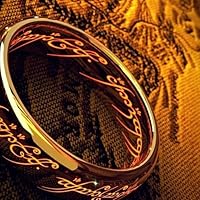
While I did read 5 books (technically 22, accounting for the individual short stories), Goodreads is like Gimli towards Legolas in "The Return of the King" when he tells him: "That still only counts as one!"
F. Scott Fitzgerald has a tendency to write these fun flourishes in his text that gives them a little more life, however, they don't feel like additions so much as replacements. It's a shame, cause they're replacing important plot points that make you understand what's happening in the story.
Worse than being frustrating is how racist so much of his work is. For instance, it doesn't take long for the Great Gatsby to suddenly veer off and start talking about the discredited "white replacement theory." It's so disgusting and the thought of this being taught to children makes it even less surprising how racist that country is.
I spent a lot of time reading through his work and most of that time was spent building up the energy to actually pick up the book and read the words. It's a classic, but it's not fun.
I enjoyed the content as a whole of his stories, but the execution in which he wrote them I felt was very bland and dated. All of his writing just feels so monotone as over people have put it. Even though I feel like he does capture things in a great way, so it’s a weird feeling that it can be boring yet very insightful into the human experience. Now for why it’s dated is in the way he talks about women and race, which is so hard to read. Overall I don’t think I’ll be reading any more of his stuff anytime soon or even rereading for that matter.
Another classic, but for different reasons. I felt obligated to give this book 5 stars because I love the story so much, but it’s not an easy read. I like to think of this book as a hopeful love story, but in the end it’s a tragedy. Gatsby deserved better.
Great stories, love the overall vibes from them, too. One of my new favorite authors. Great to have a cup of coffee, snuggle, and read for an hour or two.
Also, this is going to majorly throw off how many pages I read this year. I only read The Great Gatsby, but this collection is ginormous, and Goodreads will be confused.
analyzed in schools for a reason!!! (i bought this version just because i love Fitzgerald and i can't get enough) But super easy and fun, always my recommendation for people who want to get into classics but are intimidated and don't know where to start.