

What do you think?

The Pronoun Book
"Welcome to The Pronoun Book! Join Ellie and Casey as they introduce you to the wonderful world of pronouns. Learn about what pronouns are, how they relate to us, and why it's so important to get them right!"
This fun, engaging, and empowering children's book is the perfect introduction to pronouns in relation to gender diversity and identity for children aged 5+. Through illustrated scenarios and explanations, it gently encourages children to learn pronoun etiquette and educates them on they/them pronouns, trans and non-binary identities, misgendering, and neo-pronouns such as xe, zir, and hir.
This illustrated book also includes a dedicated section at the back for adults, which includes a pronoun table, photocopiable pronoun labels, and sample letters addressed to schools.
This fun, engaging, and empowering children's book is the perfect introduction to pronouns in relation to gender diversity and identity for children aged 5+. Through illustrated scenarios and explanations, it gently encourages children to learn pronoun etiquette and educates them on they/them pronouns, trans and non-binary identities, misgendering, and neo-pronouns such as xe, zir, and hir.
This illustrated book also includes a dedicated section at the back for adults, which includes a pronoun table, photocopiable pronoun labels, and sample letters addressed to schools.
32 pages, Hardcover
Published October 21, 2021
About the author
Cassandra Jules Corrigan
8 books23 followersCassandra Jules Corrigan (she/he/they) is a genderqueer and disabled writer and human rights defender from Murfreesboro, Tennessee. Her writing, be it poetry or prose, is influenced by her time as a student at Arcadia University and her own struggles with mental health, trauma, and growing up queer in the south.
2024 AASECT Book Award Winner for Audience Focus Children Under 18
2024 Purple Dragonfly Award Honorable Mention for Cultural Diversity
2025 Moonbeam Children's Book Awards Gold Medalist in Education Spirit
2024 AASECT Book Award Winner for Audience Focus Children Under 18
2024 Purple Dragonfly Award Honorable Mention for Cultural Diversity
2025 Moonbeam Children's Book Awards Gold Medalist in Education Spirit
Ratings & Reviews
Friends & Following
Create a free account to discover what your friends think of this book!
Community Reviews
Displaying 1 - 30 of 149 reviews

December 15, 2021
3★
“Avoid terms like ‘preferred pronouns.’ A person’s correct pronouns are not ‘preferred’; they are mandatory!”
Just so you know! I admit to finding this manner of speech awkward and difficult after living for so many years with decades of MCs announcing: Step right up, boys and girls, ladies and gentlemen! I’m not saying it’s right – I’m saying it’s hard.
This book is illustrated with cartoons, as if it’s for kids, but it’s actually a serious subject the author is trying to discuss in what appears to be an accessible style. Terms are defined: the difference between sex and gender; what is meant by cisgender, transgender, non-binary (in several variations) and intersex.
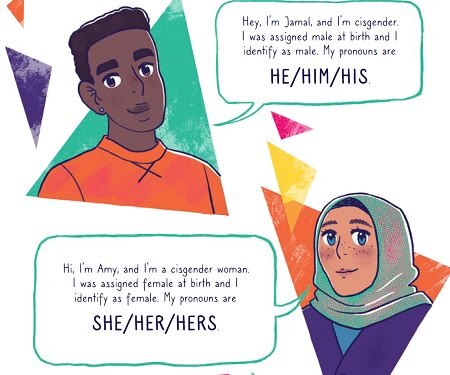
Two cisgender people, clarifying their chosen pronouns
You will note there is also a diversity of ethnic backgrounds.
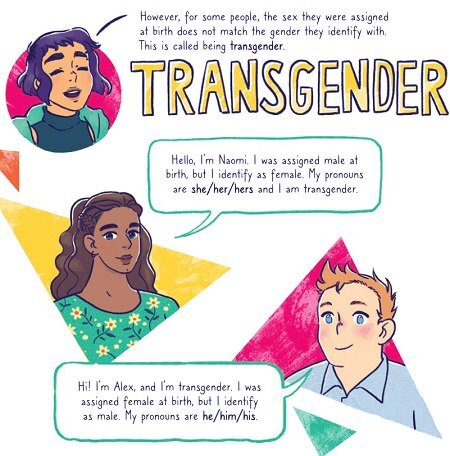
Here we have two transgender people and their chosen pronouns
There is a discussion of various ways of identifying as non-binary: agender, bigender, genderqueer, genderfluid “. . . you should never assume anyone’s gender simply based on how they look.”
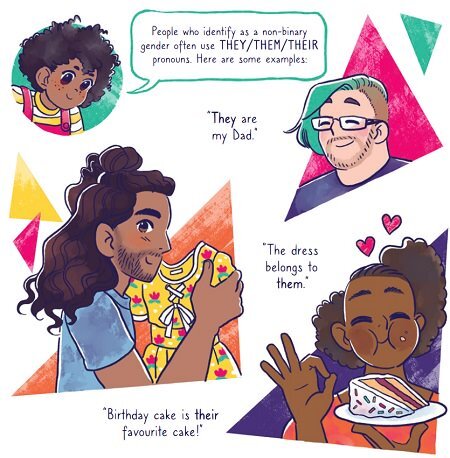
Three examples of sentences using they/them/their pronouns for individual, non-binary people
Mind you, it’s up to the people themselves to let others know which pronouns they use. On some social media platforms, Twitter, for example, people will add their pronouns to their Twitter profiles.
Former US soldier Bradley Manning, who blew the whistle on war activities in Iraq, transitioned to Chelsea Manning. On Twitter, she is @xychelsea and her profile says “trans femme (she/they)”, meaning we refer to her as either “she” or “they”.
Of course it’s easy to make mistakes!
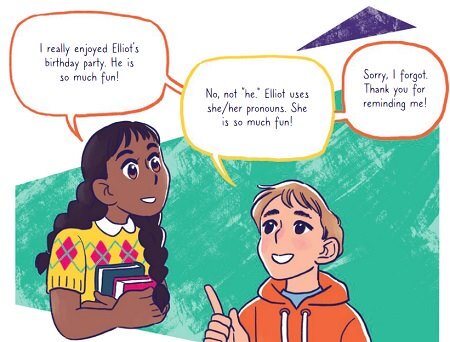
If you hear someone make a mistake, remind them (gently)
If you meet someone new, you can ask when you’re introducing yourself. Here, the suggestion is that you ask for someone’s pronouns from the start, which gives them an opening to do likewise.

Introductions can include pronoun choices
If you can’t read this conversation in the pictures, here it is:
(Dark hair, yellow shirt)“’Hello! My name is Jacob.”
(Blond hair, green shirt) ‘Hi Jacob. Nice to meet you. I’m L. J. What pronouns do you use?”
(Dark hair, yellow shirt) ‘I use he/him pronouns. How about you?’
(Blond hair, green shirt) ‘I use they/them pronouns. Thanks for asking.’”
I found this exchange particularly awkward, since the person who first asked for the pronouns then thanks the other person for asking.
But, I acknowledge it’s a tricky subject and the author has tried to be as inclusive as possible (couldn’t find any sign of oriental people, though) while keeping explanations as simple as possible. It isn’t simple, but I expect younger generations will pick it up easily enough.
There are tips, resources, glossary, pronoun chart, even recommended notes to write for teachers and parents of children’s friends.
I can’t say I’m enthusiastic about it, because I’m not sure who the target audience is. Perhaps it's for YA readers of graphic novels, but if so, it might have been a good idea to have a story winding through it to hold their interest and give some real-life scenarios. As it is, its main usefulness is the added information at the end - the tips, resources, etc.
Thanks to NetGalley and Jessica Kingsley Publishers for the preview copy from which I’ve shared a few illustrations.
“Avoid terms like ‘preferred pronouns.’ A person’s correct pronouns are not ‘preferred’; they are mandatory!”
Just so you know! I admit to finding this manner of speech awkward and difficult after living for so many years with decades of MCs announcing: Step right up, boys and girls, ladies and gentlemen! I’m not saying it’s right – I’m saying it’s hard.
This book is illustrated with cartoons, as if it’s for kids, but it’s actually a serious subject the author is trying to discuss in what appears to be an accessible style. Terms are defined: the difference between sex and gender; what is meant by cisgender, transgender, non-binary (in several variations) and intersex.
Two cisgender people, clarifying their chosen pronouns
You will note there is also a diversity of ethnic backgrounds.
Here we have two transgender people and their chosen pronouns
There is a discussion of various ways of identifying as non-binary: agender, bigender, genderqueer, genderfluid “. . . you should never assume anyone’s gender simply based on how they look.”
Three examples of sentences using they/them/their pronouns for individual, non-binary people
Mind you, it’s up to the people themselves to let others know which pronouns they use. On some social media platforms, Twitter, for example, people will add their pronouns to their Twitter profiles.
Former US soldier Bradley Manning, who blew the whistle on war activities in Iraq, transitioned to Chelsea Manning. On Twitter, she is @xychelsea and her profile says “trans femme (she/they)”, meaning we refer to her as either “she” or “they”.
Of course it’s easy to make mistakes!
If you hear someone make a mistake, remind them (gently)
If you meet someone new, you can ask when you’re introducing yourself. Here, the suggestion is that you ask for someone’s pronouns from the start, which gives them an opening to do likewise.
Introductions can include pronoun choices
If you can’t read this conversation in the pictures, here it is:
(Dark hair, yellow shirt)“’Hello! My name is Jacob.”
(Blond hair, green shirt) ‘Hi Jacob. Nice to meet you. I’m L. J. What pronouns do you use?”
(Dark hair, yellow shirt) ‘I use he/him pronouns. How about you?’
(Blond hair, green shirt) ‘I use they/them pronouns. Thanks for asking.’”
I found this exchange particularly awkward, since the person who first asked for the pronouns then thanks the other person for asking.
But, I acknowledge it’s a tricky subject and the author has tried to be as inclusive as possible (couldn’t find any sign of oriental people, though) while keeping explanations as simple as possible. It isn’t simple, but I expect younger generations will pick it up easily enough.
There are tips, resources, glossary, pronoun chart, even recommended notes to write for teachers and parents of children’s friends.
I can’t say I’m enthusiastic about it, because I’m not sure who the target audience is. Perhaps it's for YA readers of graphic novels, but if so, it might have been a good idea to have a story winding through it to hold their interest and give some real-life scenarios. As it is, its main usefulness is the added information at the end - the tips, resources, etc.
Thanks to NetGalley and Jessica Kingsley Publishers for the preview copy from which I’ve shared a few illustrations.

July 10, 2021
I received an advance reader copy of this book to read in exchange for an honest review via netgalley and the publishers.
The Pronoun Book is a fantastic resource for teaching children of all ages about the correct gender terms and which means which. As an adult I myself have learned many different things from this book!
This book doesn't just teach about gender identity it teaches children what each term means, how it fits a person and how one term may be changed numerous times until the person using it finds the right fit for them.
This is a great resource and one I strongly suggest educational settings have somewhere within their settings for children who differentiate themselves for the standard gender differentiation.
The Pronoun Book is a fantastic resource for teaching children of all ages about the correct gender terms and which means which. As an adult I myself have learned many different things from this book!
This book doesn't just teach about gender identity it teaches children what each term means, how it fits a person and how one term may be changed numerous times until the person using it finds the right fit for them.
This is a great resource and one I strongly suggest educational settings have somewhere within their settings for children who differentiate themselves for the standard gender differentiation.

August 24, 2021
The colourful cover and the title caught my attention, so I decided to read this book. Let me tell you how much I adored it! The information was provided in such an accessible, clear way, without becoming difficult to grasp the meaning of all the terms. It also contained examples which is a great tool to clarify everything. The illustrations are gorgeous and added colour and diversity to the book!
We should aim for children to read this book, either in classes or their homes, so that the next generations can be more inclusive and understanding. Despite that, I believe it's a great book for older people too, in order to get a better understanding of gender identity and pronouns.
Thank you to NetGalley for the preview of the book!
We should aim for children to read this book, either in classes or their homes, so that the next generations can be more inclusive and understanding. Despite that, I believe it's a great book for older people too, in order to get a better understanding of gender identity and pronouns.
Thank you to NetGalley for the preview of the book!

May 16, 2021
This is a sweet, pretty simple book about pronouns. I'm glad it exists and think it does its job pretty well! I liked the diversity of people shown in the book's illustrations.
I didn't love the reliance on the word "identifies" as that feels more like a mircoaggression than a correct word describing one's gender. I wasn't always sure that the language or presentation was that well targeted for very young audiences as the book seems to be meant for. It seemed to be trying to focus on gender identity, intersex experience, and pronouns in a very short picture book and I think it might have missed its mark on meeting all three needs - at one point it kind of seemed like it was implying that intersex people were the main people using neo-pronouns, but it moved away from that idea later on. It also didn't really explain what a pronoun IS in the actual grammar sense, which even as it's meant for young kids would probably be helpful... I did like and appreciate the note in the back for parents/adults as well as the resources available there. All in all, a cute, to-the-point and helpful book, there's just some language I would have chosen differently.
Thank you to NetGalley and Jessica Kingsley Publishers for the ARC!
I didn't love the reliance on the word "identifies" as that feels more like a mircoaggression than a correct word describing one's gender. I wasn't always sure that the language or presentation was that well targeted for very young audiences as the book seems to be meant for. It seemed to be trying to focus on gender identity, intersex experience, and pronouns in a very short picture book and I think it might have missed its mark on meeting all three needs - at one point it kind of seemed like it was implying that intersex people were the main people using neo-pronouns, but it moved away from that idea later on. It also didn't really explain what a pronoun IS in the actual grammar sense, which even as it's meant for young kids would probably be helpful... I did like and appreciate the note in the back for parents/adults as well as the resources available there. All in all, a cute, to-the-point and helpful book, there's just some language I would have chosen differently.
Thank you to NetGalley and Jessica Kingsley Publishers for the ARC!

May 11, 2021
The Pronoun Book by Cassandra Jules Corrigan is such a fantastic bite-sized book about pronouns and identities that is great for EVERYONE. This important book should be in every classroom in school, and I hope to see it in my library. I'll definitely be preordering this essential read to help teach my child about pronouns, compassion, and diversity.
Thanks Jessica Kingsley Publishers for the advanced read in exchange for my honest opinion!
Thanks Jessica Kingsley Publishers for the advanced read in exchange for my honest opinion!

May 22, 2021
4.5*
"changing pronouns can be very scary. but no matter what pronouns you use, those who matter will love and support you all the same."
"changing pronouns can be very scary. but no matter what pronouns you use, those who matter will love and support you all the same."

July 29, 2021
This is a children's non-fiction book that teaches all about pronouns. Narrated by two kids, children are able to learn that pronouns are important, that one's pronouns may not match their appearance or the sex that was assigned to them at birth and that one's pronouns should always be respected.
The illustrations are cute and I appreciated how in the end, there were suggestions about how a parent should approach a teacher or another parent in case their kid uses a different than expected pronoun.
Granted, this book leaves out all the struggle that comes with realizing your gender identity is different than the one society expects you to have or the discrimination and the bullying that unfortunately comes with it (because unfortunately, many people are horrible.)
But whatever, this is a children's book after all, and maybe if we our selves are gentle about such topics and educate the kids, maybe the younger generation won't be as cruel as the ones before.
If you made it so far, congratulations!
'Til next time, take care :) :) :)
I received a free e-book from NetGalley in exchange for an honest review.
The illustrations are cute and I appreciated how in the end, there were suggestions about how a parent should approach a teacher or another parent in case their kid uses a different than expected pronoun.
Granted, this book leaves out all the struggle that comes with realizing your gender identity is different than the one society expects you to have or the discrimination and the bullying that unfortunately comes with it (because unfortunately, many people are horrible.)
But whatever, this is a children's book after all, and maybe if we our selves are gentle about such topics and educate the kids, maybe the younger generation won't be as cruel as the ones before.
If you made it so far, congratulations!
'Til next time, take care :) :) :)
I received a free e-book from NetGalley in exchange for an honest review.

August 29, 2021
ARC provided by Netgalley in exchange for an honest review.
The Pronoun Book by Cassandra Jules Corrigan is an amazingly illustrated guide aimed primarily at children in order to help them understand the use of pronouns. It explains in a very simple yet accurate and beautiful way the pronouns one may have, what neopronouns are and a lot more interesting answers to a child’s questions. The illustrations are literally fantastic, they’re colorful and on point. Overall, an amazing book!
The Pronoun Book by Cassandra Jules Corrigan is an amazingly illustrated guide aimed primarily at children in order to help them understand the use of pronouns. It explains in a very simple yet accurate and beautiful way the pronouns one may have, what neopronouns are and a lot more interesting answers to a child’s questions. The illustrations are literally fantastic, they’re colorful and on point. Overall, an amazing book!
September 16, 2021
such a wonderful graphic novel! the illustrations are cute and engaging, the information is delivered in a simple and reaching way so that little kids can understand what pronouns are and get a first touch with different gender identities!
( received this through netgalley! thank you! )
( received this through netgalley! thank you! )

May 30, 2021
I know this will be an unpopular review, but, here goes ...
This is such an important topic, and such a confusing subject, but this is not the book I’d choose to open a discussion in my classes.
First, it seems to be trying to be too many different things at once and thus falls flat, not accomplishing any of them. I feel like all the high praise is simply to be “politically correct” and so the reviewers feel “woke,” but for me, I’m truly looking for an appropriate starting point to address a difficult and uncomfortable discussion within my classroom. Or with friends. Or with ignorant strangers.
It appears (yes, as the book points out, appearances can be misleading or absolutely false) to be aimed at children. But if so, it’s too wordy, and the pages are too cluttered. There needs to be feeling behind the story, and, in fact, a story. Right now, it’s boring and between too simplistic and not simplified enough.
If it’s aimed at teens, then the words need to be slightly more “sophisticated” and the feelings and thoughts behind the reexamination of the pronouns need to be addressed. The book needs to explain why this is an important topic and why this isn’t a matter of just choosing a new name or choosing what to wear in the morning or choosing a title.
If it’s for adults, then there needs to be a discussion of the politicalization of gender and the sides of the issue, less cutesy language and cartoonish characters, but more of a sophistication in thought.
The book doesn’t address any of the politics, or feelings behind the pronouns, nor why this topic would even need to be addressed, and therefore it’s not much more than illustrated dictionary definitions.
Thank you to NetGalley and the publisher for an ARC in exchange for my honest opinions.
This is such an important topic, and such a confusing subject, but this is not the book I’d choose to open a discussion in my classes.
First, it seems to be trying to be too many different things at once and thus falls flat, not accomplishing any of them. I feel like all the high praise is simply to be “politically correct” and so the reviewers feel “woke,” but for me, I’m truly looking for an appropriate starting point to address a difficult and uncomfortable discussion within my classroom. Or with friends. Or with ignorant strangers.
It appears (yes, as the book points out, appearances can be misleading or absolutely false) to be aimed at children. But if so, it’s too wordy, and the pages are too cluttered. There needs to be feeling behind the story, and, in fact, a story. Right now, it’s boring and between too simplistic and not simplified enough.
If it’s aimed at teens, then the words need to be slightly more “sophisticated” and the feelings and thoughts behind the reexamination of the pronouns need to be addressed. The book needs to explain why this is an important topic and why this isn’t a matter of just choosing a new name or choosing what to wear in the morning or choosing a title.
If it’s for adults, then there needs to be a discussion of the politicalization of gender and the sides of the issue, less cutesy language and cartoonish characters, but more of a sophistication in thought.
The book doesn’t address any of the politics, or feelings behind the pronouns, nor why this topic would even need to be addressed, and therefore it’s not much more than illustrated dictionary definitions.
Thank you to NetGalley and the publisher for an ARC in exchange for my honest opinions.

July 15, 2021
Arc provided by Netgalley for an honest review.
This was a lovely and concise book that does a good job at introducing pronouns and gender identities in a way that will be easy for children to understand. I really liked the illustrations and conversations between the characters as well as the glossary at the back of the book.
It would be nice if schools could start including books like these in their health and sex education courses, this is something that is missing from students’ education.
Date(s) read: 07/15/2021
This was a lovely and concise book that does a good job at introducing pronouns and gender identities in a way that will be easy for children to understand. I really liked the illustrations and conversations between the characters as well as the glossary at the back of the book.
It would be nice if schools could start including books like these in their health and sex education courses, this is something that is missing from students’ education.
Date(s) read: 07/15/2021

November 27, 2021
Great for kids, and some (many!) adults.
Perfect introduction to the theme of pronouns and gender identity, in a clear, easy to understand way, while not dumbing it down.
Also many great resources at the end, would be especially helpful for guardians and educators.
Perfect introduction to the theme of pronouns and gender identity, in a clear, easy to understand way, while not dumbing it down.
Also many great resources at the end, would be especially helpful for guardians and educators.

August 17, 2021
This is a bright and positive book designed for children, and presented in an accessible, simple way with plenty of diversity (as you would expect!). It’s not a bad start in terms of explaining pronouns but seems slightly confused. The book is presented in a colourful cartoonish style that will appeal to very young children but it isn't a picture book/read along book for young children. Older children that might be coming across children at school who are unsure of their identity or choosing to use a different pronoun & who would therefore benefit from the book may not appreciate the very childish style.
I think this book would benefit from using a few more examples/mini stories of “this in action”. An incredibly long pronoun list was supplied but not really discussed in terms of why people might choose to use these or even how to pronounce them, and I think this could lead to further confusion. It also didn’t address the issue of “they” being used as a plural & the difficulties some people have in using this in the singular (one tip I have heard is to imagine the person with a pet hamster in their pocket or a bird on their shoulder whilst you get used to using “they”)
Overall I think this book is a step in the right direction, and could be one for parents to buy & pop on a childs bookshelf for them to discover when the time is right/to open discussions but its not quite hitting the right audience in its current format.
Disclosure: I received an advance reader copy of this book free via NetGalley. Whilst thanks go to the author & publisher for the opportunity to read it, all opinions are my own.
#ThePronounBook #NetGalley
I think this book would benefit from using a few more examples/mini stories of “this in action”. An incredibly long pronoun list was supplied but not really discussed in terms of why people might choose to use these or even how to pronounce them, and I think this could lead to further confusion. It also didn’t address the issue of “they” being used as a plural & the difficulties some people have in using this in the singular (one tip I have heard is to imagine the person with a pet hamster in their pocket or a bird on their shoulder whilst you get used to using “they”)
Overall I think this book is a step in the right direction, and could be one for parents to buy & pop on a childs bookshelf for them to discover when the time is right/to open discussions but its not quite hitting the right audience in its current format.
Disclosure: I received an advance reader copy of this book free via NetGalley. Whilst thanks go to the author & publisher for the opportunity to read it, all opinions are my own.
#ThePronounBook #NetGalley

April 20, 2021
Just a few weeks ago, I had a conversation with my stepdaughter about pronouns. Someone in her family made it public that they prefer they/them pronouns and want to be addressed by a different name. My stepdaughter had never experienced that and was sort of confused. I explained how we should always respect someone else’s chosen name and pronouns, and after a few questions she had it! It was a lovely moment.
Except for that I’m not always the best at explaining things clearly and concisely, especially not to an elementary school aged kid. And I didn’t use the opportunity to explain what cis and trans meant, nor what intersex meant. I so wish I’d had The Pronoun Book to pull out once we got home so that I could continue the conversation!
The Pronoun Book does an excellent job of providing terms, examples, and encouragement for any kids who might have questions about what personal pronouns are and what they mean. Normalizing asking for pronouns is so important, so I really loved that the book included that page as well. The glossary and resources in the back of the book I just know are going to be so helpful to so many kids and parents alike. I’m so happy The Pronoun Book exists and would recommend that every parent add it to their child’s bookshelf, but also to read it themselves!
Thank you to NetGalley for allowing me to read an eARC of this book!
Except for that I’m not always the best at explaining things clearly and concisely, especially not to an elementary school aged kid. And I didn’t use the opportunity to explain what cis and trans meant, nor what intersex meant. I so wish I’d had The Pronoun Book to pull out once we got home so that I could continue the conversation!
The Pronoun Book does an excellent job of providing terms, examples, and encouragement for any kids who might have questions about what personal pronouns are and what they mean. Normalizing asking for pronouns is so important, so I really loved that the book included that page as well. The glossary and resources in the back of the book I just know are going to be so helpful to so many kids and parents alike. I’m so happy The Pronoun Book exists and would recommend that every parent add it to their child’s bookshelf, but also to read it themselves!
Thank you to NetGalley for allowing me to read an eARC of this book!

July 19, 2021
The best beginner friendly book for identifying gender and understanding pronouns as how to address people with different gender identities.
The illustrations are great. The presentation is effortless to read and go through.
Highly recommended.
This book needs to be in every home, library and and every educational institute.
I as an adult gained so much from this book.
Thank you, author/artist and the publisher, for the advance reading copy.
The illustrations are great. The presentation is effortless to read and go through.
Highly recommended.
This book needs to be in every home, library and and every educational institute.
I as an adult gained so much from this book.
Thank you, author/artist and the publisher, for the advance reading copy.

June 12, 2021
Thank you Edelweiss for an advanced copy. This book left me feeling more confused than before. Who knew neo-pronouns are such a thing (I still don't believe it exists). I requested a copy of this book because it features someone with hijab. However, she didn't come up in the book. So I recommend that her image be removed from the cover, because it is misleading.

December 8, 2021
No. Political correctness gone mad. Doesn't even explain the difference between singular and plural third person pronouns. Avoid.

June 6, 2021
An extremely useful starting resource that introduces the concept of pronouns. 'The Pronoun Book' addresses important topics (such as pronouns, biological sex, and gender-albeit briefly) in a fun and engaging manner appropriate for children. The information is digestible and not too overwhelming with text.
However, I feel that this book serves as a great starting resource and should be accompanied by more information to consolidate understanding. The glossary and tips and resources, and pronoun charts are extremely useful. Furthermore, I feel understanding could perhaps be enriched by more use of storytelling and/or characters for readers.
Also, I appreciate how the book notes that it is important to use the correct pronouns and that it is kind and respectful to do so,
The accompanying art is gorgeous and engaging, using bright and vivid colours. I love the art style.
Overall, 'The Pronoun Book' is not only useful for children, but also for adults. I would highly recommend this book in a classroom setting.
Thank you to NetGalley and the publishers for a copy of this book in exchange for an honest review.
However, I feel that this book serves as a great starting resource and should be accompanied by more information to consolidate understanding. The glossary and tips and resources, and pronoun charts are extremely useful. Furthermore, I feel understanding could perhaps be enriched by more use of storytelling and/or characters for readers.
Also, I appreciate how the book notes that it is important to use the correct pronouns and that it is kind and respectful to do so,
The accompanying art is gorgeous and engaging, using bright and vivid colours. I love the art style.
Overall, 'The Pronoun Book' is not only useful for children, but also for adults. I would highly recommend this book in a classroom setting.
Thank you to NetGalley and the publishers for a copy of this book in exchange for an honest review.

November 23, 2025
[REVIEW]
This is a great intro into genders, pronouns, and the etiquette to use when meeting someone! I loved the illustrations and how easy the author made it to help readers understand the importance of respecting one’s gender and pronouns. There was even a couple of examples of letters for parents to give to teachers and parents who may not be aware of a child’s pronouns, which is SUPER helpful.
One thing I do wish that this book had included was a part on people who use no pronouns. Regardless of gender, these people exist and deserve to be respected. I think this book just needed a quick guide on how to address and talk about people who don’t use pronouns (something I’m still trying to learn, too!).
Other than that, a great book for children and adults alike!
This is a great intro into genders, pronouns, and the etiquette to use when meeting someone! I loved the illustrations and how easy the author made it to help readers understand the importance of respecting one’s gender and pronouns. There was even a couple of examples of letters for parents to give to teachers and parents who may not be aware of a child’s pronouns, which is SUPER helpful.
One thing I do wish that this book had included was a part on people who use no pronouns. Regardless of gender, these people exist and deserve to be respected. I think this book just needed a quick guide on how to address and talk about people who don’t use pronouns (something I’m still trying to learn, too!).
Other than that, a great book for children and adults alike!

April 20, 2021
This was such a cute picture book to explain pronouns! The wording was easy to understand and the accompanying illustrations were bright, colorful, and so beautifully diverse! I loved how at the end there was a more in-depth explanation for adults, including example letters to send to school or the parents of friends to explain if their child goes by different pronouns. I think this will be a great book to teach the next generation all about pronouns and how to be accepting and respectful towards all different walks of life!

May 14, 2021
The conversational format and clear, simple language in The Pronoun Book made it the perfect resource to use to talk with my kids about pronouns and gender diversity and identity. I appreciated that this book not only provides accessible definitions, but it also depicts simple, empowering examples of how to ask someone about their pronouns and what to do if you accidentally get someone’s pronouns wrong. This is a great educational resource for home or school and would be appropriate for anyone ages 5 to adult.

Read
April 27, 2021This is a wonderful book that explains pronouns in a simple and easy-to-understand way for children. It also explains the importance of using pronouns correctly. Despite being an adult, I learned many things that I did not know from this short book. It helps a lot that there are illustrations so that the children can be familiar with the pronouns.
Thanks Netgalley for sending me an ARC in exchange for an honest review!
Thanks Netgalley for sending me an ARC in exchange for an honest review!

June 24, 2021
This book was so cute. A great way to teach young kids, or even adults, about pronouns. I found myself learning along the way, past the basics of the most popular three pronouns. The illustrations are also gorgeous and nicely coloured, and I loved the representation of people in the book as they discussed pronouns. You should definitely pick this up for your kids or a friend when it comes out in October. Glad I got to read it early through Netgalley.

April 22, 2021
Well-written book for all ages, explaining the importance of, courtesy, and explanations for identifying people by their preferred pronouns. This may be a controversial book with some parents so teachers and counselors may want permission before reading or discussing. Including the parents may also be a courteous and encouraging way of discussing this topic.
February 2, 2022
The main problem with this book is that it's boring. But it is also problematic that the concepts of sex and gender are conflated and never explained. Much too text heavy for the under 6 set, and illustrations too juvenile for an older set. In general, this book is I suppose not evil but there are LOTS of other books that do this much better. Skip it.

February 23, 2022
Amazing! Loved every page! So informative!

September 10, 2022
Solid direct information, a great conversation starter, has tips for parents in the back.

June 21, 2026
Who exactly is this book for? Where does this book belong? Yea… not at school. It is the epitome of indoctrination.
June 7, 2021
Simple way to teach children (and maybe some adults!) about pronouns. The book includes a list of pronouns and neo-pronouns that include subject pronouns, object pronouns, and possessives.

April 17, 2021
The Pronoun book is a great teaching tool for any kiddo! The illustrations in the book are beautiful, and the simple explanation of pronouns and gender identity is simply phenomenal. The author does a great job at using examples and scenarios of each gender identity and using each pronoun in a sentence so children can understand how to use them. I especially enjoyed the scene when you were taught what to do when you use the wrong pronoun, and how to simply ask someone their pronouns when you meet them. This is something we need to get used to and this book does an excellent job. I can not wait for publishing and I hope you all enjoy this book too.
Displaying 1 - 30 of 149 reviews