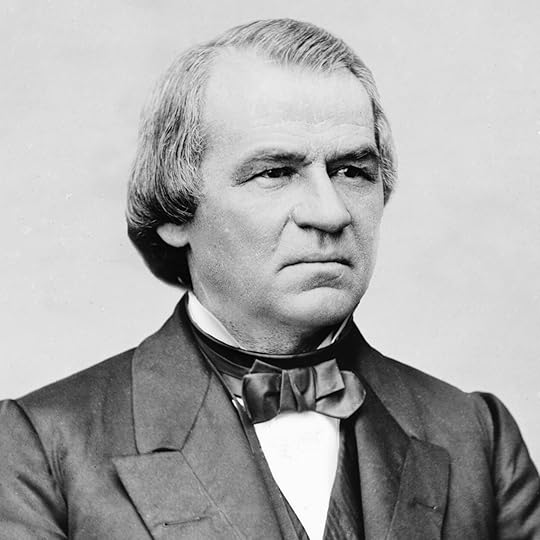
Few presidents have been as eviscerated in history as Andrew Johnson, who suddenly on a rainy morning in April of 1865 became the nation’s new chief executive upon the assassination of Abraham Lincoln.A man who rose from dire poverty through a sheer primal force of will, Johnson was elected to every level of government—always taking his case to the people—in a remarkable, if often chaotic career that included service as a state legislator, member of Congress, Governor of Tennessee, U.S. Senator, vice-president, and finally the presidency itself.During the Civil War, Johnson bravely stood up to Confederates, his life repeatedly threatened serving at Lincoln’s pleasure as the Military Governor of Tennessee and pushing for an end to slavery. Yet he is the same man who, upon succeeding Lincoln, could not see his way clear to securing the full Constitutional rights for ex-slaves.Because of his endless fights and many confrontations, Johnson’s presidency has since been roundly condemned as one of the most disastrous in U.S. history. Johnson, notes Page Smith in his seminal People’s History series, put on full display “a reckless and demonic spirit that drove him to excess, to violence, harsh words and actions.”“He was thrust into a role that required tact, flexibility, and sensitivity to the nuance of public opinion—qualities that Lincoln possessed in abundance, but that Johnson lacked,” asserts historian Eric Foner,“He was an angry man,” notes David Stewart, a chronicler of Johnson’s impeachment trial, “and he was rigid, and these were qualities that served him terribly as president.” Yet, for all of the scholarly indictments of the 17th President, indictments supported by a recent Siena College Research Institute historians’survey placing him at the bottom in overall performance, Andrew Johnson challenges us as a singularly American story of triumph, defeat, and renewal, a man who overcame the challenges of poverty, class, and alienation to reach the highest peaks of power in the country.That drive was ironically most tellingly on display after Johnson left the White House, denied even the opportunity of a party nomination for another term in office. From the ashes of that loss, Johnson methodically rose again, winning election to the U.S. Senate and improbably returning to national prominence. Andrew Johnson’s renaissance, coming 6 years after an unprecedented effort to impeach and remove him from the presidency, represents one of the greatest comebacks in American political history and serves as a testament to a man who could never be totally defeated.
Following the magnificent magnum opus that was Michael Burlingame's biography of Abraham Lincoln, Andrew Johnson was doomed to be a disappointment. Lincoln's vice president, who became our third "accidental president" following Lincoln's assassination, Johnson is mostly known for being the one who botched Reconstruction, consigning recently freed slaves to almost a century of racial violence and Jim Crow, and for being the first president to be impeached.
Previously, I had read Garry Boulard's biography of James Buchanan (the mediocre president who preceded Lincoln), so I picked up his biography of the mediocre president who followed Lincoln.
Surprisingly, after reading this fairly short biography (because I didn't really feel like reading a long one for an accidental one-term president), I sympathized with Andrew Johnson more than I thought I would. He wasn't great. His failure to restrain the South following the Civil War had lasting effects on African-Americans and indeed, the entire South. (It is arguable that the enduring "Lost Cause" myth and ongoing sympathy for the Confederacy could have been crushed during Johnson's administration, had he the will to crush it.) He was argumentative, grudge-holding, and obstinate. If he were alive today, he'd be a Ben Shapiro or Jordan Petersen type, always lecturing, hectoring, and certain of his own certitude and blind to his own blind spots. Still, even as frustrating as I found POTUS #17, he never struck me as evil or malicious. Like many flawed politicians, he did everything in the sincere belief that he was right and what he was doing was right. He was a very honest and incorruptible man, maybe even as honest as "Honest Abe," and the Constitution was his Bible. He even specified that he was to be buried with his casket wrapped in the American flag and a copy of the Constitution laid beneath his head.
Unfortunately, he just wasn't the man to fill Lincoln's shoes.
Johnson was a poor white Southerner from Tennessee. He and his brother were essentially sold into indentured servitude to a tailor at a young age. He and his brother both ran way (for reasons that are unclear, as Johnson never really spoke about it), and Johnson eventually made his way to another town and set up his own tailor shop, where he became quite successful. He married his wife, Eliza, when he was 18 and she was 16. Eliza was well-educated, sickly, and introverted; as First Lady, she would rarely appear at social occasions. They would be married for 50 years.
Johnson's beginnings as what today might be called "white trash" informed his attitudes and his politics for the rest of his life. He was a Southerner, with no great sympathy for black people, and he was never an abolitionist, but while he was indifferent to blacks, he hated the wealthy Southern aristocratic class of slaveholders. His longtime enemy in Congress, Jefferson Davis, a rich plantation owner, held Johnson in contempt. That Johnson would later hold Davis's fate in his hands only made them each more contemptuous of one another.
Johnson's political career began as Mayor of Greeneville, Tennessee, which would remain his hometown for the rest of his life. He ran for the Tennessee legislature, and was later elected to Congress. In 1853 he became Governor of Tennessee, and in 1856 he was elected to the Senate. During the secession crisis that arose when Abraham Lincoln was elected President, Johnson became popular nationwide as a Southern Democrat who made blistering pro-Union, anti-secession speeches, fueled in large part by his class hatred of wealthy Southerners. When Tennessee seceded, Johnson remained a Unionist, and thus was the only sitting Senator from a seceded state. This brought him to Lincoln's attention, and in 1862, Lincoln appointed Johnson as the military governor of Tennessee, in charge of civil authority there even as Union and Confederate armies fought in the state. (This was one of many moves by Lincoln that was of questionable Constitutionality, but then, a civil war wasn't really something the Constitution had been meant to take into account.)
Johnson did not get along with the Union generals. He wanted them to send more troops to take eastern Tennessee back from the Confederates; they mostly ignored him. Eventually the Confederate Army threatened Nashville, and Johnson was in direct danger of being captured and hung. (His wife was actually forced to flee ahead of him.) Johnson proved that if nothing else, he was no coward; he took a private carriage along the road north. He was shot at by a few partisans, but though the Confederates almost certainly could have intercepted him, Jefferson Davis himself ordered that they let him go, deciding that having Johnson assassinated would look poorly for the Confederacy (who were concerned about enlisting sympathy both in the border states and from European powers).
The Vice President Who Showed Up Drunk to His Own Inauguration
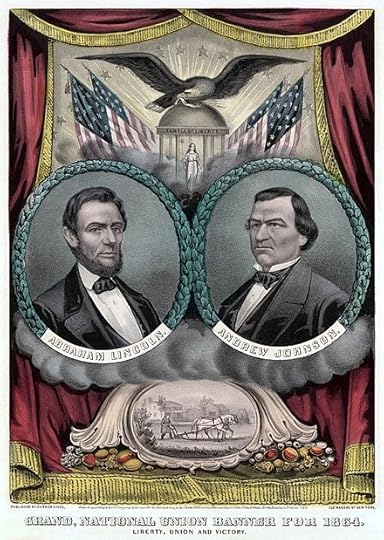
19th century politics were certainly interesting. Today, a party would never elect a VP from the opposite party, and it would be rare and politically momentous to replace the current VP on the ticket. But in 1864, with the war winding down (but not quite over yet), the Republicans decided that Lincoln's vice president, abolitionist Hannibal Hamlin of Maine, was more of a liability than not, and they decided to replace him... with a prominent, popular War Democrat. Thus Andrew Johnson became Lincoln's running mate for his reelection. Lincoln himself reportedly had little say in the matter and didn't comment publicly on the choice. (Could Lincoln have prevented Johnson from being his running mate, if he were absolutely opposed? Probably - but it seems Lincoln respected Johnson well enough and agreed with his party's judgment.)
Lincoln was reelected (it was a surprisingly near thing), and the night before their inauguration, Andrew Johnson went to a party in his honor where he drank heavily. The next morning, hung over, he some "hair of the dog," and showed up to the inauguration absolutely hammered. He gave a long, rambling 20-minute speech that was painful to everyone to listen to; Lincoln himself was visibly trying not to wince.
This did serious damage to Johnson's reputation, including starting the rumor that he was an alcoholic (which probably wasn't true; there don't seem to be any other stories of Johnson drinking too much). Lincoln, characteristically, defended him and insisted that Johnson was not an alcoholic and that he had every confidence in him.
Johnson returned to Greeneville to hide from the public embarrassment, but returned to Washington in time for the Lincoln assassination.
While John Wilkes Booth shot Abraham Lincoln at Ford's Theatre, Booth's co-conspirators also plotted to kill Andrew Johnson and Secretary of State William Seward. Seward was badly wounded by his attacker, but the guy who was supposed to try to kill Johnson got drunk and chickened out. Johnson quickly came to Lincoln's side, avoiding Mary Lincoln (who hated Johnson). When Lincoln died, Johnson was sworn in as POTUS #17 and the United States' third "accidental President."
Bungling Reconstruction
The "Radical Republicans," as they were called, were the liberals of the post-war period. They wanted the former Confederate states to be harshly occupied until all secessionist sentiment was crushed out of them, with former slaves granted full civil rights and the protection of the federal government.
Johnson told his cabinet that he wanted to carry on Lincoln's Reconstruction plan and make no cabinet changes. This would be one of several mistakes: he kept Secretary of War Edwin Stanton, who basically ran the White House in the immediate aftermath of Lincoln's assassination, and considered himself to still be in charge. According to Boulard, Stanton was a powergrubbing backstabber who undermined Johnson repeatedly. I am not sure whether this is entirely fair or one of Boulard's more opinionated projections, but certainly he caused problems for the new president. For example, when General William Tecumseh Sherman negotiated a surrender from Confederate generals, he offered a conditional surrender that would have allowed the surrendering states to keep their slaves. This was in direct contradiction to Lincoln and Johnson's demand for an unconditional surrender, and Johnson quickly repudiated it and forced Sherman to retract it, but Stanton went further, and all but called Sherman a traitor in the press. General Ulysses S. Grant had to calm Sherman down and keep him from immediately resigning.
At first, the Radical Republicans were delighted by Andrew Johnson's ascendency to the Presidency. His animosity for the Southern slaveholding class was well known (although Johnson had also owned slaves, though he freed them in 1863) and he frequently made bellicose speeches about hanging all the secessionists, including Jeff Davis. The Radical Republicans believed Johnson would treat the South with an iron fist; instead, he punted. Soon after taking office, he gave a speech in which he announced that he would not be instituting a military occupation of the South, and would not be granting the right to vote to freed blacks. He decided it was more important to reintegrate the South back into the Union, and he basically ignored pleas from Republicans to protect former slaves who were now being subject to waves of white violence throughout the South. Republicans felt betrayed, and Johnson's popularity began to plummet, as most of the North was in a much more punitive mood.
Johnson wasn't an abolitionist, had been opposed to abolitionists, and had owned slaves himself. He made it clear he considered the rights of white Southerners to be more important than the rights of former slaves. There is an anecdote in this book about Frederick Douglas, during a visit to the White House, at one point catching Johnson in an unguarded moment staring at him with disgust and contempt, which he took to be a "mask off" moment revealing how Johnson really felt about a black man speaking to the President. Like many Southerners, Johnson was pleasant and generous to blacks he knew personally.
With the Confederacy defeated, Johnson had to decide what to do with Jefferson Davis and other Confederate leaders. Johnson and Davis had always hated each other, but notwithstanding his threats to hang him, it was clear Johnson didn't really want to have his old political foe hung. He probably did enjoy the visits of Davis's wife Varina, and other Confederate wives, pleading for their husbands' lives.
Swing Around the Circle
At this point, Johnson decided the thing to do was take a tour around the country, explaining his position and rallying public support. He strong-armed General Grant and Admiral Farragut into accompanying him. This tour would come to be known as the "Swing Around the Circle," and it would be a disaster.
His first stops were in New York. This went well; Johnson gave good speeches and he was well received. But when he went West, he started getting heckled. Crowds chanted "New Orleans!" at him (referring to civil unrest and mass murder of blacks that was happening there) and some demanded to know what he was going to do with Jefferson Davis. Unwisely, Johnson let the hecklers bait him into shouting back at them, and soon he was regularly arguing with crowds.
Grant, bored, disgusted, and hating every minute of this trip, started drinking a lot and eventually bailed, deciding he had better things to do. After that, Johnson started bad-mouthing Grant, and the two of them became absolute enemies.
Indictment
By now, the Republicans were thoroughly pissed at Johnson and already talking about impeaching him.
Johnson proceeded to veto the Freedman's Bureau, vetoed the Civil Rights Act of 1866, and vetoed the Fourteenth Amendment. Republicans had had enough; they overrode Johnson's veto of the Fourteenth Amendment. They also passed the Tenure of Office Act, which said that the President needed Congress's approval to fire cabinet members. Johnson vetoed it, and Congress overrode his veto. When Johnson fired Secretary of War Stanton, in defiance of the law, Congress voted to impeach. This made Johnson the first president to be impeached. During the three months that his impeachment trial lasted, he had considerable support, including from "insurgents" who threatened to storm Congress.
Even some of the Republicans who hated him admitted that the grounds for impeachment were rather thin (the Tenure of Office Act was Constitutionally questionable and later repealed). Ultimately, he survived impeachment by one vote.
When your own party turns its back on you
Johnson very much wanted to run for reelection in 1868. The Democratic Party rejected him, however, and chose New York Governor Horatio Seymour instead. Johnson sulked for a while, and only belatedly came out in support of Seymour, which he regretted when Seymour lost resoundingly to Johnson's nemesis, Republican candidate and former commanding Union General Ulysses S. Grant.
In his last few months as a lame duck president, Johnson pardoned essentially all former Confederate officials, including Jefferson Davis. He and Grant despised each other so much so that he didn't even attend Grant's inauguration. Instead, he took up residence in Washington for a few months, before quietly returning to Greeneville, Tennessee.
Political Comeback
Like many politicians, Johnson declared at this point that he was done with politics and had no further ambitions. Of course, this was bullshit. He ran for the Senate again, but lost because neither Tennessee Republicans nor former Confederates were willing to forgive him. He ran for Congress and lost. There were jokes that he might resort to running for Mayor of Greeneville again. His political career seemed dead. He caught cholera during an epidemic that swept the country in 1873, but survived.
He traveled to Washington, D.C. for his son's graduation from Georgetown, and gave an interview where he issued another blistering condemnation of President Grant. While intemperate, Grant was having problems of his own, and Johnson began to gain popularity again.
Johnson staged an impressive political comeback in 1875, when he was once again elected to the Senate, becoming the first ex-President since John Quincy Adams to return to Congress after having been in the White House. He was riding high and all of Washington awaited one of his famous long speeches, which he gave in 1875, lambasting President Grant once again for sending federal troops into Louisiana.
At this point, Johnson was experiencing a resurgence in popularity. There was even talk of him running for President again in 1876.
Taking a short trip to make some speeches in July of 1875, he stopped at his daughter's farm, where he suddenly had a stroke. He died three days later at the age of 66. President Grant issued a solemn press release announcing the "painful duty" of informing the public of Johnson's death. At that time, Johnson had been the only surviving ex-president. Boulard points out that had their positions been reversed, Johnson would probably have been less gracious and respectful towards Grant.
Legacy
Mostly remembered for failing to finish Reconstruction and being the first president to be impeached, Andrew Johnson isn't rated highly by many historians. That said, he was in probably one of the most unusual and difficult situations for any president to take office. He wasn't helped by his argumentative and petty nature, but he couldn't be accused of dishonesty, and his administration was less corrupt than the more popular Grant's.
Garry Boulard's book was a decent summary of Johnson's life and political career and about the right length, without dipping too much into speculation. Nor did it dip into deep analysis. I didn't sense a strong bias on Boulard's part; he seemed to find Johnson admirable in some respects while not really admiring him. The writing, if anything, felt a bit routine; I suspect this wasn't his favorite subject or a book he really put his heart into. (I also noticed an unfortunate number of typos and grammatical errors, which have sadly become more common in published books nowadays.) But if you're treading through presidential biographies, I can recommend this one as a readable and fairly even-handed treatment of Johnson.