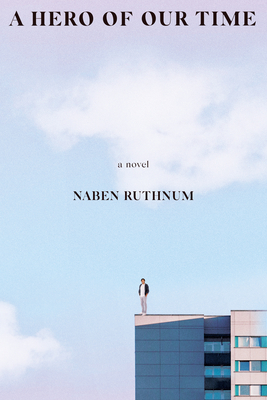
A wry comic novel with an acerbic wit, A Hero of Our Time is a vicious takedown of superficial diversity initiatives and tech culture, with a beating heart of broken sincerity.
Osman Shah is a pitstop on his white colleague Olivia Robinson’s quest for corporate domination at AAP, an edutech startup determined to automate higher education.
Osman, obsessed by Olivia’s ability to successfully disguise ambition and self-interest as collectivist diversity politics, is bent on exposing her. Aided by his colleague turned comrade-in-arms Nena, who loathes and tolerates him in equal measure, Osman delves into Olivia's twisted past. But at every turn, he's stymied by his unfailing gift for cruel observation, which he turns with most ferocity on himself, without ever noticing what it is that stops him from connecting to anyone in his past or present. As Osman loses his grip on his family, Nena, and everything he thought was essential to his identity, he confronts an enemy who may simply be too good at her job to be defeated.
A Hero of Our Time cracks the veneer of well-intentioned race conversations in the West, dismantles cheery narratives of progress through tech and “streamlined” education, and exposes the venomous self-congratulation and devouring lust for wealth, power, and property that lurks beneath.
One of the smartest, sharpest books I've ever read, although I can't say I enjoyed it exactly. But I don’t think it's meant to be enjoyed. It's a vicious satire of corporate DEI discourse and the edutech industry as a whole. Its protagonist, Osman, is a deeply self-loathing failed academic who works for an edutech company bent on evsicerating in-person higher ed so they can reap the profits of providing digital learning tools. The antagonist is a white woman disgustingly good at disguising her greed and self-interest as progressive collectivist politics.
A devastatingly sad book that is by turns funny in a haha way and funny in a brutally bleak way. Very smart crystalline prose. loved it and hated it as a fellow traveller of the humanities-academic to tech worker pipeline. Mostly made me feel awful. Beware of the body horror contained in these pages, not a book for the squeamish!
Ruthnum takes the “grotesque body” concept literally, and studies the interaction between modern tech, society and the literary through his leading man’s self-loathing.
Started off slow and I kinda struggled for most of the book to get through it, but I’m chalking that up to general overthinking and tiredness over the last couple weeks. The back of the book points out the main character Osman’s “gift for cruel observation”, and I can’t stress enough how much that is true. The world through his eyes, including the people around him, most of all himself, is ugly. He sees things in the most grotesque way you possibly could, which is sometimes funny, sometimes unsettling, and oftentimes sad. He reads into the thoughts and actions of those around him with a scathing projection of hatred towards him, his near nonexistent self esteem a constant throughout. This ugly point of view left me questioning what was true and what was not, in terms of Osman’s relationships, the intentions of the people around him, appearances, and more. Olivia as a character was immensely interesting and confusing. Because of said uncertainty in reality, I had a hard time forming an opinion of her, right up through to the end. However terrible, racist, manipulative, or cunning her actions appear to be, Olivia, or someone close to her, had an explanation. The book explores racism as mentioned among topics like progressive education, corporate culture, and personal identity among all those things, and to me, it felt like Olivia sort of personified gaslighting, both in regards to the specific scenarios and characters in the book, and as a reflection of that type of internal gaslighting we sometimes do to ourselves… or just me? Idk. The conclusion was validating in a sense while also grim and realistic. Idk. I enjoyed it and found many distinct lines of writing which I had to stop, reread, and highlight. Will probably reread soon.
2.5. Kind of funny, kind of sad, but mostly just annoying. I felt thrown into a plot that I didn't really see the point of. I was sort of told that Olivia is terrible, but didn't feel like I was shown it enough? And honestly, it felt hard to dislike her too much, in the beginning at least, when Nena and Osman were just being really frustrating characters. Nena in particular was just so rude, seemingly for no reason. Or maybe there was one. My favourite parts were the descriptions or interactions with/about Osman's family. Just not for me I guess.
Whip smart with caustic humour, a daring subversive examination of 'progressive' workplace diversity policies and those white people in power who pay lip service, twisting them to their own use. Osman Shah is the self-deprecating underdog hero one can't help rooting for and there are many gasp worthy revelations later in the novel. Pairs extremely well as the contemporary fiction counterpart to Rafia Zakaria's (she has a cameo here) nonfiction book.
Ruthnum is scathing and he's allowed to be because he never misses. For a book about falsities and facades, A Hero of Our Time is just so excitingly true.
a painful read that offered little to no reward. neither the eductech or parent trauma were fleshed out well enough for me. the narrator loathed himself and was jealous of others. that much was clear.
It hit all the right notes for me - multi-layered, satirical, thoughtful, surprising, on the mark with the tech academic mix, and extremely topical. Ruthnum’s characters are complex and kept me engaged throughout. It might be too text heavy at times for some reader’s taste, but not for me; he carried me right along with the narrative with no issue. A serious book, delivered with a light touch and a note of forewarning.
Had a lot of potential in its examination of diversity initiatives, corporate politics and the way we wield narrative, but the narrator’s self-deprecation and organization of plot bloat the novel and distract from its most compelling elements.
A deeply dystopian book. Cynical, humourless, bleak on all fronts - work, love, family, life in general. Minimal plot which crawls. Author clearly intelligent, and knowledgeable about the setting of the story, the education technology sector, so a missed opportunity. A struggle to read.
An eviscerating satire of the corporate takeover of education, nice white lady racism, and complicity. If it wasn't so funny, it would have been almost too dark to read. Fortunately, it's extremely funny.
a novel that explores the lies we tell, to ourselves, to those closest to us and to the world. the lies to keep us safe, bring our enemies down or create success. This book looks at so many current issues but to be honest in the end I found myself not completely invested in the story.
Ruthnum pulls off a lovely high-wire act, taking on the full horror and emptiness of modern extractive capitalism, and combining it with the self-aware anxiety and self-referencing of the modern online natives.
His narrator Osman is so self-loathing it's obviously ridiculous, and he is surrounded by amateur psychologists analyzing everything and everyone. As he works to establish some control on his employer who mines the last bit of post-secondary education for it's remaining dollars and its soul, you're treated to an over-the-top lesson on identity politics and our obsession with public presentation, with a lot of body horror and deadpan wit.
Everyone is looking to spin their own oppressive narration, from Osman to his girlfriend to his mother to his nemesis. But Ruthnum somehow pulls off a mocking of this idpol obsessiveness not through a reactionary lens but a sympathetic one: yet another bit of our society we must monetize to escape the crushing late-capitalist bulldozer.
The novel's strength and weakness is that it recognizes that so much of what matters now is surface level gloss and who controls the perception. It's an accurate diagnosis of our current hollowness, but it robs the plot of a lot of oomph and impact. It feels almost too light in its rich people struggling to get even richer and retreat more into themselves and their lies.
But it's well-written and scathing and even if it feels light it's deeper than much of what it critiques. It means a bit too hard into Osman's ridiculousness, but it has that biting Bodies Bodies Bodies critique of our current hypocrisies, but much more sharply drawn. I look forward to following any future work.
The violence oozing out of the word “pleasant” is duly noted.
How did the book make me feel/think?
“You’re a mediocre, pleasant Indo-Canadian, the perfect hyphenate-union of cultures to elicit zero interest, and you moved to Los Angeles two years ago. That’s the start of you. Your background—the degree, your father’s transferred academic prestige—those are stats, not story. You made a move that allows you to exist in the world, to make a salary while you think small thoughts to yourself, and that’s your beginning and end…”
Why am I so fragile to allow you to think or speak of me how you do?
Coming from another world, culture, and existence is too much for me to comprehend. I just want to blend in. You have no right to judge me, use me as a prop, or feign your awakening. You are what you are, a manipulator. A person who climbs over people and destroys them because you are part of a disease, festering in the online world (hiding in a screen), a bastion of illness where you can disparage me. You flex your ignorance , claiming you are not the racist garbage you are. My mother spews unconditional by pushing me out of her life—because she can’t stand me, I mean bear to have me see who she really is.
How could I possibly have a chance to be well-rounded?
I need a drink to cloud the days.
I love you, but I’m so disgusted with myself, I am incapable of intimacy.
I’m broken.
I want to think small thoughts; the violence oozing out of the word “pleasant” is duly noted.
A chillingly close-to-home satire of craven power games in the guise of "do-gooder" education orgs and corporate diversity efforts. No one gets off unscathed, especially the protagonist, whose involvement comes at the expense of his dignity and mental health. The insularity of these power plays is both part of the satire and also a narrative constraint that the novel struggles to overcome. At one point, a few chapters in, the narrator's mother makes a comment asking why should she care about these executives at his job? They're not doing anything really meaningful and getting paid tons to do/not do that. This came right as the story was about to lose me, and I hoped it would respond to that, showing us a wider world with more sympathetic stakes. It gets beyond the corporate politics a little but the novel never quite transcends the narrator's narrowmindedness. I don't mean this to be a criticism of "unlikableness"--the characters are nakedly unlikeable, and maybe that's the point. But the most compelling parts are almost glossed over, the narrator's too myopic to see them pass, and I wish the novel would've done more to ironize that. Nonetheless, I've not seen the "politics" of corporate identity politics dramatized in this way, and I appreciated its tricky balancing act of exposing the abuse of liberal tactics without undercutting an awareness of larger structural issues at play.
I really enjoyed this book. The author is a smart writer and almost every sentence can be savoured and considered, making the book slow to read, at least for me. It is set in current Covid-isolation times. Major themes are racism and diversity. Tech culture and wealth, body image, family, workplace interactions and manoeuvring, all in a modern, critical, unflattering, unhopeful, maybe realistic light. Characters are intriguing. Felt a little like reading trolls online...everything negative and destructive. That's the world as seen by the main character Osman and most of the other players. Despite all their higher education and wealth they are unhappy and unsatisfied with their own performance/creations or the way those are received. While this all sounds very dour the book is not an unpleasant read. I found myself interested in these characters, how they thought, what they would do next. Probably one of the best books I read this year.
I can enjoy and appreciate that this book tries to highlight the nuances of progressive politics / self identity / the grey in between of self interest and community work that exists.
The narrative was confusing until halfway though the book, since we start the book straight into Osman's thoughts, not much introduction. We just figure it out on the way. I didn't even know what AAP was lol.
Interesting that the antagonist was nuanced, that Nena used to have a good relationship with, etc. I think that's needed to reflect reality. And well written that it's uncertain how exactly Osman's relations are / what his body looks like--it's all just his perception.
It becomes bleak and sad with the broken connections. At the end... It just ends. 🤷🏻♀️