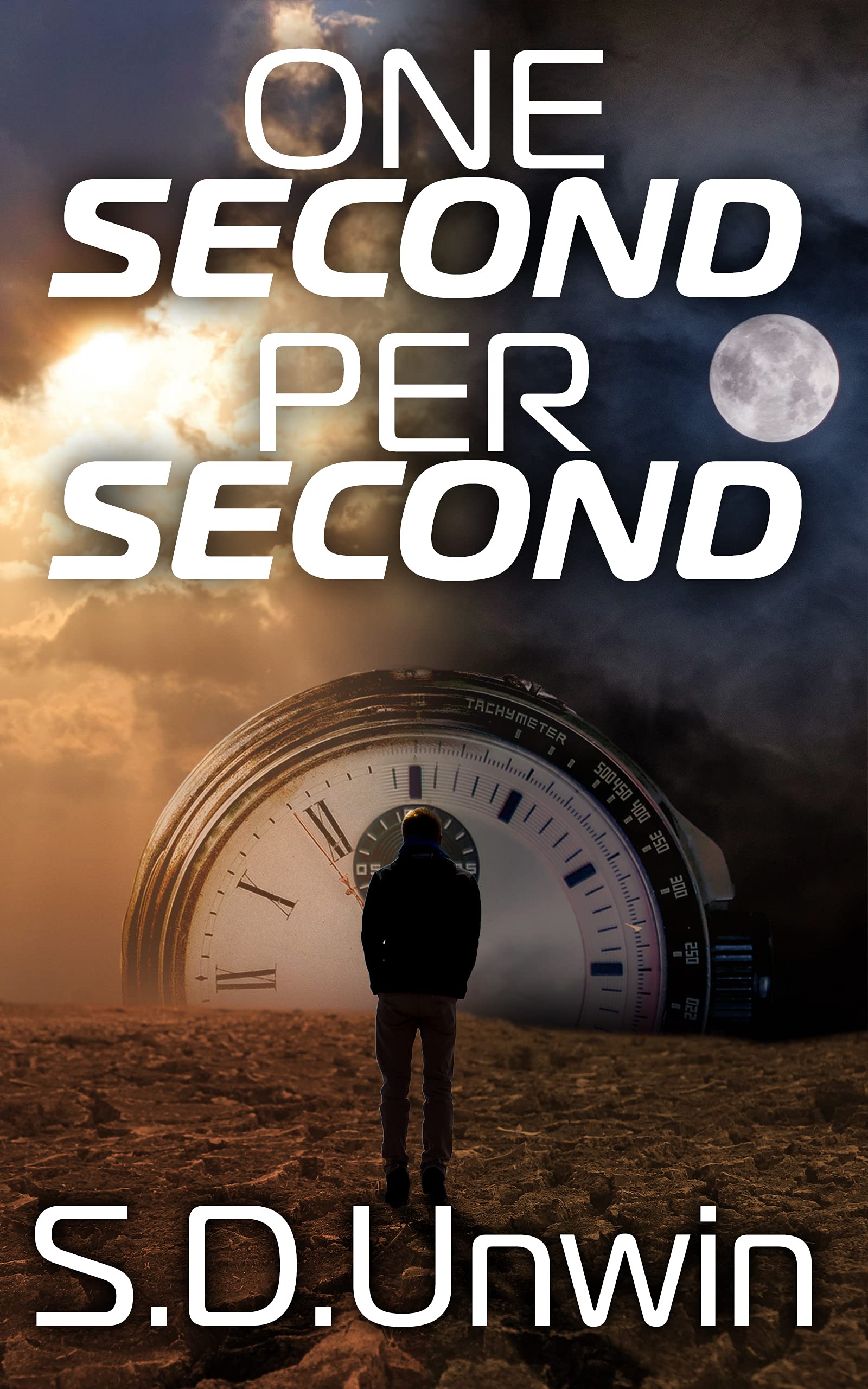
The greatest scientific challenge of our age wasn’t to enable time travel, it was to prevent it. The laws of physics had turned out to be idiotic, erecting no barriers to hopping time. In fact, they make it hard to avoid. I’m in the business of preserving the timeline—making sure the world sticks to the sacred rule of One Second Per Second, and that history unfolds according to plan. The problem is, there is no plan until I make it.
S. D. Unwin began as a theoretical physicist searching for the Holy Grail of a quantum theory of gravity. He later turned his mathematical skills to analyzing and communicating catastrophic risk, from nuclear mishaps to major earthquakes. He has now settled happily on writing science fiction. His work includes The Magni and the time travel trilogy of One Second Per Second, Fall Of Time, and Time Wall. Hailing originally from Manchester in the United Kingdom, he now lives in the U.S. Pacific Northwest.
It wasn’t completely shit. But let’s not pretend it was any good, either. “One Second Per Second” manages the rare feat of making time travel - arguably one of the most thrilling, brain-twisting concepts in all of fiction - feel like doing your taxes with a hangover. On a Sunday. In August.
The big problem? It’s boring. Not quietly meditative, not existentially reflective, just… tedious. The narrative loops back on itself over and over in ways that feel less like clever structure and more like someone got stuck in their own CTRL+C/CTRL+V spiral. Yes, I get that repetition is the point. That doesn't mean I want to relive the same dull sequence for the fourth time, now with 12 per cent more techno-waffle.
And the techno-waffle. My god. The jargon is either real and poorly explained or made-up and badly disguised. I honestly couldn’t tell. Either way, it made my brain quietly switch off, like a computer going into sleep mode to protect itself.
The time travel rules? Laughably easy. Press a button, say something cryptic, and off you pop. There’s no tension, no sense of consequence. You could argue it’s part of the narrative’s point, but if so, the book’s point is undermining its own dramatic structure, which feels a bit like a magician starting a trick by showing you where the rabbit’s hidden.
Anachronisms are scattered throughout, some subtle, most not. I'd be fine with that if they were at least amusing, or clever, or - God forbid - used to say something interesting. But they just sit there, like set dressing nobody bothered to tidy up.
World-building? Barely. It’s shallow as a puddle in a drought. Everything feels sketched rather than inhabited. Places don’t feel real; they feel like concept art for a low-budget indie game that never made it past Kickstarter.
And characters? Apparently, there were lots of them. I know this because names kept appearing. Unfortunately, I couldn’t tell you a single trait about 98 per cent of them. They flit in and out, deliver a line of exposition or two, then vanish back into the narrative fog. No personality, no presence, just warm bodies filling space.
By the end, I had a proper time travel headache. The kind where you’re trying to keep track of who’s when and why, and your brain just sighs, folds its little arms and decides to stop participating. Which, frankly, was the most relatable moment I had with anything in the book.
There are glimmers of potential. A line here, a scene there, where you think, ah, maybe this is where it takes off. But no. It doesn’t. It loops back to mediocrity and idles there, humming softly to itself. Like a very clever student who forgot to pack a plot.
If you’re the sort of person who loves flowcharts, beige dialogue and the theoretical physics section of Wikipedia, you might find something to chew on here. For the rest of us: one second per second is more than enough.
First few chapters were full of technical jargon, Were they even real words? Then we got the time hopping. Same era, different locations. The ending is rather obvious. When it comes to time travel, for now I'll stick to Outlander.
I found it difficult to get past the first couple of chapters, the action was moving too slowly. However once past that I found it fascinating. I finished reading the book in one sitting. I found the science a bit far fetched , more like alchemy. It was an interesting read and looking forward to a sequel if the author is so inclined.
Ok, I gave this book a 5 but I feel I was being generous because I liked it, so technically a 4.5. The storyline was good and well crafted but unlike some of the more intense publications I've read it didn't get me rushing through pages in eagerness to find the outcome or should I say the excitement didn't carry me away. A relatively short read but well worth the effort.
I have a particular thing for time travel book. Because there is infinite possible story lines. This was an interesting book there were very realistic characters, and the time travel made sense in as far as time travel can. There were lots of twists and turns, and reversals. Defiantly a page turner.
This is a good time travel novel with some novel mechanisms and interesting discussions about the uncertainty and confusion that arises from any time travel scenario. The author's physics background lends some credibility to the time travel method. The plot is a James Bond-like page turner; I couldn't put it down. My one complaint is that there should have been more about Gallie's cat. '
I thoroughly enjoyed the story. This was a well crafted story that kept me turning page after page. Like any time travel story, there were a few times where I would have to re-read some of the "tech talk" but overall I have but one question for the author and it is a single word.... Sequel?
I'm always looking for new time travel stories and this book hit the spot completely. Well written, thought out story. It's one of my new favorites in the genre, destined for several re- reads.
This book was just OK. The premise is ostensibly "time travel is way too easy, we need to actually work to prevent it from happening," but it almost immediately just becomes a standard time travel narrative. By the end of the book, it seems unclear to me why the time travel agency cares about preventing time travel, particularly since they seem to have pretty arbitrary rules about it. The plot doesn't hugely hinge on the notion of how time travel works in this universe, so I am writing off the fact that the time travel model doesn't seem terribly coherent (it is a single-modifiable-history model; these feel like the only way to create palpable consequences for most authors so they are very popular, but they don't work).
Overall, the plot was a bit shallow but OK. The world-building did not live up to its potential, and the characters were again a bit shallow but OK. Overall this is an OK book.
I liked it. I enjoy time travel stories, and this one entertained me. Really, what other purpose is there for a novel?
It doesn't get too much into character development or that kind of thing, because after all it's only a little over 200 pages. But the idea and method and of time travel are unique, and best of all the author doesn't spend too much time trying to explain how it works. The characters seem aware that they don't fully understand how it all works (temporal paradoxes and that kind of thing).
The ending left things open for a sequel, but it also works as a stand-alone novel (which I was happy about, the last time-travel series I read, a trilogy, gradually got worse until I was just skimming the last book waiting for the end).
The fact that this was the author's first book hopefully means many good things to come.
One Second Per Second reads to me like a book that’s meant to be a fun time-travel adventure, so that’s how I engage with it. I think it succeeds on that front. The time-travel fits well within the story, the adventure was interesting and it had quite a few interesting twists and turns. The writing itself isn’t phenomenal and I felt no real connection to the characters, but it was a fun story. It entertained me and reading the book was a good way for me to spend part of a Saturday. If anyone’s looking for a quick, entertaining time-travel tale, I’d say give this book a shot.
This is fun , young-adult style, a different take on time travel as Joad, the protagonist, is working at TMA, dedicated to stopping accidental, unauthorized time trips that mess up the continuum. But what if someone wanted to mess things up just because he could? Highly recommended.
Perhaps the best thing about this story was that it was a literary one. This is usually quite rare in science fiction but in this case not only was the writing solid but the characters were great. Add to that an original plot, great romance and great ending and you got a winner.
One Second Per Second would be a great, rollicking time travel sort no matter who wrote it. But, that it is from a first-time author makes it very impressive. Oh, and it was great that he placed the story around the Tri-Cities of Washington State, where I grew from child to adult.
I could not put it down. This is the first time travel story that didn't annoy me with unresolved paradoxes. Not that everything was tied up neatly, but it wasn't annoying. What it was: an engaging story with good character development and a sufficiently complicated plot.
In my opinion, the book started off slow. But once you got past the foundation/background chapters, the book picked up the pace considerably. Overall, a very well-written novel and I can't wait for Mr. Unwin's sequel.
I've always enjoyed time travel books and this one is a ripping read. It has a good mix of modern life and fun time travel. I loved it and am recommending it to my book club!
A great fun time travel adventure story. Twists and turns, history and a little future. Love and loss. All thrown together. Read it in a day and really enjoyed it.
Time Travel Hocus Pocus … Along With All The Expectant Confusion!
This book gets a 5-star Rating more because it’s an interesting SciFi/Time Travel experiment, than due to the plot. Frankly, the Plot was quite confusing at times, vague at others, and preposterous in other ways. (But, to some degree, that’s just a repercussion of Time Travel stories, ain’t it?) SOME of this book actually seemed to follow a sequential trail and make some sense, but certainly not all of it was clear to a willing Reader.
The main Villain had many justifications for his actions, but The Author totally blew it by not better explaining this character’s intentions and capabilities … in particular, The Author never explained if The Villain was actually a good guy or not, nor WHERE this guy disappeared to shortly before the Book’s end … I’ll take a WAG and suspect The Villain will show up in at least one, if not both of the Sequels …
Despite my disagreements on how this tale was presented — I highly recommend this to other Readers, and I’m looking forward to the next books in the Series. Go read it!!!
It's about time. The MC works for a time travel operation - set up to prevent changes to the past to avoid unplanned deviations from the present. However things do not go to plan, and someone or something appears to be making changes. The story contains many twists and turns as the MC tries to sort out what is going on - and to come to terms with his own past. Interesting - looking forward to the next book in the series
I like time travel books and this one was pretty good. I was confused by some characters and how they fit with each other, but overall I really enjoyed this book and look forward to the next one in the series.
Generally a great book. What I missed were some loose ends that weren't tied up at the conclusion. I guess you are meant to read the next novels in the series - I just don't like getting sucked into the series. So I'll just have to live with it.
Probably THE best time travel story I have ever read!
Writing stories about time travel isn’t easy (I wrote one too) … just trying to wrap one’s brain around all the permutations is enough to give one a headache. I really enjoyed this book.