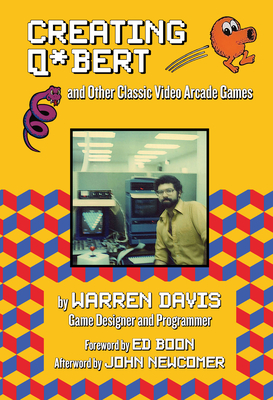
Creating Q*bert and Other Classic Video Arcade Games takes you inside the video arcade game industry during the pivotal decades of the 1980s and 1990s. Warren Davis, the creator of the groundbreaking Q*bert, worked as a member of the creative teams who developed some of the most popular video games of all time, including Joust 2, Mortal Kombat, NBA Jam, and Revolution X.
In a witty and entertaining narrative, Davis shares insightful stories that offer a behind-the-scenes look at what it was like to work as a designer and programmer at the most influential and dominant video arcade game manufacturers of the era, including Gottlieb, Williams/Bally/Midway, and Premiere.
Likewise, the talented artists, designers, creators, and programmers Davis has collaborated with over the years reads like a who’s who of video gaming Eugene Jarvis, Tim Skelly, Ed Boon, Jeff Lee, Dave Thiel, John Newcomer, George Petro, Jack Haeger, and Dennis Nordman, among many others.
The impact Davis has had on the video arcade game industry is deep and varied. At Williams, Davis created and maintained the revolutionary digitizing system that allowed actors and other photo-realistic imagery to be utilized in such games as Mortal Kombat, T2, and NBA Jam. When Davis worked on the fabled Us vs. Them, it was the first time a video game integrated a live action story with arcade-style graphics.
On the one-of-a-kind Exterminator, Davis developed a brand new video game hardware system, and created a unique joystick that sensed both omni-directional movement and rotation, a first at that time. For Revolution X, he created a display system that simulated a pseudo-3D environment on 2D hardware, as well as a tool for artists that facilitated the building of virtual worlds and the seamless integration of the artist’s work into game code.
Whether you’re looking for insights into the Golden Age of Arcades, would like to learn how Davis first discovered his design and programming skills as a teenager working with a 1960's computer called a Monrobot XI, or want to get the inside scoop on what it was like to film the Rock and Roll Hall of Fame band Aerosmith for Revolution X, Davis’ memoir provides a backstage tour of the arcade and video game industry during its most definitive and influential period.
How I read this: Free ebook copy received through NetGalley
I loved this book so much and now I'm sad I'm finished with it. If you love retro gaming, I'm sure you'll love it too. It's just that the guy who wrote the book seems to be one of those people you can't help falling in love with as you read. You just kind of want to actually know them and hang out with them, cause they're just so wholesome. The last such book for me was the memoir of the Apollo 11 astronaut Michael Collins (Carrying the Fire: An Astronaut's Journey).
But of course, it's not just that the author's vibe is lovely, the story itself was lovely to read. I happen to adore pinball and while the story was not about pinball, those industries intersected a lot at the time, so it was remarkably interesting to get a glimpse into the same offices of those legendary pinball companies. I guess I should find me some pinball nonfiction next.
I thank the publisher for giving me a free copy of the ebook in exchange to my honest review. This has not affected my opinion.
This is a review for an ARC copy provided by Netgalley.
To begin with, I must say that I am not huge into video games or know much about the industry. However, I was drawn to this book from the appeal of learning more about the creative process of making them, and especially with such limiting technology. So, I decided to give it a go and was pleasantly surprised!
When you first enter the Evergreen Chemical building, some dweeb behind the desk ducks down and starts lobbing grenades at you. That's me! I'm the dweeb!
This book is written with so much personality and gives much insight into the technology of the time and different company relations that I had no clue about until reading, and all this historical and relational background was hugely helpful to me in envisioning everything that was talked about and I greatly appreciated that since I am very out of the loop with this kind of stuff.
The descriptions of his experiences and the way that he goes about telling it are, in my opinion, very vivid and really makes his life story come to... well, life! I really connected with his experiences. I laughed, had fun, got frustrated, and felt a range of other emotions as I was reading this recount of his experiences.
I would highly recommend this book to any videogame nerds that I know! However... I knocked off a star because, if we get into the more technical side of the book formatting, this ARC definitely needs more revisions before it releases to the general public.
This next part of the review will detail Kindle PDF specific issues of the ARC version that is provided by Netgalley, so this won't be relevant to anybody who is reading this after its official release, but it's worth mentioning if not for the sake of comparison to see if any of these issues have been fixed:
So, a few issues with the PDF I received: • Some punctuation errors, especially in some hyphenated words, and I spotted one sentence that didn't have a period at the end. • BIG issue with the images. This might just be because I was reading the PDF on my Kindle, but regardless, it's something that might need to be revised for any future digital releases. Whenever there were images in a chapter, it would often cause sentences to cut off in the middle and have the image taking up a whole page or so, and then the rest of the same sentence would begin again either on the next page or the page after that. There was one in particular that was jarring because discussion about Q*bert had already passed and he was recalling a different game when, in the middle of a paragraph, there were suddenly about ten pages of images of Q*bert in different stages and things of that nature. By the time I looked through all the pictures I forgot that they have been placed in the middle of a sentence about an unrelated paragraph so it was incredibly jarring. Not sure what all that was about, but those images definitely need to be moved over to a more appropriate section of the book. • Another, separate issue with the images. In all, I'm pretty sure there were two images that were missing. I could tell because there's always a description of the image in small bold font directly underneath, but there were two places that had descriptions with no image attached.
But hopefully, these issues that I mentioned won't be relevant for the official release, but it's worth noting.
Warren Davis' "Creating Qbert and Other Classic Video Arcade Games" is a fun trip down memory lane. Revisit the neon-lit, coin-clinking world of 1980s and 1990s video arcade games. Davis, the creative genius behind the iconic Qbert, takes us on an amusing journey through the heart of the video game industry during its golden age.
With humor and insight, Davis shares anecdotes from his days as a designer and programmer at the industry's pioneering giants like Gottlieb, Williams/Bally/Midway, and Premiere. The ensemble of individuals he acquaints us with resembles a roster of gaming luminaries, featuring Eugene Jarvis, Ed Boon, and Jeff Lee, among others.
While Davis created Q*bert, he also made significant contributions to groundbreaking technology that reshaped the gaming landscape. His digitizing system, used in games like Mortal Kombat, allowed for realistic imagery, marking a turning point in the industry. His work on Exterminator introduced a novel joystick that detected both omni-directional movement and rotation, a true innovation at the time.
The book also reveals his experiences with iconic titles like NBA Jam, Revolution X, and Joust 2 -- like a backstage pass to the creative process and technical wizardry that brought these games to our lives!!
Davis' memoir is an engaging and entertaining read no matter if you are a nostalgic gamer reliving the era of arcades or a curious newbie eager to learn about the pioneers of the gaming world. "Creating Q*bert" is a tribute to a bygone era, a covenant to innovation, and is perfect for anyone who ever chased high scores in dimly lit arcades. Grab your quarters and prepare for an adventure through the pixelated wonderland of classic arcade games.
"A journey through the joysticks and pixels of gaming history."
"Unleash your inner gamer."
"An arcade odyssey -- Relive the golden age of video games."
"Exploring the mind of a gaming visionary."
"Gaming magic unveiled -- A look behind the screen."
"Nostalgia-infused gaming chronicles by a legendary creator."
"Coin-op classics and cutting edge innovation."
"Pixelated dreams and digital adventures."
"From pixels to pixels -- A tale of gaming evolution."
If you couldn’t tell by the cubes, Davis was the main programmer for Q*Bert. What you may not know is that Davis also helped create the foundations for many other games you’ve played.
In Creating Q*Bert, you’ll get a first-hand account of Warren Davis’ journey through Chicago in the late 1980s through the early 1990s. You’ll also learn about technology as it grew alongside his career, starting with the Monrobot XI Computer up to the tools he created to work on various games. Like Q*Bert, you’ll also bounce around throughout the industry; from Gottlieb, Williams, Premier (Gottlieb), and back (Williams/Bally/Midway). Each chapter flows easily and will have your saying Davis’ favorite phrase: “What’s next?”.
As this is a memoir, you’ll find more personal insights, stories, accountability, and specific details than you would in a straight video game history book. What’s interesting is that while you’ll see names you may recognize, they play minor roles in this book, as Davis worked on other teams adjacent to the industry titans. He freely gives credit where credit is due, and openly tells you his involvement in any given project. There are a few technological tangents, but he won’t judge if you skip them. I personally found them to be great contextual information to what he was creating at the time, and it was a glimpse into how his mind works.
His mind is of finding the challenge within technology to improve skills and to make everything for everyone better. Experimentation also played a heavy roll in his development process. As an exercise of his skill and his interest in M.C. Escher, he created the gravity calculations for balls falling down a pyramid into what became Q*Bert. He took on the enormous task of programming different points of view and video editing to further the interactivity of LaserDisc games in Us vs. Them. His fascination with digitization and his expertise with creating palette reduction algorithms helped to optimize Williams’ boards to handle and produce the characters you’ve seen in NARC, T2, NBA Jam, and Mortal Kombat.
But most of all, his story illuminates the fact that while some people created great characters, he helped created the platforms that made those characters and the industry run.
In the early 1980's, I was all about hanging out in the arcades on the weekends with my high school buddies - unloading quarters into those bright and colorful consoles to have some fun. Q*bert was one of my go-to games, even though I was not super good at it. For this reason, I was instantly attracted to Warren Davis' story.
Right from the start of his narrative, I totally connected with Davis. In the introduction, he talks about why he got into programming and his reasons very much mirrored my own in the early 80's when I decided to go to college to study computer science. I remember the wild enthusiasm that programming used to bring me. When that fire is there, designing and coding is a creative release, a joy. When that spark burns out, it becomes drudgery.
Having spent several decades in the software business myself, I found the details of the development, testing and release of Q*bert to be very engaging. It took me back. For those familiar with the field, this will resonate. However, I can also see it appealing to those completely unfamiliar with the process. Davis' delivery is entertaining and approachable, making sure to breakdown the technical details in easy-to-follow terms.
The rest of his career, bouncing from company to company and project to project, was relatable as well. Not every idea becomes a cultural icon but as noted, even some of the lesser hits are still fondly remembered by those that enjoyed them. I also appreciated that he kept pursuing his passions wherever they took him.
This was one of the lightest reads I've ever read. There was practically no conflict or sizeable challenge throughout the entire story, and what's more is the author is both humble and obviously extremely talented in their field. It's like reading the diary of a Sorkin side character who never got any screen time because who'd want to watch this story?
Sorry, that's not meant to be insulting. I just mean this is like Parks & Rec in a book; the author is wholesome, nerdy, and just regales you with anecdotes you probably wouldn't really ask for but are delighted to listen to because they are in fact fun to hear.
I've always thought there's three types of people who get into the entertainment industry: people who want to be famous, people who are good at it and just want to make a buck, and people who want to have fun telling stories. Davis is the latter, and even says so himself he was not in this for fame, but was just curious about the prospects of game design, graphics, and coding, and was just having fun.
If you are a nerd who likes video games and has a soft spot for the arcade cabinets, I'd say get this. It's like having a long conversation with a humble famous person at a convention.
I, as previously mentioned in my review of John Romero’s forthcoming memoir, Doom Guy, adore nostalgia-drenched stories about the video game industry. It just feels good to read about these types of things in this dark, modern world of pandemics and political unrest. I knew before reading the first page of Warren Davis’s Creating Q*Bert and Other Classic Video Arcade Games that it would be delightful.
Davis, despite a bit of self-deprecation about his recollection ability in the introduction, seems to remember a great deal about his career in video games. Readers get an in-depth account of his creation of Q*Bert, co-creation of Us Vs. Them, and the work he put in on unreleased games like USSA. He also goes into detail about the innovative tools he designed for video digitization. All these stories are told in quite an engaging way without getting too bogged down in technospeak. There is SOME technospeak, but not enough to cause someone to yawn, regardless of how tech savvy they are.
Creating Q*Bert mostly focuses on Davis’s work in the arcade arena; however, you get details about his acting career, improv training, and his family life. I highly recommend this book for anyone interested in the early days of arcade gaming.
Mr. Davis points out that most of the people behind the scenes aren't really known outside of the industry, but there are tons of names in here that are childhood heroes of mine. He has certainly had a memorable career in games. (And I guess is still working on them. I just googled and saw he helped create a Star Trek themed mobile game. Cool!)
I don't think this book is for everyone. There's a lot of technical information that a geek like me loves, but might be tough for others. Still it's a pretty short read, and I enjoyed it. Definitely recommended.
What struck me personally as a Production Artist is Warren's versatile hybrid status. I'm a production artist who can design... sometimes. My main contribution is the fulfillment other people's creative work. Warren had an early pop culture hit, then his main impact on most projects were technical. Warren said in a recent podcast that the industry didn't know what a video game was in that era. I cringe at the amount of time Warren spent developing concepts that just didn't sound promising in my opinion. The stories are fun and not overly technical. The time period was my teenage years as I remember a kid talking about Q*Bert on the school bus. He swore he heard Q*Bert say: "I hate cafeteria food." I'd read somewhere that Q*Bert was adapted to more platforms than any other video game in history and that's not mentioned in the book. For me Q*Bert has always been worth playing a few times. Q*Bert seemed to have the perfect business model for repeat business. Q*Bert wasn't the titan like Pac-Man but was certainly a fun distraction full of random, unpredictable scenarios. I love it when the character shows up in movies like Wreck-It-Ralph. I loved the afterword by John Newcomer who created Joust. I LOVE JOUST!
This memoir is Warren Davis' history with technology and his foray into creating video games, including the classic game, Q*bert. It was a bit "in the weeds" about the technical specs of the creation of the video game division in a pinball game company and the creation of Q*bert itself. (And this is coming from a family who has worked in the games industry for 30 years.). I was interested in Davis' story and the history of the development of the games division, but overall the book wasn't all that engaging. I would have enjoyed hearing more about Davis' history as an actor and improv actor, or more detail about the games industry at that time. The storyline in this book might be more interesting to those who really enjoy the technical details of the game, and unfortunately I am not one of those people. I think it's worth a borrow from the library and a skim, but I don't know that I'd necessarily evangelize this book as one of the best video game histories.
I had the pleasure of meeting Warren Davis at this year's Retro World Expo, where I was able to get my copy of Q*bert signed and snag a copy of this book. Overall, I enjoyed the time I spent with Creating Q*bert. Davis is such a multihyphenate individual that it was interesting to hear not only about his programming experience, but also about the work he did on software tools and even hardware. Plus, he's a successful actor to boot!
For all of Davis' success near the start of his career, he isn't shy about discussing his failures, from games that never made it to market to the near disintegration of his marriage. I don't read a lot of memoirs, but I do feel that I wanted to get inside the author's head a bit more, especially regarding these low points. Still, this is a small criticism of a book that I fairly enjoyed on a topic I find fascinating.
I very much enjoyed Warren Davis' memoir about creating Q*Bert, a famous coin-op arcade video game from the early 1980s. The book proceeds quickly from his high school and college days (RPI!) to his incredible luck at landing a job at Gottlieb where he would create Q*Bert.
He spends just the right amount of time talking about the challenges of making a video game, especially in that day and age. He also points the spotlight at his collaborators, artist Jeff Lee and sound designer Dave Thiel, highlighting their important contributions.
What I liked best about his book was his recounting of the many job changes he had through the years. Each job change reminded me how tenuous high-tech employment can be, even for someone at his high level! He always followed his heart and his interest, and even when he couldn't, he stayed positive and optimistic, which is a great lesson to leave his readers!
As the main character from Q*Bert might say: this is a @!#?!@ book!
This book was pretty interesting. I actually enjoyed some of the more technical diversions and explanations of how the graphical processing of arcade software was accomplished. Some of the material seemed like filler, especially the last chapter where the author summarized his later years (I would have preferred the book to be longer, or for him to include those stories in greater detail in another book…perhaps he will write it one day.) I found my attention drifting with some of the material, but it was certainly comprehensive. The afterword was surprisingly touching.
At any rate, I’ve always enjoyed the Q*bert arcade game, so hearing from the developer about the behind the scenes details was interesting.
Warren writes an entertaining and modest retrospective on not only his personal career in coin op, but the underlying technical innovations that made it possible. I enjoyed the pace of the chapters, but kept losing the book, only for it to turn up where I’d left it later. As it turns out, an aspiring game designer in my house had been sneaking off with it to read it! This makes sense, as Warren’s explanations of the industry and its hardware and software is very clear and assumes you know nothing — so much so that a ten year old will steal your copy! :)
This book was right up my alley about classic arcade video games and the stories behind them - so interesting that a lot of it took place in Chicago. I found it engaging through the pages since it was written by Warren Davis himself. The pictures thoughout (more than just in the middle) helped portray more details about that particular section. I'm excited to check out the FHMC edition of Q*Bert with now all the more knowledge that went into that game.
Really interesting memoir by Warren Davis that covers much more than just Q*Bert! Though he describes its creation in great detail, his recollections about his later work are just as fascinating and well worth a look. Recommended reading for folks interested in classic arcade games from the 80s and 90s.
Surprisingly interesting, at first I thought it was going to be something completely different and just about the games but after being upset about that I actually kept reading and was happily surprised about the book I got.
This is a great tour through Warren’s career, with a special focus on Q*Bert but with plenty of further career highlights to also share (Us vs Them, exterminator, Mortal Kombat, T2 and so much more).
Absolutely worth a read for any Q*Bert and general video game history fans.
Read preliminary book that was released during COVID in 2020. Good book on the developement of an industry. Can wait for the other career of Warren Davis to be written.