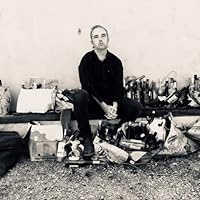
Interrogating the Abyss is the first volume in the collected interviews, essays, and fictions of Chris Kelso. It's an exploration of darkness and a dissection of human relationships and obsession, featuring conversations with writers such as Dennis Cooper and Matthew Stokoe, and culminating in Voidness, ten sessions of psychic intervention by some of literature's most compelling storytellers.
Chris Kelso is an award-winning genre writer, editor, illustrator, and musician from Scotland. His work has been published widely across the UK, US and Canada.
Reading this book is like having a philosophical conversation with a person who is unafraid to expose his fears and steers with abundant curiosity. I loved the creative dark offerings interspersed with interviews and stimulating ideas from many different artists. I have always found the void to be a provocative and intriguing subject, and this book takes the subject seriously with great finesse.
There’s a number of entry points for me wanting to read “Interrogating The Abyss.” The main two are my near constant satisfaction with everything I’ve read from the Apocalypse Party imprint, as well as Kelso’s “The Dregs Trilogy” being a favorite read of mine in 2021. What I wasn’t expecting from “Abyss” was how much it felt like a self-help book. I’m not sure if this was an intention from Kelso, but I couldn’t help but feel helped by this collection. It certainly touches the idea of an abyss through a multitude of forms, so those looking to ponder darkly will be satisfied, but then there’s those like myself, who don’t have a direct connection to writing/publishing as a profession or even as a hobbyist, just those possessing an effect of gravity towards the catastrophically abysmal nature of being alive. I loved it.
Chris Kelso is the author of the Dregs Trilogy as well as the new Burroughs and Scotland biography, not to mention fifteen other novels; quite a resume for such a young man. What’s so unique about Interrogating the Abyss, is that he’s combined his fiction/prose/poetry/luminary interviews and non-fiction pieces as equal works of art in this collection — the black hole centerpiece being a section called “Voidness” in which he interviews ten authors about their views of the murky otherworld; where we either consciously submerge ourselves or find ourselves there, drowning in panic. Luckily, there is no wrong option — just the required thick skin to enter through its thin veil.
Immediately, Kelso turns me onto an overlooked auteur I should be hip to — the great Buddy Giovinazzo. Buddy G is most commonly known as director of Combat Shock, the Troma film that screams beyond the camp. Fallen to the fate of many misunderstood films, it was picked up by Troma for its off-the-cliff audacity but failed upon its release due to misguided marketing. Most movie-goers thought they were going to see a Rambo-esque action flick — what they got was absolute nihilism on steroids and brown acid, like Richard Kern or Nick Zedd directing a war-torn PSA with Goblin doing the soundtrack. His interview in ItA was enough to make me seek out Combat Shock on YouTube and it delivered on every morbid promise. Must be seen to be believed.
I’m not sure how Kelso does it — how a poem like “Blood Eagle” follows an interview so seamlessly. Even when the forms change, he’s laying out a path for us, the anti-theme of this collection acknowledging the fierce individualism of each artist (including himself), while threading together the shared fraternity of transgression, its undertow we are all pulled into, as “drunken dreams become waking nightmares.” Even prose like “Will To Power takes on seductive yet fragmented disembodiments, Kelso the ever-observant street-level gargoyle.
Interrogating the Abyss fills a large gap in our termite-devoured drift-wood counterculture, building new mosaics out of our dystopia’s shards from Kelso’s inherently dark philosophical perspectives. By the end, it inhabited the spirit of a pocket-sized RE/SEARCH journal or a High-Risk Books anthology where the subjects and the author/editor are euphorically blurred.
This book plain and simple is a must read. If you like cosmic horror, transgressive fiction, and a relationship with all dark things this book has to be on your shelf. This book contains the author speaking with writer director Buddy Giovinazzo the creator of cult classic Combat Shock. There’s also plenty of other authors who are interviewed. We are talking masters of transgressive fiction like Dennis Cooper, Matthew Stokoe, Thomas Moore, Audrey Stasz, Steve Finbow, and so many others. Chris Kelso blends fiction and non fiction expertly through this book. Some of the stories left me absolutely chilled and I take in lots of horror material but his work truly has a flavor unique to him. Add this book to your collection you won’t regret it.
Interrogating the Abyss feels like a generous offering to the realm of transgressive literature in the same way for example DC’s blog does, both in concept and for the selection of other contributors the author has assembled here.
Chris Kelso’s willingness to explore the darkness, both collective and individual, and the thoughtful curation of the interview/collaborations alongside his own writings (which were the highlight of the collection for me) combine to create a work which has an atmosphere and purpose all its own.
Even if after reading this book you have no questions to ask of the abyss, no relationship with the void of your own to examine, the very least you will get from Interrogating the Abyss is the feeling of having been gifted a killer literary mixtape by a writer who really gets it.
An excellent collection of essays, interviews and (creative) non-fiction from the prodigious Chris Kelso, mostly focused on transgressive artists and material. Some of the essays are nakedly personal, and the interviews almost always revealing - Kelso has a very open interview style that usually gets the best out of his subjects. A must read for anyone interested in the darker side of literature and life.
I have a much longer review up at 3AM magazine if you're interested:
Kelso's on-the-sleeveness makes him a sympathetic and trustworthy kind of taste-maker—I admire the way he navigates and pursues his curiosities like a hauntingly familiar and yet foreign city, creating a map of the tangents that's enjoyable and rewarding to trace as a reader.
In a way this book is like finding a cool kid who knows about everything out at a gig or at the record shop. He knows more underground and transgressive bands (writers really) and you want to follow him wherever he's gonna go.
I could elongate the analogy, but the point is that this collection of introductions, interviews, poems and stories was a rare treat. The choice of the cuts kept me on my toes and there was plenty to glean from whatever was on the page.
For a book exploring the vagaries of the void, it was a surprisingly touching and moving book at times. The discussion with Matthew Stokoe about trying to make as a writer was forthright, passionate and honest. Kelso's essay on friendship was excellent and a later piece married up with it and showed that as much as you might make the effort it may not be reciprocated.
Talk of nihilism and how to feel about certain moments in writing and art touched me as well as I have struggled to celebrate my own successes in the face of seeming pointlessness to the whole thing, but here it was tinged with that urge to make yourself keep going lest you get swallowed by the hovering abyss.
This was an outstanding and unique read that has added to my TBR and left me looking at the world slightly different and for all its darkness left me feeling a bit lighter than when I came into it.
This is a great collection of writing. Kelso excels by making himself vulnerable to both his readers and the subjects he interviews. I’ll definitely be reading more of his work.
Several years back, I went hiking in the Catskills with my now-wife, my childhood best friend, and his then-girlfriend in search of some unmapped swimming hole cliffjumps we’d heard about. The first one we came to was quite high, and quite narrow – a slim, deep canyon enclosing a complexly tiered waterfall. There was a large rock at the bottom, on the near side, that you would have to clear, and an even larger rock jutting out from the opposite cliff-face that you would essentially have to angle under midair in order to hit the water safely – a formidable bit of real-time spatial reasoning to be sure.
The girls bowed out immediately, and climbed down to explore the rocks below. My friend – a friend whom I’ve always looked up to, always competed against, rarely bested at anything, and if I’m being honest, whose friendship I have, at times, put entirely too much on with regards to my own sense of self-worth – carefully picked his way down the cascades and ensured that the water at their base was in fact deep enough for a high-dive plunge. He too declined to come back up and jump.
That left only me, still standing at the unmarked trail’s highest point, examining all the angles, weighing the odds of success vs. failure (failure, in this instance, almost certainly being death). I asked my friend for reassurance that the water was deep enough. He said that it was. I asked him to throw a stick down to mark the spot I should aim for. He obliged. I looked to my then-serious-girlfriend/now-wife, (by this time stretched out and sunning on the very rock I needed to clear in order to hit the water) to throw a wet blanket over the proceedings and bail me out of my bravado. She smiled behind her sunglasses and said it was my call.
This was the moment I thought about during much of Chris Kelso’s achingly personal and uncommonly sincere Interrogating the Abyss, a collection of stories, poems, essays, and interviews about that ineffable, impassable space that I think it’s fair to say everyone on Earth has, at some time or another, both wanted to, and felt unable to cross over. The abyss is a multitude of things, both huge and infinitesimally small, and Chris Kelso has some questions to ask of it. His investigation kicks off with the abyss in its most common, relatable form – a choice most of us likely make every day: to go out and brave the perilous ego-jeopardies of social interaction, or return home to our ever-cozier media cocoons where we can better control how much we do (or don’t) connect with other people. Post(ish)-Covid, this has become, in many ways, the question of our times. Why do I need to go anywhere? Or even, why should I have to? Why, exactly, can’t the world do without me? What do I have to gain by continuing to take this risk? Is any job/relationship/destination/experience worth getting sick for – worth potentially dying for – when I can increasingly do almost anything I want (or a reasonable facsimile) from the comfort of my own home? Why, Kelso’s brief introduction asks us (and pretty clearly himself ) is even this narrowest abyss one I should bother to cross?
Having quickly established the inclusive, warmly endearing tone he’ll maintain throughout the entire book – a tone that, even as it plumbs the depths of depression and anxiety, never fails to reach out and remind his readers that he doesn’t have all the answers to these questions – that he’s chasing them on his own behalf, as much as ours – Kelso subsequently takes things all the way back to the boldly naïve transgressions of childhood; the reading, listening, and watching of things which had been theretofore forbidden. As a highly churched child who fought tooth-and-nail for every R-rated movie, Parental Advisory-stickered album, and banned book I brought home (and consumed more in secret than I can even count), I connected with Kelso’s essay about his early viewings of Buddy Giovinazzo’s Combat Shock (for me it was probably A Clockwork Orange), and the intense feelings that arose after that first baby-step toward willful rebellion; that first tiny (if huge-seeming) risk rewarded; that newfound sense that there are entire worlds which have been kept from you, and that those worlds are somehow more important – more real – than the one you knew before. In these moments, the abyss is but a single fired synapse; the bite of an apple; the gap between knowing something, and never again being able to unknow it.
From here, Kelso naturally widens his field of inquiry, setting out with his newlost innocence in search of newfound compatriotism. Much of Interrogating the Abyss – the bulk of it, really – is made up of interviews, conducted by Kelso (by his own admission a lonely, gloomy, and at times perceptibly needy fellow) (AKA, a writer) with his creative peers and artistic idols. Here the abyss is surely a tad wider, if no less familiar – the vast, self-doubting spacewalk of the unsolicited invitation – the “Will they answer?” “Will they be nice?” “Will they like my work?” “Will they like me?” of it all – both the void of eternal loneliness, and the scant distance between two lonely people sitting at a bar, wishing the other would talk first. But again, Kelso crosses it with abandon. Running the gamut from the aforementioned Giovinazzo, to contemporaries like Evan Isoline, Paul Curran, and my fellow Athenian Jordan Rothacker (who I definitely need to read), to long-tenured titans of the boundary-pushing bizarre like Iain Sinclair, Ellen Datlow, and Dennis Cooper, these multifarious exchanges have the delightful dual effect of allowing the reader to share in both the nervous excitement Kelso feels as he unabashedly geeks out over meeting his heroes, and the joy he experiences at finding them almost uniformly friendly and generous toward his project.
As interesting and well-crafted as the stories and poems included in Interrogating the Abyss are (and they are excellent – “Contiguity to Annihilation” and “Tidal Bore” being notable standouts), they almost feel like adornments amidst these real-world inquiries – metaphorical totems propping up the questions he and his correspondents tackle head on. The resultant plexus of expansive, likeminded conversation – wheeling freely, as such conversation notoriously does, between the broad, universal experience (the Audrey Szasz section is maybe the most affecting six pages in the entire book), and the uniquely specific (the Chris Zeischegg chapter is a brief window into a libertine world most of us will never know); the current state of the publishing business (we could all use a friend like Matthew Stokoe), and why and how people make art (take your pick) – somehow threads the needle between celebration and commiseration; hope and despair. It is here, in crossing the abyss between souls – between admiring someone from afar and meeting them face-to-face – that Kelso truly shows his work, and finds his best answers to all those thorny “why’s” with which he first began.
Why do we leave our safe houses? To see what else is out there. Why do we seek the verboten? To better know ourselves. Why do we talk to strangers? To see if anyone gives a shit. Why do we cross the abyss? To get to the other side.
I jumped, in case you were wondering, and since you’re reading this, clearly I lived to tell the tale. But the reason I began with that story in the Catskills is because, for me, it touches on all the different versions of what Kelso found as he shouted interrogations down into the abyss and patiently awaited their bounceback replies. The abyss is the distance I felt between myself and my best friend – a person whom I’ve now known for almost 30 years – who knows me better than just about anyone on Earth – and yet, with whom I’ve never stopped wanting to feel closer; with whom I’ve never stopped wanting to share more. The abyss is the last five feet or so of space that I covered at the end of that cliffjump – the point at which my body realized it had passed any sense-mnemonic frame of reference it had of previous falls, and yet was still falling – the point at which I instinctively, autonomically tucked my arms and legs into a cannonball, not to effect a bigger splash, but to best protect my bones from what my brain was now screaming was their certain atomization. And the abyss is the howling, reverberant wasteland of potential nothingness between this objectively dumb decision and the outsize harm it could have inflicted – on my friends, on my then-serious-girlfriend/now-wife, on my family back home, and on any further good I might have done in the world had I not thoughtlessly dashed myself upon the rocks. In short, it is the distance, whatever distance, large or small, that stands between us and risk. The entire ocean, and the single stroke between safety, and no longer being able to see the shore.
Sitting here now, I can say that I’m both glad I took that by-and-large indefensibly dangerous leap, and that I also regularly look back on it with mortifying regret, and a kind of visceral fear. In my most fancifully dour moments, I’ve even wondered if I actually did die that day, and have been wandering the Earth ever since in some deluded, Bruce-Willis-in-The-Sixth-Sense state of oblivious incorporeality. But that’s the thing about the abyss – you don’t really know what it is until you jump. And in as much as any of us can know what’s real, I seem to still be here, crossing smaller abysses – like the one between writing this article and hoping someone will read it – with more ease and frequency every day. And in as much as I’m still here, I can say (with a little perceptibly needy fandom of my own) that I’ve read very few books in my life that rang so authentically, nakedly true as Interrogating the Abyss. Chris Kelso wears his heavy heart on his sleeve in a way that far more successful, or even objectively better writers wouldn’t dare. He braves an openness that lets you feel everything – the very risks he took in putting this material together – right along with him, harnessing his considerable empathy in the name of igniting yours. And thanks to his courage, the abyss between him, his interviewees, and his readers, now feels a little bit smaller; a little bit lighter; a little bit easier for all of us to cross. At least that’s how I felt when I finished it. I hope he does too.