The complete 4-volume original run of the genre-defining Kamen Rider manga, now in English in a special 50th anniversary hardcover omnibus!
Fans the world over have long been enthralled by tales of Kamen Rider, the masked, motorcycle-riding superhero who protects the world from injustice. Kidnapped and experimented upon by the evil terrorist organization known as Shocker, Takeshi Hongo manages to escape their clutches and use his newfound strength to fight against their schemes.
The adventures of Kamen Rider span dozens of television series and films, but in these pages are collected his very first adventures in manga print, drawn and written by original creator and manga superstar Shotaro Ishinomori. This beautiful hardcover edition, over 800 pages long, contains the entirety of Volumes 1-4 of Kamen Rider in an all-new translation.
Shōtarō Ishinomori (石ノ森章太郎) was a Japanese manga artist and cartoonist. Known as the "King of Manga", he is regarded as one of the most influential manga artists of all time.
Turned into a cyborg, Hongo Takeshi battles evil as Kamen Rider!
Manga is hit or miss for me so I've been sticking with the classics. I knew Kamen Rider spawned a whole genre of Japanese television that includes the Power Rangers so I gave this a shot.
I'll get my gripes out of the way first. Shotaro Ishinomori probably didn't use any construction guides when drawing Kamen Rider because his proportions change quite a bit between pages, especially in the early stories. Also, there are a few tonal shifts that are jarring and the art is crude at times.
Enough of that, I enjoyed the shit out of this. It's a lot of fun in a super hero monster fight kind of way. I love Kamen Rider's design and the enemies are suitably monstrous. There's a big surprise about halfway through that I had to stop and tell my wife about. There's a strong environmental message, especially surprising since this is '70s manga.
Kamen Rider - The Classic Manga Collection was good for a few hours of monster-bashing good fun. Four out of five stars.
This holds up amazingly well for sci fi from the usually-campy 1970s. The themes of environmental decline and the abuse of technology are, unfortunately, timeless, and Ishinomori's art is spectacular in the action scenes.
Absolutely loved this. I had no idea who Kamen Rider was and now he’s become one of my favourite heroes. The thing about old school manga is that it’s so simple in it’s writing that the reader fills the gaps. For me, this is a poetic superhero saga filled with great fun! KAMEN KICK!
Ishinimori's classic Kamen Rider manga is from a similar place as his Gorenger manga that was re-released in a similar format a couple of years ago* . Like Gorenger, Kamen Rider was a contemporaneous retelling of one of Ishinomori's on-going hit live-action television shows; compressing a few key episodes together in a quicker read format while altering the basic mechanics [no cyborg pun intended] of the plot. The first chapter is more or less spot-on to the television series: Takeshi Hongo is a brilliant scientist and motorbike racer who is kidnapped by a global organization named Shocker who escapes and uses his new cyborg body to fight crimes. We then get five or six other primary conflicts against Shocker leading up to a...finale. Or, at least it stops telling the story and the pages run out. The non-ending is one of the primary reasons the book does not get five-stars.
From the start to the end, though, there is a lot of charm in this cutesy, hyper-violent tale of a motorbiking grasshopper cyborg versus other animal-shaped mechanoids. Spoilers, I suppose, but two motorbiking grasshopper cyborgs. In the production of the original series, the first Kamen Rider actor injured himself performing stunts and so had to be replaced by a second actor who was written in. While the first actor did return to finish out the series, it was several months later and so the show heavily features Rider v2. The manga follows this general format with the latter half being a secondary character after the first Kamen Rider gets caught up in a grisly gunfight.** Out of the context of knowing the original series (which presumably the original readers would have known), this can give newer readers a feeling of disjointedness.
The handful of stories chosen to highlight the adventures of Kamen Rider are good adventures with a trend towards horror set-ups and shout-outs to Ishinomori's comic heroes [the first adversaries are Man Spider and Man Bat]. There's a classic haunted fishing village, a body-snatcher type plot, and various other references to mind control and loss of bodily autonomy (the manga, like the show, briefly informs the reader that the other cyborgs were also victims like Hongo, but unable to escape before the mind-control is completed). The comical graphics are regularly contrasted with bloody violence while the stories show a more traditional comic book style narrative over the live-action series' "monster of the week" style formats. It would have been fascinating to have seen this expanded to a much longer run since it allows certain elements to be developed and the general style of the piece to take a stronger character.
And had it gone on longer, maybe there would have been an actual ending.
This volume includes a handful of colorized pages at the front as a slight bonus and then a handful of short "kindergarten" stories at the back [they tend to be super short retellings of Kamen Rider plots, including some otherwise in the volume, I do not know the precise context of them. This book could have used at least a couple of quick introductory pages to discuss its contents]. Interestingly, the "kindergarten" shorts tend to have a less cutesy drawing style. I'm sure there's a historical reason for this, but I do not know it off the top of my head.
====================
* or was it last year? Man, the pandemic has made time a bit harder to judge. ** never bring a rider kick to a gunfight, I suppose.
Me encantó. Conocía a Kamen Rider solo por referencias pero nunca había tenido la oportunidad de conocer al personaje original. El arte de Ishinomori evoca mucho al de su maestro Ozamu Tezuka, pero es más fluido e impactante. La historia de Kamen Raider es muy básica pero esta muy bien contada y tiene dos que tres giros argumentales que no te esperas y que sirven para enriquecer aún más la historia. Esta edición del 50 aniversario presenta en su totalidad la serie original del personaje (4 volúmenes en uno) en una historia que mezcla elementos de ciencia ficción, aventura, thriller y espionaje para crear un relato entretenido y lleno de acción. Hongo Takeshi, un joven millonario (muy al estilo Bruce Wayne) es secuestrado por una organización secreta e invisible conocida como Shocker, quien lo interviene y lo convierte en un ciborg con grandes poderes para usarlos para sus propios y malévolos fines. Sin embargo, Hongo se revela y acaba convertido en Kamen Rider (el jinete enmascarado), quien se enfrentará a las criaturas ciborg de Shocker para impedir que la organización se haga con el control de Japón. La historieta de Ishinomori no se toma concesiones y puede resultar muy violenta. No es tanto para niños, sino más bien para adolescentes e incluso así, las nuevas sensibilidades pueden verla como algo pasada. Armado con una motocicleta especial y un casco que lo hace ver como un grillo humanoide, Kamen Rider no descansará hasta acabar con Shocker y sus planes de dominación.
For years, we have been captivated by the adventures of this fearless hero, a masked hero known only as Kamen Rider. Riding on his motorcycle, defeating evil cyborgs that were part of a villainous organization called SHOCKER, the rest would be history. The adventures of Kamen Rider would lead to a vast universe of other riders having their adventures on television screens, in films, video games, and in Manga. Speaking of manga, a couple of years ago Seven Seas Entertainment got the license for Shotaro Ishinomori’s Kamen Rider (Classic Manga) for a North American release and the publisher released all four volumes in one collectible hardcover omnibus. The story focuses on a brilliant student named Takeshi Hongo, one day Hongo was kidnapped and experimented on by an evil organization called SHOCKER. Hongo Takeshi manages to escape their clutches and use his newfound strength to fight against their schemes.
One important thing to remember about this manga is that the Manga came out before the television series. The original manga followed a similar path of the first five episodes of the television series but eventually diverged later on. It set up the groundwork of what Hongo stood for and what story Ishimomori wanted to tell, in this case, it looked to be campy, but had its moments when it could be extremely violent at times (for that era of time.) Some came across as a compressed retelling of a Kamen Rider TV Episode, but it also offered more of a vibrant approach to the masked hero’s fight against evil, in terms of action and drama.
Keep in mind that one of the biggest differences between the manga and the TV series was how Hayato Ichimonji took over the mantle of Kamen Rider. In this variation, Hongo was severely injured after the battle with the twelve SHOCKER Riders. Ichimonji was one of the twelve riders at that time, who received a head injury during the fight and regained his conscience as a result. He then turns against Shocker with Hongo’s help and guidance, they take the fight to SHOCKER. In the television series, the actor portraying Hongo shattered his leg in a motorcycle stunt gone wrong. The injury forced him to take a long-term hiatus from acting, and Takeshi Sasaki was brought on to replace Fujioka as Hayato Ichimonji until he could make his eventual return. Other than that, Shotaro Ishinomori’s main story and the surprise Kindergarten stories that were also included in this collected omnibus gave readers a sense of how much the hero meant to not only Ishinomori but also the kids who both read the manga and watched the Television Series, the stories weren’t complicated and easy for new fans to understand. Ishinomori’s stories also had themes, each was ahead of its time, for example, it tackled environmental issues and the abuse of technology. These two issues were some of the things that were on the minds of the younger generation during the 70s and Shotaro channeled this in his work, including in Kamen Rider.
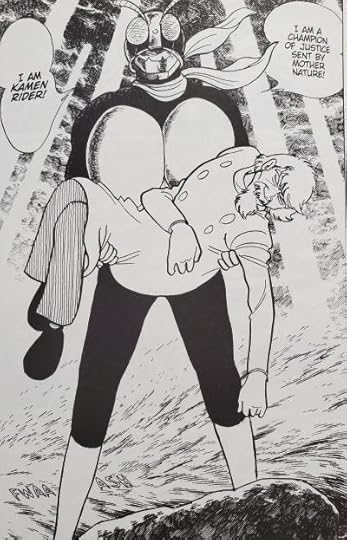
Finally, the artwork featured in this omnibus was one of the best things about it, speaking as a first-time reader of Shotaro Ishinomori’s work. The beginning offered a beautiful color spread illustration, and a mix of realism mixed with a charm of cartoon hijinx in certain situations. I enjoyed that each cyborg he designed was unique and didn’t tone down their personalities, evil tone, or horror they brought in their presence, my favorite cyborg designs from these stories were Cobra Man and his girlfriend Snake Woman Medusa. Medusa’s design blends both Greek Mythology with a touch of science fiction. Given that this was targeted at a younger audience, the action sequences were drawn wonderfully, dedicating an entire double-page panel to a single moment. It was presented in an action-heavy, imaginatively energetic story with some great splash pages and linework.
I'm going to consider this as being a recent re-read since my girlfriend read it before watching Shin Kamen Rider with me and I got to go through a lot of major beats with her through discussion. Kamen Rider is one of my favourite things in the world, I could literally watch it all day every day and never get sick of it. It's a tragic monster opera in the skin of a henshin hero, the perfect cross section of gothic horror and tokusatsu. Ishinomori really captures the pains of both Hongo and Ichimonji's journey in a way that its televised counterpart just couldn't, while also making sure to delve into the more sympathetic elements of its antagonists in ways that are pretty ahead of their time(the chapter with Cobra and Snake alone illustrates a level of nuance we wouldn't get in any televised/filmic toku till the Heisei era). I could sing its praises and gush over its art and its themes of technological abuse and environmental decline hit harder now more than ever, but at the end of the day it's marred by its lack of an actual ending. Things happen, but it eventually just sort of stops. It's fun enough but thematically unsatisfying in a way that does hurt it for me. But that's alright. The story would be told again and again, transforming, recontextualizing and Rider kicking its way through the times that change but stay the same.
Before I begin there are a few of things I want to say 1st. I want to wish Booktopia a happy 18th birthday. That's where I purchased a Kamen rider manga from. This review is dedicated to my best friends and family on Instagram including @aussiegamerchick @nerdorkeeg @1upemily @toohappygamers @fozzdikes.world @roguesultana @_atrinity and @xeneriith for supporting me on my passionate love for all things tokusatsu including Kamen Rider Ultraman and Super Sentai and to all you guys and girls for supporting me on social media including Insta. Love you all
Kamen Rider isn't just 1 of the best shows on Japanese TV but it's my all time favourite superhero franchise. Sorry Spider-Man. However I'm still looking to watch online with English Subs
This is actually the 3rd time I got a book from my multimedia hero - the legendary Shotaro Ishinomori. While the translation seems great it's actually the manga character designs and the action I like the most however it's a lot different that the 1971 original 98 episode entry. But it's great to check out 4 volumes from 1972 since the Himitsu Sentai Gorenger manga and of course A Link To The Past graphic novel. Loved it
I just hope Cyborg 009 manga gets an English translation and more Kamen Riders entries are available to watch with English subtitles
Obviously by modern standards, this is not necessarily what one might consider great storytelling or dialogue, but that’s not what you come to this stuff for. Having never really been exposed to Kamen Rider before, the pure nostalgic camp of this volume brought on a very welcome and warm feeling. It has a goofy style and humour to it that reminds one of classic Japanese icons like Astro Boy and Lupin the Third, being presented in an action-heavy imaginatively energetic story with some great splash pages and linework. The unreality of everything leads to having creative liberty for some truly horrifying images and pretty visceral action at times. Within these stories we also see the overt and sometimes moralistic politics of the stories from that time, which we would also see in the likes of the original Godzilla films. It is a perfect little time capsule that brings a feeling with it that just makes it feel like a Saturday morning. Almost like the stream-of-consciousness of a child’s imagination, as a wonderful cast of characters are brought to life.
This was a terrific manga. I bought this on a whim, a very thick hardcover omnibus with 850 pages for a very good price. Since jumping into everything Godzilla i really start to dig oldskool sciencefiction and action stuff from Japan, Ultraman and such, i already thoroughly enjoyed stuff like early Star Trek but this is a totally new world. Kamen Rider was originally published in 1971 so its over 50 years old, yet it still looks beautifull. The story is fantastically absurd, Hongo Takeshi is kidnapped and experimented on by a organisation named Schocker, he escapes and so starts a adventure with outgoing b type villains like Man Bat, Cobra man and mostly some kind of animal batguy. The designs are wonderfull and weird, and the sets with oldskool computers and lairs are fantastic. It gots twists and turns and read very easily, this was simply put, a blast.
I didn't know what to expect when picking up a manga adaptation of a live action superhero drama, particularly one made in the 70s. What I got, though, managed to feel exactly like an old Kamen Rider show, surprisingly enough. The dialogue was snappy and very 70s Japanese show, the action scenes were laid out cinematically, and everything just had this fluid feel that I really enjoyed. I haven't watched the original Kamen Rider series, but this made me want to run out and find a copy.
The artwork by Shotaro Ishinomori was also incredible. Lots of full page/full spread action shots with clean lines and a really great look. I've already picked up his other manga adaptation to read next.
This was great fun, highly recommend to any tokusatsu fan.
Goofy character proportions, silly yet seriously dangerous kaijin, and a strong thematic spine exploring power and social control - there is a surprising amount of the core Kamen Rider plot that is still recurring in its newest iterations decades later: our hero being framed for murder, stuck sharing his body with a presence alien, the villains being business interests hijacking government interests, it's all present here, not buried under thematic variation but instead plainly stated, being the first. The strong scripting also focuses on what is shown, panels of fistfights and motorcycle dances paced and arranged in sequences far more compelling than Spiderman's acrobatics at a comparable time. It makes this collection an excellent introduction to the character, rather than just a novelty for those already a fan.
Reading this was like taking a look back into history. Obviously comparing this to the newest stuff coming out now there are huge differences but this continues to hold its own. What I like the most is what comes through the story about what the author thought about the environment, nuclear power, politics, and even the biker culture made its way into it too. Of course if someone reads this and has no background in Modern Japanese post WWII history then it might not make much sense but brush up on a small amount of it and then it becomes a lot more interesting.
It was a very fulfulling experience finally reading the orignal manga which started the entire Kamen Rider Franchise. There was a lot of great pieces of artwork in the book, some showing great action and some moments which show how working for Osamu Tezuka rubbed off on Ishinomori. The only drawback was how this particular version was released. It is dense and the size of a dictionary. It made it intimidating to start. Otherwise an incredible reading experience overall.
I’ve never really watched Kamen Rider, the bits I did see didn’t grab me, but it’s also impossible to watch in my region. So I saw this for sale and bought it (I’m a big Godzilla fan and they’re both massive Tokusatsu franchises). Yeah this wasn’t for me. I didn’t enjoy it. I can see why a Kamen Rider fan would love this, I can see how a Super Sentai fan would love this. But wow this was rough. I’m aware it’s manga from the 70s but I don’t think it didn’t aged well.
This is a gorgeous book, and a steal even at cover price. The splash pages and double-splash pages in it are sometimes jaw-dropping. The plots sometimes don't make much sense, but that's partly from the Japanese to English translation, which probably isn't perfect. It's otherwise a neat read, and surprisingly bleak in some chapters.
Bought this after seeing Shin Kamen Rider. God this book gripped me hard. It was really fun seeing all the original inspirations for a lot of things in the show and later film.
It was this manga that took my obsession to the next level: I watched the original show online and I’ve been a die hard rider fan ever since. Henshin!
Classically Cringe. I loved it!!! Sometimes getting a dose of another era of manga is what you need as a palette cleanser. I’m still not sure this is an age 10+. I have read many things 13+ and 16+ that are far more suitable for 10 year olds lol!!!!
I can’t wait to read more of this honestly. What a fun time!
What a great manga/comic! nearly 800 pages which I found totally enthralling and I did not want it to end! Shōtarō Ishinomori's influence on Japanese popular culture really can't be understated and this original kamen rider manga from 1971 really does show that! The art and writing in this hold up surprisingly well!
Love that the first two villains are Spider-Man and Bat-Man. The art in the first half can get a little repetitive, but I love the inventiveness of the villains and how different this Japanese take on superheroes is then the American.
Apenas llevo un mes de conocer Kamen rider, realmente es una franquicia que estoy amando y más me encanta mientras más me adentro y se me hace tan curioso cuántos detalles que hacen que me encante estén acá desde me mera concepción de la idea, me sigue fascinando cada vez más
I love it! as a Fan of Kamen Rider, seeing the manga that started it all is incredible. I only wish I could have the opportunity to get my copy autographed by Hiroshi Fujioka. That would be my biggest dream
Even though I'm only recently getting into the Kamen Rider series in the past couple of years I am more than happy to read this. I enjoy seeing the origins of such an epic hero. I highly recommend.