Leslie Poles Hartley (1895-1972) was born in Whittlesey, Cambridgeshire, and educated at Harrow and Balliol College, Oxford. For more than thirty years from 1923 he was an indefatigable fiction reviewer for periodicals including the Spectator and Saturday Review. His first book, Night Fears (1924) was a collection of short stories; but it was not until the publication of Eustace and Hilda (1947), which won the James Tait Black prize, that Hartley gained widespread recognition as an author. His other novels include The Go-Between (1953), which was adapted into an internationally-successful film starring Julie Christie and Alan Bates, and The Hireling (1957), the film version of which won the Palme d'Or at the Cannes Film Festival.
Story 10/72 from Black Water 1 (The Anthology of Fantastic Literature) read together with The Short Story Club
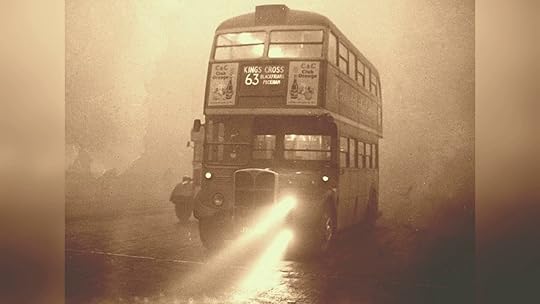
Another new English author and a story I enjoyed. The writing was quite exquisite and the plot was creepy enough for me. A man who found his fortune in Australia, returns to his favorite hotel in London. While relaxing in a lounge, he hears some strange children games through the wall. The chanting of the children becomes increasingly odd and foreboding. Also, there is an atmospheric description of a bus ride in the beginning, preceded by a proper English weather description. The title is very smart, it all becomes clear after you read the story.
The story opens thus: “After a promising start, the March day had ended in a wet evening. It was hard to tell whether rain or fog predominated. The loquacious bus conductor said, ‘A foggy evening,’ to those who rode inside, and ‘A wet evening,’ to those as were obliged to ride outside.” Elmore Leonard would disapprove (and be wrong, imo). The first of his (in)famous Ten Rules for Writing is: “Never open a book with weather.”
Maybe it’s because we Brits are obsessed with the weather, but I think it’s an atmospheric start. It continues: “But in or on the buses, cheerfulness held the field, for their patrons, inured to discomfort, made light of climatic inclemency. All the same, the weather was worth remarking on: the most scrupulous conversationalist could refer to it without feeling self convicted of banality.”
The eponymous “visitor from down under” is - apparently - Mr Rumbold. He travels by taxi to a familiar, and rather old-fashioned, London hotel, after several years getting rich in Australia. “The hotel… maintained an old-time habit of deference towards darkness.”
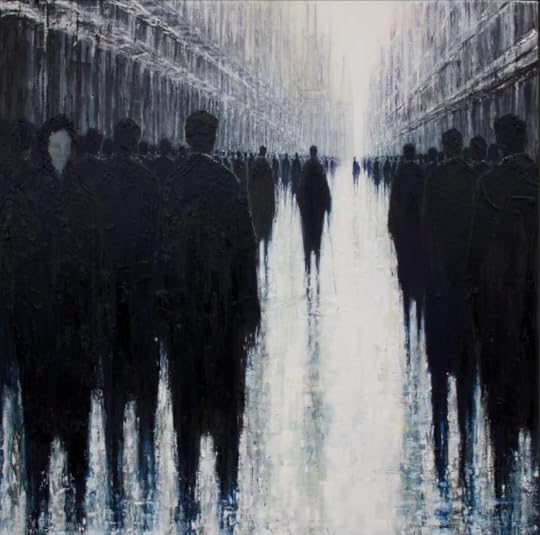
Image: “Disconnected” by Lesley Oldaker, 2020 (Source)
Drinking alone in the lounge, late at night, he's haunted by long-buried memories, especially of his childhood. Rumbold seems unaware of the trigger, but is duly troubled. As a plot device, it probably worked better around the time of publication.
You can read this story here, starting at page 63. After a promising start, I was rather underwhelmed by what followed. The writing is fine at the sentence level, but I wasn’t engaged by the characters, plot, or the twist. The group discussion made me appreciate it more.
"A Visit from Down Under" is a supernatural story set in London. Mr Rumbold has just returned from Australia as a much richer man, and is spending the night relaxing at his favorite hotel. The story has an unusual element when Mr Rumbold hears a children's radio show coming faintly through the walls. They are chanting various childhood singing games with morbid lyrics. This includes "Here We Come Gathering Nuts in May" which grows increasingly ominous:
"And who will you send to fetch him away, Fetch him away, fetch him away; Who will you send to fetch him away On a cold and frosty morning?"
My reviews keep drifting into the ether, much like a reverse image of this story—where ghostly justice arrives on a rainy evening in London. I readily enjoyed the atmosphere. I will pursue more by Hartley.
Not so sure about this . Although I liked the setting - foggy cold London a century ago - and the ghostly visitor i felt parts of the story were contrived..why would a ghost bother catching a bus , why did the waiter start a discussion about murderers and revenge ? I'm probably missing something . Liked the nursery rhymes though ...took me right back .
Update.
Thanks to fellow members of The Short Story Book Club , whose comments inspired a second reading , I can now see more of the craft in this moral tale . Rumbold , the guilty protagonist , is repeatedly reminded of the likely consequences of his crime by innocuous comments by his cab driver , coincidental radio broadcasts of children's games and small talk from a waiter . His mounting anxiety isn't quelled by alcohol , a nightmare ensues and he is cornered by the ghost of his victim . A very satisfying building of suspense and the motif of " down under " is used to good effect not just in the characters but the bus at the start and the hotel at the end.
Ghost stories have a certain mundane quality, once one has read too many of them.
There is a character on the bus, and then the narrative jumps back about 5 hours and follows a Mr. Rumbold. There are expository conversations, very "on-the-nose" which telegraph the plot.
Giving this one 3 stars, because I do want to read more from this writer.
Mr. Rumbold returns from Australia a millionaire and takes a room at Rossall's Hotel in Carrick Street, Soho, a modest establishment for a man of his means but he's popular with the staff and it's the nearest thing he has to a home. Also arriving from down under at the same time, a surly uncommunicative passenger on the top deck of a bus also headed to Carrick Street, the conductor has him down as a cripple and clearly very ill, but that's no excuse for his churlish behavior. Relaxing in the Hotel's lounge Rumbold can hear what sounds like a radio broadcast of a children's party in progress on the other side of the wall. They don't sound particularly happy but their rendition of the children's rhyme of Oranges And Lemons brings a tear to his eye, reminiscent as it is of his own youth, although he's never liked the "here comes a candle to light you to bed/ and here comes a chopper to chop off your head" line less than he does tonight and, either he's mishearing things, or those are nothing like the right words to Nuts In May? another rhyme from youth. When a stranger telephones the hotel requesting a room on this foul night which is full, Rumbold, the worse for drink, informs the waiter the man can share his double room. When the ghastly friend from the bus arrives at the hotel, Rumbold finds he is being sought by something he thought he’d left behind and forgotten.
this is why I decline cold calls from strangers wonderful writing; the writing had more substance than the subject, which now that I think about it, makes perfect sense . . . a sojourner rejoins to familiar haunts only to be subject to cold harsh reality . . .