

What do you think?

Three: A Tale of Brave Women and the Eyam Plague
In 1665 a box from London brought more than cloth from plague-ridden London to the quiet village of Eyam in Derbyshire. For the next year the villagers had to learn to live with a silent enemy. 'Three' tells the story of three very different women in their courageous attempts to keep themselves and their loved ones alive as Eyam closed its doors to the outside world, instead facing the malevolent danger alone. Emmott Syddall, Catherine Mompesson and Elizabeth Hancock were each determined to live and the courage each of them found was as unique as the women themselves. Will 1666 bring salvation?This work of historical fiction, written during a pandemic whilst reflecting on another, fuses creative imagining with historical fact to bring three female protagonists to life...
246 pages, Kindle Edition
Published May 2, 2021
About the author
Jennifer Jenkins
1 book19 followersJennifer Jenkins lives in a village just outside of Rugby, Warwickshire, with her husband David (illustrator of the book’s cover), her two sons & her dog. Jennifer loves all things literary (including writing her own poetry), in particular historical fiction and Shakespeare, and supports local schools with Religious Education & spiritual development. Jennifer’s first novel, ‘Three’, is the tale of three brave women who lived through the plague visitation of the village of Eyam in Derbyshire in 1665-1666. Jennifer originally taught the Eyam plague to her class of seven year olds, sparking an interest in the Derbyshire village that has led to her first novel.
For an insight into Jennifer’s writing process for ‘Three: The Tale of Brave Women and the Eyam Plague’ visit https://jenjenkinsthree.wordpress.com/
For an insight into Jennifer’s writing process for ‘Three: The Tale of Brave Women and the Eyam Plague’ visit https://jenjenkinsthree.wordpress.com/
Ratings & Reviews
Friends & Following
Create a free account to discover what your friends think of this book!
Community Reviews
Displaying 1 - 30 of 42 reviews

October 19, 2021
In a Nutshell: If you want to know what happened in Eyam during the plague and how the citizens rallied together in those hard times, this is a great option. However, if you expect a well-structured and well-written book, you might end up disappointed. (‘might’ is the key word here.)
Keeping a safe distance from others, staying at home as far as possible, dealing with deaths of family members while still surviving for the sake of those alive, understanding the importance of hygiene, the hope that the new year would bring a fresh start, the disappointment at some people profiteering from others’ struggles, simply living in hope day by day, growing closer to God, going farther from God,… all are aspects that are familiar to us since the last eighteen odd months. But we have been lucky in two ways:
1. Science is advanced enough to tell us the behaviour of viruses, and
2. Technology is advanced enough to help us keep in tough not just with near and dear ones but also to stay abreast of the latest news.
Imagine going through a similar pandemic in the 17th century. This book shows you how life would have been under a viral scourge in that era.
Story Synopsis:
I wasn’t aware of the history of Eyam, though I have read about the ghastly plague that killed so many in England. This story turned out to be really hard on my feelings. To constantly see people dying left, right and centre put me on the verge of an emotional breakdown. I was initially upset with the author at killing off so many characters pitilessly, but during my post-reading research on the actual events, I found out that the three principal women (and the rest of the characters, every single one of them) were actual residents of Eyam, and the author had been faithful in her research and factual in her death toll. That depressed me even more. That all those horrendous events had actually happened was devastating to learn.
The three main female characters are intriguing. Each of them has a distinct personality and a distinct lesson to teach us. Their fears, their strength, their grief, their uncertainties…all were portrayed beautifully. I don’t know if I can call them “inspirational”; to me, they were just ordinary women caught in extraordinary circumstances, and they faced their situations the best way they could. My favourite of them was Elizabeth Hancock. Oh God! I wish I could tell you her story, but I won’t as I don’t want to give out spoilers. (Of course, her story is available online too, if you are really curious.) But the way she handled whatever she had to handle, I haven’t sobbed so much during any scene in any book, ever! (And I’m not even a habitual crier while reading!) She is one of the bravest women I’ve read about.
I was amazed by the parallels in the human situation under the viral scourge between the 17th century plague and the 21st century covid-19 pandemic. So many of the circumstances seem to overlap and there were times when I forgot the era and wondered why they weren’t wearing a mask before stepping out. The main difference lay in the invocations to God for help. The 1660s was an era where science was still learning how to handle viruses and religion dominated human thinking. And that shows in the way the villagers used biblical verses and their faith to pray for a better and safer future, and the trust they had in their rectors’ decision of “cordon sanitaire”, the self-quarantined lockdown of the village. In fact, this would work great as a Christian fiction. (There is a sex scene between a married couple but it is pretty mild, and not at all explicit. It is written more to depict the emotional upheaval of the characters than physical passions.)
As I said at the start, if you just want to know more about the plague through a fictionalised version of the facts, this would be a wonderful book. However, in terms of its writing, the book left me quite dissatisfied. This is a debut indie work, and it shows in the writing style. There is a fair bit of repeated content and a constant cross-referencing to the previous deaths, all of which make the content tedious. (The almost 450 pages of death and grief doesn’t help matters.) Add to this the fact that we see the same events from three perspectives, and this too adds to the repetition. The editing really needed to be a lot tighter, and proof-reading stricter.
Furthermore, the number of deaths becomes too much to take in after a point. (Sorry, I know this sounds like a really silly thing to say because these people actually died and it is a book about the plague after all. But there were so many names being mentioned again and again in the death toll that it became saturating after some chapters.)
Finally, (and this point isn’t the author’s fault), there are many repeated names in the book, the most frequent of which was Elizabeth. Emmott's mother is Elizabeth. One of Emmott's sisters is also Elizabeth. Catherine's daughter is Elizabeth. Not to forget Elizabeth Hancock, the third narrative voice of the book. And a couple more Elizabeths in the village. There are also multiple versions of John, William, Catherine, Richard and so on. I'm not sure if people in the 17th century had only a limited stock of Biblical/royal names that they keep reusing, but as a 21st century reader, it sure was confusing to follow. I was very grateful to be reading this on Kindle as the search button proved invaluable in keeping track of who was who. Of course, these are all actual names of the villagers from that time so the author shouldn’t be censured for this overlap in names.
All in all, the research in the book was immaculate and praiseworthy. But the graphic and repeated depictions of death become very intense to take in. (especially as there are many young children who were victims too.) I might have felt differently if we were still in the good old days (circa 2019), but reading this book during a global pandemic results in very personal and severe emotions. I love the book for the information and insight it provided to me, but I really wish the writing were crisper.
3.5 stars from me, rounding up to 4 for the mind-blowing research and the genuine efforts to bring this story to us as authentically as possible.
My thanks to Cameron Publicity & Marketing Ltd and NetGalley for the ARC of the book in exchange for an honest review.
***********************
Join me on the Facebook group, Readers Forever! , for more reviews, book-related discussions and fun.
Keeping a safe distance from others, staying at home as far as possible, dealing with deaths of family members while still surviving for the sake of those alive, understanding the importance of hygiene, the hope that the new year would bring a fresh start, the disappointment at some people profiteering from others’ struggles, simply living in hope day by day, growing closer to God, going farther from God,… all are aspects that are familiar to us since the last eighteen odd months. But we have been lucky in two ways:
1. Science is advanced enough to tell us the behaviour of viruses, and
2. Technology is advanced enough to help us keep in tough not just with near and dear ones but also to stay abreast of the latest news.
Imagine going through a similar pandemic in the 17th century. This book shows you how life would have been under a viral scourge in that era.
Story Synopsis:
Eyam (pronounced 'eem') is a small rural village in the county of Derbyshire. In 1665, a tailor’s assistant from this village received a bundle of cloth from London. Unfortunately, London was already heavily plague-afflicted at that time, and this material, unknown to anyone, was contaminated with infected fleas. When the assistant hung out the damp cloth to dry, he got afflicted with the disease and became the first Eyam resident to die. This was just the beginning of the ordeal in Eyam of what we now know as the Bubonic Plague, or the Black Death. Over the next fourteen months, at least 260 villagers died from the deadly disease. Many families were completely wiped out, while many others had just a single survivor. Of those who contracted the disease, all except two died. In the face of this human devastation, the two rectors of the village took a brave decision: they closed off the borders of the village so that no one could enter or exit it, thereby stopping the “plague seeds” from spreading to neighbouring villages and saving them from peril.
Three women who lived in the village during this scary period were twenty three year old Emmott Syddall (engaged, soon to be married; dutiful, loyal and loving), twenty seven year old Catherine Mompesson (wife of the village rector; delicate in health but strong in her faith), and Elizabeth Hancock (staying on the outskirts of the village with her husband and six children; considers her distance from the village a blessing; practical and hardworking.) We see the impact of the plague mainly from the third-person perspectives of these three women.
I wasn’t aware of the history of Eyam, though I have read about the ghastly plague that killed so many in England. This story turned out to be really hard on my feelings. To constantly see people dying left, right and centre put me on the verge of an emotional breakdown. I was initially upset with the author at killing off so many characters pitilessly, but during my post-reading research on the actual events, I found out that the three principal women (and the rest of the characters, every single one of them) were actual residents of Eyam, and the author had been faithful in her research and factual in her death toll. That depressed me even more. That all those horrendous events had actually happened was devastating to learn.
The three main female characters are intriguing. Each of them has a distinct personality and a distinct lesson to teach us. Their fears, their strength, their grief, their uncertainties…all were portrayed beautifully. I don’t know if I can call them “inspirational”; to me, they were just ordinary women caught in extraordinary circumstances, and they faced their situations the best way they could. My favourite of them was Elizabeth Hancock. Oh God! I wish I could tell you her story, but I won’t as I don’t want to give out spoilers. (Of course, her story is available online too, if you are really curious.) But the way she handled whatever she had to handle, I haven’t sobbed so much during any scene in any book, ever! (And I’m not even a habitual crier while reading!) She is one of the bravest women I’ve read about.
I was amazed by the parallels in the human situation under the viral scourge between the 17th century plague and the 21st century covid-19 pandemic. So many of the circumstances seem to overlap and there were times when I forgot the era and wondered why they weren’t wearing a mask before stepping out. The main difference lay in the invocations to God for help. The 1660s was an era where science was still learning how to handle viruses and religion dominated human thinking. And that shows in the way the villagers used biblical verses and their faith to pray for a better and safer future, and the trust they had in their rectors’ decision of “cordon sanitaire”, the self-quarantined lockdown of the village. In fact, this would work great as a Christian fiction. (There is a sex scene between a married couple but it is pretty mild, and not at all explicit. It is written more to depict the emotional upheaval of the characters than physical passions.)
As I said at the start, if you just want to know more about the plague through a fictionalised version of the facts, this would be a wonderful book. However, in terms of its writing, the book left me quite dissatisfied. This is a debut indie work, and it shows in the writing style. There is a fair bit of repeated content and a constant cross-referencing to the previous deaths, all of which make the content tedious. (The almost 450 pages of death and grief doesn’t help matters.) Add to this the fact that we see the same events from three perspectives, and this too adds to the repetition. The editing really needed to be a lot tighter, and proof-reading stricter.
Furthermore, the number of deaths becomes too much to take in after a point. (Sorry, I know this sounds like a really silly thing to say because these people actually died and it is a book about the plague after all. But there were so many names being mentioned again and again in the death toll that it became saturating after some chapters.)
Finally, (and this point isn’t the author’s fault), there are many repeated names in the book, the most frequent of which was Elizabeth. Emmott's mother is Elizabeth. One of Emmott's sisters is also Elizabeth. Catherine's daughter is Elizabeth. Not to forget Elizabeth Hancock, the third narrative voice of the book. And a couple more Elizabeths in the village. There are also multiple versions of John, William, Catherine, Richard and so on. I'm not sure if people in the 17th century had only a limited stock of Biblical/royal names that they keep reusing, but as a 21st century reader, it sure was confusing to follow. I was very grateful to be reading this on Kindle as the search button proved invaluable in keeping track of who was who. Of course, these are all actual names of the villagers from that time so the author shouldn’t be censured for this overlap in names.
All in all, the research in the book was immaculate and praiseworthy. But the graphic and repeated depictions of death become very intense to take in. (especially as there are many young children who were victims too.) I might have felt differently if we were still in the good old days (circa 2019), but reading this book during a global pandemic results in very personal and severe emotions. I love the book for the information and insight it provided to me, but I really wish the writing were crisper.
3.5 stars from me, rounding up to 4 for the mind-blowing research and the genuine efforts to bring this story to us as authentically as possible.
My thanks to Cameron Publicity & Marketing Ltd and NetGalley for the ARC of the book in exchange for an honest review.
***********************
Join me on the Facebook group, Readers Forever! , for more reviews, book-related discussions and fun.
August 5, 2022
I thought this might be a fairy tale from the picture on the cover because I didn't know what "Eyam" was. Eyam turns out to be a town in England that during the bubonic plague outbreak of 1665-6 quarantined themselves in a "cordon sanitaire", in a famous act of self-sacrifice, to prevent the spread of the plague. Outside vendors would bring their wares to a well outside the town and residents would leave payment (coins) in vinegar to disinfect them. 260 died during that time, including entire families.
They take some precautions, such as when the minister holds services outside. When he tells the town the decision to quarantine--
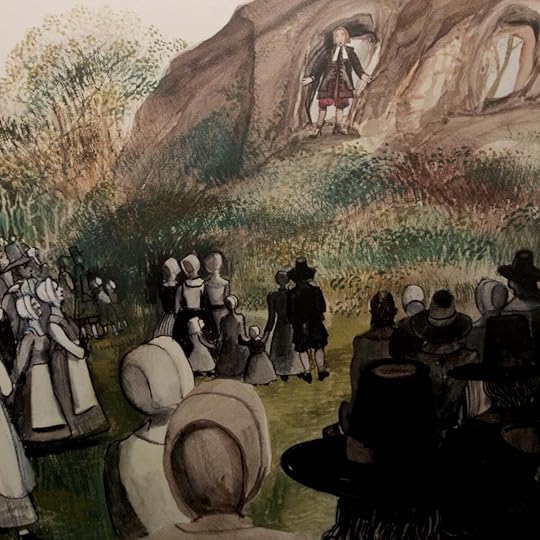
So no, not a fairy tale by any means. This was an accurate historical retelling of the time. Years ago I read Year of Wonders and in my review of that I wrote, "This novel really didn't get into the nitty-gritty of the Plague, but more of how people acted around it. I think Brooks could have added another 100 pages of more details and storyline." Well, this book does that. It's almost too dry because it mentions death after death after death and needed some relief. I could see where a couple subplots might go
Supposedly the virus came from London in a package of cloth and the first victim was the tailor's helper.
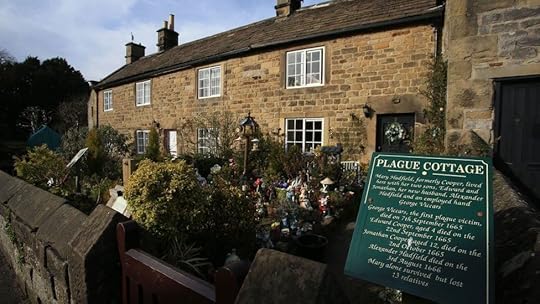
As others have mentioned, there are so many Elizabeths, Williams, Catherines, etc. so I didn't really keep up with who's who. There was a family named Rowbothams and Rowlands, and the finance of a main character was also Rowland. I'm sure it's accurate but also confusing. As for the title, I'd add the word "strong". I know I could never
Thanks to Netgallery for a free advance reader's copy.
They take some precautions, such as when the minister holds services outside. When he tells the town the decision to quarantine--
So no, not a fairy tale by any means. This was an accurate historical retelling of the time. Years ago I read Year of Wonders and in my review of that I wrote, "This novel really didn't get into the nitty-gritty of the Plague, but more of how people acted around it. I think Brooks could have added another 100 pages of more details and storyline." Well, this book does that. It's almost too dry because it mentions death after death after death and needed some relief. I could see where a couple subplots might go
Supposedly the virus came from London in a package of cloth and the first victim was the tailor's helper.
As others have mentioned, there are so many Elizabeths, Williams, Catherines, etc. so I didn't really keep up with who's who. There was a family named Rowbothams and Rowlands, and the finance of a main character was also Rowland. I'm sure it's accurate but also confusing. As for the title, I'd add the word "strong". I know I could never
Thanks to Netgallery for a free advance reader's copy.

March 6, 2026
Oh man, this was so disappointing, I'm gutted.
I'm always fascinated and humbled by the tragic story of Eyam and their self-imposed quarantine in the face of the 1600's plague.
This story could have been so so good. To be fair to Jenkins, the three female protagonists (based on real women) are well thought out with solid back stories, good morals and incredible fortitude in the face of terrible adversity.
The problems lay with :-
a) the amount of characters included - there are literally dozens of families mentioned and as members of said families start to die of the plague, it's impossible to remember who is who as everyone seems to have a name from a generic bank of Elizabeth and John!! I literally gave up caring who was dead because it got so confusing!!
b) the incessant doom - whilst I get this is a story of the plague spread and is not liable to be a barrel of laughs, there is literally nothing light in this book at all. There is no balance to all the death. Aww look a baby is born, next day BOOM, dead! Aww a kid is playing with a doll, doll is source of infection, BOOM, dead! Over the course of the book, it probably evens out to a death every other page! It is so heavy going it actually becomes a chore to read.
The book is overly lengthy which, coupled with the constant death fest, makes for some quite unpleasant reading. The bravery of the three women is sadly lost amidst all the dispatching of seemingly every single character.
2 very disappointed stars.
I'm always fascinated and humbled by the tragic story of Eyam and their self-imposed quarantine in the face of the 1600's plague.
This story could have been so so good. To be fair to Jenkins, the three female protagonists (based on real women) are well thought out with solid back stories, good morals and incredible fortitude in the face of terrible adversity.
The problems lay with :-
a) the amount of characters included - there are literally dozens of families mentioned and as members of said families start to die of the plague, it's impossible to remember who is who as everyone seems to have a name from a generic bank of Elizabeth and John!! I literally gave up caring who was dead because it got so confusing!!
b) the incessant doom - whilst I get this is a story of the plague spread and is not liable to be a barrel of laughs, there is literally nothing light in this book at all. There is no balance to all the death. Aww look a baby is born, next day BOOM, dead! Aww a kid is playing with a doll, doll is source of infection, BOOM, dead! Over the course of the book, it probably evens out to a death every other page! It is so heavy going it actually becomes a chore to read.
The book is overly lengthy which, coupled with the constant death fest, makes for some quite unpleasant reading. The bravery of the three women is sadly lost amidst all the dispatching of seemingly every single character.
2 very disappointed stars.
May 9, 2021
Loved it!
I really enjoyed this book. Having an idea of the history of the plague and how it hit Eyam, I found myself unable to put the book down as I kept reading on to see how the lives panned out for each member of the community. Inspirational women despite a year which took all they loved from them: a book I would recommend.
I really enjoyed this book. Having an idea of the history of the plague and how it hit Eyam, I found myself unable to put the book down as I kept reading on to see how the lives panned out for each member of the community. Inspirational women despite a year which took all they loved from them: a book I would recommend.
October 11, 2025
I bought this book just after the pandemic but the sheer size of it put me off reading it for a while. I have read a few of the reviews here & agree this book was very well researched. Once I started reading it I felt I really should finish because it would have felt as though I was dishonouring the memory of the people of Eyam who lived through the plague not to finish it. Some of the scenes in the book are very well written and heart wrenching, but this book could really have benefitted from the touch of a good editor. Also a map of the village at the start of the book, and family lists, may have been helpful as a lot of people shared the same name & it was a bit confusing at times. I would really love to see this book picked up by a great editor & republished. Telling the history through three strong central female characters is a great hook and I know the story will stay with me for a long time. This book deserves to be edited, re-shaped & then more widely read.
May 4, 2021
A beautifully written book which brings alive three real people who lived in the tiny village of Eyam. You can transport yourself back in time through the characters and feel enormous empathy for their plight. Although the main events are real, the author’s creation of these women is unique and insightful, and you connect on a personal level and get invested in their hopes and dreams as well as their fears and the truly terrifying experience of the plague. These women were heroes not of their own making. As the events unfold, you find yourself praying with and for these women. A gripping read with some chilling echoes of our current pandemic but of course without the science and knowledge we now have. Thoroughly enjoyable and moving.
May 4, 2021
A heart warming reflection of a difficult period in history from the point of view of three very different woman. The characters came to life and I was invested in their journeys from start to finish. A story of hope and the strength in the most challenging of circumstances. A brilliant debut novel.
May 6, 2021
Couldn't put it down, loved the way the description of the characters and their surroundings and stories brought them to life. Beautifully written.

May 11, 2021
A must read
A beautifully written tale of the lives of three very different courageous women and the love for their families. I couldn't put this down wanting to watch their lives unfold. This is truly the best novel I have read in a long while. I can't wait for more from Jennifer Jenkins
A beautifully written tale of the lives of three very different courageous women and the love for their families. I couldn't put this down wanting to watch their lives unfold. This is truly the best novel I have read in a long while. I can't wait for more from Jennifer Jenkins

April 15, 2024
For a long time this book was 1* for me - it was everything I would usually love in a book, but I found the flitting between the three characters superficial and I wasn’t engaging with their stories. A long time felt like lists of those who had died - often repeated in the next chapter focusing on one of the other women. But the final 20% was quite harrowing and emotive.

March 16, 2023
Eyam is a village in Derbyshire that during the Great Plague from 1665 - 1666 made the rather noble decision to quarantine themselves from the rest of the country in an attempt to keep the plague at bay. The author writes from the perspectives of three women: Emmott, Catherine, and Elizabeth.
I was actually quite pleasantly surprised by this chosen read for our book group. The author has clearly done her research and written what I believe is an accurate account of what it was like to have lived through that time, and it’s difficult not to draw comparisons from our own lived experience of Covid-19.
I did find myself struggling at times with who’s who - everyone seems to be called “Catherine” or “Elizabeth” and I had trouble keeping up. There was also mention of a family called the Rowbothams, Rowlands, and Emmott’s fiancé is called Rowland - this was a tad confusing.
There is an awful lot of death throughout this story - it’s almost as if you’ve got to prepare yourself every time you turn over the page for another death, and there was the odd character who I actually grew rather fond of. But I suppose this is also fairly accurate as the plague certainly robbed a great many lives.
In conclusion, I would say this is definitely worth picking up - the author has quite a way with words and beautiful imagery and description. And she’s encouraged me to do some of my own research into this period of time.
I was actually quite pleasantly surprised by this chosen read for our book group. The author has clearly done her research and written what I believe is an accurate account of what it was like to have lived through that time, and it’s difficult not to draw comparisons from our own lived experience of Covid-19.
I did find myself struggling at times with who’s who - everyone seems to be called “Catherine” or “Elizabeth” and I had trouble keeping up. There was also mention of a family called the Rowbothams, Rowlands, and Emmott’s fiancé is called Rowland - this was a tad confusing.
There is an awful lot of death throughout this story - it’s almost as if you’ve got to prepare yourself every time you turn over the page for another death, and there was the odd character who I actually grew rather fond of. But I suppose this is also fairly accurate as the plague certainly robbed a great many lives.
In conclusion, I would say this is definitely worth picking up - the author has quite a way with words and beautiful imagery and description. And she’s encouraged me to do some of my own research into this period of time.

August 9, 2021
Wow! An unforgettable journey with three amazing women.
The author has shared these women’s lives with such sensitivity and feeling. You are completely invested in there lives, their emotions and challenges.
This is one of the rare books I will re-read.
The author has shared these women’s lives with such sensitivity and feeling. You are completely invested in there lives, their emotions and challenges.
This is one of the rare books I will re-read.
July 23, 2021
I thoroughly enjoyed this book. Having visited Eyam a few times, I found myself being transported back there and guided around the village and it’s story. The three women are incredibly strong characters, and the deep emotions they feel are so relatable in this timely story.
The book is gently written, but at the same time paints a vivid picture of Eyam and the life changing circumstances they found themselves in. I particularly enjoyed the detail of medicines they used during this period; an obviously well researched book.
I have already bought an additional copy as a birthday present and will continue to recommend to many others.
The book is gently written, but at the same time paints a vivid picture of Eyam and the life changing circumstances they found themselves in. I particularly enjoyed the detail of medicines they used during this period; an obviously well researched book.
I have already bought an additional copy as a birthday present and will continue to recommend to many others.

October 15, 2021
Three covers the 1665-1666 plague in the village of Eyam and follows three different women and their experiences with the disease. Eyam is a real village and the characters are based off of real people who lived and died during that time and Three provides a glimpse into their lives.
I'm a little embarrassed to admit that I didn't know that this book was actually closely based off of real historical events and people. I also didn't realize that Year of Wonders by Geraldine Brooks is based off of the same village until the village decided to self-isolate and I recognized all of the parallels. In my defense, Three is more historically based and uses the names of real people while Year of Wonders took more narrative liberties and books about the Black Death hit a lot of the same beats (i.e. people continuously dying horribly and grieving loved ones).
If you are AT ALL sensitive regarding death, illness, and grief, this book is absolutely not for you. There are a lot of graphic depictions of death, especially of children and spouses, that are upsetting. I knew what I was getting into after reading the title and I recommend going in with the same attitude.
Reading this book during a pandemic certainly made things more interesting. I have read books about the Black Death before, but not in the past year and a half. I think the story affected me more because of this and I found myself hit harder by the deaths of characters than I might have been in different times. Debilitating plague for an extended period of time and isolation did not seem so far off as it once did. I like that this book made me reflect on how I have been impacted in the by the pandemic and just how much worse the villagers of Eyam had it.
Three is meant to depict three (surprise) women of different social classes and their experiences through the plague. I thought that the families were of similar-ish standing and wondered why there wasn't more variation until I got to the end, did more research, and realized that they are based off of the stories of real people in a small village that ended up getting closed off. It makes more sense now that Jenkins was more limited in choosing characters and I think that they did a good job choosing three notable figures on which to focus this novel.
I felt like the plot got pretty repetitive, which seems like a stupid comment for a novel based on plague, but I would have enjoyed a little more background about the characters to help them stand out from one another. I sometimes forgot which perspective I was reading from because the POVs were pretty similar, particularly for the older women. This made it more difficult for me to notice how their experiences were different when they were all caring for infected people and burying friends and family. Also, this is absolutely a critique of history and not of the book, but most of the characters have the same name (Elizabeth, Katherine, Anne, John, Richard, etc.) and it made it very hard to keep them straight. I would have appreciated a little more name creativity, early modern England!
Overall, if you are ready to read a book about the terrible effect of a historical plague, I recommend this book. 3.45 stars rounded down to 3. Thank you to NetGalley for the electronic advanced reader's copy of this book!
cw: death, dying, illness
I'm a little embarrassed to admit that I didn't know that this book was actually closely based off of real historical events and people. I also didn't realize that Year of Wonders by Geraldine Brooks is based off of the same village until the village decided to self-isolate and I recognized all of the parallels. In my defense, Three is more historically based and uses the names of real people while Year of Wonders took more narrative liberties and books about the Black Death hit a lot of the same beats (i.e. people continuously dying horribly and grieving loved ones).
If you are AT ALL sensitive regarding death, illness, and grief, this book is absolutely not for you. There are a lot of graphic depictions of death, especially of children and spouses, that are upsetting. I knew what I was getting into after reading the title and I recommend going in with the same attitude.
Reading this book during a pandemic certainly made things more interesting. I have read books about the Black Death before, but not in the past year and a half. I think the story affected me more because of this and I found myself hit harder by the deaths of characters than I might have been in different times. Debilitating plague for an extended period of time and isolation did not seem so far off as it once did. I like that this book made me reflect on how I have been impacted in the by the pandemic and just how much worse the villagers of Eyam had it.
Three is meant to depict three (surprise) women of different social classes and their experiences through the plague. I thought that the families were of similar-ish standing and wondered why there wasn't more variation until I got to the end, did more research, and realized that they are based off of the stories of real people in a small village that ended up getting closed off. It makes more sense now that Jenkins was more limited in choosing characters and I think that they did a good job choosing three notable figures on which to focus this novel.
I felt like the plot got pretty repetitive, which seems like a stupid comment for a novel based on plague, but I would have enjoyed a little more background about the characters to help them stand out from one another. I sometimes forgot which perspective I was reading from because the POVs were pretty similar, particularly for the older women. This made it more difficult for me to notice how their experiences were different when they were all caring for infected people and burying friends and family. Also, this is absolutely a critique of history and not of the book, but most of the characters have the same name (Elizabeth, Katherine, Anne, John, Richard, etc.) and it made it very hard to keep them straight. I would have appreciated a little more name creativity, early modern England!
Overall, if you are ready to read a book about the terrible effect of a historical plague, I recommend this book. 3.45 stars rounded down to 3. Thank you to NetGalley for the electronic advanced reader's copy of this book!
cw: death, dying, illness

September 22, 2022
This book is based on the true events of the black death plague when it affected Eyam in Derbyshire.
To be honest, I didn't know too much about the plague, but have wanted to learn more about it. I live not too far away from Eyam, in Matlock about 7 or 8 miles away, so this made me want to read it even more.
This follows 3 women who live in the village of Eyam when the plague hits. The story gets straight to the start, which the cloth arriving from London carrying the plague and goes from there.
I would have liked to have read a bit more about the women's life before the plague arrived, as I didn't really feel a connection with the women at first.
A lot of the characters have the same name which I found very confusing. I think there was 3 or 4 Elisabeth's, a few Williams, John's, Catherine etc. I kept getting the characters mixed up because of this. And often wondered why the author did this. Then I found out that the author used all the real names of the real people of Eyam at that time. I can understand why she would do this and liked that she did this but still was confusing.
I enjoyed the last part of the book the most and was even moved to tears. Overall I liked reading this but lowering my star rating as was confused with the names and because of this took me a while to get into it.
3.5 stars
To be honest, I didn't know too much about the plague, but have wanted to learn more about it. I live not too far away from Eyam, in Matlock about 7 or 8 miles away, so this made me want to read it even more.
This follows 3 women who live in the village of Eyam when the plague hits. The story gets straight to the start, which the cloth arriving from London carrying the plague and goes from there.
I would have liked to have read a bit more about the women's life before the plague arrived, as I didn't really feel a connection with the women at first.
A lot of the characters have the same name which I found very confusing. I think there was 3 or 4 Elisabeth's, a few Williams, John's, Catherine etc. I kept getting the characters mixed up because of this. And often wondered why the author did this. Then I found out that the author used all the real names of the real people of Eyam at that time. I can understand why she would do this and liked that she did this but still was confusing.
I enjoyed the last part of the book the most and was even moved to tears. Overall I liked reading this but lowering my star rating as was confused with the names and because of this took me a while to get into it.
3.5 stars
June 25, 2021
The story of a truly harrowing time brought to life.

November 30, 2021
While the premise of this book sounds like a very intriguing one, unfortunately I found it to be rather dull. The story is told through the viewpoint of three characters, however, it was all a bit 'samey', the same points were being rehashed time and again from each person, this alongside the unfortunate case that everyone back then had similar names, I found it incredibly tiring keeping track of which Elizabeth or Catherine etc was being talked about, and whether they were describing a new event about a new person or the same event as already described but from another viewpoint. It was all terribly slow and confusing. Can't recommend I'm afraid. Two stars purely because the idea is there, it was just executed poorly.
June 12, 2021
Beautiful
A beautiful tale of three women in the village of Eyam during the time of the plague. Simply told but with detail that brings their stories to life. Poignant to read during the time of coronavirus. I'm now looking forward to reading Jennifer's blog to find out more about her research into the lives of these three women.
A beautiful tale of three women in the village of Eyam during the time of the plague. Simply told but with detail that brings their stories to life. Poignant to read during the time of coronavirus. I'm now looking forward to reading Jennifer's blog to find out more about her research into the lives of these three women.
May 23, 2021
I found this book absorbing and the characters fascinating.
Think about the similarities between the Plague, Spanish Flu, and now Covid-19. I live Rural Northern Michigan and now better understand how easily these deadly diseases spread. I don't want to spoil it for you... just read it!
Think about the similarities between the Plague, Spanish Flu, and now Covid-19. I live Rural Northern Michigan and now better understand how easily these deadly diseases spread. I don't want to spoil it for you... just read it!

June 14, 2021
This was a fascinating book about a subject which really resonates today with the current pandemic. I couldn't put it down once I had started, and the author makes you really care about the fate of the three central women.

October 17, 2021
This book deals with the village of Eyam during the plague years 1665/66. The author selected as her protagonists three women who existed during that time, as evident from the preserved parish register: Catherine, wife of the vicar, Emmott, a young bride-to-be, and Elizabeth, the smith's wife. Jenkins also followed a strict historical chronology as pertains to time lines and deaths from infection. In these two selections, heros and chronology, lie both the strengths and weaknesses of this tale:
I found that the chronology and, especially the choice of protagonists made for a tediously repetitive account for much of the book. It led to endless re-stating of the same facts by the different protagonists and, as they were similarly altruistic characters, to very similar reactions and sentiments. I found this painfully tedious at times, and wondered how the liveliness of the book could have been enhanced by including the perspective of an anti-hero, like that of the apparently much reviled sexton and gravedigger, Marshall Howe. I also wondered about the negative human traits that hardly appeared to have surfaced among the population of this sizeable village. No dissenters to the imposed lockdown, no nastiness, selfishness, denial, cruelty... Living through a pandemic now, we know that fear and grief can manifest themselves in many ways and I suspect that humans in the 17th century were not so different from our current selves. The tameness and generalized saintliness of the villagers made the book bland and unreal to me, and I would have appreciated some poetic licence in creating a more lively narrative.
A rather less important qualm of mine was the faulty proofreading, which allowed missing words, misspellings, and an unfinished sentence at the end of chapter 26.
However, the book has many excellent parts to commend it. For one, Jenkins' research was immaculate. This applies to details of Eyam, the village, chronology, knowledge and superstitions regarding the plague at the time, as well as the use of herbal medicines to combat the disease. Throughout, she shows sensitive insight into the fears and grief of the three protagonists. Add to that competent, fluent prose and compassionate, but vivid descriptions of illness, tremendous physical and emotional suffering, fear, and death.
Overall, having read both facts and fiction about Eyam before, I expected more from this book, but nevertheless enjoyed its portrayal of three remarkable historical women.
My thanks go to NetGalley and the publishers for an eARC of this novel; the opinions expressed in this review are my own.
I found that the chronology and, especially the choice of protagonists made for a tediously repetitive account for much of the book. It led to endless re-stating of the same facts by the different protagonists and, as they were similarly altruistic characters, to very similar reactions and sentiments. I found this painfully tedious at times, and wondered how the liveliness of the book could have been enhanced by including the perspective of an anti-hero, like that of the apparently much reviled sexton and gravedigger, Marshall Howe. I also wondered about the negative human traits that hardly appeared to have surfaced among the population of this sizeable village. No dissenters to the imposed lockdown, no nastiness, selfishness, denial, cruelty... Living through a pandemic now, we know that fear and grief can manifest themselves in many ways and I suspect that humans in the 17th century were not so different from our current selves. The tameness and generalized saintliness of the villagers made the book bland and unreal to me, and I would have appreciated some poetic licence in creating a more lively narrative.
A rather less important qualm of mine was the faulty proofreading, which allowed missing words, misspellings, and an unfinished sentence at the end of chapter 26.
However, the book has many excellent parts to commend it. For one, Jenkins' research was immaculate. This applies to details of Eyam, the village, chronology, knowledge and superstitions regarding the plague at the time, as well as the use of herbal medicines to combat the disease. Throughout, she shows sensitive insight into the fears and grief of the three protagonists. Add to that competent, fluent prose and compassionate, but vivid descriptions of illness, tremendous physical and emotional suffering, fear, and death.
Overall, having read both facts and fiction about Eyam before, I expected more from this book, but nevertheless enjoyed its portrayal of three remarkable historical women.
My thanks go to NetGalley and the publishers for an eARC of this novel; the opinions expressed in this review are my own.

October 20, 2021
This book denotes the plague of 1665, which came from London, possibly nestled amongst cloth travelling from the city, and settled down into the town of Eyam. I have read another book in the past that featured the same setting, and was always impressed by the fact that the town decided to shut off their town, condemning themselves in order to stop the plague from spreading further. Reading about the catastrophe now, in the midst of our own rampaging pestilence, makes their sacrifice all the more poignant and brave, especially given the fact that they had no idea how the plague spread and very little by means of protecting themselves.
As an added note, I really like how the author didn't shy away from describing the illness, taking the reader along from house to house as family after family succumbed to the plague. It was a heartbreaking affair, and helped to show the enormity of it as dozens died one after the other. I liked that the author followed along with three women's fates in the bulk of the book, and then the last three chapters were from the viewpoint of three men in their lives, the survivors. It was, of course, a shock when Emmott died, and then I had to brace myself wondering whether Catherine and Elizabeth would follow along her tragic path.
Finally, I was really struck by this passage in the novel: "But Mary Cooper was not simply a broken version of herself, she was a new incarnation of courage sealed with sorrow, like a butterfly crushed inside its cocoon, and though Catherine knew she would emerge again in time, it would be with crumpled wings." I find it a good descriptor of the grief people feel in general, and must have surely felt then, also.
The book might have been best suited by the addition of a page at the front (or back) denoting the members of families (at least those most important), given all those with similar or same names. It also sorely needed editing--dropped and misspelled words littered the text. I give the book a higher grade because of the research the author did, peppering in different recipes used to stave off the plague, detailing those who lived and died, and describing the village and the layout of the homes.
I received a copy of this book via NetGalley in exchange for an honest review.
As an added note, I really like how the author didn't shy away from describing the illness, taking the reader along from house to house as family after family succumbed to the plague. It was a heartbreaking affair, and helped to show the enormity of it as dozens died one after the other. I liked that the author followed along with three women's fates in the bulk of the book, and then the last three chapters were from the viewpoint of three men in their lives, the survivors. It was, of course, a shock when Emmott died, and then I had to brace myself wondering whether Catherine and Elizabeth would follow along her tragic path.
Finally, I was really struck by this passage in the novel: "But Mary Cooper was not simply a broken version of herself, she was a new incarnation of courage sealed with sorrow, like a butterfly crushed inside its cocoon, and though Catherine knew she would emerge again in time, it would be with crumpled wings." I find it a good descriptor of the grief people feel in general, and must have surely felt then, also.
The book might have been best suited by the addition of a page at the front (or back) denoting the members of families (at least those most important), given all those with similar or same names. It also sorely needed editing--dropped and misspelled words littered the text. I give the book a higher grade because of the research the author did, peppering in different recipes used to stave off the plague, detailing those who lived and died, and describing the village and the layout of the homes.
I received a copy of this book via NetGalley in exchange for an honest review.
This entire review has been hidden because of spoilers.
August 20, 2021
A beautifully written well researched historical fiction on the harrowing times of plague stricken Eyam in the 17th century. The author’s compassionate tale of the three courageous, selfless female characters makes this a hard book to put down. Knowing that these were non-fictitious women struggling to do their utmost to protect their friends and family in a time of little medical understanding also makes for a profound gripping read. This book inspired me to revisit Eyam to retrace the footsteps of these three brave women with the attempt to try and take in how their lives suddenly changed with the spread of disease that took their loved ones so cruelly from them. I guarantee this book will encapsulate you and leave you wondering what you would have done in these times. A fascinating first novel by this excellent author leaves you eagerly anticipating the next one.

January 15, 2022
At first, I found the number of characters with the same name quite confusing, and so it took me a good hundred pages to work out who everyone was and a sense of their story. The book appears to be very well researched, and so the limited names might be a historical detail.
However, from this point on, I enjoyed the story, and I had a real sense of who each woman was. I read the final half of the book almost in one sitting because I needed to know what happened to each family. This is obviously a sad book, I cried several times, and so you need to be in the right frame of mind. The parallels with today make this a fascinating and challenging book to read at the moment.
It also inspired me to do some research about Eyam, and we are planning a visit.
However, from this point on, I enjoyed the story, and I had a real sense of who each woman was. I read the final half of the book almost in one sitting because I needed to know what happened to each family. This is obviously a sad book, I cried several times, and so you need to be in the right frame of mind. The parallels with today make this a fascinating and challenging book to read at the moment.
It also inspired me to do some research about Eyam, and we are planning a visit.

December 14, 2021
I was very intrigued by this book as it focuses on the plague that haunts Eyam, a small rural village the county of Derbyshire. I know nothing of Eyam nor the plague that had killed so many during the 1600s. This book is closely based on the real historical events and people living in Eyam.
This story follows the lives of three very different women and their experiences dealing with the plague in Eyam. Although they came from different social classes, their courage and love for their family was portrayed throughout the story. We have Catherine - the wife of the vicar, Emmott - a young bride to be and Elizabeth - who owned a farm further up from Eyam. Because the plague was getting out of control and there were still no cure at the time, Eyam was closed off. With limited resources and increasing number of the infected, these three women put down their fear and do the best they can for their friends and family.
Even though I enjoyed the story, I felt the plot was a little repetitive which is not the author’s fault as she has very limited characters and place to work with but what I would have loved to see more of would be the background of main characters in the story to help them stand out more. I found myself getting confused with whose perspective I was reading from because their perspectives were quite similar.
Reading this made me realise how far we have advanced in science and medicine today. These villagers didn’t know what this was or how to cure the plague. Death came fast and they can only stand by and watch their loved ones die one by one. This also reminded me of our current pandemic - how helpless and scared we were when we were struck with the first wave and then a second…if these brave women have the strength to pull through the plague, we all can too.
Thank you Netgalley and Cameron Publicity for the arc.
This story follows the lives of three very different women and their experiences dealing with the plague in Eyam. Although they came from different social classes, their courage and love for their family was portrayed throughout the story. We have Catherine - the wife of the vicar, Emmott - a young bride to be and Elizabeth - who owned a farm further up from Eyam. Because the plague was getting out of control and there were still no cure at the time, Eyam was closed off. With limited resources and increasing number of the infected, these three women put down their fear and do the best they can for their friends and family.
Even though I enjoyed the story, I felt the plot was a little repetitive which is not the author’s fault as she has very limited characters and place to work with but what I would have loved to see more of would be the background of main characters in the story to help them stand out more. I found myself getting confused with whose perspective I was reading from because their perspectives were quite similar.
Reading this made me realise how far we have advanced in science and medicine today. These villagers didn’t know what this was or how to cure the plague. Death came fast and they can only stand by and watch their loved ones die one by one. This also reminded me of our current pandemic - how helpless and scared we were when we were struck with the first wave and then a second…if these brave women have the strength to pull through the plague, we all can too.
Thank you Netgalley and Cameron Publicity for the arc.
November 27, 2022
Three is a reverent and gentle telling of the stories of three women who really existed and endured during the terrible pestilence of 1665-1666. This is a work of fiction, Jennifer Jenkins has taken the known facts of the plague at Eyam and deftly woven them into a touching tribute to these women. Thank you Ms. Jenkins for giving Emmott her due.

January 20, 2024
Really interesting book! Given it 3 stars but actually enjoyed reading it! It’s just clearly the first book of the authors! It does get a bit confusing with character names and is very depressing throughout! However, did look forward to reading every evening :)
January 20, 2022
A pertinent analogy towards today's events
It took me some time to read this book as I was constantly shedding tears. What the people of Eyam must have gone through could only be described as horrific. To loose all one's children would drive anyone to distraction.
However the similarities of the plague in 1665 and Covid of today seemed to run in parallel to each other.
It took me some time to read this book as I was constantly shedding tears. What the people of Eyam must have gone through could only be described as horrific. To loose all one's children would drive anyone to distraction.
However the similarities of the plague in 1665 and Covid of today seemed to run in parallel to each other.
July 23, 2022
Set in 1665 in the village of Eyam in Derbyshire and based on real events tells the story of three women living and experiencing the dreaded plague which took the life’s of friends and neighbours…….a must read
March 16, 2023
At the beginning of this book I was a little disappointed as I felt the women's voices were too alike (this continued to be a little bit of a problem all the way through) but as their stories unfolded I became amazed by the immensity of what happened to them and their community. having recently gone through covid the thought of a lockdown with no science, no proper updates or support from the outside world and the absolute awfulness of the disease that was picking off entire families - not only one by one but in some cases multiples-this book really celebrates the quiet dignity of the villagers and especially the women who tried so hard to survive and support their families and community.
Displaying 1 - 30 of 42 reviews