Thank you in advance to the author, Barbara M. Britton, for providing a complimentary review copy through JustRead Publicity Tours, a positive review was not required nor requested, and all words are my own.
What is interesting, is that up until two (2) years ago, I had NEVER read biblical fiction. Thanks to JustRead tours for introducing me to the genre through Tessa Afshar’s Daughter of Rome back in 2020.
Since then, I’ve read an addition book by Tessa Afshar for her launch team (Jewel of the Nile) and two by Jill Eileen Smith (Miriam’s Song and The Prince and the Prodigal). I was recently on the launch team for the newest release. A review of mine from Miriam’s Song was quoted on the back cover and inside the front cover. This is my fifth (5th) book in the genre and definitely the first by this author.
I’ll admit – I am NO bible scholar, but I have heard some bible stories. I’d NEVER heard of Ittai, my mother hadn’t heard of him either. And, as far as who David was, the only David we knew – the one who slew Goliath. And, as it turned the David in this book is that same David.
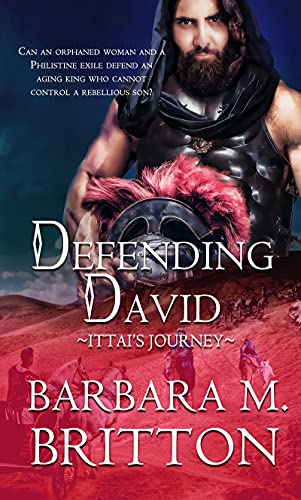
I’ll say that right off the cover is striking, powerful, and drew my attention. I could easily see it as the cover of a DVD for a movie. Right off, I’m intrigued.
Some of the characters are real – from the bible: Ittai, David, David’s son Absalom.
In researching Absalom and his later death in the Battle of the Wood of Ephraim – it is noted that “David divided the army into three parts—one was to be led by Joab; one by Abishai; and the third by Ittai, the trusted friend and commander from Gath”.
Right off, there is a spoiler as most of the story can be found in 2 Samuel of the bible. As of note a Gittite is someone from Gath.
What the author does, is takes some creative liberty of Ittai’s journey to Jerusalem to find refuge for his troops, having left Gath behind.
The developed characters of Hamuran, his wife Parveda, their daughter Lana, and orphan Rimona feel as though they could be right there in the bible – we’re just not hearing their stories.
Since this is a bible story – readers should take caution of some themes that were prevalent and accepted back in those times. Some such are slavery, the treatment of women as property, lack of women’s rights, harsh and cruel punishments. The description of Absalom’s death is a bit gruesome and could be a bit offensive to some readers. There is a mention of circumcision in regards to Ittai – that is a reference to a procedure and a ritual done to Hebrew male children within eight (8) days of their birth.
Despite this being the fourth (4th) book of the series, it truly reads as a standalone unlike many that claim to. Many books (no matter what genre of fiction) claim to be standalone reads only to find that some characters and “incidents” were established in a previous book. I was able to read this book from start to finish without feeling like I was missing something.
I could barely put it down as it was that gripping – the story as well as the author’s writing. Her prose as well as the use of short chapters helped move the story along. It definitely read as a movie would go. And, I would honestly watch a movie of this. Though, I have an idea who I’d cast as Ittai.
That said …
Defending David is told from Ittai and Rimona’s POVs.
This begins with young Ittai trying to catch a piglet and ending up meeting David. It is David’s kindness and generosity towards the young boy that has an endearing effect. So much so that 30 years later, Ittai heads to the home of now King David to seek refuge and a “home” for his battle-weary troops. Ittai doesn’t want to spill Hebrew blood, he wants to live among them as he has accepted their God as the one true God, thus defying his own king.
Though, there are some among Ittai’s men who wonder if David will remember Ittai the Gittite. He is almost certain the king would remember him.
It is on this journey where Ittai encounters Rimona, an orphan on her way to Hebron to live with her uncle. A family member was supposed to take her there, but she almost gets sold into slavery to settle a debt. Ittai rescues her and will see her to safety. And, where some might think this could go wrong – it doesn’t. Ittai and Rimona spark up a friendship based on commonalities. He even finds her donkey and belongings and returns them to her. He has no interest in a wife nor she a husband at that point.
It is on their way they encounter Absalom who takes an interest in Rimona. The younger man tells Ittai and his group to wait for him before heading to Jerusalem. But, as most people who’ve read the bible know – Absalom is looked to dethrone his father.
Ittai doesn’t trust him, and for good reason. Though one of Ittai’s men wonder if Ittai is remembering David as more fond of him than he was. Ittai has faith.
It is Ittai, Rimona, and little Lana who travel to the palace to talk with David. As first the reception is awkward, but Ittai’s faith is rewarded – the older man remembers him. Though, due to his son’s actions, David doesn’t feel like the warrior he once was.
Rimona’s uncle, a musician, is none too happy to see her – but, he will fulfill her duty and take her in. He was definitely a horrid man from the moment readers meet him until the very end.
And, the author is correct – Ittai arrives on the eve of a rebellion. Ittai’s loyalty is to David, as is the army Ittai brings with him.
It is clear to Rimona that with her uncle – loyalty is not an attribute. And, now she has to worry for her own safety yet again, especially with Absalom’s renewed interest.
It is clear to David that his son wants him dead and the former king wonders if he is being punished for his own sins. But, Ittai refuses to let the man be killed. And, as history goes, Ittai becomes one of his trusted friends and generals.
A wonderful build-up to a war between a father and son, and a lesson in loyalty and God’s trust.
This is, as was bible times – intriguing, dramatic, riveting, and educational.
The trust David had for Ittai and the respect the younger man showed him, despite their differences (one being a Hebrew, the other a Philistine) was inspiring and remarkable.
The war itself seemed rather anti-climatic given the build-up. But, the death of Absalom was definitely gruesome, though biblically accurate.
The slow-build romance between Ittai and Rimona was sweet. And, despite not knowing his end-story in the bible, I love how the author created a sweet “what if” kind of ending.
Parveda’s advice to Rimona to live in the moment was sweet and inspiring; as was her advice on grief – if you don’t grieve for someone or something lost, you can’t experience love or joy of life. Rimona’s spunk was admirable including a daring escape. Little Lana was definitely a scene stealer as well.
In addition, despite what Absalom wanted to do to his father, the older man’s showing or advice to show mercy upon his son – he wanted him captured alive and not killed – “deal gently, for my sake, with the young man, with Absalom”. David’s compassion is endearing and heart-breaking.
Overall, I thoroughly enjoyed this, and I definitely wouldn’t hesitate to read another book by the author.
Fans of the author, genre, and those who enjoy the books of Jill Eileen Smith and Tessa Afshar are sure to enjoy this read.