

What do you think?

La Cité des dames
Née à Venise en 1364, fille de l’astrologue de Charles V, poétesse, historienne, moraliste, Christine de Pizan serait « le premier auteur » de la littérature française. La Cité des Dames couronne son œuvre féministe. Profondément déprimée par la lecture d’une satire misogyne, l’auteure se lamente d’être née femme. Apparaissent alors pour la consoler trois envoyées de Dieu : Raison, Droiture et Justice. Avec leur aide, Christine de Pizan construira une cité imprenable où les femmes seront à l’abri des calomnies. Les pierres de ce bel édifice seront les femmes du passé, guerrières, artistes et savantes, amoureuses et saintes !
L’argumentation surprend par sa modernité : Christine de Pizan y aborde le viol, l’égalité des sexes, l’accès des femmes au savoir… La Cité des Dames apparaît comme un ouvrage capital pour l’histoire des femmes et pour la pensée occidentale à l’aube des temps modernes.
L’argumentation surprend par sa modernité : Christine de Pizan y aborde le viol, l’égalité des sexes, l’accès des femmes au savoir… La Cité des Dames apparaît comme un ouvrage capital pour l’histoire des femmes et pour la pensée occidentale à l’aube des temps modernes.
408 pages, Paperback
First published January 1, 1405
About the author
Christine de Pizan
136 books228 followersChristine de Pizan (also seen as de Pisan) (1363–c.1434) was a writer and analyst of the medieval era who strongly challenged misogyny and stereotypes that were prevalent in the male-dominated realm of the arts. De Pizan completed forty-one pieces during her thirty-year career (1399–1429). She earned her accolade as Europe’s first professional woman writer (Redfern 74). Her success stems from a wide range of innovative writing and rhetorical techniques that critically challenged renowned male writers such as Jean de Meun who, to Pizan’s dismay, incorporated misogynist beliefs within their literary works.
In recent decades, de Pizan's work has been returned to prominence by the efforts of scholars such as Charity Cannon Willard and Earl Jeffrey Richards. Certain scholars have argued that she should be seen as an early feminist who efficiently used language to convey that women could play an important role within society, although this characterisation has been challenged by other critics who claim either that it is an anachronistic use of the word, or that her beliefs were not progressive enough to merit such a designation
In recent decades, de Pizan's work has been returned to prominence by the efforts of scholars such as Charity Cannon Willard and Earl Jeffrey Richards. Certain scholars have argued that she should be seen as an early feminist who efficiently used language to convey that women could play an important role within society, although this characterisation has been challenged by other critics who claim either that it is an anachronistic use of the word, or that her beliefs were not progressive enough to merit such a designation
Ratings & Reviews
Friends & Following
Create a free account to discover what your friends think of this book!
Community Reviews
Displaying 1 - 30 of 613 reviews

March 28, 2016
About six years ago I read Giovanni Boccaccio's The Decameron. While I found it a worthwhile experience, I remember thinking that the women were not portrayed in a very kind light all the time in his stories. I also remember thinking that was not unusual considering the fact it was written in the 14th century, and those people were really unenlightened when it came to women's rights and stuff.
But then I read this book. Christine de Pizan wrote this book in the 15th century, and calls Boccaccio out a few times, which made me cheer a bit. She questioned what he wrote, as well as other writers (Ovid, for example), which made me realize that not everyone was completely unenlightened back in the Middle Ages after all.
This allegory was written in the early 1400s but wasn't translated into English until 1521. Pizan herself is a character in her story which involves her talking to the three daughters of God (Reason, Rectitude, and Justice). They have come to help Pizan build a safe haven for women since they have gotten the short end of the stick throughout history. Remember this was written in the 15th century. I feel de Pizan's City has grown exponentially since it was first published. She would hardly recognize it now if she showed up. And she would be pissed. I'm sure her first words would be along the lines of "Did no one read my book, and did you assholes learn nothing?"
Nope. No one reads your book, Christine. And no one has learned anything. It's a fucking disgrace out here in the future.
The three daughters of God listen to Pizan's questions, all of which are about how women have been treated throughout history, the way they are portrayed in literature, the way they are subjected to rape and torture, and accused of being malicious and manipulative. Pizan points out examples from Boccaccio and Ovid and the daughters of God bring out other examples that disprove what those guys had written, and then those historical figures they have illustrated to Pizan are then "housed" in the safety of this City they have created.
It's actually a really brilliant idea. They're not just sitting around waiting for the Plague to blow over, telling each other stories. No, here's a story that uses some fucking imagination. An imaginary city created to provide safety to women who have no other safe place to turn. It sounds like an utopia, doesn't it?
This was a powerful read especially when considering when it was written and how unpopular these ideas must have been. It's a feminist work at a time when women were not given a voice, especially not a feminist one. They were objects and property, but here is one woman who said that was not good enough, and misogyny has no place in this world. Of course we're still fighting that one, but here's another text to show that it's been a long battle and we're not alone.
But then I read this book. Christine de Pizan wrote this book in the 15th century, and calls Boccaccio out a few times, which made me cheer a bit. She questioned what he wrote, as well as other writers (Ovid, for example), which made me realize that not everyone was completely unenlightened back in the Middle Ages after all.
This allegory was written in the early 1400s but wasn't translated into English until 1521. Pizan herself is a character in her story which involves her talking to the three daughters of God (Reason, Rectitude, and Justice). They have come to help Pizan build a safe haven for women since they have gotten the short end of the stick throughout history. Remember this was written in the 15th century. I feel de Pizan's City has grown exponentially since it was first published. She would hardly recognize it now if she showed up. And she would be pissed. I'm sure her first words would be along the lines of "Did no one read my book, and did you assholes learn nothing?"
Nope. No one reads your book, Christine. And no one has learned anything. It's a fucking disgrace out here in the future.
The three daughters of God listen to Pizan's questions, all of which are about how women have been treated throughout history, the way they are portrayed in literature, the way they are subjected to rape and torture, and accused of being malicious and manipulative. Pizan points out examples from Boccaccio and Ovid and the daughters of God bring out other examples that disprove what those guys had written, and then those historical figures they have illustrated to Pizan are then "housed" in the safety of this City they have created.
It's actually a really brilliant idea. They're not just sitting around waiting for the Plague to blow over, telling each other stories. No, here's a story that uses some fucking imagination. An imaginary city created to provide safety to women who have no other safe place to turn. It sounds like an utopia, doesn't it?
This was a powerful read especially when considering when it was written and how unpopular these ideas must have been. It's a feminist work at a time when women were not given a voice, especially not a feminist one. They were objects and property, but here is one woman who said that was not good enough, and misogyny has no place in this world. Of course we're still fighting that one, but here's another text to show that it's been a long battle and we're not alone.

June 12, 2009
This is an amazing humanist text written in 1405. Through her discourse to explain the misconception of woman, Pizan elevates her argument beyond the literature of 20th century feminists. Where Friedan, Steinem, Hooks, etc. would outline the maladjustment and oppression of women, Pizan would argue that equality is a potential from birth. She doesn't just academically complain through proof or experience that woman is a second class citizen.The purpose of The Book of the City of Ladies is to build an intellectual, emotional, and spiritual refuge/foundation for all women to draw from as they pursue their natural aptitude. It is interesting to read a text and see how the cult of the Virgin Mary helped elevate women's place in society. Equally fascinating is to see the intellectual breadth of the day and endearing to read the errors of their knowledge in history and linguistics. Much like de Beauvoir's Second Sex, Pizan's masterpiece is still one of the best feminist critiques ever written. It is still at the same time elevating to men. This being said, we have more to do and to write.

Read
November 21, 2023
Christine de Pisan (1364 - c.1430) oferecendo a sua obra à rainha Isabel da Baviera, mulher de Carlos VI
Retirado de: Obras poéticas, British Library, Harley MS 4431 - 1410-14
(...)não há desculpa para a ignorância total. Se eu te matasse com boas intenções e por perfeita estupidez, estaria a agir correctamente? Todo aquele que agiu desta forma, seja lá quem for, abusou do seu poder. Atacar uma parte, na crença de que se está a beneficiar uma terceira, é injusto. Assim como é injusto criticar a natureza de todas as mulheres, o que é completamente injustificado.
Houve tempos em que me atirei a uma cadeira com um nome pavoroso: codicologia. E, se é verdade que passei as passas do algarve a tentar discortinar numas fotografias manhosas tudo o que eram rubricas, caldeirões e marcas de leitura apagados pelos tempo, intervenções e erros de copistas que ainda hoje me dão um nó no cérebro só de recordar, também é verdade que foi lá que primeiro me foi apresentado este nome: Christine de Pisan. E foi nome que nunca mais esqueci.
Christiane de Pisan é considerada a primeira escritora profissional na cultura europeia, e, quiçá, a primeira defensora da igualdade de género (a deixar esse testemunho propositadamente em papel, ou melhor, em pergaminho) que, vendo-se viúva aos 25 anos, e com três filhos a cargo, decide armar a sua trouxinha e fazer-se à vida enquanto escritora e pensadora. Graças a esse passo iluminado nascem obras nas quais a defesa dos valores femininos se contrapõem a títulos de teor misógino como Arte de Amar, de Ovídio ou O romance da Rosa, de Jean de Meun (ao qual este Cidade das Mulheres pretende responder). Dentro em breve, por esta ousadia e talento, Christine granjeia o apoio de patronos como o duque de Orléans ou a rainha Isabel de Baviera a quem presenteia as suas obras.
A Cidade das Mulheres, segundo título que a autora dá à estampa, é uma obra de índole moralista (nada anormal para a época) e uma espécie de contra-argumentação para a retórica misógina que grassa na época e no meio literário no qual a autora entrara há não muito tempo:
De modo a julgar com toda a imparcialidade se é verdade o que tantos homens famosos disseram acerca das mulheres, também pensei nas que conheço, todas as princesas e inúmeras damas das mais variadas camadas sociais que partilharam comigo os seus pensamentos mais íntimos e pessoais. Qualquer que fosse o lado por onde observasse a questão ou por mais que pensasse no assunto, não consegui encontrar provas, a partir da minha própria experiência, para gerar ideias tão negativas da natureza e dos hábitos femininos. Mesmo assim, dado que raramente conseguia encontrar uma obra que não devotasse um capítulo ou parágrafo a atacar o sexo feminino, tive de aceitar as suas opiniões desfavoráveis acerca das mulheres, já que era improvável que tantos homens letrados, que pareciam dominar todos os assuntos com tanta inteligência e discernimento, pudessem ter mentido em tantas ocasiões diferentes. Foi com base neste simples e único argumento que fui forçada a concluir que o meu espírito, na sua ingenuidade e ignorância, não estava apto a reconhecer as grandes imperfeições em mim e nas outras mulheres, e que estes homens deviam estar certos.
Inspirada pelo De Claris Mulieribus, de Bocaccio, que cita diversas vezes, a obra obedece a uma estrutura tripartida na qual Christine constrói uma cidade simbólica (de mulheres), a qual ergue sob as palavras/pilares da Razão, Retidão e Justiça, três figuras alegóricas que a visitam um dia para com ela trocar um diálogo em que desfazem generalizações e preconceitos relacionados com as mulheres, aludindo, como exemplo, a várias grandes personalidades históricas e mitológicas que são modelos de coragem, sabedoria e de uma conduta virtuosa desde Judite (como exemplo de guerreira e salvadora do povo de Israel), à Rainha do Sabá (como exemplo de governança), a Safo de Lesbos (enquanto mulher culta e poeta), ou a Carmenta (enquanto profetiza iluminada e fundadora de Roma).
Crê no que te digo, apesar do que leste nos livros, nunca tiveste oportunidade de o observar na realidade, porque não passam de um monte de escandalosas mentiras. Minha querida amiga, tenho a dizer que foi a tua ingenuidade que te levou a aceitares o que eles escrevem como sendo verdade. Toma juízo e pára de preocupar a tua mente com tais tolices. Deixa que te diga que todo aquele que diz mal das mulheres causa pior mal a si mesmo do que às mulheres que difama.
Recordemos que falamos de uma autora dos séculos XIV/XV e de uma obra terminada em 1405 na qual a vitalidade e a erudição transparecem evidentemente a favor da defesa das mulheres, cuja "cidade" ela ergue, em prol de, e a partir daquelas que têm um nobre caráter - e não apenas um nascimento nobre - sejam elas pagãs, judias ou cristãs, mulheres de ontem, de hoje, ou se amanhã:
Embora eu não tenha citado os nomes de todas as mulheres santas que existiram, existem ainda, ou que venham realmente a existir, pois ser-me-ia impossível fazê-lo, podem, todavia, todas tomar o seu lugar na Cidade das Mulheres.
Durante a construção da sua utópica cidade, Christine vai inquirindo as virtudes acerca da natural inclinação feminina para a aprendizagem, e das capacidades e talentos a cultivar pelas mulheres, chegando mesmo a abordar temas como a violência doméstica ou a criminalização da violação sexual, obtendo sempre como resposta que não existe qualquer justificação para o preconceito e injustiça sistemática a que se sujeita a figura feminina, que a excelência ou a inferioridade não é determinada pela diferença sexual, mas pelo grau de virtudes e perfeição moral que cada um atinge.
A defesa da educação das mulheres em cujo favor advoga...
(...)se fosse costume enviar meninas para a escola e ensinar-lhes todas as diferentes matérias que ensinam aos rapazes, elas compreenderiam e apreenderiam as artes e as ciências com a mesma facilidade que os rapazes.
...e as reflexões que nos deixa sobre princípios, como a retidão moral que deve governar de igual forma homens e mulheres, são de uma frescura magnífica para a época:
(...)o bem comum ou público é o bem que atinge uma cidade, um país ou qualquer outra comunidade de pessoas, onde todos participam activamente e lucram com ele. Algo que é feito no intuito de privilegiar apenas uma secção da população é chamado um bem privado ou individual, não um bem comum ou público. Além disso, algo que é feito apenas para o bem de alguns mas em detrimento de outros é não só um bem privado ou individual, como constitui um tipo de infracção cometida sobre uma parte de modo a beneficiar a outra: assim, só beneficia a segunda parte às custas da primeira.
Descontando algum mofo religioso que não pode deixar de circundar uma obra medieval, A Cidade das Mulheres é um daqueles livrinhos que estão na génese do pensamento feminista moderno cujos valores já acalenta nas suas páginas apenas à mercê de uma depuração no tempo.
Minhas damas, vede como estes homens vos criticam e vos acusam de todos os vícios imagináveis. Provai que estão errados, mostrando-lhes a vossa moral e refutando as críticas através do vosso comportamento honrado.

Read
April 29, 2025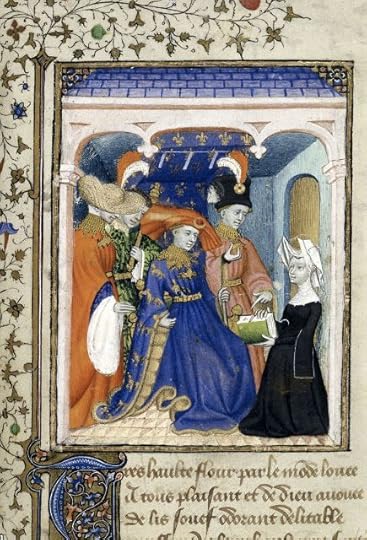
Christine de Pizan presenting one of her books to a group of Royals.
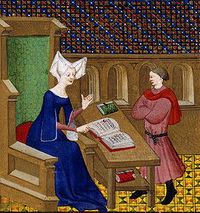
But I prefered thinking of her in her study among her great collection of books:
"Selon mon habitude et la discipline qui règle le cours de ma vie, c’est-à-dire l’étude inlassable des arts libéraux, j’étais un jour assise dans mon étude, tout entourée de livres traitant des sujets les plus divers. L’esprit un peu las de m’être si longtemps appliquée à retenir la science de tant d’auteurs, je levai les yeux de mon texte, décidant de délaisser un moment les livres difficiles pour me divertir à la lecture de quelque poète. C’est dans cet état d’esprit qu’il me tomba entre les mains certain opuscule qui ne m’appartenait pas, mais qui avait été pour ainsi dire laissé en dépôt chez moi par un tiers. Je l’ouvris donc, et vis qu’il avait pour titre Les Lamentations de Mathéole. Je me pris alors à sourire, car si je ne l’avais jamais vu, je savais que ce livre avait quelque réputation de dire grand bien des femmes !
Je pensai donc que, pour m’amuser un peu, je pouvais le parcourir. Mais ma lecture n’était guère avancée quand ma bonne mère vint m’appeler à table, l’heure étant déjà venue de souper. Me proposant donc de remettre cette lecture au lendemain, je l’abandonnai pour l’instant. Le lendemain matin, retournant comme à l’accoutumée à mon étude, je n’oubliai pas de mettre à exécution ma décision et de parcourir le livre de Mathéole. Je me mis à le lire et y avançai quelque peu. Mais le sujet me paraissant fort peu plaisant pour qui ne se complaît pas dans la médisance et ne contribuant en rien à l’édification morale ni à la vertu, vu encore l’indécence du langage et des thèmes, je le feuilletai par-ci par-là et en lus la fin, puis l’abandonnai pour retourner à d’autres études plus sérieuses et plus utiles. Mais la lecture de ce livre, quoiqu’il ne fasse aucunement autorité, me plongea dans une rêverie qui me bouleversa au plus profond de mon être. Je me demandais quelles pouvaient être les causes et les raisons qui poussaient tant d’hommes, clercs et autres, à médire des femmes et à vitupérer leur conduite soit en paroles, soit dans leurs traités et leurs écrits...
La Cité des Dames, published in 1404, contains all the evidence Christine de Pizan could find in mythology and history to refute the negative accounts of women which she frequently found in books by men.

July 4, 2026
شهر بانوان، تلاش کریستین دوپیزان، شاعر و نویسندهی ایتالیایی، برای آگاهسازی و فرهنگسازی جامعه در رابطه با حقوق زنان بوده. با توجه به اینکه کتاب در قرون وسطی نوشته شده و جز اولین تلاشها برای مطالبهی حقوق زنان هست، ارزش تاریخی داره.
در واقع ما به تسامح اینطور فکر میکنیم که این نگرش نسبت به زمانهی خودش یعنی 600 سال پیش قابلقبول بوده، اما دوپیزان چنین فکری نمیکرده و از روم و یونان باستان شروع میکنه، تکتک اندیشمندان، نویسندگان و فلاسفه رو به باد سرزنش و لعنت میگیره! و اشخاص از 1500سال پیش از خودش رو با متر و معیار زمان خودش میسنجه. دوپیزان در مواردی آشکارا حقیقت رو تحریف و مصادرهبهمطلوب میکنه، دست به ساخت روایتهای جعلی میزنه و برداشتهای دلبخواهی میکنه و این سوال ایجاد میشه که حمایت از حقوق زنان به چه قیمتی؟
اگر ما مثل من دوپیزان نباشیم و فاکتور «زمان» رو در نظر بگیریم، میبینیم اتفاقاً این کتاب در تاریخ بسیار اثرگذار بوده! چرا که مخاطبش پژوهشگرانی با دسترسی به دیتابیسهای جهانی نبودند که صحت و سقم حرفش رو تشخیص بدن! بلکه زنان تقریباً بیسواد یا با میزان سواد بسیار پایینی بودند که حتی خودشون نمیتونستند از روی کتاب بخونند! گفته میشه دوپیزان کتابش رو برای زنان میخوند و سوالاتشون رو با توجه به کتاب جواب میداد. خلاصه که با تمام ایراداتش در روزگار خودش اثرگذاری لازم رو داشته، اما برای مخاطب امروزی کارآمد نیست چرا که کذب بودن بسیاری از روایتهای دوپیزان به سادگی آشکار میشه.
چند موردش رو در این ریویو شرح میدم، اما تعدادش بسیار بسیار بیشتر از چیزی هست که حتی بتونید تصور کنید!
قبل از هرچیزی ببینیم چرا و چه طور شهر بانوان نوشته شد؟
کریستین دوپیزان علاقهی بسیاری به مطالعه داشت، اما میدید در بسیاری از کتابها در لفافه یا آشکارا به زنان توهین شده و حقوق زنان رو لگدمال کردند. کریستین خشمگین میشد، اما در جامعهای که کموبیش چنین افکاری رو داشتند، جواب دادن به این حرفها کار سادهای نبوده و از طرف دیگه دانش بسیار اندکی در فلسفه و منطق و توان خیلی کمی در استدلال و استنباط داشت. پس در چنین شرایطی چه کاری بهتر از روی آوردن به کشفوشهود و رویا!؟
داستان اینطور شروع میشه که کریستین وقتی از مطالب زنستیزانهای که در یک کتاب خونده، بسیار ناراحت شده، میخوابه و سه الهه بر او نازل میشن. به ترتیب بانوی خرد، بانو صداقت و بانوی عدالت جلو میان و ضمن جواب به سوالات کریستین و مطرح کردن بحثهایی دربارهی زنان، بهش کارهایی میدن که به واسطهی اون آرمانشهری برای زنان ساخته بشه.
در ظاهر امر، اولین چیزی که شدیداً توی ذوق آدم میزنه اینه که صحبت این بانوان پر از اشتباه است. منظورم مباحث پیچیده و بحثبرانگیز نیست؛ در تاریخها، تقدم و تأخر، محل تولد و بسیاری از موارد اینچنینی اشتباه دارند. مثلاً کریستین میگه: «سیسرو معتقد است که یک مرد هرگز نباید به یک زن خدمت کند، چرا که هیچ مردی نباید به کسی که شأن و مقامش پایینتر از اوست خدمت کند.» بانوی خرد جواب میده: سیسرو غلط کرده با تو! و «به طور حتم سیسرو خرسند است که به مریم باکره خدمت میکند.» بانوی خرد جان، سیسرو سال 43 پیش از میلاد دار فانی را وداع گفت. زمانی که سیسرو از دنیا رفت، هنوز مریم مقدس متولد نشده بود!!
بعد کمکم تحریف تاریخی شروع میشه! مثلاً درمورد زانتیپ همسر سقراط. زانتیپ یا به قول کتاب، گرانتیپ، همواره با سقراط در دعوا و کشمکش بودند و سقراط گفته بود مثل کسی که اسب سرکشش رو تحمل میکنه، منم این زن رو تحمل میکنم! درموردش جستوجو کردم دیدم این جمله سندیت داره.¹ و متن کاملش رو هم میذارم.²
دادگاه سقراط و نوشیدن جام شوکران، روایت بسیار معروفی هست که افلاطون با تمام جزئیات روایتش کرده. اما دوپیزان، بیتوجه به شواهد تاریخی، یک نقش دستاول به زانتیپ در تراژدی جام شوکران خوردن سقراط داده و ازش یک قهرمان ساخته! «گزانتیپ درست در لحظهای سررسید که سقراط قصد نوشیدن جام شوکران را داشت. او جام را به قصد نوشیدن زهر بر لب گذارد. گرانتیپ به سوی سقراط هجوم برد و خشمگینانه جام را از دستانش گرفت و شرنگ زهرآلودش را بر زمین ریخت و...» (بخش دوم بند 24)
اما طبق شواهد تاریخی از جمله «محاکمه سقراط» اثر افلاطون، خانوادهی سقراط برخلاف رسم رایج و تا به انتهای محاکمهی سقراط، در دادگاه حضور نداشتند.
اما در مواردی که کریستین دست به تحریف تاریخی نزده، چیزی شبیه به لیست خوبها و بدها روی تختهسیاه دبستان درست کرده و تمام اندیشمندان، فلاسفه، نویسندگان، شاعران و... در این دو دسته جا داده.
دسته اول: بدها!
افراد کمتر شناختهشدهای که به زنان توهین کردند، در این دسته جا گرفتند. کریستین با استفاده از ضعفهایی که در زندگیشون وجود داشته، به سادگی متهمشون میکنه. مثلاً:
«بانوی خرد پاسخ داد: دخترم اگر چیچو داسچلی دربارهی زنان به زشتی سخت گفت تعجب نکن، چرا که او از همه زنان بیزار بود و آنها را منفور و مغضوب میدانست. به همین ترتیب به دلیل بدجنسی خبیثانهاش میخواست تا تمام مردان از تمام زنان متنفر و بیزار باشند. او پاداش کارش را دریافت کرد و در ننگ و شرم بر تختهای با میخ کوبیده و سوزانده شد.» (فصل یک بند 8)
درمورد داسکولی یا به قول کتاب داسچلی جستوجو کردم. در بازهای دادگاه تفتیش عقاید بالاخص در ایتالیا به شدت با نجوم و اخترشناسی مخالفت میکرد و داسکولی با اتهامی شبیه به گالیله و جوردانو برونو محاکمه و در آتش سوزانده شد!³
این حقیرانه نیست که از قربانی شدن یک فرد به دلیل دفاع از علم خوشحال بشی و بگی آخیش دلم خنک شد، جواب توهین به زنانش رو گرفت؟
باقی دستهی بدها هم به همین شکل هست؛ از ضعفها و دردهای فرد استفاده کرده برای کوبیدنش...
دسته دوم: خوبها
این دسته شامل افراد شناختهشدهتری هست که سفیدشویی میشن و تمام جملاتی که در مذمت زنان گفتند، انکار میشه و با استدلالهای بسیار قرص و محکم «به جون مادرم» ادعا میشه این حرفها برای این اشخاص نبوده. مطلبی که در ادامه ضمیمه کردم مربوط به پاسخ بانوی خرد دربارهی ارسطو هست:
«باور کردنی نیست بتوان چنین فیلسوفانی را به سبب اکاذیبی که در این کتاب هست متهم و سرزنش کرد. چرا که زنان میتوانند به وضوح و بدون هیچ استدلال و دلیلی دریابند مسائلی که نویسندهی کتاب مورد بحث قرار میدهد نه تنها حقیقت ندارد، بلکه کذب محض است.»
رویکرد بانوی خرد اینجا خیلی جالبه. ارسطو رو از بیخ و بن و خیلی تمیز از کتابش جدا میکنه! به نوشتههای کتاب سیاست ارسطو که سندیت بسیار محکمی داره میگه «اکاذیبی که در این کتاب هست». حالا چه طور به چنین نتیجهای رسیده؟ خب مشخصه چون «زنان میتوانند بدون استدلال دریابند چنین چیزی حقیقت ندارد». یعنی بدون استدلال میشه فهمید این کتاب و نوشتهها رو ارسطو ننوشته! هنوز از شوک این استنباط محکم بیرون نیومدیم که همین دلیل رو فرض حکم بعدی میکنه: «به همین ترتیب زنان میتوانند نتیجه بگیرند سایر جزئیاتی هم که این مؤلف به کار میبرد جملگی دروغ است.» (فصل یک بند 8)
این مدل نتیجهگیریها بارها تکرار میشه و مدارک و مستندات محکم رو با «خب اینکه واضحه اینطوری نیست» زیر سوال میبره!
در واقع کریستین دوپیزان به هر دروغ، تحریف، سیاهنمایی و سفیدشویی چنگ انداخته تا به مقصود خودش برسه و از حقوق زنان دفاع کنه، اما جالبه بسیاری از دفاعیات دوپیزان، با مقیاسهای امروزی کاملاً زنستیزی به حساب میاد!
در جواب سوال «چرا زنان مواد قانونی را در دادگاههای حقوقی اقامه نمیکنند؟» بانوی خرد بیخرد پاسخ میده: «بهتر بود میپرسیدی چرا خدا نخواست تا مردان وظایف و کارهای زنان را انجام دهند و زنان وظایف و کارهای مردان را.» و بعد خرواری از اراجیف دربارهی تقسیم کار بین زن و مرد گفته میشه که کم از حرفهای زنستیزی حتی در زمانهی خودش هم نداره! و اوج فاجعه اینجاست که ادامه میده: «اصلاً شایستهی آنان نیست تا همچون مردان در دادگاهها و محاکمهها، بیباکانه و گستاخانه ظاهر شوند. زیرا به اندازهی کافی مردانی هستند که این کار را انجام دهند.» (فصل یک بند 11) به کوری چشمت ظاهر میشیم! :))
مورد فاجعهآمیز بعدی ابراز نظرهای این بانوی خرد خرفت دربارهی جسم زنان هست! دوپیزان میگه: «از آنجا که زنان جسم ضعیفی دارند، این ضعف به مقدار قابل توجهی از مقام و اعتبار ویژگیهای جنسی میکاهد.» و بانوی خرد میگه: «این نقض را با جایگزین ساختن سیرت پاک و باتقوا برای زنان جبران کرده.» (فصل یک بند 14) یعنی همچنان معتقد هست داشتن پیکری با اندام زنانه نقص به حساب میاد، ولی خب اخلاق مهمه! ای مردهشور، اون ارزشگذاری مقام زنت رو ببرند! همون مردهای دوهزار سال پیش که صادقانه زنستیز بودند خیلی بهتر بود!
مورد آزاردهندهی بعدی (که سعی میکنم آخریش باشه!) افتخار به زنانی هست که «به هر قیمتی» منفعل و به قولی کدبانوی خونه نبودند! درسته مطیع بودن مطلق زنان و به قولی تو سری خوردنشون قابلقبول نیست، اما یکم توجه کن به چی و کی داری افتخار میکنی!!
«سینوپ به نحوی شایسته با از دم تیغ گذراندن تمام ساکنان کشوری که مادرش را به قتل رسانده بودند، انتقام گرفت. او تمام این سرزمین را با خاک یکسان ساخت و علاوه بر آن بر بسیاری دیگر از کشورها غلبه کرد.» (فصل اول بخش 16)
اول اینکه این روایت ملکهی آمازونها اسطورهای هست نه تاریخی و در روایتهای مختلف اختلافهای بسیاری وجود داره دوم اینکه مادر سینوپ در جنگ تنبهتن کشته شده، بعد این روانی رفته کل شهر رو با مردم بیگناه و زن و بچه با خاک یکسان کرده، تو داری بهش افتخار میکنی؟؟؟
در کل من از پایه با نظریات – با نگاه امروزی – زنستیزانهی فلاسفه و اندیشمندان مشکلی ندارم. چرا که فکر میکنم فیلسوف کسی است که ابتدا آراء شاخص پیش از خودش رو مطالعه و بعد در مسائل بنیادین فلسفه عمیقاً فکر میکنه و به درکی بیشتر از عامهی مردم میرسه. در واقع یک پله بالاتر از مردم زمانهی خودش قرار میگیره، و این یک پله بالاتر ممکن است هزاران پله پایینتر از عامهی مردم زمانهی ما باشه. یک فیلسوف به هر حال تعدادی از مسائل رو جز مفروضاتش حساب میکنه و نمیتونه از بنیاد به غلط بودن همهچیز و دگرگونی هر باوری فکر کنه. فلاسفهی باستانی در برابر مردمی که هر افسانه و اسطورهای رو چشمبسته قبول میکردند، به فکر کردن دربارهی پدیدهها پرداختند و با نگاه امروزی ما ابلهانهترین نظریهها رو دربارهی پدیدههای طبیعی – از بارش باران تا ضربان قلب – دادند. این فلاسفه از این نظر اهمیت ندارند که لزوماً تئوریهاشون امروزه هم درست باشه، بلکه از این نظر برای ما اهمیت دارند که «در مواردی» فراتر از زمانهی خودشون فکر کردند. و البته در موارد بسیاری – مثل مسئلهی زنان – همون افکار رایج در جامعه رو بازگو کردند، یا حتی کمی بهترش کردند که بهتر شدهاش هم با متر و معیار امروزی فاجعه است. بنابراین فکر میکنم باید این تلاش برای قضاوت هر فرد با ترازوی عدالت اکنون رو کنار گذاشت و هر نظریه رو در افق دید خودش بررسی کرد – کاری که کریستین دوپیزان ابداً انجامش نداده. با این وجود من حتی این کتاب رو هم در بستر زمانی خودش نگاه میکنم.
میگن ته چاه که باشی، مهم نیست به چه زبونی کمک بخوای! مهم اینه که فریاد بزنی، تا بفهمن یکی در این چاه گیر افتاده. کار دوپیزان پر از ایراده، زبان این کتاب استدلالی نیست، محتواش با دانش امروز ما حرفی برای گفتن نداره، دفاعیهها به غایت ضعیف و کماثرند، تحریف تاریخی، سیاهنمایی و سفیدشویی عضو لاینفک کتاب هست، برخی از نظریات با علم و عرف امروزی حتی زنستیزانه هستند. اما یک چیز در این کتاب بسیار اهمیت داره! «نویسنده با زبان الکن خودش و با تمام توانش، فریاد زده تا شنیده بشه، تا صداش رو به گوش مردمی که همین حرفها هم براشون سنگین و تابوشکن بوده برسونه.» و این تلاش دوپیزان، نسبت به زمانهی خودش اقدامی جسورانه و پیشرو بوده. یعنی کتاب نه از نظر محتوایی، بلکه از نظر تاریخی اهمیت داره. (اگر کتاب در چند ده سال اخیر نوشته شده بود نیم ستاره هم نمیدادم!)
نشر روزگار نو در مجموعهی «ایدههای بزرگ» این کتاب رو منتشر کرده و ترجمه و تلخیص خانم مرضیه خسروی بسیار روان و کارآمد هست. شیوهی خلاصهسازی به این صورت هست که بعضی از بخشها کامل حذف شده و بخشهای باقیمانده کامل ترجمه شده. شمارهی بخشهای ترجمه شده هم هست تا بدونید چی از کجا حذف شده و بتونید راحتتر پیداش کنید. با اینکه همیشه از خلاصهی کتاب خوندن متنفر بودم، ولی در این مورد بسیار مفید واقع شده! من از سر کنجکاوی تعدادی از بخشهای حذف شده رو از نسخهی انگلیسی و کامل کتاب خوندم و دیدم همون بهتر که حذف شدند! (یا زیادی زنستیز شده، یا بیش از اندازه وارد خرافات شده، یا شدیداً به توهین و تحقیر برخی از افراد رو آورده و...).
کتاب رو آذر 404 شروع کردم و انقدر حرص خوردم که بیخیالش شدم، دوباره در ایام عید شروع کردم و امروز در سیزده بهدرِ دربهدر 405 تمومش کردم...
جالب اینکه برای چک کردن صحت دانستهها قبلیم مثل همسر سقراط، نیاز به اینترنت داشتم (کتاب رو در زمان جنگ تموم کردم که دسترسی به اینترنت وجود نداشت) و ادیت این ریویو تا الان که نیمههای تیر هستیم طول کشید! از بس که کتاب نچسبی بود!
این رو هم ذکر کنم که این ریویو مثلاً خلاصه شده چیزی هست که اول نوشتم و حجم یادداشت های که برداشتم سه چهار برابر این بود! باز هم از هر مورد یک مثال رو نگه داشتم تا مقصودم بهتر بیان بشه. خلاصه که دستم به کم نمیره!!
1. منبع دقیق: گزنفون، «خاطرات سقراط» (Memorabilia)، کتاب 2، فصل 2، بندهای 7 و 8
2. «آیا تا به حال دیدهای که سوارکاری که میخواهد بر اسبی مسلط شود، اسبی مطیع و آرام انتخاب کند؟ نه، او اسبی سرکش میخواهد. اگر بتواند بر اسب سرکش چیره شود، بر هر اسب دیگری هم چیره خواهد شد. تحمل زانتیپ هم برای من همین طور است. چون عادت کردهام حرفهای او را تحمل کنم، با هر کس دیگری هم به راحتی کنار میآیم.»
3. کتاب A History of Magic and Experimental Science، جلد دوم صفحات 953 تا 959 به پروندهی داسکولی و نظریات ستارهشناسش که منجر به محکومیتش شد میپردازه.
در واقع ما به تسامح اینطور فکر میکنیم که این نگرش نسبت به زمانهی خودش یعنی 600 سال پیش قابلقبول بوده، اما دوپیزان چنین فکری نمیکرده و از روم و یونان باستان شروع میکنه، تکتک اندیشمندان، نویسندگان و فلاسفه رو به باد سرزنش و لعنت میگیره! و اشخاص از 1500سال پیش از خودش رو با متر و معیار زمان خودش میسنجه. دوپیزان در مواردی آشکارا حقیقت رو تحریف و مصادرهبهمطلوب میکنه، دست به ساخت روایتهای جعلی میزنه و برداشتهای دلبخواهی میکنه و این سوال ایجاد میشه که حمایت از حقوق زنان به چه قیمتی؟
اگر ما مثل من دوپیزان نباشیم و فاکتور «زمان» رو در نظر بگیریم، میبینیم اتفاقاً این کتاب در تاریخ بسیار اثرگذار بوده! چرا که مخاطبش پژوهشگرانی با دسترسی به دیتابیسهای جهانی نبودند که صحت و سقم حرفش رو تشخیص بدن! بلکه زنان تقریباً بیسواد یا با میزان سواد بسیار پایینی بودند که حتی خودشون نمیتونستند از روی کتاب بخونند! گفته میشه دوپیزان کتابش رو برای زنان میخوند و سوالاتشون رو با توجه به کتاب جواب میداد. خلاصه که با تمام ایراداتش در روزگار خودش اثرگذاری لازم رو داشته، اما برای مخاطب امروزی کارآمد نیست چرا که کذب بودن بسیاری از روایتهای دوپیزان به سادگی آشکار میشه.
چند موردش رو در این ریویو شرح میدم، اما تعدادش بسیار بسیار بیشتر از چیزی هست که حتی بتونید تصور کنید!
قبل از هرچیزی ببینیم چرا و چه طور شهر بانوان نوشته شد؟
کریستین دوپیزان علاقهی بسیاری به مطالعه داشت، اما میدید در بسیاری از کتابها در لفافه یا آشکارا به زنان توهین شده و حقوق زنان رو لگدمال کردند. کریستین خشمگین میشد، اما در جامعهای که کموبیش چنین افکاری رو داشتند، جواب دادن به این حرفها کار سادهای نبوده و از طرف دیگه دانش بسیار اندکی در فلسفه و منطق و توان خیلی کمی در استدلال و استنباط داشت. پس در چنین شرایطی چه کاری بهتر از روی آوردن به کشفوشهود و رویا!؟
داستان اینطور شروع میشه که کریستین وقتی از مطالب زنستیزانهای که در یک کتاب خونده، بسیار ناراحت شده، میخوابه و سه الهه بر او نازل میشن. به ترتیب بانوی خرد، بانو صداقت و بانوی عدالت جلو میان و ضمن جواب به سوالات کریستین و مطرح کردن بحثهایی دربارهی زنان، بهش کارهایی میدن که به واسطهی اون آرمانشهری برای زنان ساخته بشه.
در ظاهر امر، اولین چیزی که شدیداً توی ذوق آدم میزنه اینه که صحبت این بانوان پر از اشتباه است. منظورم مباحث پیچیده و بحثبرانگیز نیست؛ در تاریخها، تقدم و تأخر، محل تولد و بسیاری از موارد اینچنینی اشتباه دارند. مثلاً کریستین میگه: «سیسرو معتقد است که یک مرد هرگز نباید به یک زن خدمت کند، چرا که هیچ مردی نباید به کسی که شأن و مقامش پایینتر از اوست خدمت کند.» بانوی خرد جواب میده: سیسرو غلط کرده با تو! و «به طور حتم سیسرو خرسند است که به مریم باکره خدمت میکند.» بانوی خرد جان، سیسرو سال 43 پیش از میلاد دار فانی را وداع گفت. زمانی که سیسرو از دنیا رفت، هنوز مریم مقدس متولد نشده بود!!
بعد کمکم تحریف تاریخی شروع میشه! مثلاً درمورد زانتیپ همسر سقراط. زانتیپ یا به قول کتاب، گرانتیپ، همواره با سقراط در دعوا و کشمکش بودند و سقراط گفته بود مثل کسی که اسب سرکشش رو تحمل میکنه، منم این زن رو تحمل میکنم! درموردش جستوجو کردم دیدم این جمله سندیت داره.¹ و متن کاملش رو هم میذارم.²
دادگاه سقراط و نوشیدن جام شوکران، روایت بسیار معروفی هست که افلاطون با تمام جزئیات روایتش کرده. اما دوپیزان، بیتوجه به شواهد تاریخی، یک نقش دستاول به زانتیپ در تراژدی جام شوکران خوردن سقراط داده و ازش یک قهرمان ساخته! «گزانتیپ درست در لحظهای سررسید که سقراط قصد نوشیدن جام شوکران را داشت. او جام را به قصد نوشیدن زهر بر لب گذارد. گرانتیپ به سوی سقراط هجوم برد و خشمگینانه جام را از دستانش گرفت و شرنگ زهرآلودش را بر زمین ریخت و...» (بخش دوم بند 24)
اما طبق شواهد تاریخی از جمله «محاکمه سقراط» اثر افلاطون، خانوادهی سقراط برخلاف رسم رایج و تا به انتهای محاکمهی سقراط، در دادگاه حضور نداشتند.
اما در مواردی که کریستین دست به تحریف تاریخی نزده، چیزی شبیه به لیست خوبها و بدها روی تختهسیاه دبستان درست کرده و تمام اندیشمندان، فلاسفه، نویسندگان، شاعران و... در این دو دسته جا داده.
دسته اول: بدها!
افراد کمتر شناختهشدهای که به زنان توهین کردند، در این دسته جا گرفتند. کریستین با استفاده از ضعفهایی که در زندگیشون وجود داشته، به سادگی متهمشون میکنه. مثلاً:
«بانوی خرد پاسخ داد: دخترم اگر چیچو داسچلی دربارهی زنان به زشتی سخت گفت تعجب نکن، چرا که او از همه زنان بیزار بود و آنها را منفور و مغضوب میدانست. به همین ترتیب به دلیل بدجنسی خبیثانهاش میخواست تا تمام مردان از تمام زنان متنفر و بیزار باشند. او پاداش کارش را دریافت کرد و در ننگ و شرم بر تختهای با میخ کوبیده و سوزانده شد.» (فصل یک بند 8)
درمورد داسکولی یا به قول کتاب داسچلی جستوجو کردم. در بازهای دادگاه تفتیش عقاید بالاخص در ایتالیا به شدت با نجوم و اخترشناسی مخالفت میکرد و داسکولی با اتهامی شبیه به گالیله و جوردانو برونو محاکمه و در آتش سوزانده شد!³
این حقیرانه نیست که از قربانی شدن یک فرد به دلیل دفاع از علم خوشحال بشی و بگی آخیش دلم خنک شد، جواب توهین به زنانش رو گرفت؟
باقی دستهی بدها هم به همین شکل هست؛ از ضعفها و دردهای فرد استفاده کرده برای کوبیدنش...
دسته دوم: خوبها
این دسته شامل افراد شناختهشدهتری هست که سفیدشویی میشن و تمام جملاتی که در مذمت زنان گفتند، انکار میشه و با استدلالهای بسیار قرص و محکم «به جون مادرم» ادعا میشه این حرفها برای این اشخاص نبوده. مطلبی که در ادامه ضمیمه کردم مربوط به پاسخ بانوی خرد دربارهی ارسطو هست:
«باور کردنی نیست بتوان چنین فیلسوفانی را به سبب اکاذیبی که در این کتاب هست متهم و سرزنش کرد. چرا که زنان میتوانند به وضوح و بدون هیچ استدلال و دلیلی دریابند مسائلی که نویسندهی کتاب مورد بحث قرار میدهد نه تنها حقیقت ندارد، بلکه کذب محض است.»
رویکرد بانوی خرد اینجا خیلی جالبه. ارسطو رو از بیخ و بن و خیلی تمیز از کتابش جدا میکنه! به نوشتههای کتاب سیاست ارسطو که سندیت بسیار محکمی داره میگه «اکاذیبی که در این کتاب هست». حالا چه طور به چنین نتیجهای رسیده؟ خب مشخصه چون «زنان میتوانند بدون استدلال دریابند چنین چیزی حقیقت ندارد». یعنی بدون استدلال میشه فهمید این کتاب و نوشتهها رو ارسطو ننوشته! هنوز از شوک این استنباط محکم بیرون نیومدیم که همین دلیل رو فرض حکم بعدی میکنه: «به همین ترتیب زنان میتوانند نتیجه بگیرند سایر جزئیاتی هم که این مؤلف به کار میبرد جملگی دروغ است.» (فصل یک بند 8)
این مدل نتیجهگیریها بارها تکرار میشه و مدارک و مستندات محکم رو با «خب اینکه واضحه اینطوری نیست» زیر سوال میبره!
در واقع کریستین دوپیزان به هر دروغ، تحریف، سیاهنمایی و سفیدشویی چنگ انداخته تا به مقصود خودش برسه و از حقوق زنان دفاع کنه، اما جالبه بسیاری از دفاعیات دوپیزان، با مقیاسهای امروزی کاملاً زنستیزی به حساب میاد!
در جواب سوال «چرا زنان مواد قانونی را در دادگاههای حقوقی اقامه نمیکنند؟» بانوی خرد بیخرد پاسخ میده: «بهتر بود میپرسیدی چرا خدا نخواست تا مردان وظایف و کارهای زنان را انجام دهند و زنان وظایف و کارهای مردان را.» و بعد خرواری از اراجیف دربارهی تقسیم کار بین زن و مرد گفته میشه که کم از حرفهای زنستیزی حتی در زمانهی خودش هم نداره! و اوج فاجعه اینجاست که ادامه میده: «اصلاً شایستهی آنان نیست تا همچون مردان در دادگاهها و محاکمهها، بیباکانه و گستاخانه ظاهر شوند. زیرا به اندازهی کافی مردانی هستند که این کار را انجام دهند.» (فصل یک بند 11) به کوری چشمت ظاهر میشیم! :))
مورد فاجعهآمیز بعدی ابراز نظرهای این بانوی خرد خرفت دربارهی جسم زنان هست! دوپیزان میگه: «از آنجا که زنان جسم ضعیفی دارند، این ضعف به مقدار قابل توجهی از مقام و اعتبار ویژگیهای جنسی میکاهد.» و بانوی خرد میگه: «این نقض را با جایگزین ساختن سیرت پاک و باتقوا برای زنان جبران کرده.» (فصل یک بند 14) یعنی همچنان معتقد هست داشتن پیکری با اندام زنانه نقص به حساب میاد، ولی خب اخلاق مهمه! ای مردهشور، اون ارزشگذاری مقام زنت رو ببرند! همون مردهای دوهزار سال پیش که صادقانه زنستیز بودند خیلی بهتر بود!
مورد آزاردهندهی بعدی (که سعی میکنم آخریش باشه!) افتخار به زنانی هست که «به هر قیمتی» منفعل و به قولی کدبانوی خونه نبودند! درسته مطیع بودن مطلق زنان و به قولی تو سری خوردنشون قابلقبول نیست، اما یکم توجه کن به چی و کی داری افتخار میکنی!!
«سینوپ به نحوی شایسته با از دم تیغ گذراندن تمام ساکنان کشوری که مادرش را به قتل رسانده بودند، انتقام گرفت. او تمام این سرزمین را با خاک یکسان ساخت و علاوه بر آن بر بسیاری دیگر از کشورها غلبه کرد.» (فصل اول بخش 16)
اول اینکه این روایت ملکهی آمازونها اسطورهای هست نه تاریخی و در روایتهای مختلف اختلافهای بسیاری وجود داره دوم اینکه مادر سینوپ در جنگ تنبهتن کشته شده، بعد این روانی رفته کل شهر رو با مردم بیگناه و زن و بچه با خاک یکسان کرده، تو داری بهش افتخار میکنی؟؟؟
در کل من از پایه با نظریات – با نگاه امروزی – زنستیزانهی فلاسفه و اندیشمندان مشکلی ندارم. چرا که فکر میکنم فیلسوف کسی است که ابتدا آراء شاخص پیش از خودش رو مطالعه و بعد در مسائل بنیادین فلسفه عمیقاً فکر میکنه و به درکی بیشتر از عامهی مردم میرسه. در واقع یک پله بالاتر از مردم زمانهی خودش قرار میگیره، و این یک پله بالاتر ممکن است هزاران پله پایینتر از عامهی مردم زمانهی ما باشه. یک فیلسوف به هر حال تعدادی از مسائل رو جز مفروضاتش حساب میکنه و نمیتونه از بنیاد به غلط بودن همهچیز و دگرگونی هر باوری فکر کنه. فلاسفهی باستانی در برابر مردمی که هر افسانه و اسطورهای رو چشمبسته قبول میکردند، به فکر کردن دربارهی پدیدهها پرداختند و با نگاه امروزی ما ابلهانهترین نظریهها رو دربارهی پدیدههای طبیعی – از بارش باران تا ضربان قلب – دادند. این فلاسفه از این نظر اهمیت ندارند که لزوماً تئوریهاشون امروزه هم درست باشه، بلکه از این نظر برای ما اهمیت دارند که «در مواردی» فراتر از زمانهی خودشون فکر کردند. و البته در موارد بسیاری – مثل مسئلهی زنان – همون افکار رایج در جامعه رو بازگو کردند، یا حتی کمی بهترش کردند که بهتر شدهاش هم با متر و معیار امروزی فاجعه است. بنابراین فکر میکنم باید این تلاش برای قضاوت هر فرد با ترازوی عدالت اکنون رو کنار گذاشت و هر نظریه رو در افق دید خودش بررسی کرد – کاری که کریستین دوپیزان ابداً انجامش نداده. با این وجود من حتی این کتاب رو هم در بستر زمانی خودش نگاه میکنم.
میگن ته چاه که باشی، مهم نیست به چه زبونی کمک بخوای! مهم اینه که فریاد بزنی، تا بفهمن یکی در این چاه گیر افتاده. کار دوپیزان پر از ایراده، زبان این کتاب استدلالی نیست، محتواش با دانش امروز ما حرفی برای گفتن نداره، دفاعیهها به غایت ضعیف و کماثرند، تحریف تاریخی، سیاهنمایی و سفیدشویی عضو لاینفک کتاب هست، برخی از نظریات با علم و عرف امروزی حتی زنستیزانه هستند. اما یک چیز در این کتاب بسیار اهمیت داره! «نویسنده با زبان الکن خودش و با تمام توانش، فریاد زده تا شنیده بشه، تا صداش رو به گوش مردمی که همین حرفها هم براشون سنگین و تابوشکن بوده برسونه.» و این تلاش دوپیزان، نسبت به زمانهی خودش اقدامی جسورانه و پیشرو بوده. یعنی کتاب نه از نظر محتوایی، بلکه از نظر تاریخی اهمیت داره. (اگر کتاب در چند ده سال اخیر نوشته شده بود نیم ستاره هم نمیدادم!)
نشر روزگار نو در مجموعهی «ایدههای بزرگ» این کتاب رو منتشر کرده و ترجمه و تلخیص خانم مرضیه خسروی بسیار روان و کارآمد هست. شیوهی خلاصهسازی به این صورت هست که بعضی از بخشها کامل حذف شده و بخشهای باقیمانده کامل ترجمه شده. شمارهی بخشهای ترجمه شده هم هست تا بدونید چی از کجا حذف شده و بتونید راحتتر پیداش کنید. با اینکه همیشه از خلاصهی کتاب خوندن متنفر بودم، ولی در این مورد بسیار مفید واقع شده! من از سر کنجکاوی تعدادی از بخشهای حذف شده رو از نسخهی انگلیسی و کامل کتاب خوندم و دیدم همون بهتر که حذف شدند! (یا زیادی زنستیز شده، یا بیش از اندازه وارد خرافات شده، یا شدیداً به توهین و تحقیر برخی از افراد رو آورده و...).
کتاب رو آذر 404 شروع کردم و انقدر حرص خوردم که بیخیالش شدم، دوباره در ایام عید شروع کردم و امروز در سیزده بهدرِ دربهدر 405 تمومش کردم...
جالب اینکه برای چک کردن صحت دانستهها قبلیم مثل همسر سقراط، نیاز به اینترنت داشتم (کتاب رو در زمان جنگ تموم کردم که دسترسی به اینترنت وجود نداشت) و ادیت این ریویو تا الان که نیمههای تیر هستیم طول کشید! از بس که کتاب نچسبی بود!
این رو هم ذکر کنم که این ریویو مثلاً خلاصه شده چیزی هست که اول نوشتم و حجم یادداشت های که برداشتم سه چهار برابر این بود! باز هم از هر مورد یک مثال رو نگه داشتم تا مقصودم بهتر بیان بشه. خلاصه که دستم به کم نمیره!!
1. منبع دقیق: گزنفون، «خاطرات سقراط» (Memorabilia)، کتاب 2، فصل 2، بندهای 7 و 8
2. «آیا تا به حال دیدهای که سوارکاری که میخواهد بر اسبی مسلط شود، اسبی مطیع و آرام انتخاب کند؟ نه، او اسبی سرکش میخواهد. اگر بتواند بر اسب سرکش چیره شود، بر هر اسب دیگری هم چیره خواهد شد. تحمل زانتیپ هم برای من همین طور است. چون عادت کردهام حرفهای او را تحمل کنم، با هر کس دیگری هم به راحتی کنار میآیم.»
3. کتاب A History of Magic and Experimental Science، جلد دوم صفحات 953 تا 959 به پروندهی داسکولی و نظریات ستارهشناسش که منجر به محکومیتش شد میپردازه.

April 28, 2025
“Glorieuses sont les choses que l’on dit de toi, ô Cité de Dieu.” p. 347
City of God; City of Women. Glorious are these stories in this book dedicated to “all of you virtuous and glorious women” (I am paraphrasing the French). History has been written by men about men so why not a history of women written by a woman?
Of course what makes this book interesting is that Christine de Pizan or as she was known in Italian Cristina da Pizzano, lived from 1364 to circa 1430. Christine was born in Italy but moved at the age of four when her father got a position with the French court of Charles V. She married but both her father and husband died of the plague in 1389. With legal issues surrounding her estate she went to work as a court writer. Her book was written around 1405. If it wasn’t for my reading group, before this I would have said, “Christine who?”
As the name implies, Pizan wrote a book about the allegorical building of a city dedicated to women. Relying on Boccaccio’s “De Mulieribus Claris” (On Famous Women, 1361-62), she describes how she was “visited” by three Dames or Virtues: Raison (reason, political and sciences), Droiture (Righteousness), and Justice (Equality or Fairness). Divided into three books, each Dame illustrates the famous women who will occupy this city. All three are guiding Christine into understanding the importance of women, their roles and of course their merits to the world.
The women who fill this City are varied and numerous. They range from various French queens and nobility (to be expected) to Queen Dido who founded Carthage and Zenobia of Palmyra. Of course there are women married to famous men like Artemis and Mausoleo, Julia and Pompey, Emilia and Scipio Africanus, and Paulina and Seneca. Oddly she adds the fierce and warlike Amazon queen and her group.
A treat for me are the women who defined the arts: the poet Sappho, the inventor of the alphabet Carmenta, Arachné (weaving) and Timarète, Irène, Marcia and Anastasia (painting). I must admit I enjoyed this section. Not to exclude any goddesses, we have the goddesses Minerva (numbers and ciphers) and Ceres (agriculture).
As you can see we have women from antiquity and of course the Bible. A good mix and shows that Christine knew her historical figures. Being a Christian, the final book describes the many women who became martyrs for their religion. And sadly, I must admit that I had a tough go with this section. Certainly we see the disturbing effects of not complying with the Roman Empire but often the numerous tortures, beheadings, and assorted deaths were too grim for me. “Enough” I said.
And that led to her final chapter, a kind of manual for the women of that time (who could read and presumably of the court). Be virtuous, humble, honest, and patient but also be wary of the sweet words of seduction. Defend your honour and your virtue. Misogyny was definitely out there. Yet it seems rather common advice. Did Christine tone down her advice for the ladies of the court? We must remember that the men still controlled things. Or perhaps she inferred some subtle advice with some of those more daring women in history? I guess each of us will take something out of it, even 600 years later. It’s certainly good to see that list of “famous” women.
A special thanks to the CdP discussion group for the invaluable insight, images, and great conversation regarding this book.
City of God; City of Women. Glorious are these stories in this book dedicated to “all of you virtuous and glorious women” (I am paraphrasing the French). History has been written by men about men so why not a history of women written by a woman?
Of course what makes this book interesting is that Christine de Pizan or as she was known in Italian Cristina da Pizzano, lived from 1364 to circa 1430. Christine was born in Italy but moved at the age of four when her father got a position with the French court of Charles V. She married but both her father and husband died of the plague in 1389. With legal issues surrounding her estate she went to work as a court writer. Her book was written around 1405. If it wasn’t for my reading group, before this I would have said, “Christine who?”
As the name implies, Pizan wrote a book about the allegorical building of a city dedicated to women. Relying on Boccaccio’s “De Mulieribus Claris” (On Famous Women, 1361-62), she describes how she was “visited” by three Dames or Virtues: Raison (reason, political and sciences), Droiture (Righteousness), and Justice (Equality or Fairness). Divided into three books, each Dame illustrates the famous women who will occupy this city. All three are guiding Christine into understanding the importance of women, their roles and of course their merits to the world.
The women who fill this City are varied and numerous. They range from various French queens and nobility (to be expected) to Queen Dido who founded Carthage and Zenobia of Palmyra. Of course there are women married to famous men like Artemis and Mausoleo, Julia and Pompey, Emilia and Scipio Africanus, and Paulina and Seneca. Oddly she adds the fierce and warlike Amazon queen and her group.
A treat for me are the women who defined the arts: the poet Sappho, the inventor of the alphabet Carmenta, Arachné (weaving) and Timarète, Irène, Marcia and Anastasia (painting). I must admit I enjoyed this section. Not to exclude any goddesses, we have the goddesses Minerva (numbers and ciphers) and Ceres (agriculture).
As you can see we have women from antiquity and of course the Bible. A good mix and shows that Christine knew her historical figures. Being a Christian, the final book describes the many women who became martyrs for their religion. And sadly, I must admit that I had a tough go with this section. Certainly we see the disturbing effects of not complying with the Roman Empire but often the numerous tortures, beheadings, and assorted deaths were too grim for me. “Enough” I said.
And that led to her final chapter, a kind of manual for the women of that time (who could read and presumably of the court). Be virtuous, humble, honest, and patient but also be wary of the sweet words of seduction. Defend your honour and your virtue. Misogyny was definitely out there. Yet it seems rather common advice. Did Christine tone down her advice for the ladies of the court? We must remember that the men still controlled things. Or perhaps she inferred some subtle advice with some of those more daring women in history? I guess each of us will take something out of it, even 600 years later. It’s certainly good to see that list of “famous” women.
A special thanks to the CdP discussion group for the invaluable insight, images, and great conversation regarding this book.
April 29, 2020
One day, at the beginning of the 15th century, Christine de Pizan feels bored and starts reading a neglected tome, only to find the author is a woman hating prat. Pizan is so disheartened by another example of her male contemporaries' misogyny, that she's visited by three spirits who tell her to give Bob Cratchit the day off instruct her to build a city and populate it with the best and brightest women from history. And presumably some pig dung filled catapults for when Machiavelli attempts to invade.
This is a rather sweet book, mostly good natured and takes absolutely no bullshit from even the most well respected poets or writers and their words on women. Between brick laying and churning cement, Pizan asks her ethereal companions about those irritating allegations that were (and worringly still are) railed against women: 'women ruin men through marriage', 'women are vain', 'women are stupid', etc, redpill etc. In turn, the spirits smack down every stereotype and provide examples of famous women who disprove these accusations by their actions and deeds. They also point out misconceptions like:
Of course women will seem less intelligent to men if most are denied access to education.
The 'annoying, nagging wife' has usually been married to the 'lazy sod of a husband who needs constant reminding before anything gets done'.
Men and women are people, individuals, and therefore both are just as likely to be either Saints or tosspots.
Pizan's rallying cry for female agency has some flaws, most of which come from the fact she's a 15th Century Catholic. For instance, Pizan stating that a woman married to an abusive arsehole must still be content with her life, because religious supremacy overrules anyone's safety or happiness, is miserable to read beside what is an otherwise uplifting text. Also troublesome, several of Pizan's examples of good women are Biblical or mythical, i.e their authenticity is in doubt, which isn't great for her arguments.
Using women who didn't exist is a problem for today however, especially considering most other writers of Pizan's time, and before, based their opinions on what is now commonly agreed to be complete bollocks (looking at you, Geoffrey of Monmouth), and the book isn't hurt too much by it as you won't be reading this as a praxis feminist text. We've moved on a bit, thankfully, and why you'll want to read this is the prose, the likeableness of Pizan, as a mini-glossary of important women of history and myth, and as a window into gender politics during the transition of the Middle Season to the Renaissance.
This is a rather sweet book, mostly good natured and takes absolutely no bullshit from even the most well respected poets or writers and their words on women. Between brick laying and churning cement, Pizan asks her ethereal companions about those irritating allegations that were (and worringly still are) railed against women: 'women ruin men through marriage', 'women are vain', 'women are stupid', etc, redpill etc. In turn, the spirits smack down every stereotype and provide examples of famous women who disprove these accusations by their actions and deeds. They also point out misconceptions like:
Of course women will seem less intelligent to men if most are denied access to education.
The 'annoying, nagging wife' has usually been married to the 'lazy sod of a husband who needs constant reminding before anything gets done'.
Men and women are people, individuals, and therefore both are just as likely to be either Saints or tosspots.
Pizan's rallying cry for female agency has some flaws, most of which come from the fact she's a 15th Century Catholic. For instance, Pizan stating that a woman married to an abusive arsehole must still be content with her life, because religious supremacy overrules anyone's safety or happiness, is miserable to read beside what is an otherwise uplifting text. Also troublesome, several of Pizan's examples of good women are Biblical or mythical, i.e their authenticity is in doubt, which isn't great for her arguments.
Using women who didn't exist is a problem for today however, especially considering most other writers of Pizan's time, and before, based their opinions on what is now commonly agreed to be complete bollocks (looking at you, Geoffrey of Monmouth), and the book isn't hurt too much by it as you won't be reading this as a praxis feminist text. We've moved on a bit, thankfully, and why you'll want to read this is the prose, the likeableness of Pizan, as a mini-glossary of important women of history and myth, and as a window into gender politics during the transition of the Middle Season to the Renaissance.

March 14, 2015
A useful look at the history of women's rights, but through the eyes of a ruling-class woman noble who wants nothing different systemically, just more respect culturally. This is like a proto-first wave feminist, that bourgeoisie of rich women who simply wanted to be respected and feared like their rich, property-owning husbands.
Along with this, she is pretty excessively christian, obsessed with virginity, and zealously opposed to women's independence from men. While one might say this is to be expected, it nonetheless disappoints when she repeatedly makes statements of a woman's worth depending on where they stand as servants for men, which are beside statements supporting a women's separatism. The very essence of this book is in women's separatism, despite the caveat of still being hierarchal.
I'm not one to believe that a person from the past should be given more leeway for ignorance due to it being typical of the past - I simply don't believe this linear historical supremacism. Instead, I find that her position as a noble allows for the most obvious cognitive dissonance through the privilege of rule-by-hierarch and hoarding-of-wealth.
There was one mention of an excessively wealthy woman from rome's history who housed 10,000 ill and homeless people, which is great until we find out it was for the sole purpose of returning to fight for rome, an empire which began expansion through sexual violence. And yet she is described as virtuous for her charity. It is moments like this division in criticism that I expect from the rich and powerful, not simply from historical people.
But back to the good. This book is important, and very inspiring at times, while empowering in some ways at other times. I made many notes, skips, and edits for my own thoughts and to build some consistency in the passages. Overall it was worth the read.
Along with this, she is pretty excessively christian, obsessed with virginity, and zealously opposed to women's independence from men. While one might say this is to be expected, it nonetheless disappoints when she repeatedly makes statements of a woman's worth depending on where they stand as servants for men, which are beside statements supporting a women's separatism. The very essence of this book is in women's separatism, despite the caveat of still being hierarchal.
I'm not one to believe that a person from the past should be given more leeway for ignorance due to it being typical of the past - I simply don't believe this linear historical supremacism. Instead, I find that her position as a noble allows for the most obvious cognitive dissonance through the privilege of rule-by-hierarch and hoarding-of-wealth.
There was one mention of an excessively wealthy woman from rome's history who housed 10,000 ill and homeless people, which is great until we find out it was for the sole purpose of returning to fight for rome, an empire which began expansion through sexual violence. And yet she is described as virtuous for her charity. It is moments like this division in criticism that I expect from the rich and powerful, not simply from historical people.
But back to the good. This book is important, and very inspiring at times, while empowering in some ways at other times. I made many notes, skips, and edits for my own thoughts and to build some consistency in the passages. Overall it was worth the read.

April 22, 2012
In this book, written in 1405, the author is given examples (by Lady Reason, Lady Rectitude and Lady Justice)to help erect a 'city of ladies'. In part it is a metaphor of the city being built up of the reputations of great women, but it is also meant to be peopled with great and virtuous women too.
In building up their support of this ‘city’, we are shown that things like morality, learning, chastity, prophesy, loyalty, mediation, stoicism, intelligence, and strategy.... are very much part of the territory of women as well as men. We are shown that women are not naturally lesser beings when it comes to possession of these virtues.
Many of the women cited are hugely strong characters....for instance we are shown how the Sabine women mediated between their families and their abductors, and how Judith killed Holofernes, a terrible enemy ruler of her people, or how Portia violently ended her life when her husband was murdered.
Other women are cited for their intelligence and learning – such as Nicostrata, legendry inventor of Latin alphabet, or Hortensia, educated by her father Quintus Hortensius, surpassing him in her “command of oratory”, and Novella, taught by her father to be a lecturer in law.
Others are held up because of their great moral virtue – Susanna, wife of Joachim, of Biblical myth, Lucretia, wife of Tarquinius Collatinus, who killed herself after being raped by Tarquin The Proud, and Xanthippe, wife of Socrates, who fought his death, and remained loyal to him ever afterwards.
Throughout the book I was struck by Pizan’s even handed-approach towards the sexes. This is no angry diatribe, but simply a defence of women and their abilities. Given some of the extreme superstition that was levied against women in the Middle Ages (I have just watched Robert Bartlett’s series on television “Inside the Medieval Mind”), I felt that Pizan’s position was generous.
I was also interested that in the end of the book, the Virgin Mary was invited to head up the city, and the next two women mentioned for the city are the martyrs St. Catherine and St. Afra. Maybe what is more surprising is that all the book isn’t Bible based, but rather it takes its examples from a variety of sources – most of which came via the stories told in Giovanni Boccaccio’s De mulieribus claris (a treatise on ancient famous women), and Boccaccio’s Decameron.
Given my ignorance of things classical, mythical and Biblical- throughout the book I was grateful to Wikipedia for giving me a bit of background on most of the women mentioned. It also has an excellent introduction to the book itself.
Finally, this book is outside my normal reading range, both in terms of its age and in terms of its content. Considering this, a three star rating is good.
In building up their support of this ‘city’, we are shown that things like morality, learning, chastity, prophesy, loyalty, mediation, stoicism, intelligence, and strategy.... are very much part of the territory of women as well as men. We are shown that women are not naturally lesser beings when it comes to possession of these virtues.
Many of the women cited are hugely strong characters....for instance we are shown how the Sabine women mediated between their families and their abductors, and how Judith killed Holofernes, a terrible enemy ruler of her people, or how Portia violently ended her life when her husband was murdered.
Other women are cited for their intelligence and learning – such as Nicostrata, legendry inventor of Latin alphabet, or Hortensia, educated by her father Quintus Hortensius, surpassing him in her “command of oratory”, and Novella, taught by her father to be a lecturer in law.
Others are held up because of their great moral virtue – Susanna, wife of Joachim, of Biblical myth, Lucretia, wife of Tarquinius Collatinus, who killed herself after being raped by Tarquin The Proud, and Xanthippe, wife of Socrates, who fought his death, and remained loyal to him ever afterwards.
Throughout the book I was struck by Pizan’s even handed-approach towards the sexes. This is no angry diatribe, but simply a defence of women and their abilities. Given some of the extreme superstition that was levied against women in the Middle Ages (I have just watched Robert Bartlett’s series on television “Inside the Medieval Mind”), I felt that Pizan’s position was generous.
I was also interested that in the end of the book, the Virgin Mary was invited to head up the city, and the next two women mentioned for the city are the martyrs St. Catherine and St. Afra. Maybe what is more surprising is that all the book isn’t Bible based, but rather it takes its examples from a variety of sources – most of which came via the stories told in Giovanni Boccaccio’s De mulieribus claris (a treatise on ancient famous women), and Boccaccio’s Decameron.
Given my ignorance of things classical, mythical and Biblical- throughout the book I was grateful to Wikipedia for giving me a bit of background on most of the women mentioned. It also has an excellent introduction to the book itself.
Finally, this book is outside my normal reading range, both in terms of its age and in terms of its content. Considering this, a three star rating is good.

October 26, 2022
Me gustaría presentaros a Christine de Pizan, nacida en Venecia en 1364, se trasladó junto a su familia a vivir a Francia pues su padre trabajaba en la corte del rey Carlos V. En ese ambiente intelectual, Christine pudo disfrutar de una buena educación y aprendió varios idiomas. Se casó a los quince años y enviudó muy pronto. Con toda su familia a mantener, dedicó su vida a ser escritora y poeta. En 1405, publicó “La ciudad de las Damas”, una alegoría que es considerada una de las primeras y principales obras feministas de la historia de la literatura.
Esta obra fue escrita para contraargumentar al exitoso volumen “Roman de la Rose” y a otros títulos de autores de la época cuyos textos denotaban una gran carga misógina. Para hacerlo, la autora nos presenta una sociedad alegórica donde hace un repaso por algunos eventos o vidas de muchas damas ilustres. Poco a poco irá construyendo un lugar seguro para ellas, gracias a la ayuda que recibirá de tres diosas que le dan respuesta y ejemplos a todas sus preguntas.
Nos encontramos ante una defensa afilada, mordaz y valiente, dotada de un estilo único pulcro en el que reina el carácter enciclopédico, aunque prefiero denominarla una “compilación biográfica” que toma como referente en varios aspectos a Boccaccio. Son muchas las fuentes de información que tuvo que estudiar la autora y la simpleza con la que logra contarnos sus historias denota no solo un gran trabajo de documentación sino también de narración.
Christine busca liberar a las mujeres de los estigmas, les da armas en forma de argumentos para poder rebatir cuando se encuentren en situaciones críticas, pero también les da motivos para creer, para tener fe y para crecer y ser cada día más fuertes y vivir en una sociedad más sólida y justa. Realmente ofrece un espejo donde poder ver cómo hemos actuado las mujeres a lo largo de la historia.
Sigo en comentarios👇
De este texto me ha sorprendido sobre todo la modernidad de su narrativa, lo actuales que pueden llegar a ser los temas que se tratan y sin duda la belleza excepcional que reina en cada una de las páginas que es, definitivamente, un precioso y delicado homenaje que considero totalmente imprescindible. Leedlo, saboreadlo de espacio, pues supone un auténtico deleite en todos los sentidos.
Esta obra fue escrita para contraargumentar al exitoso volumen “Roman de la Rose” y a otros títulos de autores de la época cuyos textos denotaban una gran carga misógina. Para hacerlo, la autora nos presenta una sociedad alegórica donde hace un repaso por algunos eventos o vidas de muchas damas ilustres. Poco a poco irá construyendo un lugar seguro para ellas, gracias a la ayuda que recibirá de tres diosas que le dan respuesta y ejemplos a todas sus preguntas.
Nos encontramos ante una defensa afilada, mordaz y valiente, dotada de un estilo único pulcro en el que reina el carácter enciclopédico, aunque prefiero denominarla una “compilación biográfica” que toma como referente en varios aspectos a Boccaccio. Son muchas las fuentes de información que tuvo que estudiar la autora y la simpleza con la que logra contarnos sus historias denota no solo un gran trabajo de documentación sino también de narración.
Christine busca liberar a las mujeres de los estigmas, les da armas en forma de argumentos para poder rebatir cuando se encuentren en situaciones críticas, pero también les da motivos para creer, para tener fe y para crecer y ser cada día más fuertes y vivir en una sociedad más sólida y justa. Realmente ofrece un espejo donde poder ver cómo hemos actuado las mujeres a lo largo de la historia.
Sigo en comentarios👇
De este texto me ha sorprendido sobre todo la modernidad de su narrativa, lo actuales que pueden llegar a ser los temas que se tratan y sin duda la belleza excepcional que reina en cada una de las páginas que es, definitivamente, un precioso y delicado homenaje que considero totalmente imprescindible. Leedlo, saboreadlo de espacio, pues supone un auténtico deleite en todos los sentidos.

August 20, 2023
Hace no muchas semanas, me puse a revisar los libros que podrían servirme para completar el #retopiaspirits de @victorianspirits que llevo haciendo desde enero. Entonces me percaté que para este reto enfocado en la distopia y la ucronia encajaba una obra que tenía muy pendiente desde hace muchos años y que estaba deseando leer. Un escrito medieval que puede inscribirse dentro del género del Speculum. Dicha narrativa puede definirse como (y cito a Wikipedia sin ningún pudor) “muestra un retrato moral o ideal a nivel especulativo (contenidos de teología o filosofía) o —esto más propiamente— práctico y sobre todo moral. Muestran el ideal al que deben tender diversas clases de personas: discípulos, maestros, príncipes, hijos, etc. y enumeran algunos medios prácticos para alcanzarlo”. Quizás me equivoqué, pero a mí eso me suena mucho a distopía. Así que por eso me decidí incluir esta obra en el reto tan contenta.
En el año 1405 ve la luz por primera vez “ Le Livre de la Cité des Dames“ como contestación a un best-seller de la época, “Le Roman de la Rose” y a otras tantas obras misóginas en las que se perpetuaba la imagen de la mujer como un ser débil e inferior moral y fisicamente, abocado a cometer todo tipo de pecados y que debía de estar supeditado al hombre. En su poema, Christina de Pizán recibe la visita de tres mujeres, la Razón, la Derechura y la Justicia; quienes la encomendaran la misión de crear una ciudad para ser poblada únicamente por mujeres excepcionales, siendo un lugar seguro para ellos. Y ejemplos de esto, no faltarán, tal y como expresa en las tres personificaciones, mientras ayudan a la autora en su construcción. Una galerías de profetisas, reinas, inventoras, beatas, diosas, vírgenes, princesas, santas, estudiosas y nobles recorrerán las páginas de su obra, demostrando con sus biografías que las mujeres son tan capaces y hábiles como los hombres, y echando por tierra todos los tópicos impuestos por una cultural medieval patriarcal y llena de prejuicios.
Dice la medievalista Victoria Cirlot en la introducción que acompaña la edición de Siruela que he manejado (y a la que luego volveré) Que cuando buceo en Internet para empezar a preparar esta reedición de la obra del libro de Christine de Pizan, se encontró con muchas reseñas las que se maravillaba de la modernidad de esta obra escrita en el siglo XV. Y desde luego que lo es, pero también hay algo que se debería valorar, y es el increíble valor del que hizo gala Cristina de Pizàn ya no solo para escribirla, también en otros aspectos de su vida. Hija de Tommaso di Pizzano, Cristina nació en 1364 en Venecia, ciudad que abandono siendo muy niña cuando su padre se convirtió en el astrólogo y medico del rey de Francia, Carlos V. Desde muy pequeña, Cristina demostró una gran inclinación y habilidad para los estudios, en aquel entonces vedados para la inmensa mayoría de las mujeres medievales. Tomaso, un hombre muy culto, apoyó los intereses de su hija y le proporcionó una educación humanística de primer orden, ignorando las ideas imperantes de la época, que dictaban que para una mujer solo era necesaria la mínima educación que garantizase que sabría llevar la casa y cuidar de su familia. Primer punto en el que nuestra escritura se pone el mundo por montera, gracias al apoyo de su padre, que no de su madre, quien hubiera preferido que su hija se dedicase más a las tareas del hogar, tal y como dice la propia Cristina en la obra que nos ocupa. No obstante, Como muchas otras antes y después de ella, a Cristina le tocó casarse. Tenía 15 años cuando contrajo matrimonio con Étienne Du Castel. La pareja parece haber estado muy bien avenida, Cristina habla en el libro de su marido con bastante cariño y aprecio. Desgraciadamente todo se vino abajo cuando Étienne murió en 1390, poco después que su suegro. Viuda con apenas 25 años, con tres hijos a su cargo y una posición económica muy inestable, Cristina encontró un somero consuelo para sus problemas escribiendo poemas para ella misma. Pero pronto vio allí la solución para poder mantenerse ella, a sus hijos, a un sobrino y a su madre. Pronto sus escritos empezaron a difundirse por la corte francesa gracias al apoyo de importantes patrocinadores, y rápidamente Cristina se convirtió en una escritora muy cotizada y apreciada dentro de la corte francesa. Sus obras llegaron a traducirse en el extranjero (Si bien en muchos casos adjudicadas a escritores varones). Esto convirtió a Cristina en la primera femme de letres, la primera mujer en la historia de la que tenemos constancia que se mantenía con sus escritos.
Además de poemas inscritos en el amor cortés, Cristina escribió tratados de caballería, obras educativas para príncipes y princesas y hasta un poema dedicado a Juana de arco, obras que aún se siguen leyendo en la actualidad y que sorprenden por lo adelantadas para su época que fueron las ideas que su autora defendía en ellas. No debió ser una existencia fácil, seguramente se encontró con muchos escollos en el camino y no pocas críticas. Pero aún así, leyendo este libro, uno puede intuir toda la fortaleza de su autora. La gran mayoría de sus trabajos tienen un corte claramente feminista (aunque esa expresión, por supuesto no se contemplaba en la Edad Media, se empezó a acuñar en ma Inglaterra del XVIII), y se inscriben dentro de la llamada Querella de las Mujeres, un movimiento cultural que surgió por ese entonces en Francia y que buscaba reconocer la igualdad intelectual, judicial y social de las mujeres y su acceso a la misma educación de los hombres.
Es en este contexto donde se fragua esta “Ciudad de la Damas” por la que principalmente Cristina de Pizán ha pasado a la historia. En su libro, Cristina habla de temas que aún hoy en día son de rabiosa, actualidad, como la educación de la mujer, el matrimonio, la violencia de género y la sororidad. Y lo hace desde una perspectiva que sorprende por lo cercana que nos resulta. Muchas de las ideas que defiende son algo más que sabido y asumido para el lector moderno. Pero para el lector medieval debieron suponer una auténtica revolución, ya que contradecían los cimientos de una sociedad en la que la mujer era la gran pecadora, cuyo único deber en la vida era ser madre, esposa o monja. Es cierto que no todo era tan rígido como siempre se nos ha presentado, que había casos y casos, que dependiendo de tu situación social y económica tenías más o menos poder y era muy normal que muchas mujeres se movieran entre tareas que, a priori, podemos pensar que estaban delimitadas únicamente por y para el hombre medieval. Pero eso no quita a que sea cierto que el mundo de la edad media era bastante hostil para la figura femenina, que prejuicios hacia ellas estuviesen a la orden del día. Empezando por la literatura, plagada de libros, ensayos y poemas, que siempre daban una imagen muy negativa de la mujer.
Ese es el punto de partida de esta obra tan novedosa, contradecir todas esas leyendas, demostrar que con la educación y la preparación moral y cultural adecuada una mujer es tan capaz como un hombre, y que los defectos humanos se dan tanto en hombres como en mujeres. Esa es una de las cosas que más me ha sorprendido de esta lectura, y que me ha llamado la atención que no se incida en ella en las reseñas. Cristina tiene una visión muy igualitaria entre sexos. Es cierto que defiende a una mujer, casta, modesta, discreta y sensata, defendiendo que el que tenga una educación no tiene que ser óbice para que también sea una buena esposa y madre, sino que la mujer ideal es una estupenda cabeza de familia y un ser moral y culturalmente intachable. Y es que el ensayo está inscrito desde la óptica religiosa y filosófica que imperaba en los años medievales. Al fin de al cabo, Cristina era una mujer de su época para bien y para mal, una época cuya realidad e ideales no pueden ser los mismos que los que tengamos ahora en el siglo XXI, al igual que las posibilidades vitales y sociales que tenemos hoy en día las mujeres no son las mismas que en el siglo XV. Por eso me llama la atención leer críticas en los que se pone en tela de juicio esta mujer ideal de la que habla Cristina, se protesta porque ella enfoque la feminidad solo como esposa y madre o como monja. No obstante, incluso en este aspecto, la escritora es una adelantada: y es que, en general, la literatura hasta ese entonces se había enfocado más en los aspectos negativos en la mujer. No fue hasta esos años en los que se empezó a componer una bibliografía que mostraba a la mujer desde un prisma más positivo, poniendo en relieve su papel dentro de las familias. Pero además, Cristina defiende que los varones deben regirse también por los mismos parámetros, comportarse de una forma igual de moral y justa que la que defiende para las mujeres. Es decir, habla a favor de la igualdad de sexos, que es de lo que va el feminismo, básicamente. Es muy importante contextualizar las obras, un ejercicio en el que este volumen sigue saliendo muy bien parado, incluso aunque sea hijo de su época.
El estilo narrativo de Cristina de Pizán es rico, colorido y vivaz. La autora se mueve entre disgregaciones filosóficas y sociales y la biografía de diferentes mujeres de una forma ágil y dinámica, con un estilo directo y una pluma florida y delicada. Usa la historia, la literatura y la mitología en favor de sus ideales, de forma que diosas romanas y egipcias son pasadas por un tamiz cristiano, convirtiéndose en mujeres ejemplares que fueron deificadas por sus obras, inventos y demás aportaciones a la humanidad. La autora demuestra sin ningún tipo de pudor, y con todo el orgullo su gran erudición. Al escribir sobre tantos temas históricos e intelectuales y moverse en las biografías de tantos personajes históricos (muchos de los cuales conocieron a la propia Cristina, y algunos fueron sus patrocinadores), Cristina nos habla de que si ella pudo llegar a este grado de conocimiento con esfuerzo y estudio, cualquier mujer es perfectamente capaz de hacerlo también. En ese sentido me has recordado mucho, salvando las distancias históricas y temporales, a “Middlemarch”, una novela publicada en 1871, en la que su autora, George Elliot, se esforzaba por demostrar que por méritos culturales ella estaba igual que cualquier varón para dedicarse al mundo de las letras.
El libro no es para nada pesado o difícil de leer, resulta muy accesible por la pulcritud con la que escribe Cristina. Está articulado en tres libros, los cuales se dividen en varios capítulos bastante cortos (los más largos se extienden como mucho unas seis páginas ). Esto aporta mucha agilidad a la lectura. No obstante, reconozco que puede hacerse un poco pesado si lo lees del tirón, ya que la mayor parte de la obra se centra en diferentes biografías, muchas de las cuales muy parecidas entre sí. Por eso, yo recomendaría leer poco a poco este libro e intercalarlo con otras lecturas, tomárselo con calma para permitir que su contenido penetre mejor y no te agobies con tantas historias y vidas. Si tuvieras que ponerle un pequeño “pero” al libro, sería que me hubiera gustado que hubiera habido un poco menos de biografías y que la autora hubiera tratado con más profundidad aspectos de la vida de la mujer medieval y de los prejuicios y problemas a los que tenía que enfrentarse, y que a día de hoy siguen, en muchos aspectos, latentes en nuestra sociedad.
He tenido la gran suerte de leer esta obra en una edición de Siruela. Digo suerte, porque hay libros que es bueno leerlos en ediciones especializadas, con introducciones y notas que ayuden a explicar el contexto histórico en que se escribieron las obras. Gracias a estos anexos he podido aprender mucho y comprender mejor porque esta obra es tan adelantada a su tiempo en muchos aspectos y cuanto le debemos las mujeres a personas tan valientes y perspicaces como Cristina, que con sus escritos fue una de las primeras en abrir el camino para que las mujeres de la actualidad pudiéramos gozar de todos los derechos que actualmente tenemos y que durante siglos se nos negaron por nuestro género .
En el año 1405 ve la luz por primera vez “ Le Livre de la Cité des Dames“ como contestación a un best-seller de la época, “Le Roman de la Rose” y a otras tantas obras misóginas en las que se perpetuaba la imagen de la mujer como un ser débil e inferior moral y fisicamente, abocado a cometer todo tipo de pecados y que debía de estar supeditado al hombre. En su poema, Christina de Pizán recibe la visita de tres mujeres, la Razón, la Derechura y la Justicia; quienes la encomendaran la misión de crear una ciudad para ser poblada únicamente por mujeres excepcionales, siendo un lugar seguro para ellos. Y ejemplos de esto, no faltarán, tal y como expresa en las tres personificaciones, mientras ayudan a la autora en su construcción. Una galerías de profetisas, reinas, inventoras, beatas, diosas, vírgenes, princesas, santas, estudiosas y nobles recorrerán las páginas de su obra, demostrando con sus biografías que las mujeres son tan capaces y hábiles como los hombres, y echando por tierra todos los tópicos impuestos por una cultural medieval patriarcal y llena de prejuicios.
Dice la medievalista Victoria Cirlot en la introducción que acompaña la edición de Siruela que he manejado (y a la que luego volveré) Que cuando buceo en Internet para empezar a preparar esta reedición de la obra del libro de Christine de Pizan, se encontró con muchas reseñas las que se maravillaba de la modernidad de esta obra escrita en el siglo XV. Y desde luego que lo es, pero también hay algo que se debería valorar, y es el increíble valor del que hizo gala Cristina de Pizàn ya no solo para escribirla, también en otros aspectos de su vida. Hija de Tommaso di Pizzano, Cristina nació en 1364 en Venecia, ciudad que abandono siendo muy niña cuando su padre se convirtió en el astrólogo y medico del rey de Francia, Carlos V. Desde muy pequeña, Cristina demostró una gran inclinación y habilidad para los estudios, en aquel entonces vedados para la inmensa mayoría de las mujeres medievales. Tomaso, un hombre muy culto, apoyó los intereses de su hija y le proporcionó una educación humanística de primer orden, ignorando las ideas imperantes de la época, que dictaban que para una mujer solo era necesaria la mínima educación que garantizase que sabría llevar la casa y cuidar de su familia. Primer punto en el que nuestra escritura se pone el mundo por montera, gracias al apoyo de su padre, que no de su madre, quien hubiera preferido que su hija se dedicase más a las tareas del hogar, tal y como dice la propia Cristina en la obra que nos ocupa. No obstante, Como muchas otras antes y después de ella, a Cristina le tocó casarse. Tenía 15 años cuando contrajo matrimonio con Étienne Du Castel. La pareja parece haber estado muy bien avenida, Cristina habla en el libro de su marido con bastante cariño y aprecio. Desgraciadamente todo se vino abajo cuando Étienne murió en 1390, poco después que su suegro. Viuda con apenas 25 años, con tres hijos a su cargo y una posición económica muy inestable, Cristina encontró un somero consuelo para sus problemas escribiendo poemas para ella misma. Pero pronto vio allí la solución para poder mantenerse ella, a sus hijos, a un sobrino y a su madre. Pronto sus escritos empezaron a difundirse por la corte francesa gracias al apoyo de importantes patrocinadores, y rápidamente Cristina se convirtió en una escritora muy cotizada y apreciada dentro de la corte francesa. Sus obras llegaron a traducirse en el extranjero (Si bien en muchos casos adjudicadas a escritores varones). Esto convirtió a Cristina en la primera femme de letres, la primera mujer en la historia de la que tenemos constancia que se mantenía con sus escritos.
Además de poemas inscritos en el amor cortés, Cristina escribió tratados de caballería, obras educativas para príncipes y princesas y hasta un poema dedicado a Juana de arco, obras que aún se siguen leyendo en la actualidad y que sorprenden por lo adelantadas para su época que fueron las ideas que su autora defendía en ellas. No debió ser una existencia fácil, seguramente se encontró con muchos escollos en el camino y no pocas críticas. Pero aún así, leyendo este libro, uno puede intuir toda la fortaleza de su autora. La gran mayoría de sus trabajos tienen un corte claramente feminista (aunque esa expresión, por supuesto no se contemplaba en la Edad Media, se empezó a acuñar en ma Inglaterra del XVIII), y se inscriben dentro de la llamada Querella de las Mujeres, un movimiento cultural que surgió por ese entonces en Francia y que buscaba reconocer la igualdad intelectual, judicial y social de las mujeres y su acceso a la misma educación de los hombres.
Es en este contexto donde se fragua esta “Ciudad de la Damas” por la que principalmente Cristina de Pizán ha pasado a la historia. En su libro, Cristina habla de temas que aún hoy en día son de rabiosa, actualidad, como la educación de la mujer, el matrimonio, la violencia de género y la sororidad. Y lo hace desde una perspectiva que sorprende por lo cercana que nos resulta. Muchas de las ideas que defiende son algo más que sabido y asumido para el lector moderno. Pero para el lector medieval debieron suponer una auténtica revolución, ya que contradecían los cimientos de una sociedad en la que la mujer era la gran pecadora, cuyo único deber en la vida era ser madre, esposa o monja. Es cierto que no todo era tan rígido como siempre se nos ha presentado, que había casos y casos, que dependiendo de tu situación social y económica tenías más o menos poder y era muy normal que muchas mujeres se movieran entre tareas que, a priori, podemos pensar que estaban delimitadas únicamente por y para el hombre medieval. Pero eso no quita a que sea cierto que el mundo de la edad media era bastante hostil para la figura femenina, que prejuicios hacia ellas estuviesen a la orden del día. Empezando por la literatura, plagada de libros, ensayos y poemas, que siempre daban una imagen muy negativa de la mujer.
Ese es el punto de partida de esta obra tan novedosa, contradecir todas esas leyendas, demostrar que con la educación y la preparación moral y cultural adecuada una mujer es tan capaz como un hombre, y que los defectos humanos se dan tanto en hombres como en mujeres. Esa es una de las cosas que más me ha sorprendido de esta lectura, y que me ha llamado la atención que no se incida en ella en las reseñas. Cristina tiene una visión muy igualitaria entre sexos. Es cierto que defiende a una mujer, casta, modesta, discreta y sensata, defendiendo que el que tenga una educación no tiene que ser óbice para que también sea una buena esposa y madre, sino que la mujer ideal es una estupenda cabeza de familia y un ser moral y culturalmente intachable. Y es que el ensayo está inscrito desde la óptica religiosa y filosófica que imperaba en los años medievales. Al fin de al cabo, Cristina era una mujer de su época para bien y para mal, una época cuya realidad e ideales no pueden ser los mismos que los que tengamos ahora en el siglo XXI, al igual que las posibilidades vitales y sociales que tenemos hoy en día las mujeres no son las mismas que en el siglo XV. Por eso me llama la atención leer críticas en los que se pone en tela de juicio esta mujer ideal de la que habla Cristina, se protesta porque ella enfoque la feminidad solo como esposa y madre o como monja. No obstante, incluso en este aspecto, la escritora es una adelantada: y es que, en general, la literatura hasta ese entonces se había enfocado más en los aspectos negativos en la mujer. No fue hasta esos años en los que se empezó a componer una bibliografía que mostraba a la mujer desde un prisma más positivo, poniendo en relieve su papel dentro de las familias. Pero además, Cristina defiende que los varones deben regirse también por los mismos parámetros, comportarse de una forma igual de moral y justa que la que defiende para las mujeres. Es decir, habla a favor de la igualdad de sexos, que es de lo que va el feminismo, básicamente. Es muy importante contextualizar las obras, un ejercicio en el que este volumen sigue saliendo muy bien parado, incluso aunque sea hijo de su época.
El estilo narrativo de Cristina de Pizán es rico, colorido y vivaz. La autora se mueve entre disgregaciones filosóficas y sociales y la biografía de diferentes mujeres de una forma ágil y dinámica, con un estilo directo y una pluma florida y delicada. Usa la historia, la literatura y la mitología en favor de sus ideales, de forma que diosas romanas y egipcias son pasadas por un tamiz cristiano, convirtiéndose en mujeres ejemplares que fueron deificadas por sus obras, inventos y demás aportaciones a la humanidad. La autora demuestra sin ningún tipo de pudor, y con todo el orgullo su gran erudición. Al escribir sobre tantos temas históricos e intelectuales y moverse en las biografías de tantos personajes históricos (muchos de los cuales conocieron a la propia Cristina, y algunos fueron sus patrocinadores), Cristina nos habla de que si ella pudo llegar a este grado de conocimiento con esfuerzo y estudio, cualquier mujer es perfectamente capaz de hacerlo también. En ese sentido me has recordado mucho, salvando las distancias históricas y temporales, a “Middlemarch”, una novela publicada en 1871, en la que su autora, George Elliot, se esforzaba por demostrar que por méritos culturales ella estaba igual que cualquier varón para dedicarse al mundo de las letras.
El libro no es para nada pesado o difícil de leer, resulta muy accesible por la pulcritud con la que escribe Cristina. Está articulado en tres libros, los cuales se dividen en varios capítulos bastante cortos (los más largos se extienden como mucho unas seis páginas ). Esto aporta mucha agilidad a la lectura. No obstante, reconozco que puede hacerse un poco pesado si lo lees del tirón, ya que la mayor parte de la obra se centra en diferentes biografías, muchas de las cuales muy parecidas entre sí. Por eso, yo recomendaría leer poco a poco este libro e intercalarlo con otras lecturas, tomárselo con calma para permitir que su contenido penetre mejor y no te agobies con tantas historias y vidas. Si tuvieras que ponerle un pequeño “pero” al libro, sería que me hubiera gustado que hubiera habido un poco menos de biografías y que la autora hubiera tratado con más profundidad aspectos de la vida de la mujer medieval y de los prejuicios y problemas a los que tenía que enfrentarse, y que a día de hoy siguen, en muchos aspectos, latentes en nuestra sociedad.
He tenido la gran suerte de leer esta obra en una edición de Siruela. Digo suerte, porque hay libros que es bueno leerlos en ediciones especializadas, con introducciones y notas que ayuden a explicar el contexto histórico en que se escribieron las obras. Gracias a estos anexos he podido aprender mucho y comprender mejor porque esta obra es tan adelantada a su tiempo en muchos aspectos y cuanto le debemos las mujeres a personas tan valientes y perspicaces como Cristina, que con sus escritos fue una de las primeras en abrir el camino para que las mujeres de la actualidad pudiéramos gozar de todos los derechos que actualmente tenemos y que durante siglos se nos negaron por nuestro género .

April 6, 2019
«XXXVI. Contro quelli che dicono che non è bene che le donne apprendano le lettere.»
Christine de Pizan (1365 – 1430) è tra le figure più interessanti e significative del panorama letterario francese tra XIV e XV secolo.
Questo che ho avuto tra le mani è solo la versione ridotta (90 pagine), curata da Matteo Luteriani, del libro originale, ben più vasto (528 pagine) e completo.
Ma già queste poche paginette, bene riassumono la filosofia dell’autrice, che nella costruzione di questa sua ideale Cité des Dames, sarà assistita da tre figure allegoriche, Ragione, Rettitudine e Giustizia.
Anno 1405 – Anno 2019. Trova le differenze …
«Certo, amica mia, come hai detto tu altre volte a questo proposito: chi accusa un assente, vince presto la sua causa. E ti posso assicurare che non sono state delle donne a scrivere quei libri! Ma non dubito che chi volesse informarsi sui disordini del matrimonio e scrivere un nuovo libro secondo verità, troverebbe altre versioni. Ah! Cara amica, quante donne ci sono che, a causa della crudeltà dei loro mariti, passano una vita matrimoniale disgraziata, in più grave penitenza che se esse fossero schiave dei Saraceni? Dio! quante botte senza causa né ragione, quante infamie, oltraggi, offese, servitù e ingiurie devono sopportare tante nobili e oneste donne, senza che nessuna di loro protesti. E quante sono quelle che, con tanti figli, muoiono di fame e di miseria, mentre i loro mariti stanno in luoghi dissoluti o se la spassano in città e nelle taverne; per di più, quando i mariti rientrano,picchiano le povere donne, ed è tutto quello che ricevono per cena. Non è forse vero, e non è questa la condizione che puoi osservare tra le tue vicine?» E io a lei: «Certo, Dama, ne ho viste molte, e provavo grande pietà per loro».
Qui troviamo solo alcune delle tante figure femminili che compaiono nel libro maggiore. Ma per quelle poche di cui leggeremo, Christine saprà tracciare un breve ma intenso profilo: Lampedo e Marpasia, regine delle Amazzoni; Fredegonda, regina di Francia; Saffo, poetessa e filosofa; Cerere, regina di Sicilia; Didone, il cui primo nome era Elissa, fondatrice di Cartagine; Giuditta, che … sconfigge Oloferne; Tisbe, nobile fanciulla Babilonese che ama, ricambiata, Piramo; Semiramide, sorella del dio Giove; Artemisia, regina di Caria; Argia, figlia di Adrasto, re d’Argo; Porzia, figlia di Catone il Giovane; Lucrezia, nobile romana, moglie di Tarquinio Collatino; Santa Caterina, figlia del re Costa di Alessandria. E altre ancora.
Novanta pagine, due ore di lettura che meglio non avrei saputo impiegare.
«Seulete sui et seulete vueil estre …»
Christine de Pizan (1365 – 1430) è tra le figure più interessanti e significative del panorama letterario francese tra XIV e XV secolo.
Questo che ho avuto tra le mani è solo la versione ridotta (90 pagine), curata da Matteo Luteriani, del libro originale, ben più vasto (528 pagine) e completo.
Ma già queste poche paginette, bene riassumono la filosofia dell’autrice, che nella costruzione di questa sua ideale Cité des Dames, sarà assistita da tre figure allegoriche, Ragione, Rettitudine e Giustizia.
Anno 1405 – Anno 2019. Trova le differenze …
«Certo, amica mia, come hai detto tu altre volte a questo proposito: chi accusa un assente, vince presto la sua causa. E ti posso assicurare che non sono state delle donne a scrivere quei libri! Ma non dubito che chi volesse informarsi sui disordini del matrimonio e scrivere un nuovo libro secondo verità, troverebbe altre versioni. Ah! Cara amica, quante donne ci sono che, a causa della crudeltà dei loro mariti, passano una vita matrimoniale disgraziata, in più grave penitenza che se esse fossero schiave dei Saraceni? Dio! quante botte senza causa né ragione, quante infamie, oltraggi, offese, servitù e ingiurie devono sopportare tante nobili e oneste donne, senza che nessuna di loro protesti. E quante sono quelle che, con tanti figli, muoiono di fame e di miseria, mentre i loro mariti stanno in luoghi dissoluti o se la spassano in città e nelle taverne; per di più, quando i mariti rientrano,picchiano le povere donne, ed è tutto quello che ricevono per cena. Non è forse vero, e non è questa la condizione che puoi osservare tra le tue vicine?» E io a lei: «Certo, Dama, ne ho viste molte, e provavo grande pietà per loro».
Qui troviamo solo alcune delle tante figure femminili che compaiono nel libro maggiore. Ma per quelle poche di cui leggeremo, Christine saprà tracciare un breve ma intenso profilo: Lampedo e Marpasia, regine delle Amazzoni; Fredegonda, regina di Francia; Saffo, poetessa e filosofa; Cerere, regina di Sicilia; Didone, il cui primo nome era Elissa, fondatrice di Cartagine; Giuditta, che … sconfigge Oloferne; Tisbe, nobile fanciulla Babilonese che ama, ricambiata, Piramo; Semiramide, sorella del dio Giove; Artemisia, regina di Caria; Argia, figlia di Adrasto, re d’Argo; Porzia, figlia di Catone il Giovane; Lucrezia, nobile romana, moglie di Tarquinio Collatino; Santa Caterina, figlia del re Costa di Alessandria. E altre ancora.
Novanta pagine, due ore di lettura che meglio non avrei saputo impiegare.
«Seulete sui et seulete vueil estre …»

November 6, 2025
una gran obra, però definitivament és cafè per a "cafeterus", que diuen. avançada al seu temps, digna de llegir en calma. en xerrarem!!

December 3, 2025
DNF page 91

November 17, 2017
This book has quite a lot of points which are very interesting and pretty progressive (bearing her Medieval period in mind!) from a feminist point of view (pro-woman representation, criticism of patriarchal double standards, gender roles, and the behaviour of misogynistic entitled men against women).
Some parts, however, still include quite a lot of problematic content (internalized misogyny, especially regarding modesty mindsets; promotion of patriarchal gender roles - albeit in order to protect women from a cruel patriarchal society; and a lot of religious content).
Giving it 4.5/5 in spite of this problematic content because I think her pro-woman anti-misogyny feminist ideas - sometimes remarkably close to modern feminism, especially her direct criticism of men's misogyny and double standards - are remarkable and amazing for the society of the 14th-15th Century, and Christine also deserves recognition as the first professional female writer in Europe, and also as the first who tackled the defense of women and feminist themes in her writing in a direct way - an important turning point in the history of feminism.
The first part is especially interesting in its female representation and its description of proactive, 'non-traditional' roles (it tackles ruling queens, warriors, erudites and inventors); and even if Christine didn't actually promote that the women of her time veer away from the established repressive gender roles society imposed upon them, it's still refreshing representation at the time. It's peppered with some biological determinism and religious problematic sections, but overall it's quite good in its pro-woman content.
The second part also includes pro-woman representation and criticism of patriarchal double standards and men's behaviour against women that is on point (and awesomely snarky at times!), but it also includes more problematic issues such as the patriarchal concepts of 'modesty' and 'chastity', and other internalized misogyny issues (such as the fact that only 'respectable' women who uphold the patriarchal notions of 'modesty' and 'virtue' will be welcome in the City). We have to bear in mind, though, that one aspect of Christine's anti-misogynist and pro-woman strategies was to advise women to conform to these patriarchal mindsets in order not to be scorned and attacked by the repressive society they were living in. To her view, Christine was actually trying to help women and countering the misogynist stereotypes that painted women as 'sinful by nature', 'impure because of their female body' and 'lascivious adulterers'.
The third part was my least favourite and focuses mainly on religion - it's particularly distasteful in its description of saints and martyrdom and had to skip the details when I was nearly half-through. It also includes some problematic issues having to do with the fact that, for all her remarkable criticism, Christine, like I mentioned above, doesn't really challenge the patriarchal societal system - Thus, she also falls into internalized misogyny/religious brainwashing by promoting female compliance and gender roles - I especially suffered through the very last part where wives are advised to tolerate and be devoted to their husbands no matter how wayward or cruel they may be :/ In the second part, however, Christine actually also criticizes wayward and abusive husbands and unequal marriages (and, like I mentioned above, Christine's own reasons for this 'promotion of the traditional status quo' discourse were to protect women from societal retaliation rather than because of a purely misogynistic anti-women mindset. Still problematic, but we also have to bear that in mind).
Christine's books seem at times almost contradictory in the way they alternate pro-woman activism and a harsh criticism of men's entitlement, misogyny and their treatment of women (issues which are tackled in a remarkable 'modern feminism' way, like I mentioned) with her own brainwashed religious upbringing and internalized misogyny, promoting biological determinism, gender roles, and the patriarchal status quo (such as the modesty mindset and women being of use to the world basically if they benefit men in some way - being good wives/daughters/etc). Sometimes these two views are to be found side by side in the very same page, which also makes me think that, although she was already pretty enlightened for her day, Christine was maybe also less brainwashed by Patriarchy that she chooses to let on, potentially choosing to alternate her more progressive pro-woman ideas with the more regressive patriarchal ideas of her contemporary society and sphere, as a tactic in order to defend herself from criticism in a society which still punished people harshly for 'heresy' and the like (for example, when tackling the issue of whether women should be allowed to rule and be involved in lawmaking, she goes from using biological determinism and established gender roles to justify the status quo to then stating that women are able to do anything and giving a handful of examples of ruling queens who made laws and governed admirably).
She also uses the 'selective quotation' tactic against the misogynistic authors she criticizes in a really good way, quoting their sources - Greco-Roman mythology and culture and the Bible - in a way that only highlights pro-woman content and refutes their own misogynistic propaganda. A pretty intelligent move that made her pro-woman arguments difficult to refute unless misogynistic men wanted their religious piety and respect to Classical authority figures to be put into question xD.
I also really liked the useful introduction by Rosalind Brown-Grant, with whom I agree on nearly all points about Christine's feminist stance and interpretation of her writings (also read her book Christine de Pizan and the Moral Defence of Women: Reading Beyond Gender). I also recommend Charity Cannon Willard's Biography for a fuller understanding of Christine's life.
More about her apparent promotion of gender roles and the unequal status quo after reading the sequel: In the Treasure of the City of Ladies/Book of the Three Virtues , which at first may seem to be just a courtesy book full of the promotion of the backward ideas of the time, it becomes clearer that Christine was advising women to comply to society's conventional roles, mindsets and expectations as a way to offer strategies to protect women from harm in a ruthless patriarchal society and help them survive the attacks of unforgiving misogynist slanderers :/ She doesn't actually denounce those social inequalities and gender roles, focusing rather on the 'moral and spiritual' equality of women and men in regards to the pursuit of virtue rather than social equality and rights, but her aim was pretty feminist and subversive at the time all the same, and I think that Christine is pretty praiseworthy for that, internalized misogyny/classism/heteronormativity/problematic religious views aside.
*Added note also related to this*
Societal internalized gender roles aside, I think the main difference between Christine's brand of feminism and the more modern feminism is that she doesn't even think of the possibility of changing and trying to abolish an unequal system (patriarchy), she tends to "just" acknowledge misogyny in some of its forms and denounce misogynist authors who spout patriarchal double standards (no small deed and already incredibly revolutionary for the time!), defending women by refuting misogynistic stereotypes, but not actually considering the possibility to fight for equality and liberation in society per se - So the thing she ends up doing, especially in the sequel, is advising women how to cope with society as it is, with all its gender roles and misogyny, and how to tolerate the status quo, which usually means endorsing gender roles in order to try to protect women from harm :/
For all her revolutionary thinking and intelligent tactics against misogynistic men, she is still *also* suffering from internalized sexist issues due to her socialization and patriarchal religious upbringing and sphere, of course (especially regarding the modesty mindset issue. That and religion in general are the two things that really fetter her, I think :S) - something that should have been nearly impossible not to be in that context, really. But in spite of all that, her more progressive and remarkably pro-woman ideas shine through in a way that definitely do make Christine a 'feminist' (most definitely a pro-woman activist who criticized and denounced quite a lot of aspects of her patriarchal society,), and paved the way for modern feminism.
Blog post here: http://aeternalswirlingfight.blogspot...
Some parts, however, still include quite a lot of problematic content (internalized misogyny, especially regarding modesty mindsets; promotion of patriarchal gender roles - albeit in order to protect women from a cruel patriarchal society; and a lot of religious content).
Giving it 4.5/5 in spite of this problematic content because I think her pro-woman anti-misogyny feminist ideas - sometimes remarkably close to modern feminism, especially her direct criticism of men's misogyny and double standards - are remarkable and amazing for the society of the 14th-15th Century, and Christine also deserves recognition as the first professional female writer in Europe, and also as the first who tackled the defense of women and feminist themes in her writing in a direct way - an important turning point in the history of feminism.
The first part is especially interesting in its female representation and its description of proactive, 'non-traditional' roles (it tackles ruling queens, warriors, erudites and inventors); and even if Christine didn't actually promote that the women of her time veer away from the established repressive gender roles society imposed upon them, it's still refreshing representation at the time. It's peppered with some biological determinism and religious problematic sections, but overall it's quite good in its pro-woman content.
The second part also includes pro-woman representation and criticism of patriarchal double standards and men's behaviour against women that is on point (and awesomely snarky at times!), but it also includes more problematic issues such as the patriarchal concepts of 'modesty' and 'chastity', and other internalized misogyny issues (such as the fact that only 'respectable' women who uphold the patriarchal notions of 'modesty' and 'virtue' will be welcome in the City). We have to bear in mind, though, that one aspect of Christine's anti-misogynist and pro-woman strategies was to advise women to conform to these patriarchal mindsets in order not to be scorned and attacked by the repressive society they were living in. To her view, Christine was actually trying to help women and countering the misogynist stereotypes that painted women as 'sinful by nature', 'impure because of their female body' and 'lascivious adulterers'.
The third part was my least favourite and focuses mainly on religion - it's particularly distasteful in its description of saints and martyrdom and had to skip the details when I was nearly half-through. It also includes some problematic issues having to do with the fact that, for all her remarkable criticism, Christine, like I mentioned above, doesn't really challenge the patriarchal societal system - Thus, she also falls into internalized misogyny/religious brainwashing by promoting female compliance and gender roles - I especially suffered through the very last part where wives are advised to tolerate and be devoted to their husbands no matter how wayward or cruel they may be :/ In the second part, however, Christine actually also criticizes wayward and abusive husbands and unequal marriages (and, like I mentioned above, Christine's own reasons for this 'promotion of the traditional status quo' discourse were to protect women from societal retaliation rather than because of a purely misogynistic anti-women mindset. Still problematic, but we also have to bear that in mind).
Christine's books seem at times almost contradictory in the way they alternate pro-woman activism and a harsh criticism of men's entitlement, misogyny and their treatment of women (issues which are tackled in a remarkable 'modern feminism' way, like I mentioned) with her own brainwashed religious upbringing and internalized misogyny, promoting biological determinism, gender roles, and the patriarchal status quo (such as the modesty mindset and women being of use to the world basically if they benefit men in some way - being good wives/daughters/etc). Sometimes these two views are to be found side by side in the very same page, which also makes me think that, although she was already pretty enlightened for her day, Christine was maybe also less brainwashed by Patriarchy that she chooses to let on, potentially choosing to alternate her more progressive pro-woman ideas with the more regressive patriarchal ideas of her contemporary society and sphere, as a tactic in order to defend herself from criticism in a society which still punished people harshly for 'heresy' and the like (for example, when tackling the issue of whether women should be allowed to rule and be involved in lawmaking, she goes from using biological determinism and established gender roles to justify the status quo to then stating that women are able to do anything and giving a handful of examples of ruling queens who made laws and governed admirably).
She also uses the 'selective quotation' tactic against the misogynistic authors she criticizes in a really good way, quoting their sources - Greco-Roman mythology and culture and the Bible - in a way that only highlights pro-woman content and refutes their own misogynistic propaganda. A pretty intelligent move that made her pro-woman arguments difficult to refute unless misogynistic men wanted their religious piety and respect to Classical authority figures to be put into question xD.
I also really liked the useful introduction by Rosalind Brown-Grant, with whom I agree on nearly all points about Christine's feminist stance and interpretation of her writings (also read her book Christine de Pizan and the Moral Defence of Women: Reading Beyond Gender). I also recommend Charity Cannon Willard's Biography for a fuller understanding of Christine's life.
More about her apparent promotion of gender roles and the unequal status quo after reading the sequel: In the Treasure of the City of Ladies/Book of the Three Virtues , which at first may seem to be just a courtesy book full of the promotion of the backward ideas of the time, it becomes clearer that Christine was advising women to comply to society's conventional roles, mindsets and expectations as a way to offer strategies to protect women from harm in a ruthless patriarchal society and help them survive the attacks of unforgiving misogynist slanderers :/ She doesn't actually denounce those social inequalities and gender roles, focusing rather on the 'moral and spiritual' equality of women and men in regards to the pursuit of virtue rather than social equality and rights, but her aim was pretty feminist and subversive at the time all the same, and I think that Christine is pretty praiseworthy for that, internalized misogyny/classism/heteronormativity/problematic religious views aside.
*Added note also related to this*
Societal internalized gender roles aside, I think the main difference between Christine's brand of feminism and the more modern feminism is that she doesn't even think of the possibility of changing and trying to abolish an unequal system (patriarchy), she tends to "just" acknowledge misogyny in some of its forms and denounce misogynist authors who spout patriarchal double standards (no small deed and already incredibly revolutionary for the time!), defending women by refuting misogynistic stereotypes, but not actually considering the possibility to fight for equality and liberation in society per se - So the thing she ends up doing, especially in the sequel, is advising women how to cope with society as it is, with all its gender roles and misogyny, and how to tolerate the status quo, which usually means endorsing gender roles in order to try to protect women from harm :/
For all her revolutionary thinking and intelligent tactics against misogynistic men, she is still *also* suffering from internalized sexist issues due to her socialization and patriarchal religious upbringing and sphere, of course (especially regarding the modesty mindset issue. That and religion in general are the two things that really fetter her, I think :S) - something that should have been nearly impossible not to be in that context, really. But in spite of all that, her more progressive and remarkably pro-woman ideas shine through in a way that definitely do make Christine a 'feminist' (most definitely a pro-woman activist who criticized and denounced quite a lot of aspects of her patriarchal society,), and paved the way for modern feminism.
Blog post here: http://aeternalswirlingfight.blogspot...

April 6, 2023
Un testo del 1405 (un po' ripetitivo e a volte monotono anche per come è strutturato) scritto da una donna con le idee chiare che fanno breccia per la portata dei ragionamenti. Uno sui tanti, quello che più mi ha colpito considerando l'epoca e la devozione religiosa: la regina di Babilonia, Semiramide, alla morte del marito decide di sposare il proprio figlio per continuità dinastica e perchè l'unico degno di accoppiarsi con lei. Ecco la spiegazione dell''Autrice: "Ce fut certes là une grande faute, mais comme il n’y avait pas encore de lois écrites, on peut l’en excuser quelque peu ; les gens ne connaissaient en effet d’autres lois que celles de la Nature, et il était loisible à chacun de suivre son bon plaisir sans commettre de péché."

May 25, 2017
honestly, way better than I remembered it being when I read it in undergrad. a good reminder that we read differently as we get older! an easy, unexpectedly funny read, partially due to the sharp translation.
the introduction for this edition is very weird... overly apologetic (it's 2017, yall, I think we should all be past the "but she's not a 21st century feminist" angle, this was written 600 years ago) and couched in language that is bizarrely focused on authorial intention rather than the text itself. maybe this is just the repressed formalist in me. but the edition was put together in 1999, which is not too long ago, and while the translation is great, the intro feels like it clawed its way out of the 1970s.
the introduction for this edition is very weird... overly apologetic (it's 2017, yall, I think we should all be past the "but she's not a 21st century feminist" angle, this was written 600 years ago) and couched in language that is bizarrely focused on authorial intention rather than the text itself. maybe this is just the repressed formalist in me. but the edition was put together in 1999, which is not too long ago, and while the translation is great, the intro feels like it clawed its way out of the 1970s.

November 24, 2024
Al principi em va flipar molt fort.
Després, conforme es va construint la ciutat, reconec que m'ha cansat una mica a estones i se m'ha fet força repetitiu, a banda d'algunes idees que han quedat clarament obsoletes i desfasades i m'ha fet la lectura una mica més pesada (sobretot per la religiositat). No obstant, és un text de denuncia brutal i avançat centenars d'anys en moltes coses. Us el recomano per llegir a glopets!
Després, conforme es va construint la ciutat, reconec que m'ha cansat una mica a estones i se m'ha fet força repetitiu, a banda d'algunes idees que han quedat clarament obsoletes i desfasades i m'ha fet la lectura una mica més pesada (sobretot per la religiositat). No obstant, és un text de denuncia brutal i avançat centenars d'anys en moltes coses. Us el recomano per llegir a glopets!

Read
February 2, 2020Cristine de Pizan es la primera mujer escritora profesional de la historia, nació 1364 y su primer escrito profesional fue publicado en 1399. Es considerada la precursora del movimiento feminista, varias de sus obras, como la que hoy nos compete, son abiertamente pro mujeres, escribió varios libros como protesta a otros autores que denigraban y minimizaban a las mujeres.
Este libro es un compendio de grandes mujeres a lo largo de la historia, que si bien es un reconocimiento a ellas, es también un recordatorio a sus lectores y a sus detractores de que la mujer ha tenido una fuerte influencia en la historia, que la mujer no solo ha comprobado ser históricamente valerosa si no también inteligente y valiosa.
Hay que poner en contexto esta obra, ya de por sí es un libro sumamente interesante considerando la época en el que fue escrito, si no también por quien la escribió, publicada en 1405 durante la edad media, donde había grandes detractores de la mujer, desde políticos, eclesiásticos, escritores y sociedad en general, de Pizan tuvo la valentía no solo de plantarles cara sino de hacerlo de manera exitosa, fue una escritora demandada por las cortes de Francia y de Inglaterra, vivía de la letra, con esto mantuvo económicamente a su familia y eso no era algo común.
Regresando al contexto, es verdad que esta obra tiene mucho de un grito rebelde, una sentencia hacía la misoginia pero desde el punto de vista de una mujer de su época, así que para quienes lean este libro, sobre todo las acérrimas feministas, es muy probable que encuentren criticables algunas de las afirmaciones de la autora, para mí ha sido una verdadera joya.
de Pizan en esta obra se ve a ella misma dudando realmente de su lugar en el mundo como mujer ¿tendrán razón todos aquellos hombres que afirman que las mujeres valen menos que los hombres? ..
“Me preguntaba cuáles podrían ser las razones que llevan a tantos hombres, clérigos y laicos, a vituperar a las mujeres, criticándolas bien de palabra, bien en escritos y tratados…….. Yo, que he nacido mujer, me puse a examinar mi carácter…….”
Si hay tantos que lo dicen, es porque debe ser cierto y ella sumida en sus pensamientos, angustias y dudas, se le presentan tres deidades: La Razón, la Rectitud y la Justicia, quienes le dicen que se presentan ante ella para encomendarle que construya “La ciudad de las Damas”
“¡Levántate, hija mía! Salgamos sin tardanza hacia el Campo de las Letras. Es allí, en aquel país rico y fértil, donde será fundada la Ciudad de las Damas”
Así es como la autora junto con estas tres Damas recorren un camino basado en la historia, donde le presentan a las muchas mujeres que han hecho y logrado tanto a lo largo de la historia.
Vamos pasando de una historia a otra, donde con ejemplos se va acallando a cada acusación a la que se le hace a las mujeres, que si no pueden pelear una guerra, que si no pueden trabajar o estudiar el derecho, que si no son lo suficientemente inteligentes para estudiar ciencias, que si no son capaces de inventar algo nuevo y a cada una de estas historias contadas o explicadas a través de la historia relacionada con alguna mujer se explica cómo las mujeres, son inteligentes y capaces.
Es realmente fascinante este libro, por muchas razones, es un libro que se disfruta y que no puedes evitar pensar en la mujer que lo escribió y la valentía de hacerlo.
No puedo evitar sentir una enorme admiración hacia esta escritora, es una pena que en castellano no haya más que este libro publicado, porque fue bastante prolífica, si bien es verdad que escribió muchos poemas y canciones que fueron muy populares, también escribió un libro sobre las artes de la guerra, una biografía del Rey Carlos V de Francia, una autobiografía y su última obra conocida sobre Juana de Arco que acababa de liberar Orleans de los Ingleses
“Tú, Juana, en buena hora nacida
¡Bendito sea el que creó! (……)
¡Ay! ¡Qué honor para el sexo
Femenino! Bien amado de Dios, según provee,
Cuando todo este gran pueblo desfallecido,
Huye del reino despavorido,
Ahora rescatado y salvado por una mujer
(lo que no pudieron los hombres hacer)
Y los traidores desertores,
Antes apenas hubiesen podido creer que fuera cierto”
Este libro es un compendio de grandes mujeres a lo largo de la historia, que si bien es un reconocimiento a ellas, es también un recordatorio a sus lectores y a sus detractores de que la mujer ha tenido una fuerte influencia en la historia, que la mujer no solo ha comprobado ser históricamente valerosa si no también inteligente y valiosa.
Hay que poner en contexto esta obra, ya de por sí es un libro sumamente interesante considerando la época en el que fue escrito, si no también por quien la escribió, publicada en 1405 durante la edad media, donde había grandes detractores de la mujer, desde políticos, eclesiásticos, escritores y sociedad en general, de Pizan tuvo la valentía no solo de plantarles cara sino de hacerlo de manera exitosa, fue una escritora demandada por las cortes de Francia y de Inglaterra, vivía de la letra, con esto mantuvo económicamente a su familia y eso no era algo común.
Regresando al contexto, es verdad que esta obra tiene mucho de un grito rebelde, una sentencia hacía la misoginia pero desde el punto de vista de una mujer de su época, así que para quienes lean este libro, sobre todo las acérrimas feministas, es muy probable que encuentren criticables algunas de las afirmaciones de la autora, para mí ha sido una verdadera joya.
de Pizan en esta obra se ve a ella misma dudando realmente de su lugar en el mundo como mujer ¿tendrán razón todos aquellos hombres que afirman que las mujeres valen menos que los hombres? ..
“Me preguntaba cuáles podrían ser las razones que llevan a tantos hombres, clérigos y laicos, a vituperar a las mujeres, criticándolas bien de palabra, bien en escritos y tratados…….. Yo, que he nacido mujer, me puse a examinar mi carácter…….”
Si hay tantos que lo dicen, es porque debe ser cierto y ella sumida en sus pensamientos, angustias y dudas, se le presentan tres deidades: La Razón, la Rectitud y la Justicia, quienes le dicen que se presentan ante ella para encomendarle que construya “La ciudad de las Damas”
“¡Levántate, hija mía! Salgamos sin tardanza hacia el Campo de las Letras. Es allí, en aquel país rico y fértil, donde será fundada la Ciudad de las Damas”
Así es como la autora junto con estas tres Damas recorren un camino basado en la historia, donde le presentan a las muchas mujeres que han hecho y logrado tanto a lo largo de la historia.
Vamos pasando de una historia a otra, donde con ejemplos se va acallando a cada acusación a la que se le hace a las mujeres, que si no pueden pelear una guerra, que si no pueden trabajar o estudiar el derecho, que si no son lo suficientemente inteligentes para estudiar ciencias, que si no son capaces de inventar algo nuevo y a cada una de estas historias contadas o explicadas a través de la historia relacionada con alguna mujer se explica cómo las mujeres, son inteligentes y capaces.
Es realmente fascinante este libro, por muchas razones, es un libro que se disfruta y que no puedes evitar pensar en la mujer que lo escribió y la valentía de hacerlo.
No puedo evitar sentir una enorme admiración hacia esta escritora, es una pena que en castellano no haya más que este libro publicado, porque fue bastante prolífica, si bien es verdad que escribió muchos poemas y canciones que fueron muy populares, también escribió un libro sobre las artes de la guerra, una biografía del Rey Carlos V de Francia, una autobiografía y su última obra conocida sobre Juana de Arco que acababa de liberar Orleans de los Ingleses
“Tú, Juana, en buena hora nacida
¡Bendito sea el que creó! (……)
¡Ay! ¡Qué honor para el sexo
Femenino! Bien amado de Dios, según provee,
Cuando todo este gran pueblo desfallecido,
Huye del reino despavorido,
Ahora rescatado y salvado por una mujer
(lo que no pudieron los hombres hacer)
Y los traidores desertores,
Antes apenas hubiesen podido creer que fuera cierto”

Read
March 20, 2026Если хотите меня пытать, дайте почитать о женщинах, убивающих себя после смерти их мужей и о блаженных, соглашающихся на пытки только бы не отказаться от веры

August 1, 2013
Quite simply this book changed my life and is a must for any elegant feminist. Written over 610 years ago Christine De Pizan was the first female professional author. The City of Ladies is her most famous book written as a literary riposte to male writers slandering women. Her unique rhetorical strategy to belittle her style and writing against the grain of her meaning became her trademark literary weapon. She exposed crude and vulgar language as another weapon used to slander women while simultaneously denigrating the sexual act itself.
Pizan deserves was the first woman in history to reinterpret the word Lady, to mean not a woman of noble birth, but a woman of noble spirit, wit, courage and charm.
Her greatest literary work is the City of Ladies in which she describes a female utopia, an allegorical society built by ladies for ladies.The book begins with Christine responding to Matheolus’s book, Lamentations a misogynist text in which Matheolus insists women make men’s lives miserable. She says quite simply that, “This thought inspired such a great sense of disgust and sadness in me that I began to despise myself and the whole of my sex as an aberration in nature.”
The three Virtues then appear to Christine; Lady Reason, Lady Rectitude & Lady Justice and one by one they dispel the myths and slanders against women by men and aid the allegorical Christine to create a utopian city built for and by valiant ladies.
I read it first while a teenager at a time when women were burning their bras for equal rights and the word Lady had become a word of hate and it literally changed my life.
I felt I owed it to the ladies of history and my own matriarchal lineage to preserve and honour the word Lady. My female ancestors, beleaguered Irish Catholic women who faced oppression not just by virtue of their gender but for their race and religion, managed to maintain their noble spirit despite oppression violence and starvation. These ladies – for they were ladies and proudly classified themselves as such despite their poverty – educated, protected, fed and fought for their families armed solely with the dandizette weapons of dignity, razor sharp wit, humour, charm and impeccable manners. I owe it to their bravery and sacrifices to reclaim the word lady as a description of all women of courage, wit, good manners and charm. I am not exagerating when I say this book and Christine De Pizan inspired my Dandizette Revolution: an elegant feminist call to charms:
http://www.dandizettes.com/dandizette...
Pizan deserves was the first woman in history to reinterpret the word Lady, to mean not a woman of noble birth, but a woman of noble spirit, wit, courage and charm.
Her greatest literary work is the City of Ladies in which she describes a female utopia, an allegorical society built by ladies for ladies.The book begins with Christine responding to Matheolus’s book, Lamentations a misogynist text in which Matheolus insists women make men’s lives miserable. She says quite simply that, “This thought inspired such a great sense of disgust and sadness in me that I began to despise myself and the whole of my sex as an aberration in nature.”
The three Virtues then appear to Christine; Lady Reason, Lady Rectitude & Lady Justice and one by one they dispel the myths and slanders against women by men and aid the allegorical Christine to create a utopian city built for and by valiant ladies.
I read it first while a teenager at a time when women were burning their bras for equal rights and the word Lady had become a word of hate and it literally changed my life.
I felt I owed it to the ladies of history and my own matriarchal lineage to preserve and honour the word Lady. My female ancestors, beleaguered Irish Catholic women who faced oppression not just by virtue of their gender but for their race and religion, managed to maintain their noble spirit despite oppression violence and starvation. These ladies – for they were ladies and proudly classified themselves as such despite their poverty – educated, protected, fed and fought for their families armed solely with the dandizette weapons of dignity, razor sharp wit, humour, charm and impeccable manners. I owe it to their bravery and sacrifices to reclaim the word lady as a description of all women of courage, wit, good manners and charm. I am not exagerating when I say this book and Christine De Pizan inspired my Dandizette Revolution: an elegant feminist call to charms:
http://www.dandizettes.com/dandizette...

April 3, 2023
A cidade das damas foi fundamental para uma retratação de milênios de misoginia nas artes e na filosofia, de escritores vilipendiando a figura das mulheres. Também não podemos esquecer que Pizan constrói em tal livro um tratado moral baseado nos critérios de Razão, Retidão e Justiça que dão nome às damas de sua cidade utópica.
Tendo em vista que Pizan está sob o jugo do medievalismo cristão, fica patente que seu texto é seminal em progressismo feminista do que era vigente ao status quo da época. Um exemplo é como ela trabalha a questão de que a mulher saiu de fato da costela de Adão, Pizan podia enxergar nisso uma metáfora poética como pôde enxergar em outros momentos alegorias oriundas das penas masculinas, em sumo ela era mais afeita a enxergar uma figura de linguagem do que uma misoginia literal.
No livro primeiro há diálogos salutares entre Pizan e as Damas Razão, Retidão e Justiça em que a tríade exemplifica mulheres históricas e fictícias, sempre lembrando que Pizan não distinguia as qualidades palpáveis das metafóricas em torno da persona dessas mulheres. Com isso o livro primeiro deixa claro o verniz proto feminista ao dotar tais mulheres com a razão, retidão e senso de justiça no mesmo patamar que os homens.
Tendo em vista que Pizan está sob o jugo do medievalismo cristão, fica patente que seu texto é seminal em progressismo feminista do que era vigente ao status quo da época. Um exemplo é como ela trabalha a questão de que a mulher saiu de fato da costela de Adão, Pizan podia enxergar nisso uma metáfora poética como pôde enxergar em outros momentos alegorias oriundas das penas masculinas, em sumo ela era mais afeita a enxergar uma figura de linguagem do que uma misoginia literal.
No livro primeiro há diálogos salutares entre Pizan e as Damas Razão, Retidão e Justiça em que a tríade exemplifica mulheres históricas e fictícias, sempre lembrando que Pizan não distinguia as qualidades palpáveis das metafóricas em torno da persona dessas mulheres. Com isso o livro primeiro deixa claro o verniz proto feminista ao dotar tais mulheres com a razão, retidão e senso de justiça no mesmo patamar que os homens.

July 6, 2026
Πρόκειται για μια αναγνωστική επιλογή που θα αφήσει την αναγνώστρια με βαρύ κεφάλι, καθώς πολλοί υπολογισμοί οφείλουν να γίνουν. Μάλλον είναι ένα από τα πρώτα συστηματικά κείμενα υπεράσπισης των γυναικών στη δυτική γραμματεία. Γραμμένο το 1405, Το Βιβλίο της Πολιτείας των Κυριών δεν θα διαβαζόταν σήμερα ως φεμινιστικό μανιφέστο (εξαρτάται βέβαια πόσο ‘αδύνατη’ είναι η συζήτηση) αλλά ως η προσπάθεια μιας εξαιρετικά μορφωμένης χριστιανής γυναίκας που προσπαθεί να απαντήσει, με τα διαθέσιμα πνευματικά εργαλεία της εποχής της, στον βαθιά εδραιωμένο μισογυνισμό του Μεσαίωνα.
Η αφετηρία του έργου είναι συγκινητικά απλή και γνωστή στις περισσότερες: Η Πιζάν, έχοντας μόλις διαβάσει ακόμη ένα βιβλίο γεμάτο προσβολές για τις γυναίκες, αρχίζει να αμφιβάλλει ακόμη και η ίδια για την αξία του φύλου της. Αναρωτιέται πώς είναι δυνατόν τόσοι διάσημοι άνδρες φιλόσοφοι, ποιητές και θεολόγοι να επαναλαμβάνουν τις ίδιες κατηγορίες χωρίς αυτές να περιέχουν κάποια αλήθεια.
Τότε εμφανίζονται μπροστά της τρεις αλληγορικές θηλυκές μορφές ή αλλιώς τρεις κυρίες: η Λογική, η Ορθότητα και η Δικαιοσύνη, οι οποίες την καλούν να οικοδομήσει μια συμβολική πόλη, μέσα στην οποία θα κατοικήσουν όλες οι σπουδαίες γυναίκες της ιστορίας. Η πόλη αυτή δεν είναι ένας πραγματικός τόπος, αλλά ένας πνευματικός χώρος προστασίας απέναντι στη συκοφαντία και στη λήθη.
Το σπουδαιότερο χαρακτηριστικό του βιβλίου είναι ότι η επιχειρηματολογία της Πιζάν δεν στηρίζεται σε αφηρημένες θεωρίες, και αντί να διατυπώσει μια φιλοσοφική πραγματεία για την ισότητα, συγκεντρώνει εκατοντάδες παραδείγματα γυναικών από την ελληνική και ρωμαϊκή αρχαιότητα, τη Βίβλο, τη μυθολογία και τη μεσαιωνική ιστορία. Η αφήγηση είναι μια πλούσια και αναλυτική βιογραφική ανθολογία, ενώ κάθε ιστορία αποτελεί μια απάντηση σε κάποιο στερεότυπο: απέναντι στον ισχυρισμό ότι οι γυναίκες είναι ανόητες παρουσιάζονται μορφές εξαιρετικής διανόησης· απέναντι στην ιδέα ότι είναι δειλές προβάλλονται πολεμίστριες και βασίλισσες· απέναντι στην κατηγορία της ηθικής αδυναμίας παρατίθενται παραδείγματα «αυταπάρνησης» και αρετής. Η ίδια η δομή του έργου λειτουργεί σαν μια εγκυκλοπαίδεια της γυναικείας ιστορίας, αποκαθιστώντας πρόσωπα που η ανδροκρατούμενη ιστοριογραφία είχε αγνοήσει ή υποβαθμίσει.
Το πιο σύγχρονο και εντυπωσιακό επιχείρημα της Πιζάν είναι ο τρόπος με τον οποίο αντιμετωπίζει την εκπαίδευση των γυναικών, σε μια εποχή όπου η περιορισμένη μόρφωση επέμενε να παρουσιάζεται ως απόδειξη φυσικής κατωτερότητας, εκείνη αντιστρέφει πλήρως το επιχείρημα και υποστηρίζει ότι οι γυναίκες φαίνονται λιγότερο μορφωμένες μόνο επειδή αποκλείονται συστηματικά από τη γνώση κι εάν είχαν τις ίδιες εκπαιδευτικές ευκαιρίες με τους άνδρες, θα μπορούσαν να διακριθούν εξίσου στις επιστήμες, στις τέχνες και στη διακυβέρνηση. Η συγκεκριμένη είναι πράγματι μια εξαιρετικά μοντέρνα θέση για τις αρχές του 15ου αιώνα, η οποία προαναγγέλλει μεταγενέστερες φεμινιστικές θεωρίες γύρω από την κοινωνική κατασκευή της ανισότητας.
Ιδιαίτερα γοητευτικό είναι επίσης το εύρος των γυναικείων μορφών που επιλέγει και η ανθολογία της γραμμένη με απλό τρόπο, δεν χάνεται στις αντρικές φιγούρε, ενώ τονίζει τον εκάστοτε βίο των γυναικών – ένας καλός και εύκολος τρόπος να ενημερωθεί καμία για βίους που ίσως είχαμε ακούσει αλλά δεν είχαμε ποτέ μελετήσει παραπάνω. Δίπλα σε βασίλισσες και αγίες συνυπάρχουν ποιήτριες όπως η Σαπφώ, ζωγράφοι, εφευρέτριες, ηγεμόνες, μυθικές μορφές όπως η Διδώ και οι Αμαζόνες (τι ωραία ιστορία!), αλλά και γυναίκες που διακρίθηκαν για τη σοφία, την πολιτική τους ικανότητα ή τη γενναιότητά τους. Η συγγραφέας δείχνει ότι η γυναικεία αξία δεν περιορίζεται σε έναν μόνο κοινωνικό ρόλο, αντιθέτως, εκτείνεται σε κάθε πεδίο και χρόνο της ανθρώπινης δραστηριότητας.
Παράλληλα, το βιβλίο αποτελεί ένα εντυπωσιακό δείγμα ουμανιστικής παιδείας, καθώς η Πιζάν αποδεικνύει ότι έχει μελετήσει ένα τεράστιο σώμα πηγών (που η έκδοση ευτυχώς μας προσφέρει στις σημειώσεις) και καταφέρνει να συνδυάσει την αρχαία ελληνική και ρωμαϊκή παράδοση με τη χριστιανική γραμματεία. Το γεγονός ότι μπορεί να μεταπηδά με φυσικότητα από τη μυθολογία στη Βίβλο και από την ιστορία στη φιλοσοφία, μαρτυρά το χαρισματικά κατακτημένο εύρος των γνώσεών της, τη συγγραφική της δεξιοτεχνία, αλλά και την ανοιχτοσύνη που είχε – μόνο να υποθέσει καμία μπορεί σχετικά με το ποια θα ήταν η Πιζάν σήμερα και πόσα παραπάνω θα είχε απορρίψει ως σεξιστική κοσμογονία. Η αφήγηση της διατηρεί μια αξιοθαύμαστη ζωντάνια που θυμίζει νεαρό κορίτσι, παρά τον μεγάλο αριθμό παραδειγμάτων (που θα μπορούσε να κουράσει), γεγονός που κάνει το έργο να διαβάζεται ακόμη και σήμερα με ενδιαφέρον, ενώ οι βίοι και η συνομιλία με τις τρεις κυρίες εμφανίζονται με εναλλαγές κι έτσι δεν καταλήγει εγκυκλοπαιδική γνώση, αλλά «συνομιλία» προς κατατρόπωση του σεξισμού και εμψύχωση του απογοητευμένου γυναικείου πνεύματος.
Το δυσκολότερο σημείο του έργου για τη σύγχρονη αναγνώστρια είναι αναμφίβολα το έντονο χριστιανικό του στοιχείο. Το τρίτο βιβλίο αφιερώνεται σχεδόν ολοκληρωτικά στις γυναίκες που μαρτύρησαν για την πίστη τους και καταλήγει με την Παναγία ως βασίλισσα της συμβολικής πολιτείας. Οι συνεχείς περιγραφές βασανιστηρίων, διωγμών και μαρτυρικών θανάτων μπορεί να κουράσουν ή ακόμη και να αποξενώσουν όποια δεν είναι εξοικειωμένη με τη χριστιανική αγιολογική παράδοση. Βέβαια, γίνεται κατανοητό πως για την Πιζάν η πίστη ήταν η «γέφυρα» ανάμεσα στο πλάσμα «γυναίκα» και τον ενάρετο κόσμο που στους άνδρες δινόταν πολύ πιο εύκολα, καθώς μέσα στο πνευματικό πλαίσιο του Μεσαίωνα, η αγιότητα ήταν η μεγαλύτερη μορφή κοινωνικής αναγνώρισης που μπορούσε να αποδοθεί σε μια γυναίκα.
Το ίδιο ισχύει και για το τελευταίο μέρος του βιβλίου, όπου η συγγραφέας απευθύνει συμβουλές προς τις γυναίκες της εποχής της. Η έμφαση στην ταπεινότητα, την υπομονή, την αγνότητα και την υπακοή φαίνεται αντιφατική σε σχέση με τον υπόλοιπο δυναμισμό του έργου. Σε ορισμένα σημεία, μάλιστα, η Πιζάν φαίνεται να αποδέχεται ότι μια γυναίκα οφείλει να υπομένει ακόμη και έναν κακοποιητικό σύζυγο, επειδή η θρησκευτική της υποχρέωση υπερισχύει της προσωπικής της ευτυχίας (νά τα μαρτύρια!). Πρόκειται αναμφίβολα για μια θέση που προκαλεί έντονη δυσφορία, ωστόσο, η αντίφαση αυτή φανερώνει τα ιστορικά όρια εντός και εκτός της Πιζάν: προφανώς δεν είχε την όρεξη να ανατρέψει τη μοναρχία, την Εκκλησία ή τη μεσαιωνική κοινωνική τάξη κι έτσι προσπαθεί να αποδείξει ότι οι γυναίκες αξίζουν σεβασμό και αναγνώριση μέσα στο ήδη υπάρχον κοινωνικό σύστημα – όπως πολλές φεμινίστριες σήμερα εντός του καπιταλισμού, της εκκλησίας και της κυβέρνησης.
Μάλλον η μεγαλύτερη δύναμη του Βιβλίου της Πολιτείας των Κυριών βρίσκεται στη βασική, γοητευτική του σύλληψη: η Πιζάν κατανοεί ότι οι γυναίκες χρειάζονται μια ιστορία, μια πλούσια αφήγηση ως όπλα για το οπλοστάσιό τους, έναν «τόπο» όπου μπορούν να αναγνωρίσουν τον εαυτό τους, χωρίς να υποβάλλονται σε ψυχικά και σωματικά βασανιστήρια. Χτίζει, επομένως, μια συμβολική πόλη όχι από πέτρες και ξύλα αλλά από μνήμες, βιογραφίες και παραδείγματα. Δημιουργεί έναν πνευματικό χώρο όπου οι γυναίκες παύουν να εμφανίζονται ως εξαιρέσεις μέσα στην ιστορία των ανδρών και αποκτούν τη δική τους συλλογική παράδοση.
Η αφετηρία του έργου είναι συγκινητικά απλή και γνωστή στις περισσότερες: Η Πιζάν, έχοντας μόλις διαβάσει ακόμη ένα βιβλίο γεμάτο προσβολές για τις γυναίκες, αρχίζει να αμφιβάλλει ακόμη και η ίδια για την αξία του φύλου της. Αναρωτιέται πώς είναι δυνατόν τόσοι διάσημοι άνδρες φιλόσοφοι, ποιητές και θεολόγοι να επαναλαμβάνουν τις ίδιες κατηγορίες χωρίς αυτές να περιέχουν κάποια αλήθεια.
Τότε εμφανίζονται μπροστά της τρεις αλληγορικές θηλυκές μορφές ή αλλιώς τρεις κυρίες: η Λογική, η Ορθότητα και η Δικαιοσύνη, οι οποίες την καλούν να οικοδομήσει μια συμβολική πόλη, μέσα στην οποία θα κατοικήσουν όλες οι σπουδαίες γυναίκες της ιστορίας. Η πόλη αυτή δεν είναι ένας πραγματικός τόπος, αλλά ένας πνευματικός χώρος προστασίας απέναντι στη συκοφαντία και στη λήθη.
Το σπουδαιότερο χαρακτηριστικό του βιβλίου είναι ότι η επιχειρηματολογία της Πιζάν δεν στηρίζεται σε αφηρημένες θεωρίες, και αντί να διατυπώσει μια φιλοσοφική πραγματεία για την ισότητα, συγκεντρώνει εκατοντάδες παραδείγματα γυναικών από την ελληνική και ρωμαϊκή αρχαιότητα, τη Βίβλο, τη μυθολογία και τη μεσαιωνική ιστορία. Η αφήγηση είναι μια πλούσια και αναλυτική βιογραφική ανθολογία, ενώ κάθε ιστορία αποτελεί μια απάντηση σε κάποιο στερεότυπο: απέναντι στον ισχυρισμό ότι οι γυναίκες είναι ανόητες παρουσιάζονται μορφές εξαιρετικής διανόησης· απέναντι στην ιδέα ότι είναι δειλές προβάλλονται πολεμίστριες και βασίλισσες· απέναντι στην κατηγορία της ηθικής αδυναμίας παρατίθενται παραδείγματα «αυταπάρνησης» και αρετής. Η ίδια η δομή του έργου λειτουργεί σαν μια εγκυκλοπαίδεια της γυναικείας ιστορίας, αποκαθιστώντας πρόσωπα που η ανδροκρατούμενη ιστοριογραφία είχε αγνοήσει ή υποβαθμίσει.
Το πιο σύγχρονο και εντυπωσιακό επιχείρημα της Πιζάν είναι ο τρόπος με τον οποίο αντιμετωπίζει την εκπαίδευση των γυναικών, σε μια εποχή όπου η περιορισμένη μόρφωση επέμενε να παρουσιάζεται ως απόδειξη φυσικής κατωτερότητας, εκείνη αντιστρέφει πλήρως το επιχείρημα και υποστηρίζει ότι οι γυναίκες φαίνονται λιγότερο μορφωμένες μόνο επειδή αποκλείονται συστηματικά από τη γνώση κι εάν είχαν τις ίδιες εκπαιδευτικές ευκαιρίες με τους άνδρες, θα μπορούσαν να διακριθούν εξίσου στις επιστήμες, στις τέχνες και στη διακυβέρνηση. Η συγκεκριμένη είναι πράγματι μια εξαιρετικά μοντέρνα θέση για τις αρχές του 15ου αιώνα, η οποία προαναγγέλλει μεταγενέστερες φεμινιστικές θεωρίες γύρω από την κοινωνική κατασκευή της ανισότητας.
Ιδιαίτερα γοητευτικό είναι επίσης το εύρος των γυναικείων μορφών που επιλέγει και η ανθολογία της γραμμένη με απλό τρόπο, δεν χάνεται στις αντρικές φιγούρε, ενώ τονίζει τον εκάστοτε βίο των γυναικών – ένας καλός και εύκολος τρόπος να ενημερωθεί καμία για βίους που ίσως είχαμε ακούσει αλλά δεν είχαμε ποτέ μελετήσει παραπάνω. Δίπλα σε βασίλισσες και αγίες συνυπάρχουν ποιήτριες όπως η Σαπφώ, ζωγράφοι, εφευρέτριες, ηγεμόνες, μυθικές μορφές όπως η Διδώ και οι Αμαζόνες (τι ωραία ιστορία!), αλλά και γυναίκες που διακρίθηκαν για τη σοφία, την πολιτική τους ικανότητα ή τη γενναιότητά τους. Η συγγραφέας δείχνει ότι η γυναικεία αξία δεν περιορίζεται σε έναν μόνο κοινωνικό ρόλο, αντιθέτως, εκτείνεται σε κάθε πεδίο και χρόνο της ανθρώπινης δραστηριότητας.
Παράλληλα, το βιβλίο αποτελεί ένα εντυπωσιακό δείγμα ουμανιστικής παιδείας, καθώς η Πιζάν αποδεικνύει ότι έχει μελετήσει ένα τεράστιο σώμα πηγών (που η έκδοση ευτυχώς μας προσφέρει στις σημειώσεις) και καταφέρνει να συνδυάσει την αρχαία ελληνική και ρωμαϊκή παράδοση με τη χριστιανική γραμματεία. Το γεγονός ότι μπορεί να μεταπηδά με φυσικότητα από τη μυθολογία στη Βίβλο και από την ιστορία στη φιλοσοφία, μαρτυρά το χαρισματικά κατακτημένο εύρος των γνώσεών της, τη συγγραφική της δεξιοτεχνία, αλλά και την ανοιχτοσύνη που είχε – μόνο να υποθέσει καμία μπορεί σχετικά με το ποια θα ήταν η Πιζάν σήμερα και πόσα παραπάνω θα είχε απορρίψει ως σεξιστική κοσμογονία. Η αφήγηση της διατηρεί μια αξιοθαύμαστη ζωντάνια που θυμίζει νεαρό κορίτσι, παρά τον μεγάλο αριθμό παραδειγμάτων (που θα μπορούσε να κουράσει), γεγονός που κάνει το έργο να διαβάζεται ακόμη και σήμερα με ενδιαφέρον, ενώ οι βίοι και η συνομιλία με τις τρεις κυρίες εμφανίζονται με εναλλαγές κι έτσι δεν καταλήγει εγκυκλοπαιδική γνώση, αλλά «συνομιλία» προς κατατρόπωση του σεξισμού και εμψύχωση του απογοητευμένου γυναικείου πνεύματος.
Το δυσκολότερο σημείο του έργου για τη σύγχρονη αναγνώστρια είναι αναμφίβολα το έντονο χριστιανικό του στοιχείο. Το τρίτο βιβλίο αφιερώνεται σχεδόν ολοκληρωτικά στις γυναίκες που μαρτύρησαν για την πίστη τους και καταλήγει με την Παναγία ως βασίλισσα της συμβολικής πολιτείας. Οι συνεχείς περιγραφές βασανιστηρίων, διωγμών και μαρτυρικών θανάτων μπορεί να κουράσουν ή ακόμη και να αποξενώσουν όποια δεν είναι εξοικειωμένη με τη χριστιανική αγιολογική παράδοση. Βέβαια, γίνεται κατανοητό πως για την Πιζάν η πίστη ήταν η «γέφυρα» ανάμεσα στο πλάσμα «γυναίκα» και τον ενάρετο κόσμο που στους άνδρες δινόταν πολύ πιο εύκολα, καθώς μέσα στο πνευματικό πλαίσιο του Μεσαίωνα, η αγιότητα ήταν η μεγαλύτερη μορφή κοινωνικής αναγνώρισης που μπορούσε να αποδοθεί σε μια γυναίκα.
Το ίδιο ισχύει και για το τελευταίο μέρος του βιβλίου, όπου η συγγραφέας απευθύνει συμβουλές προς τις γυναίκες της εποχής της. Η έμφαση στην ταπεινότητα, την υπομονή, την αγνότητα και την υπακοή φαίνεται αντιφατική σε σχέση με τον υπόλοιπο δυναμισμό του έργου. Σε ορισμένα σημεία, μάλιστα, η Πιζάν φαίνεται να αποδέχεται ότι μια γυναίκα οφείλει να υπομένει ακόμη και έναν κακοποιητικό σύζυγο, επειδή η θρησκευτική της υποχρέωση υπερισχύει της προσωπικής της ευτυχίας (νά τα μαρτύρια!). Πρόκειται αναμφίβολα για μια θέση που προκαλεί έντονη δυσφορία, ωστόσο, η αντίφαση αυτή φανερώνει τα ιστορικά όρια εντός και εκτός της Πιζάν: προφανώς δεν είχε την όρεξη να ανατρέψει τη μοναρχία, την Εκκλησία ή τη μεσαιωνική κοινωνική τάξη κι έτσι προσπαθεί να αποδείξει ότι οι γυναίκες αξίζουν σεβασμό και αναγνώριση μέσα στο ήδη υπάρχον κοινωνικό σύστημα – όπως πολλές φεμινίστριες σήμερα εντός του καπιταλισμού, της εκκλησίας και της κυβέρνησης.
Μάλλον η μεγαλύτερη δύναμη του Βιβλίου της Πολιτείας των Κυριών βρίσκεται στη βασική, γοητευτική του σύλληψη: η Πιζάν κατανοεί ότι οι γυναίκες χρειάζονται μια ιστορία, μια πλούσια αφήγηση ως όπλα για το οπλοστάσιό τους, έναν «τόπο» όπου μπορούν να αναγνωρίσουν τον εαυτό τους, χωρίς να υποβάλλονται σε ψυχικά και σωματικά βασανιστήρια. Χτίζει, επομένως, μια συμβολική πόλη όχι από πέτρες και ξύλα αλλά από μνήμες, βιογραφίες και παραδείγματα. Δημιουργεί έναν πνευματικό χώρο όπου οι γυναίκες παύουν να εμφανίζονται ως εξαιρέσεις μέσα στην ιστορία των ανδρών και αποκτούν τη δική τους συλλογική παράδοση.

March 4, 2023
We tend to think of apologias as being works of nonfiction. Here we in The Book of the City if Ladies, we encounter an apologia that transcends the fiction/nonfiction divide. Christina the narrator speaks of having read the Lamentations of Matheolous where Matheolous complains of wives. In defense of women, Christina the narrator states.jer argument of the value of women. With the help.of three spiritual allegorical entities--Reason, Rectitude, and Justice. These allegorical beings tie this apologia to mystery plays, to spiritual makeup of women. The narrator does her best to bring out the historical nature of women, even of the women so mythical that is difficult to imagine them as anything but allegorical or ideals, for example Circe and Diana. The women described in historical terms include women of pagan myth, biblical stories, oral traditions, along with some French queens of which we do have some records.
Overall the narrator overstates her argument. But she does so for two reasons. One, the arguments against women were overstated by various men of the medieval period. Two, women needed the protection of a strong argument.
The women described in this apologia are moved into the walls of a city. The women described and all worthwhile women need the protection of that walled city where they can feel safe and work freely, safe from the dangers men posed the women who had little or no legal or social recourse.
Creative and True at the same time.
Overall the narrator overstates her argument. But she does so for two reasons. One, the arguments against women were overstated by various men of the medieval period. Two, women needed the protection of a strong argument.
The women described in this apologia are moved into the walls of a city. The women described and all worthwhile women need the protection of that walled city where they can feel safe and work freely, safe from the dangers men posed the women who had little or no legal or social recourse.
Creative and True at the same time.
April 23, 2024
Denna var rolig lärde mig massa om massa tjejer! Lite tråkig när de började handla om helgon :/

September 3, 2026
Belle découverte, même si à la lecture c'est vite répétitif
March 28, 2013
Even though I do not entirely agree with Christine de Pizan on a few things, the main one being strict divisions of labor between women and men which is linked to "God giving people different roles" which is linked to my uncertainty about some beliefs from Christianity, I am impressed considering that this was written in medieval times.
Christine de Pizan is one of those people that I wouldn't mind becoming friends with, even if I didn't agree with everything she said. She could be my slightly stuffy/old-fashioned aunt; I would love talking to her. Her arguments are balanced, neither going through solely Reason or Rectitude or Justice but through all three.
Not only is she reasonable, but she also has moral wisdom. "Human superiority is not determined by sexual difference but by the degree to which one has perfected one's nature and morals." There are many instances such as these in which she draws away from condemning either men or women. "Let God do the judging. Let he who has never sinned cast the first stone," she reminds. Rather than promote harmful stereotypes--she says that there are men and women of every kind--she promotes a universal do-good attitude. That way, she defends women as whole, without doing men the injustice of condemning them as a whole. Like I said, someone peaceful you'd feel safe talking to.
Through Reason, she gives examples of women who are virtuous, intelligent, loving, faithful, and kind that refute misogynist views of the day. She also judges from her own experience of other women, and uses the clever example, "herself". If I see many women who are smart, kind, virtuous, and intelligent, it can't be that all women are bad. Similarly, if I am a good woman, it can't be that all women are bad.
I also find the book aesthetically pleasing through her use of the allegorical Ladies of Reason, Rectitude, and Justice helping her build the foundations and palaces and buildings of the City of Ladies through the "mortar of her pen". By the end of the book, I thought, man, I want to join this city of precious stones with these noble, beautiful ladies and have a Virgin Mary empress who is kind and virtuous and celestial.
Christine de Pizan is one of those people that I wouldn't mind becoming friends with, even if I didn't agree with everything she said. She could be my slightly stuffy/old-fashioned aunt; I would love talking to her. Her arguments are balanced, neither going through solely Reason or Rectitude or Justice but through all three.
Not only is she reasonable, but she also has moral wisdom. "Human superiority is not determined by sexual difference but by the degree to which one has perfected one's nature and morals." There are many instances such as these in which she draws away from condemning either men or women. "Let God do the judging. Let he who has never sinned cast the first stone," she reminds. Rather than promote harmful stereotypes--she says that there are men and women of every kind--she promotes a universal do-good attitude. That way, she defends women as whole, without doing men the injustice of condemning them as a whole. Like I said, someone peaceful you'd feel safe talking to.
Through Reason, she gives examples of women who are virtuous, intelligent, loving, faithful, and kind that refute misogynist views of the day. She also judges from her own experience of other women, and uses the clever example, "herself". If I see many women who are smart, kind, virtuous, and intelligent, it can't be that all women are bad. Similarly, if I am a good woman, it can't be that all women are bad.
I also find the book aesthetically pleasing through her use of the allegorical Ladies of Reason, Rectitude, and Justice helping her build the foundations and palaces and buildings of the City of Ladies through the "mortar of her pen". By the end of the book, I thought, man, I want to join this city of precious stones with these noble, beautiful ladies and have a Virgin Mary empress who is kind and virtuous and celestial.

March 18, 2023
confession: technically i only read the book of the city of ladies. but it's my goodreads and i can do what i want.
i summed up my thoughts quite well in a text to a dear friend, copied here:
if you are ever looking for a book that is not super well written and incredibly repetitive and hugely classist, but also is literally a list of all the cool women from greek/roman/early christian times and is a feminist statement, read the book of the city of ladies by christine de pizan
and i stand by that <3
i summed up my thoughts quite well in a text to a dear friend, copied here:
if you are ever looking for a book that is not super well written and incredibly repetitive and hugely classist, but also is literally a list of all the cool women from greek/roman/early christian times and is a feminist statement, read the book of the city of ladies by christine de pizan
and i stand by that <3
February 24, 2013
3.5/5
[A]s for the point you mention that these men attack women for the sake of the common good, I can show you that it has never been a question of this. And here is the reason: the common good of a city or land or any community of people is nothing other than the profit or general good in which all members, women as well as men, participate and take part. But whatever is done with the intention of benefiting some and not others is a matter of private and not public welfare...For they never address women nor warn them against men's traps even though it is certain that men frequently deceive women with their fast tricks and duplicity.I found this work less useful than other women in the past would have if access too it had not been largely denied to them a million times over, which sums up the nature of the beast when it comes to historical spans of institutionalized hatred that go into the building of the master's house. More than six centuries have passed since this perceptive work first came to light, six centuries that should have been filled with translation upon translation upon commentary upon criticism upon field of work upon movement upon meaning upon revolution, and instead we have a "modern" English translation at the tail end of the 20th century, between it and the first English translation in 1521 a vague and menacing blank. Simply compare this open maw of a history to the work-referenced Boccaccio or Dante or other contemporaneous male writers and you have an accretion that has grown nigh incontestable through sheer weight of influence and progeny and calcification into what is treated in this day and age as normal and viable and legit. Those myriad decades of wealth of growth were stolen from The Book of the City of Ladies by a little willful ignorance here, a little socially encouraged bad faith there, etc, etc, etc, and suddenly five centuries have passed and the patriarchy reigns with the certainty that none of its deconstruction will surface from the 14th and 15th centuries. Alas, for all the time lost to those who fought to make it seem as such.
A]fter a father and mother have made gods out of their sons and the sons are grown and have become rich and affluent—either because of their father's own efforts or because he had them learn some skill or trade or even by some good fortune—and the father has become poor and ruined through misfortune, they despise him and are annoyed and ashamed when they see him. But if the father is rich, they only wish for his death so that they can inherit his wealth.Pizan's work reflects the best and worst of its times, combining keen observation and deflation of hypocrisy and socially normalized marginalization along artificial constraints of gender via the weight of slander and absolutism with antiblackness, antisemitism, and blinkered centricity in the realms of sexuality, religion, history, and gender roles. The fact that the commentary is coming to prominence now rather than during the 16th or 17th or 18th centuries, however, is a symptom of the complex Pizan was fighting with every stroke of her pen, and the multigeneration gap happens because those who would've slowly but surely developed the text along more complicatedly inclusive lines were forbidden to read, or forbidden to learn, or forbidden to learn French, or forbidden to travel, or forbidden to travel alone, or forbidden to work, or forbidden to learn French, or forbidden to learn the classically complicated version of French Pizan lovingly renders, or forbidden to meet and greet and write their these paper on such ancient travail, etc, etc,etc, or were caused by any number of small obstacles to become exhausted by the effort of surmounting a system all by themselves and fall into complacency. The miraculous tragedy and tragic miracle is that, despite the last, thankfully brief, section that sounds like it came straight out of my Lives of Holy Women lecture, Pizan's words still point out the work that still needs doing, as six hundred years later the same slag is being spilled from the same lips and fists and rapes that rely on the combined powers of an erased history and a terrorist present to ensure the next Pizan will be lost for even longer to the eyes and arms of her like-minded audience. Complacency prevented Pizan's text from a natural continuation of development in the cultural limelight in which she belonged, and complacency damns and will damn others so long as the farce of obfuscation functioning today continues to present itself as normal.
Are the men who accuse women of so much changeableness and inconstancy themselves so unwavering that change for them lies outside the realm of custom or common occurrence? Of course, if they themselves are not that firm, then it is truly despicable for them to accuse others of their own vice or to demand a virtue which they do not themselves know how to practice.
Women are usually kept in such financial straits that they guard the little that they can have, knowing they can recover this only with the greatest pain. So some people consider women greedy because some women have foolish husbands, great wastrels of property and gluttons, and the poor women....are unable to refrain from speaking to their husbands and from urging them to spend less.Reading Pizan reminds me of all the work I have left to do. For every confident declarer of the nonentity of works, or even existences, of a certain demographic in a certain period, there is excavation to undertake and analysis to be done and acknowledgement to be generated, for nothing that has survived between one time and now did so out of sheer luck, more so if it has been suppressed via the efforts of the Powers That Be. Pizan's not the oldest of the works I've tackled and/or have yet to tackle, and she's also rather overly familiar, what with the whiteness and the wealth and the superficially heterosexual romantics. She does, however, offer a powerful cornerstone to build off of, which can be demonstrated simply by the Wiki page devoted to collating hyperlinks to all the historical and religious figures of women mentioned throughout the pages of this work. Parts of the tract have become stale and atrophies, but what remains applicable is so to the point of pain, for one always prefers that the sadists of yesteryear had been annihilated through sheer mass acknowledgement of fellow humanity. Christianity, or individual good intent, obviously isn't enough. What will be so remains to be seen, so long as there are readers willing to put the effort into seeing.
[I]t is very true that many foolish men have claimed [that it is bad for women to be educated] because it displeased them that women knew more than they did.
Certainly that man is servile who seeks to rule others but does not know how to rule himself. Woe to him who is overly concerned with having his stomach full of delicacies and takes no care for the famished; woe to him who wishes to be warm but fails to warm or clothe those dying of cold; woe to him who wants to rest and makes others work; woe to him who claims everything is his which he has received from God; woe to him who desires that everyone do him good and who does evil to all.

January 25, 2026
It was fascinating to listen to devout, educated, articulate 15th-century Christine de Pizan roasting misogynistic men and plugging women’s unmitigated potential for bad-assery (multiple chapters on Amazon warrior queens, etc), intellect, wisdom, steadiness, ability, etc as men’s equals if not superiors in many cases, while also fully buying into the patriarchal system as just the way things are—women should be grateful when their husbands are good and long-suffering when they’re boors, and even though women are PERFECTLY capable of being lawyers, the men are doing an adequate enough job in their sphere and we’ll leave it at that. Also chastity, soberness and a good reputation are the highest virtues any good Christian woman can attain (the ones with loose morals won’t be admitted into our city of illustrious ladies). It does track for a medieval writer who is both pushing the envelope for her time and working within the constraints of her time. But some of the roasts are so dang sassy—she totally knows a double standard when she sees one—it’s a let down when the pious submission to the patriarchy comes back out.
Also, as a biographical catalogue it gets a bit long and repetitive, but the rhetorical dialogue between Christine and her allegorical spirit guides and the framing metaphor of a city where women can take refuge on their own terms from the slander and verbal abuse of misogyny*, along with the immersion in the array of characters and stories important to the medieval world, make a reasonably readable tour.
*although this is entirely a literary exercise; she is only taking on male authors, not the violence inherent in the system :p
Also, as a biographical catalogue it gets a bit long and repetitive, but the rhetorical dialogue between Christine and her allegorical spirit guides and the framing metaphor of a city where women can take refuge on their own terms from the slander and verbal abuse of misogyny*, along with the immersion in the array of characters and stories important to the medieval world, make a reasonably readable tour.
*although this is entirely a literary exercise; she is only taking on male authors, not the violence inherent in the system :p
Displaying 1 - 30 of 613 reviews