What do you think?
Rate this book


384 pages, Hardcover
Published November 23, 2021
By August of 1974, America had lost faith in Richard Nixon. I had lost my faith in him, too. This is the story of how I got back my faith and how all of us have gotten it all wrong for so long.
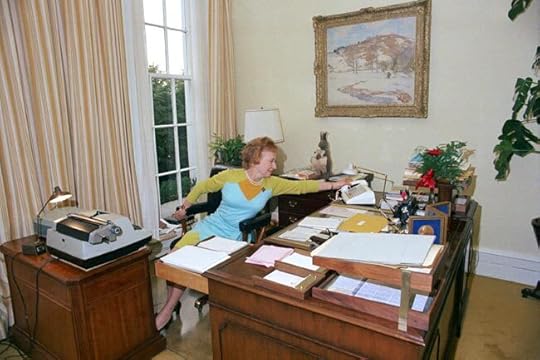
Two further observations that may be of interest. First, the famous picture of the “Rose Mary Stretch” appears to me to be incorrect. That is a picture taken in her ceremonial office, situated between the Oval Office and the Cabinet Room. This was the office shown to the public, demonstrating how wonderfully the president’s secretary was being treated. Let me assure you that such an open and public place was not where Rose or Marge would have been trying to transcribe the tapes. No, it was in that tiny office off to the side and well off the beaten track where they could go to find the silence and privacy they needed to struggle over transcribing those pesky tapes. My guess is that Rose didn’t want to reveal that location and somehow got trapped into doing her demonstration in a much larger office where her supposed “stretch” was unrealistically long.
To test the theory, Volner gave Woods a similar tape recorder and asked her to demonstrate her stretch as she reached for the telephone—as soon as she did, her foot came off the pedal. (A photo later released by the White House of Woods, at her desk, awkwardly re-creating her stretch to answer the phone while keeping her foot on the pedal was almost laughable in her contortions; it ran on the cover of Newsweek with the headline “Rose Mary’s Boo Boo.”)
Even if Woods’s story was believable, it still only accounted for five or six minutes of the eighteen-minute gap, and over the course of the three days, she never tried to offer an explanation for the full loss. Moreover, the timelines she’d listed didn’t add up. Woods said she’d spent more than two hours transcribing the tape on October 1, but the Uher 5000 machine was only delivered to her sometime after 1:15 p.m., and she said she reported the problem to Nixon at 2:08 p.m., a time stamp backed up by White House records.
“Hunt now is demanding another $72,000 for his own personal expenses; another $50,000 to pay his attorneys’ fees—some $120,000. Wants it—wanted it—by the close of business yesterday,” [Dean] said, adding that Hunt also now was explicitly threatening Ehrlichman and Krogh.
Suddenly the Oval Office conversation took a surprising—and ominous—turn. “It’ll cost money. It’s dangerous. Nobody, nothing—people around here are not pros at this sort of thing,” Dean began. “This is the sort of thing Mafia people can do: washing money, getting clean money, and things like that, uh—we’re—we just don’t know about those things, because we’re not used to—we are not criminals and not used to dealing in that business.”
“That’s right,” Nixon said.
“It’s a tough thing to know how to do,” Dean concurred.
“Maybe we can’t even do that.”
“That’s right,” the counsel replied. “It’s a real problem as to whether we could even do it. Plus there’s a real problem in raising money. Mitchell has been working on raising some money—feeling he’s got, he’s one of the ones with the most to lose. But there’s no denying the fact that the White House, and uh, Ehrlichman, Haldeman, Dean are involved in some of the early money decisions.”
“How much money do you need?” the president asked, bluntly.
“I would say these people are going to cost, uh, a million dollars over the next, uh, two years,” Dean guessed.
“We could get that,” Nixon said. “On the money, if you need the money, I mean, you could get the money. You could get a million dollars. And you could get it in cash. I know where it could be gotten.”
Once again, confronted with a decision point that was clearly illegal, the president did not condemn or reject the possibility, but instead chose to advance the scheme himself. There was no question that the hush money would continue—the debate was only over where it would come from and who would deliver it.
"First you’ve got the Hunt problem. That ought to be handled.” As they prepared to wrap up, Nixon made a final point: “No problem, we could, we could get the money. There is no problem in that. We can’t provide the clemency. The money can be provided. Mitchell could provide the way to deliver it. That could be done.”
The sole purpose of involving the CIA was not to interfere with the FBI’s investigation but to prevent disclosure of the identities of two prominent Democrat donors. Critics can quibble over whether even such a limited effort constituted a technical obstruction of justice, but in no one’s book does it rise to the level of the sort of high crime or misdemeanor necessary to impeach a president.
The ever-growing hostility alarmed and saddened some reporters. The New York Times’s White House correspondent, Max Frankel, told the President’s Press Secretary that it was “most painful for me to see my President being cut up.” Frankel complained that Johnson and his staff had fostered the bitterness, but he also acknowledged that both sides had lavished excessive attention “on the most petty aspects of policy and personality.” Why, he said, “must we all punish each other so strenuously on things that don’t [count]?” UPI’s White House correspondent, Merriman Smith, whose son had been killed in Vietnam, told his colleagues that Johnson was “the object of some of the worst vilification—even obscenity—that I’ve seen or heard in more than 25 years on the White House assignment.
The President’s withdrawal was cloaked in typical, albeit understandable, secrecy. The day after announcing it, Johnson insisted that his action had been long planned and had nothing to do with his declining political fortunes. Nevertheless, it seemed—and again, the perception was important—that media and street politics had, for the first time, driven a president from the White House. Johnson acknowledged as much when in a speech to broadcasters in Chicago on April 1, he blamed the failure of the war on the media which had fostered and marshaled unfair opposition to that war and his policies.