

What do you think?

My Lesbian Experience with Loneliness #4
My Alcoholic Escape from Reality
An emotional new diary comic from Nagata Kabi, creator of My Lesbian Experience with Loneliness.
Nagata Kabi's downward spiral is getting out of control, and she can't stop drinking to soothe the ache of reality. After suffering from unbearable stomach pains, she goes to the hospital, where she is diagnosed with pancreatitis--and is immediately hospitalized. A new chapter unfolds in Nagata Kabi's life, as she struggles to find her way back to reality and manga creation in the wake of her breakdown.
Nagata Kabi's downward spiral is getting out of control, and she can't stop drinking to soothe the ache of reality. After suffering from unbearable stomach pains, she goes to the hospital, where she is diagnosed with pancreatitis--and is immediately hospitalized. A new chapter unfolds in Nagata Kabi's life, as she struggles to find her way back to reality and manga creation in the wake of her breakdown.
140 pages, Kindle Edition
First published November 7, 2019
About the author
Kabi Nagata
10 books1,589 followersNagata Kabi is a Japanese manga artist best known for My Lesbian Experience with Loneliness. Nagata has been drawing for as long as she can remember.
Ratings & Reviews
Friends & Following
Create a free account to discover what your friends think of this book!
Community Reviews
Displaying 1 - 30 of 380 reviews

August 20, 2021
Kabi Nagata’s latest memoir manga, My Alcoholic Escape From Reality, should really be called something like Dealing wIth the Consequences of Alcoholism as her drinking escalates to the point where she’s hospitalised with pancreatitis and fatty liver. The book follows her treatment and long road back to recovering her health.
The title led me to expect more about her spiral into alcoholism but the cover illustration is more indicative of the contents as Nagata spends most of the book in a hospital bed; only a small portion at the start covers her alcoholism. I was hoping for more drunk stories, exploring her reasoning behind these choices, hitting rock bottom and so on but I can see why she chose to keep all that stuff out of this book given what she reveals as you read and, regardless, this wasn’t a bad memoir even without it.
I felt really sorry for Nagata’s situation. Her drinking is a direct result of her previous memoirs causing her parents to cry and the guilt she felt after learning this. She tries to change that in this book by focusing her creative energies on making fiction, not memoir. It’s really sad that her being honest about who she is and expressing herself through her chosen creative medium were received so poorly by her nearest and dearest - no wonder she chose a way of numbing that pain.
While informative, the extensive descriptions of treatment at the hospital get a bit dull after a while, and her battle with herself over creating fiction or nonfiction manga got repetitive too. I also wonder if she was an alcoholic as she manages to control her drinking quite easily after leaving hospital. So it’s not even a story about overcoming addiction as she continues to drink, just in smaller amounts!
Still, I’m glad she overcame her demons and continued creating memoir manga. She’s clearly talented, both as a writer and an artist, with a strong narrative voice, and, though not a consistently compelling read, My Alcoholic Escape From Reality has enough to it for it to be worth checking out for fans of slice-of-life manga.
The title led me to expect more about her spiral into alcoholism but the cover illustration is more indicative of the contents as Nagata spends most of the book in a hospital bed; only a small portion at the start covers her alcoholism. I was hoping for more drunk stories, exploring her reasoning behind these choices, hitting rock bottom and so on but I can see why she chose to keep all that stuff out of this book given what she reveals as you read and, regardless, this wasn’t a bad memoir even without it.
I felt really sorry for Nagata’s situation. Her drinking is a direct result of her previous memoirs causing her parents to cry and the guilt she felt after learning this. She tries to change that in this book by focusing her creative energies on making fiction, not memoir. It’s really sad that her being honest about who she is and expressing herself through her chosen creative medium were received so poorly by her nearest and dearest - no wonder she chose a way of numbing that pain.
While informative, the extensive descriptions of treatment at the hospital get a bit dull after a while, and her battle with herself over creating fiction or nonfiction manga got repetitive too. I also wonder if she was an alcoholic as she manages to control her drinking quite easily after leaving hospital. So it’s not even a story about overcoming addiction as she continues to drink, just in smaller amounts!
Still, I’m glad she overcame her demons and continued creating memoir manga. She’s clearly talented, both as a writer and an artist, with a strong narrative voice, and, though not a consistently compelling read, My Alcoholic Escape From Reality has enough to it for it to be worth checking out for fans of slice-of-life manga.

March 21, 2022
Honest and raw look at alcoholism. Kabi Nagata spirals downward when she is diagnosed with pancreatitis - and told she can no longer drink. Drinking had become the way that she dealt with issues she did not want to deal with: and now she has to deal with it all as it comes 'snowballing' down - until her very career as an artist is threatened. Powerful and honest - will look for more of her works.

Read
September 2, 2021I think this is my favorite autobiographic work of hers so far, thoughtful and straightforward about approaching some extremely difficult topics - and she's aware of the difficulty, and the possibility of people receiving it in a bad way.
This is not about queerness like some of her previous work, but about how, struggling with the side effects of her ADHD medication that make her unable to work, she starts drinking to manage the intolerable stress stemming at least partly from this work situation. She gets her medication switched and that resolves the particular issue with working, but by then she already got accustomed to drinking larger and larger amounts to relieve stress - until she ends up in the hospital with liver damage. She talks about her hospital experience, her treatments, etc. in considerable detail. (She seems worried that she didn't take notes in the hospital; but to be honest, there was enough detail that I as a health sciences researcher - not an MD though - would be able to comment on specific issues about her treatments, so I'm quiiiiite confident that's enough detail for a memoir.)
I felt that this was a really important book. Not just well-told and engaging (it is all those things) but also about really important topics. A lot of people who experience addiction often start consuming a specific substance/s as an attempt to self-medicate for something for which there is a medical treatment but it is not applied properly / the person has no access to it. We see more of the access issue when she has to drag herself out of the hospital while not very ambulatory, because they don't have the ability to extend her prescription for her ADHD medication, so they tell her to go see someone quite far away. I feel these are the kind of small but extremely telling details in disability/chronic illness memoirs that I as a disabled/chronically ill reader really want to see in books, and here they are there and shown.
Angry paragraph follows.
I am honestly quite uncomfortable how this book is nowhere near as discussed as her books focusing on lesbian solitude, especially the ones that can be labeled "F/F". To the extent that for a long while I wasn't even aware it had come out in English, and my library didn't order it either, so the lack of discussion definitely creates a spiral of ever-less discussion even from people who'd want to read it otherwise. Nagata Kabi is literally the same lesbian person writing the same kinds of autobiographic works, published by the same publisher. But once the topic is something else, and once it cannot be shoehorned into "a pairing," so many people stopped promoting her work altogether. Just own it that you don't want queer literature (which includes *anything* by queer authors), you want a pairing. And that's before even touching how many, many nondisabled and not chronically ill reviewers immediately drop a series once it becomes somehow "about" disability or chronic illness. We notice! And third of all, but definitely not last - I also notice the massive amounts of lateral ableism directed at people in disability/chronic illness circles who say anything about addiction. So all these factors are working against this book, and the most difficult aspect of it for me might be that the author understood that going in, and had to contemplate it; especially getting flak for talking about alcoholism and being excluded and ostracized.
Please sit with all that for a moment, and contemplate how you can work against these kinds of exclusion in your own environment. I did too.
And now, if this book is of any interest to you, I urge you to get a copy and read it!
_____
Source of the book: Lawrence Public Library
This is not about queerness like some of her previous work, but about how, struggling with the side effects of her ADHD medication that make her unable to work, she starts drinking to manage the intolerable stress stemming at least partly from this work situation. She gets her medication switched and that resolves the particular issue with working, but by then she already got accustomed to drinking larger and larger amounts to relieve stress - until she ends up in the hospital with liver damage. She talks about her hospital experience, her treatments, etc. in considerable detail. (She seems worried that she didn't take notes in the hospital; but to be honest, there was enough detail that I as a health sciences researcher - not an MD though - would be able to comment on specific issues about her treatments, so I'm quiiiiite confident that's enough detail for a memoir.)
I felt that this was a really important book. Not just well-told and engaging (it is all those things) but also about really important topics. A lot of people who experience addiction often start consuming a specific substance/s as an attempt to self-medicate for something for which there is a medical treatment but it is not applied properly / the person has no access to it. We see more of the access issue when she has to drag herself out of the hospital while not very ambulatory, because they don't have the ability to extend her prescription for her ADHD medication, so they tell her to go see someone quite far away. I feel these are the kind of small but extremely telling details in disability/chronic illness memoirs that I as a disabled/chronically ill reader really want to see in books, and here they are there and shown.
Angry paragraph follows.
I am honestly quite uncomfortable how this book is nowhere near as discussed as her books focusing on lesbian solitude, especially the ones that can be labeled "F/F". To the extent that for a long while I wasn't even aware it had come out in English, and my library didn't order it either, so the lack of discussion definitely creates a spiral of ever-less discussion even from people who'd want to read it otherwise. Nagata Kabi is literally the same lesbian person writing the same kinds of autobiographic works, published by the same publisher. But once the topic is something else, and once it cannot be shoehorned into "a pairing," so many people stopped promoting her work altogether. Just own it that you don't want queer literature (which includes *anything* by queer authors), you want a pairing. And that's before even touching how many, many nondisabled and not chronically ill reviewers immediately drop a series once it becomes somehow "about" disability or chronic illness. We notice! And third of all, but definitely not last - I also notice the massive amounts of lateral ableism directed at people in disability/chronic illness circles who say anything about addiction. So all these factors are working against this book, and the most difficult aspect of it for me might be that the author understood that going in, and had to contemplate it; especially getting flak for talking about alcoholism and being excluded and ostracized.
Please sit with all that for a moment, and contemplate how you can work against these kinds of exclusion in your own environment. I did too.
And now, if this book is of any interest to you, I urge you to get a copy and read it!
_____
Source of the book: Lawrence Public Library

June 1, 2021
Nagata Kabi's fourth autobiographical manga finds her hospitalized for acute pancreatitis and fatty liver at just thirty years old. This development isn't too shocking if you've followed the details of her descent into alcohol abuse in the previous volumes. She has had mental health issues as she has dealt with her sexual identity, inability to develop a romantic relationship, and the extremely negative reaction of her parents to her tell-all comics. She had hoped to turn to writing fiction to appease them, but coping with her life-threatening condition puts her back on the road to confessional diaries.
It's painful to watch her suffering and the choices she makes in the course of this memoir, but I could not turn away.
It's painful to watch her suffering and the choices she makes in the course of this memoir, but I could not turn away.

May 13, 2021
I had to completely reevaluate my thoughts on this volume when she casually mentions that alcoholism just culturally isn't a "thing" in Japanese culture?? This makes me extremely nervous for her recovery, (and explains the bizarreness of her treatment not addressing any underlying issues. Talk about throwing a bandaid on a broken arm.) Still, I found her fascinating as always and hope she manages to embrace her dual desires for memoir and fiction. Regardless, I'll be looking out for more.

September 7, 2021
damn. stay strong queen

May 23, 2022
Compulsively readable, this volume of Nagata's memoir explores her alcohol-induced pancreatitis, which she experiences at the age of only 30. During the volume, she struggles to cope without drinking, and facing her new reality as someone with a chronic physical illness. She also muses on whether or not she should write personal memoir at all: I'm really glad she decides to do so, because her writing is fresh, compelling and urgent. I read this in one sitting!
She complains a lot about hospital food, but I must saying Japanese hospital food sounds AMAZING in comparison to what we get here!
She complains a lot about hospital food, but I must saying Japanese hospital food sounds AMAZING in comparison to what we get here!

July 30, 2021
My first manga! I've gotten really into the idea of graphic novel autobiography lately, and Kabi Nagata did not disappoint. In this piece, she chronicles a hospital stay for alcohol-induced pancreatitis. Moments of hilarity sit alongside moments of pain, as the author grapples with the ethics of writing autobiography. Sometimes, family members are included in the story and are hurt by her revelations. Yet ultimately, autobio only true route she has to make sense of her own experience.

April 8, 2023
چه نقاشیای کیاتیکی داشت!
و جالب به مورد پانکراتیت الکی پرداخته بود؛ از این زاویه تاحالا دقت نکرده بودم بهش.
و جالب به مورد پانکراتیت الکی پرداخته بود؛ از این زاویه تاحالا دقت نکرده بودم بهش.

August 23, 2021
7/10
I sucked this book with great pleasure, despite the heavy content and the constant awareness that I was reading the first person account of someone's struggle with life.
Kabi Nagata is a Japanese mangaka, now in her early 30's. She seems not particularly gifted with creating fictional stories. At least that's what she says, and the manga industry seems to agree, as I think she has not managed to publish any fictional comic yet. Nonetheless, she has become a small sensation in her country - with usual echoes in Western comics niches - drawing about her real life. According to the info I gather from this book, which is her fourth memoir, her previous three manga were about her long list of problems: depression, eating disorders, inability to communicate, loneliness, health issues, sexual identity, lack of romantic life. I have not read those previous books, maybe for the best, because it sounds like they could strike home a bit too much in some aspects. Also, they are all in pink, and that colour bores me quickly. But this book is in orange, my favourite colour! Plus, it speaks of health problems different from the one that I have/had in my life. I gave it a try.
So, Kabi had never drunk alcohol until she was 28 year old. ('I thought I did not deserve to have a drink' she states in one of the most mysterious passages of her confession.) Then, in between the age of 28 and 31, she becomes a record-making alcoholic, ruining her liver and pancreas as much as other compulsive drinkers achieve in at least ten years - her doctor's claim, not mine. The memoir starts summing up the mental state that pushed her down this spiral. Then it focuses on her three weeks of hospitalisation for 'severe acute pancreatitis' and the following months of rehabilitation.
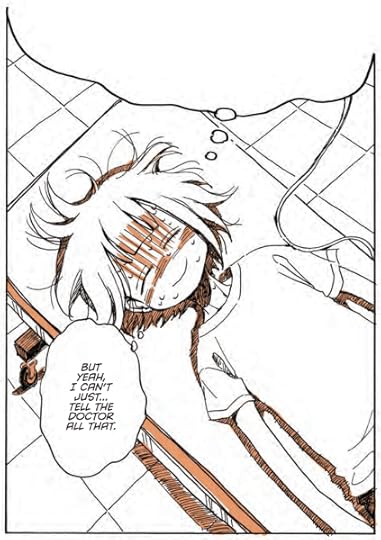
Mostly, she draws herself in a hospital bed or at her drawing table in her parents's house. Sometimes agonising with aches, sometimes agonising with depressive thoughts. But always thinking. This is a book about great painful reflexions and small realisations. In the most recurrent kind of panels she is seen from above, raising her head to the ceiling in the act of realising things about her existence. Most often bad things, but thankfully not always.
An important theme of the story is acceptance of irreversible changes. In the author's case, the fact that she will be a patient for her entire life. With the exception of a couple of painful and powerful panels, this theme is treated almost lightly, depicting how concretely Nagata learns to adjust to a low-fat diet and less drinking. (She does not completely stop drinking though, because this is real life, kids.)
In general, the portrait of Kabi Nagata that we obtain should belong to a therapist rather than us. Firstly, we have the longstanding deep rooted trauma: Kabi is a forgotten loner, to whom the surrounding environment has rarely paid attention or given love, since she was a kid. Then, the more recent trauma: Kabi is a daughter crushed by the guilt of having hurt her parents by displaying their family troubles in the previous memoirs. This guilt is somehow the engine that moves the story: the sense of guilt pushes Nagata to devote herself to pure fiction; the difficulty of writing good fiction pushes her to obsessively drink day and night; the drinking puts her in the hospital; the physical pain reinforces her guilt for making the family worry and not being able to produce manga. On top of all of that, we also have the (expected) Japanese self-flagellation for not being able to constantly produce an absurd amount of work. Indeed, her depression deepens when she notice that that she has not produced any publishable manga in four months. Actually three months, if we consider that one was spent basically dying in a hospital. This is the hard part to believe for a Westerner. Or at least for me. Everyone who has ever tried to create a comic story - actually everyone who has ever created anything - knows what a ridiculous magic wishful thinking is the idea of creating interesting stuff in only three months. (Well, everyone except Japanese people, apparently.)
The book ends with positive realisations. Somehow obvious realisations. But then again, when you struggle with your own demons, the obvious things can be the hardest to recognise and accept.
Nagata's approach to storytelling is simple and direct. The narration flows smoothly. The tender, yet never mawkish, art prevents it from becoming dry.
Pleasant reading. Maybe I will consider one day giving a look at her 'pink' books too.
I sucked this book with great pleasure, despite the heavy content and the constant awareness that I was reading the first person account of someone's struggle with life.
Kabi Nagata is a Japanese mangaka, now in her early 30's. She seems not particularly gifted with creating fictional stories. At least that's what she says, and the manga industry seems to agree, as I think she has not managed to publish any fictional comic yet. Nonetheless, she has become a small sensation in her country - with usual echoes in Western comics niches - drawing about her real life. According to the info I gather from this book, which is her fourth memoir, her previous three manga were about her long list of problems: depression, eating disorders, inability to communicate, loneliness, health issues, sexual identity, lack of romantic life. I have not read those previous books, maybe for the best, because it sounds like they could strike home a bit too much in some aspects. Also, they are all in pink, and that colour bores me quickly. But this book is in orange, my favourite colour! Plus, it speaks of health problems different from the one that I have/had in my life. I gave it a try.
So, Kabi had never drunk alcohol until she was 28 year old. ('I thought I did not deserve to have a drink' she states in one of the most mysterious passages of her confession.) Then, in between the age of 28 and 31, she becomes a record-making alcoholic, ruining her liver and pancreas as much as other compulsive drinkers achieve in at least ten years - her doctor's claim, not mine. The memoir starts summing up the mental state that pushed her down this spiral. Then it focuses on her three weeks of hospitalisation for 'severe acute pancreatitis' and the following months of rehabilitation.
Mostly, she draws herself in a hospital bed or at her drawing table in her parents's house. Sometimes agonising with aches, sometimes agonising with depressive thoughts. But always thinking. This is a book about great painful reflexions and small realisations. In the most recurrent kind of panels she is seen from above, raising her head to the ceiling in the act of realising things about her existence. Most often bad things, but thankfully not always.
An important theme of the story is acceptance of irreversible changes. In the author's case, the fact that she will be a patient for her entire life. With the exception of a couple of painful and powerful panels, this theme is treated almost lightly, depicting how concretely Nagata learns to adjust to a low-fat diet and less drinking. (She does not completely stop drinking though, because this is real life, kids.)
In general, the portrait of Kabi Nagata that we obtain should belong to a therapist rather than us. Firstly, we have the longstanding deep rooted trauma: Kabi is a forgotten loner, to whom the surrounding environment has rarely paid attention or given love, since she was a kid. Then, the more recent trauma: Kabi is a daughter crushed by the guilt of having hurt her parents by displaying their family troubles in the previous memoirs. This guilt is somehow the engine that moves the story: the sense of guilt pushes Nagata to devote herself to pure fiction; the difficulty of writing good fiction pushes her to obsessively drink day and night; the drinking puts her in the hospital; the physical pain reinforces her guilt for making the family worry and not being able to produce manga. On top of all of that, we also have the (expected) Japanese self-flagellation for not being able to constantly produce an absurd amount of work. Indeed, her depression deepens when she notice that that she has not produced any publishable manga in four months. Actually three months, if we consider that one was spent basically dying in a hospital. This is the hard part to believe for a Westerner. Or at least for me. Everyone who has ever tried to create a comic story - actually everyone who has ever created anything - knows what a ridiculous magic wishful thinking is the idea of creating interesting stuff in only three months. (Well, everyone except Japanese people, apparently.)
The book ends with positive realisations. Somehow obvious realisations. But then again, when you struggle with your own demons, the obvious things can be the hardest to recognise and accept.
Nagata's approach to storytelling is simple and direct. The narration flows smoothly. The tender, yet never mawkish, art prevents it from becoming dry.
Pleasant reading. Maybe I will consider one day giving a look at her 'pink' books too.

September 12, 2021
Girl please don't die

March 22, 2022
Non nasconde nulla del suo consumo di alcol, dove e quando, delle sue prescrizioni per gli psicofarmaci, del suo sentirsi in crisi creativa e personale. Per questo è un manga potente e vero, triste e pieno di speranza al tempo stesso.

September 6, 2021
someone please get this woman a girlfriend she deserves one

August 19, 2023
Not that I'm not sympathetic, because addiction is a terrible disease, but this really felt like reading a train wreck.

September 12, 2021
Three and a half stars.
I'm very fond of Kabi, the fictional/real person whom we've come to know since her first autobiographical manga "My Lesbian Experience With Loneliness". As a child, Kabi was the kind whom everyone forgot; they switched off the lights while she remained in the classroom, they forgot she was invited to other people's birthday parties, etc. Life didn't improve much over time, if at all. In this current entry of Kabi's likely descent into madness, she opens up about how she has abused alcohol to cope with having failed to live independently, find love, write fictional series, etc., to the extent that she caused herself acute pancreatitis for which she'll need to keep medicating herself for the rest of her life.
Kabi drank on top of receiving medication for ADHD, anxiety, and I don't know what else. She mentions that at one point she worried that she couldn't invent new material, that she wasn't good enough, etc., the kind of stuff that comes with making something of your own. Instead of struggling through it, she medicated herself; the cocktail described in the manga is troubling. Then she complained that the drugs were erasing her ability to imagine stuff, or even retain the drive to put whatever was left into fruition. Artists are fucked up people who exploit their psychological issues and anxiety to produce hopefully meaningful works (often because society hasn't implemented yet a button that would kill you instantly); if instead of using that anxiety as fuel, you drown it with pills, you end up a zombie. I already went that route in my early twenties.
I would say that I don't understand such a blatantly self-destructive method of coping as drinking alcohol, but then again I've done very little exercise since this whole mysterious virus thing started however long ago that was, and I've been eating more. Basically whenever I feel down, I've been eating garbage. And I always feel down. Kabi also opens up about feeling sinful, that partly she's punishing herself for having failed her parents, for being a waste of space, etc.
What worries me the most is that her doctors couldn't have put it any clearer: either Kabi stops alcoholizing herself or she's fucked. She had destroyed her pancreas in three years or so worse than most alcoholics achieve in twenty; even so, Kabi found the hospital food unacceptable (a diet tailored to her ruined pancreas) mostly because it was bland, and she threw plenty of it away. Her blood thickened so much that the doctors couldn't draw blood, and were forced to push air or some shit through her veins. Once, Kabi was allowed to leave the hospital, but she was so weak that she felt about to collapse on her way to get on a taxi. After the hospital discharge and when she returned to her parents' home, it didn't take her long until she went back to drinking; not remotely to the extent that had landed her in a hospital, but given her condition, she should make an effort to forget that alcohol even exists. In addition, Kabi now has to be careful and avoid fatty foods, because the pancreas is in charge of processing that stuff, probably.
By the end of the manga, Kabi realizes that until now she had taken for granted that although she knew herself to be mentally ill, at least her body worked properly, but now she feels old and broken. Unsurprisingly, in the last stretch of this manga she opens up about wishing to die, and how her life is a cycle of wanting to disappear and justifying her existence through creating art. This latest entry in Kabi's descent ends with her hoping to move forward somehow in her quest to find someone to love, as a thirty something years old lesbian, alcoholic, ADHD/anxiety sufferer, possibly autistic (I feel that kind of kinship with her, from the first volume) manga author who may only be capable of creating meaningful art about her private disasters.
I love you, Kabi. I hope I don't wake up one day to read that your bloated body has washed up on a shore.
I'm very fond of Kabi, the fictional/real person whom we've come to know since her first autobiographical manga "My Lesbian Experience With Loneliness". As a child, Kabi was the kind whom everyone forgot; they switched off the lights while she remained in the classroom, they forgot she was invited to other people's birthday parties, etc. Life didn't improve much over time, if at all. In this current entry of Kabi's likely descent into madness, she opens up about how she has abused alcohol to cope with having failed to live independently, find love, write fictional series, etc., to the extent that she caused herself acute pancreatitis for which she'll need to keep medicating herself for the rest of her life.
Kabi drank on top of receiving medication for ADHD, anxiety, and I don't know what else. She mentions that at one point she worried that she couldn't invent new material, that she wasn't good enough, etc., the kind of stuff that comes with making something of your own. Instead of struggling through it, she medicated herself; the cocktail described in the manga is troubling. Then she complained that the drugs were erasing her ability to imagine stuff, or even retain the drive to put whatever was left into fruition. Artists are fucked up people who exploit their psychological issues and anxiety to produce hopefully meaningful works (often because society hasn't implemented yet a button that would kill you instantly); if instead of using that anxiety as fuel, you drown it with pills, you end up a zombie. I already went that route in my early twenties.
I would say that I don't understand such a blatantly self-destructive method of coping as drinking alcohol, but then again I've done very little exercise since this whole mysterious virus thing started however long ago that was, and I've been eating more. Basically whenever I feel down, I've been eating garbage. And I always feel down. Kabi also opens up about feeling sinful, that partly she's punishing herself for having failed her parents, for being a waste of space, etc.
What worries me the most is that her doctors couldn't have put it any clearer: either Kabi stops alcoholizing herself or she's fucked. She had destroyed her pancreas in three years or so worse than most alcoholics achieve in twenty; even so, Kabi found the hospital food unacceptable (a diet tailored to her ruined pancreas) mostly because it was bland, and she threw plenty of it away. Her blood thickened so much that the doctors couldn't draw blood, and were forced to push air or some shit through her veins. Once, Kabi was allowed to leave the hospital, but she was so weak that she felt about to collapse on her way to get on a taxi. After the hospital discharge and when she returned to her parents' home, it didn't take her long until she went back to drinking; not remotely to the extent that had landed her in a hospital, but given her condition, she should make an effort to forget that alcohol even exists. In addition, Kabi now has to be careful and avoid fatty foods, because the pancreas is in charge of processing that stuff, probably.
By the end of the manga, Kabi realizes that until now she had taken for granted that although she knew herself to be mentally ill, at least her body worked properly, but now she feels old and broken. Unsurprisingly, in the last stretch of this manga she opens up about wishing to die, and how her life is a cycle of wanting to disappear and justifying her existence through creating art. This latest entry in Kabi's descent ends with her hoping to move forward somehow in her quest to find someone to love, as a thirty something years old lesbian, alcoholic, ADHD/anxiety sufferer, possibly autistic (I feel that kind of kinship with her, from the first volume) manga author who may only be capable of creating meaningful art about her private disasters.
I love you, Kabi. I hope I don't wake up one day to read that your bloated body has washed up on a shore.

May 21, 2021
Just as good as MY LESBIAN EXPERIENCE WITH LONELINESS, with (in my opinion) slightly more confident and sophisticated artwork. I really hope Nagata is eventually able to have a healthier relationship with alcohol (it's hard, I get it!) , and doesn't suffer a relapse of pancreatitis.

December 22, 2022
A very good, if sometimes exasperatingly chaotic, depiction of creative block and hyperfixation.

Read
January 12, 2022Nagata oferuje ten szczególny rodzaj introspektywnej narracji, który nie ma w sobie nic pretensjonalnego, jest szczery, odważny, bolesny i bardzo ludzki. Odsłania się całkowicie i robi to bez żadnych oczekiwań wobec czytelnika, wyłącznie z potrzeby nawet nie tyle autoekspresji, co usensowienia własnych doświadczeń. Te strony są jak wyciągnięcie ręki ponad szerokościami geograficznym i przedstawienie się "to ja i moje życie".

March 14, 2024
Più leggo Kabi Nagata, più sono sbalordito dalla sua capacità di raccontare qualcosa di estremamente personale ma in maniera universale. Anche in questo volume, la mangaka si racconta e va a indagare in profondità le cause della sua pancreatite. La vergogna, la paura di deludere i genitori e la solitudine sono sentimenti che tutt3 noi proviamo prima o poi, è quasi invitabile. Mi hanno straziato le ultime pagine, anche se Kabi Nagata lascia sempre spazio alla speranza.
February 16, 2025
de momento es el q he anotado más

May 14, 2021
My alcoholic escape from reality was my most anticipated manga this year!
I didn't know what to expect in this new memoir so it was a surprise to read that Nagata didn't plan to write another diary comic in the first place after the fallout of her past work and the guilt she felt for hurting her family by being completely honest with their portrayal at that time. Considering how popular her work became in Japan and internationally, that feel is understandable.
So this piece lost many details and feels shorter than her previous works because it's more a recount of the time she spent in the hospital dealing with pancreatitis, how she struggled to create different works of fiction, experienced an artblock for the first time, and ended up with the unbearable itch to create another memoir yet again. Despite the serious topic of suffering pancreatitis and a liver disease, she portrayed that journey in a way that make the reader laugh at times. Though it baffles me to imagine the amount of alcohol she drank for 3 years to the point of developing those diseases and how since in Japan there's no alcohol culture, alcoholism apparently is not an issue tackled by psychologists.
Nagata's deeply personal work always hits home in some aspects, this one isn't the exception. Her self-reflection about what's the core of her drive to draw and create something was something i understood as a creative person myself who has spent years denying myself from creating certain stories because I think they'll be met with more backlash than positivity. Also her bouts of depression and suicide idealization is something i know too well.
In resume, My alcoholic scape from reality is another fantastic work by Nagata Kabi, i was afraid it wouldn't end on a positive note but thankfully it did!, and I'm glad she's doing another diary manga and it's got licensed by Seven Seas.
**I watched her interview in the Toronto Comic Arts Festival where she mentioned the orange tone for this manga was completely accidental on the publisher's side (the editor though it was orange instead of the usual pink) and she didn't correct them haha, it suits the story tbh.**
I didn't know what to expect in this new memoir so it was a surprise to read that Nagata didn't plan to write another diary comic in the first place after the fallout of her past work and the guilt she felt for hurting her family by being completely honest with their portrayal at that time. Considering how popular her work became in Japan and internationally, that feel is understandable.
So this piece lost many details and feels shorter than her previous works because it's more a recount of the time she spent in the hospital dealing with pancreatitis, how she struggled to create different works of fiction, experienced an artblock for the first time, and ended up with the unbearable itch to create another memoir yet again. Despite the serious topic of suffering pancreatitis and a liver disease, she portrayed that journey in a way that make the reader laugh at times. Though it baffles me to imagine the amount of alcohol she drank for 3 years to the point of developing those diseases and how since in Japan there's no alcohol culture, alcoholism apparently is not an issue tackled by psychologists.
Nagata's deeply personal work always hits home in some aspects, this one isn't the exception. Her self-reflection about what's the core of her drive to draw and create something was something i understood as a creative person myself who has spent years denying myself from creating certain stories because I think they'll be met with more backlash than positivity. Also her bouts of depression and suicide idealization is something i know too well.
In resume, My alcoholic scape from reality is another fantastic work by Nagata Kabi, i was afraid it wouldn't end on a positive note but thankfully it did!, and I'm glad she's doing another diary manga and it's got licensed by Seven Seas.
**I watched her interview in the Toronto Comic Arts Festival where she mentioned the orange tone for this manga was completely accidental on the publisher's side (the editor though it was orange instead of the usual pink) and she didn't correct them haha, it suits the story tbh.**

August 17, 2023
By all means, I am in no position to criticize someone choosing to talk about their life - whether I review a book or talk about an album, sure enough, that "I" always appears; it must, for I am not a machine, but a person with their unique viewpoints, tastes, and preferences/disinclinations. As a baseline, I can only commend Nagata for talking about the difficult things she's facing; and in previous installments, that led to raw storytelling in which the lessons felt hard-won.
But this one just makes her look like that one messy Twitter mutual who always gets into fights and always has a problem and always seeks your pity for it. Something about the beginning, saying she's only telling me, the reader that, already removes the distance to an uncomfortable degree; and then the lessons that she already learned the last two volumes... and it's like, who told you to drink this much!! Jesus! It felt less like insight and just rushing to tell the story because there was nothing else. I don't necessarily like the whole fiction/autobiographical dichotomy, but for her, like previously stated, it makes a lot of sense - that one-shot was painful on a dramaturgical basis; but presenting it like a grand realization feels even more of a head-scratcher, especially so late to the end.
Yeah... sadly didn't enjoy this one at all.
But this one just makes her look like that one messy Twitter mutual who always gets into fights and always has a problem and always seeks your pity for it. Something about the beginning, saying she's only telling me, the reader that, already removes the distance to an uncomfortable degree; and then the lessons that she already learned the last two volumes... and it's like, who told you to drink this much!! Jesus! It felt less like insight and just rushing to tell the story because there was nothing else. I don't necessarily like the whole fiction/autobiographical dichotomy, but for her, like previously stated, it makes a lot of sense - that one-shot was painful on a dramaturgical basis; but presenting it like a grand realization feels even more of a head-scratcher, especially so late to the end.
Yeah... sadly didn't enjoy this one at all.

Read
March 16, 2022I'm not going to consider this a real review. I really enjoy the occasional graphic memoir, but I'm not going to pretend I know enough about what goes into producing one or what the genre norms and standards are to be knowledgeable enough to 'review' it. So, instead, this is just my reaction to having read the media. And I enjoyed it...as much as you can 'enjoy' a memoir about someone's spiral into and possibly out of alcoholism and chronic mental and physical health issues. But Nagata does a good job making the reader feel her fear, insecurities, and exasperation at her situation, as well as her professional and familial struggles to work through both. Then, the whole thing ends on a hopeful note. This is the first Nagata Kabi Graphic memoir/diary I've read. I guess I'll have to go find her backlog now.

October 24, 2022
Los mangas de Kabi Nagata me encantan (aunque me preocupa mucho ella). En este manga en particular explica su ingreso hospitalario tras una pancreatitis muy aguda a causa de su alcoholismo y habla sobre sus dilemas de reflejar su vida y hacer manga de ensayo autobiográfico.

December 18, 2023
муки творчих людей ще ніколи не були описані так правдиво

May 27, 2021
This books is an interesting follow-up to her previous 3. Each time I read one of her books I feel like I get something different --a different experience. With the 1st, there was a particular experience and history told. The second two were exercises in self assessment. This book is something in a new direction. It's been a 3 part series with 3 different narrative and perspective styles: 1. My Lesbian Experience with Loneliness, 2. My Solo Exchange Diary Vol. 1 + My Solo Exchange Diary Vol. 2, and 3. now this book. She reverts back to the narrative style of the first book, but without the time crunch aspect. As she notes in the book, part of the trouble she had writing the book was because this book took place across less than a year whereas her other titles covered about 10 years worth of content.
Rather than focusing on psychology aspects of her life, we dig a little deeper into her physical illness. If you read the previous titles, you know that the author suffered from mental health issues and some feelings of inadequacy related to her familial relationships and growing up/being an adult. We left after Solo 2 with a sort of hopefulness that things were getting somewhat better for the author, but there was this teetering alcoholism. Between that publication and this one, there was a sad hospital tweet about the content of this present book. So, the real depth of the story comes from understanding her previous struggles within the context of her physical pain and .
It's a heavy book that begins in what seems like a non-threatening place: she has a stomach ache that doesn't go away. The pancreatitis and fatty liver issues (not a spoiler it's on the back cover!) are coupled with her ADHD, depression, eating disorder, and imposter syndrome. Each book puts the reader in the pit with the author, looking at the walls around you --exploring the depths of her pain. This book finds an even deeper hole of despair to fall into, especially as the physical damage to her body settles into her mind. If you liked the look that Wit gave an informed observer, this book takes the road of someone from the average person experience longer hospital stays. You feel her helplessness and this internal flailing. She blames herself, but struggles with the strength to fix it.
What I like about this book is that rather than leaning on her parents to gratify her or comfort her, she looks to herself to try to fix her problems and process what is happening in her life. The last chapter shows some real growth for her and an acceptance that writing biographical manga is not a terrible things; it's part of who she is and one of her incredible successes. That particular growth is a show of her own fortitude because she grapples with her mother not being pleased with what she has written. Sometimes, when we write the truth and people involved in our stories see themselves presented a certain way, it can be hard for them to support a negative perception of themselves even if what was written is true. We can see the little finger prints of that on this book as her parents are in the story, but with very limited on page time. She has found the way to balance sharing her truth with respecting the privacy of those around her.
Rather than focusing on psychology aspects of her life, we dig a little deeper into her physical illness. If you read the previous titles, you know that the author suffered from mental health issues and some feelings of inadequacy related to her familial relationships and growing up/being an adult. We left after Solo 2 with a sort of hopefulness that things were getting somewhat better for the author, but there was this teetering alcoholism. Between that publication and this one, there was a sad hospital tweet about the content of this present book. So, the real depth of the story comes from understanding her previous struggles within the context of her physical pain and .
It's a heavy book that begins in what seems like a non-threatening place: she has a stomach ache that doesn't go away. The pancreatitis and fatty liver issues (not a spoiler it's on the back cover!) are coupled with her ADHD, depression, eating disorder, and imposter syndrome. Each book puts the reader in the pit with the author, looking at the walls around you --exploring the depths of her pain. This book finds an even deeper hole of despair to fall into, especially as the physical damage to her body settles into her mind. If you liked the look that Wit gave an informed observer, this book takes the road of someone from the average person experience longer hospital stays. You feel her helplessness and this internal flailing. She blames herself, but struggles with the strength to fix it.
What I like about this book is that rather than leaning on her parents to gratify her or comfort her, she looks to herself to try to fix her problems and process what is happening in her life. The last chapter shows some real growth for her and an acceptance that writing biographical manga is not a terrible things; it's part of who she is and one of her incredible successes. That particular growth is a show of her own fortitude because she grapples with her mother not being pleased with what she has written. Sometimes, when we write the truth and people involved in our stories see themselves presented a certain way, it can be hard for them to support a negative perception of themselves even if what was written is true. We can see the little finger prints of that on this book as her parents are in the story, but with very limited on page time. She has found the way to balance sharing her truth with respecting the privacy of those around her.

March 26, 2024
Наскільки складно визнати, що ти залежна/ний від алкоголю та відверто це розказати? Наскільки важко вийти з кризи, про яку ти навіть не здогадувалась/ся, щоб знову знайти себе?
Неймовірно важко. Й цей тягар обтяжує ще й те, що у спробах подолати цю кризу, треба ще й рефлексувати, осмислювати дійсність та намагатися творити.
Ось про цю боротьбу й розповідає манґа "Моя алковтечя від реальності" Наґати Кабі. Це есе починається з того, що головна героїня (вона ж - авторка) потрапляє у лікарню з гострим панкреатитом, спричиненим алкогольним отруєнням. А далі - лікування, пошук способу життя зі значними обмеженнями та спроби знайти музу та продовжити створювати манґу.
Й все це - у індивідуальній та типовій для авторки манері, яка є впізнаваною та дуже милою. Та дуже персиковою🍑
Мені подобається творчість та здатність авторки до чесної саморефлексії. Іноді у цій чесності я зустрічаю саму себе. Не скажу, що наші проблеми схожі - зовсім ні. Просто думки Наґати провокують мене подумати та прорефлексувати щось своє. А це вже цінно.
Я із задоволенням буду читати й інші есе Наґати Кабі. А цій алковтечі ставлю ⭐️⭐️⭐️.
Неймовірно важко. Й цей тягар обтяжує ще й те, що у спробах подолати цю кризу, треба ще й рефлексувати, осмислювати дійсність та намагатися творити.
Ось про цю боротьбу й розповідає манґа "Моя алковтечя від реальності" Наґати Кабі. Це есе починається з того, що головна героїня (вона ж - авторка) потрапляє у лікарню з гострим панкреатитом, спричиненим алкогольним отруєнням. А далі - лікування, пошук способу життя зі значними обмеженнями та спроби знайти музу та продовжити створювати манґу.
Й все це - у індивідуальній та типовій для авторки манері, яка є впізнаваною та дуже милою. Та дуже персиковою🍑
Мені подобається творчість та здатність авторки до чесної саморефлексії. Іноді у цій чесності я зустрічаю саму себе. Не скажу, що наші проблеми схожі - зовсім ні. Просто думки Наґати провокують мене подумати та прорефлексувати щось своє. А це вже цінно.
Я із задоволенням буду читати й інші есе Наґати Кабі. А цій алковтечі ставлю ⭐️⭐️⭐️.

August 22, 2023
Це була ще одна чудова подорож, хоч і не така близька мені, як перша манга цієї авторки “Мій лесбійський досвід самотности”.
Це автобіографічна історія про те, як авторка почала вживати алкоголь і довела себе до залежності, панкреатиту і госпіталізації.
Я розумію, чому ця історія може подобатися значно менше. Адже ми маємо героїню, яка, на перший погляд, абсолютна невдаха. Їй 30 років, вона живе з батьками, п’є алкоголь діжками і не дуже то й досягнула успіхів у житті. Така історія рідко може викликати захоплення у людей чи хоча б знайти емоційний відклик.
Але я не вважаю героїню невдахою. По перше, вона дуже талановита і має 5 координаторів з різних компаній, з якими підписані контракти. У неї є повна свобода творчості, а її твори очікувані на ринку.
По друге, у героїні депресія і синдром порушення активності й уваги. Це серйозні ментальні захворювання, які потребують лікування, як медикаментозного, так і терапії. Тому постійні тривоги, страждання та розгубленість героїні дуже мені зрозумілі і знайомі.
У найгірші свої депресивні епізоди я також ще тією невдахою почуваюся. Депресія щодня краде найкраще у моєму житті.
Але авторка, і це буде по третє, попри все, знаходить у собі сили і сміливість розповідати про своє життя без прикрас, без спроб применшити того, якою вона є лузеркою, які хибні рішення ухвалює і як випускає з рук стільки чудово у її житті.
Це дуже чесна історія. З притаманною для японців відвертістю. Але не впевнена, що історія для широко загалу. Тут треба читати між рядків і позбутися власних упереджень.
Це автобіографічна історія про те, як авторка почала вживати алкоголь і довела себе до залежності, панкреатиту і госпіталізації.
Я розумію, чому ця історія може подобатися значно менше. Адже ми маємо героїню, яка, на перший погляд, абсолютна невдаха. Їй 30 років, вона живе з батьками, п’є алкоголь діжками і не дуже то й досягнула успіхів у житті. Така історія рідко може викликати захоплення у людей чи хоча б знайти емоційний відклик.
Але я не вважаю героїню невдахою. По перше, вона дуже талановита і має 5 координаторів з різних компаній, з якими підписані контракти. У неї є повна свобода творчості, а її твори очікувані на ринку.
По друге, у героїні депресія і синдром порушення активності й уваги. Це серйозні ментальні захворювання, які потребують лікування, як медикаментозного, так і терапії. Тому постійні тривоги, страждання та розгубленість героїні дуже мені зрозумілі і знайомі.
У найгірші свої депресивні епізоди я також ще тією невдахою почуваюся. Депресія щодня краде найкраще у моєму житті.
Але авторка, і це буде по третє, попри все, знаходить у собі сили і сміливість розповідати про своє життя без прикрас, без спроб применшити того, якою вона є лузеркою, які хибні рішення ухвалює і як випускає з рук стільки чудово у її житті.
Це дуже чесна історія. З притаманною для японців відвертістю. Але не впевнена, що історія для широко загалу. Тут треба читати між рядків і позбутися власних упереджень.
October 3, 2021
Un relato acerca del proceso creativo durante un periodo de enfermedad.
Es un cómic muy curioso porque parece que alguien se ha molestado en pintar con un marcador fosforito naranja cada página.
El relato en sí es la propia moraleja de la zorra y las uvas, algo que he aprendido gracias a estas páginas. Rechazamos lo que anhelamos como justificación para no sufrir al relegar nuestros deseos al plano de la imposibilidad. Y es que parece que nos alejamos siempre de lo que nos gusta, tomando direcciones opuestas y colocándonos orejeras para no sufrir. La contradicción propia de los seres humanos.
Kabi Nagata relata de nuevo los estragos derivados de la salud mental y su relación con el alcoholismo. Teniendo esta práctica una perspectiva diferente en Oriente respecto a Occidente.
A nivel personal me ha resultado muy interesante puesto que la mayor parte del libro se desarrolla en un contexto hospitalario, lo cual me atrae. Sin embargo, a pesar de que me parezca una historia curiosa, me ha dado la impresión de que ha sido realizada con excesiva rapidez. Como que le falta quizá algún pulido. Desconozco si es por el trazo o bien si es por el desarrollo de la propia historia.
Es un cómic muy curioso porque parece que alguien se ha molestado en pintar con un marcador fosforito naranja cada página.
El relato en sí es la propia moraleja de la zorra y las uvas, algo que he aprendido gracias a estas páginas. Rechazamos lo que anhelamos como justificación para no sufrir al relegar nuestros deseos al plano de la imposibilidad. Y es que parece que nos alejamos siempre de lo que nos gusta, tomando direcciones opuestas y colocándonos orejeras para no sufrir. La contradicción propia de los seres humanos.
Kabi Nagata relata de nuevo los estragos derivados de la salud mental y su relación con el alcoholismo. Teniendo esta práctica una perspectiva diferente en Oriente respecto a Occidente.
A nivel personal me ha resultado muy interesante puesto que la mayor parte del libro se desarrolla en un contexto hospitalario, lo cual me atrae. Sin embargo, a pesar de que me parezca una historia curiosa, me ha dado la impresión de que ha sido realizada con excesiva rapidez. Como que le falta quizá algún pulido. Desconozco si es por el trazo o bien si es por el desarrollo de la propia historia.

February 12, 2022
He leído tres de los cuatro mangas autobiográficos de Nagata y creo que cometí un error al leerlos de manera tan seguida.
El dibujo no es particularmente “bueno” —no al menos en lo que se puede considerar dentro del universo de magakas— pero logra captar bastante bien las emociones y retratar las situaciones que narra su autora y por tanto creo que ahí reside su principal valor. Dicho esto, se hace agotador leerla a ratos, hay cierto nivel basal de autocomplacencia e inmadurez emocional que termina por hacer que el lector en lugar de conectar con la autora, termine antagonizando con ella.
No digo que le pase a todo el mundo, sin duda los temas que toca en sus obras —suicidio, depresión, trastorno de conducta alimentaria, homofobia internalizada, autolesiones y alcoholismo— no solo deben ser tratados y se debe hablar de ellos, sino que resultan muy atractivos porque no suelen tocarse de manera tan abierta. Sin embargo, la honestidad de la autora es tan brutal, que leerla a ratos resulta exasperante y uno termina necesitando un respiro de su obra y de ELLA.
Creo que no se lo recomendaría a alguien depresivo o que estuviera pasando por un mal momento.
El dibujo no es particularmente “bueno” —no al menos en lo que se puede considerar dentro del universo de magakas— pero logra captar bastante bien las emociones y retratar las situaciones que narra su autora y por tanto creo que ahí reside su principal valor. Dicho esto, se hace agotador leerla a ratos, hay cierto nivel basal de autocomplacencia e inmadurez emocional que termina por hacer que el lector en lugar de conectar con la autora, termine antagonizando con ella.
No digo que le pase a todo el mundo, sin duda los temas que toca en sus obras —suicidio, depresión, trastorno de conducta alimentaria, homofobia internalizada, autolesiones y alcoholismo— no solo deben ser tratados y se debe hablar de ellos, sino que resultan muy atractivos porque no suelen tocarse de manera tan abierta. Sin embargo, la honestidad de la autora es tan brutal, que leerla a ratos resulta exasperante y uno termina necesitando un respiro de su obra y de ELLA.
Creo que no se lo recomendaría a alguien depresivo o que estuviera pasando por un mal momento.
Displaying 1 - 30 of 380 reviews