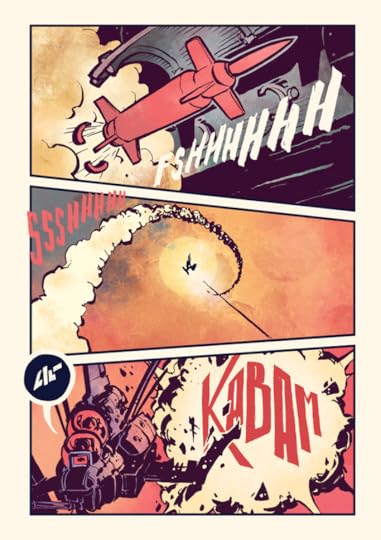
During a skirmish with an opposing Martian faction, a fighter pilot disobeys orders to pursue a fleeing foe.
Guided by her determination and curiosity, she is led into a dangerous chase through Mars's forbidden valley where she will be confronted with the red planet's darkest of secrets.
A fast-paced, 128-page, full-color, pocket-format, sci-fi adventure through Mars's mysteries all told in its original Martian form.
Billed as a story being reprinted in its original Martian form, all the lettering is in Martian. In essence, making this a wordless graphic novel. The art is intriguing. It has got this chunky retro feel to it like the cover of a sci-fi novel from the 70's. It's all told in 1 to 3 page panels, making this almost a flip book. It's about 2 pilots from opposing forces crashing in a wasteland. They come across an odd factory. I'm not sure what the story is trying to say. I didn't much get the point of it, like only seeing the middle of a movie.
First things first - I helped Kickstart this book, which I don't think will influence my review, but best to be upfront about that sort of thing, what?
Two Martian factions are at war with eachother - one is dressed in white, the other in black. They only speak in Martian, which you can supposedly decode if that's your thing. Turns out there's something dodgy about this war, which I won't spoil for you here.
The story is okay. It takes an interesting turn, but then it feels like EPHK doesn't know how to end it, so it just fizzles out on a 1970s dystopian sci-fi ending.
However, I didn't support this project on Kickstarter for its story, I was there for the art. And I am still here for the art, which reminds me a bit of Chris Ware (huge compliment, I feel).
Sort-of silent SF, which is to say there are sound effects, and there is speech, but while the former are perfectly comprehensible beeps and slurps, the latter is all in a series of glyphs which I assume from the title are supposed to be Martian. Although the technology and body shapes all look fairly near-future Earth, so it seems odd the language should be quite so alien, even if the reason for that does ultimately become clear-ish. I'm not averse to a comic one can't exactly 'read', but it helps if there are faces to go off instead, and here they're all obscured by flight suits, which would throw us back on physical cartooning, and again, still doable...but here the art seems less concerned with letting us follow the lead's emotional state, than giving us plenty of good views of her butt in said figure-hugging flight suit. And when she meets another pilot, the distinction between them is pretty much down to the different flight suit designs, because they both have very much the same lovingly contoured backside. Once we do eventually see some faces, it becomes clear [SPOILER I suppose] why the butts were so similar, but the rather characterless faces still don't carry much emotion, tending more to support the notion that all the humanoid characters are not just clones but interchangeable sex dolls, without any particular clarification as to why (beyond the artist's own tastes) that might fit the story. I guess the art does a reasonably good job of catching a dogfight on the comics page – which, as with car chases, is notoriously trickier than you might think – but even that isn't hugely impressive when so much of what might otherwise take up the page budget, like any form of recognisable human drama, or even the sense of wonder and shock reveal for which I think the comic might have been aiming, is absent. Just dogfights, a bit of wilderness survival and exploration, and shapely posteriors, all rendered in a manner vaguely reminiscent of Brandon Graham, but minus the humour and character and intricacy, and thus most of the point.
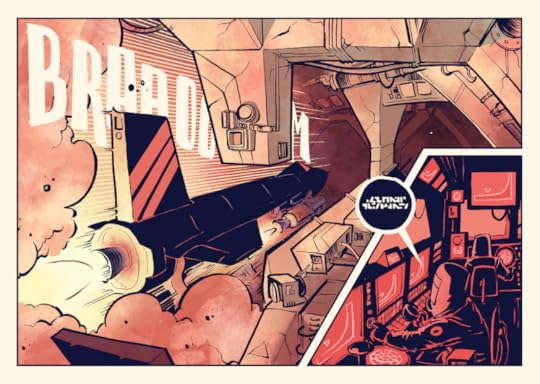
Well there's nothing like a book that takes a concept and runs with it. This, we're told, is a reprint of the original Martian graphic novel, meaning of course that not only do the characters have to look odd but able to be engaged with, but all the speech bubbles have to have the original Martian lettering. But that's taken even a step further early on in the action here. A base is under attack from three fighter craft, and the pilots to defend it are being scrambled – so here is a complete schematic of their craft, complete with the pilot's controls, the weapons it can use, and so on, all in fluent Martian.
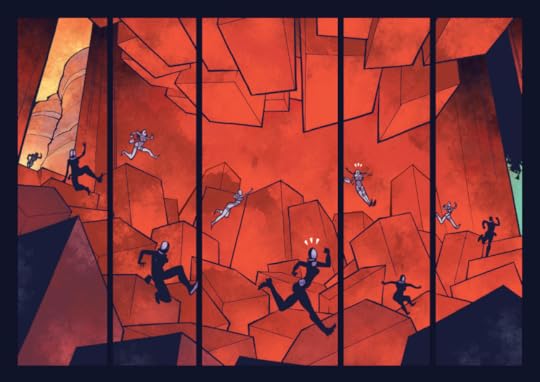
It does turn out that tracking scopes still go "Blip" on Mars, and explosions still go "Kablamo", but the stress of the book must be on making sure you can follow the story, even with unreadable speech bubbles. And generally that problem's met with, with only a couple of instances where the visuals are hard to decipher. It's not the lengthiest of reads, what with it being more or less silent, and in fact it might not be terribly satisfying were it to actually be in English – the conceit of the book adding a different kind of novelty, and otherworldliness, to everything. It's a fun little sci-fi actioner, with dogfights, chases, and even a bit of Martian parkour. Some more quirky visual choices, such as a multi-pose, top-down path through a maze of tunnels to convey distance and passage of time, add to the cleverness of the whole Martian idea. And it's certainly a distinctive little read – if that's even the right word.
This was super nice. Not-so-silent (since this comics is full of words, but those you won´t understand), kinda sexy and kinda creepy. Loved those detailed sketches.
The main character's clothing seems gratuitously revealing, but who am I to complain about uniforms? Or about all the butt-shots in this cartoony, but still sexy comic? Where are the words, though? Given the many butt-shots, who cares about words?
The unnamed main character, let's call her O-X from her callsign, is a fighter pilot on a station that is under attack from the first panel of the comic. She pilots one of three fighters scrambled to fight off the enemy attack. After two of the enemy fighters are destroyed, O-X follows the third, against orders, to a hidden location on Mars. After crashlanding on the planet, she arms herself and checks on the last remaining enemy pilot.
"Mawrth Valliis" depicts a clash between two Martian factions that forces downed pilots from opposing sides to rely on each other to navigate a hostile environment. This fast paced and visually slick book relies on its impressive and memorable art work for most of its storytelling. All dialogue in the book is in "Martian". Although, some cryptographically inclined readers may be able to decipher the text, most readers should be able to suffice with the illustrations alone.
One hurdle for some readers will be posed by the depictions of the female characters , who wear the tightest space suits this side of Barbarella. Although, not purposefully misogynistic or overly revealing, this is an interesting choice for a story that takes place primarily within the context of combat and survival.
I checked this out because I was digging the cover art without realizing that everything in the story is written in an alien language. The story then develops based on what we can make out visually and I believe it does an excellent job at that. I don't think anything is particularly lost. I liked the twist towards the end between the two pilots. I can actually picture this as a Love, Death & Robots episode.
I loved this. It feels like a supremely well done Heavy Metal story told out over 128 breathlessly paced pages that begins with a dogfight above Mars and becomes something far more unusual and sinister. THe story doesn't go that deep, but the execution is outstanding, especially for what amounts to a silent comic book. Bravo.
I enjoyed the graphic storytelling in this wordless (not counting fictional Martian text) book. I could visualize the action as if I were watching an animated short. The story is okay, but possibly familiar to avid sci-if readers.
MAWRTH VALLIS je zakázaná oblast. Na Marsu. V podivné technické věži se právě rozezněl alarm, protože se blíží tři nepřátelské stíhačky. Vnadné pilotky ve velmi přiléhavých kombinézách naskakují do letounů a vydávají se vstříc útočníkům. Boj zavede hlavní hrdinku až do již zmíněné zakázané oblasti, kde narazí na jedno velmi ošklivé tajemství. Vyprávění příběhu je velmi dobré a bavilo by mě i v mnohem delší knize. Konec je mě úplně nenadchnul, ale není špatný.
MAWRTH VALLIS je a není komiks beze slov. Slov je tam plno. V bublinách i v technických nákresech. Jenže to jsou marťanské slova napsané marťanským písmem. Nikdo je nepřečte. Alespoň nikdo na Zemi. Je to vtipné, když vidíte, jak pečlivě EPHK popsal třeba technický nákres marťanské stíhačky, včetně detailů pohonu, řízení a zbraní. Nebo když vidíte všechny ty dialogy a snažíte se uhodnout, o čem se ti Marťané baví. Na jednu stranu můžete říct, že to není komiks beze slov, protože to byste mohli prohlasit třeba i o manze v japonštině. Jenomže ta je určená pro Japonce a ti tomu rozumí a slova tak nesou obsah nutný pro vyprávění. A to je právě ten rozdíl. Tady jsou ty marťanské znaky pouze na ozdobu. Nesou maximálně tu informaci, že jde o Marťany, kteří spolu komunikují. Leda že by EPHK věděl něco víc. Prozrazují ho ale anglické SFX. Vyprávění tak musí spoléhat jen na kresbu. Ta je velmi zdařilá a moc pěkně se na ni dívá.
EN
MAWRTH VALLIS is a forbidden area. On planet Mars. In a strange techno-tower are ringing alarms. Three enemy fighters are approaching. Female pilots in very tight jumpsuits jump into fighters and go to defend the tower. The fight leads the main pilot to the forbidden area where she finds nasty Mars secret. Storytelling is really good in this book. I would like to read a much longer story in this style. The ending wasn’t as good for me but it was still good enough.
MAWRTH VALLIS is and isn’t wordless comics. It’s full of words. In speach balloons and on technical blueprints. But it’s martian words written in martian letters. No one can read them. At least no one on Earth. It’s funny when you see how much time EPHK had spent for example on a blueprint with technical detail and description of a martian fighter. Or when you see all those dialogues and trying to guess what they are talking about. On one hand you can say it’s not comics without words because it’s like manga in Japanese language for you. But manga in Japanese language is for Japanese and they can read it and understand. The Japanese words are telling the story. And this is the difference. Here are those martian letters only to show that they are Martians and they are speaking. Story must be told by drawing and pictures. And I have to say that drawing is really nice in this comics.
The main selling point of this book is that it is "in the original Martian", i.e., all of the dialogue is written in some made up script (except all of the sound effects are in English). This does make it effectively a wordless story, since all of the storytelling must happen through visuals and not dialogue or narration. I can't help but wonder if there is actual dialogue though. There is rather a lot of this "Martian" text and it is sufficiently varied that it would make more sense for the author to have invented a script and just written a normal story. But I can't see a way to crack it if so: it is probably not English, since the writing on the last page has the number of characters for "the end", but the two characters that would be "e" don't match. It could be written in another language, especially since its printing was originally funded through a Kickstarter project based in Germany. Otherwise, the title is an actual name location on Mars, Mawrth apparently Welsh for Mars; is this a hint at the language, or me overly speculating?
As to the artwork: it has some nicely drawn action scenes. Slightly cartoonish realism. Minor downgrade for the cheesecake factor of the main characters being women running around in tight outfits; this isn't quite an issue in my opinion, but it is also not not an issue. As to the story, as can be made out: I swear I've encountered something with this basic plot before, where two enemy organization are really just propped up in a false conflict by some alien third party; even that they seem to be clones or replicants or something is a familiar element.
This was a bit of a different read for me. The text here is in "Martian," so I couldn't read it, though sound effects translate the same (which makes sense, presuming the sounds are processed the same way in the brain). The reader must rely on the art to tell the story. We have two warring factions engaging in an air battle, and wow, the art is just stunning in these action panels! I mean, the art is pretty fabulous throughout, but the action sequences are stellar. Two of the dogfighters shoot each other down, and do the start-out-fighting-but-team-up-to-fight-a-greater-danger thing when a big scary monster of a beast wants to eat them. They work together to get through some sort of building they take shelter in, and we get the hint twist here that will make the big reveal twist at the end even better. It makes for an interesting thought piece, and while I wanted to know why things are as they are at the end, the open ending is satisfying, and one can draw one's own conclusions about it. Through all of this, we get lots of shots of curvy butts in ridiculously tight, murph-inducing space suits- seriously, this artist has a butt fetish, which I suppose is a change from the usual boob fetish? I'm just annoyed that the space suits look so uncomfortable- how's anyone supposed to be able to concentrate on battle with a severe wedgie like that? So, 4.5 stars, half a star off for the obnoxious wardrobe, rounded up to 5 stars. The art is worth getting this, even with the butt floss.
Mawrth Valliis is a wordless (if you discount the incomprehensible alien dialogue and captions) graphic novel from EPHK. Featuring a dogfight between two spaceships over Mars, the story follows one pilot as she hunts down her enemy in a labyrinthine valley of Mars. Since it's effectively wordless, the story is entirely action packed and serves to produce enticing, bold images of spaceships and alien landscapes. EPHK's artwork is pretty nice, capturing some of the similar energy of Jesse Lonergan's Hedra and Brandon Graham's Prophet series with respect to scope. Unfortunately, the art-driven story doesn't pack the same creative edge with respect to formalist experimentation, and you're left with a story that has some weird elements to it that isn't fully captured by the artwork. Mawrth Valliis is an intriguing little sci-fi comic that is uniquely packaged with its small pocket book style presentation, but really doesn't elevate the genre in a memorable kind of way. Fun enough to look at, but not one to really revisit.
Fun read/Amazing release from Image comics and artist EPHK
Named after the Mawrth Valliis region of Mars, Mawrth Valliis chronicles a cat an mouse chase on the red planet. Pilot A zooms past the military depot of Pilot B. Ensuing chase ends in a crash and lots of unexpected results. Timeline TBD as we have native fauna and lots of tech.. Future? Past?
Following the lead of Artist EPHK in the spirit of the original Kickstarter, I will refrain from any further description and maintain some mystery..
The art in this graphic novel caught my attention, and I liked the idea of a wordless/story in alien speech. However, I struggled to follow what was happening in many parts of this book. It’s a bit like Mad Magazine’s “Spy vs. Spy”—if the spies were wearing thongs and had big boobs. A tad gratuitous.
Quite enjoyed "reading" this. The restricted colour palettes work brilliantly with the illustration style. The story manages to come across well despite the unintelligible dialogue.
Keen to see more work by the artist, especially if he could maybe get together with a writer to put some actual dialogue in the next one ;)
I love the style and textures of this comic, and having the lettering in Martian really made me pay extra attention to the story unfolding through the images. Fantastic twist at the end, I wish it would have been longer! I would have liked to sit with the characters more.
A small graphic novel entirely in a Martian language, this reminds me a lot of Aeon Flux (the animated original silent series) tbh. interesting quick lil dystopian sci-fi read, the texture in the art is well done, and I love the design of the Martian language. very visually appealing all around






![Profile Image for Amanda [Novel Addiction].](/_next/image?url=https%3A%2F%2Fi.gr-assets.com%2Fimages%2FS%2Fcompressed.photo.goodreads.com%2Fusers%2F1415744673i%2F4886503._UX200_CR0%2C36%2C200%2C200_.jpg&w=128&q=75)


