Jump to ratings and reviews
Rate this book

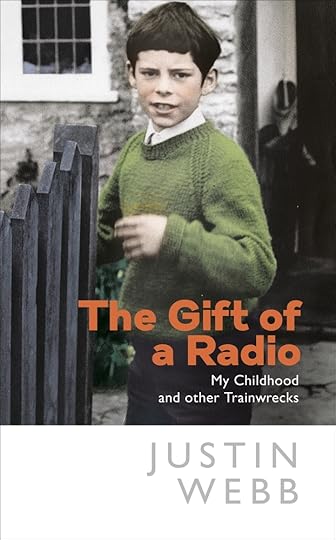
The Gift of a Radio

Rate this book
Justin Webb's childhood was far from ordinary.

Between his mother's un-diagnosed psychological problems, and his step-father's untreated ones, life at home was dysfunctional at best. But with gun-wielding school masters and sub-standard living conditions, Quaker boarding school wasn't much better.

And the backdrop to this coming of age story? Britain in the 1970s. Led Zeppelin, Janis Joplin and Free. Strikes, inflation and IRA bombings. A time in which attitudes towards mental illness, parenting and masculinity were worlds apart from the attitudes we have today. A society that believed itself to be close to the edge of breakdown.

Candid, unsparing and darkly funny, Justin Webb's memoir is a portrait of personal and national dysfunction. So was it the brutal experiences of his upbringing, or an innate ambition and drive that somehow survived them, that shaped the urbane and successful radio presenter we know and love now?

256 pages, Hardcover

Published May 10, 2022

39 people are currently reading
194 people want to read

About the author

Justin Webb

16 books2 followers

Ratings & Reviews

What do you think?
Rate this book

Friends & Following

Create a free account to discover what your friends think of this book!

Community Reviews

5 stars
132 (30%)
4 stars
174 (40%)
3 stars
107 (24%)
2 stars
14 (3%)
1 star
7 (1%)
Displaying 1 - 30 of 42 reviews
Profile Image for Nigeyb.
1,480 reviews407 followers
June 25, 2023
I read The Gift of a Radio by Justin Webb for my book group.

I knew nothing of Justin Webb however can now confirm he has quite the tale to tell. Most families can potentially seem odd to outsiders but few could match Justin Webb's. A smothering, snobbish mother and a mentally ill stepfather made for a tricky environment for only child Justin who perpetually walked on eggshells, going to great pains to please.

He discovered who his real father was when his mother casually remarked, "That’s your father". It was TV newscaster Peter Woods. The pair never had any contact.

It's incredible how Justin Webb managed to create a childhood memoir out of this uber-weirdness that is generally light and compelling.

Things got no better when he went to Sidcot, a private Quaker boarding school, which sounds even more grim than his home life. Bullying and violence were rife with disinterested teachers unconcerned about the violence or indeed imparting knowledge. Justin Webb continued to conceal all feelings and ended up growing his hair, drinking a lot, and listening to the likes of Free and Led Zep. Towards the end of his time there he was thrown a lifeline and got himself together.

Justin Webb is a survivor and it's incredible how he went on to thrive in journalism and broadcasting.

Fascinating, grim, compelling and redemptive

4/5


Profile Image for Stephen.
2,183 reviews466 followers
November 16, 2022
enjoyed this book written about the author growing up in the west country in parts bitter sweet
Profile Image for Sophy H.
1,908 reviews113 followers
May 27, 2024
Erm........

This was a weird one. The book is billed as Justin Webb having lived a strange childhood with the effects of familial mental illness, thereby giving him a unique perspective on growing up in the 70's when the UK was already sliding into the shit!

After a few chapters of reading I was thinking ok, fair enough, his stepdad's behaviour is odd and his mum is a pedantic snob with a bit of a sordid back story, but other than that, nothing felt "unique" or "different".

On reading further I began to question what was the point of this memoir? Not in a nasty way but Webb has nothing new to add. For most of us growing up in the 70's/80's, life was by turns good and completely fucking mental and most of us were screwed up by our parents (I do like Webb's use of Philip Larkin's poetry to illustrate his point).

I began skim reading large sections of the same sort of writing, missing nothing.

All in all, unless you're a huge fan of Justin Webb (who actually is ???) then I think this book is a bit pointless.
Profile Image for Nick Davies.
1,744 reviews60 followers
December 9, 2025
Unexpectedly enjoyable. BBC journalist and presenter Justin Webb writes with intelligence and candour about his unconventional and at times unhappy childhood and adolescence - there's an absorbing depth and a sense of self-reflection that I thought offered a lot for such a slim memoir. Focussing too on the first twenty years of his life as he does, this also particularly interested me as I tend to find autobiographies can get a little tedious and 'name-droppy' once the author is an adult.
Profile Image for Kim Symes.
137 reviews4 followers
September 27, 2022
I listen to Radio 4 every morning, so Justin Webb's voice is probably as familiar to me as members of my own family. I didn't really know anything about his background, except vague recollections of him reporting from Washington on the evening news back in the '90s, but he seems quite affable, and is one of the less confrontational interviewers.
When I saw this book in Waterstones, I thought the blurb looked interesting - apparently he did not have a conventionally privileged or happy childhood.
This book is a memoir of his early life, up to his entry into university (it makes a brief mention of what happens after Uni); a life that has been an unremarkable mixture of good and bad luck. On the good side, he had a very loving mother, cultural capital (training in the 'correct' way to say and do things) decent health, funding from his absent father that allowed him to attend a private school and social confidence. The bad luck included an unstable stepfather, loneliness in childhood, and a miserable time (initially) at secondary school.
The content is interesting, and it is very readable. However, I was surprised at the ragged quality of the narration, and the generally mediocre quality of the writing. I had assumed that an experienced journalist would be good at these things. There's one point (for example) where he is relating the story of how he entered a writing competition at school. It then jumps to prize ceremony and the audience reaction, without actually telling us that he won! It's surprising that the editor didn't spot this.
For me, the most interesting parts were where he talks about Class. He is pretty honest in saying that working class people were seen as a race apart, and were therefore all right as long as they didn't have 'ideas above their station'. These are attitudes he heard from his mother, but also, to some extent absorbed himself. It would be interesting to read a second memoir detailing his adult years, to see how these attitudes may have been challenged or evolved over the years.
One other minor criticism is the title: 'other train wrecks?' His childhood couldn't really be described as that for a start, but also, there aren't any other train wrecks mentioned (There is a bus crash, but that doesn't count).
Profile Image for Karen.
75 reviews
October 28, 2022
I’m sure this was very cathartic for the writer but unfortunately I found the narrative and, dare I say, reading quite bland
Profile Image for Catherine Minnis.
76 reviews
April 14, 2023
This was recommended by a friend so I dutifully, rather than enthusiastically, read it. I must admit that I didn't know of Justin Webb before this at all. However, he's my age so despite him being a middle-class southerner and me a working-class northerner, I found myself nodding along in recognition at some of his experiences, and certainly I enjoyed the trip down memory lane, reliving the cultural atmosphere of the 1960s, 70s and 80s.

Of course, he faced many challenges in his young life - never knowing his father; coping with the mental illnesses of his mother and step-father; being sent to a Quaker boarding school - but there's never any sense of anger or bitterness. I especially loved his philosophical comment at the end of the book, that no matter what the make-up of our families (and let's face it, whose family is not dysfunctional in some way?) and the characters within them, what matters is that we are loved. Absolutely!
328 reviews
July 25, 2022
I like Justin Webb on the radio and I am one year younger than he is, so grew up at the same time. Luckily for me, my childhood was not in the slightest way like his. He never knew his father, lived in a dysfunctional home and was packed off to a dreadful 'Lord of the Flies' Quaker boarding school. How he manages to seem so calm, easy-going and, well, normal, on the radio is a mystery. The book was very well written and interesting, especially the school, but it meandered and jumped about a bit too much for me.
32 reviews
April 22, 2022
Radio journalist Justin Webb looks back on his highly dysfunctional childhood. His father was a married tv news reader he never knew, his stepfather suffered terribly from mental problems and he was packed off young to a brutal Quaker boarding school. At times this is a harrowing read but Webb's determination to succeed ensures a fairly happy ending.
Profile Image for Manda Thompson.
38 reviews4 followers
December 20, 2022
Reading this autobiography was like taking a brisk walk in a favourite cardigan. So interesting to reflect on the attitudes towards and about mental illness in the 60s and 70s, which in conjunction with post war cultural values, created the fabric that clothed my childhood and adolescence too.
I was brought up and still am a Quaker so was intrigued and shocked to read about Sidcot and slightly saddened that Webb refers to it as a cult. Although I loved his discussion of silence (p128-9) “if Greenlanders have a thousand words for snow the Quakers could have a million for silence… it was a different kind of silence again, a deeper silence… But silence -especially Quaker silence - can be much more than that [absence of noise]. It is a thing in itself… more was learned through the silence than the teaching, I suspect.”
Other than his reflections on Rugby Union which I skim read, I felt I had been sharing the warmth and flickering flames of a dying fire; sitting alongside a fellow survivor of a transitioning age, musing on all the changes experienced and what had contributed to them; allowing us to put down thoughts of blame and accommodate the memories and relationships in a more loving and accepting way.
Profile Image for Nick James.
66 reviews
August 21, 2022
I was drawn to this book because his mother was a bit like mine (he is 5 years younger than me) with her zeal for judgement based on language and social class, and her mission to keep him separate from his father. On that line I ended up almost jealous of him, for his mother allowed him to call her Mum (mine forbade the use of the word as "common") and she also gave him cuddles and self belief. (Both disparaged and denied in my family) There were other family parallells too. Anyway - all that part of the book rang enormous bells with me and also gave an interesting review on the 70's from a dysfunctional family's perspective.
The rest of the book is about his view of a particular boarding school and the start of his career which weren't particularly engaging, I thought.
17 reviews
October 15, 2022
Engrossing, at times funny, and intensely moving. How could anyone survive a childhood so dysfunctional? Caught between a detached account of the madness, petty snobbery, and unwritten codes that keep a family together, and still showing compassion for the choices adults made with love. Despite it all, there was joy, escapism, and survival.
This is a wonderful book of what it means to be a child in a puzzling world. And who can’t relate to that?
Profile Image for Nigel Baylem.
51 reviews1 follower
April 21, 2022
Marvellous. -Really enjoyed this tale of a very sheltered upbringing, followed by time at a Quaker boarding school-and a late teenage European Inter rail trip in the summer after he left. Resonated to some extent with my own early life, especially the radio part!
17 reviews
March 7, 2023
I found this book hard going .. It felt like life has been sucked out of me .. ‘a mood hoover’ book.
Well written
63 reviews
October 13, 2022
The Gift Of A Radio – Justin Webb
If you were brought up without your real father, but knew his name and that he was alive, would you seek him out?
It’s a fascinating question, and one which features heavily in the childhood memoirs of BBC Radio 4 Today presenter Justin Webb. Brought up by his Quaker mother Gloria and stepfather, Charles, who she married two years after he was born, Justin Webb introduces us to his real father just seventeen pages in to The Gift Of A Radio. It’s a fleeting introduction. There he was watching the TV news presented by “a lugubrious looking chap with a deep plumy voice,” when his mother said – “That’s your father.” Justin Webb writes, “I don’t think I spoke.” His real father’s name is Peter Woods, a very familiar TV newsreader in the 1960‘s and 1970’s. And that’s that. “We hardly mentioned him again,” he writes. He adds that he’s not written his early autobiography to blame anyone, but that he’s to blame “for not asking the questions that demand answers decades later.”
Towards the end of the book, Justin Webb finds himself chosen as one of those lucky few who make it on to the BBC Graduate news trainee scheme. It’s not completely clear from his book whether his real father was also still working at the BBC when he joined, but he states “he had been retired for three years when I first walked into a TV newsroom.” It’s perfectly possible therefore that though they may not have worked in the same room in the BBC, they may well have been working for the corporation at the same time, before Justin Webb made it into the TV newsroom and was being trained in other departments.
It’s clearly something that haunts him. The last paragraph in his book begins, “Peter Woods and I never met.”
I cannot begin to try to understand his feelings towards his real father he never knew. However, presented with the facts he reveals in his book, I’m fascinated that a man who has become one of the nation’s chief inquisitors, never attempted to seek Peter Woods out. Journalists are naturally nosey, forever prying and probing into the affairs of others, and yet, despite hoping throughout the book that he has made contact with Peter Woods, it’s sad to think he never did.
I have some sympathy for Justin Webb, as my own father also lived his entire life, only seeing his real father on two or three occasions. My father was brought up by just his mother. He rarely talked about his father, never had the urge to go and visit him even though he had his address. I and my siblings never met him. My father only found out his father had died when a cheque for a small amount from his will arrived in the post. That lack of a relationship with his father led my father to have personal problems in his life, and I’m pretty sure affected the way he brought me and my siblings up. I could sense his feeling of sadness, of let down, of a refusal to put the past behind him and start afresh. However, that could have led to further rejection as it takes both parties to want to get together.
In Justin Webb’s case it’s sadder still to read of the absence of any loving relationship with his stepfather. In one episode, sitting on an English beach, he watches his stepfather Charles swim out to sea, and hopes he will never come back. Justin Webb writes that his stepfather had what would be described today as “a personality disorder.” He writes that Charles once confided to his mother that he could hear voices in his head. “He could not accept that anything anyone ever said or did in front of him, or to him, was anything other than part of a plot.” He would sit listening to Bach on the record player, sometimes at a very loud volume. Then there was the issue with supposed delusions of people getting into the family garage and fiddling with the oil or the windscreen wipers on the Hillman. It led Charles to replace the garage doors and even sleeping there. He writes, “Charles was becoming eccentric to the point of frightening.”
No wonder growing up in such an atmosphere gives Justin Webb a very depressed view of the decade in which he grew up – the 70’s. There are paragraphs on what he perceives to be the dismal state of Britain during that time – industrial strife, the three days week, the oil crisis etc.. There is nothing of the TV programmes, the music, the culture, the arrival of foreign holidays, the growing consumerism and affluence that children of his age were enjoying and realising that they’d really never had it so good.
The sense of this depression is worsened when he is carted off to private school, a Quaker school in Somerset. To those of us who went to state secondary moderns, it’s no surprise that Justin Webb went on to get onto the revered BBC news trainee scheme, which virtually exclusively year after year was reserved for former private school pupils who’d gone on to the top universities. I should know because after applying two years running, and getting one interview, I asked the BBC to send me details of the general education of the successful applicants. Despite being years before the Freedom of Information Act, they sent me a file showing year after year, ten of the twelve successful applicants recruited from Oxbridge. In his book though, Justin Webb tells the reader, “My private school life never felt privileged.....I would have yearned for actual privilege: for a home with parents and a life in a nice comprehensive.” Having been educated in a secondary modern which turned into a comprehensive, nice is not the word I would use to describe it!
Whether he feels his education was privileged or not, Justin Webb is quite graphic about the horror of the brutality metered out to boys at his private school. He writes of a twelve year old pupil discovered having gay sex in the changing rooms - “he was made to sit in the showers while boys cracked the top of his head with their knuckles until he cried. He adds he was chased and kicked, subjected to mental torture as well as physical - “He was a pariah at twelve. A leper at thirteen.” And then the sentence of tortured guilt –“he haunts me still because I did absolutely nothing to help him.”
Later in the chapter, he tells how the teachers and governors knew about the physical beatings going on, “but didn’t care.....there was no authority that could protect younger or vulnerable boys.” This is not the first account of the regime in private school and it won’t be the last. I’m pleased to read his view now about private education, which is identical to my own –“to send a child to live away from home at the age of eleven may be forgivable in some circumstances, but not in most.”
Justin Webb writes of feeling alone in the big wide world in which he was becoming an adult. Just him and his mother, with few friends. It’s therefore somewhat amazing that he has made such a success of his life and become one of the nation’s favourite broadcasters, at a time when his employer, the BBC, is recruiting it seems, anyone but privately educated, white, well spoken men.
He and I are about the same age, and I can identify with some of his experiences including, uncannily, a trip he made to Athens around the same time as me in the early eighties. He went with the Magic Bus company, I went with a similar operator but Greek – Theo Consolas. The fare was dirt cheap, you travelled more or less non stop with just a few minutes’ stop at emerging service stations, travelling across Europe including behind the Iron curtain into what was then Yugoslavia, arriving in Athens about four days later. Justin Webb’s memory of the drivers is something I share which has never left me and often relate to others. There were two coach drivers. When they changed shifts they didn’t stop the bus. As Justin Webb masterfully describes, “Grizzled driver would get the coach into fourth gear and lurch suddenly out of his seat while keeping one hand on the wheel. The coach was coasting along with no ability to brake. Fat Man would ease himself into the seat and grab the wheel, slightly correcting a course that was taking us into the middle of the road....the drivers did not sleep and did not eat.” I can vouch for every word because that’s exactly what happened on Theo Consolas’ coach. What didn’t happen to my coach is the incident Justin Webb goes on to describe and which I won’t reveal here, as it’s for you to discover if you read his book. All I will say is
he’s lucky to have survived!
As a regular listener of the Today programme, I now tune to Justin Webb with a renewed and added interest, knowing a lot about what has moulded him. It’s clear from his book that his childhood was not a happy one. To emerge sane from a home where there is mental illness is an achievement. I speak from personal experience. I congratulate him for being so honest and hope it may have been a cathartic experience to publicly reveal his sad start in life. One thing I feel for sure – his life’s experiences will help him as an interviewer as he comes across others who’ve been through similar hardship and he’ll have a more rounded view of the world in which very little, if anything, is perfect.
Profile Image for Juan Fernandez.
109 reviews
December 17, 2025
The Gift of a Radio is an interesting and, in many ways, rewarding memoir of coming of age, though it feels like a book that was one careful edit away from being truly great. I found it hard to settle into at first — the opening sections take time to find their rhythm — but the book grows in confidence and clarity as it goes on. By the latter two thirds, it really comes into its own.

What ultimately gives the memoir its depth is the way Justin Webb reframes his story. His life becomes less defined by absence or the gaps left by the men around him, and more by love — imperfect, unconventional, but real. This is captured beautifully when he writes:

“Peter Woods and I never met. But one of the blessings of an eccentric upbringing is that it frees you from conventional regret. He had children he loved. They loved him. I had a mother I loved, who loved me. In the end, what else is there?”

Webb writes with generosity about his mother, Gloria Crocombe, who did her best and is never presented as a monster, and about his stepfather Charles, whose failures are shown as the result of illness and a life that left him ill-equipped. There’s maturity and kindness in this reckoning that gives the book much of its emotional weight.

Uneven in places, but thoughtful, humane and quietly beautiful by the end. A memoir that improves as it unfolds, and one that stays with you once finished.
This entire review has been hidden because of spoilers.
Profile Image for Rachel Elvidge.
49 reviews5 followers
September 14, 2023
Justin Webb is one of my favourites of the Today presenters, and I had always assumed, from his dulcet tones, that he came from a privileged background. How wrong I was.. Or was I? In his very funny and clear sighted memoir, he examines his bizarre 70s upbringing with a dispassionate eye, and ultimately decides he'd change nothing about it. This seems a surprisingly common attitude among boarding school types ("did me no harm" whilst careering through life, self destructing), but in Webb's case he seems to really mean it. And he seems surprisingly sane.

As in The Color of Water, another book about a rather toxic mother, I thought how lucky these mothers are to be viewed so clearly but so forgivingly by their sons.

Out of pure nosiness, I really wanted the story to continue a little... How did his mother, who lived only for him for so long, react to his having relationships and marrying? Was she a different grandmother from the mother she'd been? I imagine her as the mother in law from hell, but who knows?

I listened to this as an audio book, read by the author, which l highly recommend.
1,604 reviews1 follower
April 27, 2022
An enjoyable read but I have to disagree with two of his thoughts.
1. I quote from P175: ‘around the nation, one of the famous winds of change was in the air. Did we begin to notice the horrors, the bullying, the misery around us as the country did in the run-up to 1979?’ Well, I was there in the 70s, living 40 miles north of Justin’s school, and it wasn’t like that for me.
2. He says, about his stepfather’s mental health issues, that the doctor implied ‘Madness was a bit of a head-scratcher. There were all sorts of wacky ideas around but … no real options far removed from the placing of leeches’(P7). I totally disagree with this and wonder if this was what his mother told him, in part because she was ashamed of her husband’s condition, perhaps because of class issues? I say this because my mother suffered from mental health issues during that period and spent spells in a mental hospital, from which she was discharged having become much better, for a time at least, because of the treatment given.
Profile Image for Catherine.
42 reviews
November 10, 2023
This is a memoir of Justin Webb’s childhood. It ends as he starts work for the BBC. Justin sets out with remarkable detail his memories from early childhood and in particular his time at boarding school. His writing is captivating and some events are gripping. The coach crash, being one example-sliding door moments are always thought provoking. Undoubtedly his childhood caused him much angst and unhappiness and at times the book’s purpose seemed to be a means for him to purge himself, setting them out his feelings around various events to try and make some sense of this period of his life. I hope it has brought Justin some peace.
Overall I enjoyed the book but given that it was such a personal memoir, it did at times seem narcissistic, bordering on whinging. The 4 stars are for the quality of the writing.
This entire review has been hidden because of spoilers.
798 reviews1 follower
August 21, 2022
Very well written and interesting, this book is written in an easy and conversational style, and outlines Justin Webb's early life.

He and his mother clearly had a close and loving relationship, but his wasn't an easy childhood by any means. As there are only a few years difference in age between Justin Webb and myself, I found that many of his recollections really resonated.
I devoured this in an afternoon.
297 reviews2 followers
January 20, 2024
We are of a very similar age and some of the experiences resonated. I came from a dysfunctional family with 2 big secrets that I did not learn until I was a teenager. My mother was definitely snobbish but unlike Justin's mother she had come from a very working class background, but felt that she had raised herself because she had a mortgage on a house rather than a council house like her two sisters. It was an interesting read.
Profile Image for Gillian McCafferty.
4 reviews1 follower
April 15, 2022
I struggled at the start of this book, maybe it was the writing style, I’m not sure. I thought it would be a very quick read but that turned out not to be the case. Once I got into the book it was worth sticking with. I felt satisfied by the end that Jeremy was happy with his lot and his childhood experiences had made him. I would recommend it.
Profile Image for Rachel.
Author 26 books23 followers
July 31, 2022
I'd never heard of Justin Webb or the alluded-to father, and still haven't. This autobiography is interesting until the author descends into self-contemplation and thoughts about his mother's view of the world. Those bits are best skipped. 95% of the book are his school years, with most of the rest of his life in footnotes.
3 reviews
July 28, 2023
As one of the best Radio 4 personalities, I have listen to Justin Webb for a number of years. I enjoyed his book immensely. He is very open about his childhood; his relationship with his rather 'posh' Mother and comments on Charles.His experience at the Quaker Boarding School at Sidcot left nothing to the imagination - a candid an honest biography and a good readf.
Profile Image for Judith.
655 reviews1 follower
January 31, 2024
I’ve really enjoyed this book. I am 5 years older than Justin Webb. He describes what living thro’ the 1970’s was like in a way I’ve never come across before - and explains why people (particularly the women) behaved as they did. And there’s a wonderful underlying dark humour, that kept me chuckling thro’ almost a whole chapter. Very glad I’ve read it - highly recommended…
Profile Image for Rick Bach.
170 reviews1 follower
March 22, 2024
Really enjoyed this autobiography featuring a lonely childhood with only an snobbish, emotionally stunted mother and a sadly bonkers and cruelly maligned stepfather for company, made even worse by being foisted into a chaotic and cruel Quaker boarding school. The sadness is made more palatable by the author's thoughtful, witty and modest voice.
Profile Image for Julian Walker.
Author 3 books12 followers
March 24, 2025
I loved this tale of the life of someone I feel I know in reality but realise I don't - I only know them as a broadcaster.

He vividly recreates his formative years, family relationships (mainly with his mother) and school days in such a way as they come to life and I really felt I was living them with him.

An unexpected pleasure and a treat.
Profile Image for Hannah Myers.
137 reviews6 followers
September 17, 2023
Short and easy read, but also a bit of a weird one. I think I am probably not the target audience for it as I am not of Webb’s generation nor am I British. Probably missed a lot of references. But I like hearing him on the Today programme on BBCR4 so thought I’d give it a shot, and am glad I did.
Author 9 books15 followers
January 7, 2024
Like all good books in the genre, this mixes darkness with light almost perfectly. The 'almost' bit simply reflects that I would have liked to have read a bit about the other stuff in his childhood. Highly recommended.
Author 9 books1 follower
March 20, 2024
This is an excellent book but it is not like a usual autobiography. The author has very cleverly weaved his personal thoughts and feelings into his story. Do not expect a straightforward chronological account of his dysfunctional upbringing. The author had a trying relationship with his mother and step father and this is laid out in the book.

A truly good read.
Displaying 1 - 30 of 42 reviews

Can't find what you're looking for?

Get help and learn more about the design.