Race Cars is a children's book about white privilege created to help parents and educators facilitate tough conversations about race, privilege, and oppression.
Written by a clinical social worker and child therapist with experience in anti-bias training and edited by a diversity expert, Race Cars tells the story of 2 best friends, a white car and a black car, that have different experiences and face different rules while entering the same race.
Filled with bright, attention-grabbing illustrations, a notes and activities section at the back helps parents, guardians, and teachers further discuss these issues with children.
Why is this book important? As early as 6 months old, a baby's brain can notice race-based differences; children ages 2 to 4 can internalize racial bias and start assigning meaning to race; and 5- to 8-year-olds begin to place value judgments on similarities and differences. By age 12, children have a complete set of stereotypes about every racial, ethnic, and religious group in society. Our guidance is especially crucial during this impressionable time.
Race Cars offers a simple, yet powerful, way to introduce these complicated themes to our children and is a valuable addition to classroom and home libraries.
4★ “For as long as anyone could remember, every year when the big race came around, a white car would win the race. A white car would win fourth place, third place, second place, and first place. Until last year…”
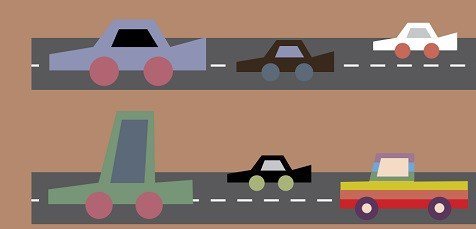
Last year, Chase won! Chase and Ace have been best friends forever. “This is Chase. Chase is a black race car. - - - This is Ace. Ace is a white race car.”
“They live in a world with lots of other race cars. Big ones, small ones, short ones, tall ones, old ones, new ones, brown ones, blue ones.”
So far, so good. Lots of diverse friends. Ace and Chase are so excited when they are finally old enough to compete in the annual race! And guess what? Chase came in first and Ace was fourth. Ace is delighted.
“Ace was so happy for Chase, and Chase was so happy for Ace. They loved to race and did not care about place.”
This phrase is repeated later in the story. The friends are loyal to each other. Meanwhile, the race committee is less than pleased., except for Grace, who kept quiet. Who is this committee? You might well ask.
“No one had ever seen them, but everyone knew who they were. They were a group of white cars that made all the rules for the annual race-car race.”
You will see here that Grace has pink wheels and little vibration lines shooting out from her car character. “Grace was the youngest committee member, and the only girl! But she didn’t say anything because everyone else felt so strongly.”
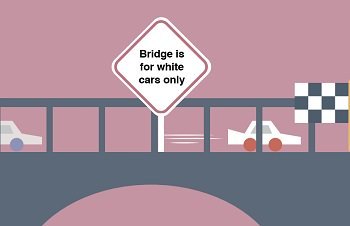
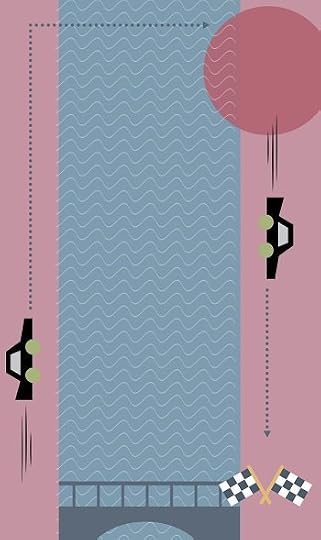
The committee, in their wisdom, decided to skew the odds by forcing black cars to take the long way around the river. “The bridge is for white cars only.”
NO! Chase followed the rules and sped around the long way and still managed to come in second place behind his best friend, Ace. “‘I must be getting much faster,’ thought Ace. He drifted off to sleep dreaming of next year’s race-car race.”
Chase is getting worried but is determined to keep trying harder. Next year, the committee has another surprise for him. Before he even gets to the restricted bridge, he is stopped at the top of the mountain for an identification check! He sees that no white cars are stopped. He is delayed so long, that he doesn’t place at all when he finishes the race.
“Chase was happy for Ace, but they were both upset about Chase’s race. They loved to race and did not care about place, but the committee had just announced a new rule. Cars that did not place this year could no longer race next year...”
At the committee meeting, a couple of other members join Grace in protesting that the new rule is unfair, but nobody listens to them.
Next year, Chase goes along to watch and cheer on his friend. Ace takes off at great speed, zips around the usual course – around the track, through the cornfields, up the mountain, through the magical forest. He notices a fork in the road with a sign pointing straight ahead for white cars and down a side track for black cars.
He is curious about where Chase has been racing. He gets lost! The committee is worried. They need the fastest car to find him – but ACE is their fastest car! At last, Grace speaks up
“‘The fastest race car is Chase, even though we did not ever let Chase have a fair race,’ said Grace. ‘Take down those unfair signs! If we let Chase race at his fastest pace, he will definitely be able to find Ace!’”
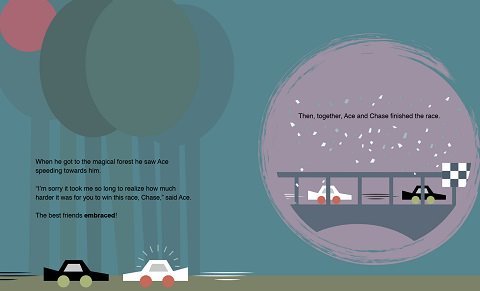
Chase is still upset about not being allowed to race but he takes off at top speed, meets Ace, and they race back and finish together. This is the kind of simple, direct story that encourages questions all the way through. For teachers or other older people reading with children, there are author’s and editor’s notes, as well as many discussion notes.
Each time we see the committee, there are another couple of “members” who have the vibration or noise lines shooting out around them to visualise their growing sense of injustice. I think anything that helps children talk about and discuss race is worth trying.
Thanks to NetGalley and Quarto’s Frances Lincoln Children’s Books for the copy for review from which I’ve copied a few illustrations.
This book is horrible! It does exactly what it is preaching against- putting ideas of race into the minds of young children. Children of that age demographic don’t see color and hold it against one another yet. These mindsets are taught and learned through their parents and neighborhood surroundings. Teaching young children that being white is bad is just as bad as teaching them that being black is bad. No young child should be made to feel bad about the color of their skin- and authors of these types of books are encouraging just that...
This is such a deeply flawed allegory I don't know where to begin.
Do we want to express to children that life is a race? What does winning look like? More stuff? Ace is unlikely to "just to like to race." Ace wants to win, just as Chase does. They both "care about place." That's the point of a race. Otherwise, it's just driving. Even the names are over the top: Ace, the star, the best card, and Chase, always in pursuit but not the lead.
The goal of White Privilege Pedagogy (and other privilege pedagogies) is that once aware, privilege holders will abdicate or step aside and make room for the less privileged. This is patently absurd in both assumption and objective. It divides people, incites rage, and leads nowhere productive. Parents who read this book, will you tell a non-Black child [or a boy] to forego an award in class, school, sport, music lessons, etc. so a Black child [or a girl] can receive it? Will you stop reading books to your child and ensuring your child gets enough sleep, refrain from using tutors, using higher level vocabulary, and discussing political topics, all proven to result in higher achievement, to equalize the field for children whose parents don't or can't? Of course not! You simply want for Chase what Ace has, which is laudable.
Convincing people the deck is stacked against them is disempowering or that it's in their favor ratifies a sense of superiority. Know what keeps people out of poverty? "Indeed, a staggering 97% of millennials who followed the 'success sequence'--getting at least a high school degree, working full-time, and marrying before having any children, in that order--avoided poverty." See this report: https://www.aei.org/research-products...
Wouldn't that suggest that a children's book reinforcing those values would be far more helpful?
Back to the book. The all-White "Committee" constantly imposes new obstacles against Chase. This would have been a fair analogy to the failed Reconstruction (1865-1877), under Johnson (1865-69), who was, recall, from a poor rural White family who resented the "bottom rail on top this time." [This population remains neglected. KSU Political Science Professor Wilfred Reilly, who is Black, wrote, "Poor white Americans...ineligible for both affirmative action and legacy programs may be the most genuinely neglected population...making up the plurality or majority of those felled annually by suicide, auto wrecks, and opiate and other drug overdoses."]
But, after the Civil Rights Act of 1964 and the evolution of Affirmative Action since 1961, does anyone believe there is an inexorable stream of new barriers imposed specifically to keep one ethnicity behind? We are constantly told that historical barriers' lingering consequences hold one ethnicity back. Currently, 72% of all Black births are out-of-wedlock births, supposedly a vestige of slavery, but in 1938, only 11% were out-of-wedlock, and in approximately 75% of enslaved families, "all of the children had the same mother and father" (7). So, no. It's a personal choice, often a rational economic one, as revealed in Black economist Robert Cherry's work.
In AEI's report, Black Men Making it in America, we read, "More than one-in-two black men (57%) have made it into the middle class or higher as adults today, up from 38% in 1960, according to a new analysis of Census data. And the share of black men who are poor has fallen from 41% in 1960 to 18% in 2016. So, a substantial share of black men in America are realizing the American Dream—at least financially—and a clear majority are not poor." Seems like Chase is doing OK.
WPP usually negates the very real roles of ability, motivation, and hard work. In this case, there is an affirmation of hard work and ability at the end, "The very fastest race car is Chase." That "the Committee decided to give Chase the gold medal" reveals that Ace and Chase nevertheless have no real agency; the Committee wields all the power. Committee= Government and Committee=White people. Either way, we are meant to see a diabolical entity deliberately excluding Blacks.
Know how others like Jews, Japanese, Chinese, Irish, and other groups who had been legally suppressed overcame? From Manhattan Institute Fellow Coleman Cruz Hughes: "...history is replete with examples of minority groups, even ones who have suffered routine political repression and violence, rising to affluence by pursuing the opposite strategy: avoiding politics entirely and focusing single-mindedly on entrepreneurship and education. Rarely does history provide a lesson as unambiguous as this one."
Convincing people of privilege or lack thereof will have a dangerous impact, not the one most of us want, which is for those with the drive, determination, and ability to succeed, regardless of immutable characteristics.
I have a low tolerance for people who don't review the reams of research on what works to decrease racism and who blithely believe that any action is better than no action, when we know that specific actions can have the opposite effect of the one desired. White privilege pedagogy is one of these. It "makes whites more complacent, more at home in an unjust world, and more comfortable with their whiteness."
Read for example, "Unpacking the invisible knapsack: The invention of white privilege pedagogy" by Leslie Margolin, a professor of rhetoric and counseling: https://www.tandfonline.com/doi/full/...
By all means do read the original essay that started WPP in 1989, penned by a woman of extraordinary privilege https://www.slcc.edu/ssvp/docs/white-... and about her here: https://quillette.com/2018/08/29/unpa... "Her ‘experiential’ list enumerating the ways in which she benefits from being born with white skin simply confuses racial privilege with the financial advantages she has always been fortunate enough to enjoy."
I lived abroad among people who looked different from me. Did I expect that stores would stock cosmetics or hosiery in my complexion or size shoe? No. It would have been ridiculous for them to do so, but that logical demand-driven lack in some markets in the U.S. is construed as privilege by McIntosh.
Understand that "On average, Americans say that 33% of the U.S. population is black. In fact, a majority of Americans (56%) estimate that the percentage of blacks in this country stands at 30% or higher. As many as 17% of Americans say the percentage of blacks is 50% or greater. Only 7% accurately state that the percentage of blacks falls between 10% and 14% of the entire population" https://news.gallup.com/poll/4435/pub... If you believe that the USA is half Black or even one-third Black, you will have a different understanding of what should be representative. To further understand the Black population demographics, check out https://blackdemographics.com/populat...
Most importantly, as Joshua Daniel Phillips, Instructor at Penn State, wrote in 2015, it does not make for a healthy society to instill the notion that, "if you’re really intelligent and white, then you must accept that some of your educational success was due to 'white privilege.' If you have a great job and are male, then you must accept that during the interview you benefited from 'male privilege.' There is no discussion about study habits, discipline, or earning advantages through hard work. Rather, privileges are unearned and treated as the only explanation for group disparities instead of being treated as one possible explanation among a host of others...
Therefore, when I teach about the theory of privilege, I have students move through the following three questions in an attempt to help them arrive at their own conclusions as to whether they believe privilege exists. First, what are the disparities between groups? For example, whites graduate from college at a rate of approximately 62%. Blacks graduate from college at a rate of approximately 40%. These numbers are quantifiable facts that everyone can observe and agree on. The second question is where people begin to disagree.
Second, I ask students, “Why do these disparities exist?” To the constant purveyors of “privilege as fact,” this is where the conversation becomes uncritical and dogmatic because the only justification for any disparity among race, gender, sexuality, or any other demographic is “privilege.” However, many other valid theories account for such disparities without implying privilege. In a serious classroom that aims to challenge its students and engage in rigorous scholarship, these alternative theories will be presented and discussed. In the previous example, we might ask: Do whites graduate college at a higher rate than blacks because of pervasive white privilege on college campuses or because of mismatch theory (the idea that affirmative action places black students in the wrong educational institutions)? [from ck: see the work of Peter Arcidiacono] Both theories have legitimate reasons to be presented in a classroom, and even if an instructor is convinced that privilege is the only answer he should not feel intimidated to present all possible explanations. Instructors should trust their students enough to present all explanations instead of omitting some theories because they do not conform to the privilege mantra. If an argument is sound and robust enough, it will persuade students. They should be able to decide for themselves what arguments they deem to be most compelling.
Finally, I ask my students, “How do we fix the disparity?” If students are convinced that the disparity is caused by privilege, then the only way to the fix the problem is through systemic change. To address the disparity between white and black graduation rates, some solutions might include hiring more diversity officers, overhauling the resource centers, and implementing a more Afro-centric education model because the curriculum is founded in white supremacy.
However, if the disparity is caused by something other than privilege, then colleges can overhaul as many departments as they’d like and still not close the graduation gap between white and black students."
And books like Race Cars will only lead to confused erroneous assumptions. Instead, all children could benefit from books and families that promote the bourgeois norms Amy Wax and other scholars identified as the practices that "will do far more to move working-poor Americans toward success" than "culturally responsive teaching: "Get married before you have children and strive to stay married for their sake. Get the education you need for gainful employment, work hard, and avoid idleness. Go the extra mile for your employer or client. Be a patriot, ready to serve the country. Be neighborly, civic-minded, and charitable. Avoid coarse language in public. Be respectful of authority. Eschew substance abuse and crime." ( See https://www.inquirer.com/philly/opini... )
I applaud the author for tackling such a difficult topic for any age group to understand, let alone children. This would be best for third through fifth grades, I believe. It will be a good resource for starting important conversations. Highly recommended.
This unbiased review is based on a complimentary copy provided by the publisher.
A good starting metaphor, but a little disappointing that it ends up getting all wrapped up at the end as though issues of institutional racism could be so easily fixed. I wish the book had more of an open end to lead grown-ups and children into discussions. That said, it's still a good jumping off point, and I'm glad it was attempted.
Let's say you're an open-minded white person, maybe you're affluent, maybe you even consider yourself a good citizen. And maybe, despite all those things, you still find yourself at a loss to bring up and discuss race with your children in a constructive way. You could solve the problem by wading through Google for answers, only to get a heap of bad takes and half-truths. Or you could save yourself the time and just get this book. If you've never talked to your white kids about race, and you yourself struggle with what to say, this book lays it out with a helpful framing device (the story is literally about race cars running a race, and figuratively about the way that systematic white oppression makes it harder for non-white people to succeed) plus it contains a discussion guide in the back. No book is a silver bullet--reading must be followed up with action, listening, and systematic change--but this is a great first step for families, libraries, and any setting with young kids wanting to start a conversation about race.
I have been desperate to read this book ever since I saw one of my favourite teacher influencers recommend this, and wow. Was so worth the wait, it fulfilled all of my expectations and more. This book has simplistic illustrations yet such a powerful message behind each illustration as well as the text to complement the illustrations.
Issues raised within this book/reflecting realities: - Racism, - White privilege, - Males being superior to women, - The struggles white privilege can have on friendships (historical links), - Equality.
This book is something I will keep a hold of in the classroom, as I feel the story within it is such a simplistic idea, yet highlights a key part of our history / today’s events. This book is educational also emotionally challenging - would be great for PSHE.
I found this to be a great way to delve further into discussions about white privilege and systemic racial inequality with my 3rd grade son. The story on it's own provided a pretty good, simple example for children to identify injustice and there are many places where we connected the narrative points in the story to real world examples. Overall I felt like this book was a good tool to use as we discuss issues of racism, justice, and white privilege with our kids.
I hope in my lifetime we can put behind us picture books with discussion notes that help adults navigate the social ills of white supremacy. This book is a great resource for starting a dialog with children about white privilege. It won't make them feel guilty, instead it demonstrates how or when to speak up when bias hurts. Despite its huge intro and discussion notes, the book is very simple. It is designed to help adults talk about the difficult topic of racism and white privilege. This is a teaching book not to be confused with general children's literature. I have a short attention span for books that are designed for kids, but preferred by adults and this book comes close, however it is intended as a tool to teach. I hope the need for such books is short lived and we can stop asking to make #blacklivesmatter I strongly recommend this book for your library.
I have mixed feelings about this book. It can be a difficult topic to explain and the race cars are a good intro. It's a pretty pat ending that makes it seem things were solved when they aren't. The tips for reading and discussion notes could be combined--since the reading tips are at the start, you wouldn't know there were also discussion notes because those are at the end.. The text length is for kids who can sit and listen, as well as discuss.
Okay, am I the only one who is a little ticked about the gendering in this book? The car with pink tires is a girl, the only girl as a matter of fact, and I guess girls don't get to race.
couldn't be more thankful that books like this are being published. i thought for the most part, the metaphor wasn't heavy-handed and it is a child-friendly way of explaining social power dynamics. i kind of wish there was a teacher/parent guide or discussion questions as an appendix accompanying the book.
Some folks might call the tone of this book "heavy-handed" as a friend of mine did when I was reading it with my test littles audience. Neither the audience nor I thought it was too intense, and even if it was, sometimes we need some discomfort to get us to learn. The tone of book was quite accommodating for the people who may not be aware of racial biases and discriminations until it affects them personally or someone that they love. The tone was quite understanding of the various ways that racism places limits on lives while doing so in a way that a kid might understand. The images are rather sparse but I think that was to not distract from the message.
This book should be required reading for adults who say “I don’t have privilege”. After reading it I sat and thought about where I can see white privilege in our systems today, such as voter suppression. Privilege is a sensitive conversation for so many people, and this book explains it so clearly and simply, without villainizing the white car, Ace. At the end of the story Ace realizes the privileges that helped him win the race, and has a better relationship with his best friend, a black car, Chase. I would love to see a sequel where Chase and Ace work together to find equitable solutions.
Reviewed from a paper ARC sent to me by the publisher.
This is an admirable starting place to talk about white privilege with young children. It was first self-published by the author/illustrator in 2016 - ISBN 978-0692786505.
Two friends who happen to be race cars - one white (Ace) and the other black (Chase) - enjoy friendly competition against each other on the race track. Organizers of the car race want Ace to win, so they set the rules of the competition so that Chase cannot compete or win in another race. When Ace makes a wrong turn and gets lost in the final leg of a race, one of the committee members finally calls out the group for their unfair actions.
This allegory, written by a clinical social worker and edited by a diversity expert, is a good place to begin a discussion on the topic of racism. I found the text a bit wordy for young listeners (particularly on the olive green pages that detail the actions of the committee); this wordiness takes the book almost to the point of being didactic. Additionally, this tale takes a simplistic approach to correct the problem of bias by having the only female member of the committee [token?] who happens to be the youngest speak up to stop the bias as a delayed response. Finally, while I thought it clever to use a "white" car and "black" car in a car "race" (showing their differences were only on the exterior), I do have a reservation that the sociological construct of "race" and the use of a car "race" might confuse some youngsters when this book is being discussed.
I would have preferred the author's note, editor's note, and tips for reading the book be placed as backmatter; it is very daunting to have this in the front of this book. Readers will want to jump into the story - not get a lecture first. The questions in the backmatter will be helpful for many adults trying to raise anti-racist children, however the discussions for each question seems to be less about anti-racism and equity than it is about the lie of white supremacy. As an anti-racist white person who has some racist family members, this portion of the book would completely turn them off reading this book and getting its important message. This is precisely the audience who really needs to read this book in order to see their white privilege. Better to show them than to tell/dictate to them. Could the focus of the discussion center more on social justice, equity, being aware of your biases, and speaking up when you see racism? Would it be possible to move this deeper discussion of white privilege and white supremacy onto a separate printed teacher guide online - and not in the book? Finally, I would have appreciated some other suggestions of titles to also read to this age group and list of resources for educators; only one anti-bias source is listed for teachers. Several organizations offer fantastic anti-racist teaching tips and booklists with titles for children: ISTE, Edutopia, ADL, Teaching Tolerance, NYT, among others.
Overall, the layout is disappointing; it feels amateurish. The digital illustrations are not splashy or exciting, however they are serviceable. They are credited in fine print to Devenny on the CIP page.
A good place to start a discussion on racism, with reservations.
There is Chase who is a black race car. There is Ace who is a white race car.
They have been best friends for a long time, loving to race. They have been training to enter a world famous race and are finally old enough to enter.
Chase comes first! Ace is really happy for him.
They loved to race and did not care about place.
But the organising committee were NOT happy. How did a black car win the race without the best tyres and motor?
Next year friends Chase and Ace lined up to race. This time Chase’s track is different to Ace’s track.
Chase still did well, but wondered later on why he wasn’t allowed to use the same bridge as Ace? Was something wrong with him?
Next year’s race was different again and Chase doesn’t place. The new rules say, no place, no race.
Chase feels terrible, and finally someone called Grace is brave enough to speak out. Why are there different rules for Chase than Ace?
When Ace discovers the real reason Chase didn’t place in last year’s race, he finally learns the truth.
On first reading, this book made me angry. It is written so cleverly with rhyme and action and friendship, and blatant prejudice and racism underneath. The author is a psychotherapist, specialising in providing anti-racist psychotherapy to children. She is also passionate about helping adults, particularly white adults.
The race car theme is attractive and exciting and will capture children’s interest on reading but then goes deeper every time Chase does better than Ace. The white Committee Cars don’t like it and do everything in their power to stop Chase’s success, even though he is the undoubtedly the best race car.
There are tips in the front of the book on how to read Race Cars with children and more in depth discussion notes at the back of the book.
The metaphor is an apt one, but it is belabored in its heavy text, lack of explicit connection to white privilege and race in reality, and a missed opportunity for a real and nuanced ending. Things to note:
I felt the refrain “get to the point” over and over in my head. The metaphor was deeply parsed, but if not made clear how this parallels systemic racism, do young readers truly understand it in an effective way? There is back matter with discussion points, but the metaphor continues to be centered. I would love to see a stronger connection to real people and identities.
The author is a white woman. The editor is a Black woman.
The ending wraps up too neatly and unrealistically, undermining the entire metaphor. The white car realizes how many more obstacles the black car faces as they race along. The white car states he now realizes this. What happens next? They embrace. The black has no agency, no words, no response. He simply accepts and is satisfied with a hug from the white car. Why can’t the black car ask “Great that you realized this…now what are YOU going to do about it?”…but, no. Then they finish the race together, black in front of white, giving off serious white savior vibes. The black car doesn’t need the white car to LET him win. He needs him to be part of dismantling the obstructions in the race so they can race fairly.
The text is loooooong. Would kids stick with it?
Grace, the only girl car on the all-white race committee, is represented with pink tires. Hmmm, so the metaphor needs gender conforming cues to pull off the message…
I want to preface my review by saying that the score was not due to the content - I think the overall message of the story is important.
This book attempts to explain systemic racism using a race car analogy, but in my opinion it might be trying to do too much and stretches the analogy in a way that might get lost on younger kids. It could be a good analogy for adults lerning about the topic.
There are also quite a few things that I didn't care for in this example: -The two friends (cars) have been trainning as long as they could remember for the annual race car event--but they don't care about place? - Chase (the black car) felt like he wasn't good enough because he couldn't race? (I know this may happen in real life with people, but this is an example of the book trying to do too much). - Chase shows up to cheer his best friend on the following year, but they never spoke about what happened? When the committee members came to him to help find his friend he was just silently upset but agreed to find him but didn't use this time to tell them about how he felt about it. - Ace says at the end that is sorry and it's a happy ending, no need to speak further?
There are good discussion points at thte end of the book--but again, probrably better for older kids. I think this book has complicated things by adding so much and glossed over things in an effort to keep it simple and sadly it just didn't meet the mark for me.
*A free copy of this book was provided by NetGalley and Quarto Publishing Group – Frances Lincoln Children's Books in exchange for an honest review. All opinions are my own*
This is a simplly illustrated picture story book about a some very challenging problems; white privilege and racial discrimination. I can see this being a great starting point for conversations with children about race.
From the outset of this review, I'd like to note that I am not an Own Voices reviewer. Overall, I thought the presentation was engaging for children and a car race is a good way to introduce the idea of white privilege. There are tips provided to support adults when reading this text with children and some questions to stimulate conversation. This is definitely not an independent text, if you want the child to get the deeper meaning out of the book. It requires thoughtful discussion and an openness to questions. And that is ok - the best learning comes when the child is an active member in their learning, rather than when an answer is handed to them in black and white.
The only improvement I would suggest is to adjust the ending. It was oversimplistic, alluding to the false idea that racism can be solved with one small action.
I would definitely recommend this to educators and parents with children from 5-12 years old.
My nephew initially grabbed this because it had cars on the cover. He's five and still grabs based off of what's on the cover. But, I liked that he ended up grabbing it esp. since he is a mixed race child who will most often be identified as brown skinned. Most of this I think went over his head but, he still seemed to enjoy it and was actually paying attention to the story. I read it a few times and while I did not totally engage him in what was going on in depth, I like that it was a good way to introduce this topic to him. As he gets a older I will borrow it again and again from the library and read it to him while talking more about what is really going on in the story as he ages he will start to understand this more and more and we can have deeper conversations about it.
There are discussion notes in the back to help you talk to your child about what is going on and gives you some suggestions as to what to say/talk about.
The artwork is very simplified computerized graphics and do not distract away from the message of this book. While it can seem a bit wordy at times it is used appropriately to portray feelings and topics that are happening at that moment.
The only issue I had with reading this book was that the font is black and on a few of the darker background pages it was hard to read in low lighting (such as at bedtime).
3.5 stars. I have complicated thoughts on this. I understand and appreciate what the author was trying to do. I think books like this are important, and I'm glad they are being published, and I fully intend to buy this for my library because I think it's a good starting point.
That being said, I had some struggles with it. The language rhymes, sometimes, and sometimes has a rhythm, and sometimes does not. This has the effect of pulling you out of the story, whether you are reading aloud or listening to it, because the changes can trip you up while reading it.
The book is obviously targeted toward young kids, and that's great. My concern is that I'm not sure that at a young age they will be able to identify some of the things that we as adults understand to be institutionalized racism. As an adult, I fully understand the allegory of Chase having to stop at a checkpoint, or having obstacles thrown in his way while he is racing. I am not sure that my (Caucasian, in a predominantly Caucasian town) first grader would be able to take that next step and understand what the book is trying to say. The notes and suggested questions in the back are super helpful, but I feel like the book loses some of it's power if I have to be constantly explaining the entire way through.
Overall, A+ for effort, probably a B for execution.
I received an electronic ARC from Quarto Publishing Group – Frances Lincoln Children's Books through NetGalley. Devenny presents a lesson in equity for younger readers. Two race cars - one white, one black - are friends and enjoy racing against each other. White cars have always won the annual race. In fact, white cars have always taken all the places. Then Chase won and the committee was upset that a black car had won. They changed the rules to make it harder for cars other than white ones. Chase still came in second the next year which led to more changes. This pattern continues until a member of the race committee becomes brave enough to speak out and others join her. Informative text for adults is included before the story as well as questions for discussion at the end. A read together book for families to begin dialogue about equity and awareness. Readers will connect to cars and see the unfair changes in the race course to set up white cars to win. The illustrations add to the story and offer a clear look at the different paths cars must travel. Discussion about the application to broader patterns is helped by the information provided by the author.
This is a decent explanation of racial injustice. It falls short of being a good explanation of white privilege. Which only really matters to me because that's what the tag line on the cover claims the book is about.
Chris Rock's "Who wants to trade places?" joke is one of the best and most concise explanations of what white privilege is. It illustrates that are inherit advantages of being white in our society that make it more desirable to some people to be poor and white than to be successful and black.
"Race Cars" fails to get that point across. Despite the claim that this book is about white privilege the metaphor presented is more about active and overt racial injustice with the examples in the metaphor being about the active attempts by white cars to place obstacles in front of the black car rather than explaining or illustrating how the passive advantages of privilege work.
And I guess I really wanted something in there to explain that disadvantaged people still benefit from privilege, even if they don't realize it.
Super interesting book. As an adult, thinking about using this book with kids, it left me wanting more.... possibly back matter about white privilege, a weblink, or at least an author's note about why she wrote this book. Maybe the intent was to leave the reader unsettled... if so, job accomplished!
The story is pretty straight forward, 2 race cars, one white and one black, love to race. They finally get to go to the big race and the black car does better than the white car. This is all great with the 2 cars, however the committee behind the race, is not ok with the outcome. The next year, they make it more difficult for the black car to win. The following year, it is even more difficult. Problems occur and the committee changes its policies, or maybe it just makes an exception....
Lots of room to discuss how white privilege is a systems issue, not so much the fault of an individual person. There is no discussion about how to fix the problem.
This children's book is based around the topic of white privilege, racism and oppression. The book tells the story of two best friends, a white car and a black car. Both taking part in the same race, but having different experiences due to the colour of their car. After doing some research on the author, I understood and respected that she as a white female, wanted to portray the fact that white people are more privileged in society and how sometimes they are not aware of it, whilst also touching on the injustices that black people unfortunately still face. After reading this book with my Year 5 class on placement in relation to Black History Month, it was amazing to hear the questions and discussions that came from the children. The children really understood the message behind this story so much so, that we actually extended the book talk into two sessions instead of one, due to the fact that there were so many interesting and important discussions that were still to be had.
'Race Cars: A children's book about white privilege' by Jenny Devenny takes a difficult topic and presents it for young readers.
Black car and white car like to race. They don't care who wins, but the cars that run the big race do. When black car wins, they add rules to make the race harder for black car to win. White car and black car are confused but both want to keep racing. But the rules get tougher for black car. Is this fair?
It's a simplistic approach to a very complex issue, but does it in a way that children can understand. I applaud the approach. There are discussion questions at the end to continue conversations.
I received a review copy of this ebook from Quarto Publishing Group - Frances Lincoln Children's Books, and NetGalley in exchange for an honest review. Thank you for allowing me to review this ebook.
A welcome anti-racist picture book for the 5-8 year old age range. I think this book is a great conversation starter. It won't "work" on its own; learning bias and empathy and how to have critical thinking on these issues takes more than just a one book read-through. That said, I think this book is engaging for this age range and the narrative is compelling. The work of the author and editor team shines; at the end of the book there are further discussion questions and details for caregivers/educators. This is a great tool and kick starter for essential conversations.
***Note: I was given a review copy of this book by Quarto Kids. Opinions are my own.
Though Devenny's intention is basically good, this book feels one-sided and she uses references that feel the subject is about events from the past not about modern situations (ie. "white-only" signs and national committees of "only white" members). This book feels more like someone's agenda to promote a personal point of view rather than a book created to uplift and encourage every child. It also assumes every community has the same problems and needs, which is not the case. This country still needs to work on irradicating racial issues but it should be done through honest, balanced and relevant conversations.