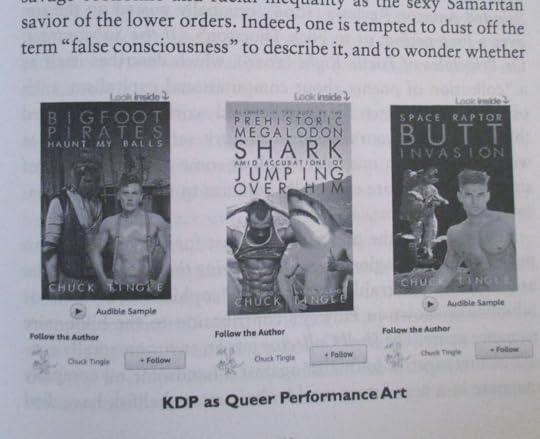
As the story goes, Jeff Bezos left a lucrative job to start something new in Seattle after being deeply affected by Kazuo Ishiguro’s Remains of the Day. If a novel gave us Amazon, what has Amazon meant for the novel? In Everything and Less, acclaimed critic Mark McGurl discovers a dynamic scene of cultural experimentation in literature. Its innovations have little to do with how the novel is written and more to do with how it’s distributed online. On the internet, all fiction becomes genre fiction, which is simply another way to predict customer satisfaction.
With an eye on the longer history of the novel, this witty, acerbic book tells a story that connects Henry James to E. L. James, and Faulkner and Hemingway to contemporary romance, science fiction and fantasy writers. Reclaiming several works of self-published fiction from the gutter of complete critical disregard, it stages a copernican revolution in how we understand the world of letters: it’s the stuff of high literature—Colson Whitehead, Don DeLillo, and Amitav Ghosh—that revolves around the star of countless unknown writers trying to forge a career by untraditional means, adult baby diaper lover erotica being just one fortuitous route. In opening the floodgates of popular literary expression as never before, the age of Amazon shows a democratic promise, as well as what it means when literary culture becomes corporate culture in the broadbest but also deepest and most troubling sense.
There have been plenty of books about the business impact of Amazon, and to be honest you probably don't need to read any of them anymore, it being the sort of non-fiction truism that's now accessible more or less by osmosis. This is something sideways and stranger – an investigation of Amazon's effect on literature. Because after all, it did begin as a bookshop, before it rechristened itself the Everything Store, and for McGurl, that's still significant, just as it matters that Amazon's foundation was inspired by The Remains Of The Day, or that the Kindle began as 'Project Fiona', an attempt to emulate The Diamond Age. After all, he notes, are we not at a point where the new protagonist who has replaced the bourgeois individual as culture's focus is not, as was once hoped by some, the masses - but the corporation itself? Like a lot of ideas here, in summary this can sound a little 'makes u think' – but more often than not, McGurl does make a plausible case for his theories as at least worth considering, if not always fully buying into.
Which is not to say Everything And Less is perfect, not by a long shot. His previous book suggested creative writing courses as the factor defining modern fiction, and in places you get the sense of him as slightly embarrassed to be coming up with a new claimant so soon – the parable of The Boy Who Cried Unified Field Theory. Then too, he does his best not to fall into the short-sighted, ahistorical wittering which ebooks and such can so easily occasion in those who like to think of themselves as literary, and instead reveal themselves as merely parochial, but doesn't always succeed. So yes, a lot of self-published Kindle fiction does come in series, but can we really talk about a transition towards literature as a mass, as against a presumed past of individual and discrete books, when such firmly canonical authors as Proust and Zola are known largely for series fiction? Yeah, call it roman-fleuve if you think you're fooling anyone, whatever; we all know that is to series as freedom fighter is to terrorist. He's read so widely, and is full of so much cool and weird information, yet he keeps referring (in my Netgalley ARC, at any rate – hopefully the finals will correct it) to Twilight as a trilogy. And more than once we get references to Max Weber's thoughts on the 'acetic' character of Protestantism, which I suspect are meant to read as 'ascetic', though it can't be denied the sect's most characteristic manifestations can be quite vinegary. There are also occasional lapses into theory, and not always the good stuff. Yes, even here, in a field more strewn with absolute rot than zombie apocalypse fiction, McGurl does manage to unearth some gems. Cora Kaplan on how maybe we don't necessarily identify with characters in books, but sometimes with a structure, and Frederic Jameson's 'affect', the sense of being there in the story in a suspended moment, as against the chronological progression of the plot -– these really helped me put my finger on elements of my reading experience which I've long experienced but never really seen anatomised before. Elsewhere, though, we get into murkier waters, occasionally accompanied by some almost comically unhelpful diagrams.
Yet even here McGurl will frequently pull out of an apparent death spiral, perhaps by moving within a page from the depths of sodding Barthes to "Barbara Deloto and Thomas Newgen's rigorously cheerful self-published novella The House of Enchanted Feminization" – along with a brief explanation of the ways in which it's distinct from darker works in the same sub-subgenre. Discussing the attempted legal land-grab known as #cockygate – of which, gods help me, I was already somewhat aware – he becomes quite animated. "It was after all based on one word of a book title, a word that already in any case been used in 2015, in Penelope Ward and Vi Keeland's delightful Cocky Bastard (There is no justice in the literary field – this novel is far superior to Fifty Shades of Grey, let alone the idiotic Cocky Roomie, with a real sense of humor as well as a sidekick role filled by a blind baby goat)." In short, he cares about this stuff, and has read it as a reader, not just a tourist or researcher. Sturgeon's Law is not namechecked, but McGurl's very familiar with the principle: as he puts it himself, "Among the many who write fiction as though vaguely remembering a TV show are some who really surprise you with the vividness and individuality of their imagined worlds." Nor does he make any effort to deny the corollary – I 100% share his only mildly childish delight in pointing out that litfic is a genre too, and that "We all know how bad a "literary" novel can be." One of his early examples is Jeff Bezos' ex-wife, Mackenzie; I had known that she was a novelist, and an early and integral part of Amazon as a company, but I've never seen this sort of detailed work on her output, "militantly literary fiction" which will show a loaded gun, then studiously ensure it never does anything so vulgar as go off. Later, by way of comparison with the easily mocked field of alpha billionaire romance, McGurl considers a certain far more respectable and literary strain of books, and if I still slightly prefer the genre heading of 'sad boner professor books', I can appreciate the symmetry of his coinage, 'beta intellectual romance'. Doubly so his descriptions of how the male protagonists here approach women: "They do not want to whip them, just to waste their time."
This is the delight of the book as a read – well, at least when it's steering clear of Barthes. It is at once incredibly idiosyncratic and absolutely big-picture thinking, shamelessly attention-grabbing and deeply thought through. "There is a case to be made for self-published Adult Baby Diaper Lover (ABDL) erotica as the quintessential Amazonian genre of literature" is an eye-catching chapter opening, but lines like that lure the reader in just like an explosive opening to a Kindle Unlimited novel must, and boy does McGurl know his Kindle Unlimited novels. I had been mercifully unaware of the existence of LitRPG, for instance - essentially a whole genre derived from Ready Player One, which McGurl is probably fair to identify as "a fantasy of meritocracy". But what could easily have been an opportunity to point and laugh at the no-hopers and weirdos is (almost) always careful to turn the mirror to the reader of terribly clever and respectable books and ask how much real difference there is. Unlike many self-defined Marxists, McGurl remembers that Marx was impressed with capitalism's achievements even as he objected to its errors and excesses, and himself takes a similar view of Amazon, which he doesn't defend, but also doesn't boycott. More widely, he knows that consumption is a real pleasure, and that there's a snobbishness in refusing to acknowledge as much, as also in not accepting that many people read primarily for pleasure, and why shouldn't they? On 'the genre turn' whereby carefully finessed SF or horror or crime books can now be taken seriously by literary types, he asks why romance never seems to have been afforded the same leeway, despite having spent so long as the primary engine of many books still considered canonical today – and aside from its readership slanting female even more than the readership of fiction in general, he concludes that part of the issue is a fundamental resistance to taking anything with a happy ending seriously, and isn't that ridiculous? As he says: "Critique chugs along, fed by the infinite coal-supply of capitalism's contradictions. It's just that critique should be as thoroughly dialectical as it can, as suspicious of its own suspicion as of anything else." Sometimes it's OK just to like things because they're cute or cosy. Yes, novels may be an escape, but reading is still a real experience among others, and why on Earth not seek out comforting experiences over grim ones, at least sometimes?
Of course, it can't be denied that ultimately, none of us outside the pages do get a happy ending. Thinking too hard about opportunity cost always makes me feel terribly mortal, and there's plenty here on the grim implications of 'time is money' in an age when the former is far more limit than the latter on our reading. Seldom have I felt so called out as by the line "The overstuffed Kindle e-reader or iPad is at once a world-historically powerful condensation of potential literary experience and a little tombstone prophesying the rapidly approaching day of our death." This even before we get into the unknown and unknowable quantity of dead books, lurking unfavoured by the algorithms, destined never to be read by anyone but their writer-uploaders. Still, on the whole I found this a strangely affirming read. "We need novels like we need food to eat and clothing and shelter – at least some of us do, numbering in the hundreds of millions." And with all the other demands on our time now, isn't that quite something?
The long-form reviews of this are better than the book itself, unfortunately. I took issue with the narrative voice, which often uses 10 words when three or four would have done best - to say nothing about how McGurl tends to suggest wide conclusions from sometimes scant grounds.
Ehhhhh....this isn't what I thought it would be. (Parul Sehgal's New Yorker review is great and crystallizes a lot of what I was thinking while reading https://www.newyorker.com/magazine/20... ) It is much more economic theory-heavy than I anticipated, and far-less data-driven.
And it seems like a number of things that have happened in The Book World which were only made possible as Amazon grew and changed weren't included in the book. While McGurl notes some KDP-enabled scandals like #cockygate he doesn't touch upon "book stuffing" or those internal hyperlinks that hop readers to the end of the book file, thereby making it look like the reader has read more pages (since it's a pay-by-pages-read scheme), or the #copypastechris plagiarism fiasco (for which the enterprising reader who uncovered the plagiarist was sent a sword by Nora Roberts herself in thanks) or the Omegaverse stuff (which I still don't really understand). While McGurl jumps into the genre deep-end that has been enabled through KDP, he zeroes in on the Adult Baby Diaper Lover (ABDL) sub-genre without noting that romance authors who include trigger or content warnings as part of the book description are often delisted and sent to the "dungeon" where books cannot be found through search, only through the direct link. There's a graphic (which for some reason I can't add here, but I screencapped it for my blog review) where he has a timeline of books for both romance and literary fiction novels using the marriage plot trope and on the romance side he appears to skip directly from Pride and Prejudice to 50 Shades of Gray, while there are almost a dozen novels on the lit fic side progressing up to the modern era; kind of a big omission to skip Heyer, Harlequin, Roberts, etc. There are small inconsistencies that cropped up and should have been caught/challenged by editors (i.e. Twilight isn't a trilogy) as well as the mistake of repeating the fabled Bezos-Ishiguro anecdote that has been debunked.
If you like the theory angle, go for it. Some of it is kind of interesting once you get used to it.
While reading this, I wondered why the content didn't catch fire within me. The reason is summarized succinctly in a footnote on p272: "... this book differs from [name of someone] in moving from the question of aesthetic judgment to the matter of the uses and functions of contemporary fiction specifically--that is, to matters more proper to literary-economic sociology than to aesthetic theory per se." Not so up (or keen on) LES (ironic, considering the title of the book). I found more in McGurl's The Program Era, but there, like here, he divides contemporary writing into a binary world: maximalism versus minimalism, with only a hint of grey allowed.
The point of this book is to say that Amazon has changed delivery, content, and production of writing. Could that have been done in a long essay? I will say that this book does offer, in a handy form, a view of current interpretations of what the novel is expected to do by theorists. No need to read all the works cited by McGurl.
This book shocked me, not so much for what it says that could easily be true, but especially for the boldness of the comparisons and the fact that it shows Amazon and the Kindle not as good or bad, but rather as bearers of a series of novelties on which I, despite considering myself a "strong reader" had not only never thought about, but not even noticed.
Questo libro mi ha scioccato, non tanto per quello che dice che potrebbe tranquillamente essere vero, ma soprattutto per l'azzardo dei paragoni e il fatto che fa vedere Amazon e il Kindle non tanto buoni o cattivi, quanto piuttosto portatori di una serie di novitá sulle quali io, nonostante mi consideri un "lettore forte" non avevo non solo mai riflettuto, ma nemmeno notato.
I received from the Publisher a complimentary digital advanced review copy of the book in exchange for a honest review.
In Steel Magnolias, Shelby quotes her father: “An ounce of pretension is worth a pound of manure.” If that’s accurate, this book is worth about a ton of manure. As far as I can tell, this was an overwritten excuse to shit on genre fiction in the guise of analyzing Amazon’s effect on the modern novel—which was not accomplished.
He picked exceptionally poor examples of genre fiction to serve as exemplars that he could destroy because apparently all genre fic is destroying the “well-respected” genre of literary fiction. Look, read what you want, but it’s 2023, and we need to be well past this absolute nonsense of what is “correct” reading.
If I’d gotten this at the library, I would have DNFed it by the end of chapter 1, but I unfortunately bought it. So I hate read it till the horrible end. Don’t waste your time on this one. Go read some genre fic.
This book is about the ways in which Amazon has changed the novel, and the literary landscape at large. The author’s previous book was about what he considers the previous big shift, which was the proliferation of MFA programs after WW2. McGurl argues that Amazon is changing everything about literary life, from the material changes in the book industry to the purpose of fiction. He even claims that Amazon itself is a sort of grand literary project. (Side note–McGurl uses words like “relentless” to describe Amazon, but he never mentioned the fact that when you go to www.relentless.com it sends you to Amazon bc that was its original name. I wish he knew this anecdote!! It’s so perfect! It’s a little *too* on the nose which is why Bezos probably decided to change the name.)
I found this argument very compelling, both as someone who loves to read and as someone who works in the book industry–in fact, to quote the book, I’m viewing the industry from its “lowest rung” (actually I am lower than low working in the secondhand market!). As usual I got extremely carried away. I wrote literally 8 single spaced pages examining my own reading habits, the meaning of my labor and leisure time. There’s also a long portion where I searched through my family’s amazon records to 1999 and examined the ways in which Amazon has penetrated my own domestic sphere… It got way too unwieldy and personal and would be very boring for anyone to read. In keeping with McGurl’s assertion that one of the main functions of both reading and writing today is that of therapy, I would say I ticked my therapeutic boxes by writing all that nonsense and can get to talking about the actual book.
McGurl correctly points out that fiction is “a therapeutic instrument for managing the problem of opportunity cost” 140. Once you have made a choice, you have limited your own freedom by forfeiting your ability to do all of the choices you didn’t make. This produces a lot of anxiety, especially because we are told that we can Have It All and it seems like everyone else is having a far more exciting life. Fiction can help alleviate this by being “an alternative to the actual world inhabited by readers, which fictions amount, in their consumption, to affective experiential add-ons or supplements” (138). This has been true to some extent since the first story was ever told, but the Age of Amazon has heralded a therapeutic turn in which the stories we consume MUST be pleasing, therapeutic, or pleasurable. KDP’s own guidelines state that they cannot include content that would be “disappointing to the reader”, because that would lead to unhappy customers. A book's worth is now measured in sales rather than other metrics such as awards or prestige. On one hand, elitism and gatekeeping are ostensibly bad. On the other hand, letting the market be the arbiter of what books are “the best” means books cater to what’s palatable and easily consumable. The latest James Patterson has always outsold any highbrow experimental work, so this isn’t a totally new phenomenon. But the lines between “highbrow” (literary fiction) and “lowbrow'' (genre fiction) are blurring, for better or for worse.
In the Age of Amazon fiction becomes something to serve and soothe, pure escapism. The reader is a customer above anything else. “These customers are largely not in school, and when they reflect on the works they read– for instance, when they write a review on Goodreads, they do so as customers, not students” (173). This is why when you look at most Goodreads reviews you’ll see things like people getting mad that a character was unlikeable, or conflating characters doing bad things with the work itself being bad. I’ve written at length about this in other reviews, so I don’t want to rehash too much of this. I just wish I’d had this language to describe fiction as a tool to manage the anxiety of opportunity cost when I was trying to express what feels bleak to me about the popularity of Multiverse Narratives like the Midnight Library and Everything Everywhere All At Once.
McGurl spends a large portion of this book examining the functions of genre fiction, and argues that literary fiction has been subsumed as just another genre. (I have more to say about literary fiction being genre fiction when I finish Beach Read, bc that book coincidentally explores this very idea). Because capitalism always needs people to want More to continue making a profit, it is necessary to create more identities to make more micromarkets. This division into smaller and smaller categories is everywhere, but is notably present in the proliferation of genre fiction. Amazon has something like 10,000 genres with their accordant bestseller lists. McGurl takes a look at several genres and their functions, proposing a dialectic between the Epic found in fantasy/sci fi (sprawling, expansive social network) and the Romance (shrinking the world down to a social world of 2). I really appreciated that McGurl takes all of the works he discusses seriously. He’s looking at things like “Adult Baby Diaper Lover” fiction, and he analyzes them thoughtfully without being snobby about it.
In order for a novel to help us manage the problem of limited time, the novel must condense and dilate time within its pages. Even the most “realistic” novels like Knausgaard’s My Struggle series cannot capture every single detail. It would be like that one Borges story where they try to make a map more and more detailed until the map is just as big as the world. Reading a book is so time consuming in an age where people want instant gratification and have very little leisure time, which is why it’s almost odd that it’s still such a popular pastime. “We cannot read more than one book at a time, not literally, and we will not live long enough to read even a fraction of the books we might enjoy reading, the overstuffed kindle ereader or iPad is at once a world historically powerful condensation of potential literary experience and a little tombstone prophesying the rapidly approaching day of our death” (137).
This line really got to me lol. I spend so much time making my book lists (i am in the top 1% users of ListChallenge.com) while knowing it is physically and temporally impossible for me to finish them. I own a shit ton of books and buy more all the time because of my job. I look at them and wonder which ones I will die without reading. The time crunch feels extra pressing bc everything’s on the verge of collapse and climate disaster so the future feels uncertain. I always scoff at people who buy funko pops because they seem so useless to me, but I am functionally doing the exact same thing. I buy these objects that I find beautiful and I want them on a shelf because of what they express about my (idealized) self.
I work in a used bookstore, and we throw away 2 dumpsters full to the brim of books every week. My first week I was horrified at having to throw books in the garbage, because I love books so much. (They are in fact recycled, but it still felt sacrilegious because I upheld books as a sacred object). Now I feel something like glee when I throw them away, like I’m helping clean the world of clutter. People get mad at us, but sometimes we can’t even fit all the books in the dumpsters and have to fill bins and boxes because 2 pickups per week is not enough. THERE ARE TOO MANY BOOKS! It is staggering thinking of the sheer amounts of information going in the trash every day. I imagine how much time all these writers spent writing these books and feel overwhelmed by what a colossal waste of time it was. (Even though when I sit and think about what constitutes a “waste” of time I wouldn’t actually consider it a waste, but this line of thinking could lead to 5 more paragraphs so let me stop). McGurl’s final chapter addresses this surplus of fiction.The advent of direct publishing has removed barriers to getting your book out there, and resultantly there are millions of novels being published every year. Given the limited time available, a huge majority of these works will never be read. It’s just not possible. I was already overwhelmed given that my job is basically ”literary garbageman”, and hadn’t even considered how much fiction exists in servers. I also yearn for a world that “doesn’t need so much fiction, at least not as we know it, having progressed beyond a desire for the forms of therapy it currently offers” (258).
I read so much, but I’m often not learning, I’m just consuming. There is a false notion that reading is a higher pursuit than watching TV, but for me much of the reading I do is equivalent to binge watching. I am consuming content. Even when I read nonfiction I often feel like I’m just consuming the facts. The great thing about this book is that it doesn’t moralize too much about whether this is a bad thing or not. There are worse ways to spend your time. (Interestingly, I spend very little leisure time reading. It’s almost all done while eating or listening to audiobooks doing chores/work— all things I HAVE to do that I try to make more pleasant by doing something I want to do at the same time). I could keep going, but at this point my review is becoming like the map in the Borges story in that I’m going to keep addressing points until the review covers every single sentence of the book. Needless to say, I really liked this book and got a lot out of it. I am a satisfied customer.
What if you took the most pretentious person in the literary community and forced him to write about the state of the novel in the Amazonian marketplace? The product you might find would likely be this book.
I don't like writing negative reviews at all, but I felt it might be wise to recommend folks to another title (or titles...or just creep around on Google and Amazon all the time like me) that cover/s this subject area with a less conceited air.
There are a few great novels well worth analyzing that have risen through the ranks of the Amazon market and KDP, but McGurl doesn't cover any of them. He prefers to navel-gaze at the lost art of high-brow prose and cite Fifty Shades of Grey every chance he can get, rather than mention other hard-hitting examples such as:
· Andy Weir's online debut of The Martian, · the production and publishing structures of KDP/Little A/other Amazon imprints, · the rise of Bookshop as the more socialist interconnected alternative to book-buying, and · the endless disputes of ebook embargoes between Amazon, libraries, and the big four pubs.
I was quite looking forward to reading this book after having read The Program Era in grad school and how the MFA revolution created a whole literary industrial pipeline of white male banality. It seems as if McGurl was thrown a lot of money to research how Amazon is infiltrating the book publishing world, and all he spent it on was a butt-load of ebooks to read and call research in itself.
And no, this review won't tank his spot here on Goodreads (not that it matters to him), so I'm not losing sleep over bringing up the book's failings here. Until another book comes around, it looks like Merchants of Culture will have to suffice...
It seems clear that Amazon has disrupted retail and changed it for better or worse. But what has Amazon and its publishing arms done to change the world of literature? Professor Mark McGurl considers this question in the provocative book Everything and Less: The Novel in the Age of Amazon.
Amazon has undoubtedly had major effects on retail and much more -- ebooks were not making much of a splash before Amazon introduced its own Kindle ereader and then used its outsized influence to try to control the price of ebooks. Then Amazon set up its own publishing companies. Looking back on the rise of Amazon, it looks as if their main accomplishment was to speed along changes that were already happening and, because of their ever increasing size, exaggerate the effects.
Self publishing was already becoming common on the internet before Amazon. Even without Amazon, blogging and internet publishers like iUniverse and Lulu and Smashwords allowed authors without agents or experience publish their books. Amazon quickly became the biggest player in the field and gave these unaffiliated authors a place to sell their books. The result was a plethora of books, mostly fiction, and mostly genre fiction, that anyone could find if they were willing to sift through the millions of books on Amazon. Once again, the effect seems to be one of exaggeration and speed rather than a real difference in what was being published.
But McGurl presents plenty of anecdotal evidence, data, charts, and analysis, to argue that Amazon has fundamentally changed the face of literature in the 21st century. Everything and Less is a mostly fun and surprising read, although it does occasionally get bogged down in academese. Agree with McGurl, or not, it's a crunchy book that will get you thinking. Thanks to Verso and Edelweiss for a digital review copy.
The lazy academic who lives the good life off the taxes collected from the people who work, has his navel gazing moment, probably on yet another volume published with grants. Sweet irony: the writers have to pay the taxes that help the leech keep churning papers.
DNF at about the 1/3 mark. Self indulgent and repetitive and completely without focus. Took me an hour and a half to read the fucking intro. And it wasn't like it Hegel's preface to the phenomenology. At the point where I was reading the 100th description of Amazon's place in world capitalism with absolutely no connection to the space of literature or the means of literary production and I hit the table of contents button to see what the chapter was even supposed to be about (after having read it for a half hour), I threw in the towel.
McGurl is plain and simple a bad writer. This is bad academic writing. And I am beginning to wonder if there are editors at Verso books.
Stanford professor who loves big words uses far too many words to describe simple concepts in a 267 page rant (including a preface, introduction, and afterward) about Amazon's impact on Fifty Shades of Grey and Adult Baby Diaper Erotica.
I really enjoyed this in-depth exploration of how the very existence of Amazon and its business model has changed fiction itself – if indeed it has. There was much I agreed with in the book, but much I disagreed with, which perhaps makes the book even more worthwhile as it gets the reader to think – deeply or casually – about the issues raised. The author seems pretty anti-Amazon overall and accuses it of being responsible for a downturn in literary merit and value, only caring “that the books get sold”, which seems to me to be a not unreasonable stance – Amazon is a business, after all, there to sell, not to uphold literary standards. According to McGurk, Amazon has blurred the lines between genre fiction and literary fiction – but has it? It seems to me that Amazon has enabled readers to read and write the sort of book they want to read and write – what’s wrong with that? I certainly was amazed to discover so many genres now available such as ABLD (Adult Baby Diaper Love). Who knew? Well, I do now, and if I’m not tempted to read them I don’t feel any need to disapprove of such books being available. If Amazon enables people to find the sorts of reading matter they want, then good on Amazon. More books to cater to more tastes. I don’t see any subsequent downturn in literary fiction – just more people reading more books. The writing in this book, moreover, leaves a lot to be desired, being overly wordy and academic, often getting bogged down in the arguments, and it would have been more convincing if the writing had been more succinct. The aspects of Amazon that McGurk sees as negative, I see as positive – more books, lower prices, easy availability, easy self-publishing. So I remain unconvinced that Amazon has changed fiction. Its distribution and availability, yes, but not literature itself. Nevertheless I found this a thought-provoking and illuminating read and recommend it to all bibliophiles or potential authors as it certainly raises some important and relevant issues.
McGurl’s main achievement here is a surprisingly comprehensive tour through the generic highpoints of the kinds of novels that have flourished under the regime of Amazon and Kindle Direct Publishing. It does not quite succeed as a theory of the novel that takes Amazon as the current protagonist of literary history, although that lofty goal is at least an interesting idea to offer up. McGurl comes up with some interesting concepts and suggests some fairly lame correctives to Marxist frameworks (like “social reproduction theory”) but he is often waylaid from really delving into these theoretical debates because of the urgency of his survey of different kinds of self-published novels. I found the ending particularly underwhelming: it was a strange expression of support for the “markets without capitalism” version of socialist politics, triggered by a kind of reparative reading of consumerism as therapeutic in a positive sense. Seems odd that a book published by Verso would be so lukewarm on Marxism. Lots of typos too.
The question Everything and Less poses - and by God does it pose it, over and over again, in every chapter - is: has Amazon (by which he means “capitalism” in general) influenced how people read and write novels? Anyone with eyes, ears and common sense will say yes. But Marc McGurl is in love with his own writing, so his priority is to just pose and pose again this question, in sentences of ever-increasing pomposity, rather than to just admit he’s got nothing to say about a question to which everybody already knows the answer.
A book this conceptually disorganised and undisciplined in its thought processes is hard for me to summarise, but fortunately, repeatedly stating the two spheres he’s trying and failing to theoretically merge throughout the book is Professor McGurl's forte. When I say repeatedly, I mean it. “For this book”, he says in the introduction, “the weird disjunction between the subtleties of literary fiction and the garishness of contemporary capitalism and popular culture is the point.” Fair play. The third chapter begins: “To speak of fiction in the Age of Amazon is perforce to speak of it in relation to the consumer economy”. The question is still: “has the consumerist ethos embodied in Amazon’s commercial practices been internalized in the novel’s form?” This is the only question McGurl really allows himself in this book to be asked, and his laziness in pretending to answer it is almost offensive. His endless rhetorical questions may have been forgiven, if they were the upper limit of his rhetorical flailing. But McGurl’s first attempt to answer his only question is this: “In giving over literature wholly to the market, collapsing as far as possible the distance between literature’s residually sacral significance as a repository of higher values and its everyday function as a commodity, Amazon in one sense intensifies a phenomenon occasioned by the consolidation of publishing in recent decades into immense multinational media conglomerates.”
It’s like having brain-freeze to read McGurl, but that aside, I think he is probably right that reading and writing practices have changed in the years Amazon has been on the scene. But his precise reasoning for spinning a whole book out of that specific conjunction never materialises. “Reading for pleasure is predominantly a phenomenon of the educated middle class in broadest definition,” he supposes, in his one attempt at explaining his concept, “and so is Amazon.” I’m not convinced at either of those claims are true enough to warrant two hundred pages; it may be that they are true, but unfortunately McGurl never bothers to evidence these claims, preferring to recline ever deeper into his academic, professorly and shockingly tone-deafly patronising comfort zone.
But I won’t pretend to care too much about facts. What matters to me in a book like this is what the book thinks, what it proposes. Does this book think anything at all? It’s hard to say. The words McGurl uses to describe his thoughts range from comically to appallingly pompous. For him, the internet is “the weather of our emotional lives, the informational air we breathe”; the “physical book is […] a box of time”; the “pleasures of the present are […] stoked by the kernel of incompletion at their core.” This language may give the impression of McGurl being someone unbearably obsequious and egotistical, flailing around with his thesaurus, but not necessarily a person with nothing to say on his chosen subject. But that’s exactly what he is. He says that Bezos’s ‘Letter to Shareholders” “is interesting […] for the very fact that is is interesting”, talks about “[t]he novelty of this novelty”, and, on page 172, he references, amazingly, “the genericity of the genre system in general.”
The first chapter, which McGurl is finally able to wrap up once we hit the 72nd page of the book, essentially makes the point that fiction reading is both a pleasure and a type of labour - and that Amazon’s ulterior financial motives are better served by encouraging authors and readers to incline dramatically towards the “pleasure” side of fiction. True of course, but McGurl never explains what makes Amazon more uniquely influential in this respect than the publishing and bookselling industries more generally. “What is a reader?” McGurl asks. “Amazon sees them as a customer with needs, above all a need for reliable sources of comfort, or utility in its original sense”. Well, so does a literary agent, bookseller, or publisher. But that fact is peripheral to McGurl, who clearly wants justification for salting his text with some of the more overtly mental romance novels self-published on Kindles. The second chapter makes no point - other, that is, than its weird claim that “the corporate form enables a transcendence of limitations of mere mortals” and “is not bound by […] petty physical laws”; that it can’t “suffer or go to jail”; and that “[t]o this extent the corporate person is the historical obverse of the African American person.”
This is a book, really, about genre fiction - indeed, I hypothesised a few times in my reading that we probably have McGurl’s (for him) inexplicable fascination with Fifty Shades of Grey to thank for its existence. This subject, which he devotes the third chapter to, is the book at its most interesting. Chapter Three, primarily an essay about such romance novels, makes the point that Amazon, by which, again, McGurl means “capitalism” in general, has exerted massive pressure on our capacity to imagine our own freedom, and that romance novels are generically susceptible to the absorption of this essential pathology. He borrows a lot from Erich Fromm to argue this; for him, there’s something in the sub-dom romance plot, particularly when involving CEOs, that gratifies a part of the brain of someone forced to live and work in a capitalist economic system, someone with “a deep uneasiness […] with the novelty of their own freedom.”
But in this, McGurl is attempting something closer to anthropology than literary criticism; he claims “that our desires are fundamentally generic in nature, and that the literary forms we call with varying degrees of intended insult “genre fiction” are profoundly related to that fact”, and that “the deepest truth revealed about human beings in genre fiction is the truth of our repetitiousness”. A fascinating proposition, but one which, in being made, causes McGurl to lose sight both of Amazon as a company and phenomenon and of novels as aesthetic objects.
A shame, because I’d have liked to see someone take that essentially joke argument seriously and see how far they could run with it. Unfortunately, Mark McGurl doesn’t know how to write, nor how to write critically about literature or socio-economic concepts. It feels like being put under general anaesthetic to read a sentence such as this one: “Still, as against the deeper reality of relentless abstraction we feel in out bones, the bourgeois individual of novel fame could be taken as having been compensatory and nostalgic from the get-go.” Or: “Without denying the aggressive advance of consumer capitalism into places heretofore protected from it, to think that love and friendship and human creativity are “capitalist” in any fundamental sense fives that system too much credit”. And anyway, his real interest is in making his own thoughts seem more elaborate than they are. To describe the only type of movement of a human life from birth to death the word “linear” would probably suffice. Not for McGurl, though, for whom time isn’t just "linear", but is “the medium of our being-unto-death, and relentlessly unidirectional in its entropic movement toward that end.” And if you’re going to read this book, I hope you enjoy reading words like “heretofore” and “perforce”, because they’ll always replace a “previously” or “maybe”. When McGurl needs his analyses to become Freudian, he’s more than happy to basically hallucinate in real time and call the Amazon logo “cheerfully phallic”, “the smiling phallus […] [e]ver bending upward, it stretches from A to Z, disseminating utility across the entire span of effable needs”, to refer to Amazon’s dominance of many households as its “penetration of the home”.
All in all, this book has absolutely nothing to say about a topic everyone has already thought about. The impression one gets of its author is of an entitled, lazy, unfocussed, overqualified pedant. It contributes nothing, says nothing, means nothing, serves no purpose other than to offer Professor McGurl a canvas onto which to scatter his so-called thoughts - if by thoughts we mean lazy, needy, attention-grabbing soliloquies, designed not to inform but to create an impression of what Mark McGurl, maybe one of the stupidest writers I’ve ever read, thinks makes for pretty solid writing.
This was a very pleasant and informative read. I always appreciate an academic when they can have fun with their writing and their research is accessible to those outside of the field.
Not going to rate, as this is not my type of book (literary criticism). I thought it was a popular essay but honestly I have no idea what is being said here. I *think* the academy is (once again) under attack, but don't quote me.
At times interesting for its fairly unique perspectives, at other times excessively wordy, like an annoying thesaurus, and quite often a collection of book reviews, that all somehow loosely tie back to the Amazon as Innovator, Master and Margarita.
Academically masturbatory but not without value. Opportunity cost is a question not pondered by the consumer increasingly dependent on Amazon, who McGurl offers as a key cause for an increasingly fragmented readership seeking to endorse lifestyles brought to you by the Everything Store itself. Moreover, the KDP publishing universe has a system of reading converts who happily immerse in texts that are increasingly shorter and serialized but gives a sense of a reading community brilliant, perverse and the like. The whole experience of reading, suggesting, creeping, algorithm-ing, purchasing, and preferring becomes a self sustaining feedback loops yielding addicted consumers who are radicalized, suffering from short attention spans and great fact-checking capacities. The problem is McGurl is TOO academic and his long sentences prevent the messages to be clear and resolute. Also the diagrams are TOO small and end up detracting from the support they can provide for non-academic readers. It was a strain to finish and made me glad I’d never suffered McGurl’s class…
Unexpectedly enjoyable. Different from what I'm used to being assigned. Also quite funny. Props to this scholar, who doesn't take himself too seriously. And seems to do a lot of tedious, depths-of-the-web research. Raises some really interesting questions, even if almost all are left unanswered. I feel that the lack of consideration of fan-fiction was really a weak point here. (How are you not gonna have a chapter on Ao3?)
Had to DNF this one, but I'll share the most interesting idea in it:
The culture that has created the ability for us to have books delivered to our doorstep overnight is also the culture that deprives us the time to read.
I know, right? Good stuff. That's what kept me going for half the length of the book before I decided to tap out.
It's been a minute since I read a book that felt this much like homework. And at first I thought, Maybe it's me. Maybe my brain is too rotted to understand this sort of thing. Too much TikTok, which is seeing TikToks reposted on Twitter, which I only use very occasionally for work because my job requires me to be on social media a lot which is a very specific way to have a hellish existence, try it if you've been feeling content and full of life.
But, I'm not sure it's me. I think this book might just be...kinda bad. Bad in a very specific way that's hard to critique, especially as ME, but I'm going to give my butt an extra wipe and try.
Marky Mark is an academic's academic, Ph.D. in Comparative Literature from Johns Hopkins (I misspelled two words between this parenthetical and the comma, if that gives you an idea of our relative accomplishments in English), and he writes like it. By which I mean, he writes like someone who I totally believe understands what he's saying, and people who subscribe to journals like Rhetoric Society Quarterly probably know what he's saying, but I do not.
This just isn't a consumer-level book, which is kind of ironic because it seems to be all about Amazon and consumption and how Amazon has changed the way novels are written and consumed.
The style is incredibly off-putting, not reader-friendly at all. Marky Mark will often start a sentence, then meander into a new idea set off by commas, before arriving back at his original point many, many lines later, by which time the reader has forgotten how the sentence started and has no hope of comprehending the full meaning of the sentence. On top of that, both ideas introduced are dense with references that'd have me running to my Norton Anthology of Literary Criticism. WOULD have me running to it if I was willing to run to that goddamn brick that still haunts my bookshelf to this day.
At the same time that the book feels dense, I felt like I'd read 10 pages and have no concrete ideas, nothing to grab onto. I read the entire chapter about romance novels, and I don't think I got a single thing out of it. I couldn't tell you what was going on in that chapter or where we were headed. CONFUSION AKIN TO MY EXPERIENCES WITH REAL LIFE ROMANCE, EXPERIENCEs I DON'T CARE TO REPLICATE.
Am I too dumb for this book? Yes.
But could this book be written in a clearer way that would be easier for us, The Dumbs, to understand? Also, definitely Yes.
I pose to the Goodreads community: Is it harder to write a book that is high-falutin' and references Hegelian dynamics and so on—is it harder to write that sort of thing, or is it harder to write a book that people will actually read, maybe even more than once, and get something out of?
I mean, McGurl is definitely the smart guy in the room here, I'm not being sarcastic and bitchy, I'm being serious. And being the smart guy, I think it's more within his skillset to dumb this shit down than it is within my skillset to get less dumb.
One time, I was talking to my younger brother, who used to work at Google. And I said something like, "I don't think I'd understand what you do even if you explained it to me," and he said, "If I explained what I did, and you didn't understand it, I would consider that a failure on my part, a failure in my explanation, not in your ability to understand."
It was a very kind and generous thing to say to me, and it's something I have moved forward with in life when, in the course of my job for example, I have to explain to someone how to use a computer, or a tablet, or a smartphone. If I'm the expert, I should know the material well enough to explain it to anyone.
Here's the other major problem I had with this book: a concept that can be explained to me is probably a concept that, generously, half the population would not understand. If I'm too dumb to understand this book, and if at least half of people are dumber than me, how many people can understand this thing? Like, 5?
Even if this book contains incredible ideas, world-changing even, if most people cannot understand them, they aren't useful.
Books don't have to be useful all the time, they can just be fun bullshit. But I think this book is intended to be useful, not fun bullshit. If this is supposed to be fun bullshit, it missed the mark even harder than I think it did.
There's room in the world for all kinds of books, books for all different audiences, and if this is how Mark McGurl writes, more power to him.
But if you're an academic out there, and if you're thinking of putting your ideas into print, maybe find some beta readers who don't have an advanced degree, eh?
Uns anos atrás, ganhei uns meses de kindle unlimited, o que me fez descobrir um novo (pra mim) tipo de doomscrolling: listas de livros mais baixados entre os assinantes do negócio, inacreditavelmente cheias de títulos envolvendo CEOs e secretárias. Daí apareceram 1) a ideia de um romance (aliás satírico à clef) sobre uma secretária com algum tipo raro de fibromialgia que seria curada por meio do contato físico com o seu CEO, mas também 2) a sensação intensa de que aí tinha coisa - "aí", no caso, sendo a quantidade delirantemente grande de livros distribuídos na Amazon de acordo com segmentações do mercado de leitores em nichos que fazem qualquer teoria tradicional dos gêneros (genre, não gender) parecer brincadeira de criança. Esse livro aqui concorda e vai além, levando a sério até coisas como "Adult Baby Diaper Lover (ABDL) erotica", gênero exemplificado pelas Mommy Claire Chronicles (vol. IX e contando). Nem todos os argumentos funcionam tão bem, mas pelo menos a perspectiva é decididamente de esquerda (e basicamente marxista, se eu entendi certo), e o livro é cheio de boas sacadas: p. ex., a ideia de que o romance de pretensões artísticas é hoje um apêndice do sistema de gêneros, ao invés de algo acima dele, é boa (como descrição do estado de coisas, que não é bom), e "alpha billionaire romance" é um bom nome pro nicho no qual vou tentar inserir minha futura "atualização" canalha da lenda do rei CEO pescador.
This is a weird book, and I say that as a compliment. It’s not about Amazon per se, but about the state of the novel in our present moment as mediated by Amazon. In particular, it’s about the status of what is called “literary” fiction in the environment of self-published genre fiction enabled by Amazon’s Kindle Direct Publishing. I found this book quite fascinating, and very perceptive about the therapeutic uses of reading fiction. I appreciated the author’s take on genre fiction (as a Stanford English professor, he could have been completely dismissive of it, but he is not), although he does need to realize that there is more to the romance genre than FSOG-style alpha billionaire romance and Adult Baby Diaper Lover erotica. I have, in general, pretty negative feelings about Amazon (and yes, I know I’m writing this on an Amazon-owned social media site) and “Everything and Less” clarified why that is for me. It’s not just the commodification of novels (which has pretty much existed since they were invented) so much as their commoditization - their transformation into commodities similar to toothpaste or toilet paper. Anyway, I could write much more about this, and probably will at some point, but I do recommend this book, dense as it can sometimes be, for the way it captures the literary zeitgeist.
As I read this with a specific research topic in mind, I will not be rating this book, but I'll tell you what I think about it briefly.
This is a very detailed account of the recent evolution of literature and the novel as an art form and object in the past 20 years, within a consumer capitalist world. I felt it was enlightening in some of its chapters, especially as it delves deep into self-publishing through Amazon primarily. If you want to understand how Amazon is dominating part of the literary world, this will be a very interesting book for you. I felt that McGurl did a good job at both critiquing the company for its dodgy practices as well as recognising where it's created opportunities for both authors and readers.
If that is of any interest to you as it is to me, the reference list is extensive and full of gems which have helped me go deeper in my own research, too. Beware, McGurl can be a bit convoluted at times, and this book could have been about 20 pages shorter (which doesn't sound like a lot, but for a research topic is quite a bit). Now, to digitise all my notes and move onto the next book...
This is a well argued, thought-provoking book that has enriched my knowledge both of the way the publishing industry works and of the history of contemporary literature. It brings out how the way Amazon operates has shaped the novel. Lots of interesting ideas at the core, for example the notion that the author has become a service provider with a clientele to satisfy (where is the space for uncomfortable ideas?), the predominance of texts that ritualistically reassure us with their predictable narratives, the demise of literary fiction as a genre among others -- something that makes you see things in a new, estranged light but marginalised as this does not fit the contract established with the reader. I also learnt a lot about Amazon’s way with authors – and many things made me shiver.
I really liked the way the author singles out texts and novels from different genres that mark key moments in recent literary history in order to illustrate his points (my TBR has grown considerably thanks to this book) and the way he analyses and deconstructs Amazon’s own storytelling as positioned at the intersection of epic and romance, i.e. played out showing the monumental effort and gratifying the individual. These are only a few ideas to be found in this excellent book, to which I will definitely go back.
Thanks to Edelweiss and Verso for an ARC in exchange for an honest review.
An intriguing analysis of the state of the novel in today's world, especially addressing the influence of Amazon search functions and self-publishing on what it means to both read and write fiction. I found much of it persuasive, although I felt the comments on community (although true) missed some deeper levels of representation and the importance of accessibility of fiction in which specific marginalised experiences are present. I cannot be the only person whose first purchases on Amazon, as soon as I'd grasped the idea of the world's biggest bookstore, were 'try and buy all the queer books I can't find locally'. McGurl's analysis of reading as comfort and therapy takes a Freudian childhood-experiences turn and doesn't attend to the role of fiction in validation - of course both, and other factors, can be operating at the same time. And it doesn't quite manage a rousing finish; some of the content which critiques forms of capitalism might hint at calls to action, but ultimately, this is a call to reflection and awareness.
OMG this is unreadable. So funny that a book about books is so over written! Can someone please send me a summary so I’ll know what the hell he is saying? I “think” he is saying that Amazon has made books more of a capitalistic commodity than in history but at the same time that books have become more subversive but at the same time authors have more power than ever because they can self publish but at the same time less than ever because there are so many but at the same time genre fiction is over shadowing literary fiction but at the same time he keeps going on about the influence of Neal Stephenson who wrote sci fi but also mentions Remains of the Day huge influence on Bezos which is not sci fi and then goes on about sparsity of quiet books about normal people living little lives but, like, is that really how he defines literary fiction and if you are tired reading this review then just wait until you try reading his book…