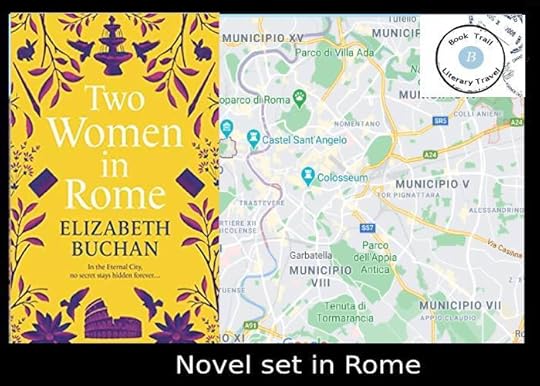
In the Eternal City, no secret stays hidden forever...
Lottie Archer arrives in Rome excited newly married and ready for change as she takes up a job as an archivist. When she discovers a valuable fifteenth-century painting, she is drawn to find out more about the woman who left it behind, Nina Lawrence. Nina seems to have led a rewarding and useful life, restoring Italian gardens to their full glory following the destruction of World War Two. So why did no one attend her funeral in 1978? In exploring Nina's past, Lottie unravels a tragic love story beset by the political turmoil of post-war Italy. And as she edges closer to understanding Nina, and the city draws her deeper into its life, she is brought up against a past which will come to shape her own future.
Elizabeth Buchan began her career as a blurb writer at Penguin Books after graduating from the University of Kent with a double degree in English and History. She moved on to become a fiction editor at Random House before leaving to write full time. Her novels include the prizewinning Consider the Lily – reviewed in the Independent as ‘a gorgeously well written tale: funny, sad and sophisticated’. A subsequent novel, Revenge of the Middle-Aged Woman became an international bestseller and was made into a CBS Primetime Drama. Later novels included The Second Wife, Separate Beds and Daughters. Her latest, I Can’t Begin to Tell You, a story of resistance in wartime Denmark, was published by Penguin in August 2014.
Elizabeth Buchan’s short stories are broadcast on BBC Radio 4 and published in magazines. She reviews for the Sunday Times and the Daily Mail, and has chaired the Betty Trask and Desmond Elliot literary prizes, and also been a judge for the Whitbread First Novel Award and for 2014 Costa Novel Award. She is a patron of the Guildford Book Festival and of The National Academy of Writing, and sits on the author committee for The Reading Agency.
Lottie Archer meets and marries Tom who lives and works in Rome. She is able to secure a job as chief archivist at Archivo Espatriati where one of her first tasks is to archive materials belonging to Nina Lawrence, murdered in Rome in 1978. Lottie gets drawn into Nina’s world with astonishing results. The story is told in two timelines in the late 1970’s and the present day.
This is a really well written and very enjoyable thriller, the setting in Rome is wonderful and there are some fantastically rich descriptions of the Eternal City which transport you there. The characterisation is good and you can picture both women vividly. There’s a good mix of characters to like and loathe. Nina’s story is mysterious, elusive and absorbing and is set against the violent political turbulence, turmoil and tensions of the ‘Years of Lead’. Italy is a mess in the ‘70’s and especially prominent in the novel is the kidnap of Aldo Moro a former Prime Minister of Italy. We have the Red Brigade, Communists, Fascists, spies, the CIA and so much political wrangling and machinations. Set against this jaw dropping and factual backdrop is a love story that is fated from the start. There are so many layers to the storytelling as also interwoven is a fascinating art theme which I really like and if that isn't enough to whet your appetite we have the Catholic Church and the Vatican! It all works really well and keeps you reading as you try to sift through the veil of, secrecy, espionage, lies, betrayal and guilt to get to the truth. I admire Lottie’s doggedness in her pursuit of Nina’s story which is truly an astonishing one. It works alongside her personal pursuit for her identity which is central to her inquiry.
Overall, I really like Elizabeth Buchan’s books. She has a way of pulling you into a storyline in a very compelling way particularly in this clever thriller. I thoroughly enjoyed it and would recommend it to thriller fans.
With thanks to NetGalley and especially Atlantic Books, Corvus for the much appreciated arc in return for an honest review.
First of I have something to confess. One year my mother requested from me for her birthday a book by Elizabeth Buchan. I became a fan of Elizabeth Buchan books since the day I bought my mum a book for her birthday. Now I just love reading books by author Elizabeth Buchan.
Two women in Rome really pulled me in. I took my time reading this book as to take in Lottie’s job as I loved reading about it. Her job was something so completely different from what I have ever read before. I literally savoured every page.
I loved reading about Lottie as she was my favourite character. I did feel really sorry for Lottie as she was given away at birth by her mother and she didn’t even know who her father was.
I was attached to the back story in how Lottie found her husband Tom, as it’s wasn’t how I thought Lottie would have found Tom. So I really liked that part as I do like reading the unexpected of how two couples meet.
Tom persuades Lottie to move to Rome and apply for a archivist job, where she finds two boxes one with a label on Nina Maria Lawrence, 1940 - 78 with written the words No know contacts, No known issue. No claimants. And inside is a valuable painting from a manuscript. I was interested from this moment on to find out who was Nina Lawrence.
This is a gorgeous uplifting story that makes a good choice for all book clubs to talk over about some of the many storylines set within in these chapters as so much more happens, I can’t possibly spill and tell you!
Nina’s part of the story, revealed through her journal and other papers, features a particularly turbulent time in Italy’s political history – the late 1970s – a period I’ve not seen featured in historical fiction before. Although perhaps it’s my age that makes it difficult for me to see any part of the 1970s as ‘historical’!
Regular followers of my blog will know I’m not a great fan of the narrative device of the secret journal, finding it rather artificial. However, in this case the author manages to make it work chiefly because Lottie’s role as an archivist naturally involves the perusal of previously unexamined papers. Although I still found Nina’s journal remarkably detailed (she obviously had a good memory for conversations), the motivations suggested for her having kept it were believable, albeit unwise given what the reader learns about her.
As Lottie discovers, the devious machinations of government officials and those employed by the Vatican during Nina’s time in Rome continue into the present day. As one character observes, ‘The Vatican is home to the humble, the saintly and the ambitious’. And in a country where family is everything, the power of blood ties to influence events should never be underestimated or ignored.
The similarities between the two women could make them merge into one but the author successfully ensures they exist as characters in their own right. In the case of Nina, it’s her love of botanical history and the hint of intrigue. In the case of Lottie, it’s her passion for documenting and preserving the records of past lives. As Lottie reflects at one point, ‘She had a strange feeling that Nina Lawrence was speaking directly to her’. Having said that, Lottie’s curiosity does seem to have a blind spot closer to home.
As you would expect from a novel set in Rome, food features prominently. Who can blame Lottie for being tempted by the goods displayed in a delicatessen window? ‘The jars of goats’ cheeses in oil, black olives in cream earthenware bowls and salamis hanging from ceiling hooks like stalactites.’ The atmosphere of ‘the Eternal City’ is vividly evoked and I enjoyed learning about the symbolism of Medieval religious art, especially the significance of the colours used, ‘paint ventriloquism at its most dazzling’ as it is so eloquently described.
The author’s choice of Rome as a setting – a city I’ve been fortunate enough to visit – combined with a story that encompasses art history and garden design ticked plenty of boxes for me. Add in the element of mystery and a touch of romance, and you have a book that deserves to have a wide appeal. I really enjoyed it and a return trip to Rome is definitely going on my wishlist.
*Thank you to NetGalley for the ARC in exchange for an honest review*
I requested to read and review this book as I am currently enjoying a burst of historical fiction and wanted to read something different from the WW1 & 2 books I have mostly been reading. I'll admit, I've also been experiencing a bit of wanderlust, as I am sure many of us have been amid these restrictions - so a book set in Rome felt like a nice way to feed the need for travel.
We are following the current day third person narrative of Lottie, a young, recently married woman who has moved to Rome and works in the archives. She begins to archive documents related to a second woman, Nina Lawerence, who was murdered and seemingly no investigation was made, however her documents and journal remain and we explore her narrative via a diary she kept. Lottie takes it upon herself to investigate more into this woman.
I have mixed feelings about this book. It took me a long time (for me) to read this novel, which tells me something about how gripping (or not) it is. I wasn't particularly invested in the characters, when given their pasts I really could have been. I wanted to care for Nina and Lottie, but I just couldn't - there wasn't enough there for me to do so.
The story itself seemed gentle and plodded, when it could have been pretty interesting and pacy. This book could have been gripping, it could have pulled me in and refused to let go. But it just didn't... many aspects of the story felt underdeveloped. There was both too much information of some kinds, and not enough of others. There were paragraphs of writing which just seemed irrelevant to the overall story, but then on the next page I was wondering why something was relevant because there hadn't been enough detail.
My final gripe, was that it wasn't clear to me just why Lottie was so intent on finding out more about Nina Lawerence. Indeed, one of the characters says "Signora, it shows Christian spirit that you care about a dead woman after so long a time. Do you have a personal connection?" Lottie responds 'No', to which he replies "Why, ten, are you interested?'. And he has a good point. Lottie's narrative states 'there were several answers' but none of them seem to justify the intent with which Lottie pursues this case. It just didn't feel convincing to me.
That said, some parts of writing style were beautiful. The few descriptions of Rome as a city were captivating, and some of the secondary characters were developed enough to feature in the story and have impact. I would recommend this to people who are perhaps not expecting too much and are up for a slow, gentle, 'plod' of a read.
Two Women in Rome is a captivating work of historical fiction set in the sun-drenched Italian capital of Rome and a beautifully atmospheric story of two women who can never meet, set in a city full of secrets both ancient and modern. Nina Lawrence is a British ex-pat living and working in Rome as a successful landscape gardener throughout what came to be known as the ‘Years of Lead’ when political strife led to violence and assassination. But on her death in the late 1970s, or murder to be more precise, few people attended the funeral to pay their respects and it appears her killing was never properly investigated. But is Nina all that she says she is? Are there other things going on in her life? Thirty years later, Lottie Archer has taken up the post as archivist in an archive housing expatriate papers where she comes across a trove of Nina’s papers in which is discovered the painting of an Annunciation which could be medieval. What happened to Nina, and the story behind the painting, causes Lottie to rethink her experiences and attitudes but it also puts her in danger as some people want what happened kept hidden. Yes, politics and work are crucial in life but so, too, is forgiveness.
This is a captivating, richly described and intriguing novel with a dual timeline linking two women who never meet but have the common experience of living in Rome many decades apart. You are immersed in the sights, sounds and smells of this enchanting city from the get-go and the characters were likeable and easy to empathise with. Nina’s story was very cleverly woven as it was clear there was still so much to find out about her and Buchan showed Nina’s pain at giving up on love to save herself from heartache. Lottie questioned how much she really knew about her husband as secrets began to unravel about him. This book is part history, part mystery-thriller and part beautiful paean to the city of Rome. A plethora of clues, deceit and betrayals are woven into the pages of the story and spread throughout the city and the characters' lives. Each character had their own motivations and traumas and when everything started to unravel the revelations were both alluring and heart wrenching. It kept me guessing right the way through, and I loved how the two timelines converged at the end to form a conclusion. Highly recommended.
Questo libro presenta la narrazione su due piani diversi e come sapete questa cosa mi piace molto: in un capitolo la protagonista è Nina, in quello successivo Lottie. L’alternanza della narrazione fa scoprire molte cose proprio perché Lottie, al lavoro, scopre il diario di Nina e così inizia un’avventura fatta di segreti, misteri e pensieri. Mentre il piano narrativo di Nina è precedente a quello di Lottie perché la vita di Nina è stata stroncata nel momento in cui stava per sbocciare. Quando lascia l'Inghilterra nel 1977, Nina è convinta che Roma sarà l'ennesima tappa di un lavoro. Ma poi incontra Leo e nonostante i limiti lo ama davvero. Toccherà a Lottie di scoprire la fine che abbia fatto Nina e leggendo il suo diario, sente di avere molto in comune con quella donna vissuta quarant'anni prima: anche lei straniera in una città che non conosce, anche lei pronta a lasciare tutto per seguire l'uomo che ama. Questo libro mi è piaciuto ma l’ho trovato confusionario in alcune parti, in quanto la scrittrice cerca di utilizzare alcuni avvenimenti storici davvero importanti, con lo scopo di creare un sfondo misterioso e intrigante, legato alla città eterna di Roma. Per il resto la penna della scrittrice è davvero semplice e d’impatto e si legge molto velocemente perché la scrittura è scorrevole.
I'll be honest I received an advanced copy of this book in return for an honest review and I wasn't expecting much BUT what a brilliant book, so well written with such intricate detail to the plot and setting.
A tale of one city, two women separated by decades and a death.
I found the city to be the most seductive character in the book, the author wrote it so well I could feel the Italian heat on my face, smell the market places and could see the dazzling colours of the paintings and gardens described.
The characters were well developed and interesting with a wonderful mix of Europeans all mixed into the melting pot of a city in Summer
The plot kept you hooked from the very first chapter and I did find the dual periods of time meant we (the readers) were able to explore Rome not once but twice which meant new experiences of the same locations.
A very detailed and intriguing book that I honestly would never have picked up but am so glad I did it was a perfect Spring / Summer read.
3.5* Lottie has come to Rome to be with Tom and she manages to bag a job as an archivist. She discovers archive material that draws her in and takes her back to 1978 and highlights the life and death of Nina Lawrence, a shadowy figure who came to an horrific end; she was a woman who had no ties and no-one to mourn her. At the end, she was a woman abandoned by people, love and by life, and this aspect of her life chimes a chord with Lottie’s own personal experiences, abandoned as she herself had been by her own mother, her father unknown. Among the papers and records there is also a small artwork that surely must offer some clue to this woman’s existence.
The 1970s were a period of quite some political upheaval across Europe and especially in Italy. The kidnapping and killing of former Prime Minister, Aldo Moro, is one facet of the machinations at various levels throughout political and religious institutions that marked the period. There is a lurking sense that Nina was perhaps not the simple gardener and botanist she purported to be. Much of the information gleaned about her is through the diaries and notes she kept, and Lottie finds herself becoming a devoted – obsessed – researcher, a stubborn and dedicated woman on a mission, who simply will not be deterred.
There are several characters who thread their way through the narrative both then and now, right down to Concetta who is Tom’s home help, but whose loyalty lies with his previous girlfriend. Irritated at first, threatened by his paramour who seemingly continues to have a presence in Tom’s life, Lottie has to coax Concetta round. She also has to ensure her work colleagues are on side as she delves deeper into the Nina’s life and discovers secrets and lies at the heart of her story.
Rome is very much a character in its own right and you can feel how much the author has enjoyed bringing the city to the pages of this book. Streets, architecture and the metropolitan vibe come to life in the capable hands of this author as both her lead characters move around. Her writing style is quite wonderful.
For me it felt like quite a slow start to the book and I struggled to really engage with both Lottie and Nina, and that made the story feel just a little flat. Rome is a passionate city, it makes a heady backdrop and I guess I yearned to experience the intensity and colour of the metropolis reflected in the trajectory of the story and its characters, but I just couldn’t get hold of the passion which I could sense was just lurking in the wings. It all felt just a little on the dry side.
A good choice nevertheless if you are heading for Rome. The cover is a REAL eye-catcher and love the combination of purple and yellow.
This had me gripped from the first page until the last. I loved all the descriptions of Rome. My thanks to Netgalley and the publishers for giving me the opportunity to read this book in return for an honest review.
I received an ARC of this book from Netgalley in exchange for an Honest review. This is an historical fiction of the not very distant past in Rome. I think the significance of the time period is the political fascist / communist.
Lottie an archivist meets Tom in Rome and is encouraged by him to apply fora job and move to Rome and to marry him. Tom is not what he seems to be on the outside and I have inklings that the job was manufactured by him. The current incumbent of Lottie's post fails to leave int ime for Lottie to slot into the post and in the meantime she is given the job of archiving boxes of items relating to a gardener come spy known as Nina. Lottie is drawn into Nina's affairs both romantic and political.
If this makes no sense to you it is because it made little sense to me - it felt like there was something further back than Nina which we are not being told. The pace of the narrative was all wrong it feels lumpy and bumpy.
For me there are many better historical books and this author is not one i would follow
Art, Rome, and a murder mystery, this had so many elements which appeal to me but ultimately it was just an okay read. Unfortunately I could see the author pulling strings to advance the plot and she didn't trust her readers enough to be subtle with the themes and character arcs.
"Metamorphosis was something I had only read about until I met Leo. But it has happened to me. I have dived in deep as one person and come up another." un Campo de'Fiori. un Roma. un ēdiens. un Renesances gleznas. un Itālijas politika.
Nina Lawrence is a British ex-pat living and working in Rome as a successful landscape gardener. She died in the late 1970s, but few people attended the funeral to pay their respects and her killing was never properly investigated. Thirty years later, Lottie Archer is travelling to Rome having accepted a job there as an archivist in Archivo Espatriati and to be with her new husband, Tom who works for the British Council in Rome. When she comes across a valuable painting owned by Nina, Lottie becomes fascinated by Nina and her life, putting herself in danger.
In this novel with a historical context, the author delivers a compelling tale. Nina’s storyline draws the reader in and her story is swathed in the political intrigue of the decade. For her part, Lottie is trying to find out about her own history. The dual timeline linking two women who have the experience of living in Rome many decades apart is really well done. The reader is immersed in all of the delights of the enchanting city from the off and the characters are easy to empathise with. I recommend Two Women in Rome without hesitation to anyone who is partial to historical, romance, or contemporary fiction.
I read Two Women in Rome in staves with other Pigeonholers as part of a group. A special thank you to Corvus, Elizabeth Buchan, NetGalley and The Pigeonhole for a complimentary copy of this novel at my request. This review is my unbiased opinion.
A surprise murder mystery that was a lil limp.. decent premise but average execution. Has made me want to scrub up on my 1900s Italy political knowledge tho !
In a marvellous tour de force, Mrs Buchan takes us on a journey filled with everything you need from a book: love, mystery, action, deep conversations and of course Rome!
Follow along as our main gal Lottie (god bless her she was such a bad bitch!) marries Tom (who started out a little suss ngl but got so much better!) and decides to move to Rome with him.
Whilst being the chief archivist, she discovers old papers, one of which is an old medieval miniature, property of a certain Nina Lawrence. From there, we’re taken back to Cold War era Rome, learning more and more about the infamous Nina.
Buchan seemingly incorporates both narratives to form a real quest for identity, questioning how we as women are made to exist in the world while gripping you from the start with realistic dialogues, asking questions about love, faith and life in general.
I don’t want to spoil anything else but as all my updates will state… wow, just wow!!!!
I preferred the 1970s narrative - I think that was probably the book that needed to be written here. The other, contemporary storyline felt a bit convoluted at times, and both bits didn't quite mesh together for me. However, I enjoyed the art, was interested in the political/historical aspects of Rome in the seventies and, as ever, enraged by the brutality and corruption of the men at the heart of religion and politics.
I'd happily read more of her work, but would pick one with a generally high review score.
This book was ok though felt it was rather slow and drawn out. It was an interesting story & i enjoyed the setting of Rome but I felt it had potential to be better and more gripping, just unfortunately fell a bit short for me.
L’anno scorso avevo letto Il museo delle promesse infrante, un romanzo che mi era piaciuto molto, per cui, nel momento in cui è uscito questo, l’ho subito acquistato. Leggendo la trama, in realtà, temevo una scopiazzatura dell’altro, ma comunque questo non mi ha fermata.
La storia ha decisamente molti punti di contatto con l’altro romanzo dell’autrice: un personaggio che lavora in un ambiente insolito in cui si ha a che fare con delle memorie del passato, e un secondo personaggio, vissuto alcuni decenni prima, la cui vita è tutta da scoprire. Però comunque se ne discosta anche: in questo caso abbiamo infatti a che fare con un cold case, con una donna, Nina, uccisa in maniera misteriosa, di cui Lottie vuole scoprire qualcosa di più. Questo essere un cold case sotto certi punti di vista è ciò che ha salvato il romanzo, sotto altri, invece, è ciò che l’ha affossato. Il ritmo della storia è infatti molto incalzante, in grado di tenere a lungo con il fiato sospeso e di far sì che uno non si riesca a staccare dal romanzo. I personaggi coinvolti e le dinamiche tra essi, però, sono abbastanza scontati e prevedibili, si capisce praticamente subito il ruolo di ognuno nella vicenda, per cui alla fine non è che i colpi di scena siano poi così tanti. Lo stesso per quel che riguarda la parallela vicenda ambientata nel presente e che vede Lottie al centro della scena: moltissime cose le avevo sospettate sin dall’inizio, anzi, forse mi ero fatta persino più viaggi mentali dell’autrice stessa.
Stāsts par Romu pagātnē un tagadnē. Līdzība ar manu iepriekš izlasīto grāmatu "Laiks ir slepkava", kurā arī tieši tāpat paralēli lasītājam tiek atklāti pagātnes un tagadnes stāstu noslēpumi, turklāt abās šajās grāmatās tas notiek līdzīgi - ar dienasgrāmatas palīdzību.
No šīs grāmatas tomēr nesagaidīju tik lielu atdevi, uz kādu biju cerējis. Jā, zināma interese tika noturēta, pamazām atklājot detaļas par pagātnes noslēpumiem, turklāt papildus motivāciju lasīt man piedeva notikumu vieta - Itālija -, tomēr nevarētu teikt, ka stāsts būtu tik interesants, ka grāmata pilnīgi ievilktu sevī vai tamlīdzīgi, kā nereti mēdz izteikties. Arī par atrisinājumu - nu tāds, līdz galam nenoslīpēts, ja tā man atļauts izteikties..
This wasn’t quite what I was expecting; in a good way. Perfect setting, Italian art, gardens and politics. The two timelines nicely linked by a sense of intrigue. Probably 4.5 stars for me and definitely recommended.
An evocative literary tale of two women born decades apart who live in Rome but never meet. Lottie, an archivist, starts her new role by archiving the papers and possessions of Nina, a landscape gardener who died in the late 1970s.
The story is written with vibrant description that vividly brings Rome to life in the politically turbulent seventies and the present day. Nina's story draws Lottie, into her world, through her journal, which gradually reveals the secrets of her life and death. With each revelation, Lottie examines her own life.
There are many elements in this story, all of which add to its authenticity and complexity. The characters are well-written and the connections between the dual stories believably created.
An intriguing mix of art, history, mystery and love.
I received a copy of this book from Corvus via NetGalley in return for an honest review.
Il libro è gradevole, ma ci sono alcune cose veramente assurde. Tipo, perché mai Lottie si interessa così ossessivamente e fin da subito alla storia di Nina? Non mi pare normale e non ne viene data una spiegazione coerente. Inoltre, cosa che mi avrebbe perfino fatto abbassare il voto a 2 (attenzione grosso spoiler): Sono abbastanza perplessa, ma arrotondo a 3 solo perché è stata una lettura piacevole e anche molto semplice, ottima per il momento in cui l'ho affrontata.
An absorbing and intriguing read set in Rome across 2 timelines; the present day and the late 1970s. This novel explores the life of Nina, supposedly a landscaper, with a lover who is preparing to become a priest. As the novel progresses, it’s clear that Nina is not quite as she appears. In the present day, Lottie is an archivist, newly arrived in Rome and tasked with archiving Nina’s papers. Rome, and the Vatican play a large part in the story. I was previously unfamiliar with the recent historical events of the older timeline and have been interested to read about these, as well as the more traditional meanings behind artworks, which play a part in revealing Nina’s story. This is a very subtle thriller, beautifully written. Read with The Pigeonhole.
it was nice, but I'm kinda in a bookslump and wasnt really in the mood for it... was kinda forcing myself to finish it, but the story was nice, the plottwists kept coming and the vibe was lit
Bit of a slow burner, probably a fault of my unfamiliarity with Post-war Italian Politics. Some lovely ‘imagery’ of Rome seen through the eyes of the ‘storyteller’ who you ended up bonding with.
I seem to be on a role with books about botany and political turmoil. Stories with strong female leads too. This book falls into both of these boxes and draws a fascinating picture of an Italy at war, but one also of beauty, art and female resilience.
Lottie and Nina were the two central characters and we see the story unfold through their eyes. Lottie is the narrator of the present day who moves to Rome with be with her husband. She gets work as a archivist and this entails sorting through history to put it simply. There’s lots of letters and objects that people have donated or left behind and so they all have the fingerprints of a past life on them waiting to be discovered. The moment she found a painting, I was just as excited as she was. This is exactly the kind of thing I love. Objects in the present having traces of the past on them, stories attached to them just waiting to be discovered.
Nina is the botanist from the past whose story reveals itself slowly but surely/This is not a fast read but then it’s not about that. Lottie needs time to find out about Nina and the painting, so be sure to read slowly to give her more time. This is how invested I was in the story of these two women and this painting that connected them.
The richness of this novel is comes from many things. Art, religion, war-time Italy -what a mix of themes! In terms of setting for Booktrailers, the author evokes the setting with artistic flair. We spend a lot of time in Rome both past and present and this gives way to creating a picture of the city across time. Overall, it’s like a canvas of political turmoil, beauty, art, heritage and religious turmoil.
There were some lovely moments in the novel. For example, Lottie and Nina’s connection across the ages. When Nina was writing in her diary, I felt that the two women were sitting side by side, in awe of the same story unfolding between them.
The author opens up a fascinating world and does it in a clever way via a painting. It’s like a time travel portal in a book and I would recommend this book wholeheartedly.