Ted Chiang is an American science fiction writer. His Chinese name is Chiang Feng-nan. He graduated from Brown University with a Computer Science degree. He currently works as a technical writer in the software industry and resides in Bellevue, near Seattle, Washington. He is a graduate of the noted Clarion Writers Workshop (1989) and has been an instructor for it (2012, 2016). Chiang is also a frequent non-fiction contributor to the New Yorker, where he writes on topics related to computing such as artificial intelligence.
Chiang has published 18 short stories, to date, and most of them have won prestigious speculative fiction awards - including multiple Nebula Awards, Locus Awards, Hugo Awards, and British Science Fiction Association Awards, among others. His short story "Story of Your Life" was the basis of the film Arrival (2016). He has never written a novel but is one of the most decorated science fiction writers currently working.
Chiang's first eight stories are collected in "Stories of Your Life, and Others" and the next nine, in "Exhalation: Stories".
I read this in Chiang's The Stories of Your Life and Others, which I reviewed HERE.
Anyway, this story:
Mirror, mirror on the wall… I remember a childhood eureka moment when I realised that if there was no painful, nasty, evil, ugly stuff in the world, the least good things would just become the new bad (it was years before I learned the word “relativism”). But what if you neuter the ability to distinguish?
Image: “Reflections in this mirror may be distorted by socially constructed ideas of ‘beauty’.” (Source)
Lookism
This short story tackles lookism. People can have a reversible brain modification (calliagnosia, aka “calli”) so they can’t process the aesthetic qualities of faces, and therefore can’t act prejudicially or pridefully on that basis. They can still notice that eyes are blue, a nose is wonky, and tell Lisa and Amy apart, but they lack to the ability to rate qualities like symmetry and clear skin aesthetically.
The resulting consequences, complications, and controversies are played out at a university in the run-up to and aftermath of a vote on whether all its students should have to try calli. The university’s motive is social justice, rather than the antithesis to the beauty industry that motivates the National Calli Association (NCA).
There are short monologues from a variety of people (students, staff, parents, politicians, cosmetic corporations), each with vastly different experiences, opinions, and vested interests. Some are intransigent; others open to persuasion and experimentation. Is it better to take on a mild disability, or hope “maturity means seeing the differences, but realizing they don’t matter”?
At the centre is Tamera, raised in a calli community. “Being pretty is fundamentally a passive quality...I wanted Tamera to value herself in terms of what she could do.” But on turning 18, Tamera decides to have calli disabled, though she is unsure whether it’ll be a permanent or temporary switch. Her awakening to seeing and thinking about the world in a new way is challenging, but somehow charming as well.
And “charm” is a key word: Tamera is startled to learn that many of the words associated with attractiveness are etymologically related to magic, including "charm", “glamour” and most obviously, “enchanting”.
Calli or Not?
This story raises many fascinating and wide-ranging issues about the insidious dangers of being saturated with “supernormal stimuli” of airbrushed, silicone ideals, but it ignores or forgets others. It ends up focusing primarily on the advantages, disadvantages, and addictive appeal of “pharmaceutical-grade” beauty (“the cocaine of good looks”), while overlooking the disadvantages of ugliness or disfigurement that calli is intended to tackle. But that’s the point: most of us prefer not to look at such people (sometimes including those people themselves). It's easier to forget about them as much as possible.
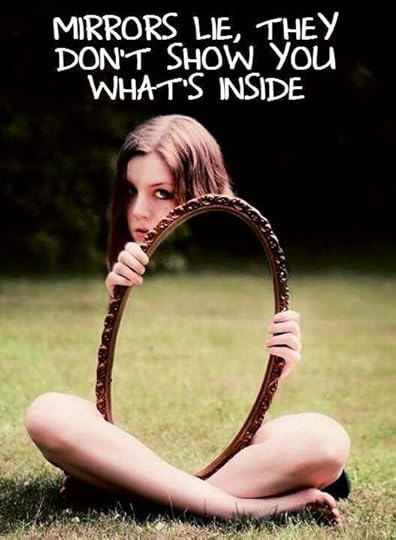
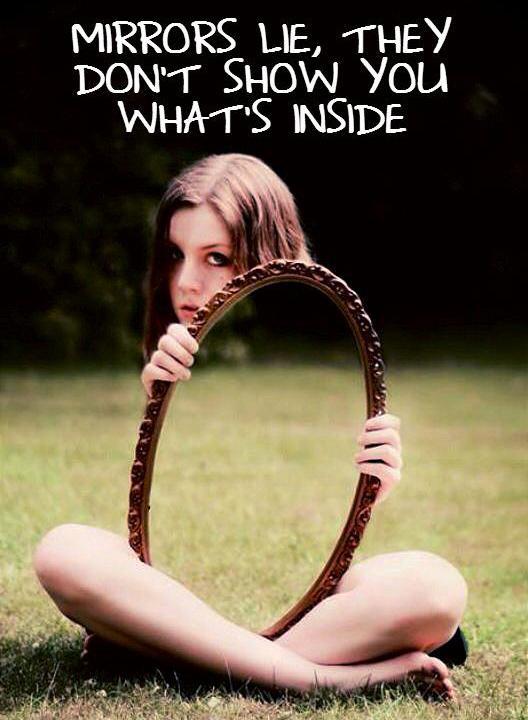
Image: “Mirrors lie, they don't show you what’s inside.” (Source)
See also
For a much older take on similar ideas, see Nathaniel Hawthorne's The Birthmark, which I reviewed HERE.
Also did for literature this week. Honestly, it wasn't bad. Short and intriguing. I've never been big on science fiction, but school has been pushing me out of my comfort zone, and I'm actually not that mad about it. 🤷🏼♀️
5/5 I found this to be an excellent discourse around both the personal and societal notions of beauty in a digital age. The basic premise is calliagnosia, a new non-invasive medical procedure that stops individuals from seeing the features that define a face as pretty or ugly. The story is told through blog-like messages from various key players in the debate around callignosia as it is to be implemented for all students at Pembleton Collge.
Arguments for include the predisposed advantage of good looks in work and life generally, as well as the ability to judge people by their internal charm. Arguments against cover the individual right to maintain bodily autonomy and take responsibility for avoiding bias/ distractions rather than being coddled and having it done for you. The way each idea was explored, attached to a human voice or story (such as when corporations get involved) make it that much more of an interesting read. And as if this all wasn't enough, Chiang throws in some more feasible-in-the-near-future technologies such as spex and personalised ads that definitely attempt to leverage an individual's perception and decision-making beyond what the brain has naturally grown to control. This all makes for an educative, reflective and exciting read!
Well, in the first paragraph I learn that “calli” as a prefix means beauty.
Ooh, when the neurologist comes up I’m reminded of the FFA (fusiform face area) region of the brain that is specialized for recognizing faces.
“Being pretty is fundamentally a passive quality; even when you work at it, you're working at being passive.”
“Every study on this issue turns up the same results: looks help people get ahead. We can't help but think of good-looking people as more competent, more honest, more deserving than others. None of it's true, but their looks still give us that impression.” This bias can be a halo effect.
I don’t recall learning about Fregoli syndrome, very interesting.
This is the only story in Stories of Your Life and Others that was originally published for the first time in the 2002 anthology. I was a little apprehensive as there had been such previous highs that I was unsure if this would live up to them–a spurious snap discrimination made on subconscious assumptions about in an in group (previously published stories) and an out group. I don't have anything interesting or profound to say about that, it simply amused me when I had the realisation in relation to this story.
My apprehension was unfounded and I found this story utterly fascinating, both in its classic Chiang thought experiment premise and the wholly different form and approach to the story. I thoroughly enjoyed it and definitely see it as part of the top tier stories in the anthology, alongside Division by Zero (seemingly my sad grrrl hipster opinion), Stories of Your Life, and Hell is the Absence of God.
Liking What You See: A Documentary reads like a simplified script of a documentary with the name and relevant information of the speaker and the transcripts of their vox pops, interviews, reports, and recordings. The documentary covers calliagnosia, a non-invasive, reversible medical procedure that induces a visual agnosia, the inability to process sensory information, regarding human facial beauty*. The narrative follows a college student who grew up with calliagnosia, her college's debate on whether to make calliagnosia a mandatory policy and the wider discussion around this, and her relationship with her partner and the condition.
*It is also seen to have other minor effects on perception of other things that use the part of the brain used for facial cognition in some, such as certain designs of cars.
Now, this is very much my initial reaction without knowing anything about this story previously or interacting with anything around this novelette, so my thoughts could change after time and considering other perspectives. This is always the case with an initial reaction, but this is really one of those stories that by its very nature of the topic, form, and how these are presented have so much to consider, that I really wanted to make that extra clear.
Any story that is presenting a dichotomy and debate, particularly one that is literally heading to a decision being made within the narrative, is going to make the reader consider the topic, arguments, how they are presented, and how they are framed. But most prominently it's going to elicit the reader's opinion. My opinion was very much clear from the outset and did not change in the least through my reading, despite genuinely trying to consider and engage with the arguments. I don't think this necessarily reflects in any way on the story, which on the whole seems to do a decent enough job of presenting the different perspectives and motivations behind certain characters’ views and arguments in a varying and balanced manner. Although, I do think Chiang's views can clearly be discerned, particularly in the way that the anti-calliagnosia perspective is interestingly, amusingly, and somewhat performatively shown as coming from underhanded means in spite of the seeming veracity of its argument. It seems the author possibly doth protest too much
Well done both as a piece of speculative fiction, and as a believable fake documentary about induced calliagnosia, i. e. a procedure blocking the circuits in the brain responsible for perceiving beauty.
Tamera Lyons, a first-year student, has already experienced calli (as they call it): the community she grew up in used it to protect their children from being vulnerable to unattainable body image ideas served by the media, as well as judging others by the looks. She is an interesting character to follow around: after having calli turned off at 18, she's trying to catch up with the world on which she felt she was missing out: being stunned by the looks of models in ads for the first time; looking at the hottest boys on the campus; waiting with baited breath for the moment she can decide whether she's pretty herself.
In the background, her college is debating over demanding calli from every enrolling student--a plan that of course stirs a full spectrum of emotions: some don't want to lose their privileges, some want equality, some point out that being pretty is not the only way to attract attention, a girl named Jolene (I so hope it was a deliberate easter egg) wishes everyone stopped seeing her looks so she could finally tell who only likes her because she's pretty. Before the matter is put to voting, we'll see secret lobbyists exposed, a hacking war, and novel tools of winning debates.
I can't say I really understand how far the technology described is away from our grasp, though it's only a flaw since I like clear ideas of things. The problem of beauty standards have been and will be relevant in every moment of history, and the way Ted Chiang was able to replicate the manner of speaking of every group of interest made me laugh a few times. Definitely worth reading.
1. Speculative fiction regarding one of the oldest and most pervasive forms of discrimination, lookism, The discriminative treatment of people who are physically unattractive. Lookism is also the most natural form of discrimination that doesn't need to be taught by society. People, innately have a preference for beautiful faces, and hence lookism is natural. This story explores the impact on society if, through a procedure, people can be blocked from sensing a face as beautiful/ugly. 2. Very thought-provoking story, exploring a wide variety of viewpoints (literally because of its documentary structure) 3. Focus on the characters and the plot both of which progress smoothly. 4. A very well-developed concept despite it being essentially a short story. 5. No obvious cons. Maybe some of the viewpoints not being interesting can be considered a con but those are essential to make a realistic documentary-styled story.
Things that can hold your interest: 1. The Same issue is being discussed from both sides where both have some great points. It feels like a real-world issue. Very interesting structure and timing of viewpoints in the story. 2. Curiosity regarding who will win the elections. It is truly unpredictable until the final reveal. Great twists and turns that hold the interest. 3. It has Politics as well as Romance which is strictly used in service of the main plot of the story. 4. Speculation regarding what corporations would have the power to do once the mechanisms of the brain are more deeply understood in the future. 5. Like a black mirror episode for People who find that series interesting. (Though I would say this story is better than a black mirror episode and less bleak)
Collected in Stories of Your Life and Others. To combat humanity's obsession with looks and judging others by that yardstick "Lookism" scientists have invented a non-invasive medical procedure called "Calliagnosia" which induces visual agnosia (inability to process sensory information) toward physical beauty. They exhort younger people to make the choice to get that surgery "beauty is a drug you can't abstain from unless you literally keep your eyes closed for all time". In other words, get this procedure so you can become a better person.
The story's protagonist is leaning the other way. Tamera Lyons grew up with calliagnosia but wants to experience life without it to see how things are from the other side. Some of what she, and others discover about themselves and others is honestly mind-blowing as I bet people never managed to break way from the paradigm of "better looking" means better people, when it is a person's personality and their choices dictate what kind of people they are. Not their looks.
The idea of Calliagnosia is honestly appealing because most of us who are not that attractive do not want to be judged based on our looks. Nor do we want to spend hundreds of dollars on the entire beauty / looks industry just to keep up appearances - this would have a negative impact on the entire make up, perfume, clothing, fashion, couture, hair and other industries worth billions that rely on hot models to advertise and sell their products. These industries would spend their coffers bare to ensure the public never gets behind the Calliagnosia movement.
Unsurprisingly, the above is exactly what happens in this story. By the end of this story I was worn out. Those who are good looking will of course not like Calliagnosia. But as I age I am faced with encountering ageism in hiring. I would love it if there was a version of Calliagnosia which every single hiring manager needs to have turned on so they would pick the best candidate based on ability, not looks, age or race. Taken to the next level, who knows, it will probably result in more diverse boards and CEOs.
This is the sort of story that explores future transformative technology in the way I feel more should: not simply presenting a single outcome, but presenting a cornucopia of responses to the technology and visions of what it could become from different people, inviting the reader to more actively develop a position based on their own arguments and values. On account of this, it serves as a much better conversation opener than most other stories of this sort about how we feel society should relate to beauty, cosmetic modification, and what kind of minds we should strive to have.
What do you all think? Would you use Calli? Why or why not? For myself, in my own life, I think I would; I would even be happy to have grown up in a total Calli community. Perception of visual attractiveness is a distorter simply does nothing that benefit any of my values, but I can see how someone else may feel differently.
Some reviewers argue that beauty perception promotes health by convincing people to stay healthy to stay attractive, but I am not as convinced. Some beauty standards are correlated with health, but others tend towards pure superstimuli, influencing people to undergo dangerous procedures. Just as some people are pushed towards by beauty standards, others are pushed into deadly eating disorders or violent body dysmorphia; one just has to glance at anorexia or incel forums to see the most drastic and horrific pathologies that beauty standards may generate at their worst. On account of this is not obvious to me that pressure to be beautiful in the modern world is overall a force for personal health. Other reviews make a (rather eugenical) argument that the sort of sexual selection beauty is required to preserve human genetic health, but even ignoring the usual troubles of Parfit’s non-identity problem and the corrosive effects of intentionally social Darwinist policies on culture, it is not clear to me that this problem would even requires sexual selection to fix when we have new things like preimplantation genetic testing and gene therapy. Ultimately, the only unambiguous benefits I can see in a modern culture that experiences physical beauty are the sense of pleasure and idealism it brings its viewers and the fact that it’s old and traditional, so we know how to live a life with it, but are those worth the suffering it may cause? For some people, beauty is simply an end in itself that is not up for debate, but for those for whom it is not, this is an interesting question to ponder. What do you think? Are there other core benefits I am missing?
Otra historia muy debatible, y por lo que es tan buena.
Teóricamente podemos llevar la historia a cómo hoy la publicidad en casi cualquier medio se enfoca en presentar productos ya no solo por quién es físicamente atractivo, sino quién llama o atrae más gente con sus "propuestas".
Los streamers, instagramers y demás que tienen y comparten rasgos físicos más atractivos son los que más seguidores tienen, pero al mismo tiempo ya necesitan reproducir el mismo chiste, baile y mensaje de vibrar alto para venderse. Incluso las mismas frases, tonos y expresiones faciales. Incluso si en el video salen llorando y sufriendo, nos conmueve más que alguien "feo" o "pobre" sufriendo.
Pero al mismo tiempo, como dice en la historia, nos resulta antinatural, y puede que al momento esto nos afecte o nos mueva los sentimientos; pero tampoco significa que no podamos apagar el teléfono, interactuar o concentrarnos en otras cosas. Lo ideal sería tener la madurez, inteligencia y educación emocional para saber cuándo podemos contemplar la belleza y cuándo debemos tener en cuenta otros factores.
La primera vez que leí la historia recuerdo que me gustó mucho sobre todo porque era una idea y una propuesta no muy mencionada. Tendemos a exaltar o negar la belleza (y más en el arte), pero pocas veces se había hablado de cortar lazos con nuestro método de captar esa belleza.
Además, me gustó que se mencionara que nuestras sociedades y culturas están basadas en la antigua grecia y su enorme apreciación por la belleza y el cuerpo físico; pero a la vez estamos bombardeados por la culpa y el sufrimiento junto a la búsqueda de la iluminación espiritual.
Sobre la historia yo opinaría que no deberíamos volvernos incapaces de notar esas diferencias y "pequeñas" cualidades que nos dan ventaja frente a otros. Como con el racismo no se trata de igualar, sino de no olvidar.
Lido um bocado como uma colecção de artigos ou posts online de várias pessoas, trata o dilema do projecto de uma escola tornar obrigatória a indução de uma cegueira à beleza facial das pessoas. Um processo fácil, reversível, e isento de efeitos secundários que tem como objectivo reduzir problemas associados ao privilégio de beleza, e melhorar as condições de vida social de pessoas com deformações faciais ou cicatrizes assim. Temos opiniões de várias pessoas, alguns alunos, outros professores, alguns pais, outros não relacionados directamente, uns a favor, outros contra, outros num meio termo.
É fácil de perceber o idealismo por detrás da ideia: basta ver quanta gente online fala na regra #1 e regra #2 na busca por um parceiro, e quanta gente aproveita a sua beleza natural ou artificial para vender produtos (ou ele próprio). Mas quando a ideia passa por forçar as pessoas a adoptar essa cegueira, deixa de ser um assunto simples.
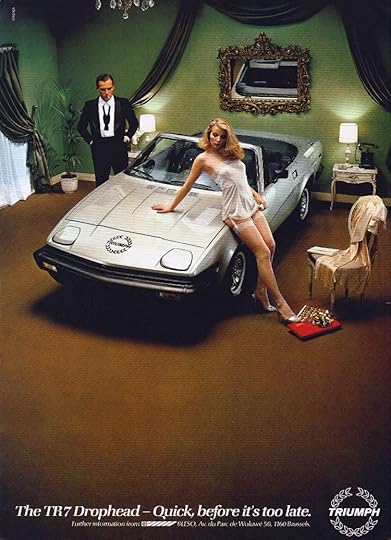
Devo dizer que por muito que se falou nos privilégios que uma cara bonita dá a uma pessoa nesta história, ninguém mencionou nada em relação à beleza corporal. Se não avaliasses a senhora da publicidade do carro pela cara, ias continuar a avaliá-la pela figura. Portanto, vale a pena questionar as pessoas pró: será que isto resolve mesmo os problemas de que falam? A miúda feia e gorda na escola vai deixar de ser ostracizada por passar a ser só gorda?
Definitivamente uma história interessante para discutir com um grupo.
Wow this was so cool. A quick rundown (as there isn’t a synopsis on Goodreads) is that it’s a short novelette about lookism which is basically discrimination based on attractiveness. It’s science fiction so the main topic being discussed is this fictional procedure called Calli which dulls your ability to perceive what is attractive and what is unattractive. You can still differentiate people and be attracted to personalities etc but you can’t comprehend whether they are visually attractive or not. The book is a collection of debates, speeches and testimonies of people who want to implement Calli on a university campus and those who oppose it (companies who profit on insecurities eg. Makeup, plastic surgery).
Super interesting, especially in the age of AI, plastic surgery and photo editing. Some amazing quotes in there too which I really enjoyed. Super short, you can read in an hour as it’s only 50 pages. Definitely recommend!
“A persons face always reflects their personality, and if anything, Calli makes that clearer. You know that saying, that after a certain age, you’re responsible for your face? With Calli, you really appreciate how true that is… Faces that are full of personality look as good as they ever did, maybe even better. It’s like you’re seeing something more essential about them”
Interesting concept. It makes some assumptions i disagree with. E.g.: - Beauty is subjective - Well yes, but at the same time there is absolutely going to be a statistical trend of what most people agree on as beautiful. - There is no upper limit to beauty - There is absolutely going to be a ceiling IMO. - Beauty has absolutely zero correlation with merit. (TBF this is the viewpoint of a character and not necessarily the author) - Counterpoint: There is a reason some features are considered more beautiful. It serves as a biological indicator of health. The body is very interconnected. If your face doesn't develop properly (e.g. because of a modern diet), you might not breathe right and that would affect your cognitive development. This may be why generally speaking high level athletes are on average less ugly. - Obviously for most things Beauty has very little correlation with merit, and shouldn't be used to morally (or otherwise) judge people.
I'll freely admit I only read about half of this and skimmed the rest because of how repetitive it was becoming. It was just the same shallow observations About how beauty is good but can also be bad and seemed to have no depth. Idk maybe if got really deep on page 323 and I missed that in my skim but I doubt it. My first thought when hearing the admittedly very good premise was "what about trans women?" You see there's a sort of well know thing in trans communities of extreme objectification. Trans women are often seen purely as objects. There are many men who believe trans women are hot (both in attraction to femininity and in an attraction to the "taboo" of transness) they love trans porn and such but still morally hate trans people they think it's morally repugnant but sexually attractive and my first thought was how would they react to calignosia? And I checked out when I realized that not only was my question not going to be answered but even the most basic ideas of institutionalized oppression were unrepresented.
Might have been more revolutionary when it was written in 2002, but it honestly felt like a man exploring lukewarm concepts of pretty privilege that the girlies figured out in middle school. It was extremely lacking in nuance, granted it was only 38 pages. Would love to hear this authors take on the hear me out cakes and the concepts of ugly hot and hot ugly.
However, I did find the section from the religious studies professor interesting: “the foundations of our culture were laid in classical Greece, where physical beauty and the body were celebrated. But our culture is also thoroughly permeated by the monotheistic tradition, which devalues the body in favor of the soul. […] So you see, this debate isn't just about commercials and cosmetics, it's about determining what's the appropriate relationship between the mind and the body. Are we more fully realized when we minimize the physical part of our nature?”
Would have LOVED to see the concept of “lookism” explored more so through this lens^^
Somewhere I read Ted Chiang refused a Hugo award for this piece of work. That it wasn't complete. That gave me a biased lens that this work wasn't his best. While reading it I felt my page turn was slower than the other short stories he has written. But by the end, I think that it may have been a recursive loop fed into the reader's mind (even after s/he read the book) make them feel as though they had switched off calli for reading. The story is glory.
I recently had an event which all of a sudden elevated the way I felt about myself. Quite drastically. It was as though I was Tamara, the protagonist of this story. It gave me a unique sense of confidence and elevated my self-esteem in a way that didn't bring my ego up with it. Would I revert back? I don't know - if anything, the event now puts me in the same playing field as others. It feels like I have calli now.
This entire review has been hidden because of spoilers.
An interesting read when you compare it to today's scenario with social media, photoshop and the vast amount of AI being used around.
I'd describe this as a "soft" electronic dystopia; not because it isn't very concerning and sort of terrifying to think about, but because despite all of what is happening it feels.... not urgent. Like, this whole "calli" thing has just crept up on people and now people are just existing with it. A terrifying "new normal". Really cool to see.
Wish it was a bit longer. There's a lot more facets that could've been explored further.
Written as a transcript of sorts for a documentary about beauty standards - and a new technology which seeks to eliminate "pretty privilege" and discrimination based on beauty and attractiveness via selective brain lesions. Students and experts on both sides argue their case - between hopes for a better world to fears of control and brain damage, its a fascinating and terrifying and increasingly relevant discussion of beauty and influence and ethics.
Really engaging and interesting story and societal commentary. I particularly appreciated how the different viewpoints expressed through the “documentary” allow one to better understand where they might fit in the debate. I found myself definitely leaning “pro-calli”, but the way the story ends introduces some elements that I think complicates the topic a bit. I also appreciate how real the story feels in a political sense. You can definitely imagine this exact debate playing out in real life.
Ted Chiang's stories are some of the most fascinating ones I've ever read. The concepts are so specific and unique. The questions they raise are quite thought-provoking. The writing is simple enough to keep us engaged but sophisticated enough not to let us get bored. This particular story talks about beauty and its perception, but more importantly, the conventional standards of beauty and how they are used to exploit people. Very interesting read. Must try if you're a sci-fi fan.