

What do you think?

Loretta Little Looks Back: Three Voices Go Tell It: A Monologue Novel
p.p1 {margin: 0.0px 0.0px 0.0px 0.0px; font: 13.0px Georgia; color: #000000} p.p2 {margin: 0.0px 0.0px 0.0px 0.0px; font: 13.0px Georgia; color: #000000; min-height: 15.0px} From bestselling an award-winning husband and wife team Andrea Davis Pinkney and Brian Pinkney, an innovative, beautifully illustrated novel that delivers a front-row seat to the dramatic events that led to African Americans earning the right to vote.
"Right here, I'm sharing the honest-to-goodness."
"I'm gon' reach back, and tell how it all went. I'm gon' speak on it. My way."
"Say what you want about the way I'm bringing it. Call my recollections running off at the mouth. Or bearing witness. Or speaking my mind."
Loretta, Roly, and Aggie B., members of the Little family, each present the vivid story of their young lives, spanning three generations. Their separate tales - beginning in a cotton field in 1927 and ending at the presidential election of 1968 -- come together to create one unforgettable story of a journey from hardship to hope.
Through an evocative mix of fictional first-person narratives, spoken word poems, folk myths, gospel rhythms and blues influences, Loretta Little Looks Bak weaves an immersive tapestry that illuminates the dignity and strength of sharecroppers in the rural South. Inspired by storytelling's oral tradition, stirring page-to-stage vignettes are presented in a series of theatrical monologues that paint a gripping, multidimensional portrait of America's struggle for civil rights as seen through the eyes of the children who lived it. The novel's unique format invites us to walk in their shoes as they experience what it means to reach for freedom.
"Right here, I'm sharing the honest-to-goodness."
"I'm gon' reach back, and tell how it all went. I'm gon' speak on it. My way."
"Say what you want about the way I'm bringing it. Call my recollections running off at the mouth. Or bearing witness. Or speaking my mind."
Loretta, Roly, and Aggie B., members of the Little family, each present the vivid story of their young lives, spanning three generations. Their separate tales - beginning in a cotton field in 1927 and ending at the presidential election of 1968 -- come together to create one unforgettable story of a journey from hardship to hope.
Through an evocative mix of fictional first-person narratives, spoken word poems, folk myths, gospel rhythms and blues influences, Loretta Little Looks Bak weaves an immersive tapestry that illuminates the dignity and strength of sharecroppers in the rural South. Inspired by storytelling's oral tradition, stirring page-to-stage vignettes are presented in a series of theatrical monologues that paint a gripping, multidimensional portrait of America's struggle for civil rights as seen through the eyes of the children who lived it. The novel's unique format invites us to walk in their shoes as they experience what it means to reach for freedom.
320 pages, Library Binding
First published September 29, 2020
About the author
Andrea Davis Pinkney
55 books317 followersAndrea Davis Pinkney is the New York Times bestselling author of more than 20 books for children, including the Caldecott Honor Book and Coretta Scott King Honor Book Duke Ellington, illustrated by Brian Pinkney; Let it Shine: Stories of Black Women Freedom Fighters, a Coretta Scott King Honor Book and winner of the Carter G. Woodson Award; and Alvin Ailey, a Parenting Publication Gold medal winner.
Pinkney's newest books include Meet the Obamas and Sojourner Truth's Step-Stomp Stride, which has garnered three starred reviews and has been named one of the "Best Books of 2009" by School Library Journal. In 2010, Andrea's book entitled Sit-In: How Four Friends Stood Up By Sitting Down, was published on the 50th anniversary of the Greensboro, North Carolina, sit-ins of 1960.
Her mother is a teacher and her father is a great storyteller, so growing up surrounded by books and stories is what inspired Andrea Davis Pinkney to choose a career as an author. The first official story she remembers writing was in second grade — it was about her family. Pinkney was born in Washington, D.C., and raised in Connecticut. She went to Syracuse University, where she majored in journalism. After college, she followed her dream and worked as an editor for Essence magazine, but after watching her husband, Caldecott Award-winning artist Brian Pinkney, illustrate children's books, she decided to switch jobs and became involved in book publishing.
Andrea Davis Pinkney currently lives in Brooklyn, New York.
For more information, please see http://www.answers.com/topic/andrea-d...
Pinkney's newest books include Meet the Obamas and Sojourner Truth's Step-Stomp Stride, which has garnered three starred reviews and has been named one of the "Best Books of 2009" by School Library Journal. In 2010, Andrea's book entitled Sit-In: How Four Friends Stood Up By Sitting Down, was published on the 50th anniversary of the Greensboro, North Carolina, sit-ins of 1960.
Her mother is a teacher and her father is a great storyteller, so growing up surrounded by books and stories is what inspired Andrea Davis Pinkney to choose a career as an author. The first official story she remembers writing was in second grade — it was about her family. Pinkney was born in Washington, D.C., and raised in Connecticut. She went to Syracuse University, where she majored in journalism. After college, she followed her dream and worked as an editor for Essence magazine, but after watching her husband, Caldecott Award-winning artist Brian Pinkney, illustrate children's books, she decided to switch jobs and became involved in book publishing.
Andrea Davis Pinkney currently lives in Brooklyn, New York.
For more information, please see http://www.answers.com/topic/andrea-d...
Ratings & Reviews
Friends & Following
Create a free account to discover what your friends think of this book!
Community Reviews
Displaying 1 - 30 of 91 reviews
October 3, 2020
I received this book for review; however, all thoughts are my own
Loretta Little Looks Back: Three Voices Go Tell It is one of those books that you never knew that you needed until you read it as an adult. There is so much discussion about the journey that Black people made from sharecropping up to the Jim Crow Era. While I won't go too in-depth into my review for this book (there will be a link to my full vlog on Youtube), I will say that this is a great book to share will middle grade readers. Quite often history courses in the United States leave out information related to the Black experience in America. This book serves as one of those books that assists in filling the gaps. Told from three perspectives, it showcases the hardships and triumphs that the Black community faced over that expanse of time. The illustrations are beautiful and well-worth checking out. If you've never heard of this book here's the link to my vlog where you can learn more about it: https://youtu.be/mKfZoaQ3D7s
Loretta Little Looks Back: Three Voices Go Tell It is one of those books that you never knew that you needed until you read it as an adult. There is so much discussion about the journey that Black people made from sharecropping up to the Jim Crow Era. While I won't go too in-depth into my review for this book (there will be a link to my full vlog on Youtube), I will say that this is a great book to share will middle grade readers. Quite often history courses in the United States leave out information related to the Black experience in America. This book serves as one of those books that assists in filling the gaps. Told from three perspectives, it showcases the hardships and triumphs that the Black community faced over that expanse of time. The illustrations are beautiful and well-worth checking out. If you've never heard of this book here's the link to my vlog where you can learn more about it: https://youtu.be/mKfZoaQ3D7s

September 27, 2020
Thank you so much to Hear Our Voices Book Tours, Netgalley, and the publisher for sending me a copy of this book in exchange for an honest review!
“Loretta knows – don’t look down when you’re looking back.
And don’t never back down when it’s time to meet memories face-on.
Loretta’s eyes, front. Her gaze, steady.
She is ready.
Prepared to tell it.”
When I tell you that this book had an impact on my soul, y’all. I went into this expecting an interesting middle grade story about sharecropping and the Civil Rights Movement. Don’t get me wrong… this is what Loretta Little Looks Back delivers, but in such a poignant and impactful way that I was left a little bit shook.
This is the story of three generations of the same family. We start with Loretta Little, growing up on a farm where her family are sharecroppers. We then move on to Loretta’s adopted brother, Rollins Little, who has a way with plants. Lastly, we get to see the story of Aggie B. Little, Rollins daughter who is coming of age when the Civil Rights Movement is gaining traction. All of their stories interweave into a gripping tale about the life and struggles of Black sharecroppers in the rural South.
“Some say, this what they call oration. I call it truth-talking. Standing up to speak on what-all I remember. Recollecting.”
My favorite aspect of this book has to be how it is presented. It is told in a monologue style that completely wraps you up in the story as it’s being related. I want someone to make this a play because I would take my family to see it in a heartbeat! The narration flows down the family line and each voice we encountered is unique and powerful. You feel Loretta’s rage when her father is cheated out of pay he rightfully earned. You feel Rollins slowly getting beaten down by a system that is stacked against him. You feel Aggie’s yearning to do, to be, to make not only her life better, but those of all the Black folks living under Jim Crow. This story has been told before, but the style in which it is told makes it hit on a different level.
“To me, Clem Parker might as well have been pinching Daddy every time he came ahead with his Giddyuuup nonsense. A pinch doesn’t hurt that bad once, or twice even. But when somebody keeps nipping you over and over, it starts to eat at your skin. When the pinch comes with a smug smile, the sting brings more pain.”
I also loved the frank look at how deeply racism can affect people in this book. The above quote hit me hard because it doesn’t just focus on the overtly racist actions of people, it talks about how microaggressions are designed to wear you down. The entire book rings with truths that are phrased in excellent ways to make it understandable for the younger age group the story targets. Not easier, mind you. Reading about racism shouldn’t be easy. But understandable.
“People say to don’t let a White person know how truly smart you are, else they’ll take it out badly on you.
But that’s negativity at work, making you believe not to believe in your own abilities. Since I do how I do, I was not going to hide none of it.”
Though we’re talking on some pretty bleak subject matter, though, this book as a beautiful current of stubborn perseverance and hope running through it. It’s a part of each of our main characters, Loretta, Rollins, and Aggie, in varying degrees and one of my favorite parts about all three of them. And can we talk about the characters?! I have never felt this attached to a set of fictional folks before. I dunno if it’s partly because my maiden last name is Little or that some of their stories make me think of stories my own father has told me (he grew up during the Jim Crow era), but I was just in awe of how layered and richly imagined they were. I found myself so attached to them and, not gonna lie, there was a certain part of this book that was really painful to read because of that attachment. See my trigger warning for graphic violence… But I also appreciate that the author doesn’t shy away from something that was a huge part of the fight for our rights.
"I tried to explain to Aunt ‘Retta that every test had different questions. That if we went to the courthouse again, there would be a new set of pages. Tried to tell her, too, that most of the questions were made-up and, no matter what, couldn’t be answered. Aunt ‘Retta wasn’t having it.
Said, ‘Well, smarty, here’s some questions for you. Are you a Little?’
I nodded.
Said, ‘Are we people who quit when asked to walk backwards, draw a line through stupidity, or vote standing on our heads?’
I giggled. Shook my head. Tossed a funny question back to Aunt ‘Retta.
Asked, ‘If Jim Crow dies, who succeeds?’
She and me answered together.
Said, ‘We do.'”
Speaking of the Civil Rights Movement, I think my favorite character to follow was Aggie B. because we get to see the movement as it was born. It’s so interesting and, not gonna lie, heartbreaking to see what Black people had to go through just to vote in the South. The phony tests, the poll taxes… all of these were things I knew about, but never get any less heated about when I encounter it in whatever context. This book does a phenomenal job of presenting these injustices to a young crowd in, again, a very accessible if not easy way. You feel Aggie’s frustrations, her pain, and her feelings of fierce triumph at any win, no matter how small. And, especially in today’s social climate, I appreciated the reminder that people bleed and fought for us to get where we are today. Am I tired of Black people having to bleed for basic rights? Hell yes I am. But this book still gives me hope for the future by taking a look at how far we’ve come.
Final thoughts: This book is the entire package. It’s told in a unique style, blending monologues, poems, and illustrations to fully captivate the reader. The characters feel like they could be people who actually lived, people who might be somewhere on your family tree if you happen to be Black. They are multifaceted with rich, strong voices that hook you in to their story. The looks at sharecropping, Jim Crow, and racism are frank. This book doesn’t shy away from the hardships, but it always leaves you feeling hopeful. Loretta Little Looks Back should not only be required reading for children, but for adults, as well! If you’re looking for a story to help talk about the history of racism in this country with a younger audience, I think this would be a smart choice.
Also, can someone make this a play now? Kthanks!
“Loretta knows – don’t look down when you’re looking back.
And don’t never back down when it’s time to meet memories face-on.
Loretta’s eyes, front. Her gaze, steady.
She is ready.
Prepared to tell it.”
When I tell you that this book had an impact on my soul, y’all. I went into this expecting an interesting middle grade story about sharecropping and the Civil Rights Movement. Don’t get me wrong… this is what Loretta Little Looks Back delivers, but in such a poignant and impactful way that I was left a little bit shook.
This is the story of three generations of the same family. We start with Loretta Little, growing up on a farm where her family are sharecroppers. We then move on to Loretta’s adopted brother, Rollins Little, who has a way with plants. Lastly, we get to see the story of Aggie B. Little, Rollins daughter who is coming of age when the Civil Rights Movement is gaining traction. All of their stories interweave into a gripping tale about the life and struggles of Black sharecroppers in the rural South.
“Some say, this what they call oration. I call it truth-talking. Standing up to speak on what-all I remember. Recollecting.”
My favorite aspect of this book has to be how it is presented. It is told in a monologue style that completely wraps you up in the story as it’s being related. I want someone to make this a play because I would take my family to see it in a heartbeat! The narration flows down the family line and each voice we encountered is unique and powerful. You feel Loretta’s rage when her father is cheated out of pay he rightfully earned. You feel Rollins slowly getting beaten down by a system that is stacked against him. You feel Aggie’s yearning to do, to be, to make not only her life better, but those of all the Black folks living under Jim Crow. This story has been told before, but the style in which it is told makes it hit on a different level.
“To me, Clem Parker might as well have been pinching Daddy every time he came ahead with his Giddyuuup nonsense. A pinch doesn’t hurt that bad once, or twice even. But when somebody keeps nipping you over and over, it starts to eat at your skin. When the pinch comes with a smug smile, the sting brings more pain.”
I also loved the frank look at how deeply racism can affect people in this book. The above quote hit me hard because it doesn’t just focus on the overtly racist actions of people, it talks about how microaggressions are designed to wear you down. The entire book rings with truths that are phrased in excellent ways to make it understandable for the younger age group the story targets. Not easier, mind you. Reading about racism shouldn’t be easy. But understandable.
“People say to don’t let a White person know how truly smart you are, else they’ll take it out badly on you.
But that’s negativity at work, making you believe not to believe in your own abilities. Since I do how I do, I was not going to hide none of it.”
Though we’re talking on some pretty bleak subject matter, though, this book as a beautiful current of stubborn perseverance and hope running through it. It’s a part of each of our main characters, Loretta, Rollins, and Aggie, in varying degrees and one of my favorite parts about all three of them. And can we talk about the characters?! I have never felt this attached to a set of fictional folks before. I dunno if it’s partly because my maiden last name is Little or that some of their stories make me think of stories my own father has told me (he grew up during the Jim Crow era), but I was just in awe of how layered and richly imagined they were. I found myself so attached to them and, not gonna lie, there was a certain part of this book that was really painful to read because of that attachment. See my trigger warning for graphic violence… But I also appreciate that the author doesn’t shy away from something that was a huge part of the fight for our rights.
"I tried to explain to Aunt ‘Retta that every test had different questions. That if we went to the courthouse again, there would be a new set of pages. Tried to tell her, too, that most of the questions were made-up and, no matter what, couldn’t be answered. Aunt ‘Retta wasn’t having it.
Said, ‘Well, smarty, here’s some questions for you. Are you a Little?’
I nodded.
Said, ‘Are we people who quit when asked to walk backwards, draw a line through stupidity, or vote standing on our heads?’
I giggled. Shook my head. Tossed a funny question back to Aunt ‘Retta.
Asked, ‘If Jim Crow dies, who succeeds?’
She and me answered together.
Said, ‘We do.'”
Speaking of the Civil Rights Movement, I think my favorite character to follow was Aggie B. because we get to see the movement as it was born. It’s so interesting and, not gonna lie, heartbreaking to see what Black people had to go through just to vote in the South. The phony tests, the poll taxes… all of these were things I knew about, but never get any less heated about when I encounter it in whatever context. This book does a phenomenal job of presenting these injustices to a young crowd in, again, a very accessible if not easy way. You feel Aggie’s frustrations, her pain, and her feelings of fierce triumph at any win, no matter how small. And, especially in today’s social climate, I appreciated the reminder that people bleed and fought for us to get where we are today. Am I tired of Black people having to bleed for basic rights? Hell yes I am. But this book still gives me hope for the future by taking a look at how far we’ve come.
Final thoughts: This book is the entire package. It’s told in a unique style, blending monologues, poems, and illustrations to fully captivate the reader. The characters feel like they could be people who actually lived, people who might be somewhere on your family tree if you happen to be Black. They are multifaceted with rich, strong voices that hook you in to their story. The looks at sharecropping, Jim Crow, and racism are frank. This book doesn’t shy away from the hardships, but it always leaves you feeling hopeful. Loretta Little Looks Back should not only be required reading for children, but for adults, as well! If you’re looking for a story to help talk about the history of racism in this country with a younger audience, I think this would be a smart choice.
Also, can someone make this a play now? Kthanks!
September 29, 2020
Andrea Davis and Brian Pinkney have spun a heartfelt historical fiction novel, spanning three generations of Black America. In both form and content, the novel pays homage to storytelling and its importance to Black culture. Andrea Davis’ choice to write each character’s section as monologues (or as Loretta says, “go-tell-its”) is a clear nod to Black America’s robust oral traditions. The ease of the prose feels more like a warm conversation with an auntie than your average reading experience.
Through Loretta’s point-of-view, we witness the emasculation and disrespect her father endures from white landowners. There’s something particularly haunting about viewing injustice through the eyes of a child. In many ways, Loretta reminds me of Cassie Logan from Roll of Thunder, Hear My Cry by Mildred D. Taylor. The mixture of innocence and despair strikes the perfect tone for educating young readers about sharecropping.
Roly speaks to the ambivalence of many Black Southerners. I often wonder how I can both love the South and hate its oppressive history, which hardly ever stays in the past. While Roly despises his people’s oppressors, he still feels a deep love for “my Magnolia state’s cherry-bark trees…night frogs that sing…autumn mornings’ piecrust skies…and red carpet roses.” His claiming of Mississippi, that “my,” houses a powerful message for Black Southerners like myself.
Aggie B.’s passion for voters’ rights truly resonated with me. Her section fits neatly into the canon of Civil Rights media and makes an excellent companion read for John Lewis’ March and Ava DuVernay’s Selma. Aggie B. represents our inspiring forebears who fought for our civil rights, and we are all indebted to these brave Black Americans for bettering our country.
Full Review: https://medium.com/barrett-book-revie...
Through Loretta’s point-of-view, we witness the emasculation and disrespect her father endures from white landowners. There’s something particularly haunting about viewing injustice through the eyes of a child. In many ways, Loretta reminds me of Cassie Logan from Roll of Thunder, Hear My Cry by Mildred D. Taylor. The mixture of innocence and despair strikes the perfect tone for educating young readers about sharecropping.
Roly speaks to the ambivalence of many Black Southerners. I often wonder how I can both love the South and hate its oppressive history, which hardly ever stays in the past. While Roly despises his people’s oppressors, he still feels a deep love for “my Magnolia state’s cherry-bark trees…night frogs that sing…autumn mornings’ piecrust skies…and red carpet roses.” His claiming of Mississippi, that “my,” houses a powerful message for Black Southerners like myself.
Aggie B.’s passion for voters’ rights truly resonated with me. Her section fits neatly into the canon of Civil Rights media and makes an excellent companion read for John Lewis’ March and Ava DuVernay’s Selma. Aggie B. represents our inspiring forebears who fought for our civil rights, and we are all indebted to these brave Black Americans for bettering our country.
Full Review: https://medium.com/barrett-book-revie...

September 24, 2020
You can find my full review on my blog, The Bookwyrm's Den, here.
Many thanks to Little, Brown Books for Young Readers and Hear Our Voices for a copy in exchange for an honest, unbiased review.
Overall:
I had absolutely no idea what to expect from this book going in. I just thought it sounded like an important story to tell. Boy was I ever surprised.
Loretta Little Looks Back is a multi-generational told from the point-of-views of three Little family members as they look back on their struggles under the wings of Jim Crow, filled with voice, family, struggle, and hope.
While this book is light on plot and doesn’t have a whole ton of action, it’s packed cover to cover with heart and some hard truths. The way it’s told (in monologues with plenty of voice) makes it an accessible read for younger children, but still something I’d recommend for the older middle grade crowd due to some violent and potentially upsetting content that the younger kiddos may not know how to process.
Because of the way it’s written, I could see this making a great classroom addition for a more hands-on, engaging look at Jim Crow era life. The writing style basically invites classroom participation, with the ability to pull out little skits for kids to perform and deepen understanding. It’d make a great jumping-off point for classroom discussions.
My Thoughts:
- The writing in this is poetic and unique, told in a series of monologues filled with voice. The book is written exactly how people would talk, so if that bothers you, this might be a struggle. I admit that it took some time for me to get used to, and I struggled the most with Aggie’s perspective. Still, each part is told very conversationally, in short vignettes that are easy to digest.
Loretta Little is the youngest daughter of a sharecropper single father. She’s strong and determined and stubborn as a mule. When she decides she wants something, she sets out to get it, no ifs, ands, or buts about it.
Roly is a Night-Deep child, abandoned in a field and taken in by the Littles, raised mostly by Loretta. He’s sturdy and steadfast, knows how to get where he’s going and doesn’t mind taking the scenic path to get there. He’s as solid and strong as an oak, but maybe a little too like an oak, his roots run deep, and he’s not particularly flexible or amenable to change.
Aggie is Roly’s daughter, a free spirit like her mother, raised to take on the world by her aunt, and given all the love her father can afford. In so many ways, she’s the culmination of the Little family and propels them forward into the future.
Each voice throughout this was unique, as was each character’s struggle, even though they all tied together. Their overall messages were slightly different, too.
- The characters are already facing a lot, but Loretta is diagnosed with MS, which becomes a big part of her story—one she refuses to let stop her. Does it slow her down sometimes? Of course. The disability rep in this is realistic. There are days Loretta just can’t, no matter how much she wants to. Later, in Aggie’s story, she relies heavily on her cane. But at no point does she let can’t turn into won’t. I thought this aspect was so well done, because it doesn’t shy away from the realities of such a diagnosis, especially the effects on the life of a Black sharecropper living under Jim Crow. It could mean the difference between living and starving for that family. Yet, they pull together and find a way, whatever that looks like from day to day. Why? Because Loretta is more than her diagnosis. Loretta has so many strikes against her in this book—a black, barely educated, poor, sharecropper, female with multiple sclerosis. So when Loretta fights, she’s fighting for the right to be everything she is, and it’s that much more poignant. It would be so easy for her to just stay down and accept her lot in life, but that is not at all how Ms. Loretta Little looks at things, and I loved it. The lengths she goes through is astounding and inspiring, just for something we all take for granted: the right to vote. It’s a dire reminder of why it’s important not to forget the past and whose shoulders our rights are built on.
- The authors have done a great job of injecting symbolism and repetition in the story, tying the three narratives together with items and word choices. Since this is told from three different perspectives, each with a different narrative, it’d be easy for this to feel disjointed or disconnected, but that’s not the case. The Pinkneys really pull the story together with the repeated themes, like the idea of reaching. Or a pair of blue socks that were Loretta’s prized possessions.
In some ways, the narratives still feel a little disjointed, even though the same people appear in all of them, but the way these things keep recurring pulls them together. It was always nice to stumble upon something in the later sections that hearkened back to the earlier ones, and it was exciting to recognize something from earlier parts come up again.
- While the story itself and the characters aren’t real, the author’s note details the real-life inspirations for some of the things that happen in the book. The authors have done a great job of capturing the time period—the endless struggle for equality and rights, even when they didn’t officially have a name for it yet, the striving to be seen as people, as equals. Also important, though, is the depiction of the importance of family, of community, of coming together for a purpose. Even though, by all means, this book has every right to be dark and dreary, it isn’t. Yes, it tackles hard topics, head on, without shying away, but also not making the situation seem hopeless nor the people completely downtrodden.
Many thanks to Little, Brown Books for Young Readers and Hear Our Voices for a copy in exchange for an honest, unbiased review.
Overall:
I had absolutely no idea what to expect from this book going in. I just thought it sounded like an important story to tell. Boy was I ever surprised.
Loretta Little Looks Back is a multi-generational told from the point-of-views of three Little family members as they look back on their struggles under the wings of Jim Crow, filled with voice, family, struggle, and hope.
While this book is light on plot and doesn’t have a whole ton of action, it’s packed cover to cover with heart and some hard truths. The way it’s told (in monologues with plenty of voice) makes it an accessible read for younger children, but still something I’d recommend for the older middle grade crowd due to some violent and potentially upsetting content that the younger kiddos may not know how to process.
Because of the way it’s written, I could see this making a great classroom addition for a more hands-on, engaging look at Jim Crow era life. The writing style basically invites classroom participation, with the ability to pull out little skits for kids to perform and deepen understanding. It’d make a great jumping-off point for classroom discussions.
My Thoughts:
- The writing in this is poetic and unique, told in a series of monologues filled with voice. The book is written exactly how people would talk, so if that bothers you, this might be a struggle. I admit that it took some time for me to get used to, and I struggled the most with Aggie’s perspective. Still, each part is told very conversationally, in short vignettes that are easy to digest.
Loretta Little is the youngest daughter of a sharecropper single father. She’s strong and determined and stubborn as a mule. When she decides she wants something, she sets out to get it, no ifs, ands, or buts about it.
Roly is a Night-Deep child, abandoned in a field and taken in by the Littles, raised mostly by Loretta. He’s sturdy and steadfast, knows how to get where he’s going and doesn’t mind taking the scenic path to get there. He’s as solid and strong as an oak, but maybe a little too like an oak, his roots run deep, and he’s not particularly flexible or amenable to change.
Aggie is Roly’s daughter, a free spirit like her mother, raised to take on the world by her aunt, and given all the love her father can afford. In so many ways, she’s the culmination of the Little family and propels them forward into the future.
Each voice throughout this was unique, as was each character’s struggle, even though they all tied together. Their overall messages were slightly different, too.
- The characters are already facing a lot, but Loretta is diagnosed with MS, which becomes a big part of her story—one she refuses to let stop her. Does it slow her down sometimes? Of course. The disability rep in this is realistic. There are days Loretta just can’t, no matter how much she wants to. Later, in Aggie’s story, she relies heavily on her cane. But at no point does she let can’t turn into won’t. I thought this aspect was so well done, because it doesn’t shy away from the realities of such a diagnosis, especially the effects on the life of a Black sharecropper living under Jim Crow. It could mean the difference between living and starving for that family. Yet, they pull together and find a way, whatever that looks like from day to day. Why? Because Loretta is more than her diagnosis. Loretta has so many strikes against her in this book—a black, barely educated, poor, sharecropper, female with multiple sclerosis. So when Loretta fights, she’s fighting for the right to be everything she is, and it’s that much more poignant. It would be so easy for her to just stay down and accept her lot in life, but that is not at all how Ms. Loretta Little looks at things, and I loved it. The lengths she goes through is astounding and inspiring, just for something we all take for granted: the right to vote. It’s a dire reminder of why it’s important not to forget the past and whose shoulders our rights are built on.
- The authors have done a great job of injecting symbolism and repetition in the story, tying the three narratives together with items and word choices. Since this is told from three different perspectives, each with a different narrative, it’d be easy for this to feel disjointed or disconnected, but that’s not the case. The Pinkneys really pull the story together with the repeated themes, like the idea of reaching. Or a pair of blue socks that were Loretta’s prized possessions.
In some ways, the narratives still feel a little disjointed, even though the same people appear in all of them, but the way these things keep recurring pulls them together. It was always nice to stumble upon something in the later sections that hearkened back to the earlier ones, and it was exciting to recognize something from earlier parts come up again.
- While the story itself and the characters aren’t real, the author’s note details the real-life inspirations for some of the things that happen in the book. The authors have done a great job of capturing the time period—the endless struggle for equality and rights, even when they didn’t officially have a name for it yet, the striving to be seen as people, as equals. Also important, though, is the depiction of the importance of family, of community, of coming together for a purpose. Even though, by all means, this book has every right to be dark and dreary, it isn’t. Yes, it tackles hard topics, head on, without shying away, but also not making the situation seem hopeless nor the people completely downtrodden.

March 30, 2021
This is a young person’s novel about 3 generations of sharecroppers between the 1920s and the 1960s in Mississippi. Told in 3 parts, each main character delivers a series of monologues about life as a sharecropper or, for Aggie, as a budding civil rights era activist in the times of Fannie Lou Hamer. I hate to say this, but this felt to me like the kind of novel adults make students read in school. I can see teachers requiring dramatic real alouds and research into the history. It felt more like the kind of book adults want kids to read rather than the kind kids love to read for themselves. It feels sacrilegious to say this given the topic of the book, but I said what I said.
June 1, 2020
Every voice deserves a stage and this book beautifully showcases historically-based fictional ones to help us remember and reflect upon race relations in our nation. The monologue format adds to the impact of the messages delivered in the book to make them even more powerful.

September 28, 2020
Both my grandparents on my mother’s side grew up as sharecroppers until they moved up North for a life in the city. They often spoke of the good parts of their childhood to me, the fresh fruit and vegetables always available to them, and the time they spent enjoying the outdoors. My mother would fill me in on the difficult parts of their childhood, parts that included horrible discrimination, lack of educational opportunity, poverty, sickness, and family difficulties. When I saw that a tour for this book was being offered, I knew I wanted to read it. I wanted to read about what other families during this time were going through, hoping to be able to learn more about the time period they grew up in. Loretta Little Looks Back tells the story of this version of the South through the eyes of three different people.
Loretta’s story was the first one told, and I believe was one of the hardest to read. She had a lot going for her, but between illness and the repercussions of the poisonous pesticides being sprayed in the field, nearly everything was taken from her. Her life wasn’t over, but she had extra struggles to deal with as she continued to live on the farm. She also had the responsibility of taking care of young Roly as the youngest sister who wasn’t able to find much other work outside the fields/garden. I felt the despair that her character felt as her own body betrayed her, and wondered how many others had stories just like hers.
Roly never had a mother and was found in one of the fields one night by Loretta and her sisters. His story is one of trying to find a family and trying to figure out the world around him. His connection with the Earth and the outdoors was amazing to read and lead to some of my favorite parts of the whole story. But his story was also one of loss, as black families in the Jim Crow South were never allowed to have even thought of being able to get out of the sharecropping relationship without being brought back down.
Aggie’s story was the most recent and included a lot of information about the Civil Rights movement. Aggie is Roly’s child, and she grows up also without a mother. But her father never leaves her and wants to protect her as much as possible. But Aggie wants better for her and her family in Mississippi. She wants them to be protected and to be able to vote so they don’t have to constantly live in poverty. I think that Aggie was my favorite character, as she was so strong and determined. The other characters had pieces that I liked, but Aggie was the one that seemed the most relatable to me. Maybe because I am used to the modern Black American life, the life that people like Aggie helped create for my generation.
This book flows so smoothly from one chapter to the next, I couldn’t stop reading it once I started. I finished the book in 2 nights, keeping me up a bit longer than I had planned for in trying to finish the novel. The mixture of poetry and songs within the chapter kept me hooked and drew me into the world of the characters even more. I can’t wait to read another book by this author, this one was a beautiful read.
I would recommend this book to anyone looking for a historical fiction novel to read.
I received a copy of this book and this is my voluntary review.
Loretta’s story was the first one told, and I believe was one of the hardest to read. She had a lot going for her, but between illness and the repercussions of the poisonous pesticides being sprayed in the field, nearly everything was taken from her. Her life wasn’t over, but she had extra struggles to deal with as she continued to live on the farm. She also had the responsibility of taking care of young Roly as the youngest sister who wasn’t able to find much other work outside the fields/garden. I felt the despair that her character felt as her own body betrayed her, and wondered how many others had stories just like hers.
Roly never had a mother and was found in one of the fields one night by Loretta and her sisters. His story is one of trying to find a family and trying to figure out the world around him. His connection with the Earth and the outdoors was amazing to read and lead to some of my favorite parts of the whole story. But his story was also one of loss, as black families in the Jim Crow South were never allowed to have even thought of being able to get out of the sharecropping relationship without being brought back down.
Aggie’s story was the most recent and included a lot of information about the Civil Rights movement. Aggie is Roly’s child, and she grows up also without a mother. But her father never leaves her and wants to protect her as much as possible. But Aggie wants better for her and her family in Mississippi. She wants them to be protected and to be able to vote so they don’t have to constantly live in poverty. I think that Aggie was my favorite character, as she was so strong and determined. The other characters had pieces that I liked, but Aggie was the one that seemed the most relatable to me. Maybe because I am used to the modern Black American life, the life that people like Aggie helped create for my generation.
This book flows so smoothly from one chapter to the next, I couldn’t stop reading it once I started. I finished the book in 2 nights, keeping me up a bit longer than I had planned for in trying to finish the novel. The mixture of poetry and songs within the chapter kept me hooked and drew me into the world of the characters even more. I can’t wait to read another book by this author, this one was a beautiful read.
I would recommend this book to anyone looking for a historical fiction novel to read.
I received a copy of this book and this is my voluntary review.

September 27, 2020
This is a middle grade book told in 3 voices chronicling the events in Jim Crow era spanning from 1940 to 1968. ⠀
⠀
Here are my thoughts about this amazing book!:⠀
Reading Loretta Little's mistrust with the white doctor when he went to check on her was so relevant. Today, as Black people, this is the same mistrust we tend to feel, since unfortunately the medical field tends to fail us again and again. Especially our Black women. ⠀
⠀
Reading the part about Emmet Till was hard. Especially because we still have to deal with horrible murders of our people and we get absoloutely no justice. A hard read but an important one.⠀
⠀
⠀
The last section of this book talked a lot about voting and how our people fought for our right to vote. We must always exercise our right to vote, even when we feel despair and like our vote doesn't count/change anything. Our ancestors got beat, humiliated, and terrorized just so we could have the right to go to the polls and cast our votes. Voting season is upon us, so please, let's register! ⠀
⠀
Thanks to Netgalley and HearourVoices for an opportunity to read and review this book!
⠀
Here are my thoughts about this amazing book!:⠀
Reading Loretta Little's mistrust with the white doctor when he went to check on her was so relevant. Today, as Black people, this is the same mistrust we tend to feel, since unfortunately the medical field tends to fail us again and again. Especially our Black women. ⠀
⠀
Reading the part about Emmet Till was hard. Especially because we still have to deal with horrible murders of our people and we get absoloutely no justice. A hard read but an important one.⠀
⠀
⠀
The last section of this book talked a lot about voting and how our people fought for our right to vote. We must always exercise our right to vote, even when we feel despair and like our vote doesn't count/change anything. Our ancestors got beat, humiliated, and terrorized just so we could have the right to go to the polls and cast our votes. Voting season is upon us, so please, let's register! ⠀
⠀
Thanks to Netgalley and HearourVoices for an opportunity to read and review this book!

September 27, 2020
There’s history in this book for me. The words, on each page, flooded memories of my Grandmother and her stories as a kid, growing up in Ky.
She would often tell me how her Aunts/ Uncles would work the land and she would sit on the porch with the Wife of the Land Owner drinking CoCa Cola while the Wife of the land owner ate cold biscuits.
From Sheep Nanny Tea, Stern warnings from her Aunt NOT to eat the biscuits specially made or the land owners wife, to stories of cured Country Ham, Loretta Little Filled my home with the loving memories of my Granny, Smells of Peppermint, Freshly brewed Coffee, and Love!
This is a novel of hope coming at a time where we all need to Dream of Equality no matter the oppressive monster that lingers in front of us all.
She would often tell me how her Aunts/ Uncles would work the land and she would sit on the porch with the Wife of the Land Owner drinking CoCa Cola while the Wife of the land owner ate cold biscuits.
From Sheep Nanny Tea, Stern warnings from her Aunt NOT to eat the biscuits specially made or the land owners wife, to stories of cured Country Ham, Loretta Little Filled my home with the loving memories of my Granny, Smells of Peppermint, Freshly brewed Coffee, and Love!
This is a novel of hope coming at a time where we all need to Dream of Equality no matter the oppressive monster that lingers in front of us all.

September 24, 2020
Loretta Little Looks Back is a novel about racism told through the lens of three generations. Aggie B lives in a town in Missisipi with her father and Aunt. She is 12 years old and goes along with her Aunt to get voter's registration. She and her Aunt face many troubles to become registered voters. They have to take a test where the questions don't make sense. After a few attempts her Aunt finally is a registered voter. Aggie volunteers to educate other African-Americans about the voter registration process. At one point in time, she gets beaten up dreadfully by the police but that does not stop Aggie and her desire for equality. This is a poignant tale about civil rights movement, voter registration and racism.
There were a few places where the story seemed disconnected but the story becomes clear later on.
There were a few places where the story seemed disconnected but the story becomes clear later on.

February 9, 2021
"Don't give up five minutes before a miracle happens."
The strength of the will, the belief, the determination of African Americans (especially in Mississippi) working for inclusion and equity and the right to vote...it all comes to life in this book. These characters will stay with me. And this book has sent me to learn more about Fannie Lou Hamer.
The strength of the will, the belief, the determination of African Americans (especially in Mississippi) working for inclusion and equity and the right to vote...it all comes to life in this book. These characters will stay with me. And this book has sent me to learn more about Fannie Lou Hamer.

November 22, 2020
Loretta Little is a monologue novel. The author throws in a mix of poetry, first-person narratives, gospel rhythms, and even a bit of blues. In each section, the characters pop out on stage and talk to us —so we, as readers, really get behind the eyes of Loretta. This book can be shared with friends, done in a theater, or just read quietly on your own. I felt like I could almost experience what the characters were going through. This book was written and beautifully-illustrated so that some of it reads like a novel, yet some reads more like poetry. It's very visual and auditory at the same time, almost as if it should be on stage as well as in a lovely book.
To listen to my interview with the author and illustrator, go to my podcast at:
https://zibbyowens.com/transcript/and...
To listen to my interview with the author and illustrator, go to my podcast at:
https://zibbyowens.com/transcript/and...

November 25, 2021
Excellent book. I learned so much. From earliest times we, humanity (I am not Black, so am not speaking to that specific oral tradition, but rather to all oral traditions) told our stories to document history, to teach our children, to explain events, and to proclaim our truths and our understanding. I can learn from reading dry, factual texts, but I am my ancient ancestors’ child, and I still learn best from stories told me. Not only does this book cover roughly 40 years of American history, Black American history, Black Southern American history*, in story form, but it does it by breaking up those 40 years into small vignettes so that it’s rather like the reader is sitting with the characters on the front porch swapping tales to get to know one another or to catch up after time apart. Each chapter is a monologue anchored in a place and time. It can be read or performed. There is a cohesive timeline, but the stories can be taken in out of order, just the way as you get to know somebody, you get their life story out of order depending on what comes up when.
I read this and consequently was able to flip back and forward, to enjoy the illustrations and the way the words were laid out on the page as well as the photographs of the author’s family who inspired the characters, and the pictures of actual historical figures who appear or are mentioned in the story.
But I also think this would be a great book to listen to-it was written to be performed.
I think this would be a great book to read to and with children. Its characters are all children/tweens at the beginnings of their narratives. You could read and discuss the history, and you can dramatically read and discuss the emotions of the character-what it would feel like to live through that experience or under certain conditions.
I think this would be a great book for a drama teacher to have as each story is a monologue. Based on disparity of everything else, I’m guessing there aren’t enough monologues out there specifically for Black actors speaking to Black experience. And 100% of this book is exactly that.
I knew about sharecroppers, I knew about reading tests, and I knew about poll taxes. Maya Angelou’s I Know Why the Caged Bird Sings brought the sharecropper’s life realities into better focus for me-or at least that time period, and the feeling of life for Black families in the south during that time. Maya Angelou’s family weren’t sharecroppers themselves. This book built on that awareness and made the actual sharecroppers and their daily lives more real to me. And more fully illustrated how the system was self-perpetuating because of its inherent discrimination and the complete lack of recourse for the people caught up in it. It's one thing to read about something and another to identify with a narrator immersed in it.
I did not know about poisoning of farm animals before reading this book.
I knew about reading tests and poll taxes, but I had no idea what those reading tests actually looked like-what people were asked to read, or that there was a written portion of the test, or what was on that written portion. Good lord.
And I hadn’t known anything about the MFDP and the struggles there.
I read a lot of this in the midst of news that Ahmaud Arbery’s murderers were found guilty of felony murder by a jury of 11 White and 1 Black people. But that news came in the middle of a bunch of other news pieces that make it abundantly clear that racism and active discrimination against Black and Brown people is still alive and thriving in this country. This book, in some ways "same story, different time period" nevertheless helped me see the positive and that persistence against unfairness and seemingly insurmountable odds can and will pay off. In short, it gives me hope.
Finally, perhaps insignificantly, this book gave me a description for a gibbous moon-“thumbprint moon”-that I had never heard before. I’ve head crescent moons referred to as thumbnail or fingernail moons all my life, but have never before heard that description for a gibbous moon. It made me so excited (I know, silly, right?). But I’m really looking forward to seeing my next gibbous moon and trying out that expression on it.
*I added the "Black, Southern" American history qualifiers mainly because I think the perspective of poor Black sharecroppers in the South is not often written about and I love that Andrea Davis Pinkney wrote from that perspective. I can feel the humanity and the dignity of each of her characters, and get a sense of the pride she feels for her own ancestors who lived that life. But my original review didn't include those qualifiers and simply said 40 years of American history. And as I typed that initially I was thinking this book certainly doesn't cover 40 years of American history comprehensively. But I initially left it alone. When I added in the qualifiers, I realized I liked the initial phrase because this book is 40 years of American history from a certain perspective, just as the history books I was given in school were American history from another perspective, and there was no concern that they weren't comprehensive...and clearly they weren't, or I wouldn't be learning all the things I'm learning now. So I almost changed it back to 40 years of American history without the qualifiers. But I still think the perspective is too important not to mention.
I read this and consequently was able to flip back and forward, to enjoy the illustrations and the way the words were laid out on the page as well as the photographs of the author’s family who inspired the characters, and the pictures of actual historical figures who appear or are mentioned in the story.
But I also think this would be a great book to listen to-it was written to be performed.
I think this would be a great book to read to and with children. Its characters are all children/tweens at the beginnings of their narratives. You could read and discuss the history, and you can dramatically read and discuss the emotions of the character-what it would feel like to live through that experience or under certain conditions.
I think this would be a great book for a drama teacher to have as each story is a monologue. Based on disparity of everything else, I’m guessing there aren’t enough monologues out there specifically for Black actors speaking to Black experience. And 100% of this book is exactly that.
I knew about sharecroppers, I knew about reading tests, and I knew about poll taxes. Maya Angelou’s I Know Why the Caged Bird Sings brought the sharecropper’s life realities into better focus for me-or at least that time period, and the feeling of life for Black families in the south during that time. Maya Angelou’s family weren’t sharecroppers themselves. This book built on that awareness and made the actual sharecroppers and their daily lives more real to me. And more fully illustrated how the system was self-perpetuating because of its inherent discrimination and the complete lack of recourse for the people caught up in it. It's one thing to read about something and another to identify with a narrator immersed in it.
I did not know about poisoning of farm animals before reading this book.
I knew about reading tests and poll taxes, but I had no idea what those reading tests actually looked like-what people were asked to read, or that there was a written portion of the test, or what was on that written portion. Good lord.
And I hadn’t known anything about the MFDP and the struggles there.
I read a lot of this in the midst of news that Ahmaud Arbery’s murderers were found guilty of felony murder by a jury of 11 White and 1 Black people. But that news came in the middle of a bunch of other news pieces that make it abundantly clear that racism and active discrimination against Black and Brown people is still alive and thriving in this country. This book, in some ways "same story, different time period" nevertheless helped me see the positive and that persistence against unfairness and seemingly insurmountable odds can and will pay off. In short, it gives me hope.
Finally, perhaps insignificantly, this book gave me a description for a gibbous moon-“thumbprint moon”-that I had never heard before. I’ve head crescent moons referred to as thumbnail or fingernail moons all my life, but have never before heard that description for a gibbous moon. It made me so excited (I know, silly, right?). But I’m really looking forward to seeing my next gibbous moon and trying out that expression on it.
*I added the "Black, Southern" American history qualifiers mainly because I think the perspective of poor Black sharecroppers in the South is not often written about and I love that Andrea Davis Pinkney wrote from that perspective. I can feel the humanity and the dignity of each of her characters, and get a sense of the pride she feels for her own ancestors who lived that life. But my original review didn't include those qualifiers and simply said 40 years of American history. And as I typed that initially I was thinking this book certainly doesn't cover 40 years of American history comprehensively. But I initially left it alone. When I added in the qualifiers, I realized I liked the initial phrase because this book is 40 years of American history from a certain perspective, just as the history books I was given in school were American history from another perspective, and there was no concern that they weren't comprehensive...and clearly they weren't, or I wouldn't be learning all the things I'm learning now. So I almost changed it back to 40 years of American history without the qualifiers. But I still think the perspective is too important not to mention.

March 15, 2021
The poetic and lyrical story of multi-generations of a black family as they move from sharecroppers picking cotton in 1927 to the advocates and freedom fighters at DMC in 1968. Author Andrea Davis Pinkney encourages it use as a theatrical piece. Agreed.
April 11, 2020
I received a copy for review, thank you Edelweiss.

December 26, 2020
I voluntarily reviewed an Advance Reader Copy from the Publisher. This does not affect my opinion of the book or the content of my review.Loretta Little Looks Back by Andrea Davis Pinkney is a great book that features three different generations in one book. We meet Loretta, Rollins, and Aggie Little at different times in the African-American community in the South.
Can the Littles make a difference?
Loretta Little
Loretta Little is the last Little girl born in the early 1900s. She was the baby of the family and being raised as well as she could with what was happening to the African-Americans back in the day. Retta had a tough time, though. She had to work in the cotton fields when she wasn't in school; really, Retta had to quit going to school to help her family get by. I really like Retta; she is a strong character who gave up her dreams to survive. Retta tells her story from 1927 to 1930.
A lot was going wrong with what had to happen back in those days to African-Americans, but it is our history as a nation. The unfairness of the time and the way these people were treated truly upset me.
Rollins "Roly" Little
Roly is a "Night-Deep" child. Meaning his own mother and father left him in a cotton field since they couldn't afford to raise him. He is the youngest child of the Little family now, and he tries his hardest to help his family. Roly has helped them with their own plot of land in Ruleville, Mississippi, where they grew everything they possibly can. He was a smart child, especially to the standards set back then.
He ended up getting married to a girl there named Tess, and they were okay. Roly tried his best with what he could do in the role that he was born into. His story is told from 1942 to 1950.
Aggie Little
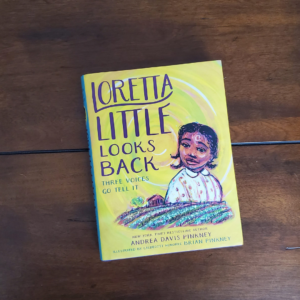 Aggie Little is the only child of Roly and Tess. She is trying to change things in Mississippi in the 1960s, which were still the hardest years ever for the African-American communities, especially in the South. She has a powerful mindset, and she fights against suppression and inequality. Aggie's story takes place from 1962 to 1968.
I have to say that each of the Littles are very different from each other, partially by the different time frames and also by the way that they are each talking and telling their stories. Each of the Littles' stories are great in their own way. I learned much from each of them and what they have gone through in their lifetime. This is a unique way of telling this story.
Four Stars
Loretta Little Looks Back by Andrea Davis Pinkney is the first book I read by this author. Ms. Pinkey is a good author that can weave a tale that transports you to another time. She did a great job of weaving these stories into a way to teach young kids what the Southern African-American communities have been through in history. I am giving this book four stars, and I recommend it to anyone who wants to learn a bit more about our nation's history.
Thank you for dropping by! I hope you enjoyed this review of Loretta Little Looks Back by Andrea Davis Pinkney.
Until the next time,

Happy Reading!
This review was originally posted on Baroness' Book Trove
Can the Littles make a difference?
Loretta Little
Loretta Little is the last Little girl born in the early 1900s. She was the baby of the family and being raised as well as she could with what was happening to the African-Americans back in the day. Retta had a tough time, though. She had to work in the cotton fields when she wasn't in school; really, Retta had to quit going to school to help her family get by. I really like Retta; she is a strong character who gave up her dreams to survive. Retta tells her story from 1927 to 1930.
A lot was going wrong with what had to happen back in those days to African-Americans, but it is our history as a nation. The unfairness of the time and the way these people were treated truly upset me.
Rollins "Roly" Little
Roly is a "Night-Deep" child. Meaning his own mother and father left him in a cotton field since they couldn't afford to raise him. He is the youngest child of the Little family now, and he tries his hardest to help his family. Roly has helped them with their own plot of land in Ruleville, Mississippi, where they grew everything they possibly can. He was a smart child, especially to the standards set back then.
He ended up getting married to a girl there named Tess, and they were okay. Roly tried his best with what he could do in the role that he was born into. His story is told from 1942 to 1950.
Aggie Little
Aggie Little is the only child of Roly and Tess. She is trying to change things in Mississippi in the 1960s, which were still the hardest years ever for the African-American communities, especially in the South. She has a powerful mindset, and she fights against suppression and inequality. Aggie's story takes place from 1962 to 1968.I have to say that each of the Littles are very different from each other, partially by the different time frames and also by the way that they are each talking and telling their stories. Each of the Littles' stories are great in their own way. I learned much from each of them and what they have gone through in their lifetime. This is a unique way of telling this story.
Four Stars
Loretta Little Looks Back by Andrea Davis Pinkney is the first book I read by this author. Ms. Pinkey is a good author that can weave a tale that transports you to another time. She did a great job of weaving these stories into a way to teach young kids what the Southern African-American communities have been through in history. I am giving this book four stars, and I recommend it to anyone who wants to learn a bit more about our nation's history.
Thank you for dropping by! I hope you enjoyed this review of Loretta Little Looks Back by Andrea Davis Pinkney.
Until the next time,
Happy Reading!
This review was originally posted on Baroness' Book Trove
January 5, 2021
Three monologues from three generations, spanning from 1927 to 1968, tell the story of living as a sharecropper under Jim Crow laws in the heart of Mississippi. The pain, the struggle and the cruelty perpetrated upon Black Americans is richly told with vivid, historically accurate detail, but sensitivity for middle school readers. Though aimed to a middle school audience, this story will resonate with ALL readers.
The first monologue is that of Loretta Little the youngest of three girls born into a loving sharecropping family, whose mother passed while still an infant. Raised by her father and two older sisters, her story is one of determination and will, despite the roadblocks placed by a culture that is determined to marginalize and maintain their superiority and control. Loretta, while working in the fields, hears the cry of a baby. Left in the fields, called a Night Deep baby, the child will become a part of the Little family, raised by Loretta and her sisters who name him Roland, in memory of their mother's maiden name.
The second monologue is that of Roland, called Roly for short. He is raised with love, but also the hardships of a sharecropper's life. He is tasked with cultivating the land that Loretta and her sisters scrimped and saved to buy. He meets, falls in love, and marries Tess, who brings Roly a daughter named Aggie. But the farm life isn't for Tess and she leaves for a better life up North. Aggie will be raised by her father and aunts. Roly is a gifted cultivator who's talents make the land and livestock prosperous, only to have those that do not want to see Blacks prosper, poison the land and livestock. Roly is a man of conviction but short on words. He doesn't want to disturb the rules set by whites as he has seen the consequences of doing so.
The third monologue is that of Aggie. Aggie is headstrong, and holds nothing back. She will not be controlled. She works her share on the farm, but she has higher aspirations. She seeks equality. She seeks to have America live up to its promises. At a local meeting to assist Blacks in exercising their right to vote, she immediately volunteers, bringing her Aunt Loretta with her. Roly is against their call to action but he cannot stop the headstrong women in his life. Loretta, Aggie and others are beaten and humiliated for trying to exercise this basic American right. Every roadblock possible is put in their way, but Aggie and Loretta will not be deterred.
The story is detailed and does not hold back on the atrocities suffered by Black Americans for exercising their civil rights. The reader should come away with a better understanding of the past and the reasons for the present. Important background information is provided as well as additional resources. The book will provide excellent background and understanding of an aspect of American history that is rarely taught. Another important work, and a necessity for all school libraries.
The first monologue is that of Loretta Little the youngest of three girls born into a loving sharecropping family, whose mother passed while still an infant. Raised by her father and two older sisters, her story is one of determination and will, despite the roadblocks placed by a culture that is determined to marginalize and maintain their superiority and control. Loretta, while working in the fields, hears the cry of a baby. Left in the fields, called a Night Deep baby, the child will become a part of the Little family, raised by Loretta and her sisters who name him Roland, in memory of their mother's maiden name.
The second monologue is that of Roland, called Roly for short. He is raised with love, but also the hardships of a sharecropper's life. He is tasked with cultivating the land that Loretta and her sisters scrimped and saved to buy. He meets, falls in love, and marries Tess, who brings Roly a daughter named Aggie. But the farm life isn't for Tess and she leaves for a better life up North. Aggie will be raised by her father and aunts. Roly is a gifted cultivator who's talents make the land and livestock prosperous, only to have those that do not want to see Blacks prosper, poison the land and livestock. Roly is a man of conviction but short on words. He doesn't want to disturb the rules set by whites as he has seen the consequences of doing so.
The third monologue is that of Aggie. Aggie is headstrong, and holds nothing back. She will not be controlled. She works her share on the farm, but she has higher aspirations. She seeks equality. She seeks to have America live up to its promises. At a local meeting to assist Blacks in exercising their right to vote, she immediately volunteers, bringing her Aunt Loretta with her. Roly is against their call to action but he cannot stop the headstrong women in his life. Loretta, Aggie and others are beaten and humiliated for trying to exercise this basic American right. Every roadblock possible is put in their way, but Aggie and Loretta will not be deterred.
The story is detailed and does not hold back on the atrocities suffered by Black Americans for exercising their civil rights. The reader should come away with a better understanding of the past and the reasons for the present. Important background information is provided as well as additional resources. The book will provide excellent background and understanding of an aspect of American history that is rarely taught. Another important work, and a necessity for all school libraries.
November 9, 2020
Source: received a copy from the publisher in exchange for an honest review
Loretta Little Looks Back is a moving account of one family’s history from sharecropping to mobilizing to help people register to vote. Spanning the years from 1927-1968, it begins with Loretta’s account of picking cotton and ends with her niece Aggie B’s experiences with SNCC and the Civil Rights Movement. Bridging their stories is Loretta’s brother Roly, a boy who likes to move slowly and take his time. His daughter’s boldness, however, will show him that, sometimes, the time to take action is now. Told in a multimedia format with spoken word poetry, first-person narratives inspired by oral history, and stage directions, Loretta Little Looks Back is an immersive story that asks the readers to sit back, listen, and learn.
The narration is one of the most powerful elements of the book, bringing Loretta, Roly, and Aggie B’s stories to life through their distinctive voices. Each one gives their own perspective on how racism affects their lives, from Loretta’s days spent picking cotton for a man who never honors his agreements to Roly’s inability to make his farm successful, due to vengeful neighbors, to Aggie’s determination that unjust laws will not stop her from registering her family and friends to vote. Though they face many hardships, each one perseveres in the best way they know how, ultimately making the story one of hope and personal triumph. Readers will be inspired the characters’ strength and determination, as well as their love and care for one another.
Andrea Davis Pinkey presents an important story that focuses on a little-taught moment of U.S. history, the Jim Crow era. Readers of historical fiction will want to pick up this book to learn more about the lives of Black Americans during this time period. The end note explains that the book is based on real events, inspired by interviews and oral histories given about individuals’ experiences under the sharecropping system. References to real historical figures and events add to the educational aspect of the work. Readers who want to know more about these figures can refer to the end matter, which includes several historical notes as well as a bibliography for further reading.
Loretta Little Looks Back delivers a unique reading experience that will draw readers into Loretta, Roly, and Aggie B’s story. The heartbreak of living under a system designed to keep them down is palpable in their words, but so are their everyday delights and triumphs. Readers searching for a historical fiction sure to have an impact will want to pick up Andrea Davis Pinkey’s work.
Loretta Little Looks Back is a moving account of one family’s history from sharecropping to mobilizing to help people register to vote. Spanning the years from 1927-1968, it begins with Loretta’s account of picking cotton and ends with her niece Aggie B’s experiences with SNCC and the Civil Rights Movement. Bridging their stories is Loretta’s brother Roly, a boy who likes to move slowly and take his time. His daughter’s boldness, however, will show him that, sometimes, the time to take action is now. Told in a multimedia format with spoken word poetry, first-person narratives inspired by oral history, and stage directions, Loretta Little Looks Back is an immersive story that asks the readers to sit back, listen, and learn.
The narration is one of the most powerful elements of the book, bringing Loretta, Roly, and Aggie B’s stories to life through their distinctive voices. Each one gives their own perspective on how racism affects their lives, from Loretta’s days spent picking cotton for a man who never honors his agreements to Roly’s inability to make his farm successful, due to vengeful neighbors, to Aggie’s determination that unjust laws will not stop her from registering her family and friends to vote. Though they face many hardships, each one perseveres in the best way they know how, ultimately making the story one of hope and personal triumph. Readers will be inspired the characters’ strength and determination, as well as their love and care for one another.
Andrea Davis Pinkey presents an important story that focuses on a little-taught moment of U.S. history, the Jim Crow era. Readers of historical fiction will want to pick up this book to learn more about the lives of Black Americans during this time period. The end note explains that the book is based on real events, inspired by interviews and oral histories given about individuals’ experiences under the sharecropping system. References to real historical figures and events add to the educational aspect of the work. Readers who want to know more about these figures can refer to the end matter, which includes several historical notes as well as a bibliography for further reading.
Loretta Little Looks Back delivers a unique reading experience that will draw readers into Loretta, Roly, and Aggie B’s story. The heartbreak of living under a system designed to keep them down is palpable in their words, but so are their everyday delights and triumphs. Readers searching for a historical fiction sure to have an impact will want to pick up Andrea Davis Pinkey’s work.

December 18, 2020
This novel offers first-person monologues from three generations of a Black family from Mississippi. They are a sharecropper family, caught in the aftermath of slavery and the cycle of poverty that resulted. Starting in 1927, Loretta tells the story of growing up picking cotton on land her family did not own. Her loving father died from exposure to the pesticides they sprayed in the fields. He gave her sapphire socks made with his own hands and she placed her other most valuable possession inside them, a marble that glowed like the sun. Loretta found Roly left outside as an infant. He grew into a boy who had a way with plants and animals. When the family got their own plot of land, they were attacked at night by someone who brutalized their animals, killing most of them, and poisoned their land. Roly slept out in the fields, hoping to draw the poison out and return the land to fertility. Then he caught the eye of Tess, a girl who he eventually married and had a daughter with. Aggie was that daughter, a girl who would not back down, much as her father would not make a hasty decision. Aggie fought for the right to vote even when she was not old enough to. She and Loretta worked together to pass the racist voting test and then to pay the toll tax. Beaten by police, Aggie finds comfort in the sapphire socks and the glow of the marble passed down to her. Just like the others in her family, she never stopped and never gave up.
Told in three distinct voices that speak directly to the reader, this novel takes a direct look at the systemic racism that has created such privilege for some and injustice for others. The use of monologues is brilliant, as the voices come through to the reader with real clarity, each speaking from their personal experience and from history. There is a sense of theater to the entire novel, helped by the introduction to each chapter that give stage directions and offers a visualization of how this would appear on stage. Often these are haunting images, transformative and full of magical realism.
The three characters are marvelously individual, each with their own approach to life, each facing daunting challenges and each ready to take those on, though in their own way. It is telling that as each new generation entered to become the new main narrator, I felt a sense of loss as the other moved off stage, since each was such a compelling character and each had more to share. I was pleased to see they stayed as part of one another’s stories all the way to the end of the novel.
Incredible writing, important civil right history, and a brilliant cast of characters make this novel glow. Appropriate for ages 9-12.
Told in three distinct voices that speak directly to the reader, this novel takes a direct look at the systemic racism that has created such privilege for some and injustice for others. The use of monologues is brilliant, as the voices come through to the reader with real clarity, each speaking from their personal experience and from history. There is a sense of theater to the entire novel, helped by the introduction to each chapter that give stage directions and offers a visualization of how this would appear on stage. Often these are haunting images, transformative and full of magical realism.
The three characters are marvelously individual, each with their own approach to life, each facing daunting challenges and each ready to take those on, though in their own way. It is telling that as each new generation entered to become the new main narrator, I felt a sense of loss as the other moved off stage, since each was such a compelling character and each had more to share. I was pleased to see they stayed as part of one another’s stories all the way to the end of the novel.
Incredible writing, important civil right history, and a brilliant cast of characters make this novel glow. Appropriate for ages 9-12.

January 22, 2022
A young woman, her found younger brother, and his daughter take turns narrating family history. The setup is a series of monologues, complete with scene setting at the beginning of each one. The rhythm of each voice is different, but all speak to the same challenging truths in U.S. history: the land of the free has long been limited.
'Retta is the first voice, she's a young girl when first diagnosed with Multiple Sclerosis (a note on the back puts this medical condition in historical context). Before that, she was a strong and confident helper on the farm, along with her two sisters. But even after her physical handicaps appear, she remains a strong rock for the household. Roly (Rollins) is the second voice. Found in a field at dark and promptly adopted by 'Retta and her sisters, his slow and methodical way of life brings both difficulty and advantage. Roly married young and is left with a young daughter when his wife Tess gets carried away by big dreams. Roly and Aggie B muddle through, working and living with 'Retta until one day, SNCC appears.
Aggie B has the last say, and is the one most disrupted by historical explanations. At twelve, Aggie B is captivated by the voter registration movement in the '60s, and she and Aunt 'Retta go on a quest to vote. I love that Fannie Lou Hamer appears here, but I didn't find that the historical context seamlessly fit into Aggie B's narrative. It added a lot of necessary information, but the reading experience became rather burdened with it.
Through all three voices, the thread of family and ties to home are strong. The book makes a powerful case for both leaving an abusive situation to follow your dreams, and staying to help make things better. Tess leaves Mississippi to get an education and equip herself for life while 'Retta and Aggie B work hard to make Mississippi a better and more just place to live.
A delightful family story and history lesson rolled into one, built in such a way as to encourage reading each piece aloud.
Part of the Read Across America Challenge 2021-2022: Explore Families and History.
'Retta is the first voice, she's a young girl when first diagnosed with Multiple Sclerosis (a note on the back puts this medical condition in historical context). Before that, she was a strong and confident helper on the farm, along with her two sisters. But even after her physical handicaps appear, she remains a strong rock for the household. Roly (Rollins) is the second voice. Found in a field at dark and promptly adopted by 'Retta and her sisters, his slow and methodical way of life brings both difficulty and advantage. Roly married young and is left with a young daughter when his wife Tess gets carried away by big dreams. Roly and Aggie B muddle through, working and living with 'Retta until one day, SNCC appears.
Aggie B has the last say, and is the one most disrupted by historical explanations. At twelve, Aggie B is captivated by the voter registration movement in the '60s, and she and Aunt 'Retta go on a quest to vote. I love that Fannie Lou Hamer appears here, but I didn't find that the historical context seamlessly fit into Aggie B's narrative. It added a lot of necessary information, but the reading experience became rather burdened with it.
Through all three voices, the thread of family and ties to home are strong. The book makes a powerful case for both leaving an abusive situation to follow your dreams, and staying to help make things better. Tess leaves Mississippi to get an education and equip herself for life while 'Retta and Aggie B work hard to make Mississippi a better and more just place to live.
A delightful family story and history lesson rolled into one, built in such a way as to encourage reading each piece aloud.
Part of the Read Across America Challenge 2021-2022: Explore Families and History.

March 16, 2024
This book, based on first-person interviews and archival research, takes readers inside the lives of three generations of ordinary Mississippi citizens from 1927 to 1968. Much of the story is written in vignettes or monologues that could easily be adapted for classroom or community performance. This technique is particularly effective in elevating the voices of the three characters and allowing readers to put on their shoes for a time so that they can experience vicariously Jim Crow, the injustices of the time period as well as efforts to make a change through voter registration and delegation recognition at two different Democratic Conventions. The author captures these voices beautifully, and even though they are fictional characters, it's easy to see how much of them is based on actual individuals who lived during this time period. There are also songs, folklore, letters, and news reports. The Littles live on a farm in the rural part of the state where Loretta Little, the first character to speak, joins her family members picking cotton and trying to survive as sharecroppers. Roly, the next speaker, keeps the family farm going even when others become jealous and try to destroy what the Littles have amassed. Aggie B., the third speaker, is the child of Roly and Tess Coles, who leaves the town to find a better life somewhere else. Against all the odds, Aggie and 'Retta, who has Multiple Sclerosis, join the fight for civil rights even while being aware of the heavy price that may be exacted on them and others for daring to stand up against an unfair system. Pinkney's words are lyrical, hypnotic, deeply engaging, and empathetic as she tells a story that is often harsh, sometimes joyous but also ultimately hopeful. There are many ways to approach the civil rights movement and the years preceding it, but this one, firmly rooted in family history and the oral tradition, is particularly compelling and essential for anyone trying to understand part of Black history and how our nation reached its current status. The text is ably supported with lovely artwork, created with paint, ink, and Japanese sumi brushes. It will be difficult for readers to finish this book without having the urge to go tell the story to others.

December 1, 2020
Loretta, Roly, and Aggie were three generations of a Black family who lived in the American south in the early 20th century. They each had different perspectives on their lives, which they tell in their monologues in each part of this book. Loretta lived with her father and two sisters, on a farm where they picked cotton. They weren’t officially slaves, but they were often treated as if they were. One day, Loretta and her sisters found a baby in a field, who became their brother Roly. During Roly’s childhood, they were able to buy their own piece of land. When Roly got older, he married and had a daughter named Aggie. His wife left when Aggie was a newborn, leaving Aggie in the care of Roly and Loretta. Aggie grew up in the 1960s, so she had a completely different perspective on the world than her older relatives.
Most of the stories that I’ve read about slaves or their ancestors have been for adults, so I loved that this one was for children. There were some tough scenes, such as when Loretta’s father was insulted by his boss or when their farm was attacked just because they were Black. These are important parts of history that need to be taught to everyone.
Even though these three storytellers were from the same family, they had different perspectives on the world. Loretta had seen her father suffer, and she had suffered herself while picking cotton. Roly was just a few years younger than her but he had a different upbringing. He had a more comfortable life, looking after the animals on their farm, and he wasn’t interested in moving higher in the world. Loretta was inspired by the civil rights movement of the 60s and wanted to make a change in the world. Though they were from the same family and lived in the same place, the time period that they were living in changed the way they viewed the world.
This is a beautiful and important children’s book.
Thank you Little, Brown Books for Young Readers and Wunderkind PR for providing a copy of this book in exchange for an honest review.
Most of the stories that I’ve read about slaves or their ancestors have been for adults, so I loved that this one was for children. There were some tough scenes, such as when Loretta’s father was insulted by his boss or when their farm was attacked just because they were Black. These are important parts of history that need to be taught to everyone.
Even though these three storytellers were from the same family, they had different perspectives on the world. Loretta had seen her father suffer, and she had suffered herself while picking cotton. Roly was just a few years younger than her but he had a different upbringing. He had a more comfortable life, looking after the animals on their farm, and he wasn’t interested in moving higher in the world. Loretta was inspired by the civil rights movement of the 60s and wanted to make a change in the world. Though they were from the same family and lived in the same place, the time period that they were living in changed the way they viewed the world.
This is a beautiful and important children’s book.
Thank you Little, Brown Books for Young Readers and Wunderkind PR for providing a copy of this book in exchange for an honest review.
October 7, 2020
This book was so moving, touching, and heavily emphasized the importance of defying against the odds, having family’s love and support, and doing what’s right!
•The Little Family are Black sharecroppers (tenant farmers who give a part of each crop as rent) who live in the rural South, more specifically, in Mississippi. The three collections of stories told from members of the Little family needs to be read! From learning about how for Black sharecroppers in the south, during that time, sharecropping was still a form of slavery, to learning about the importance of how these organizations and their members fought for their right to vote, a seat at the table, and for civil rights!
•It’s amazing how during today’s climate of making sure people are registered to vote, knowing the power of EVERY SINGLE VOTE, tackling voter suppression and disenfranchisement, that I read Loretta Little Looks Back!
•Being a Black woman, I sometimes forget how blessed I am to be able to vote today!
•But while reading this book, I am painfully reminded of the sacrifices, disenfranchisement, hardships, brutality, and plain foolishness that organizations (i.e Student Nonviolent Coordinating Committee and the Mississippi Freedom Democratic Party) and its members had to go through to gain the right to vote and for civil rights in America!
•Everyone (especially people who reside in the U.S) needs to read Loretta Little Looks Back: Three Voices Go Tell It! The history of Black families, specifically Black sharecroppers and civil rights activists in the south who fought for civil rights and the right to vote; needs to be read, shared, and talked about!!!
•don't forget to VOTE! VOTE! VOTE!
•Thank you @hearourvoicestours and @littlebrownyoungreaders for allowing me the opportunity to read this book and the e-ARC.
•The Little Family are Black sharecroppers (tenant farmers who give a part of each crop as rent) who live in the rural South, more specifically, in Mississippi. The three collections of stories told from members of the Little family needs to be read! From learning about how for Black sharecroppers in the south, during that time, sharecropping was still a form of slavery, to learning about the importance of how these organizations and their members fought for their right to vote, a seat at the table, and for civil rights!
•It’s amazing how during today’s climate of making sure people are registered to vote, knowing the power of EVERY SINGLE VOTE, tackling voter suppression and disenfranchisement, that I read Loretta Little Looks Back!
•Being a Black woman, I sometimes forget how blessed I am to be able to vote today!
•But while reading this book, I am painfully reminded of the sacrifices, disenfranchisement, hardships, brutality, and plain foolishness that organizations (i.e Student Nonviolent Coordinating Committee and the Mississippi Freedom Democratic Party) and its members had to go through to gain the right to vote and for civil rights in America!
•Everyone (especially people who reside in the U.S) needs to read Loretta Little Looks Back: Three Voices Go Tell It! The history of Black families, specifically Black sharecroppers and civil rights activists in the south who fought for civil rights and the right to vote; needs to be read, shared, and talked about!!!
•don't forget to VOTE! VOTE! VOTE!
•Thank you @hearourvoicestours and @littlebrownyoungreaders for allowing me the opportunity to read this book and the e-ARC.
September 27, 2020
This book is inspirational and a must read. This book told among monologue voices from families back in the 1920’s through the 1960’s. The monologue is told by 3 voices who are the main characters in this book... Loretta (Retta), Roland (Roly), and Aggie B. All the characters share their own recollections of what the have experienced while growing up during the time of sharecroppers, discrimination, walking on egg shells, and fighting for the right to vote. All I can say is that when you read this book you must read it with conviction, attitude, feeling, and friends. I enjoyed every single minute reading this book because it also makes me remember how my family was down south in a small town in Moultrie, Georgia and how they were also sharecroppers working in the hot sun to make ends meet and still was ripped off because the pay was ridiculous. Also they worked their butts off to own their own land then soon enough someone ends up taking it away due to jealousy and hate. Once again this book is a must read and I recommend it to everyone to read it.

September 30, 2020
Welcome to another book review! Thank you to hearourvoicestours for the opportunity to review an advanced copy of Loretta Little Looks Back. This book is a glimpse into African American history from share-cropping to the civil rights movement. The three separate stories weave themselves into a journey that’s breathtaking.
I loved the writing style of this book. Oral storytelling is a significant part of Black history. It’s how our stories were passed down from generation to generation. This book exemplified that tradition. Each piece of the story reads as of its being told to you by a family member. The other striking part of the book is that each character’s feelings and experiences leap off the page. The racism, the struggles, the triumphs, they are all described so richly that it’s like you’re experiencing them for yourself. It makes for an emotional, but amazing read. This is a story you won’t want to miss. I can’t forget about the illustrations! They were so cute. Honestly, I think I’m order to appreciate the story, you have to read it for yourself.
I loved the writing style of this book. Oral storytelling is a significant part of Black history. It’s how our stories were passed down from generation to generation. This book exemplified that tradition. Each piece of the story reads as of its being told to you by a family member. The other striking part of the book is that each character’s feelings and experiences leap off the page. The racism, the struggles, the triumphs, they are all described so richly that it’s like you’re experiencing them for yourself. It makes for an emotional, but amazing read. This is a story you won’t want to miss. I can’t forget about the illustrations! They were so cute. Honestly, I think I’m order to appreciate the story, you have to read it for yourself.

January 21, 2021
Why this book isn't on everyone's Newbery short list is utterly beyond me.
It's gorgeous. It's Andrea Davis Pinkney and Brian Pinkney so of course it's gorgeous. And well researched. To take it up a notch, it's written in what I think might be an entirely new storytelling format rooted in Black oral storytelling history: monologues. Three characters in this family each take turns telling a series of monologues that show this family's journey from sharecropping in the 1920s through fighting for the right to vote the 1960s. Family legacy is passed from person to person and each teller gets to take center stage and tell this in their own way. I'd love to see it performed but it would also make an excellent read-aloud or readers theater, as well as being mesmerizing (and fast!) to read. I want to put this right at the top of everyone's antiracist reading list. People should be talking more about this book. I'm hoping it gets the awards love it deserves.
It's gorgeous. It's Andrea Davis Pinkney and Brian Pinkney so of course it's gorgeous. And well researched. To take it up a notch, it's written in what I think might be an entirely new storytelling format rooted in Black oral storytelling history: monologues. Three characters in this family each take turns telling a series of monologues that show this family's journey from sharecropping in the 1920s through fighting for the right to vote the 1960s. Family legacy is passed from person to person and each teller gets to take center stage and tell this in their own way. I'd love to see it performed but it would also make an excellent read-aloud or readers theater, as well as being mesmerizing (and fast!) to read. I want to put this right at the top of everyone's antiracist reading list. People should be talking more about this book. I'm hoping it gets the awards love it deserves.

September 28, 2020
The book is considered a 'monologue novel,' where the form is very much a dramatic style. Because of this, I was easily able to envision the different moments throughout the book. It's an interesting way to tell a generational story that definitely felt like a passage of time was happening as we went from family member to family member. As both a thespian and a writer (and even a reader), I can always appreciate when theatrical stylistic choices are made within a book and add to the intentionality of the novel. There were several times throughout this novel where I thought to myself 'wow, directing this would be awesome,' and that rarely ever happens to me. The writing was beautiful but still accessible for the target audience. There were quite a few moments where lyrical and poetic. These moments stood as bridge passages welcoming us into a new person's narrative or bidding us farewell. I found myself rereading certain passages to better absorb and appreciate the information.

December 27, 2020
Read for the Mock Caldecott Awards voting in January. This was wonderful although it really does not have that many illustrations so I'm not sure it should be included in the Mock Caldecott voting. I enjoyed what illustrations there were but they would certainly not tell the story on their own. The story is told in 3 generational voices. Loretta (Etta) Little begins the book with her story of growing up picking cotton and realizing what slave life was all about. The story continues with Roly, Etta's little brother becoming a man and starting a family, finally Aggie B., Roly's daughter, and how she helped to fight for their right to vote. The voices and grammar of the narrators are so authentic that I could practically "hear" them. Just an inspirational read aimed at middle graders but wonderful for all ages beyond.

January 18, 2021
This is a really beautiful book due in part to the beautiful illustrations, but mainly the style of writing and the story told created such an intimate and personal experience. I picked this book up on recommendation from Bookish Realm, and honestly, if you have kids or know kids you should read this with them! The style of writing made the book very approachable, while covering some very emotional and important topics. I don't know much about sharecropping and originally picked it up to learn more about that experience, but I loved that this intergenerational saga covered not just the immediate impacts of sharecropping but how it impacts a family over time. Plus the discussion of voting rights and the awful things that were done to stop black people from voting was so important. I can't say enough good things about this book.

April 21, 2021
Love how this book uses three voices of three generations of one family to tell their saga. Full of real historical references, the book offers entry into learning about Black History. The story offers plenty of research options to learn more. The monologue format works perfectly. In fact, the author explains at the end of the book that her intent was a "page to stage approach." Yes! I would love to see this performed.
Each chapter begins with a brief "where and when" description (a sentence or two) to set the scene, and then the narrators draw us into the scene with strong voices. A few pages of verse scattered throughout the book can act as a chorus. 'Retta and Aggie B are forces to be reckoned with, and they were surely inspire other young girls and women to find their voices as well. This is the first book I have read by this author, but I will definitely read more!
Each chapter begins with a brief "where and when" description (a sentence or two) to set the scene, and then the narrators draw us into the scene with strong voices. A few pages of verse scattered throughout the book can act as a chorus. 'Retta and Aggie B are forces to be reckoned with, and they were surely inspire other young girls and women to find their voices as well. This is the first book I have read by this author, but I will definitely read more!
Displaying 1 - 30 of 91 reviews