From the award-winning creators Neil Gaiman and Colleen Doran comes a stunning new graphic novel.An elderly widow buys what turns out to be the Holy Grail from a second-hand shop, setting her off on an epic adventure with a knight who brings her gifts of ancient relics in hope of winning the cup.From the Eisner and Bram Stoker-award winning team of Snow, Glass, Apples comes a delightfully humorous and charming new graphic novel adaptation.---'Like Ray Bradbury before him, [Neil Gaiman] writes lovely little horror stories, fairy tales and fantasies which are as familiar as they are fabulous, stories that are never quite what the reader expects...' A.V. CLUB'A combination of a superb script, with Gaiman at his evocative, inventive best, and masterful artwork from Doran' STARBURST on Snow, Glass, Apples
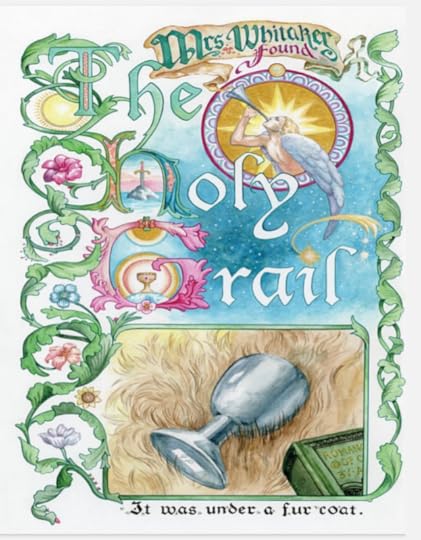
“Mrs. Whitaker found the Holy Grail; it was under a fur coat.”
A charming adaptation of a Neil Gaiman story by the team that brought us "Snow, Glass, Apples," which is to say the iconic comics legend Colleen Doran gets credit for this version, trying a very different, and classical style. The idea is that a woman finds the Holy Grail in a shop, and soon after, a dreamy knight on a white horse asks her for it. No dice; she likes it, so he hangs around, helps her around the house, gives rides on the horse to neighborhood kids, and offers her other mythical/mystical objects in exchange.
One object she turns down, surprisingly (to me) as it offers her the chance to try to change her life, but I liked the choice for the surprise, and I also liked the punchline in the end, when she finds another magical object in the shop.
Lovely. The art fits the story, and Mrs. Whitaker in particular. Doran speaks of the project here:
“I’ve wanted to do an adaptation of Neil Gaiman’s ‘Chivalry’ ever since he sent a draft of the story to me at about 1 AM via fax machine decades ago,” Colleen Doran said in a statement. “It is one of Neil’s loveliest, most charming stories, and I cried with happiness when I learned I would get to do the adaptation. I wear my art on my sleeve throughout, bringing Golden Age illustration styles and Illuminated Manuscript studies to the work. It’s a Holy Grail project for me. I sincerely hope it brings joy to people.”
According to the artist Colleen Doran, she had to wait 25 years before she could finally get to adapt this Gaiman short story. And I'm so happy she held on.
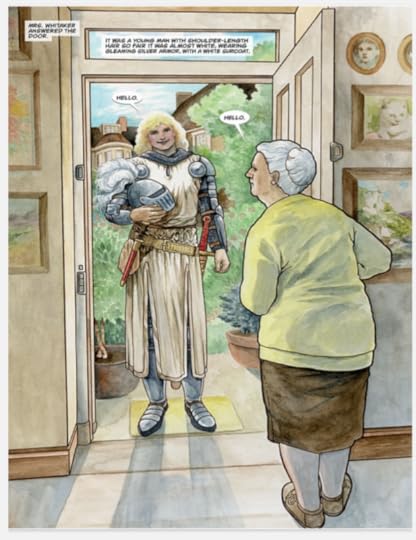
An old lady buys the Holy Grail at a second-hand shop and puts it on her mantelpiece. Then Sir Galahad visits her, on his quest for the Holy Grail, to persuade her to give him the cup. She's is not easily persuaded.
It feels like a comic from Gaiman's time at Vertigo - a lovely, gentle, very smart story full of humour. Doran's art is fantastic, taking middle ages manuscripts as a stylistic source. And it's fantastic.
Highly recommended.
(Thanks to Dark Horse Books for providing me with an ARC through Edelweiss)
Listened to LeVar Burton reading this on his podcast while my roomie and I sat and did our sewing. It's actually a great combo, sewing while listening to someone read out loud to you!
This story was so sweet and gentle and somewhat sad. Definitely worth listening to. "But you don't have to take my word for it!"
(SHAME on Reading Rainbow for suing LeVar over using that phrase! They could have been supportive and gotten more goodwill from it. Instead, money grubbing. Boo!)
Chivalry is a delightful fantasy short story by Neil Gaiman and illustrated by the talented Colleen Doran.
The story itself is simple: an elderly woman discovers the Holy Grail at a second-hand shop and takes it home. A knight comes questing for the grail and she is unwilling to give it up.
Does everything end up happily ever after for everyone in our tale? Read and see...
I loved the artwork of this story. Doran uses beautiful colors to highlight the art. Some of the pages are done like medieval folios, they were my favorite.
In the notes at the end of the book, Doran shares she wanted to make the whole book like an illuminated manuscript but she discovered that was unworkable. The pages she did do in that style are breath taking.
Highly recommended for fantasy and comic book fans.
Another Gaiman short-story adaptation by Colleen Doran. Her first 'Snow, Glass, Apples' was beautiful.
This one keeps up the lovely artwork, but I don't know... I'm not familiar with the Gaiman original and based on this I don't think it would be my cup of tea.
We follow an older woman who buys the Holy Grail from a thrift store. She puts it up on the mantle and likes how it looks there. A knight comes by and wants to trade her for the cup, but she refuses no matter how wondrous the prizes he offers are.
It's a lovely adaptation and I hope Doran keeps doing these.
Chivalry (1992) é um dos meus contos* de eleição e um dos raríssimos exemplos em que, após adaptação, a arte gráfica acompanha, complementa e beneficia a obra literária (claro que a extensão da short story ajuda). De facto, a minha paixão por esta obra é tamanha que, desde que li o conto de Neil Gaiman primeira vez, já o devo ter relido seis ou sete outras vezes - o que, no espaço de uns três/quatro anos, até que não está mal. E assim continuaria não fosse, no ano passado, saber da adaptação de Coleen Doran e, à vista da capa, me render imediatamente. Agora, chegada finalmente a vez de lavar a vista nas magníficas aguarelas que acompanham esta história, aquilo que não pensei poder ser melhorado, acabou de melhorar!
Então, a coisa começa assim: Mrs. Whitaker é uma velhinha viúva e amorosa, fã das lojas Oxfam onde, depois de levantar a sua pensão de todos os meses, vai sempre fazer umas comprinhas. Normalmente, pega em dois ou três romances (apesar de ainda ter livros para ler na cabeceira - quem não...) e sai feliz da vida. Até que, certo dia...
Então, Mrs. Whitaker leva o Graal para casa - e por 30 pence tem uma bonita peça para meter em cima da lareira junto ao cãozinho de louça e à foto do falecido marido, Henry, tirada na praia de Frinton, em 1953. Não muito depois, no entanto, um jovem Galahad chega-lhe à porta numa demanda para recuperar a relíquia, essa relíquia, o Sangrail, o Seint Graal, Sangraal...
Esta historinha adorável, que é um encanto de ler e ver, no entanto, não se fica pela fabulação lendária e oferece múltiplas leituras, dá espaço e voz a personagens fora do comum, e permite ao leitor aceder a um mundo de fantasia e mito sem sofrer o choque de abandonar a realidade e a contemporaneidade. Pelo caminho, lá estão a demanda do herói, as cenas galantes entre o cavaleiro e a donzela, a relíquia e o desafio que se impõe para a sua obtenção. E, claro, umas quantas mensagens interessantes e inteligentes deixadas ao leitor pelo caminho, como migalhinhas de salvação.
Doran, fã de Gaiman e da lenda arturiana, é uma artista de mão cheia que, nesta adaptação, recorre a inspirações diversas e acertadas para fazer nascer uma história de encantar. Usando de uma paleta de cores pastéis que quebra com toques de vermelho e verde, e extraordinários dourados, a ilustradora consegue recuperar a estética dos pré-rafaelitas, a candura de uma Beatrix Potter, o detalhe e delicadeza das iluminuras medievais. E, se mais fosse preciso para mostrar a sua devoção à causa, é interessante perceber que Doran só se atira às aguarelas depois de ter percebido que trabalhar folha de ouro sobre pergaminho era algo de absolutamente impraticável nos nossos dias. Esta graphic novel é uma obra com tanto para onde olhar que, por si só (e não digo isto muitas vezes!) a adaptação já vale a pena. Mas, se prestarmos atenção ao texto que lhe subjaz - e que em nada foi desvirtuado - a experiência não tem como ficar abaixo das cinco estrelas!
*Chivalry faz parte das coletâneas Smoke and Mirrors ou The Neil Gaiman Reader: Selected Fiction.
A charming little graphic novel abou a woman who finds the Holy Grail in a charity shop and ends up befriending a gallant Knight who desperately wants it. It's a story about reflection, loneliness and growing old. The illustrations are absolutely beautiful, very reminiscent of old religious scrolls and bibles and really helps to set this scene and imagery of an epic quest with undertones of whimsy. It left me feeling all warm and fuzzy.
A charming tale of an elderly English widow who finds the Holy Grail in an Oxfam second-hand shop and buys it because, "It'd look nice on the mantelpiece." Soon enough, Sir Galahad shows up in full knight regalia on his steed ready to negotiate an end to his centuries-old quest but finds it difficult to trade for it with something that would look just as nice on the mantelpiece.
Colleen Doran's adaptation of Neil Gaiman's 1992 short story is lushly illustrated.
Neil Gaiman’s books and I don’t always get along, so my reading them is often a struggle between what I dislike about his writing and my desire to enjoy his talent and creativity. The biggest problem I have with him is his self-awareness in the role of writer in which he uses his unique voice within his stories to the point where I just want that voice to quiet down so I can be thoroughly immersed in what I’m reading. Adding to that is a certain cuteness in some of his stories that sets my teeth on edge, though a few I’ve read have been utterly raw, such as The Truth Is a Cave in the Black Mountains.
So how did this graphic novel based on a short story by Gaiman measure up for me? My usual complaints didn’t crop up. It was a fine, quirky story made even better by the extraordinary illustrations that helped convey it, ranging from simple to highly detailed, from pastels to vivid colors. The story is completely tongue-in-cheek as Mrs. Whitaker, a widow with a penchant for second hand romance novels and bargain collectibles, encounters a knick knack she can’t resist—The Holy Grail—which she treats as nothing out of the ordinary, just a nice thing to place on her mantle between a porcelain dog and a framed photo of her late husband. But there is someone who sees it very differently, and he won’t rest until he can convince the widow to part with it, no matter what it takes.
Just don’t expect the story to go wild from there. It is all in good fun, and seemingly like a story you might even read with a child. That is, until it isn’t. Because nothing is ever that simple with Gaiman. There are some really weird elements that crop up late in this story, and in the illustrations, as the reader learns what lies hidden in these characters’ pasts. Oh yes, there’s often that sharp little piece that pokes at the reader and surprises him as he’s chewing on a story by Gaiman. This story is no exception. I’m glad I read it and will cautiously look for more books by him that I might enjoy. But you can be sure I will be careful as I bite down on them.
خود داستان رو که از اونیکی کتاب خونده بودم و گوش داده بودم ولی سری بعد بخوام برم سراغ ورژن گرافیک ناولش از همون اول همراه یا بعد اودیوبوک میرم سراغش چون دوباره خوانی نشه. راجع به طراحی ها به نسبت اینکه کار گیمن رو تصویرسازی کرده زیاده روشن و لطیف بود. البته خود داستان هم خیلی دارک نبود. چندتا پنل(؟ پنل که.. کل صفحهای بودند) اون وسط رو خیلی دوست داشتم و چشم نواز بودند.
Chivalry is the sweet and amusing story of an elderly British widow who buys the Holy Grail in a thrift shop, causing an Arthurian knight to repeatedly show up at her house with ancient relics in hope of trading them for the cup and end his noble quest... but it looks so nice on the mantle!
This tale is charming, and rather special to me. It was included as the first story in the Smoke and Mirrors collection, so it was the very first Neil Gaiman short story I ever read. It's been almost a decade since I picked that book up, but I'm prepared to say that Colleen Doran's illustrations elevates Chivalry even further: She took pains to make it look as much like an illustrated manuscript as possible—this isn't your standard graphic novel adaptation. Many scenes have no dialogue, and the art manages to capture all the unspoken nuances, and the muted watercolors perfectly fit the story's mood. It's truly a stunning piece of work in which you can see how the artist's love for the source material poured onto their pages—easily my favorite Gaiman and Doran collaboration to date, with some interesting insight into her sources and inspirations included in an afterword.
—————
Note: I received an ARC of this book in exchange for an honest review.
A sweet, short like graphic novel about an older British woman named Mrs. Whitaker who discovers the Holy Grail in a shop and brings it home. Soon, the knight Galaad comes to retrieve the Grail, but despite his politeness and gifts initial gifts, Mrs. Whitaker politely refuses. What follows is a magical and sweet tale about an elderly woman reminiscing on her dearly departed husband and a young knight's journey to try and make others happy no matter how small the gesture.
I've never read a Neil Gaiman book before, but his writing here was absolutely brilliant and lovely. The prose is whimsical and fitting for anything related to an Arthurian fairy-tale. Both Mrs. Whitaker and Galaad were just delightful characters. Colleen Doran's artwork with its bright watercolors (I am assuming they're watercolors, I might be wrong) just gives everything that whimsical, happy feeling, even in the sadder moments.
Levar Burton reads this on his podcast. A wee cute little story about a little old lady who finds the holy grail in a thrift store. And doesn't it look nice on the mantel?
Місіс Вітакер знайшла Грааль. Лежав він під шубою у секондгенді. У місіс Вітакер - походи на пошту по пенсію раз на тиждень, хворі ноги, самотнє життя, від якого не лишиться нічого (бо кому ж у сучасному світі знадобляться її порцелянові сервізики на особливі оказії і газетні вирізки, що нагадують усе страшне з її молодості під час Другої світової війни - але й усе прекрасне теж, адже тоді, під час Бліцу, познайомилася з чоловіком, уже покійним), а ще лицар Галахад, який періодично приходить і намагається виміняти на щось Грааль. Місіс Вітакер не хоче вимінювати Грааль, він гарно виглядає на поличці на каміном поруч із порцеляновою собачкою. Цей комікс рекламують як комічну адаптацію оповідання Ніла Геймана, дотепне там справді є, але я явно не чекала, що після нього ридатиму серед ночі, бо це ще й дуже зворушлива історія про честь і гідність усіх маленьких життів. І намальовано казково красиво - подекуди імітує середньовічні ілюстровані манускрипти (RIP верстальникам, яким доведеться це шрифтове безумство адаптувати у перекладі), подекуди ніжні-преніжні акварелі.
A sweet and lovely graphic novel about an elderly woman who unwittingly purchases the holy grail from and secondhand shop. Soon after she arrives home and finds a place for it on her mantel, a knight from the round table pays her a visit. He explains that he is on a quest to find the holy grail and she has it. He tries to get her to give it to him but she doesn't believe him and sends him away. Everyday he comes back with presents to try to win her over. In the meantime, they have tea, he does chores and so on. In the end, they both get what they want in a roundabout way. It was a endearing graphic novel with gorgeous artwork. Another great work from Gaiman!
Another Eisner nominee down. This feels very Gaiman-y. It’s charming and smooth. But it also doesn’t have all that much to say and reminds me of the genie story, where there’s a small twist that either will or will not interest you, and if it doesn’t, it really can’t do anything about it. In this case, for some strange reason, a knight seeking the grail enters present day and tries to entice an old woman who bought it at a second-hand shop type place to part with it. It has some things to say about being content with your life, but it does so in a way that doesn’t have any internal logic or conceit, and that never seems to fly with me. Very nice layout and artwork though.
Mrs. Whitaker, an elderly woman who lives a quiet if slightly lonely life in England is rummaging around a second hand store one day when she happens upon the holy grail.
Its just sitting there on its side under a mangy fur coat.
Deciding it will look lovely on her mantle she buys it for fifty pence, takes it home, and sure enough it does.
Mrs. Whitaker doesn't seem terribly surprised when, a few days later, a handsome, golden haired knight in shining armor on a great steed comes galloping down the street straight from King Arthur's court to promise her the greatest treasures that can he can win for her if only she will give him the grail.
But the grail looks very nice on her mantle and she's not sure she has any interest in giving it up. Perhaps if the knight would help her shift some boxes and help her get the slugs out of her garden?
This is the sort of story the word "charming" was invented for. It's witty and wise and more than a little wistful. I've been of two minds about the various graphic adaptations of Gaiman's work that have been coming out over the last few years but this particular one is tailor made for the gorgeous work of Colleen Doran (who knocks an equally impressive home run straight out of the park with her adaptation of another Gaiman great Snow, Glass, Apples). This graphic novel is, simply put, gorgeous. As the knight fights monsters and tells Mrs. Whitaker the dramatic story of his origins we see the action depicted in beautiful illuminated old world style with fancy calligraphy and language that would have made Malory proud. Then we're whisked gently back to Mrs. Whitaker's quaint, pastel colored kitchen where she puts the kettle on with a wry little smile as she watches the now much more human looking knight helping the local children feed sugar lumps to his horse, adorably named Grizzle.
There's something hilarious but also heartfelt about Mrs. Whitaker's casual acceptance of the truly extraordinary things she finds herself mixed up in. There's nothing at all strange to her about this mysterious, beautiful knight and his quest, he's just a nice young man who needs a bit of looking after. Certainly there might be amazing magical possibilities around every corner but they're no less magical than the simpler, but no less powerful memories she treasures of her long lost husband and the extraordinary love they shared.
Magic is magic after all, no matter the form it takes.
Does the knight earn the grail from its wily keeper? Does Mrs. Whitaker find something else to replace it on her mantle?
I highly, highly recommend finding out, its well worth it.
A sweet typically English story of how an old woman buys The Holy Grail at an Oxfam.
I always liked Oxfam, and Gaiman is so good at cleverly integrating typical elements of modern British culture into this story that is littered with the Arthurian chivalric code. The drawings are beautiful, many pages would lend itself to posters without any editing needed. A very impressive achievement. I wanted a longer story but it was short and sweet.
This was delightful! As much as I love Neil Gaiman's novels, I think he really excels with short pieces like this one. And the narration was excellent, too, as usual.
So so beautiful and such a wonderfully whimsical story! I love Neil Gaiman's stories, and the illustrations are divine and add more sweet whimsy to boot. I read this over and over because it is just so damn delightful!
Makes me want to shop at the second hand stores to find my own bit of magic!
I spotted this on the New Books shelf at our beautiful local library - always a magnet! I hadn’t read the short story but much enjoyed this graphic novel version.
Good to learn something new: although I’ve read CS Lewis’s The Magician’s Nephew a good few times, I always thought the apple featured in it referred to the fruit of the tree in the Garden of Eden - never heard of the apple of the Hesperides.
Also intrigued by the mention of Maresfield and Heathfield- I lived in East Sussex for some years, a few miles away from these villages.
Something Mrs Whitaker should know though - it’s no good throwing the slugs over the garden fence; they home up to 100 yards! Try putting them in the green compost recycling bin for the council to take away, thus giving them a fighting chance before said compost material is macerated! 😁
Lastly, for fans of Grail stories, might I recommend Niedermayer & Hart by MJ Johnson? It’s a cracking yarn! I need though, for the purposes of transparency, to mention that the author is my other half!
This work, an adaptation of one of Neil Gaiman's short stories, follows what happens when Mrs. Whitaker, an elderly English widow, finds the Holy Grail in a charity shop. She's fully aware of what she's found, but she views it as much the same as any other knickknack or other decorative item in her house - it looks nice on the mantelpiece in her parlor. Then she gets a visit from a handsome man in a suit of armor who claims to be Galaad, a knight of the Round Table on a quest to retrieve the Holy Grail.
This was a nice and gentle bit of light fantasy. Galaad offers a few different things in exchange for the Grail, and Mrs. Whitaker provides him with tea and has him help a bit around the house. He and Mrs. Whitaker seem to be the only two people aware that anything magical is going on.
I'd initially passed this by because the medieval manuscript-style cover art didn't really appeal to me. Overall, though, Doran's art was lovely and fit the story well. In particular, I thought the way Doran depicted the effects of one of the apples of the Hesperides was really well done.
What really made this adaptation for me, though, was Colleen Doran's "Notes" section at the end, in which she discussed her love for this story and her initial thoughts about adapting it and the way she revised her ideas. There are also several pages of her pencil sketches, as well as some images of her tests of various real and faux golds. This part really made me wish I could see the original artwork rather than just reproductions.