For transparency, I was given details about this book when it was still early in its planning stages. I backed the Kickstarter, and I was given an advanced look of some of the pages before it went to print.
For more than 10 years, I have taught American women's history, which has always included an academic journey through the Suffrage Movement. Good Girls... is a much-needed and appreciated addition to the bank of resources I have to help students understand the fraught and often violent circumstances that led to women's suffrage. It's a long and complex history, which has often been distilled to a sprinkling of prominent white women.
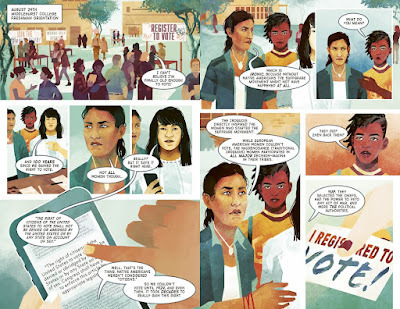
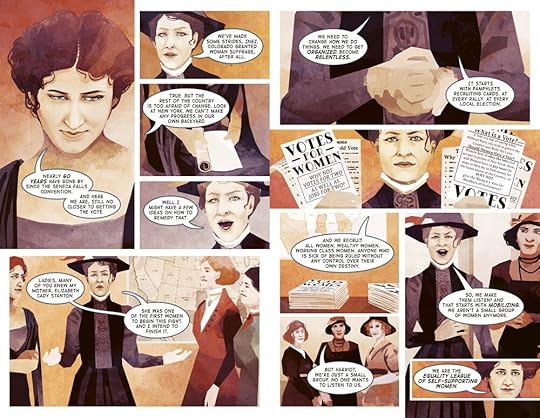
The graphic novel, beautifully illustrated by Micaela Dawn and Mary Sanche, begins in a contemporary time. A mother and daughter (Ava) wait in a long line in order for the mother to cast a ballot. While Ava, somewhat petulantly, bemoans waiting, her mother insists that this is not waiting but doing; it's democracy in action. The reader swiftly is transported to 1840 and the World Anti-Slavery Convention, leading us to feel that Ava's mother is telling the story of how it all began.
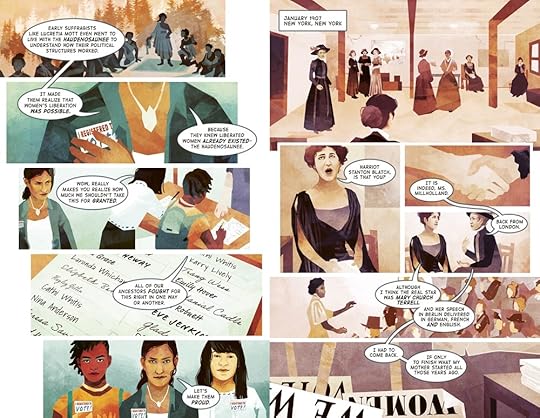
Throughout the book, we bounce between the timelines, making present the events of the past. In the contemporary timeline, other women beyond Ava and her mother discuss suffrage and the institutional impediments that continue to restrict voting rights in the United States of America. The contemporary passages feature diverse and clearly intersectional characters.
The historic sections are not quite as encompassing. Kiehner and Coyle include prominent African Americans involved in the movement: Frederick Douglass, Sojourner Truth, Francis Watkins Harper, Ida B. Wells-Barnett, Bettiola Heloise Fortson, Mary E. Jackson, Mary Church Terrell, and Juno Frankie Pierce. Their visibility here is important, and it's clear that these women, and thousands of others like them, were excluded from the major suffrage organizations and events because of racism.
While I appreciate that there are only so many pages available, I am missing the stories of the Chicana women, like Aurora Lucero and Nina Otero-Warren, who campaigned all over the American West for a national amendment and the necessity of Spanish bilingualism in suffrage-related campaign materials. I am missing the stories of the garment workers, many of them immigrants or first generation Americans, who joined the suffrage movement strategically to create labor laws that would ensure safe working conditions - especially important after the public tragedy of the Triangle Shirtwaist Factory Fire. I am missing the voices of Indigenous women, like Marie Louise Bottineau Baldwin and Zitkala-Sa, who participated in suffrage events while they advocated broadly for Indigenous Rights. (It is important for me to note that there is explicit mention of how early suffragists like Mott learned about Haudenosaunee communities and their egalitarian political infrastructures.)
I know there are too many stories to tell, and many of them don't support the cohesive storyline that's been developed over time. I think Good Girls... is a step in a better, more inclusive direction. The authors and illustrators have been thoughtful and careful in their representations. Nothing is ever painted in rose-colors for the sake of hiding how messy and sometimes destructive the movement was. The conversations between the sections about the past and those in the now are so important; the work is never done. And, those pages depicting contemporary public protests for women's rights make it clear that women of all ages can and should participate in social resistance when injustice persists.
I look forward to using this book in my women's studies classes. It will work wonderfully next to the primary source texts written by many of the women mentioned in the book. I can fill in the gaps for other stories while students get a broad overview of nearly 100 years of history. It'll work great next to something like Katja von Garnier's film Iron Jawed Angels, which focuses on the last 20 years of the movement.
I also will be gifting copies of this to my scholar friends who have interests in women's history and/or graphic novels. The format of the book is so accessible, the illustrations are beautiful, and the prose is clear and purposeful. It's appropriate for children who are learning about civics (I recall learning about Lucretia Mott in 4th grade) and can be an important resource for high schoolers who may feel anxious or apathetic about voting.
In short, I think Good Girls Don't Make History is a fantastic book, and I look forward to sharing it with my students and my friends.