

What do you think?
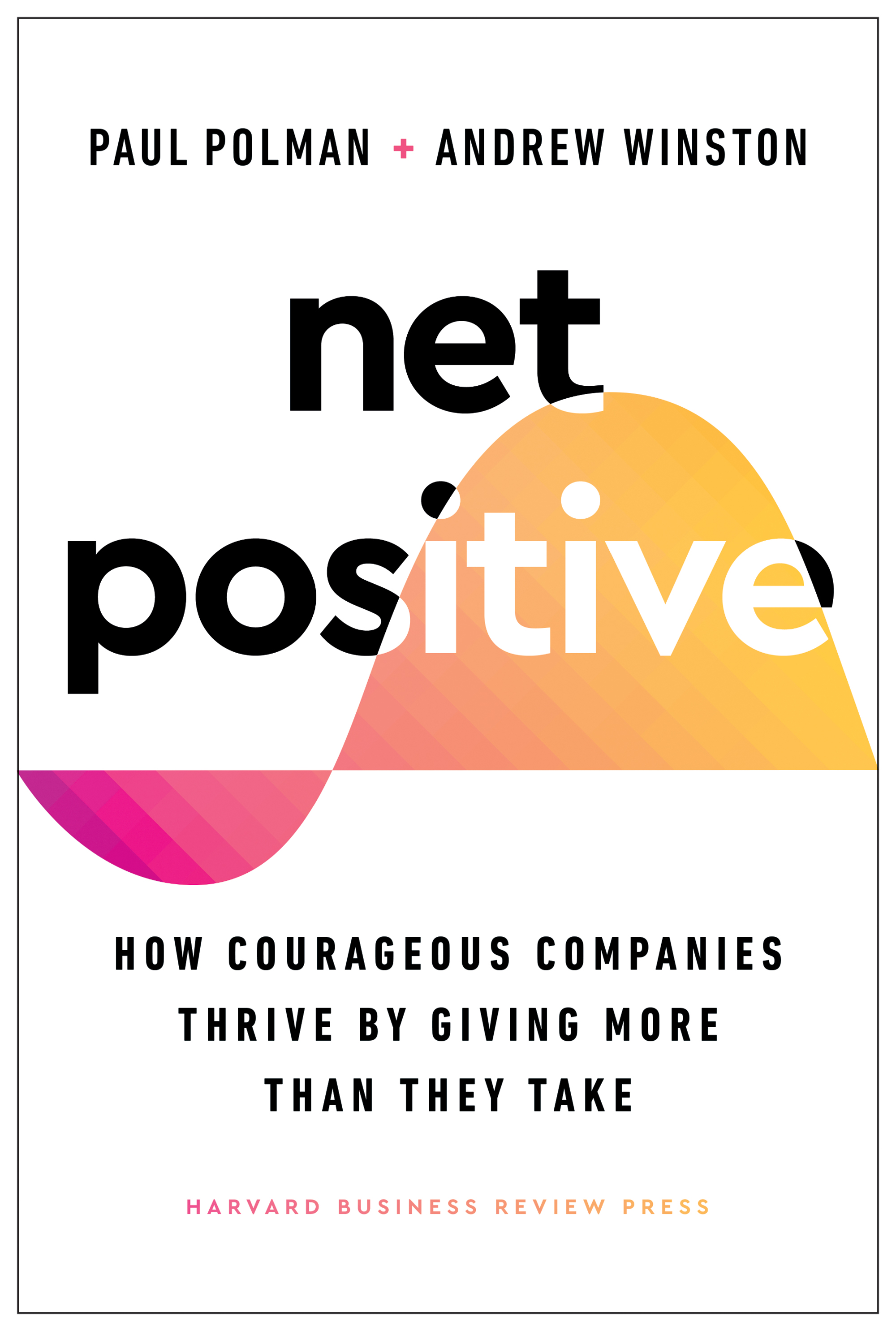
Net Positive: How Courageous Companies Thrive by Giving More Than They Take
These massive dual challenges—and other profound shifts like pandemics, resource constraints, and shrinking biodiversity—threaten our very existence on the planet. Yet division and discord risk undermining our response, just when we need to come together. Global partnership and leadership are lacking, free trade and globalization are under attack, and populism continues to breed intolerance and disruption.
At this critical time in history, the imperative to reimagine our economies and companies could not be more urgent. Fortunately, many in the business community—from large corporations to microenterprises—are helping to solve our most profound challenges by deploying long-term, purpose-led business models that put people and planet first. And they are profiting on this new path with new tools, AI and data-driven transparency, and radical improvements in the economics of clean technologies.
The key question has flipped from Why would you do sustainability? to Why wouldn't you?
In this paradigm-shifting book, former Unilever CEO Paul Polman and sustainable-business guru Andrew Winston provide a model to help leaders build companies that contribute more to the world than they use or take—that is, net positive companies. They bypass the last gasps of denial to show how purpose and profits are inextricably linked and how collective action can deliver the scale of change and transformation the world needs.
Net Positive outlines the principles and practices for surviving and thriving, based on the experience of one world-leading company, Unilever, and other groundbreaking global organizations. This essential book is for leaders, executives, managers, and professionals who want to succeed, but know that winning requires caring deeply about serving the world. Building a net positive company is the key, and this book shows the way.
At this critical time in history, the imperative to reimagine our economies and companies could not be more urgent. Fortunately, many in the business community—from large corporations to microenterprises—are helping to solve our most profound challenges by deploying long-term, purpose-led business models that put people and planet first. And they are profiting on this new path with new tools, AI and data-driven transparency, and radical improvements in the economics of clean technologies.
The key question has flipped from Why would you do sustainability? to Why wouldn't you?
In this paradigm-shifting book, former Unilever CEO Paul Polman and sustainable-business guru Andrew Winston provide a model to help leaders build companies that contribute more to the world than they use or take—that is, net positive companies. They bypass the last gasps of denial to show how purpose and profits are inextricably linked and how collective action can deliver the scale of change and transformation the world needs.
Net Positive outlines the principles and practices for surviving and thriving, based on the experience of one world-leading company, Unilever, and other groundbreaking global organizations. This essential book is for leaders, executives, managers, and professionals who want to succeed, but know that winning requires caring deeply about serving the world. Building a net positive company is the key, and this book shows the way.
256 pages, Hardcover
Published October 5, 2021
Ratings & Reviews
Friends & Following
Create a free account to discover what your friends think of this book!
Community Reviews
Displaying 1 - 30 of 98 reviews

September 21, 2021
In this seminal book, former Unilever CEO Paul Polman and sustainable business guru Andrew Winston explode fifty years of corporate dogma. They reveal, for the first time, key lessons from Unilever and other pioneering companies around the world about how you can profit by fixing the world's problems instead of creating them. To thrive today and tomorrow, they argue, companies must become "net positive"—giving more to the world than they take. A net positive company:
Improves the lives of everyone it touches, from customers and suppliers to employees and communities, greatly increasing long-term shareholder returns in the process.
Takes ownership of all the social and environmental impacts its business model creates. This in turn provides opportunities for innovation, savings, and building a more humane, connected, and purpose-driven culture.
Partners with competitors, civil society, and governments to drive transformative change that no single group or enterprise could deliver alone.
This is no utopian fantasy. Courageous leaders are already making it real—and the stakes couldn't be higher. With bold vision and compelling stories, Net Positive sets out the principles and practices that will deliver the scale of change and transformation the world so desperately needs.
Improves the lives of everyone it touches, from customers and suppliers to employees and communities, greatly increasing long-term shareholder returns in the process.
Takes ownership of all the social and environmental impacts its business model creates. This in turn provides opportunities for innovation, savings, and building a more humane, connected, and purpose-driven culture.
Partners with competitors, civil society, and governments to drive transformative change that no single group or enterprise could deliver alone.
This is no utopian fantasy. Courageous leaders are already making it real—and the stakes couldn't be higher. With bold vision and compelling stories, Net Positive sets out the principles and practices that will deliver the scale of change and transformation the world so desperately needs.

March 20, 2022
Who is this book for?
The book seems to be more of a memoir of Polman's time at Unilever than anything to do with business, ESG, or climate change. I felt every chapter was merely "preaching to the choir". There was nothing in it to convince conventional a CEO to change their ways, and nothing new for people already committed to "the cause". By Chapter 9 I was too bored to continue.
TL;DR: CEOs should try to be decent human beings, and make business decisions with that in mind.
The book seems to be more of a memoir of Polman's time at Unilever than anything to do with business, ESG, or climate change. I felt every chapter was merely "preaching to the choir". There was nothing in it to convince conventional a CEO to change their ways, and nothing new for people already committed to "the cause". By Chapter 9 I was too bored to continue.
TL;DR: CEOs should try to be decent human beings, and make business decisions with that in mind.

January 2, 2022
Recommended read by one of our co-founders. A few key messages stood out, but overall there was a lot of duplication based on the literature I’ve read over the last 18 months during MBA and since joining Phantm.
The few takeaways for me were:
1. Get sharp on purpose - not novel, but once again reinforced how a common goal is essential to delivering results
2. Effective partnerships are essential for net positive, require understanding what each party brings & clarity on business value - again not novel, a good reinforcement when trying to build a new company in a new space
3. Blow up boundaries on impact goals - this chapter introduced a useful 6 level framework for impact from internal ops through to societal influence, and challenged the idea around Achievable & Realistic within SMART goals, to be net positive you need to push further and work with all stakeholders.
Definitely recommended reading if you are new to the net positive / sustainability space, or coming from a large corporate perspective as the insights from turning around Unilever will no doubt be more relevant and useful.
The few takeaways for me were:
1. Get sharp on purpose - not novel, but once again reinforced how a common goal is essential to delivering results
2. Effective partnerships are essential for net positive, require understanding what each party brings & clarity on business value - again not novel, a good reinforcement when trying to build a new company in a new space
3. Blow up boundaries on impact goals - this chapter introduced a useful 6 level framework for impact from internal ops through to societal influence, and challenged the idea around Achievable & Realistic within SMART goals, to be net positive you need to push further and work with all stakeholders.
Definitely recommended reading if you are new to the net positive / sustainability space, or coming from a large corporate perspective as the insights from turning around Unilever will no doubt be more relevant and useful.

February 3, 2026
Sucks Unilever’s dick too much

June 23, 2025
Takeaways from reading the book:
How important is it to find purpose?
- Page 51: Purpose is about losing yourself in something bigger than you.
- Page 64: A net positive company helps people, who work for the business, to find their purpose.
- Page 66: Two Harvard business school professors, Nitin Nohria and Paul Lawrence, found out that people want to acquire, defend, bond with others and understand the world. Michael Pirson discovered that a company, which works to satisfy these 4 drives, is built around performance, growth, connection and purpose.
- Page 73: Some Unilever executives self-identified as uninterested in purpose, including the then marketing director. About 70 of the top 100 executives were replaced.
- Page 77: Having a purpose creates more unified organizations, more motivated stakeholders, and more profitable growth.
- Page 77: Purpose attracts talent, engages people, and provides psychological well-being.
- Page 77: Purpose attracts customers. 2/3 of consumers say they are willing to switch to an unknown purpose-driven brand, and 70% say they pay premiums for more sustainable products.
- Page 77: Purpose-led companies can tap into a growing, multitrillion-dollar market for sustainable and ethical products.
- Page 85: An important part of a 1-week Unilever leadership development program is helping each leader find her or his individual purpose.
How important is innovation?
- Page 59: At Unilever’s annual leadership conference, Paul Polman gave every one of the hundreds of executives a book to drive new thinking.
- Page 117: The Wallenberg family has a credo which dates back to 1946: “To move from the old to what is about to come is the only tradition worth keeping.”
How important is the health of people?
- Page 34: The pressure to constantly outpace competitors on short-term financial metrics has driven companies to stray from what is clearly right. A well-known example is Boeing losing its focus on safety.
- Page 40: More than 650 million people are overweight. 460 million people are underweight.
- Page 78: The Lever brothers, who founded Unilever, created the company’s first brands, Sunlight detergent and Lifebuoy soap, to improve health in Victorian Britain. Lord William Lever spoke in terms of shared prosperity and serving society. His early aim was “to make cleanliness commonplace and to lessen work for women.
- Page 87: Are there kids or slaves working in your supply chain?
- Page 116: In 2014, CVS Health took cigarettes off the shelves of its 8,000 stores. The move wiped out about USD 2 billion in sales.
- Page 149: When Merck helped Johnson & Johnson produce its Covid-19 vaccine to speed access, it put the world and its sector ahead of itself, helping a much-criticized industry garner praise. Net positive companies understand that despite the pressures to perform, we should not compete on the future of humanity.
- Page 206: 150 million children are working in conditions that are dangerous or deprived them of schooling.
- Page 255: Some measures of company success should grow almost without limit: Customer satisfaction and joy. Engagement and purpose of employees. Community well-being.
How important is diversity?
- Page 9: A net positive company offers extensive opportunities for inclusion of all races and abilities.
- Page 9: A net positive company achieves gender balance in management and pay equity.
- Page 212: A McKinsey study found that top quartile companies in ethnic and cultural diversity outperformed the bottom quartile by 36% in profitability. A BCG study concluded that companies with more diverse management teams have 19% higher revenues from innovation.
- Page 212: Disabled employees have equivalent or higher productivity, lower absenteeism, and lower turnover. The one billion people making up the disabled community, along with their families, control more than USD 13 trillion a year in disposable income - about the size of household spending for the entire EU.
- Page 223: A Goldman Sachs study found that the stock prices of companies with more women in management and on boards rose 2.5 percent per year faster than at male-dominated companies.
How important is equality?
- Page 6: Kraft Heinz serves a handful of owners of capital and directs the gains to them. It maximizes shareholder returns and obsesses over cutting costs to raise profits now. It takes limited responsibility for externalities - or spillover impacts on others - of the business.
- Page 9: A net positive company ensures that everyone working in the value chain earns a living wage.
- Page 9: A net positive social media company helps people find truth and strengthens the democratic process.
- Page 14: At the current pace of change, it will take 257 years to close the gender pay gap.
- Page 15: A RAND Corporation study estimated that if the income distribution in the USA had held steady from the mid-1970s, the bottom 90% would have gained USD 50 trillion in wealth. The median income would have doubled from USD 50,000 to about USD 100,000 today.
- Page 34: A net positive business puts stakeholder needs first. The word "positive" means better outcomes for stakeholders.
- Page 37: A 2019 Stanford survey showed that 5% of CEOs and CFOs believe that stakeholder interests are more important than shareholder interests. Investors hold a dominant position in the minds of CEOs.
- Page 148: A net positive company treat suppliers as partners, not as low-cost providers of
commodities, and looks for joint value creation.
- Page 156: A net positive company works with civil society partners, for example because of the knowledge they have. These stakeholders are major actors to help them succeed.
- Page 159: Unilever helped the Vietnamese government develop pension systems and stock ownership plans so the company could offer employees the same benefits everywhere.
- Page 189: During protests in Indonesia in the 1990s, rioters burned and looted a number of factories. They left Unilever’s facilities alone. Unilever's country general manager asked one of the military leaders why. He said, “It’s simple. You take care of your employees and communities. We don’t need to protect your buildings with the army. The community protects you.” The military leader was General Susilo Bambang Yudhoyono, who later became the president of Indonesia.
- Page 194: Over 8 years, Amazon paid USD 3.4 billion in taxes on USD 960 billion in revenues and USD 26 billion in profits.
- Page 201: When CareCentrix, a health-care services company, froze pay for 20 top executives, the savings from just holding those 20 high salaries flat was enough to increase the wages of 500 entry-level employees from the US minimum wage of USD 7.25 per hour to USD 16.50 per hour.
- Page 211: IBM decided not to make any political donations at all.
How important is the the climate / the environment?
- Page 9: A net positive financial company funds only clean technologies.
- Page 9: A net positive food and agriculture company makes the soil richer and protects biodiversity.
- Page 23: Young millennials and Gen Zers care much more about sustainability and climate change than their elders and want to see change.
- Page 31: Extreme weather caused by climate change is costing companies money. A company that produces something cheaply with fossil fuels is more profitable because the company did not pay the costs that carbon and air pollution impose on society.
- Page 38: When investors challenged Apple CEO Tim Cook to commit to only do climate projects that were clearly profitable, he told them that if they did not believe in climate change, they should sell their Apple shares.
- Page 40: We do not eat 40% of the food we produce. The food system is responsible for almost 30% of global greenhouse gas emissions.
- Page 56: The cement sector produces 8% of global carbon emissions. Dalmia Cement is building the largest carbon capture and sequestration facility in the industry. It’s an attempt to make carbon neutral cement by capturing CO2 in the production process and repurposing it for fuels, chemicals, or materials.
- Page 76: The insurance company AXA started divesting from coal in 2015, thereby delivering on its stated purpose to “act for human progress by protecting what matters.”
- Page 87: Why do you use so much plastic in packaging?
- Page 87: Why are you still using fossil fuels?
- Page 90: Goldman Sachs offered all US employees access to clean energy for their home or subsidies for employees to purchase electric vehicles.
- Page 109: In early 2020, Microsoft set the most aggressive climate goal in the world. Not only would the company, by 2030, be carbon negative (i.e., net positive), but by 2050 it would remove from the world the carbon it had emitted since it was founded.
- Page 109: Google committed to use only renewable power (and battery storage) on-site for all its data centers worldwide by 2030.
- Page 110: IKEA generates 32% more electricity from wind and solar than it needs for its operations.
- Page 112: Australian insurer Suncorp stopped underwriting new investment in oil and gas.
- Page 178: Unilever left the US Chamber of Commerce, Business Europe, and the American Legislative Exchange Council. All were reluctant to fight climate change or actively worked against progress.
- Page 184: China and the USA are the two biggest economies in the world and also the two largest emitters of greenhouse gases. The next two mega-emitters are not the 3rd and 4th largest economies, Japan and Germany. It is Brazil and Indonesia because they cut down and burn a lot of trees, which releases vast amounts of CO2. Deforestation produces roughly 20% of the world’s greenhouse gas emissions.
- Page 254: Less than 9% of everything, which is produced, gets reused. Less than 20% of electronic waste gets recycled.
Other research mentioned in the book:
- Page 19: Data shows that companies focusing on environmental, social, and governance (ESG) performance get equal or higher returns in the market. In 2020, 81% of sustainable indexes outperformed their benchmarks, and over a 4-year period, portfolios weighted toward higher ESG scores "outperformed their benchmarks by between 81 and 243 basis points."
- Page 33: Research shows that boards are the top source of pressure for short-term results - above investors.
- Page 46: In company financial statements people are not considered assets because a company cannot own people. On the balance sheet, people appear as a liability. For example, salaries and pensions are future payments that the company will make. In other words, what is counted is what a company owes people. Paradoxically, the value that people bring is not counted.
- Pages 38 and 71: Three weeks into his job as CEO of Unilever, Paul Polman told investors that Unilever would not report quarterly earnings. Mr. Polman believed that that was the best thing he could do to make investors focus more on the long term. The initiative by Paul Polman told managers that they could think bigger, make investments in innovation, and make decisions for the long-term.
- Page 54: The word "courage" comes from the Latin word "cor", which means “heart.” Over time, it shifted to represent bravery.
- Page 63: How do we heal the world? The solution, perhaps, is as simple as love.
- Page 65: 20th century economists, mostly led by the Chicago School of economics, found out that what motivates people is more money.
- Page 71: People remember what you do more than what you say.
- Page 73: For most companies, finance is the most difficult area to change. It was no different at Unilever. Finance executives feel the analysts and investors breathing down their necks more than any other company leaders.
- Page 120: While 73% of global respondents to the 2021 Edelman Trust Barometer say they trust scientists, 48% say they trust CEOs, and 41% say they trust government leaders.
- Page 237: Hellmann’s mayonnaise, a 125-year-old brand, started growing again due to initiatives like these: 100% recycled plastic packaging, 100% cagefree eggs, and featuring farmers, who supply
the eggs, in advertisements.
- Page 255: USD 600 billion is spent annually on advertising.
- Page 257: GDP measures the speed with which money and things pass through the economy. GDP does not measure peace, justice, quality of education, mental health, air quality, or the protection of natural capital needed for our survival. As an alternative to GDP, the happy planet index multiplies life satisfaction and life expectancy, then divides by the ecological footprint.
How important is it to find purpose?
- Page 51: Purpose is about losing yourself in something bigger than you.
- Page 64: A net positive company helps people, who work for the business, to find their purpose.
- Page 66: Two Harvard business school professors, Nitin Nohria and Paul Lawrence, found out that people want to acquire, defend, bond with others and understand the world. Michael Pirson discovered that a company, which works to satisfy these 4 drives, is built around performance, growth, connection and purpose.
- Page 73: Some Unilever executives self-identified as uninterested in purpose, including the then marketing director. About 70 of the top 100 executives were replaced.
- Page 77: Having a purpose creates more unified organizations, more motivated stakeholders, and more profitable growth.
- Page 77: Purpose attracts talent, engages people, and provides psychological well-being.
- Page 77: Purpose attracts customers. 2/3 of consumers say they are willing to switch to an unknown purpose-driven brand, and 70% say they pay premiums for more sustainable products.
- Page 77: Purpose-led companies can tap into a growing, multitrillion-dollar market for sustainable and ethical products.
- Page 85: An important part of a 1-week Unilever leadership development program is helping each leader find her or his individual purpose.
How important is innovation?
- Page 59: At Unilever’s annual leadership conference, Paul Polman gave every one of the hundreds of executives a book to drive new thinking.
- Page 117: The Wallenberg family has a credo which dates back to 1946: “To move from the old to what is about to come is the only tradition worth keeping.”
How important is the health of people?
- Page 34: The pressure to constantly outpace competitors on short-term financial metrics has driven companies to stray from what is clearly right. A well-known example is Boeing losing its focus on safety.
- Page 40: More than 650 million people are overweight. 460 million people are underweight.
- Page 78: The Lever brothers, who founded Unilever, created the company’s first brands, Sunlight detergent and Lifebuoy soap, to improve health in Victorian Britain. Lord William Lever spoke in terms of shared prosperity and serving society. His early aim was “to make cleanliness commonplace and to lessen work for women.
- Page 87: Are there kids or slaves working in your supply chain?
- Page 116: In 2014, CVS Health took cigarettes off the shelves of its 8,000 stores. The move wiped out about USD 2 billion in sales.
- Page 149: When Merck helped Johnson & Johnson produce its Covid-19 vaccine to speed access, it put the world and its sector ahead of itself, helping a much-criticized industry garner praise. Net positive companies understand that despite the pressures to perform, we should not compete on the future of humanity.
- Page 206: 150 million children are working in conditions that are dangerous or deprived them of schooling.
- Page 255: Some measures of company success should grow almost without limit: Customer satisfaction and joy. Engagement and purpose of employees. Community well-being.
How important is diversity?
- Page 9: A net positive company offers extensive opportunities for inclusion of all races and abilities.
- Page 9: A net positive company achieves gender balance in management and pay equity.
- Page 212: A McKinsey study found that top quartile companies in ethnic and cultural diversity outperformed the bottom quartile by 36% in profitability. A BCG study concluded that companies with more diverse management teams have 19% higher revenues from innovation.
- Page 212: Disabled employees have equivalent or higher productivity, lower absenteeism, and lower turnover. The one billion people making up the disabled community, along with their families, control more than USD 13 trillion a year in disposable income - about the size of household spending for the entire EU.
- Page 223: A Goldman Sachs study found that the stock prices of companies with more women in management and on boards rose 2.5 percent per year faster than at male-dominated companies.
How important is equality?
- Page 6: Kraft Heinz serves a handful of owners of capital and directs the gains to them. It maximizes shareholder returns and obsesses over cutting costs to raise profits now. It takes limited responsibility for externalities - or spillover impacts on others - of the business.
- Page 9: A net positive company ensures that everyone working in the value chain earns a living wage.
- Page 9: A net positive social media company helps people find truth and strengthens the democratic process.
- Page 14: At the current pace of change, it will take 257 years to close the gender pay gap.
- Page 15: A RAND Corporation study estimated that if the income distribution in the USA had held steady from the mid-1970s, the bottom 90% would have gained USD 50 trillion in wealth. The median income would have doubled from USD 50,000 to about USD 100,000 today.
- Page 34: A net positive business puts stakeholder needs first. The word "positive" means better outcomes for stakeholders.
- Page 37: A 2019 Stanford survey showed that 5% of CEOs and CFOs believe that stakeholder interests are more important than shareholder interests. Investors hold a dominant position in the minds of CEOs.
- Page 148: A net positive company treat suppliers as partners, not as low-cost providers of
commodities, and looks for joint value creation.
- Page 156: A net positive company works with civil society partners, for example because of the knowledge they have. These stakeholders are major actors to help them succeed.
- Page 159: Unilever helped the Vietnamese government develop pension systems and stock ownership plans so the company could offer employees the same benefits everywhere.
- Page 189: During protests in Indonesia in the 1990s, rioters burned and looted a number of factories. They left Unilever’s facilities alone. Unilever's country general manager asked one of the military leaders why. He said, “It’s simple. You take care of your employees and communities. We don’t need to protect your buildings with the army. The community protects you.” The military leader was General Susilo Bambang Yudhoyono, who later became the president of Indonesia.
- Page 194: Over 8 years, Amazon paid USD 3.4 billion in taxes on USD 960 billion in revenues and USD 26 billion in profits.
- Page 201: When CareCentrix, a health-care services company, froze pay for 20 top executives, the savings from just holding those 20 high salaries flat was enough to increase the wages of 500 entry-level employees from the US minimum wage of USD 7.25 per hour to USD 16.50 per hour.
- Page 211: IBM decided not to make any political donations at all.
How important is the the climate / the environment?
- Page 9: A net positive financial company funds only clean technologies.
- Page 9: A net positive food and agriculture company makes the soil richer and protects biodiversity.
- Page 23: Young millennials and Gen Zers care much more about sustainability and climate change than their elders and want to see change.
- Page 31: Extreme weather caused by climate change is costing companies money. A company that produces something cheaply with fossil fuels is more profitable because the company did not pay the costs that carbon and air pollution impose on society.
- Page 38: When investors challenged Apple CEO Tim Cook to commit to only do climate projects that were clearly profitable, he told them that if they did not believe in climate change, they should sell their Apple shares.
- Page 40: We do not eat 40% of the food we produce. The food system is responsible for almost 30% of global greenhouse gas emissions.
- Page 56: The cement sector produces 8% of global carbon emissions. Dalmia Cement is building the largest carbon capture and sequestration facility in the industry. It’s an attempt to make carbon neutral cement by capturing CO2 in the production process and repurposing it for fuels, chemicals, or materials.
- Page 76: The insurance company AXA started divesting from coal in 2015, thereby delivering on its stated purpose to “act for human progress by protecting what matters.”
- Page 87: Why do you use so much plastic in packaging?
- Page 87: Why are you still using fossil fuels?
- Page 90: Goldman Sachs offered all US employees access to clean energy for their home or subsidies for employees to purchase electric vehicles.
- Page 109: In early 2020, Microsoft set the most aggressive climate goal in the world. Not only would the company, by 2030, be carbon negative (i.e., net positive), but by 2050 it would remove from the world the carbon it had emitted since it was founded.
- Page 109: Google committed to use only renewable power (and battery storage) on-site for all its data centers worldwide by 2030.
- Page 110: IKEA generates 32% more electricity from wind and solar than it needs for its operations.
- Page 112: Australian insurer Suncorp stopped underwriting new investment in oil and gas.
- Page 178: Unilever left the US Chamber of Commerce, Business Europe, and the American Legislative Exchange Council. All were reluctant to fight climate change or actively worked against progress.
- Page 184: China and the USA are the two biggest economies in the world and also the two largest emitters of greenhouse gases. The next two mega-emitters are not the 3rd and 4th largest economies, Japan and Germany. It is Brazil and Indonesia because they cut down and burn a lot of trees, which releases vast amounts of CO2. Deforestation produces roughly 20% of the world’s greenhouse gas emissions.
- Page 254: Less than 9% of everything, which is produced, gets reused. Less than 20% of electronic waste gets recycled.
Other research mentioned in the book:
- Page 19: Data shows that companies focusing on environmental, social, and governance (ESG) performance get equal or higher returns in the market. In 2020, 81% of sustainable indexes outperformed their benchmarks, and over a 4-year period, portfolios weighted toward higher ESG scores "outperformed their benchmarks by between 81 and 243 basis points."
- Page 33: Research shows that boards are the top source of pressure for short-term results - above investors.
- Page 46: In company financial statements people are not considered assets because a company cannot own people. On the balance sheet, people appear as a liability. For example, salaries and pensions are future payments that the company will make. In other words, what is counted is what a company owes people. Paradoxically, the value that people bring is not counted.
- Pages 38 and 71: Three weeks into his job as CEO of Unilever, Paul Polman told investors that Unilever would not report quarterly earnings. Mr. Polman believed that that was the best thing he could do to make investors focus more on the long term. The initiative by Paul Polman told managers that they could think bigger, make investments in innovation, and make decisions for the long-term.
- Page 54: The word "courage" comes from the Latin word "cor", which means “heart.” Over time, it shifted to represent bravery.
- Page 63: How do we heal the world? The solution, perhaps, is as simple as love.
- Page 65: 20th century economists, mostly led by the Chicago School of economics, found out that what motivates people is more money.
- Page 71: People remember what you do more than what you say.
- Page 73: For most companies, finance is the most difficult area to change. It was no different at Unilever. Finance executives feel the analysts and investors breathing down their necks more than any other company leaders.
- Page 120: While 73% of global respondents to the 2021 Edelman Trust Barometer say they trust scientists, 48% say they trust CEOs, and 41% say they trust government leaders.
- Page 237: Hellmann’s mayonnaise, a 125-year-old brand, started growing again due to initiatives like these: 100% recycled plastic packaging, 100% cagefree eggs, and featuring farmers, who supply
the eggs, in advertisements.
- Page 255: USD 600 billion is spent annually on advertising.
- Page 257: GDP measures the speed with which money and things pass through the economy. GDP does not measure peace, justice, quality of education, mental health, air quality, or the protection of natural capital needed for our survival. As an alternative to GDP, the happy planet index multiplies life satisfaction and life expectancy, then divides by the ecological footprint.

January 27, 2023
I loved this book! The authors convincingly and unreservedly share their model for net positive companies — businesses that by virtue of existing and thriving do more good than harm — continuously citing examples from their own work at Unilever and the work of other, hugely successful companies throughout the world. It's a timely and urgently needed book that all current and future business and government leaders should read.

March 13, 2022
Inspiring book about the ability of net positive companies to help solve humanities problems. I like the message but the book could have been about 50% shorter without missing the point.
I would be recommend reading the first 80 pages or so if you want to understand the framework. After that, the book contains a lot of examples and stories which are not always structured well.
I would be recommend reading the first 80 pages or so if you want to understand the framework. After that, the book contains a lot of examples and stories which are not always structured well.
May 31, 2022
Quite disappointing. Actually, it's not very inspiring as it didn't touch my heart.
It speaks in a tone that it wants to reach CEOs, not like the majority of people like me, an ordinary person, who still want to contribute something to a green economy.
It speaks in a tone that it wants to reach CEOs, not like the majority of people like me, an ordinary person, who still want to contribute something to a green economy.

January 27, 2022
I think about this book every day. So why the 3 rating. I would love to have more statistics and anecdotes. More case studies would have enhanced the reading

October 10, 2022
Sustainability practitioners and emerging leaders should read this book. I enjoyed it immensely - it solidified my belief in purpose-led organisations and the power to do more. To be net positive. The path is not easy, but the book provides key things we can consider implementing whenever we have the chance or to raise. Definitely a book I will go back to whenever I need inspiration.

April 28, 2022
As someone who works in the ESG environment this is an inspiring read, reinforcing my beliefs and reminding me of why I do what I do.

March 26, 2023
algumas mensagens se destacam, vejo que vale a pena principalmente pelas mensagens de propósito, liderança, mas boa parte do livro são referências a outros livros e pessoas que falam sobre a mesma coisa de um jeito diferente. Em pouco tempo você fica com a sensação ‘já li isso em outra página’.
June 20, 2024
Interesting book that tables important concepts for our business ecosystems to address today. Paul and Andrew establish a sense of urgency and call on leaders (and individuals alike) to drive a new 'Net Positive' paradigm. The book poses these issues well, however, it can feel somewhat repetitive in the first few chapters. Rather than unpacking and progressively breaking open these concepts, it can read as if the authors continue to circle back on the same concepts. This felt tedious at times. This was resolved in the last few chapters as concrete, practical advice was offered on how we can achieve 'Net Positive'.

March 13, 2023
مشکل این کتاب ها اینه که بیشتر یه رپورتاژ آگهی برای نویسنده هستن. کل صحبت کتاب رو می شه در یه جزوه ۲۰ صفحه ای خلاصه کرد.
من واقعا ۱۵۰ صفحه اش رو زور زدم خوندم و در نهایت دادم هوش مصنوعی chat gpt برام خلاصه اش کرد و خوندم.
من واقعا ۱۵۰ صفحه اش رو زور زدم خوندم و در نهایت دادم هوش مصنوعی chat gpt برام خلاصه اش کرد و خوندم.

February 16, 2022
Best book on corporate social responsibility and purpose out there. Lots of great examples from Unilever and other companies. Comprehensive in covering all topics from environmental sustainability to shared value to politics and international trade and more. Of course, this has been my professional life for years, so I’m biased. But I think it should be mandatory university reading for all majors who touch the business or international development fields. It’s really helpful for us veterans too. Highly recommend!

June 12, 2023
Typically, when I review a book, I take notes on the blank pages. Most books I review run between three and seven pages of handwritten notes. This one generated an astonishing 18 pages. The book is very well-written, but it took me quite a while to read because I kept stopping to write things down.
For ten years, Polman was the CEO of Unilever, one of the largest consumer-facing companies in the world, with more than 300 brands including Ben & Jerry’s, Hellmann’s, Dove, Lifebouy, and Seventh Generation. Winston is a well-known green business writer whose books include Green to Gold. Many examples in the book are taken from Unilever as a whole and its individual brands.
As soon as he took the reins, Polman began to shift away from the short-sighted typical business “wisdom” that quarterly profits matter more than anything else and that stockholders are the only stakeholders who count. He transformed shareholder value from a goal to a result (pp. 36-39).
And those results are terrific. Companies in the JUST Capital 100 list of purpose-driven companies created 56% higher shareholder returns over five years. Deloitte found mission-driven companies had 30 percent more innovation and 40 percent better employee retention. B Corps in the UK grew 28 times faster than the overall economy. 70 percent of consumers will pay more for more sustainable products (p. 77). 80 percent would make lifestyle changes to stop catastrophic climate change (p. 255).
By ditching this limited mindset in favor of a holistic long-term strategy of protecting the planet and its beings, Polman took a company that was a bit shaky and turned it into an astonishingly adept and handsomely profitable force for environmental and social good. Seven years into his tenure, he was able to fend off a hostile takeover by Kraft Heinz in just nine days, by rallying the allies he’d built through committing to a society and planet that works for all (pp. 1-3).
Those alliances are key for Polman. He regularly reached out to competitors, to NGOs that had protested the company’s practices, to government officials—and joined them in action-focused committees that actually create change on issues ranging from carbon footprint to sanitation (Lifebouy’s hand-washing campaign) to fair wages, to women’s self-image (Dove). He and his successors are often the first to set new and potentially scary goals, then leverage being one of the biggest players to push the rest of the industry along.
While the three goals of the Unilever Sustainable Living Plan, “help a billion people improve their health and well-being, halve the environmental footprint while doubling sales, and enhance the livelihoods of hundreds of thousands of people” (p. 101) were implemented throughout the corporation, individual brands had great freedom to choose their causes and specific approaches.
Ten years in, the USLP had helped Unilever save €1.2 billion while switching to 100%-renewable electricity for manufacturing, slashing CO2 in manufacturing by 65 percent and water by 40 percent, and increasing sustainably produced agricultural ingredients from 14 to 67 percent (among eight successes listed on p. 83).
Using the UN Sustainable Development Goals (SDGs) as benchmarks, Polman and Winston see enormous opportunity for other companies, too. Hitting these global goals, according to one report, “will open up at least $12 trillion in business opportunity and create 380 million jobs by 2030 (in just four sectors of the economy)” (p. 21). They note that the SDGs are designed to interlock with and reinforce each other—and that partnership, the 17th goal, makes the other 16 possible (p. 138). One example is ELYSIS, codeveloped by aluminum competitors Alcoa and Rio Tinto in conjunction with Apple (which invested $13 million and purchased the first batch). This venture reinvented aluminum smelting to eliminate carbon emissions. Audi is now using this cleaner aluminum for the wheels of its electric sports car (pp.147-148).
Net Positive companies encourage their employees to challenge and question and push. Trane Technologies’ Operation Possible involved 35,000 employees who settled on addressing food waste. 9000 Amazon employees joined forces to pressure Amazon CEO Jeff Bezos to focus on climate change (p. 89).
The biggest goals, helping us do the most reframing, typically start with “zero” or “all” and are paired with some sort of “and,” e.g., net-zero energy AND happier, more productive workers (p. 97).
And these commitments really do change the culture. Not only has Unilever continued post-Polman to be a force for good while creating great financial results, but high-level Unilever execs who leave the company either start their own net-positive businesses or take positions at companies where they can bring social and environmental action to the forefront (p. 243).
The book closes with this quote from Wangari Maathai’s Nobel Peace Prize speech:
"There can be no peace without equitable development, and no development without sustainable
management of the environment in a democratic and peaceful space…In the course of history,
there comes a time when humanity is called to shift to a new level of consciousness, to reach a
higher moral ground. A time when we have to shed our fear and give hope to each other. That
time is now."
This review only scratches the surface of this amazing book. Get yourself a copy, dig in, take lots of notes, and implement!
For ten years, Polman was the CEO of Unilever, one of the largest consumer-facing companies in the world, with more than 300 brands including Ben & Jerry’s, Hellmann’s, Dove, Lifebouy, and Seventh Generation. Winston is a well-known green business writer whose books include Green to Gold. Many examples in the book are taken from Unilever as a whole and its individual brands.
As soon as he took the reins, Polman began to shift away from the short-sighted typical business “wisdom” that quarterly profits matter more than anything else and that stockholders are the only stakeholders who count. He transformed shareholder value from a goal to a result (pp. 36-39).
And those results are terrific. Companies in the JUST Capital 100 list of purpose-driven companies created 56% higher shareholder returns over five years. Deloitte found mission-driven companies had 30 percent more innovation and 40 percent better employee retention. B Corps in the UK grew 28 times faster than the overall economy. 70 percent of consumers will pay more for more sustainable products (p. 77). 80 percent would make lifestyle changes to stop catastrophic climate change (p. 255).
By ditching this limited mindset in favor of a holistic long-term strategy of protecting the planet and its beings, Polman took a company that was a bit shaky and turned it into an astonishingly adept and handsomely profitable force for environmental and social good. Seven years into his tenure, he was able to fend off a hostile takeover by Kraft Heinz in just nine days, by rallying the allies he’d built through committing to a society and planet that works for all (pp. 1-3).
Those alliances are key for Polman. He regularly reached out to competitors, to NGOs that had protested the company’s practices, to government officials—and joined them in action-focused committees that actually create change on issues ranging from carbon footprint to sanitation (Lifebouy’s hand-washing campaign) to fair wages, to women’s self-image (Dove). He and his successors are often the first to set new and potentially scary goals, then leverage being one of the biggest players to push the rest of the industry along.
While the three goals of the Unilever Sustainable Living Plan, “help a billion people improve their health and well-being, halve the environmental footprint while doubling sales, and enhance the livelihoods of hundreds of thousands of people” (p. 101) were implemented throughout the corporation, individual brands had great freedom to choose their causes and specific approaches.
Ten years in, the USLP had helped Unilever save €1.2 billion while switching to 100%-renewable electricity for manufacturing, slashing CO2 in manufacturing by 65 percent and water by 40 percent, and increasing sustainably produced agricultural ingredients from 14 to 67 percent (among eight successes listed on p. 83).
Using the UN Sustainable Development Goals (SDGs) as benchmarks, Polman and Winston see enormous opportunity for other companies, too. Hitting these global goals, according to one report, “will open up at least $12 trillion in business opportunity and create 380 million jobs by 2030 (in just four sectors of the economy)” (p. 21). They note that the SDGs are designed to interlock with and reinforce each other—and that partnership, the 17th goal, makes the other 16 possible (p. 138). One example is ELYSIS, codeveloped by aluminum competitors Alcoa and Rio Tinto in conjunction with Apple (which invested $13 million and purchased the first batch). This venture reinvented aluminum smelting to eliminate carbon emissions. Audi is now using this cleaner aluminum for the wheels of its electric sports car (pp.147-148).
Net Positive companies encourage their employees to challenge and question and push. Trane Technologies’ Operation Possible involved 35,000 employees who settled on addressing food waste. 9000 Amazon employees joined forces to pressure Amazon CEO Jeff Bezos to focus on climate change (p. 89).
The biggest goals, helping us do the most reframing, typically start with “zero” or “all” and are paired with some sort of “and,” e.g., net-zero energy AND happier, more productive workers (p. 97).
And these commitments really do change the culture. Not only has Unilever continued post-Polman to be a force for good while creating great financial results, but high-level Unilever execs who leave the company either start their own net-positive businesses or take positions at companies where they can bring social and environmental action to the forefront (p. 243).
The book closes with this quote from Wangari Maathai’s Nobel Peace Prize speech:
"There can be no peace without equitable development, and no development without sustainable
management of the environment in a democratic and peaceful space…In the course of history,
there comes a time when humanity is called to shift to a new level of consciousness, to reach a
higher moral ground. A time when we have to shed our fear and give hope to each other. That
time is now."
This review only scratches the surface of this amazing book. Get yourself a copy, dig in, take lots of notes, and implement!

March 16, 2024
3/5 LISTEN This has some incredible quotes and the beliefs around business and net positivity are absolutely right. This discusses all the necessary points.
However it has NO business being that long and being such a heavy Unilever love story. This is absolutely terrible to read. I adore this topic. I work in sustainability. Yet the way this is structured, told and full of repetition is hurting my brain. I also am a fan of Unilever what it did, but it is getting a bit old reading it every 3 sentences...
2 for editing, 4 for content. so a 3 it is.
However it has NO business being that long and being such a heavy Unilever love story. This is absolutely terrible to read. I adore this topic. I work in sustainability. Yet the way this is structured, told and full of repetition is hurting my brain. I also am a fan of Unilever what it did, but it is getting a bit old reading it every 3 sentences...
2 for editing, 4 for content. so a 3 it is.

May 16, 2025
I really enjoyed this book but I must confess it’s out of my element. It’s a business book, but it’s really more political than most anything. Well. Maybe I shouldn’t say political, maybe I should say environmental.
Basically “Net Positive” means a business creates a more positive impact on the environment and society than it does a negative impact. So the whole book is about the benefits of having a business that is “net positive”. I don’t currently own a business and I have never been a CEO or President of a company so again I felt out of my element. Still I found some of the ideas and concepts intriguing. So intriguing that I already asked three friends who are CEO’s to read the book and tell me what they thought.
The authors obviously didn’t agree with one recent President’s decisions on environmental issues, and to be dedicated to environmental issues almost demands a level of politics finds its way into the book. However, the authors also stated multiple times that businesses should refrain from backing any one political party financially. Instead the authors believed that businesses could influence the direction the world takes culturally and politically by being dedicated to becoming a net positive business regardless of what the politics of the day say.
If there was a major negative to the book it is a huge promotion of a company called “Unilever”. (A company owned by one of the authors.) I kind of got to the eye rolling stage by the end of the book listening to how great Unilever is and how Unilever was such a forward thinking company in the net positive business model. However, the authors did throw a few missteps by Unilever out there to attempt to combat this. I don’t know if it was enough, but it shows the authors were aware of their overwhelming praise of this one company.
Overall, it’s difficult to have a negative opinion on an idea that I found intriguing but felt was out of my realm. The authors presented a great case, I just don’t have an ability to practically apply any of the book to my life. However I did think enough of the book to recommend it to a few friends that I thought may be able to use it practically before I was even halfway through it. Still. I am not sure I know too many people who could appreciate the book and less who could practically apply any of the concepts of the book.
So. Was it good? I really enjoyed it, but I can’t figure out how to use it at the moment. Therefore, the question is “What’s the point?” I don’t know. It’s the first book I have read in a while that I have really enjoyed but struggled to express why. I really believe that is because it is completely out of my element. For that matter it could be complete bologna and a completely foolish business idea. I am not a Carnegie, Rockefeller, Madam Walker, or Jobs. I have a decent concept of simple business but not complex multi conglomerate business ideas or models. I am not a business savant. I mean. I work in construction. So. If business is your passion or forte, read the book and hit me up! If not well, I don’t know what to tell you. 😂😂
Basically “Net Positive” means a business creates a more positive impact on the environment and society than it does a negative impact. So the whole book is about the benefits of having a business that is “net positive”. I don’t currently own a business and I have never been a CEO or President of a company so again I felt out of my element. Still I found some of the ideas and concepts intriguing. So intriguing that I already asked three friends who are CEO’s to read the book and tell me what they thought.
The authors obviously didn’t agree with one recent President’s decisions on environmental issues, and to be dedicated to environmental issues almost demands a level of politics finds its way into the book. However, the authors also stated multiple times that businesses should refrain from backing any one political party financially. Instead the authors believed that businesses could influence the direction the world takes culturally and politically by being dedicated to becoming a net positive business regardless of what the politics of the day say.
If there was a major negative to the book it is a huge promotion of a company called “Unilever”. (A company owned by one of the authors.) I kind of got to the eye rolling stage by the end of the book listening to how great Unilever is and how Unilever was such a forward thinking company in the net positive business model. However, the authors did throw a few missteps by Unilever out there to attempt to combat this. I don’t know if it was enough, but it shows the authors were aware of their overwhelming praise of this one company.
Overall, it’s difficult to have a negative opinion on an idea that I found intriguing but felt was out of my realm. The authors presented a great case, I just don’t have an ability to practically apply any of the book to my life. However I did think enough of the book to recommend it to a few friends that I thought may be able to use it practically before I was even halfway through it. Still. I am not sure I know too many people who could appreciate the book and less who could practically apply any of the concepts of the book.
So. Was it good? I really enjoyed it, but I can’t figure out how to use it at the moment. Therefore, the question is “What’s the point?” I don’t know. It’s the first book I have read in a while that I have really enjoyed but struggled to express why. I really believe that is because it is completely out of my element. For that matter it could be complete bologna and a completely foolish business idea. I am not a Carnegie, Rockefeller, Madam Walker, or Jobs. I have a decent concept of simple business but not complex multi conglomerate business ideas or models. I am not a business savant. I mean. I work in construction. So. If business is your passion or forte, read the book and hit me up! If not well, I don’t know what to tell you. 😂😂

November 23, 2023
"Net Positive: How Courageous Companies Thrive by Giving More Than They Take" introduces a transformative vision for businesses, urging leaders to redefine success beyond mere profit and actively contribute to positive global change. In the evolving business landscape, the traditional profit-centric approach is no longer sufficient. The book advocates for a revolutionary concept called "net positive," where companies go beyond minimizing harm and commit to creating substantial positive value for people and the planet.
This net positive approach challenges companies to embrace a broader purpose, moving away from short-term gains and superficial corporate social responsibility. It encourages a holistic perspective where businesses serve multiple stakeholders, including employees, customers, communities, and the environment. In this model, shareholder returns become a result of doing good rather than the primary objective. The narrative underscores the importance of visionary leadership in driving this transformative shift.
Leadership in the net positive environment goes beyond conventional managerial skills. It requires a unique blend of values, including a profound moral compass, purpose, humility, courage, and genuine care for others. The book illustrates this through examples such as Unilever, where sustainability is intertwined with business growth. Leaders championing the net positive model eliminate short-term pressures to make room for long-term, meaningful initiatives.
The book delves into the stories of courageous leaders like Yvon Chouinard, founder of Patagonia, and John Replogle, who prioritized purpose over profit. These leaders embody the values of the net positive model, viewing business as a vehicle for positive change. Courage in a net positive leader is not just about bravery but entails a relentless pursuit of transformation and a commitment to transcending the mundane. The narrative emphasizes that leading a net positive company is a collaborative journey, requiring leaders to forge meaningful partnerships and approach every interaction as a step towards collective progress.
In conclusion, embracing the net positive business model is presented as a transformative step towards a sustainable future. The book paints a vivid picture of companies actively contributing to a more balanced and equitable world. It emphasizes that the essence of net positive companies lies not only in foundational principles but also in the leadership that brings them to life. Leaders with humility, empathy, purpose, and moral values become the architects of companies that go beyond economic gains to enrich the world and contribute to positive, enduring change. The net positive spirit, as outlined in the book, invites readers to participate actively in reshaping global business practices for a more sustainable and equitable future.
This net positive approach challenges companies to embrace a broader purpose, moving away from short-term gains and superficial corporate social responsibility. It encourages a holistic perspective where businesses serve multiple stakeholders, including employees, customers, communities, and the environment. In this model, shareholder returns become a result of doing good rather than the primary objective. The narrative underscores the importance of visionary leadership in driving this transformative shift.
Leadership in the net positive environment goes beyond conventional managerial skills. It requires a unique blend of values, including a profound moral compass, purpose, humility, courage, and genuine care for others. The book illustrates this through examples such as Unilever, where sustainability is intertwined with business growth. Leaders championing the net positive model eliminate short-term pressures to make room for long-term, meaningful initiatives.
The book delves into the stories of courageous leaders like Yvon Chouinard, founder of Patagonia, and John Replogle, who prioritized purpose over profit. These leaders embody the values of the net positive model, viewing business as a vehicle for positive change. Courage in a net positive leader is not just about bravery but entails a relentless pursuit of transformation and a commitment to transcending the mundane. The narrative emphasizes that leading a net positive company is a collaborative journey, requiring leaders to forge meaningful partnerships and approach every interaction as a step towards collective progress.
In conclusion, embracing the net positive business model is presented as a transformative step towards a sustainable future. The book paints a vivid picture of companies actively contributing to a more balanced and equitable world. It emphasizes that the essence of net positive companies lies not only in foundational principles but also in the leadership that brings them to life. Leaders with humility, empathy, purpose, and moral values become the architects of companies that go beyond economic gains to enrich the world and contribute to positive, enduring change. The net positive spirit, as outlined in the book, invites readers to participate actively in reshaping global business practices for a more sustainable and equitable future.

January 27, 2024
I read this book with the expectation that I would be able to pull from it as I consider the implications of ESG leadership for my doctoral dissertation. Unilever has been the model case company for ESG, so I was eager to hear their story from a first-hand account. Although I did have takeaways, I did not have as many as I expected. To me, the most important aspect of the book was the challenge to think about business differently. Specifically, "Why do you exist, and how do you help build a thriving world?" Then, make sure that the answer to that question cascades throughout the entire organization so that sustainability is embedded into core business strategy and processes. The sustainability officer role was more of a quarterback role.
The type of leadership espoused for a net-positives company can be true of leadership in general. Net positive leaders share traits such as discipline, toughness, commitment to high standards, strategic thinking, intelligence, curiosity, adaptability, and resiliency. What stood out to me, therefore, was not the leadership traits but rather how the traits were applied. Sustainable leaders used their influence (being in the room where it happens) to create partnerships and synergies that delivered multiplier effects toward long-term goals. Partnerships were the key vehicle for scaling up solutions to tackle issues that go beyond any one company. Sustainable leaders also used their influence for advocacy, working with and through NGOs and political processes to achieve change and leveraging partnerships to exert more pressure than otherwise possible. Transparency, sometimes to an uncomfortable degree, underpins all of the partnerships so that there is accurate information for decision-making.
Personal values were clearly interjected within the book (e.g., views on sexuality and transgenderity) and positioned as evidence of a net positive company, which I found problematic. I also found it interesting that the author continued to mention the persecution of Muslims in India but never mentioned the persecution of Christians, which is also occurring. There was clearly a negative tone toward conservative values and a tendency to generalize the complex political landscape that is the United States into far right and far left.
Overall, the book was a good read as it provided insight into the worldview that is shaping the ESG movement outside of the United States.
The type of leadership espoused for a net-positives company can be true of leadership in general. Net positive leaders share traits such as discipline, toughness, commitment to high standards, strategic thinking, intelligence, curiosity, adaptability, and resiliency. What stood out to me, therefore, was not the leadership traits but rather how the traits were applied. Sustainable leaders used their influence (being in the room where it happens) to create partnerships and synergies that delivered multiplier effects toward long-term goals. Partnerships were the key vehicle for scaling up solutions to tackle issues that go beyond any one company. Sustainable leaders also used their influence for advocacy, working with and through NGOs and political processes to achieve change and leveraging partnerships to exert more pressure than otherwise possible. Transparency, sometimes to an uncomfortable degree, underpins all of the partnerships so that there is accurate information for decision-making.
Personal values were clearly interjected within the book (e.g., views on sexuality and transgenderity) and positioned as evidence of a net positive company, which I found problematic. I also found it interesting that the author continued to mention the persecution of Muslims in India but never mentioned the persecution of Christians, which is also occurring. There was clearly a negative tone toward conservative values and a tendency to generalize the complex political landscape that is the United States into far right and far left.
Overall, the book was a good read as it provided insight into the worldview that is shaping the ESG movement outside of the United States.

December 18, 2021
I love this book. I was just reading elsewhere about the notion that, over the past few centuries, our social structures have shifted from smaller community/family structures to larger market and state structures. Also, when we read the news and we can see that the market drives the state (exhibit a: Citizens United v. Federal Election Commission), which means that any substantive change we want to see in the world can happen most rapidly if it harnesses the power of the market (businesses). This book does a fine job painting a picture of what such change can look like by laying out the case that a business can do well by doing good — those concepts are not mutually exclusive. In fact, thinking in terms of sustainability will ensure the durability of a business. And if our most powerful social structures—businesses—are not serving every stakeholder including the planet, then let’s work to move them there.
In the authors’ words: “…net positive is a business that improves well-being for everyone it impacts and at all scales—every product, every operation, every region and country, and for every stakeholder, including employees, suppliers, communities, customers, and even future generations and the planet itself…. The ultimate question is this: Is the world better off because your business is in it?”
In the authors’ words: “…net positive is a business that improves well-being for everyone it impacts and at all scales—every product, every operation, every region and country, and for every stakeholder, including employees, suppliers, communities, customers, and even future generations and the planet itself…. The ultimate question is this: Is the world better off because your business is in it?”

November 22, 2023
BLINKIST BOOK OF THE DAY
Net Positive (2021) explores the transformative concept of businesses moving beyond profit to creating substantial, positive value for people and the planet. It delves into the revolutionary approach of net positive companies which are embracing a holistic responsibility to benefit multiple stakeholders, drive systemic change, and foster sustainable futures. It offers profound insights into how companies and leaders can be harbingers of positive, enduring change in the world.
Discover transformative strategies to revamp your business models and make a significant positive impact on the world.
How can you, as a business leader, redefine the essence of success, moving beyond profit to ignite positive, substantial change in the world?
You see, in today’s rapidly evolving business landscape, merely chasing profits is no longer enough. Companies are being prompted to reflect on deeper purposes, examining how they impact people and the planet. At the heart of this transformation lies the revolutionary concept of “net positive” – a vision of businesses not just minimizing harm, but actively and significantly benefiting the world. Leadership plays a pivotal role in this transformative model: visionaries who don’t just manage, but who inspire and embody the values of positive change.
Net Positive (2021) explores the transformative concept of businesses moving beyond profit to creating substantial, positive value for people and the planet. It delves into the revolutionary approach of net positive companies which are embracing a holistic responsibility to benefit multiple stakeholders, drive systemic change, and foster sustainable futures. It offers profound insights into how companies and leaders can be harbingers of positive, enduring change in the world.
Discover transformative strategies to revamp your business models and make a significant positive impact on the world.
How can you, as a business leader, redefine the essence of success, moving beyond profit to ignite positive, substantial change in the world?
You see, in today’s rapidly evolving business landscape, merely chasing profits is no longer enough. Companies are being prompted to reflect on deeper purposes, examining how they impact people and the planet. At the heart of this transformation lies the revolutionary concept of “net positive” – a vision of businesses not just minimizing harm, but actively and significantly benefiting the world. Leadership plays a pivotal role in this transformative model: visionaries who don’t just manage, but who inspire and embody the values of positive change.
This entire review has been hidden because of spoilers.

April 15, 2023
I’ve recently taken an ESG job in a large company, and some of the learnings from this book were very useful to quote at interview.
The transformation of Unilever features in my own my own life’s story. As a teen in the late 80s, I was a vocal and active boycott-bunny of everything the brand touched, to the point that opposition to Unilever was my first step into awareness of global politics. To see them actively shift from capitalist demons to radical global activist and friend to every NGO with an ribbon pin is staggering.
I don’t share all of Polman’s political opinions or beliefs, so I found many of the truths that he considers to be self-evident to be debatable at best. That said, I discovered much more common ground in this ESG-related book than I have in any other to date. The sections on transparency and building purpose were worth the cover price alone.
I’m excited for the next few years, which for me is going to be all about implementing reporting mechanisms for TCFDs, UNGC and IFRS. I fully expect that this book will become a much-visited reference guide, and I’m going to get a real kick out of putting some of these principles into action. I suspect / hope my already well-bookmarked copy of this book will be quite tattered by the time I move on.
The transformation of Unilever features in my own my own life’s story. As a teen in the late 80s, I was a vocal and active boycott-bunny of everything the brand touched, to the point that opposition to Unilever was my first step into awareness of global politics. To see them actively shift from capitalist demons to radical global activist and friend to every NGO with an ribbon pin is staggering.
I don’t share all of Polman’s political opinions or beliefs, so I found many of the truths that he considers to be self-evident to be debatable at best. That said, I discovered much more common ground in this ESG-related book than I have in any other to date. The sections on transparency and building purpose were worth the cover price alone.
I’m excited for the next few years, which for me is going to be all about implementing reporting mechanisms for TCFDs, UNGC and IFRS. I fully expect that this book will become a much-visited reference guide, and I’m going to get a real kick out of putting some of these principles into action. I suspect / hope my already well-bookmarked copy of this book will be quite tattered by the time I move on.

July 29, 2023
5 stars for the message, 3 stars for the writing quality.
Some of the chapters are unnecessarily long and convoluted (“this could have been an article”-type). But then there are also gems like the “Embrace the Elephants” chapter, which tackles “nine issues that we feel can’t be ignored anymore: taxes, corruption, executive compensation, paying the wrong shareholders, unprepared boards, human rights, trade association lobbying, money in politics, and broader diversity and inclusion”. The structure of problem / solution is both easy to follow and impactful.
The final chapter, “Net Positive World”, is asking for some serious paradigm shifts to address society-level challenges (see below), and I appreciate that the authors didn’t stick to a “do sustainability because it will grow your business” narrative.
Society-level challenges:
- Challenge consumption and growth
- Rethink the measures and structures of success (such as GDP)
- Improve the social contract: focus on livelihoods
- Bend the curve on capitalism and overhaul finance
- Defend democracy and science, two critical pillars of society
Some of the chapters are unnecessarily long and convoluted (“this could have been an article”-type). But then there are also gems like the “Embrace the Elephants” chapter, which tackles “nine issues that we feel can’t be ignored anymore: taxes, corruption, executive compensation, paying the wrong shareholders, unprepared boards, human rights, trade association lobbying, money in politics, and broader diversity and inclusion”. The structure of problem / solution is both easy to follow and impactful.
The final chapter, “Net Positive World”, is asking for some serious paradigm shifts to address society-level challenges (see below), and I appreciate that the authors didn’t stick to a “do sustainability because it will grow your business” narrative.
Society-level challenges:
- Challenge consumption and growth
- Rethink the measures and structures of success (such as GDP)
- Improve the social contract: focus on livelihoods
- Bend the curve on capitalism and overhaul finance
- Defend democracy and science, two critical pillars of society

August 27, 2023
I must say that I am an enthusiastic practitioner of ESG, therefore, this book is providing a nice story about how a corporation could be a positive entity in the community, instead of being a greedy profiteer. However, on certain aspects, the narrative seems too be nice to be true. The authors are transparent on their failures, but I think they glide a bit too easily on the energy transition (not everyone can afford it in the short medium term, even companies in places, where legislation is not supporting investment) and working in “difficult places”. About the latter, the authors say that it’s better to be in those market because then you could try to be still a force of “good”, but, to be honest, I think it’s pretty much naïve from them. Further, I agree that a Corporation has to do the groundwork of connecting with NGO, but the opposite is true. Not every NGO is depository of the truth, but sometimes they portray themselves as they are, which makes it difficult to have a conversation. Is this good useful, I do believe it is; when you work on a relatively new field like ESG, any help to clarify the concept helps

September 23, 2022
This is not a business book. It says there are no trade-offs and that companies should reduce sales. It talks about restructuring our economic system to measure and incentivise other things. It's full of opinions and anecdotes and has virtually no numbers or evidence. And every single issue discussed in the book is left of centre. It’s clear the authors have never engaged with anyone who disagrees with them. Their points are backed up by lots of quotes but things they disagree with are reduced to silly strawmen. It's also hypocritical on its face. At the end of the book the authors say we need to rethink firing, but earlier they say that Polman "refreshed" 70 of 100 top roles when he took over Unilever (a charming euphemism). That's all fine, as long as it's clear to all that this is actually a book by activists for policymakers. If you accept that, then it’s a thought-provoking if somewhat repetitive read.

January 9, 2023
What I like: Inspiring and thought-stirring, really calls for the moral leadership to awaken in you and reevaluate your business impact. Interesting frameworks to help you get started in this very daunting task.
What I don’t like: These are global issues faced by businesses all over the world, I think it is rather biased towards western companies and democracy. Democracy is no doubt equality, but is it equitable? Really, is democracy for everyone, every nation? Democracy is the beast that feeds capitalism. I would have liked to see the authors researched more into non-American companies to understand how companies are approaching global issues in Scandinavia, East Asia, West Asia, Southeast Asia, Africa instead of minimal mentions. And to quite a large extent, this book does feel like it’s commissioned by Unilever. And the Unilever I’m experiencing in my country is nothing like the one mentioned in the book.
What I don’t like: These are global issues faced by businesses all over the world, I think it is rather biased towards western companies and democracy. Democracy is no doubt equality, but is it equitable? Really, is democracy for everyone, every nation? Democracy is the beast that feeds capitalism. I would have liked to see the authors researched more into non-American companies to understand how companies are approaching global issues in Scandinavia, East Asia, West Asia, Southeast Asia, Africa instead of minimal mentions. And to quite a large extent, this book does feel like it’s commissioned by Unilever. And the Unilever I’m experiencing in my country is nothing like the one mentioned in the book.

December 21, 2021
Coming back from COP 26 in Glasgow I'm so grateful for this book title. Net Zero is really the bare minimum and companies should go beyond, go Net Positive.
With two brilliant minds as Andrew Winston and Paul Polman this book is a must-read. And as the title says showing how courageous companies thrive by giving more than they take.
The book is also taking up the importance of resilience infrastructure, a so important subject.
This was the second time I had Andrew Winston on my podcast Inside Ideas. You can find episode 151 here: https://youtu.be/JMP5jqzYFOQ
Or check out any of the links below:
https://www.innovatorsmag.com/why-a-b...
https://medium.com/inside-ideas/andre...
https://netpositive.world/readiness-t...
With two brilliant minds as Andrew Winston and Paul Polman this book is a must-read. And as the title says showing how courageous companies thrive by giving more than they take.
The book is also taking up the importance of resilience infrastructure, a so important subject.
This was the second time I had Andrew Winston on my podcast Inside Ideas. You can find episode 151 here: https://youtu.be/JMP5jqzYFOQ
Or check out any of the links below:
https://www.innovatorsmag.com/why-a-b...
https://medium.com/inside-ideas/andre...
https://netpositive.world/readiness-t...

January 24, 2022
The last couple months of 2021, I was feeling lost and cynical about business and capitalism in general. I can’t say this book took that away, but it did remind me that it is possible for business to be a force of good in society.
The thesis here is that the neoliberal capitalistic theory of short term maximum gains for shareholders only is dead and not sustainable long term. I’ve always felt this way so it feels good to see HBS publishing books that push this concept.
Why it wasn’t 5 stars: The book is repetitive at times (most business books are). One of the authors is the former president of Unilever and while his examples from Unilever are helpful, it felt repetitive as well to talk mostly about his former company.
Recommended for: individuals who are interested in business and work in large corporations.
The thesis here is that the neoliberal capitalistic theory of short term maximum gains for shareholders only is dead and not sustainable long term. I’ve always felt this way so it feels good to see HBS publishing books that push this concept.
Why it wasn’t 5 stars: The book is repetitive at times (most business books are). One of the authors is the former president of Unilever and while his examples from Unilever are helpful, it felt repetitive as well to talk mostly about his former company.
Recommended for: individuals who are interested in business and work in large corporations.

January 5, 2023
Finally, a sustainability book written in the last decade! Polman takes a stance and definitively states that our planet can not be saved without the help of businesses, as government and NGOs only drive so much innovation. With a focus on Unilever, the global conglomerate, he reviews their various efforts to create a sustainability plan and what they've accomplished. He does pull some punches on Unilever given that the book is written with it as its benchmark, but Polman reiterates constantly that our current form of capitalism is destructive and stakeholder capitalism is the way of the future. I agreed with nearly all aspects of this book, but the last 100 pages or so got repetitive and made it tough to finish. If you're interested in making some positive change within your business, Net Positive provides a ton of inspiration.
Displaying 1 - 30 of 98 reviews