Every hero works to soothe the fears of the people during their period in history. Heroes are not only brave, but they’re also able to navigate the convoluted corridors of society, and to see through the respectable pretense of others to detect the evil that lies within.
So, who better to take on the foggy, crime-ridden streets and strict social mores of Victorian London than the iconic literary detective Sherlock Holmes?
In Sherlock Holmes: Beyond the Elementary, you’ll investigate the history behind Sir Arthur Conan Doyle’s whip-smart, charismatic detective. James Krasner, a scholar of British Victorian literature, will play the role of “Watson”, as he offers a clearer picture of the imaginative influence Sherlock Holmes has maintained over readers, from the 19th century through today. While you examine the secrets of novels like A Study in Scarlet and The Hound of the Baskervilles and stories like “A Scandal in Bohemia” and “The Final Problem”, you’ll deepen your appreciation of these enduring works. You’ll also gain insights into Holmes’ continued relevance to the social problems we face in our own world.
What does the relationship between Holmes and Watson tell us about friendship? Is Sherlock Holmes just a “thinking machine”? How do these adventures lay bare gender dynamics in surprising ways?
This was one of those little short Audible Original Great Courses that aren't quite as meaty as a "real" lecture series, but they do cover some quirky topics in a fun way. I'm a huge fan of all things Sherlock, I've read the books, watched most of the movies and tv shows, and gobble up the spin-offs like Enola Holmes & The Daughter of Sherlock Holmes to try to fill the void in my soul the exact size of a deerstalker hat.
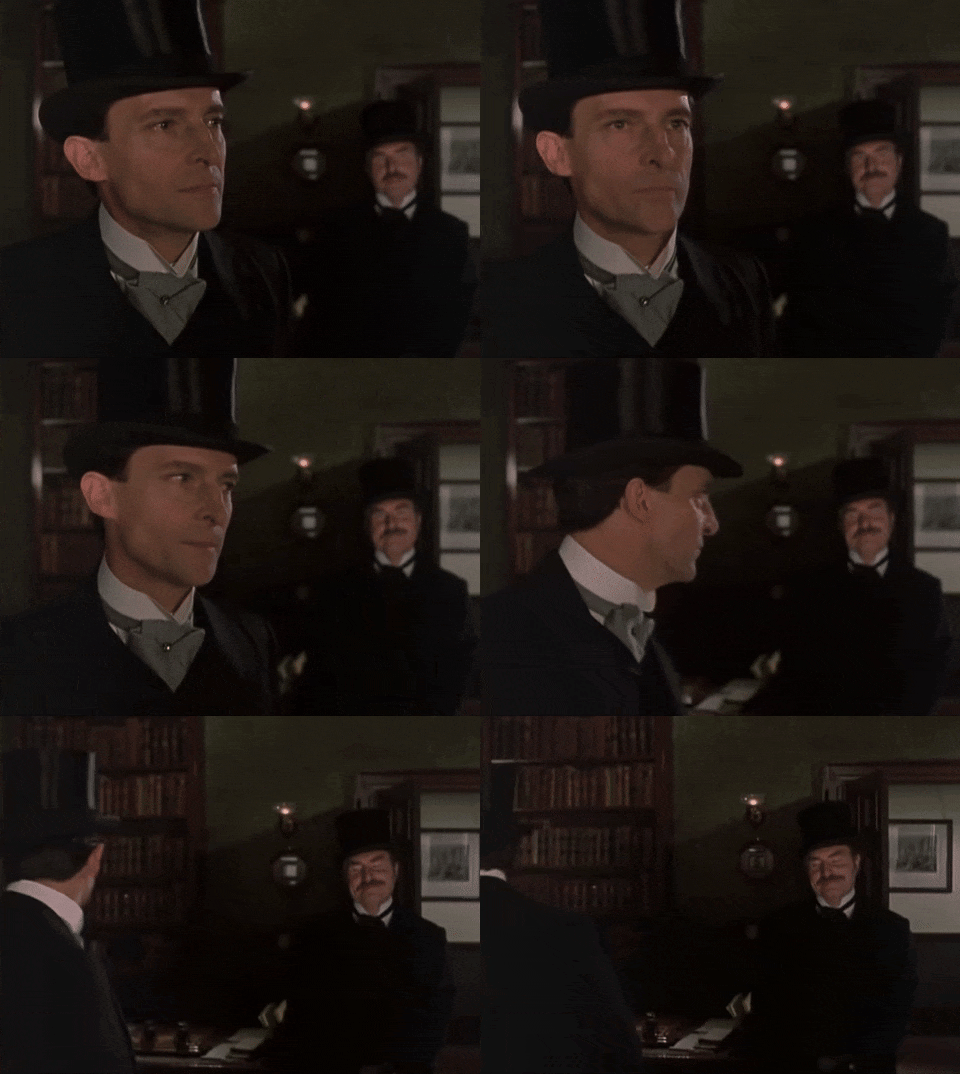
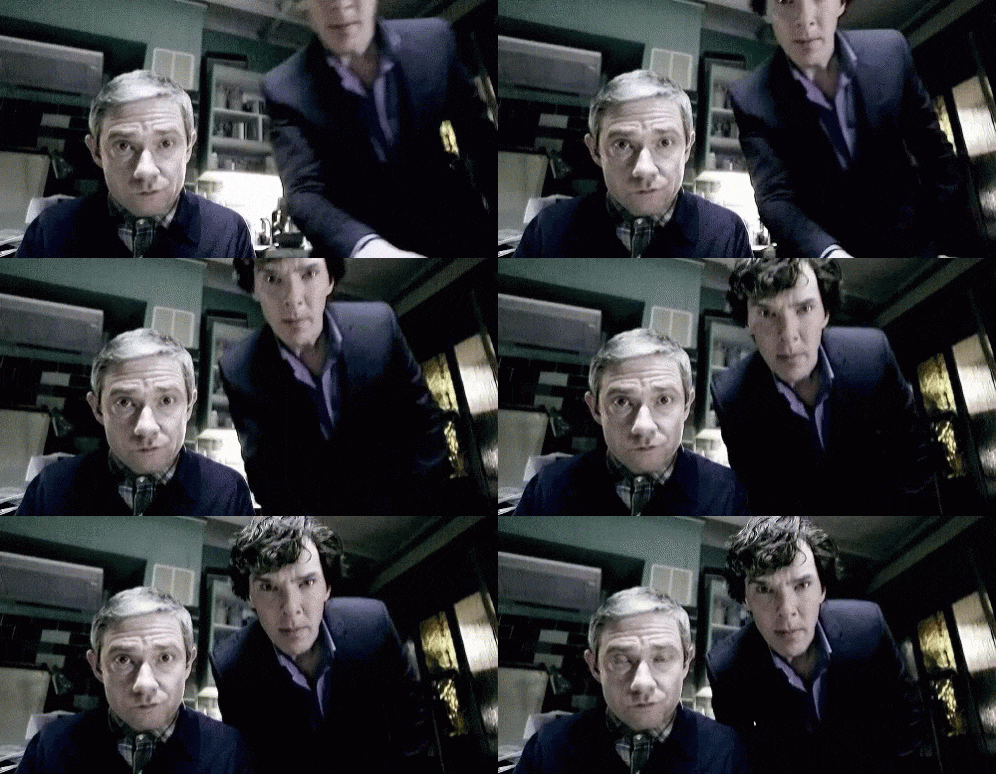
Krasner does a nice job of covering not just Doyle himself, and his inspirations for Sherlock and his stories, but also the different versions of Sherlock that have been portrayed on the big and small screen over the years.
He also has a different (rather interesting) take on what is usually considered Sherlock's seemingly misogynistic behavior. He looks at women purely as specimens, and in that way doesn't sexualize them at all - unlike Watson, who is forever commenting on their beauty. In the stories, the women aren't offended by his behavior so much as relieved that someone is treating them as something other than an objectified female. And he has a point! I never looked at it that way, but I like that take on the character. He also said that women seem to confound Sherlock in ways that men can't, and looking over the stories (not just Irene Adler's), he's right. I've been reading Holme's stories for most of my life and this gave me a new outlook on them.
I'm ready for a re-read now. Recommended for fans of John and Sherly.
This was a great lecture series about Sherlock Holmes. I now want to go back and read all the tales of Sherlock Holmes n]mention in this lecture series. I was fascinated by everything brought up and really enjoyed learning about it.
I listened to this course just before going to a festival dedicated to Sherlock Holmes, so perfect timing! I loved to learn more about both the character and his creator! It made me want to read the original series, something I stopped doing after stalling in the middle of the third volume - I got back to it during my listening!
Once more, as usual, I'll relisten to take notes, but I came out of it with a new perspective on both Sherlock Holmes and the stories. I loved the analysis of the character's popularity, to this day; James Krasner deals with its adaptations, but also with how Arthur Conan Doyle considered his creation.
Sherlock Holmes: you know who he is even if you've managed to never read one of his novels, never see an adaptation, or have missed out on on the memes, puns, and casual references out in the world. If you have managed this, you probably are not the person for this lecture series.
I truly appreciated the different aspects of Holmes that were covered throughout this lecture series. Learning about the bromance between the two, okay, this has been discussed widely before. Learning about how to write a mystery story (what makes Sherlock Holmes work?) was fun, but again, something I had read a bit about before. The we got into a discussion on how Holmes is a misogynist and his views on women are often problematic. Yes! Exciting stuff. The supernatural?! Count me in because this was a fabulous lecture, absolutely fabulous and peaks all of my interests in the occult.
I also was recently asked to teach a course on adaptation and used Sherlock Holmes as the theme for the course. I'm sad that I had not found this lecture series before the course because Krasner has some great information on adaptations. I specifically liked his take on the Robert Downey Jr. adaptation because I had some similar opinions and discussions about drugs/bohemia/etc. in my course. How great!
Really enjoyed this course and hope to find more like it.
The Lectures Lecture 1: The Victorian City Lecture 2: My Dear Watson Lecture 3: Sherlock Holmes: Man or Machine? Lecture 4: How to Write a Mystery Story Lecture 5: Doctors and Detectives Lecture 6: Nice Work if You Can Get It Lecture 7: Women and Sherlock Holmes Lecture 8: The Supernatural and Sherlock Holmes Lecture 9: The Final Problem: Sherlock Holmes and Popular Culture Lecture 10: Adaptations of Sherlock Holmes
The professor is very excited about Sherlock Holmes and Arthur Conan Doyle who produced the famous detective character.
The stories tell a lot about Victorian attitudes, at least in London. Inside each person was a hidden world, an unseen malady that might break out at any moment to consume the inattentive. Jack the Ripper was discussed but only in a sentence as a real example of person who was thought to be a respectable doctor (he was never caught) during the day and a serial killer at night. One might turn a corner and be face to face with him and never see your danger until it was too late.
In the midst of this fear and doubt comes the character of Sherlock Holmes who knows the streets of London as well as any cabby and could determine the identity of a person based on a missing hat and deductive logic.
As you can see, the professor has made me excited to read Sherlock Holmes. I certainly enjoyed the old Basil Rathbone movies portraying the detective.
Again, not a book, although this would indeed make a good short book if published as such.
I'm a Victorianist by training, so I have more than a passing interest in the sort of contextual analysis Krasner provides here. He does a very good job in looking at different approaches to the literary works and the character of Holmes in a way that is accessible to non-academic listeners. There's quite a lot of information here, but it's presented in a way that's entertaining. I tried it out on my son, who is not at all interested in the academic study of literature, and he actually listened to the whole thing voluntarily. That's a strong testament to Professor Krasner's ability!
Highly recommended for fans of Sherlock Holmes in any of his many incarnations.
Side note: Through no fault of his own, Professor Krasner's contrast between Conan Doyle's embattled relationship with his readers and J.K. Rowling's (formerly) engaged and friendly interactions with her fandom has aged rather poorly. Great Courses would be well advised to update that lesson.
This is a series of lectures by James Krasner on the stories of Sherlock Holmes by Sir Arthur Conan Doyle. Krasner divides his presentations by themes and uses material from the actual stories to illustrate his point. Krasner covers everything from the supernatural to the emotional life of our hero. Krasners style is informal and easy to read.
If you are a fan of Holmes, this book is a delightful revisit to dozens of stories and characters while gaining scholarly insight. If you are new to Holmes, you may find this one a bit dense with references to stories you may not know yet. Krasner clearly assumes his reader knows the series. Never the less, this is a good read and should be considered by anyone interested in Holmes.
This seems like an extremely short work to be in the Great Courses series, but it's still interesting. This looks at the context of the Sherlock Holmes series and Conan Doyle: how the environment (and crime and pollution and filth) of London shaped the stories; how Doyle's attitudes on women showed through in the stories; the medical doctors that inspired Sherlock Holmes; even the author wanting to distance himself from Sherlock Holmes, only to reluctantly pick up the detective again, and how that connects to modern fan culture. This short little book provides interesting extra information around the series as a whole.
The first few lectures, consisting mostly of trivial and superficial observations, were definitely not beyond the elementary and did not impress me. However, the quality improved and later lectures (particularly 7, 9 and 10) redeemed the course.
One observation is that he does spoil quite a few stories without warning or apology. Sometimes this is necessary for the point under discussion, but in quite a few cases it seems gratuitous because he could have made his point without spoiling the story.
This made me want to reread the Sherlock Holmes stories. The lectures provided some background about London during the time when Sir Arthur Conan Doyle wrote the stories. The lecturer also analyzed elements that most readers never considered. For example, why did Doyle have Watson get married and write in extra scenes for Sherlock to contact Watson for help? It would have been easy for Watson to remain a bachelor living on Baker Street. How is Doyle comparing the life of a crime-fighter versus a married person?
Who doesn't love Sherlock Holmes? Having enjoyed both the original Arthur Conan Doyle stories (yes, all of them) and a number of TV and movie adaptations in recent years, I'm always intrigued whenever I see the name of the world's favourite consulting detective on anything. Entertaining, informative, and clearly coming from someone who loves these tales just as much as I do, this short course covered a suprising array of topics and was a pleasure to listen to.
A fascinating short course on all aspects of Sherlock Holmes, from history to culture (both his own and his influence on popular culture) to literary analysis. The lecturer obviously loves everything Sherlockian, and it contributes to the enjoyment.
This is a must for all fans of Sherlock Holmes. This is a series of mini lectures on the literary devices used by Arthur Conan Doyle and other areas of note concerning Holmes. It’s very interesting and definitely includes much that I had never before considered.
This relatively short listen provides interesting insight into the Holmes stories. I found it especially interesting how it discusses the way the changes in Victorian society is addressed in the character of Holmes.
I like what the author had to say about different elements, such as the supernatural in Holmes stories. I also never realized that Sir Francis Doyle didn't like Holmes at all during the beginning. He even killed him off (which I did know about) at one point before returning him to life.
Excellent. Gives wonderful context to the times in which Doyle wrote. Flows very tightly and lots of info. Also lots of great Sherlock quotes on display. Good stuff.
The lectures actually get more interesting with time. NOTE: there are some spoilers if you have not read the books. I thought it could have been more interesting but still enjoyable.
I have always thought that Watson is a stand in for the reader. He gives us entry to the world of Holmes, so when Watson is dragged out of his ‘normal’ life, so are we.