

What do you think?
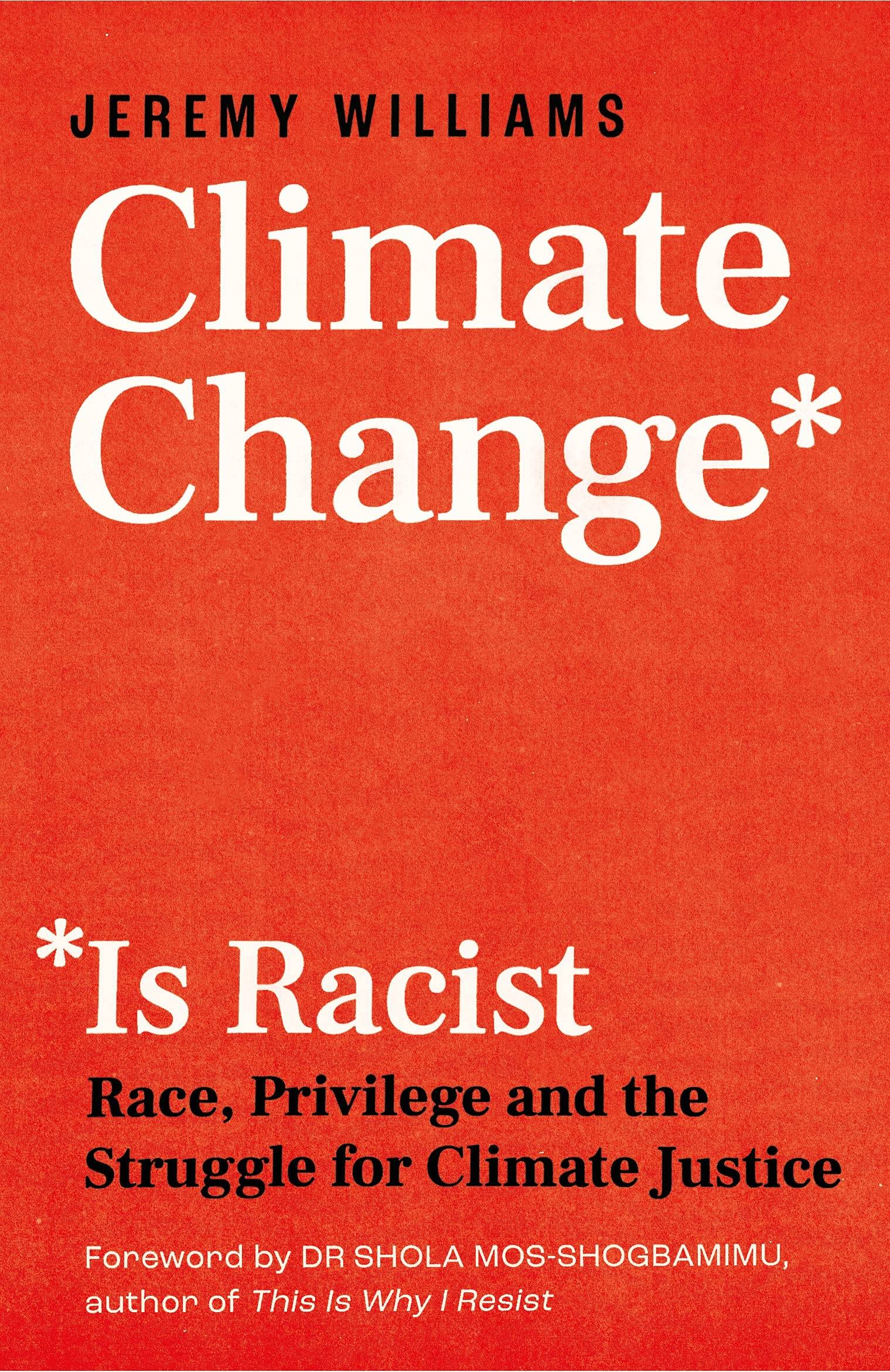
Climate Change Is Racist: Race, Privilege and the Struggle for Climate Justice
When we talk about racism, we often mean personal prejudice or institutional biases. Climate change doesn’t work that way. It is structurally racist, disproportionately caused by majority White people in majority White countries, with the damage unleashed overwhelmingly on people of colour. The climate crisis reflects and reinforces racial injustices.
In this eye-opening book, writer and environmental activist Jeremy Williams takes us on a short, urgent journey across the globe – from Kenya to India, the USA to Australia – to understand how White privilege and climate change overlap. We’ll look at the environmental facts, hear the experiences of the people most affected on our planet and learn from the activists leading the change.
It’s time for each of us to find our place in the global struggle for justice.
In this eye-opening book, writer and environmental activist Jeremy Williams takes us on a short, urgent journey across the globe – from Kenya to India, the USA to Australia – to understand how White privilege and climate change overlap. We’ll look at the environmental facts, hear the experiences of the people most affected on our planet and learn from the activists leading the change.
It’s time for each of us to find our place in the global struggle for justice.
128 pages, Paperback
First published June 10, 2021
About the author
Jeremy Williams
4 books17 followersWriter of serious books for adults, and less serious books for children. Activist and blogger on social and environmental issues.
I grew up in Madagascar and Kenya, and moved back to Britain on completing high school. I studied journalism, international relations and cultural studies, and now live in Luton, UK.
My work has led me into writing about social justice and climate change. After working on three books on those themes, the latest is a children's book with a child's perspective on the 2020 lockdown. It makes children laugh and adults cry - in a good way, apparently.
I grew up in Madagascar and Kenya, and moved back to Britain on completing high school. I studied journalism, international relations and cultural studies, and now live in Luton, UK.
My work has led me into writing about social justice and climate change. After working on three books on those themes, the latest is a children's book with a child's perspective on the 2020 lockdown. It makes children laugh and adults cry - in a good way, apparently.
Ratings & Reviews
Friends & Following
Create a free account to discover what your friends think of this book!
Community Reviews
Displaying 1 - 30 of 127 reviews

November 14, 2022
Yes,
Climate change is Racist.
Now read that again. At play here is a structural racism beyond mere racial prejudices or somehow institutionalized disadvantages. Jeremy Williams defines structural racism as ‘the scaffolding of policies, institutions, cultures and norms that perpetuate and reinforce racial inequality.’ True: he speaks from his own white-privileged position, but he does a darn well deconstruction of what the biggest challenge of our times entails. People of color who contributed little to nothing to our growing climate crisis are impacted today, as it if were a metastasis of their colonial tragedy. Trauma upon trauma, none less that this. And the West is responsible and should be held accountable. Be aware: its truths cannot be unknown... and need its readers to act upon.

January 28, 2022
4.75 stars
What an important book. I would highly recommend this to anyone and everyone as it covers an issue that affects us all - although not equally, as I learnt whilst reading this. As a white cisgender man from the UK, Jeremy Williams writes this book with consideration, grace and respect. He is constantly recognising his privilege in terms of race, class and gender as well as frequently quoting from people of colour, so it doesn't feel as if he is speaking over the people who are most affected by climate change. Rather, he is both giving those affected a space (although I can't say this for certain, as I am also white), as well as doing his part to communicate this vital issue, which should not just be solely tasked upon people of colour as if it is their job alone. Instead, Williams acknowledges how white people such as himself, as well as white countries, have predominately contributed to climate change, and thus it is white people's responsibility to clean up the climate change mess.
Indeed, this quote stood out for me:
In a world with so much climate pessimism, I also appreciated how Williams wasn't all doom and gloom in his novel. Rather, he highlighted what others are doing to address racist climate change. This left me feeling hopeful and empowered to do more to address climate change through the lens of anti-racism. I also liked the conversational tone and short length of the book, as it made this book accessible and easy to digest, whilst still quoting others in an academic sense. On a similar note, this book was very well researched, and I will probably be reading some of the books and authors Williams mentioned in this novel.
One slight misgiving I have with this book was that it could have possibly been a bit longer and in more detail. Although it was great that it was a short book, it could have still been short with an extra 50 or so pages that would have provided more detail on vital matters. For example, Williams briefly mentioned how the journalistic news value of "proximity" had racist undertones, which I found quite interesting as an aspiring journalist. However, he didn't provide any solutions as to how this issue could be overcome especially by those in the media, or go into much depth overall, which I was disappointed about. As such, in this example and others, I felt that the exploration of issues was a bit shallow.
However, for the most part, there was depth in the issues Williams explored, and I still really loved this book. I will definitely be recommending it to everyone I come across.
What an important book. I would highly recommend this to anyone and everyone as it covers an issue that affects us all - although not equally, as I learnt whilst reading this. As a white cisgender man from the UK, Jeremy Williams writes this book with consideration, grace and respect. He is constantly recognising his privilege in terms of race, class and gender as well as frequently quoting from people of colour, so it doesn't feel as if he is speaking over the people who are most affected by climate change. Rather, he is both giving those affected a space (although I can't say this for certain, as I am also white), as well as doing his part to communicate this vital issue, which should not just be solely tasked upon people of colour as if it is their job alone. Instead, Williams acknowledges how white people such as himself, as well as white countries, have predominately contributed to climate change, and thus it is white people's responsibility to clean up the climate change mess.
Indeed, this quote stood out for me:
I cannot be blamed for being privileged but I can be held responsible for what I do with it.
In a world with so much climate pessimism, I also appreciated how Williams wasn't all doom and gloom in his novel. Rather, he highlighted what others are doing to address racist climate change. This left me feeling hopeful and empowered to do more to address climate change through the lens of anti-racism. I also liked the conversational tone and short length of the book, as it made this book accessible and easy to digest, whilst still quoting others in an academic sense. On a similar note, this book was very well researched, and I will probably be reading some of the books and authors Williams mentioned in this novel.
One slight misgiving I have with this book was that it could have possibly been a bit longer and in more detail. Although it was great that it was a short book, it could have still been short with an extra 50 or so pages that would have provided more detail on vital matters. For example, Williams briefly mentioned how the journalistic news value of "proximity" had racist undertones, which I found quite interesting as an aspiring journalist. However, he didn't provide any solutions as to how this issue could be overcome especially by those in the media, or go into much depth overall, which I was disappointed about. As such, in this example and others, I felt that the exploration of issues was a bit shallow.
However, for the most part, there was depth in the issues Williams explored, and I still really loved this book. I will definitely be recommending it to everyone I come across.

December 6, 2021
This book is such an important and quick read. I definitely recommend it to anyone looking to learn more about the connections between climate change, colonialism, and structural racism.

May 4, 2026
“It was not until I went to a meeting about climate change that I heard it was not God, but the rich people in the West who are doing this to us.”
This was a good read. I was skeptical at first when I realized it was written by a white guy, but I think he did a great job.
Was kinda disheartening because he wrote this when Biden was president not realizing trump was going to show back up and continue destroying the planet :(
“And where climate silence meets White privilege, that’s a very quiet place indeed”
This was a good read. I was skeptical at first when I realized it was written by a white guy, but I think he did a great job.
Was kinda disheartening because he wrote this when Biden was president not realizing trump was going to show back up and continue destroying the planet :(
“And where climate silence meets White privilege, that’s a very quiet place indeed”

January 12, 2024
Wow. This is such an eye-opening and important book - the best I have read in a long, long time.
Picking this book up, I thought of myself as someone who is knowledgeable on, and passionate about, climate change. I also considered myself to be interested in and supportive of social justice movements and antiracism.
But ashamedly, I had never given that much thought to the link between racism/colonialism and the climate.
This book opened my eyes to a whole new dimension of the climate issue.
Williams explains the concept of structural racism and the link between colonialism and climate change brilliantly. Reading this made me assess my own thoughts and actions as an environmentalist and highlighted issues I would otherwise have been complicit in ignoring.
This is one of the only books where I have bookmarked so many of the pages and made notes on what I was reading. It will definitely be one I revisit.
I cannot recommend this book enough.
Picking this book up, I thought of myself as someone who is knowledgeable on, and passionate about, climate change. I also considered myself to be interested in and supportive of social justice movements and antiracism.
But ashamedly, I had never given that much thought to the link between racism/colonialism and the climate.
This book opened my eyes to a whole new dimension of the climate issue.
Williams explains the concept of structural racism and the link between colonialism and climate change brilliantly. Reading this made me assess my own thoughts and actions as an environmentalist and highlighted issues I would otherwise have been complicit in ignoring.
This is one of the only books where I have bookmarked so many of the pages and made notes on what I was reading. It will definitely be one I revisit.
I cannot recommend this book enough.

October 13, 2022
Amazingly well written book, that establishes how the main responsible countries for Climate Change aren't, and will not be, the ones suffering the most from it.
Before reading this I never actually considered how climate justice could have anything to do with racism, but the connection is pretty obvious once pointed out. You just have to pay attention to the news. This year there were major floods in Pakistan, last year was severe drought in Madagascar, and there are many more examples of how less developed countries are hit the hardest by climate change. And this is just the tip of what this book talks about.
I highly recommend reading it!
Before reading this I never actually considered how climate justice could have anything to do with racism, but the connection is pretty obvious once pointed out. You just have to pay attention to the news. This year there were major floods in Pakistan, last year was severe drought in Madagascar, and there are many more examples of how less developed countries are hit the hardest by climate change. And this is just the tip of what this book talks about.
I highly recommend reading it!
July 7, 2024
A very important book full of topics that everyone should take time to familiarize themselves with. I've discussed many of these points in school already, but it was a good refresher and introduction to other concepts like the racial empathy gap in the context of climate disasters which is something I wasn't too aware of.
Two of my favorite quotes from the book:
“First it was the people and their labor. Then it was the land and the resources. Now it’s the atmosphere. White people are entitled to take what they need from Black people”
“We love to tell ourselves that it all started with the Industrial Revolution. But we’re telling ourselves a lie. It started with conquest, genocides, slavery and colonialism. That is the moment when White men’s relationship with living things became extractive and disharmonious. Everything was for the taking, everything was for sale “-Mary Annaise Heglar
Two of my favorite quotes from the book:
“First it was the people and their labor. Then it was the land and the resources. Now it’s the atmosphere. White people are entitled to take what they need from Black people”
“We love to tell ourselves that it all started with the Industrial Revolution. But we’re telling ourselves a lie. It started with conquest, genocides, slavery and colonialism. That is the moment when White men’s relationship with living things became extractive and disharmonious. Everything was for the taking, everything was for sale “-Mary Annaise Heglar
January 14, 2023
A really accessible and digestible read, written with a lot of sass which I obviously adored.
Key learnings:
- Only 100 companies globally are responsible for 71% of CO2 emissions - "the destruction of the world is signed off by men called Doug, Steve or Gary"
- A key indicator of vulnerability is proximity to the equator (along with race, socio economic status and colonisation)
- Violence can be understood at three levels; (1) cultural violence being long standing attitudes, (2) structural violence being patterns of disadvantage and (3) direct violence as a reflection of inequality.
Key learnings:
- Only 100 companies globally are responsible for 71% of CO2 emissions - "the destruction of the world is signed off by men called Doug, Steve or Gary"
- A key indicator of vulnerability is proximity to the equator (along with race, socio economic status and colonisation)
- Violence can be understood at three levels; (1) cultural violence being long standing attitudes, (2) structural violence being patterns of disadvantage and (3) direct violence as a reflection of inequality.

February 9, 2022
A quick read that plainly explains the intersection between race and climate change. It’s an overview of the subject and a great starting point for anyone interested in learning more about environmental justice.

October 10, 2023
Highly recommend this short but punchy look at the deep interlinkages between climate change and racism. It taught me a lot and has magnified my need and desire to take action against the climate crisis.
But, don't listen to the audiobook. The narrator sounds so robotic it was a very unpleasant listening experience.
But, don't listen to the audiobook. The narrator sounds so robotic it was a very unpleasant listening experience.

March 17, 2022
A must read!
Loved that it was short and to the point and yet I've still learnt so much.
Loved that it was short and to the point and yet I've still learnt so much.

May 23, 2022
Food for thoughts. Great case studies and great points.
“Still fighting CO2-lonialism” - The Wretched of The Earth.
“Still fighting CO2-lonialism” - The Wretched of The Earth.

August 4, 2023
4.5 ⭐️ accessible, engaging, and realistic

June 11, 2024
Climate change did not start with the dawn of the Industrial Revolution- it started with colonialism.
June 12, 2024
4.25
Informative, quick and accessible to read and important - could have been a bit more in depth for me, great intro/ overview though
Informative, quick and accessible to read and important - could have been a bit more in depth for me, great intro/ overview though

September 8, 2026
It's a few years old now and the crisis is even worse, but its still a thought provoking and sobering story for anyone who cares about climate justice and racial justice.

September 10, 2022
Was drawn to this book for the controversial title. What an intresting lense to view climate change from. Definitely opened my eyes to the varying structures underlying this unfortunate problem we are faced with today.
Yes, the majority of people who read this are privileged. It's our problem!
Yes, the majority of people who read this are privileged. It's our problem!

July 13, 2025
Unieke onbekende kijk naar klimaatverandering. Ben na dit boek een nieuwe dimensie ingestapt en heb mezelf goed kunnen introduceren naar het probleem en oorzaak van klimaatverandering

May 15, 2025
At the heart of structural racism is the deeply embedded and perhaps subconscious notion of white privilege and class privilege; that BAME lives are worth less than white lives, than western lives, and Climate Change is a significant manifestation of this.
Silence always protects privilege.
The opposite of ‘racist’ isn’t ‘not racist’ it is ‘anti-racist’ - this requires action, to tackle the individual and structurally racist attitudes. It is not enough to sit by, as you’re then complicit, we must fight for environmental justice, we must fight for climate justice, we must fight for social justice.
The question is, which side are you on?
Silence always protects privilege.
The opposite of ‘racist’ isn’t ‘not racist’ it is ‘anti-racist’ - this requires action, to tackle the individual and structurally racist attitudes. It is not enough to sit by, as you’re then complicit, we must fight for environmental justice, we must fight for climate justice, we must fight for social justice.
The question is, which side are you on?

June 25, 2026
Excellent. Both nuanced and concise.

February 18, 2023
4.5 stars, excellent and succinct read, covers all the bases and gives great grounding to dive deeper if you want. Easy to read and understand and well argued. Great contribution to the field

August 16, 2021
I think this book is a good primer on thinking about the racial and socioeconomic impacts of climate change. It's concise - maybe a little too concise - and provides a summary of the major issues. The author mentions early in the book that he attempted to keep the book short, encouraging the reader to study further, and that was a good goal; however, I kept finding myself wishing he had expanded more, or dug a little deeper, or brought in a more difficult or nuanced discussion. Capitalism - the driving force behind climate change and reliant on structural racism - is brought up only a few times, weakened by the adjective "fossil-fueled." Williams brings up the need for systemic change, but stops short of calling out the systems that need to be changed! However, the book makes a good argument to defend its title, and it's worth reading. I'd recommend it to anyone (particularly white people) who see the title and want an explanation.
**Note: I received an advanced digital copy of this book through Edelweiss.
**Note: I received an advanced digital copy of this book through Edelweiss.

July 22, 2022
An important read!! At first I was bit nervous about approaching climate change terminology but Williams writes in a clear and accessible manner that his points were very easy to follow. I'm glad I read this, I definitely learned a lot.

July 23, 2022
(3.5) Averagely written introductory to climate change. The basicness however serves as a strength for a entry level reader, but for those with prior knowledge this may not be enough of an intellectual challenge.

March 8, 2023
“The difference between racist actions and racist structures is vital to everything else that follows.”
“As a White man, I am implicated in an unjust system, but that does not make it my fault.”
This book, by a white man, explores the economic and racial injustice of climate change and explores the structural racism embedded in society, specifically as this pertains to climate change.
“Looked at superficially, it might seem as if many of these things are more to do with poverty than racism, and the next chapter will investigate how various forms of inequality inter-sect. But as we have seen already, structural racism does not require racist intent. It might not be possible to detect a racial prejudice behind many cases of environmental injustice. But if the end result is that people of colour are disadvantaged or disenfranchised, then we are talking about a racist structure.”
“But the climate crisis arises from racial injustice and the plundering of the global South, and it is in itself a form of exploitation of the global South.”
The author makes the point in a non judgemental yet radical manner with very good explanations and extensive referencing from other works. This makes this such an essential text that could be given to someone with deep knowledge wanting a good summary or someone who has never contended with the class and racial aspects of climate change as an introduction.
“American race scholar Ibram X. Kendi argues that racism has always worked this way. Throughout history, 'the source of racist ideas was not ignorance and hate, but self-interest. It's not that people hate those that are different and set out to oppress them. More often, the powerful act to benefit themselves at the expense of others. These racist policies are then legitimised with racist ideas.”
He then goes on to explore what privilege means and how to reckon with it and be a better climate ally.
“But the most common form of denial is silence.”
“I cannot be blamed for being privileged, but I can be held responsible for what I do with it.”
Through this he exposes truths such as “The pharmaceuticals industry goes where the money is, and the money is in first world problems.
The pharmaceuticals industry is therefore structurally racist. The logic of the global economy is structurally racist. Because capital resides disproportionately with White people, capitalism itself is structurally racist.”
The then goes on to explore the racist, culturally learned empathy gap between how we see experiences of pain for people racialised as white vs. racialised as black.
“If the empathy gap is cultural, then it is not inevitable.
Change is possible. As the philosopher Roman Krznaric demonstrates in his book on the topic, empathy can be nurtured and its scope can be expanded. It may turn out to be vital to the struggle. Climate justice may depend on 'imagining ourselves into the lives and thoughts of the current and future victims of global warming.”
“A lot of activists understand this and talk about 'using their privilege. For example, Extinction Rebellion (XR) trains people for non-violent direct action, and participants choose whether they will take part in an 'arrestable' or a supporting role. Though it is always a free choice, those without British citizenship are encouraged to choose supporting roles, as they could be deported if they get in trouble with the law. Likewise people of colour: White activists may feel safer with the police, and may be treated differently in the courts.
In a supportive critique of XR, the investigative journalist Nafeez Ahmed writes that people of colour would be 'inevitably marginalised by a movement whose principal focus is "disrup-tion" actions premised on getting arrested' Even though XR makes an effort to give a platform to minority voices, the photos in the press show White activists, and the iconic moments of arrest will usually involve White people Leveraging privilege while people of colour play supporting roles might be well-meaning, but the effect is the same: 'erasing minorities and indigenous people from the movement’”
“Consumers in the West are often told that they need to make sacrifices for the good of the climate - maybe to fly less or drive Tess or eat less meat. But a great many people are making sacrifices already. Their houses, cattle and farms have already been taken away. The key difference between them is that the sacrifices made in the West will mostly be voluntary, while the ones made. in places like the Brahmaputra River Valley are involuntary….. The American ethicist Kevin J. O'Brien, in his book The Violence of Climate Change, suggests that 'the best way for privileged people to help liberate such people from involuntary sacrifices is by making our own voluntary sacrifices'.”
“As a White man, I am implicated in an unjust system, but that does not make it my fault.”
This book, by a white man, explores the economic and racial injustice of climate change and explores the structural racism embedded in society, specifically as this pertains to climate change.
“Looked at superficially, it might seem as if many of these things are more to do with poverty than racism, and the next chapter will investigate how various forms of inequality inter-sect. But as we have seen already, structural racism does not require racist intent. It might not be possible to detect a racial prejudice behind many cases of environmental injustice. But if the end result is that people of colour are disadvantaged or disenfranchised, then we are talking about a racist structure.”
“But the climate crisis arises from racial injustice and the plundering of the global South, and it is in itself a form of exploitation of the global South.”
The author makes the point in a non judgemental yet radical manner with very good explanations and extensive referencing from other works. This makes this such an essential text that could be given to someone with deep knowledge wanting a good summary or someone who has never contended with the class and racial aspects of climate change as an introduction.
“American race scholar Ibram X. Kendi argues that racism has always worked this way. Throughout history, 'the source of racist ideas was not ignorance and hate, but self-interest. It's not that people hate those that are different and set out to oppress them. More often, the powerful act to benefit themselves at the expense of others. These racist policies are then legitimised with racist ideas.”
He then goes on to explore what privilege means and how to reckon with it and be a better climate ally.
“But the most common form of denial is silence.”
“I cannot be blamed for being privileged, but I can be held responsible for what I do with it.”
Through this he exposes truths such as “The pharmaceuticals industry goes where the money is, and the money is in first world problems.
The pharmaceuticals industry is therefore structurally racist. The logic of the global economy is structurally racist. Because capital resides disproportionately with White people, capitalism itself is structurally racist.”
The then goes on to explore the racist, culturally learned empathy gap between how we see experiences of pain for people racialised as white vs. racialised as black.
“If the empathy gap is cultural, then it is not inevitable.
Change is possible. As the philosopher Roman Krznaric demonstrates in his book on the topic, empathy can be nurtured and its scope can be expanded. It may turn out to be vital to the struggle. Climate justice may depend on 'imagining ourselves into the lives and thoughts of the current and future victims of global warming.”
“A lot of activists understand this and talk about 'using their privilege. For example, Extinction Rebellion (XR) trains people for non-violent direct action, and participants choose whether they will take part in an 'arrestable' or a supporting role. Though it is always a free choice, those without British citizenship are encouraged to choose supporting roles, as they could be deported if they get in trouble with the law. Likewise people of colour: White activists may feel safer with the police, and may be treated differently in the courts.
In a supportive critique of XR, the investigative journalist Nafeez Ahmed writes that people of colour would be 'inevitably marginalised by a movement whose principal focus is "disrup-tion" actions premised on getting arrested' Even though XR makes an effort to give a platform to minority voices, the photos in the press show White activists, and the iconic moments of arrest will usually involve White people Leveraging privilege while people of colour play supporting roles might be well-meaning, but the effect is the same: 'erasing minorities and indigenous people from the movement’”
“Consumers in the West are often told that they need to make sacrifices for the good of the climate - maybe to fly less or drive Tess or eat less meat. But a great many people are making sacrifices already. Their houses, cattle and farms have already been taken away. The key difference between them is that the sacrifices made in the West will mostly be voluntary, while the ones made. in places like the Brahmaputra River Valley are involuntary….. The American ethicist Kevin J. O'Brien, in his book The Violence of Climate Change, suggests that 'the best way for privileged people to help liberate such people from involuntary sacrifices is by making our own voluntary sacrifices'.”

January 6, 2022
Jeremy Williams is one of the top writers on climate change. His website - The Earthbound Report - is recognised as one of the best on climate issues. Williams is particularly skilled at writing short, comprehensible pieces packed with facts and figures which educate rather than bore.
In many ways, this latest book from Williams is an extension of this kind of writing. Indeed, it often feels like and extended academic essay - a PhD thesis if you like - albeit one which is a joy to read. It is short (for a book), clearly structured and not a word is wasted, as though a word count was secretly in play. This is no bad thing. William's book has a use beyond just reading once; you can easily refer back to it and pick up information swiftly with each chapter fully referenced.
One might ask, what is a white, educated and privileged British man doing writing a book concerning racism? Williams deals with this from the start, not just detailing his own fight with the issue, but also his own experiences of living in Madagascar. He doesn't cry #metoo in doing so, but leads us on a short journey explaining why it is BECAUSE he is a white, educated, privileged British man that he needed to write this book. Indeed it becomes the crux of his message.
So what is that message? In essence: white people caused this mess and white people need to take the lion's share of fixing it.
There's more to it than that, of course, and when put so bluntly, it sounds like another round of 'white bashing', instantly turning off empire supporters and those on the fence. Williams tackles the issue more carefully. He gives overwhelming evidence to support the view and (in some ways much more importantly) demonstrates how many - if not most - of the former colonies are suffering the effects of white industrial revolution systems right now. It's hard to come away from his arguments and not believe that Britain, Europe and USA are wholly responsible for the mess we're now.
This would be academic - a case of arguing whose fault is it in an abstract way and just for the sake of it - if it were not for William's most cutting point: it's the non-white man today but it will be the white man tomorrow. Asia and Africa particularly are feeling the effects of climate change now with famines, droughts, floods etc. creating suffering and havoc throughout the year but we in the west hardly hear of it. Rarely is a flood in Bangladesh deemed newsworthy. It's only when fires ravage Australia or floods wipe out an inhabited area of America that we take note and the scientists take the opportunity (again) to tell us this is climate change. But very quickly we have the likes of Matt Ridley (with whom Williams opens chapter 7, Climate Privilege') who tell those of us from rich nations that it's all actually really good stuff and we can all enjoy nice warm summers now (I kid you not).
Williams argues that while we are so distanced (at least for much of the time) from the effects of climate change, it will get to us eventually. And when it does, then that's really game over for the human race experiment. Again, his arguments are convincing. Climate change is real and it is coming this way. It is time, he says, to grow up and accept our responsibilities.
That's not his whole fight on the cause of ending racism. Williams is far more nuanced than I'm portraying here. Racism is wrong even if somehow climate change was never going to affect us. But it is the major takeaway to use for those who want to deny there's any racism in climate change issues at all. No one likes to be told they (or their ancestors) are wrong and that they need to cough up the cash to fix past sins. But the fact of the matter is: we need to. Not just for the benefit of the many peoples who are suffering now, but for ourselves too.
Time is short. The academic arguments need to cease. Williams' book is a call to arms. But that call is made intelligently, rationally and with a ton of careful research behind it. Quite simply: it's a must-read.
In many ways, this latest book from Williams is an extension of this kind of writing. Indeed, it often feels like and extended academic essay - a PhD thesis if you like - albeit one which is a joy to read. It is short (for a book), clearly structured and not a word is wasted, as though a word count was secretly in play. This is no bad thing. William's book has a use beyond just reading once; you can easily refer back to it and pick up information swiftly with each chapter fully referenced.
One might ask, what is a white, educated and privileged British man doing writing a book concerning racism? Williams deals with this from the start, not just detailing his own fight with the issue, but also his own experiences of living in Madagascar. He doesn't cry #metoo in doing so, but leads us on a short journey explaining why it is BECAUSE he is a white, educated, privileged British man that he needed to write this book. Indeed it becomes the crux of his message.
So what is that message? In essence: white people caused this mess and white people need to take the lion's share of fixing it.
There's more to it than that, of course, and when put so bluntly, it sounds like another round of 'white bashing', instantly turning off empire supporters and those on the fence. Williams tackles the issue more carefully. He gives overwhelming evidence to support the view and (in some ways much more importantly) demonstrates how many - if not most - of the former colonies are suffering the effects of white industrial revolution systems right now. It's hard to come away from his arguments and not believe that Britain, Europe and USA are wholly responsible for the mess we're now.
This would be academic - a case of arguing whose fault is it in an abstract way and just for the sake of it - if it were not for William's most cutting point: it's the non-white man today but it will be the white man tomorrow. Asia and Africa particularly are feeling the effects of climate change now with famines, droughts, floods etc. creating suffering and havoc throughout the year but we in the west hardly hear of it. Rarely is a flood in Bangladesh deemed newsworthy. It's only when fires ravage Australia or floods wipe out an inhabited area of America that we take note and the scientists take the opportunity (again) to tell us this is climate change. But very quickly we have the likes of Matt Ridley (with whom Williams opens chapter 7, Climate Privilege') who tell those of us from rich nations that it's all actually really good stuff and we can all enjoy nice warm summers now (I kid you not).
Williams argues that while we are so distanced (at least for much of the time) from the effects of climate change, it will get to us eventually. And when it does, then that's really game over for the human race experiment. Again, his arguments are convincing. Climate change is real and it is coming this way. It is time, he says, to grow up and accept our responsibilities.
That's not his whole fight on the cause of ending racism. Williams is far more nuanced than I'm portraying here. Racism is wrong even if somehow climate change was never going to affect us. But it is the major takeaway to use for those who want to deny there's any racism in climate change issues at all. No one likes to be told they (or their ancestors) are wrong and that they need to cough up the cash to fix past sins. But the fact of the matter is: we need to. Not just for the benefit of the many peoples who are suffering now, but for ourselves too.
Time is short. The academic arguments need to cease. Williams' book is a call to arms. But that call is made intelligently, rationally and with a ton of careful research behind it. Quite simply: it's a must-read.

April 2, 2023
(First book read for Earth Month 2023)
Seeing “Climate Change” and “Racist” in a book title is probably going to drive off “certain” demographics from Jeremy Williams’ “Climate Change is Racist”. Regardless of the discomfort some might have towards hard truths about the ongoing Climate Crisis and the complexities of structural racism, this is a very important book that open-minded people concerned about these topics must check out.
Most of the content the book covers I was already familiar with from school and the work of climate activists/scholars that are Black, Indigenous, and People of Color (BIPOC). But I was impressed with Williams’ coverage of these complex and interconnected topics. I’d say the bulk of Williams’ arguments tie back to how White Colonial Powers set the stage for current climate racism by conquering the Global South, setting up racist power structures that let them exploit indigenous bodies to extract the materials they needed. These colonial powers used those resources to become Industrial Superpowers and now dump the wastes of their excess into the climate which in turn predominantly affected BIPOC first and will continue to do so. One of the more damming accounts Williams mentions is the city of Beira getting completely destroyed by a 2019 tropical cyclone, essentially the first city destroyed by climate change, yet CNN hardly gave it coverage compared to the Notre Dame roof fire.
These examples demonstrate that a category of white people have the luxury of denying the Climate Crisis for as long as possible while BIPOC have had to contend with environmental degradation for decades and will continue to do so because White self-interest has denied BIPOC resources and funds for climate mitigation/adaptation. It’s a lot of material and ideas to sort through, but Williams does a good job explaining it all for those unfamiliar how self-reinforcing racist and environmental harmful systems are.
Williams also draws attention to the other end of the spectrum of White awareness/action on climate. Even well-intentioned climate activists and organizations can intentionally/unintentionally promote racially insensitive notions, like prioritizing animals or making a livable planet for future generations, that BIPOC activists find frustrating because it diminishes the suffering that the Global South and BIPOC are presently enduring. The idea that humanity is “in this together” is also racially tone-death because low income minorities are/will be feeling the brunt of the Climate Crisis’ effects long before White and affluent individuals/communities will.
I won’t say that Williams' book is truly groundbreaking because he (rightfully) credits a lot of what he writes about how structural and other forms of racism drove us into the Climate Crisis has been previously covered by BIPOC scholars/activists. What “Climate Change is Racist” does do though is nicely synthesize all these ideas into a compact book that’s good for people just drawing the connection between racism and ecological and environmental catastrophes. Williams, a White British male, recognizes this connection and uses his book as a means to educate others like him about this.
Seeing “Climate Change” and “Racist” in a book title is probably going to drive off “certain” demographics from Jeremy Williams’ “Climate Change is Racist”. Regardless of the discomfort some might have towards hard truths about the ongoing Climate Crisis and the complexities of structural racism, this is a very important book that open-minded people concerned about these topics must check out.
Most of the content the book covers I was already familiar with from school and the work of climate activists/scholars that are Black, Indigenous, and People of Color (BIPOC). But I was impressed with Williams’ coverage of these complex and interconnected topics. I’d say the bulk of Williams’ arguments tie back to how White Colonial Powers set the stage for current climate racism by conquering the Global South, setting up racist power structures that let them exploit indigenous bodies to extract the materials they needed. These colonial powers used those resources to become Industrial Superpowers and now dump the wastes of their excess into the climate which in turn predominantly affected BIPOC first and will continue to do so. One of the more damming accounts Williams mentions is the city of Beira getting completely destroyed by a 2019 tropical cyclone, essentially the first city destroyed by climate change, yet CNN hardly gave it coverage compared to the Notre Dame roof fire.
These examples demonstrate that a category of white people have the luxury of denying the Climate Crisis for as long as possible while BIPOC have had to contend with environmental degradation for decades and will continue to do so because White self-interest has denied BIPOC resources and funds for climate mitigation/adaptation. It’s a lot of material and ideas to sort through, but Williams does a good job explaining it all for those unfamiliar how self-reinforcing racist and environmental harmful systems are.
Williams also draws attention to the other end of the spectrum of White awareness/action on climate. Even well-intentioned climate activists and organizations can intentionally/unintentionally promote racially insensitive notions, like prioritizing animals or making a livable planet for future generations, that BIPOC activists find frustrating because it diminishes the suffering that the Global South and BIPOC are presently enduring. The idea that humanity is “in this together” is also racially tone-death because low income minorities are/will be feeling the brunt of the Climate Crisis’ effects long before White and affluent individuals/communities will.
I won’t say that Williams' book is truly groundbreaking because he (rightfully) credits a lot of what he writes about how structural and other forms of racism drove us into the Climate Crisis has been previously covered by BIPOC scholars/activists. What “Climate Change is Racist” does do though is nicely synthesize all these ideas into a compact book that’s good for people just drawing the connection between racism and ecological and environmental catastrophes. Williams, a White British male, recognizes this connection and uses his book as a means to educate others like him about this.

January 22, 2022
A quite concise argument exposing the intersectionality of climate change and race politics. Where for many years I thought of these issues as separate, this book links the consequences of climate denial and eco destruction to systemic racism around the world.
Some interesting points I picked up from this book included:
-Western countries exploitation of natural resources for industrialisation during the 1800s and 1900s and the pollution caused by industrialisation can be linked to drought and extreme weather conditions in non western countries, making the consequences of climate change much less visible to those who benefitted from industrial practices.
-Western societies, including modern day Australia have the luxury of seeing Climate Change as just an environmental issue as we have enough food, a health system to manage pandemics and little change to our living conditions. But it's interconnected with human living conditions elsewhere. Where as in some countries, predominantly home to people of colour, directly suffer from climate change - loss of jobs due to climate conditions making industries unviable, more likely to be sick due to poor health care.
-The way we describe Climate Change to younger readers through imagery of polar bears on melting ice doesn't capture the tremendous impact on human lifestyles that climate change is having. Even using images of the globe (from cartoons to posters) with green land and blue ocean doesn't accurately depict the current condition of the planet, especially the large swathes of growing dessert and drought affected areas.
-Systemic racism exists today. Garbage dumps are built in places where the poorest live. On going echoes of slavery in America make it harder for families of colour to buy property as they are less likely to inherit wealth. In Britain, tax payers were still paying reparation payments to slave trading families until 2015 - a flow on from the emancipation of slaves nearly 220 years ago.
Large scale organisations such as the World Bank and IMF have maintained the status quo through trade deals that ensure the third world shoulders the burden of climate change and are perceived to be major polluters when the US still produces more carbon emissions than even China.
This isn't an easy read - there's lots here that will infuriate, embarrass and make you question what you might have learnt. For many, this won't be new information it's just reality.
Some interesting points I picked up from this book included:
-Western countries exploitation of natural resources for industrialisation during the 1800s and 1900s and the pollution caused by industrialisation can be linked to drought and extreme weather conditions in non western countries, making the consequences of climate change much less visible to those who benefitted from industrial practices.
-Western societies, including modern day Australia have the luxury of seeing Climate Change as just an environmental issue as we have enough food, a health system to manage pandemics and little change to our living conditions. But it's interconnected with human living conditions elsewhere. Where as in some countries, predominantly home to people of colour, directly suffer from climate change - loss of jobs due to climate conditions making industries unviable, more likely to be sick due to poor health care.
-The way we describe Climate Change to younger readers through imagery of polar bears on melting ice doesn't capture the tremendous impact on human lifestyles that climate change is having. Even using images of the globe (from cartoons to posters) with green land and blue ocean doesn't accurately depict the current condition of the planet, especially the large swathes of growing dessert and drought affected areas.
-Systemic racism exists today. Garbage dumps are built in places where the poorest live. On going echoes of slavery in America make it harder for families of colour to buy property as they are less likely to inherit wealth. In Britain, tax payers were still paying reparation payments to slave trading families until 2015 - a flow on from the emancipation of slaves nearly 220 years ago.
Large scale organisations such as the World Bank and IMF have maintained the status quo through trade deals that ensure the third world shoulders the burden of climate change and are perceived to be major polluters when the US still produces more carbon emissions than even China.
This isn't an easy read - there's lots here that will infuriate, embarrass and make you question what you might have learnt. For many, this won't be new information it's just reality.

July 16, 2021
Climate Change is Racist: Race, Privilege, and the Struggle for Climate Justice is not my "typical" non-fiction pick. I always joke that anything in the STEM field goes way over my head. When I read the description for the book, I was intrigued.
The book itself challenges readers to look at what they know about racism. Now, most readers who pick up this book are aware of personal biases or institutional attitudes that harm people of color, especially Black people. This harm can impact everything, from self-esteem to job acquisition. Williams pushes past surface-level understandings of racism to discuss the structural racism built into our society (which ultimately causes personal and institutional racism) and how this structure, combined with climate change, reinforces the racial injustices and inequalities.
Jeremy Williams takes readers all over the world to discuss how white privilege affects climate change. Through this travel, Williams encourages readers to look at the expertise presented by activists and scientists while also understanding the effect this climate change has on the most impacted communities. Dr. Shola Mos-Shogbamimu (author of This is Why I Resist: Don't Define My Black Identity) wrote the foreword and it is short but absolutely impactful. I also thought that having Mos-Shogbamimu write a foreword was a good way to add a different perspective to reinforce his words and research.
During this book, I definitely found myself understanding climate change in a much deeper way. The recent environmental events impacting the world around us make this book's topic more relevant than ever. Reading this with those events fresh in my mind just reinforced that it is up to all of us to push for change and justice. It is the only way we can hope to lessen the impact of climate change and right the wrongs of society thus far.
Overall rating: 4.5/5 (rounded to 4)
Climate Change is Racist is available for purchase now. Be sure to add it to your Goodreads shelf. Also, be sure to check out Jeremy Williams’s website!
I was lucky enough to be able to read this Advanced Reader's Copy through my partnership with NetGalley. All opinions are my own.
The book itself challenges readers to look at what they know about racism. Now, most readers who pick up this book are aware of personal biases or institutional attitudes that harm people of color, especially Black people. This harm can impact everything, from self-esteem to job acquisition. Williams pushes past surface-level understandings of racism to discuss the structural racism built into our society (which ultimately causes personal and institutional racism) and how this structure, combined with climate change, reinforces the racial injustices and inequalities.
Jeremy Williams takes readers all over the world to discuss how white privilege affects climate change. Through this travel, Williams encourages readers to look at the expertise presented by activists and scientists while also understanding the effect this climate change has on the most impacted communities. Dr. Shola Mos-Shogbamimu (author of This is Why I Resist: Don't Define My Black Identity) wrote the foreword and it is short but absolutely impactful. I also thought that having Mos-Shogbamimu write a foreword was a good way to add a different perspective to reinforce his words and research.
During this book, I definitely found myself understanding climate change in a much deeper way. The recent environmental events impacting the world around us make this book's topic more relevant than ever. Reading this with those events fresh in my mind just reinforced that it is up to all of us to push for change and justice. It is the only way we can hope to lessen the impact of climate change and right the wrongs of society thus far.
Overall rating: 4.5/5 (rounded to 4)
Climate Change is Racist is available for purchase now. Be sure to add it to your Goodreads shelf. Also, be sure to check out Jeremy Williams’s website!
I was lucky enough to be able to read this Advanced Reader's Copy through my partnership with NetGalley. All opinions are my own.

June 15, 2023
4.75
A brilliant, brilliant, brilliant book which views climate change through the prism of race.
William's central thesis is that the language of environmentalism is one of a collective. WE have all damaged the plant and therefore WE must now work together to save it. Williams argues that this language of collectivism is a myth. In fact, the data shows that the majority of climate damage is done by those in the global North but primarily affects those in the global South, mainly Black and Brown people. Furthermore, Williams discusses that the discourse of 'future damage of climate change - what would happen to our children's' children" is a privilege, afforded to us in the Global North. In fact, climate damage is happening right now - famines/droughts/wildfires are affecting people right now and it is a privilege to say that it is a future problem.
Williams also focused on how climate change is racist in the Global North. He discussed that the dumping of harmful waste is often done near Black and Brown neighbourhoods. There are less green spaces, there is often worse air pollution leading to a higher incidence of respiratory and chronic diseases.
Jeremy Williams is journalist who spent his childhood in both Madagascar and Kenya. This time has clearly been influential in his life as we repeatedly come back to sub-Saharan Africa and the effects of climate change on this particular part of the world. I have a particular interest in this area of the world and loved reading a book where sub-Saharan Africa was the main focus. Williams really talks about Madagascar and Kenya with such love and affection and it made me just love the book even more.
Williams is very aware of his role as a white man writing this book. But as he says himself, not writing this book would be a privilege and meant avoiding the problem. Williams acute awareness of his position makes this book much more enjoyable to read and references a lot of other poc authors to further flesh his argument out and not to center himself.
This was an amazingly short book which packed in a lot. The only tiny tiny downfall for me is that I wanted more. If you haven't read much about race than I think this book is a great introduction. But I would have loved a further discussion of China's involvement in sub-Saharan Africa and the role of poc women in climate change activism.
Overall, a great introduction to race and climate change but could have been slightly longer.
A brilliant, brilliant, brilliant book which views climate change through the prism of race.
William's central thesis is that the language of environmentalism is one of a collective. WE have all damaged the plant and therefore WE must now work together to save it. Williams argues that this language of collectivism is a myth. In fact, the data shows that the majority of climate damage is done by those in the global North but primarily affects those in the global South, mainly Black and Brown people. Furthermore, Williams discusses that the discourse of 'future damage of climate change - what would happen to our children's' children" is a privilege, afforded to us in the Global North. In fact, climate damage is happening right now - famines/droughts/wildfires are affecting people right now and it is a privilege to say that it is a future problem.
Williams also focused on how climate change is racist in the Global North. He discussed that the dumping of harmful waste is often done near Black and Brown neighbourhoods. There are less green spaces, there is often worse air pollution leading to a higher incidence of respiratory and chronic diseases.
Jeremy Williams is journalist who spent his childhood in both Madagascar and Kenya. This time has clearly been influential in his life as we repeatedly come back to sub-Saharan Africa and the effects of climate change on this particular part of the world. I have a particular interest in this area of the world and loved reading a book where sub-Saharan Africa was the main focus. Williams really talks about Madagascar and Kenya with such love and affection and it made me just love the book even more.
Williams is very aware of his role as a white man writing this book. But as he says himself, not writing this book would be a privilege and meant avoiding the problem. Williams acute awareness of his position makes this book much more enjoyable to read and references a lot of other poc authors to further flesh his argument out and not to center himself.
This was an amazingly short book which packed in a lot. The only tiny tiny downfall for me is that I wanted more. If you haven't read much about race than I think this book is a great introduction. But I would have loved a further discussion of China's involvement in sub-Saharan Africa and the role of poc women in climate change activism.
Overall, a great introduction to race and climate change but could have been slightly longer.
Displaying 1 - 30 of 127 reviews